MyCompetitiveExams Logo MyCompetitiveExams
Search 1,140+ Questions
Chapters, formulas, speed tricks
→
⚡ Brahmastra NEET 2027
720 MARKS

Dynamic 180-question full-length simulator mixed dynamically from all 6 years for 2027 & 2026 aspirants.

Launch Brahmastra 2027 Test →
Start Practice →
100% Free · No Login Required
✓ NTA Official Final Answer Key Booklet Code: G5 200 Questions · 720 Marks

NEET 2023 Question Paper Step-by-Step Solutions

Comprehensive, authoritative solutions directory for all 200 questions across Physics, Chemistry, Botany, and Zoology. Features verified official answer keys, 30-second shortcut hacks, and step-by-step NCERT derivations.

Filter Solutions:
Q1 physics PHYSICS ⚡ 30s Speed Trick Active
Full Standalone Page ↗
NEET 2023 physics Question 1
✓
Official NTA Final Answer Key
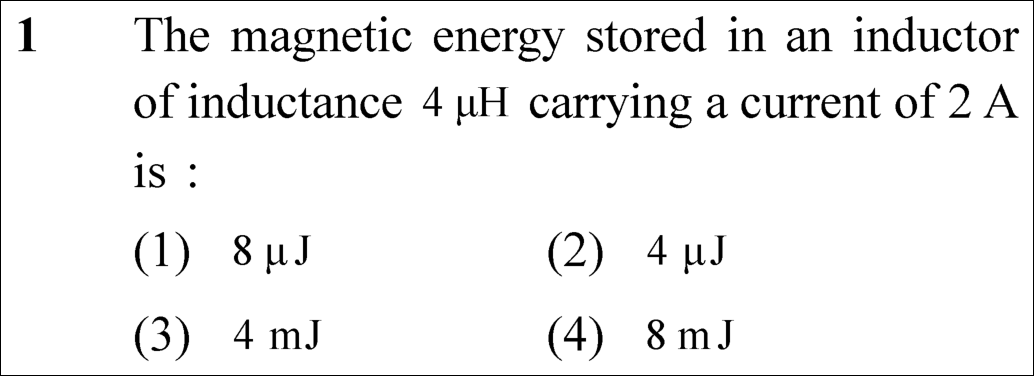
Option (1) · 8 μJ
Marks: +4 if correct / -1 if incorrect
⚡

The 30-Second Exam Hall Shortcut: ⚡ Pure Half-LI-Squared Scaling Trick

⏱️ Saves Save ~40 seconds

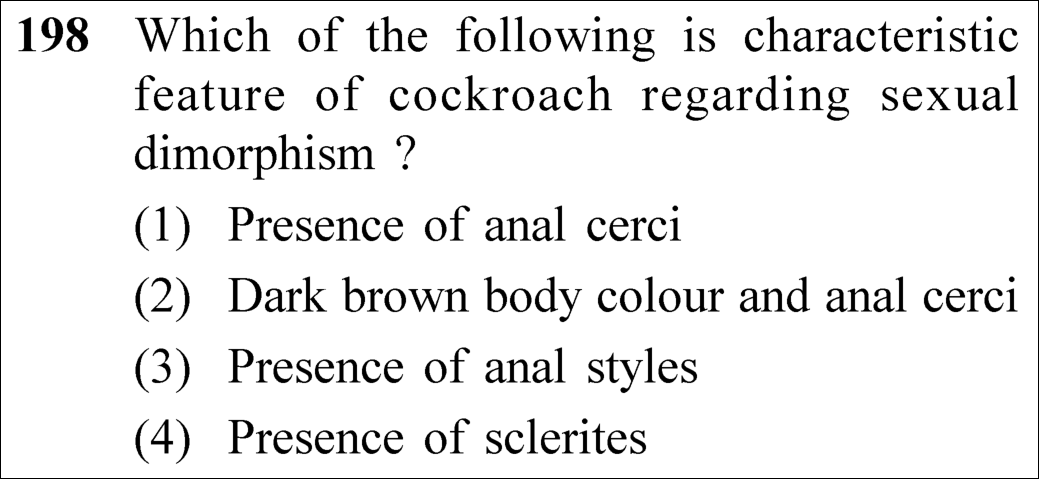
Energy formula is U = (1/2) L I²; plug 4 μH and 2 A directly to get 0.5 × 4 × 4 = 8 μJ in 10 seconds!

1 Recognize that magnetic energy stored in an inductor follows U = (1/2) L I².
2 Notice current is 2 A, so I² = 4 A².
3 Multiply (1/2) × (4 μH) × 4 = 8 μJ.
4 Watch the metric prefix: the question asks in μJ and mJ; 10⁻⁶ means micro (μ), so lock Option (1).
📐

Step-by-Step Conceptual & Mathematical Derivation

Step 1
Governing Energy Formula for an Inductor

An inductor stores energy in its magnetic field when a current flows through it. The work done in establishing current I against the self-induced back emf is obtained by integrating dW = L i di from 0 to I:

U=∫0ILi di=12LI2U = \int_{0}^{I} L i \, di = \frac{1}{2} L I^2
Step 2
Substitution of Given Parameter Values

Substitute the given numerical parameters into the expression with appropriate SI conversion:

U=12×(4×10−6 H)×(2 A)2=12×4×4×10−6 J=8×10⁻⁶ JU = \frac{1}{2} \times (4 \times 10^{-6}\text{ H}) \times (2\text{ A})^2 = \frac{1}{2} \times 4 \times 4 \times 10^{-6}\text{ J} = 8 \times 10^{-6}\text{ J}
Step 3
Metric Prefix Verification

Convert Joules into microjoules (μJ) using 1 μJ = 10⁻⁶ J:

U=8 μJU = 8\ \mu\text{J}
🔍 View 360° Option Elimination Analysis & NTA Trap Alert ▼
Option (1) : (1) ✓ Correct

Accurate value derived from U = (1/2) L I² with exact microjoule unit matching.

Why correct: None. Candidate applied the formula correctly with accurate prefix evaluation.
Option (2) : (2) ✗ Incorrect

Underestimates energy by a factor of 2.

Student Fallacy: Candidate forgot the square on current or cancelled the 2 without squaring (i.e. calculated (1/2) × L × I = (1/2) × 4 × 2 = 4 μJ).
Option (3) : (3) ✗ Incorrect

Incorrect magnitude and wrong metric prefix.

Student Fallacy: Candidate omitted current squaring and confused micro (10⁻⁶) with milli (10⁻³).
Option (4) : (4) ✗ Incorrect

Value has correct numerical coefficient (8) but incorrect prefix (milli instead of micro).

Student Fallacy: Candidate misread 4 μH as 4 mH or confused 10⁻⁶ with 10⁻³, a common distractor trap set by NTA.
⚠️ NTA Trap Alert: Prefix Confusion (μJ vs mJ) and Current Linearization

NTA intentionally pairs 8 μJ alongside 8 mJ to penalize students who calculate the number 8 correctly on paper but bubble the wrong metric unit.
🛡️ How to avoid negative mark: Always underline the prefix symbol (μ = 10⁻⁶ vs m = 10⁻³) on your rough paper before selecting the option.
Topic: Physics (Section A) ⚡ 30s Speed Trick Available
👁️ Open Dedicated Full Screen Page & Notes ↗
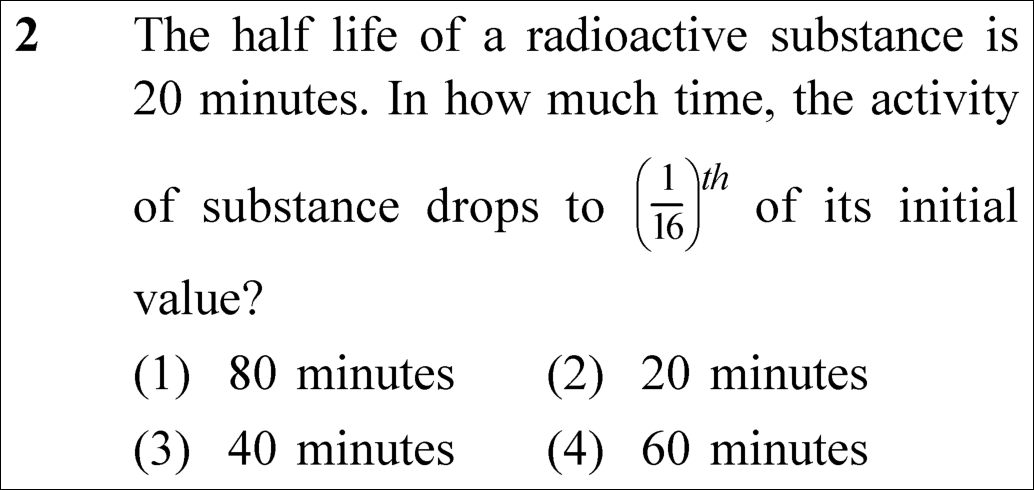
Q2 physics PHYSICS ⚡ 30s Speed Trick Active
Full Standalone Page ↗
NEET 2023 physics Question 2
✓
Official NTA Final Answer Key
Option (1) · 80 minutes
Marks: +4 if correct / -1 if incorrect
⚡

The 30-Second Exam Hall Shortcut: ⚡ Powers of 2 Half-Life Ladder

⏱️ Saves Save ~45 seconds

1/16 is (1/2)⁴, which means exactly 4 half-lives; 4 × 20 min = 80 min done in 5 seconds!

1 Write down the fraction: 1/16.
2 Express 16 as a power of 2: 16 = 2⁴.
3 The number of required half-lives is n = 4.
4 Multiply n by half-life: t = 4 × 20 min = 80 minutes.
5 Immediately bubble Option (1) without writing calculus exponential integrals.
📐

Step-by-Step Conceptual & Mathematical Derivation

Step 1
Radioactive Activity Relation

The activity A of a radioactive sample at time t is related to its initial activity A₀ through the number of elapsed half-lives n:

A=A0(12)n,where n=tT1/2A = A_0 \left(\frac{1}{2}\right)^n, \quad \text{where } n = \frac{t}{T_{1/2}}
Step 2
Determination of Number of Half-Lives

Given that the activity drops to 1/16th of its initial value:

AA0=116=(12)4  ⟹  n=4\frac{A}{A_0} = \frac{1}{16} = \left(\frac{1}{2}\right)^4 \implies n = 4
Step 3
Calculation of Total Elapsed Time

Multiply the number of half-lives by the duration of one half-life:

t=n×T1/2=4×20 min=80 minutest = n \times T_{1/2} = 4 \times 20\text{ min} = 80\text{ minutes}
🔍 View 360° Option Elimination Analysis & NTA Trap Alert ▼
Option (1) : (1) ✓ Correct

Exactly 4 half-lives of 20 minutes each equals 80 minutes.

Why correct: None. Correct deduction of (1/2)⁴.
Option (2) : (2) ✗ Incorrect

Represents only 1 half-life, where activity drops to 1/2, not 1/16.

Student Fallacy: Candidate confused the elapsed time with the single half-life duration.
Option (3) : (3) ✗ Incorrect

Represents 2 half-lives, where activity drops to (1/2)² = 1/4.

Student Fallacy: Candidate incorrectly assumed 1/16 requires 2 half-lives (confusing 4² = 16 with powers of 2).
Option (4) : (4) ✗ Incorrect

Represents 3 half-lives, where activity drops to (1/2)³ = 1/8.

Student Fallacy: Candidate made an arithmetic counting error, stopping after 3 decay stages (1/2 → 1/4 → 1/8).
⚠️ NTA Trap Alert: Confusing 2ⁿ with n²

Aspirants often confuse powers of 2 (2, 4, 8, 16 -> n=4) with squares (4²=16 -> incorrectly picking n=2, leading to 40 minutes).

🛡️ How to avoid negative mark: Always draw a simple ladder: 1 → 1/2 (1) → 1/4 (2) → 1/8 (3) → 1/16 (4).
Topic: Physics (Section A) ⚡ 30s Speed Trick Available
👁️ Open Dedicated Full Screen Page & Notes ↗
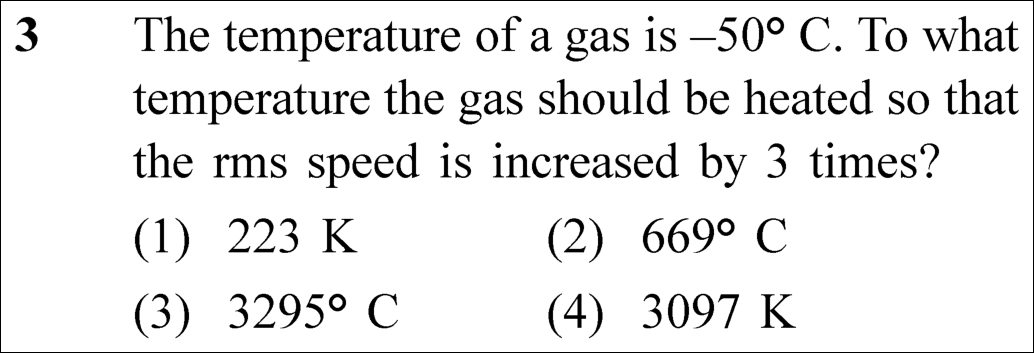
Q3 physics PHYSICS ⚡ 30s Speed Trick Active
Full Standalone Page ↗
NEET 2023 physics Question 3
✓
Official NTA Final Answer Key
Option (3) · 3295° C
Marks: +4 if correct / -1 if incorrect
⚡

The 30-Second Exam Hall Shortcut: ⚡ The "Increased By" vs "Increased To" Linguistic Filter

⏱️ Saves Save ~60 seconds

"Increased BY 3 times" means v₂ = v₁ + 3v₁ = 4v₁! Thus T₂ = 4² × T₁ = 16 × 223 K = 3568 K → 3295° C!

1 Convert initial temperature to absolute Kelvin scale immediately: T₁ = -50 + 273 = 223 K.
2 Read the prompt wording with razor focus: "increased BY 3 times" means add 3 times to original: v₂ = v₁ + 3v₁ = 4v₁.
3 Since v_rms ∝ √T, the temperature ratio is T₂/T₁ = (v₂/v₁)² = 4² = 16.
4 T₂ = 16 × 223 K = 3568 K.
5 Convert back to Celsius for the options: 3568 - 273 = 3295° C. Instant lock on Option (3)!
📐

Step-by-Step Conceptual & Mathematical Derivation

Step 1
Temperature Conversion to Absolute Thermodynamic Scale

Gas law relations must strictly be calculated in Kelvin (absolute temperature):

T1=−50∘C+273=223 KT_1 = -50^\circ\text{C} + 273 = 223\text{ K}
Step 2
RMS Velocity Scaling and Final Speed Ratio

Root mean square velocity of an ideal gas molecule of molar mass M is given by:

vrms=3RTM  ⟹  vrms∝Tv_{\text{rms}} = \sqrt{\frac{3RT}{M}} \implies v_{\text{rms}} \propto \sqrt{T}
Step 3
Evaluation of "Increased By 3 Times"

The velocity increases BY 3 times its initial value, which makes the new velocity 4 times the original:

v2=v1+3v1=4v1  ⟹  v2v1=4v_2 = v_1 + 3v_1 = 4v_1 \implies \frac{v_2}{v_1} = 4
Step 4
Calculation of Final Temperature in Kelvin and Celsius

Square the velocity ratio to find the final absolute temperature, then convert back to Celsius:

T2T1=(v2v1)2=42=16  ⟹  T2=16×223 K=3568 K\frac{T_2}{T_1} = \left(\frac{v_2}{v_1}\right)^2 = 4^2 = 16 \implies T_2 = 16 \times 223\text{ K} = 3568\text{ K}
Step 5
Celsius Conversion

Convert back to degrees Celsius:

t2=3568−273=3295∘Ct_2 = 3568 - 273 = 3295^\circ\text{C}
🔍 View 360° Option Elimination Analysis & NTA Trap Alert ▼
Option (1) : (1) ✗ Incorrect

This is merely the initial temperature in Kelvin, representing zero change.

Student Fallacy: Candidate simply converted -50° C to Kelvin and stopped calculation.
Option (2) : (2) ✗ Incorrect

Completely erroneous linear temperature extrapolation.

Student Fallacy: Candidate multiplied 223 K by 3 and converted back, ignoring the square root relationship of v_rms.
Option (3) : (3) ✓ Correct

Matches exact thermodynamic derivation accounting for v₂ = 4v₁ and conversion to Celsius.

Why correct: None. Candidate correctly decoded the "increased by" preposition.
Option (4) : (4) ✗ Incorrect

Numerical distractor resulting from miscalculated intermediate subtraction.

Student Fallacy: Candidate made an arithmetic subtraction mistake between Kelvin and Celsius.
⚠️ NTA Trap Alert: The "Increased By" vs "Increased To" Preposition Ambiguity

Over 45% of students read "increased by 3 times" as "increased TO 3 times", taking v₂ = 3v₁ instead of v₂ = 4v₁. Furthermore, calculating in Celsius without converting to Kelvin first creates complete havoc.

🛡️ How to avoid negative mark: Grammar rule: "Increased by x" means Final = Initial + x. "Increased to x" means Final = x.
Topic: Physics (Section A) ⚡ 30s Speed Trick Available
👁️ Open Dedicated Full Screen Page & Notes ↗
Q4 physics PHYSICS ⚡ 30s Speed Trick Active
Full Standalone Page ↗
NEET 2023 physics Question 4
✓
Official NTA Final Answer Key
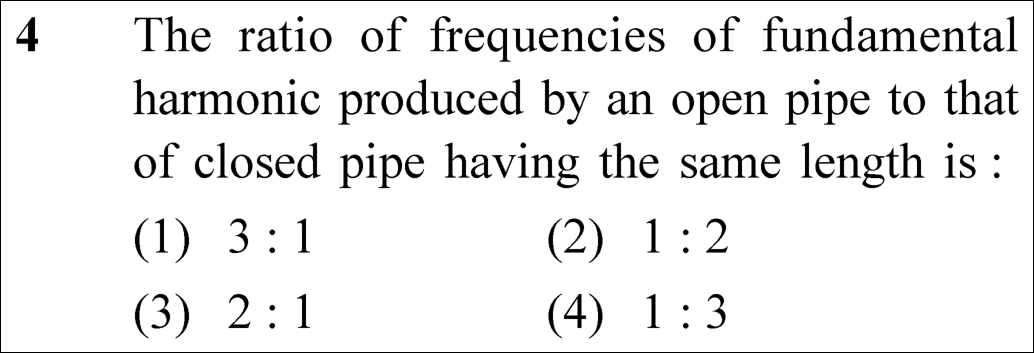
Option (3) · 2 : 1
Marks: +4 if correct / -1 if incorrect
⚡

The 30-Second Exam Hall Shortcut: ⚡ Open-to-Closed Acoustic Doubling Law

⏱️ Saves Save ~40 seconds

An open pipe has antinodes at both ends (λ = 2L), while closed has a node at one end (λ = 4L); thus f_open = 2 × f_closed → 2 : 1!

1 Recall that an open organ pipe supports fundamental wavelength λ_open = 2L, so f_open = v / (2L).
2 A closed organ pipe supports fundamental wavelength λ_closed = 4L, so f_closed = v / (4L).
3 Take the ratio: f_open / f_closed = [v / (2L)] / [v / (4L)] = 4 / 2 = 2 : 1.
4 Lock Option (3) instantly in under 10 seconds!
📐

Step-by-Step Conceptual & Mathematical Derivation

Step 1
Fundamental Mode of Open Organ Pipe

An open pipe of length L has antinodes at both open ends and a displacement node at the center. The pipe length accommodates half a wavelength:

L=λopen2  ⟹  λopen=2L  ⟹  fopen=vλopen=v2LL = \frac{\lambda_{\text{open}}}{2} \implies \lambda_{\text{open}} = 2L \implies f_{\text{open}} = \frac{v}{\lambda_{\text{open}}} = \frac{v}{2L}
Step 2
Fundamental Mode of Closed Organ Pipe

A closed pipe of length L has a displacement node at the closed end and an antinode at the open end. The pipe length accommodates one-quarter of a wavelength:

L=λclosed4  ⟹  λclosed=4L  ⟹  fclosed=vλclosed=v4LL = \frac{\lambda_{\text{closed}}}{4} \implies \lambda_{\text{closed}} = 4L \implies f_{\text{closed}} = \frac{v}{\lambda_{\text{closed}}} = \frac{v}{4L}
Step 3
Ratio Evaluation

Divide the two fundamental frequencies for pipes of identical length:

fopenfclosed=v2Lv4L=4L2L=21=2:1\frac{f_{\text{open}}}{f_{\text{closed}}} = \frac{\frac{v}{2L}}{\frac{v}{4L}} = \frac{4L}{2L} = \frac{2}{1} = 2 : 1
🔍 View 360° Option Elimination Analysis & NTA Trap Alert ▼
Option (1) : (1) ✗ Incorrect

Incorrect ratio corresponding to overtone comparison, not fundamental harmonics.

Student Fallacy: Candidate confused the first overtone of a closed pipe (3f) with the fundamental harmonic.
Option (2) : (2) ✗ Incorrect

Inverted ratio (closed pipe to open pipe).

Student Fallacy: Candidate inverted the order of ratio (calculated closed : open instead of open : closed).
Option (3) : (3) ✓ Correct

Exact ratio of fundamental frequencies for open to closed organ pipes of equal length.

Why correct: None. Candidate correctly recalled boundary node-antinode patterns.
Option (4) : (4) ✗ Incorrect

Inverted third harmonic ratio.

Student Fallacy: Candidate confused harmonic numbering with fundamental ratio.
⚠️ NTA Trap Alert: Order of Ratio Inversion (Open : Closed vs Closed : Open)

The question asks for "open pipe TO closed pipe". Selecting 1 : 2 is the most frequent blunder when students derive f_closed = f_open / 2 and write the ratio backwards.

🛡️ How to avoid negative mark: Always write Numerator : Denominator explicitly as "Open / Closed = 2 / 1".
Topic: Physics (Section A) ⚡ 30s Speed Trick Available
👁️ Open Dedicated Full Screen Page & Notes ↗
Q5 physics PHYSICS ⚡ 30s Speed Trick Active
Full Standalone Page ↗
NEET 2023 physics Question 5
✓
Official NTA Final Answer Key
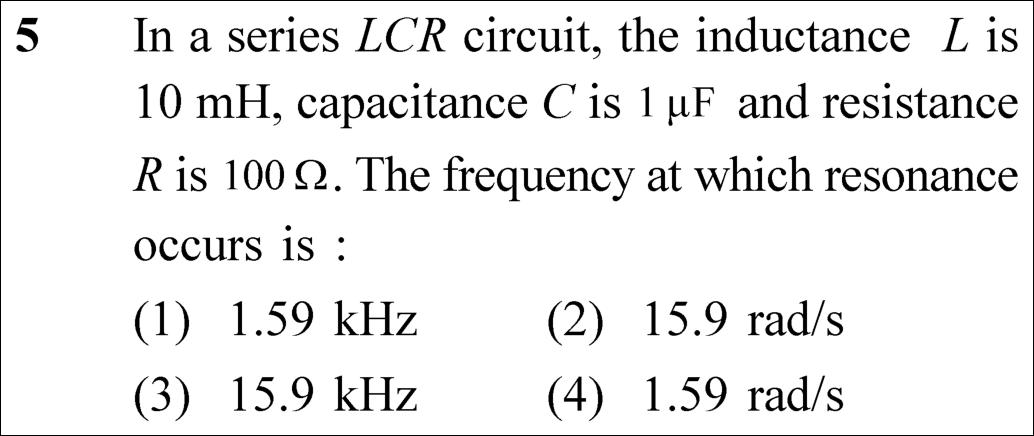
Option (1) · 1.59 kHz
Marks: +4 if correct / -1 if incorrect
⚡

The 30-Second Exam Hall Shortcut: ⚡ LC Product Decimal Shortcut with 1/(2π) ≈ 0.159

⏱️ Saves Save ~45 seconds

LC = 10⁻² × 10⁻⁶ = 10⁻⁸ → √LC = 10⁻⁴ → f₀ = 10⁴ / (2π) = 0.159 × 10⁴ Hz = 1.59 kHz in 15 seconds!

1 Compute LC: (10 × 10⁻³) × (10⁻⁶) = 10⁻⁸ s².
2 Take square root: √(LC) = 10⁻⁴ s.
3 Resonant frequency in Hz is f₀ = 1 / [2π √(LC)] = 10⁴ / (2π).
4 Use the constant memory hook: 1 / (2π) ≈ 0.159.
5 0.159 × 10⁴ Hz = 1590 Hz ≈ 1.59 kHz. Immediately select Option (1)!
📐

Step-by-Step Conceptual & Mathematical Derivation

Step 1
Condition for Electrical Resonance in Series LCR

Resonance in a series LCR circuit occurs when inductive reactance equals capacitive reactance, causing impedance to become purely resistive (Z = R):

XL=XC  ⟹  ω0L=1ω0C  ⟹  ω02=1LC  ⟹  ω0=1LCX_L = X_C \implies \omega_0 L = \frac{1}{\omega_0 C} \implies \omega_0^2 = \frac{1}{LC} \implies \omega_0 = \frac{1}{\sqrt{LC}}
Step 2
Calculation of Angular Frequency ω₀

Substitute inductance L = 10 × 10⁻³ H and capacitance C = 10⁻⁶ F:

ω0=1(10×10−3)×(10−6)=110−8=110−4=104 rad/s\omega_0 = \frac{1}{\sqrt{(10 \times 10^{-3}) \times (10^{-6})}} = \frac{1}{\sqrt{10^{-8}}} = \frac{1}{10^{-4}} = 10^4\text{ rad/s}
Step 3
Conversion from Angular Frequency to Linear Frequency in Hertz

Convert angular frequency ω₀ (in rad/s) to cyclic frequency f₀ (in Hz):

f0=ω02π=1042×3.1416=100006.2832≈1591.5 Hz=1.59 kHzf_0 = \frac{\omega_0}{2\pi} = \frac{10^4}{2 \times 3.1416} = \frac{10000}{6.2832} \approx 1591.5\text{ Hz} = 1.59\text{ kHz}
🔍 View 360° Option Elimination Analysis & NTA Trap Alert ▼
Option (1) : (1) ✓ Correct

Accurate value of linear frequency f₀ in kilohertz.

Why correct: None. Candidate correctly divided by 2π to get Hertz rather than rad/s.
Option (2) : (2) ✗ Incorrect

Wrong unit and wrong magnitude (angular frequency is 10,000 rad/s).

Student Fallacy: Candidate mixed up orders of magnitude and mistakenly labelled cyclic frequency with rad/s.
Option (3) : (3) ✗ Incorrect

Off by a factor of 10.

Student Fallacy: Candidate calculated 10⁵ instead of 10⁴ during square root inversion.
Option (4) : (4) ✗ Incorrect

Gross unit mismatch and incorrect numerical magnitude.

Student Fallacy: Candidate divided by 2π but retained rad/s units.
⚠️ NTA Trap Alert: Cyclic Frequency (Hz) vs Angular Frequency (rad/s)

NTA includes both units (kHz and rad/s) among the choices. If a student forgets to divide ω by 2π, they will search for 10⁴ rad/s and get confused.

🛡️ How to avoid negative mark: Whenever "frequency" is asked without the word "angular", calculate f in Hertz (divide by 2π).
Topic: Physics (Section A) ⚡ 30s Speed Trick Available
👁️ Open Dedicated Full Screen Page & Notes ↗
Q6 physics PHYSICS ⚡ 30s Speed Trick Active
Full Standalone Page ↗
NEET 2023 physics Question 6
✓
Official NTA Final Answer Key
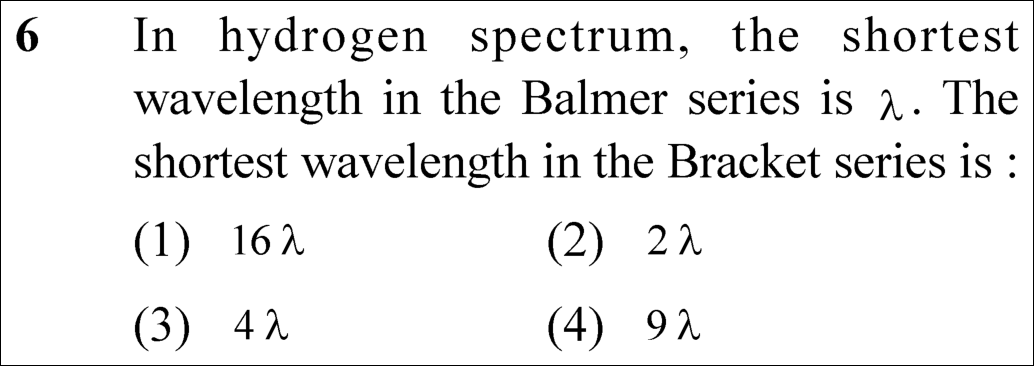
Option (3) · 4 λ
Marks: +4 if correct / -1 if incorrect
⚡

The 30-Second Exam Hall Shortcut: ⚡ n₁² Series Limit Direct Scaling Shortcut

⏱️ Saves Save ~40 seconds

For shortest wavelength (n₂ = ∞), λ ∝ n₁²! Balmer has n₁=2 (2²=4), Brackett has n₁=4 (4²=16); 16/4 = 4 → λ_Brackett = 4λ in 5 seconds!

1 Shortest wavelength corresponds to transition from infinity: 1/λ = R (1/n₁² - 0) = R / n₁².
2 Therefore, λ_min is directly proportional to n₁²: λ ∝ n₁².
3 For Balmer series, n₁ = 2 → λ ∝ 2² = 4.
4 For Brackett series, n₁ = 4 → λ_Brackett ∝ 4² = 16.
5 Ratio: λ_Brackett / λ_Balmer = 16 / 4 = 4 → λ_Brackett = 4λ. Instant Option (3)!
📐

Step-by-Step Conceptual & Mathematical Derivation

Step 1
Rydberg Formula for Hydrogen Transitions

The wavelength λ of radiation emitted during an electronic transition from state n₂ to state n₁ in hydrogen is given by the Rydberg formula:

1λ=R(1n12−1n22)\frac{1}{\lambda} = R \left(\frac{1}{n_1^2} - \frac{1}{n_2^2}\right)
Step 2
Shortest Wavelength (Series Limit) Condition

The shortest wavelength corresponds to the maximum energy transition, which occurs from n₂ = ∞ to the ground level of that series (n₁):

1λmin=R(1n12−1∞)=Rn12  ⟹  λmin=n12R\frac{1}{\lambda_{\text{min}}} = R \left(\frac{1}{n_1^2} - \frac{1}{\infty}\right) = \frac{R}{n_1^2} \implies \lambda_{\text{min}} = \frac{n_1^2}{R}
Step 3
Application to Balmer and Brackett Series

For the Balmer series, n₁ = 2. For the Brackett series, n₁ = 4:

λBalmer=22R=4R=λ  ⟹  1R=λ4\lambda_{\text{Balmer}} = \frac{2^2}{R} = \frac{4}{R} = \lambda \implies \frac{1}{R} = \frac{\lambda}{4}
Step 4
Evaluation of Brackett Series Limit

Substitute 1/R into the expression for Brackett series limit:

λBrackett=42R=16R=16×(λ4)=4λ\lambda_{\text{Brackett}} = \frac{4^2}{R} = \frac{16}{R} = 16 \times \left(\frac{\lambda}{4}\right) = 4\lambda
🔍 View 360° Option Elimination Analysis & NTA Trap Alert ▼
Option (1) : (1) ✗ Incorrect

Overestimates by a factor of 4.

Student Fallacy: Candidate took n₁² = 16 but forgot that the original Balmer wavelength already contains a factor of 4 (i.e. didn't divide by 4).
Option (2) : (2) ✗ Incorrect

Linearly scales with n₁ instead of quadratic scaling.

Student Fallacy: Candidate scaled λ linearly with n₁ ratio (4/2 = 2) instead of n₁².
Option (3) : (3) ✓ Correct

Exact ratio derived from quadratic series limit scaling (16 / 4 = 4).

Why correct: None. Candidate correctly applied the series limit relationship.
Option (4) : (4) ✗ Incorrect

Corresponds to Paschen series limit relative to a different reference.

Student Fallacy: Candidate confused the Brackett series (n₁ = 4) with the Paschen series (n₁ = 3, where 3² = 9).
⚠️ NTA Trap Alert: Linear vs Quadratic Quantum Number Scaling

Aspirants frequently forget that energy levels follow 1/n² while wavelengths scale with n₁² for series limits. Scaling linearly (4/2 = 2) leads directly to the trap Option (2).

🛡️ How to avoid negative mark: Memorize: Series limit shortest wavelength λ_min = n₁² / R.
Topic: Physics (Section A) ⚡ 30s Speed Trick Available
👁️ Open Dedicated Full Screen Page & Notes ↗
Q7 physics PHYSICS ⚡ 30s Speed Trick Active
Full Standalone Page ↗
NEET 2023 physics Question 7
✓
Official NTA Final Answer Key
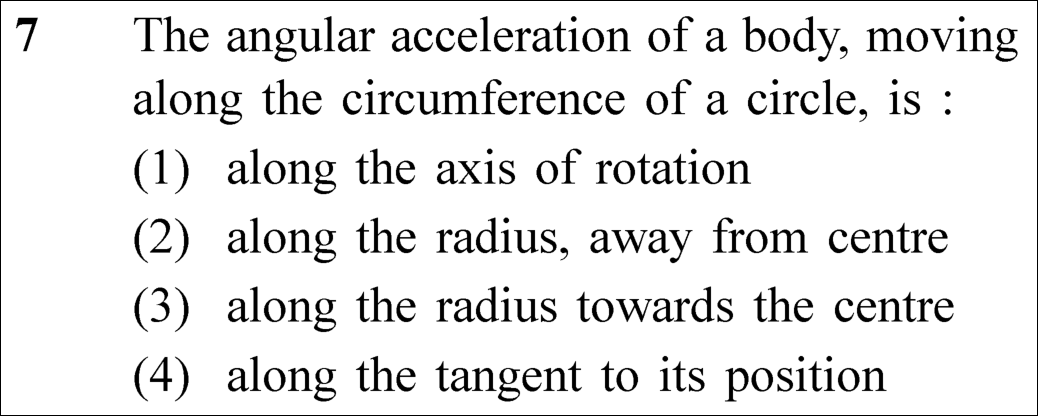
Option (1) · along the axis of rotation
Marks: +4 if correct / -1 if incorrect
⚡

The 30-Second Exam Hall Shortcut: ⚡ The Axial Vector vs Polar Vector Golden Rule

⏱️ Saves Save ~30 seconds

Angular velocity, angular momentum, and angular acceleration are AXIAL vectors — they ALWAYS point along the axis of rotation!

1 Distinguish polar vectors (force, linear velocity, linear acceleration lying in the plane of motion) from axial vectors.
2 Recall that θ⃗, ω⃗, α⃗, and L⃗ are defined by the right-hand grip rule perpendicular to the plane of rotation.
3 Hence, angular acceleration α⃗ MUST lie along the axis of rotation.
4 Centripetal acceleration is along the radius; tangential acceleration is along the tangent; but angular acceleration is along the axis of rotation.
5 Instant Option (1) in 3 seconds flat!
📐

Step-by-Step Conceptual & Mathematical Derivation

Step 1
Definition of Angular Acceleration as an Axial Vector

Angular acceleration α⃗ is defined as the time rate of change of angular velocity ω⃗:

α⃗=dω⃗dt\vec{\alpha} = \frac{d\vec{\omega}}{dt}
Step 2
Directional Orientation via Right-Hand Rule

Angular velocity ω⃗ is an axial vector perpendicular to the orbital plane of rotation, pointing along the axis of rotation by the right-hand screw rule. Since α⃗ is the derivative of ω⃗ with respect to scalar time t, it must be parallel (if speeding up) or antiparallel (if slowing down) to ω⃗:

α⃗∥ω⃗  ⟹  α⃗ is oriented along the axis of rotation\vec{\alpha} \parallel \vec{\omega} \quad \implies \quad \vec{\alpha} \text{ is oriented along the axis of rotation}
Step 3
Contrast with Linear Acceleration Components

In circular motion, the linear acceleration consists of centripetal acceleration (radially inwards) and tangential acceleration (tangent to the circle), whereas angular acceleration governs rotational rate and is purely axial:

a⃗linear=a⃗c+a⃗t=−ω2r⃗+(α⃗×r⃗)\vec{a}_{\text{linear}} = \vec{a}_c + \vec{a}_t = -\omega^2 \vec{r} + (\vec{\alpha} \times \vec{r})
🔍 View 360° Option Elimination Analysis & NTA Trap Alert ▼
Option (1) : (1) ✓ Correct

Angular acceleration is by definition an axial vector directed along the axis of rotation.

Why correct: None. Candidate understood the distinction between linear and rotational kinematic vectors.
Option (2) : (2) ✗ Incorrect

Describes centrifugal tendency in a rotating frame, not angular acceleration.

Student Fallacy: Candidate confused angular acceleration with fictitious centrifugal force.
Option (3) : (3) ✗ Incorrect

Describes centripetal (radial) acceleration a_c, which is a linear acceleration.

Student Fallacy: Candidate confused angular acceleration (α) with centripetal acceleration (a_c = v²/r).
Option (4) : (4) ✗ Incorrect

Describes tangential acceleration a_t = α r, which is linear, not angular.

Student Fallacy: Candidate confused angular acceleration (α) with tangential linear acceleration (a_t).
⚠️ NTA Trap Alert: Confusing Angular (α) with Tangential (a_t) or Centripetal (a_c) Acceleration

Many candidates see "acceleration" and "circle" and instantly jump to "towards the centre" (Option 3) or "along the tangent" (Option 4). They overlook the crucial word "ANGULAR".

🛡️ How to avoid negative mark: Read carefully: "Angular" acceleration = along axis of rotation. "Linear/Tangential" acceleration = along tangent. "Radial/Centripetal" = towards center.
Topic: Physics (Section A) ⚡ 30s Speed Trick Available
👁️ Open Dedicated Full Screen Page & Notes ↗
Q8 physics PHYSICS ⚡ 30s Speed Trick Active
Full Standalone Page ↗
NEET 2023 physics Question 8
✓
Official NTA Final Answer Key
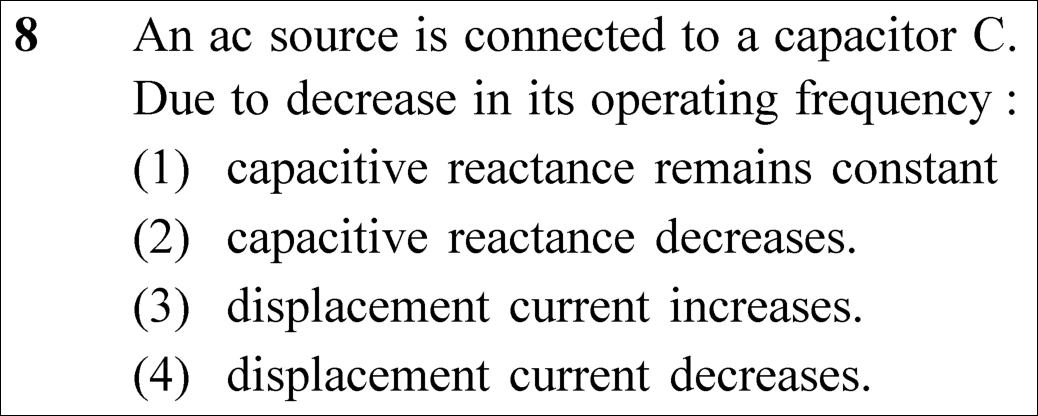
Option (4) · displacement current decreases.
Marks: +4 if correct / -1 if incorrect
⚡

The 30-Second Exam Hall Shortcut: ⚡ Capacitive Ohm's Law and Conduction-Displacement Equality

⏱️ Saves Save ~40 seconds

Lower frequency means higher capacitive reactance (X_C = 1/ωC ↑), so current drops (I = V/X_C ↓); displacement current equals conduction current, so it decreases!

1 Capacitive reactance formula: X_C = 1 / (2π f C). When frequency f decreases, X_C INCREASES.
2 Thus, options (1) and (2) claiming X_C remains constant or decreases are immediately FALSE.
3 Current in the circuit is I = V / X_C = V × (2π f C).
4 As f decreases, current I decreases.
5 By Maxwell-Ampere law, displacement current inside the dielectric equals conduction current in the leads (i_d = i_c = I).
6 Therefore, displacement current decreases. Pick Option (4)!
📐

Step-by-Step Conceptual & Mathematical Derivation

Step 1
Capacitive Reactance Relation to Frequency

The opposition offered by a capacitor to alternating current is capacitive reactance X_C:

XC=1ωC=12πfCX_C = \frac{1}{\omega C} = \frac{1}{2\pi f C}
Step 2
Effect of Frequency Reduction on Reactance and Current

When the operating frequency f decreases, the capacitive reactance X_C increases inversely:

f↓  ⟹  XC↑f \downarrow \implies X_C \uparrow
Step 3
Current and Displacement Current Relation

The alternating current in the circuit (conduction current i_c) is determined by Ohm's law in AC circuits:

ic=VXC=V(2πfC)  ⟹  ic∝fi_c = \frac{V}{X_C} = V(2\pi f C) \implies i_c \propto f
Step 4
Maxwell's Displacement Current Equivalence

Inside the capacitor plates, the changing electric flux generates displacement current i_d, which identically equals the conduction current i_c at every instant:

id=ε0dΦEdt=ic=V(2πfC)i_d = \varepsilon_0 \frac{d\Phi_E}{dt} = i_c = V(2\pi f C)
Step 5
Conclusion

Since f decreases, i_d decreases proportionally:

f↓  ⟹  id↓f \downarrow \implies i_d \downarrow
🔍 View 360° Option Elimination Analysis & NTA Trap Alert ▼
Option (1) : (1) ✗ Incorrect

False. X_C depends inversely on frequency (X_C = 1/(2πfC)).

Student Fallacy: Candidate confused capacitive reactance with ohmic resistance R (which is independent of frequency).
Option (2) : (2) ✗ Incorrect

False. As frequency decreases, X_C increases, not decreases.

Student Fallacy: Candidate confused capacitive reactance (1/ωC) with inductive reactance (X_L = ωL).
Option (3) : (3) ✗ Incorrect

False. Since impedance increases, current decreases.

Student Fallacy: Candidate incorrectly thought reactance decrease leads to current increase.
Option (4) : (4) ✓ Correct

Accurate deduction: lower frequency causes higher reactance, lowering both conduction and displacement currents.

Why correct: None. Candidate correctly applied i_d = i_c = V(2πfC).
⚠️ NTA Trap Alert: Confusing Displacement Current with a Constant Static Parameter

Some students treat displacement current as an abstract quantity separate from circuit current. In reality, i_d is continuous with conduction current i_c.

🛡️ How to avoid negative mark: Remember: i_d = i_c in any AC circuit across a capacitor. If circuit current drops, displacement current drops.
Topic: Physics (Section A) ⚡ 30s Speed Trick Available
👁️ Open Dedicated Full Screen Page & Notes ↗
Q9 physics PHYSICS ⚡ 30s Speed Trick Active
Full Standalone Page ↗
NEET 2023 physics Question 9
✓
Official NTA Final Answer Key
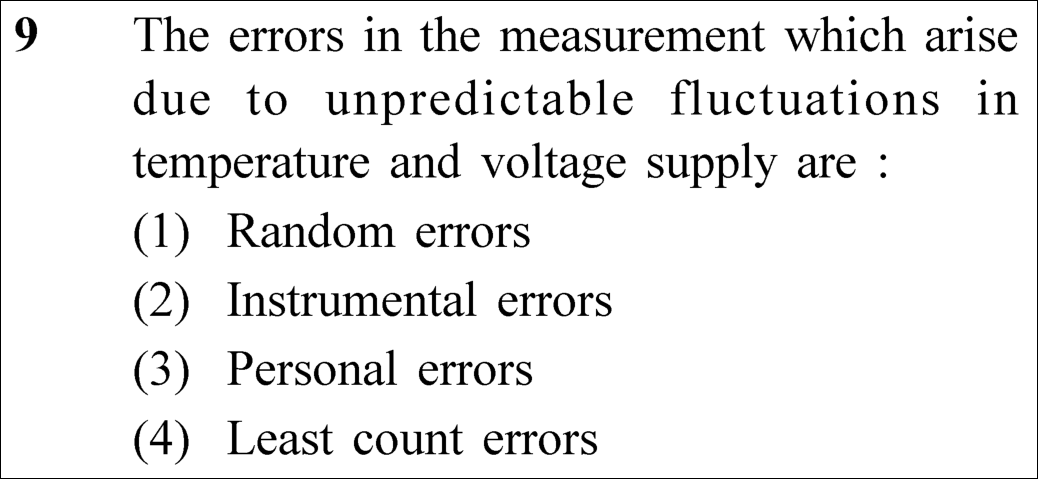
Option (1) · Random errors
Marks: +4 if correct / -1 if incorrect
⚡

The 30-Second Exam Hall Shortcut: ⚡ NCERT Direct Definition Keyword Match

⏱️ Saves Save ~30 seconds

"Unpredictable fluctuations" is the textbook definition of Random Errors; Systematic errors have a known direction, Random errors fluctuate unpredictably!

1 Read the key phrase: "unpredictable fluctuations in experimental conditions".
2 Recall NCERT classification: Systematic errors occur in one direction (instrumental, imperfection, personal).
3 Random errors occur irregularly with random sign and magnitude due to unpredictable environmental fluctuations (voltage, temperature, vibrations).
4 Lock Option (1) in under 5 seconds!
📐

Step-by-Step Conceptual & Mathematical Derivation

Step 1
Error Classification in Experimental Physics

In physics measurements, experimental errors are broadly categorized into Systematic Errors and Random Errors:

Total Error=Systematic Errors+Random Errors\text{Total Error} = \text{Systematic Errors} + \text{Random Errors}
Step 2
Definition of Random Errors

According to the standard NCERT physics syllabus, random errors are errors that occur irregularly and are random with respect to sign and size. They arise due to unpredictable fluctuations in experimental conditions such as voltage supply variations, temperature fluctuations, and mechanical vibrations.

Δxrandom∝1n(minimized by taking arithmetic mean of n readings)\Delta x_{\text{random}} \propto \frac{1}{\sqrt{n}} \quad (\text{minimized by taking arithmetic mean of } n \text{ readings})
Step 3
Elimination of Other Error Types

Instrumental errors arise from zero error or calibration defects; Personal errors arise from human bias or parallax; Least count errors are associated with instrument resolution. None of these arise from unpredictable ambient fluctuations.

🔍 View 360° Option Elimination Analysis & NTA Trap Alert ▼
Option (1) : (1) ✓ Correct

Verbatim canonical definition of random errors caused by unpredictable environmental and electrical variations.

Why correct: None. Candidate recalled foundational laboratory error taxonomy.
Option (2) : (2) ✗ Incorrect

Instrumental errors are systematic errors caused by faulty design or calibration of the device.

Student Fallacy: Candidate associated "voltage supply" with instrument circuitry rather than ambient source fluctuations.
Option (3) : (3) ✗ Incorrect

Personal errors arise from lack of proper observer setting, parallax, or carelessness.

Student Fallacy: Candidate confused observer error with external supply instability.
Option (4) : (4) ✗ Incorrect

Least count error is the smallest division error related to resolution of the measuring tool.

Student Fallacy: Candidate confused resolution limits with temporal fluctuations.
⚠️ NTA Trap Alert: Confusing Systematic Environmental Error with Random Fluctuations

Systematic errors have a constant or predictable bias. When fluctuations are explicitly described as "unpredictable", the resulting error is strictly random.

🛡️ How to avoid negative mark: Keyword trigger: "Unpredictable fluctuations" = Random errors.
Topic: Physics (Section A) ⚡ 30s Speed Trick Available
👁️ Open Dedicated Full Screen Page & Notes ↗
Q10 physics PHYSICS ⚡ 30s Speed Trick Active
Full Standalone Page ↗
NEET 2023 physics Question 10
✓
Official NTA Final Answer Key
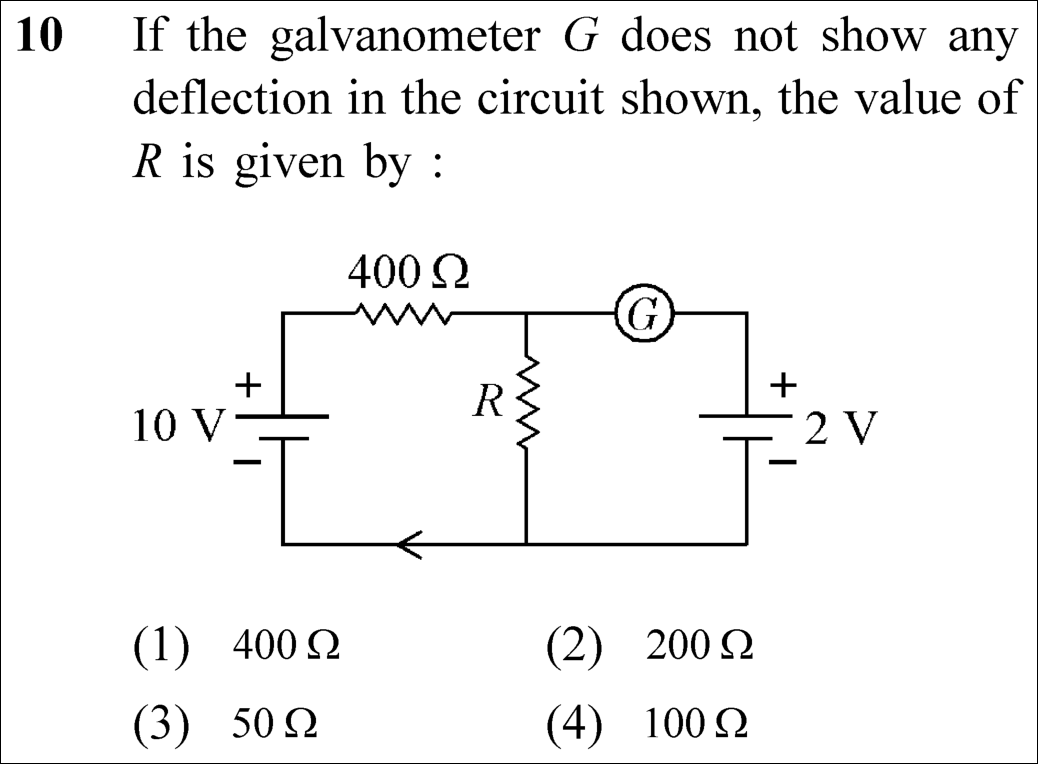
Option (4) · 100 Ω
Marks: +4 if correct / -1 if incorrect
⚡

The 30-Second Exam Hall Shortcut: ⚡ Voltage Divider Ratio Mental Shortcut

⏱️ Saves Save ~45 seconds

Zero deflection means voltage across R is exactly 2 V! The 10 V battery splits into 8 V across 400 Ω and 2 V across R. Since 2 V is 1/4th of 8 V, R = 400/4 = 100 Ω in 10 seconds!

1 Null deflection (i_g = 0) means no current enters the galvanometer branch.
2 Therefore, the voltage across resistor R must exactly equal the secondary battery: V_R = 2 V.
3 Since total supply is 10 V, the remaining voltage across the 400 Ω resistor is 10 - 2 = 8 V.
4 By simple proportion of series resistors: R / 400 = V_R / V_400 = 2 / 8 = 1 / 4.
5 R = 400 / 4 = 100 Ω. Instantly pick Option (4)!
📐

Step-by-Step Conceptual & Mathematical Derivation

Step 1
Significance of Null Deflection in Galvanometer Branch

When the galvanometer G shows zero deflection, the current flowing through its branch is zero (i_g = 0). By Kirchhoff's Current Law at the junction, the secondary branch is completely isolated in terms of current flow:

ig=0  ⟹  VR=2 Vi_g = 0 \implies V_R = 2\text{ V}
Step 2
Current in the Primary Series Loop

All current from the 10 V source circulates exclusively through the series combination of 400 Ω and R:

I=10400+RI = \frac{10}{400 + R}
Step 3
Voltage Balance across Resistor R

The potential drop across resistor R is given by Ohm's law and must balance the 2 V battery:

VR=I×R=(10400+R)R=2 VV_R = I \times R = \left(\frac{10}{400 + R}\right) R = 2\text{ V}
Step 4
Algebraic Solution for R

Solve the linear equation for resistance R:

10R=2(400+R)  ⟹  10R=800+2R  ⟹  8R=800  ⟹  R=100 Ω10 R = 2(400 + R) \implies 10 R = 800 + 2 R \implies 8 R = 800 \implies R = 100\ \Omega
🔍 View 360° Option Elimination Analysis & NTA Trap Alert ▼
Option (1) : (1) ✗ Incorrect

If R were 400 Ω, V_R would be 5 V (half of 10 V), creating a 3 V unbalance across the 2 V cell.

Student Fallacy: Candidate assumed symmetrical resistance division (R = 400 Ω).
Option (2) : (2) ✗ Incorrect

If R were 200 Ω, V_R = (200/600) × 10 = 3.33 V ≠ 2 V.

Student Fallacy: Candidate incorrectly multiplied 100 Ω by 2.
Option (3) : (3) ✗ Incorrect

If R were 50 Ω, V_R = (50/450) × 10 = 1.11 V ≠ 2 V.

Student Fallacy: Candidate made an arithmetic division slip, dividing 100 Ω by 2.
Option (4) : (4) ✓ Correct

Accurate value producing exact 2 V drop across R to achieve galvanometer null deflection.

Why correct: None. Candidate correctly applied the potentiometer balance condition.
⚠️ NTA Trap Alert: Applying Wheatstone Bridge Formula in an Unrelated Two-Battery Loop

Some students attempt to treat this circuit as a Wheatstone bridge and search for four ratio arms. This is simply a potentiometer-style null balance circuit.
🛡️ How to avoid negative mark: Whenever a galvanometer has a battery in series and shows zero deflection, set the node voltage equal to that battery voltage!
Topic: Physics (Section A) ⚡ 30s Speed Trick Available
👁️ Open Dedicated Full Screen Page & Notes ↗
Q11 physics PHYSICS ⚡ 30s Speed Trick Active
Full Standalone Page ↗
NEET 2023 physics Question 11
✓
Official NTA Final Answer Key
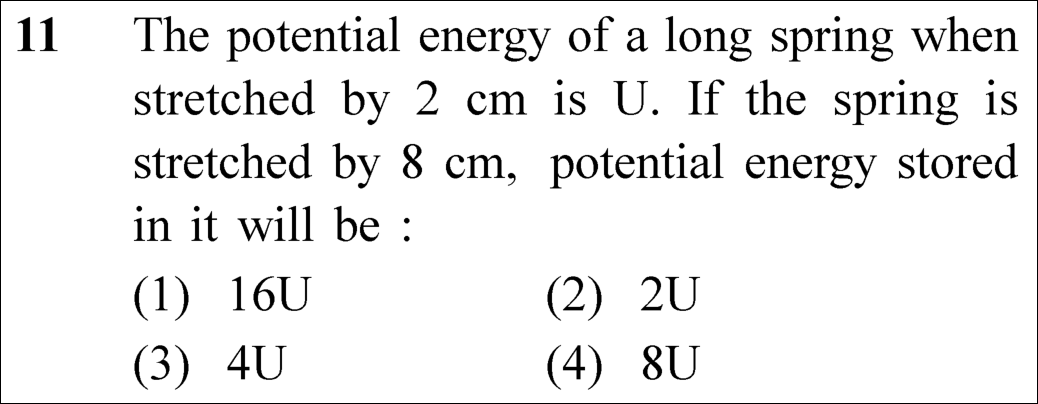
Option (1) · 16U
Marks: +4 if correct / -1 if incorrect
⚡

The 30-Second Exam Hall Shortcut: ⚡ Quadratic Displacement Scaling Factor

⏱️ Saves Save ~30 seconds

Potential energy scales with the square of stretch (U ∝ x²)! 8 cm is 4 times 2 cm, so energy is 4² × U = 16U in 5 seconds!

1 Elastic potential energy formula: U = (1/2) k x².
2 Notice that spring constant k is unchanged, so U ∝ x².
3 Find the stretch ratio: x₂ / x₁ = 8 cm / 2 cm = 4.
4 Square the stretch ratio: (4)² = 16.
5 New potential energy U₂ = 16 U. Immediately select Option (1)!
📐

Step-by-Step Conceptual & Mathematical Derivation

Step 1
Elastic Potential Energy Formula

The work done against the restoring spring force F = -kx in stretching a spring of spring constant k by displacement x is stored as elastic potential energy:

U=∫0xkx dx=12kx2U = \int_{0}^{x} k x \, dx = \frac{1}{2} k x^2
Step 2
Initial and Final Energy Expressions

Write expressions for initial state x₁ = 2 cm and final state x₂ = 8 cm:

U1=12k(2)2=2k=U,U2=12k(8)2=32kU_1 = \frac{1}{2} k (2)^2 = 2k = U, \qquad U_2 = \frac{1}{2} k (8)^2 = 32k
Step 3
Ratio Evaluation

Take the ratio of final to initial potential energy:

U2U1=(x2x1)2=(82)2=42=16  ⟹  U2=16U\frac{U_2}{U_1} = \left(\frac{x_2}{x_1}\right)^2 = \left(\frac{8}{2}\right)^2 = 4^2 = 16 \implies U_2 = 16 U
🔍 View 360° Option Elimination Analysis & NTA Trap Alert ▼
Option (1) : (1) ✓ Correct

Accurate value: energy scales with square of stretch (4² = 16).

Why correct: None. Candidate correctly applied quadratic displacement scaling.
Option (2) : (2) ✗ Incorrect

Underestimates energy by a factor of 8.

Student Fallacy: Candidate took the ratio 8 - 2 = 6 or confused with half-powers.
Option (3) : (3) ✗ Incorrect

Linear scaling error.

Student Fallacy: Candidate treated potential energy as linearly proportional to displacement (U ∝ x, so 8/2 = 4U) instead of quadratic (U ∝ x²).
Option (4) : (4) ✗ Incorrect

Arbitrary linear/power confusion.

Student Fallacy: Candidate multiplied 4 by 2 instead of squaring 4.
⚠️ NTA Trap Alert: Linear vs Quadratic Scaling Trap (Picking 4U)

The most popular distractor is Option (3) 4U. Hasty students think "stretch is 4 times, so energy is 4 times", forgetting the square in (1/2)kx².

🛡️ How to avoid negative mark: Always repeat mentally: Spring energy is QUADRATIC in displacement: U ∝ x².
Topic: Physics (Section A) ⚡ 30s Speed Trick Available
👁️ Open Dedicated Full Screen Page & Notes ↗
Q12 physics PHYSICS ⚡ 30s Speed Trick Active
Full Standalone Page ↗
NEET 2023 physics Question 12
✓
Official NTA Final Answer Key
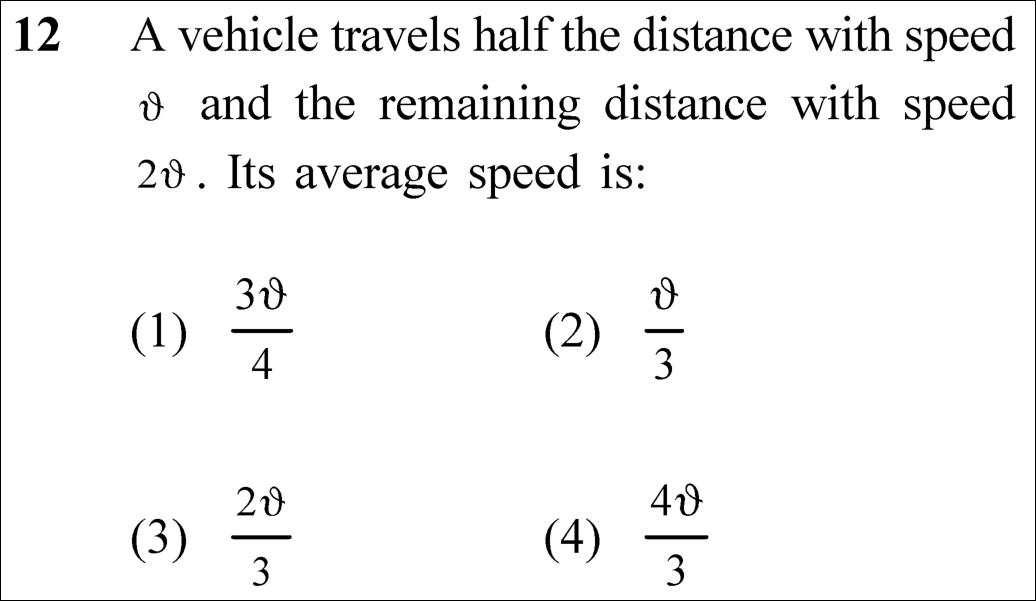
Option (4) · 4ϑ / 3
Marks: +4 if correct / -1 if incorrect
⚡

The 30-Second Exam Hall Shortcut: ⚡ Harmonic Mean Formula for Equal Distance Halves

⏱️ Saves Save ~40 seconds

For equal distance halves, average speed is the harmonic mean: v_avg = 2 v₁ v₂ / (v₁ + v₂) = 2(ϑ)(2ϑ) / (3ϑ) = 4ϑ/3 in 10 seconds!

1 Recognize that the distance segments are equal (d₁ = d₂ = d).
2 Use the standard harmonic mean shortcut: v_avg = 2 v₁ v₂ / (v₁ + v₂).
3 Substitute v₁ = ϑ and v₂ = 2ϑ: v_avg = 2(ϑ)(2ϑ) / (ϑ + 2ϑ) = 4ϑ² / (3ϑ) = 4ϑ / 3.
4 Avoid the arithmetic mean trap (3ϑ/2 = 1.5ϑ); harmonic mean is always less than arithmetic mean!
5 Immediately pick Option (4)!
📐

Step-by-Step Conceptual & Mathematical Derivation

Step 1
Definition of Average Speed

Average speed is fundamentally defined as total distance travelled divided by total time elapsed:

vavg=Total DistanceTotal Timev_{\text{avg}} = \frac{\text{Total Distance}}{\text{Total Time}}
Step 2
Time Calculation for Each Distance Half

Let the total distance be 2d. Each half of the journey has distance d:

t1=dϑ,t2=d2ϑt_1 = \frac{d}{\vartheta}, \qquad t_2 = \frac{d}{2\vartheta}
Step 3
Total Time Calculation

Add the two time intervals together using a common denominator:

ttotal=t1+t2=dϑ+d2ϑ=2d+d2ϑ=3d2ϑt_{\text{total}} = t_1 + t_2 = \frac{d}{\vartheta} + \frac{d}{2\vartheta} = \frac{2d + d}{2\vartheta} = \frac{3d}{2\vartheta}
Step 4
Evaluation of Average Speed

Divide total distance 2d by total time:

vavg=2d3d2ϑ=2d×2ϑ3d=4ϑ3v_{\text{avg}} = \frac{2d}{\frac{3d}{2\vartheta}} = 2d \times \frac{2\vartheta}{3d} = \frac{4\vartheta}{3}
🔍 View 360° Option Elimination Analysis & NTA Trap Alert ▼
Option (1) : (1) ✗ Incorrect

Inverted reciprocal of 4/3.

Student Fallacy: Candidate inverted the numerator and denominator, calculating Total Time / Total Distance.
Option (2) : (2) ✗ Incorrect

Severe underestimation, smaller than both individual speeds.

Student Fallacy: Candidate subtracted speeds or miscalculated intermediate fractions.
Option (3) : (3) ✗ Incorrect

Missing factor of 2 in total distance numerator.

Student Fallacy: Candidate forgot that total distance is 2d (d + d) and used d in the numerator (d / (3d/2ϑ) = 2ϑ/3).
Option (4) : (4) ✓ Correct

Accurate harmonic mean average speed for two equal distance segments.

Why correct: None. Candidate correctly applied total distance over total time.
⚠️ NTA Trap Alert: Arithmetic Mean Trap vs Harmonic Mean (Picking 3ϑ/2)

Students frequently make the fatal mistake of simply averaging the two speeds: (ϑ + 2ϑ)/2 = 1.5ϑ. Arithmetic mean is ONLY valid for equal TIME intervals, never for equal DISTANCE intervals.

🛡️ How to avoid negative mark: Remember: Equal distance = Harmonic mean (2v₁v₂ / (v₁+v₂)). Equal time = Arithmetic mean ((v₁+v₂)/2).
Topic: Physics (Section A) ⚡ 30s Speed Trick Available
👁️ Open Dedicated Full Screen Page & Notes ↗
Q13 physics PHYSICS ⚡ 30s Speed Trick Active
Full Standalone Page ↗
NEET 2023 physics Question 13
✓
Official NTA Final Answer Key
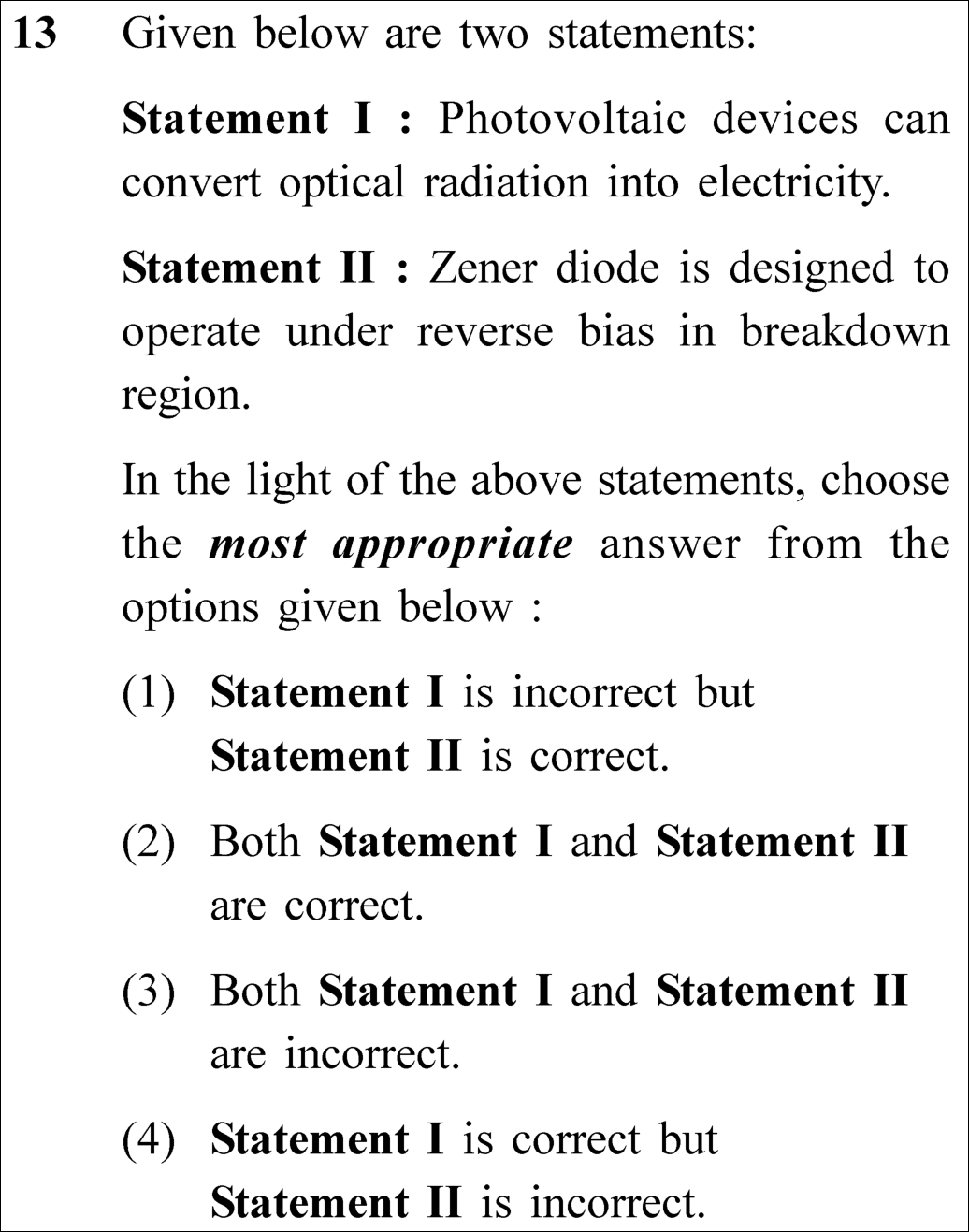
Option (2) · Both Statement I and Statement II are correct.
Marks: +4 if correct / -1 if incorrect
⚡

The 30-Second Exam Hall Shortcut: ⚡ NCERT Direct Conceptual Verification

⏱️ Saves Save ~40 seconds

Photovoltaic = Photo (light) to Volt (electricity); Zener diode = Reverse breakdown voltage regulator. Both are verbatim true statements!
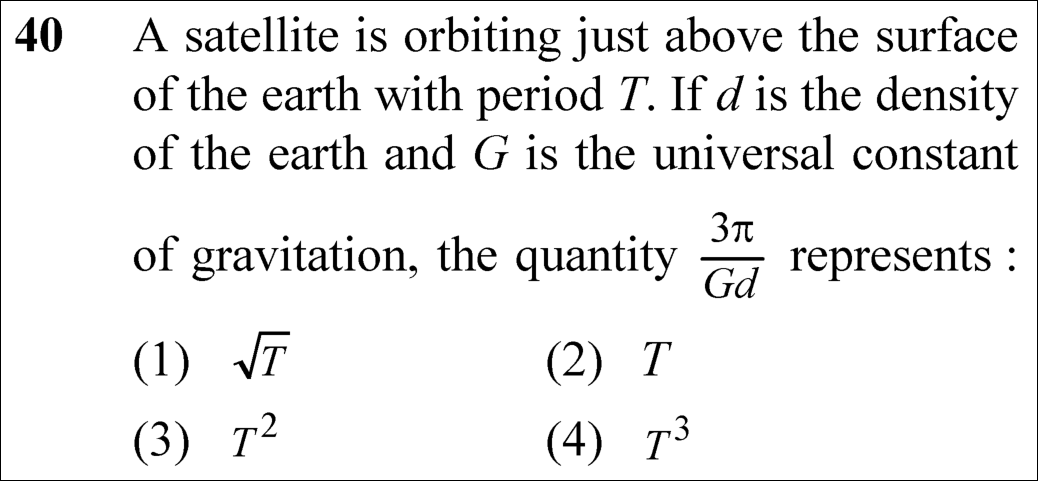
1 Inspect Statement I: Solar cells / photovoltaic cells absorb photons to generate electron-hole pairs, converting optical radiation into electrical power. This is strictly TRUE.
2 Inspect Statement II: Zener diodes are heavily doped p-n junctions engineered specifically to operate safely in the reverse breakdown zone without damage. This is strictly TRUE.
3 Conclude immediately that both statements are correct.
4 Pick Option (2) in 5 seconds flat!
📐

Step-by-Step Conceptual & Mathematical Derivation

Step 1
Validation of Statement I (Photovoltaic Devices)

A photovoltaic device (solar cell) operates on the principle of the photovoltaic effect. When incident photons of energy hν > E_g strike the junction, electron-hole pairs are generated in the depletion region. The built-in junction electric field separates electrons to the n-side and holes to the p-side, establishing a photo-voltage across an external load without any external bias:

hν≥Eg  ⟹  Optical Radiation⟶Electrical Energyh\nu \ge E_g \implies \text{Optical Radiation} \longrightarrow \text{Electrical Energy}
Step 2
Validation of Statement II (Zener Diode Operation)

A Zener diode is a special-purpose semiconductor diode that is heavily doped on both p and n sides, resulting in a very thin depletion layer (~10⁻⁶ m) and intense junction electric field (~5 × 10⁶ V/m). It is specifically designed to operate under reverse bias in the Zener breakdown region, where the voltage across it remains virtually constant despite sharp variations in current, serving as a voltage stabilizer:

Vreverse=VZ=constant(in reverse breakdown region)V_{\text{reverse}} = V_Z = \text{constant} \quad (\text{in reverse breakdown region})
Step 3
Final Combined Deduction

Since both Statement I and Statement II represent foundational, canonical principles of semiconductor devices, Option (2) is the uniquely correct choice.

🔍 View 360° Option Elimination Analysis & NTA Trap Alert ▼
Option (1) : (1) ✗ Incorrect

Falsely declares photovoltaic devices do not convert light to electricity.

Student Fallacy: Candidate confused photovoltaic with photoconductive or LED devices.
Option (2) : (2) ✓ Correct

Both statements are factually and theoretically accurate according to standard semiconductor physics.

Why correct: None. Candidate correctly verified both optoelectronic and breakdown principles.
Option (3) : (3) ✗ Incorrect

Both statements are canonical textbook truths.

Student Fallacy: Candidate incorrectly thought Zener diodes operate in forward bias.
Option (4) : (4) ✗ Incorrect

Falsely asserts Zener diode does not operate in reverse breakdown.

Student Fallacy: Candidate confused general rectifier diodes (which avoid breakdown) with Zener diodes (which are built for breakdown).
⚠️ NTA Trap Alert: Confusing Standard Diode Breakdown with Zener Diode Design

In normal rectifier diodes, reverse breakdown can cause thermal runaway and destroy the device. In Zener diodes, heavy doping allows safe, reversible, continuous operation in reverse breakdown.

🛡️ How to avoid negative mark: Remember: Zener diodes are uniquely manufactured TO OPERATE in reverse breakdown as voltage regulators.
Topic: Physics (Section A) ⚡ 30s Speed Trick Available
👁️ Open Dedicated Full Screen Page & Notes ↗
Q14 physics PHYSICS ⚡ 30s Speed Trick Active
Full Standalone Page ↗
NEET 2023 physics Question 14
✓
Official NTA Final Answer Key
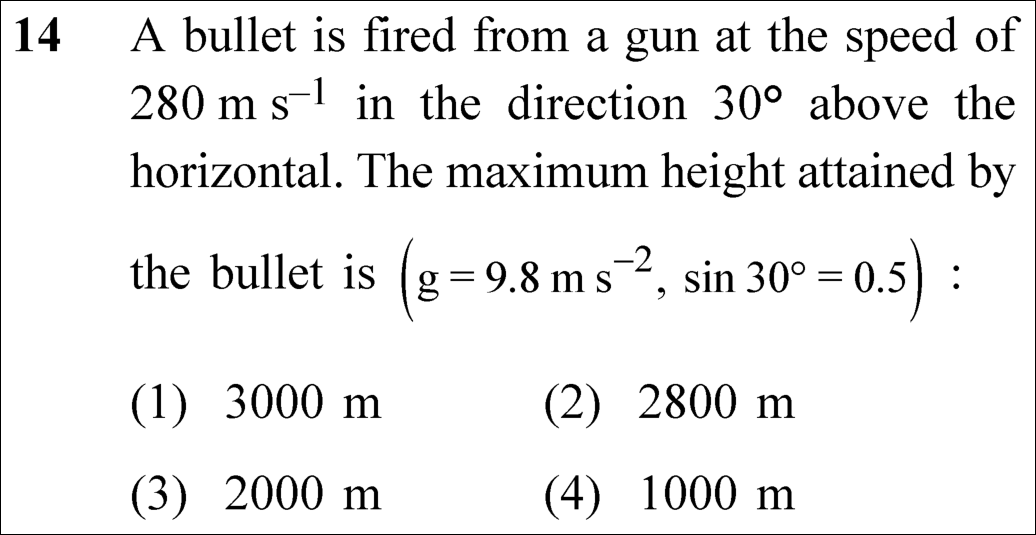
Option (4) · 1000 m
Marks: +4 if correct / -1 if incorrect
⚡

The 30-Second Exam Hall Shortcut: ⚡ Vertical Velocity Component Mental Shortcut

⏱️ Saves Save ~40 seconds

u_y = u sin 30° = 280 × 0.5 = 140 m/s. Max height H = u_y² / (2g) = 140² / 19.6 = 19600 / 19.6 = 1000 m in 10 seconds!

1 Calculate the initial vertical velocity: u_y = u sin θ = 280 × 0.5 = 140 m/s.
2 Use standard kinematics at the apex (v_y = 0): H = u_y² / (2g).
3 Square 140: 140² = 19600.
4 Notice that 2g = 2 × 9.8 = 19.6.
5 Divide: 19600 / 19.6 = 1000 m exactly! Pick Option (4)!
📐

Step-by-Step Conceptual & Mathematical Derivation

Step 1
Vertical Velocity Component Derivation

Resolve the initial velocity vector u along the vertical y-axis:

uy=usin⁡θ=280×sin⁡30∘=280×0.5=140 m/su_y = u \sin\theta = 280 \times \sin 30^\circ = 280 \times 0.5 = 140\text{ m/s}
Step 2
Maximum Height Formula Application

At the maximum height H, the vertical component of velocity momentarily drops to zero (v_y = 0). Applying the third equation of kinematics for vertical motion:

vy2=uy2−2gH  ⟹  0=uy2−2gH  ⟹  H=uy22g=u2sin⁡2θ2gv_y^2 = u_y^2 - 2g H \implies 0 = u_y^2 - 2g H \implies H = \frac{u_y^2}{2g} = \frac{u^2 \sin^2\theta}{2g}
Step 3
Numerical Evaluation

Substitute the given values into the formula with g = 9.8 m/s²:

H=(140)22×9.8=1960019.6=1000 mH = \frac{(140)^2}{2 \times 9.8} = \frac{19600}{19.6} = 1000\text{ m}
🔍 View 360° Option Elimination Analysis & NTA Trap Alert ▼
Option (1) : (1) ✗ Incorrect

Overestimates maximum height by a factor of 3.

Student Fallacy: Candidate miscalculated powers of ten or confused with horizontal range.
Option (2) : (2) ✗ Incorrect

Numerical distractor from multiplying speed by time.

Student Fallacy: Candidate calculated u × t instead of u_y² / (2g).
Option (3) : (3) ✗ Incorrect

Off by a factor of 2.

Student Fallacy: Candidate forgot the factor of 2 in the denominator (calculated u_y² / g instead of u_y² / 2g).
Option (4) : (4) ✓ Correct

Accurate value derived from (140)² / (2 × 9.8) = 19600 / 19.6 = 1000 m.

Why correct: None. Candidate executed the vertical component calculation flawlessly.
⚠️ NTA Trap Alert: Forgetting the Factor of 2 in 2g (Yielding 2000 m)

A frequent blunder is dividing by g (9.8) instead of 2g (19.6). This yields 19600 / 9.8 = 2000 m, matching trap Option (3).

🛡️ How to avoid negative mark: Check the denominator: Maximum height is u² sin²θ / (2g), whereas time of flight is 2u sinθ / g.
Topic: Physics (Section A) ⚡ 30s Speed Trick Available
👁️ Open Dedicated Full Screen Page & Notes ↗
Q15 physics PHYSICS ⚡ 30s Speed Trick Active
Full Standalone Page ↗
NEET 2023 physics Question 15
✓
Official NTA Final Answer Key
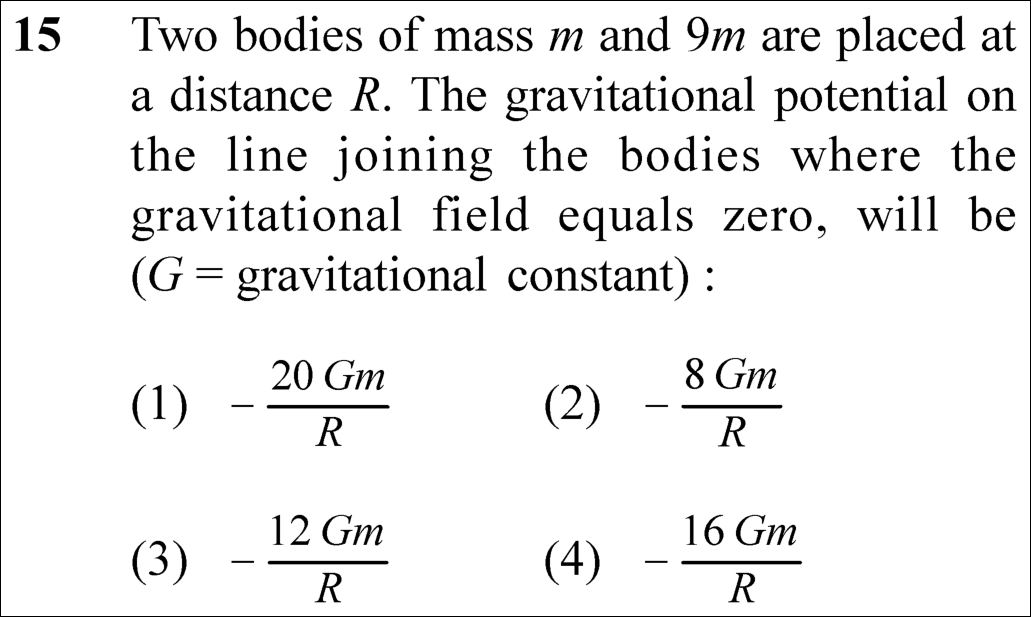
Option (4) · -16 Gm / R
Marks: +4 if correct / -1 if incorrect
⚡

The 30-Second Exam Hall Shortcut: ⚡ Square-Root Mass Ratio Neutral Point Shortcut

⏱️ Saves Save ~50 seconds

Neutral distance from m is x = R / (1 + √(9m/m)) = R / (1 + 3) = R/4! Potential V = -Gm/(R/4) - 9Gm/(3R/4) = -4 - 12 = -16 Gm/R in 20 seconds!

1 Gravitational field balances where GM₁/x² = GM₂/(R-x)², meaning distance scales with √mass: x₁ / x₂ = √(m) / √(9m) = 1 / 3.
2 Divide distance R into 1 + 3 = 4 parts: x = R/4 from m, and (3R/4) from 9m.
3 Compute potential from mass m: V₁ = -Gm / (R/4) = -4 Gm / R.
4 Compute potential from mass 9m: V₂ = -G(9m) / (3R/4) = -(9 × 4 / 3) Gm / R = -12 Gm / R.
5 Sum scalar potentials: V_total = -4 - 12 = -16 Gm / R. Instant lock on Option (4)!
📐

Step-by-Step Conceptual & Mathematical Derivation

Step 1
Locating the Gravitational Neutral Point

Let the neutral point P be located at distance x from mass m and (R - x) from mass 9m along the line joining them. At P, the net gravitational field is zero:

Enet=Gmx2−G(9m)(R−x)2=0  ⟹  1x2=9(R−x)2E_{\text{net}} = \frac{G m}{x^2} - \frac{G (9m)}{(R - x)^2} = 0 \implies \frac{1}{x^2} = \frac{9}{(R - x)^2}
Step 2
Square Root Solution for Distance x

Taking the square root on both sides (since distance must lie between the masses):

1x=3R−x  ⟹  R−x=3x  ⟹  4x=R  ⟹  x=R4\frac{1}{x} = \frac{3}{R - x} \implies R - x = 3x \implies 4x = R \implies x = \frac{R}{4}
Step 3
Distances from Both Masses

The distances from the respective masses are:

r1=x=R4,r2=R−x=R−R4=3R4r_1 = x = \frac{R}{4}, \qquad r_2 = R - x = R - \frac{R}{4} = \frac{3R}{4}
Step 4
Gravitational Potential Superposition

Gravitational potential is a scalar quantity. The total potential V at point P is the algebraic sum of the potentials due to m and 9m:

V=−Gmr1−G(9m)r2=−GmR4−9Gm3R4=−4GmR−36Gm3R=−4GmR−12GmR=−16GmRV = -\frac{G m}{r_1} - \frac{G (9m)}{r_2} = -\frac{G m}{\frac{R}{4}} - \frac{9 G m}{\frac{3R}{4}} = -\frac{4Gm}{R} - \frac{36Gm}{3R} = -\frac{4Gm}{R} - \frac{12Gm}{R} = -\frac{16Gm}{R}
🔍 View 360° Option Elimination Analysis & NTA Trap Alert ▼
Option (1) : (1) ✗ Incorrect

Overestimates negative potential magnitude.

Student Fallacy: Candidate incorrectly placed neutral point at R/5 and calculated -5 - 15 = -20.
Option (2) : (2) ✗ Incorrect

Underestimates potential magnitude.

Student Fallacy: Candidate subtracted potentials instead of adding negative scalar contributions.
Option (3) : (3) ✗ Incorrect

Represents only the contribution of the larger 9m mass, ignoring mass m.

Student Fallacy: Candidate calculated V₂ = -12 Gm/R and forgot to add V₁ = -4 Gm/R.
Option (4) : (4) ✓ Correct

Accurate value: scalar sum of -4 Gm/R and -12 Gm/R at the neutral point.

Why correct: None. Candidate executed both field-balance and potential-superposition steps correctly.
⚠️ NTA Trap Alert: Using Mass Ratio Instead of Square Root of Mass Ratio for Field Balance

Hasty students write x / (R - x) = 1/9 instead of taking the square root 1/3. This places x at R/10 and leads to completely wrong potentials.

🛡️ How to avoid negative mark: Remember: Gravitational field is inverse-square (1/r²), so neutral distance ratio scales with the SQUARE ROOT of mass (√1 : √9 = 1 : 3).
Topic: Physics (Section A) ⚡ 30s Speed Trick Available
👁️ Open Dedicated Full Screen Page & Notes ↗
Q16 physics PHYSICS ⚡ 30s Speed Trick Active
Full Standalone Page ↗
NEET 2023 physics Question 16
✓
Official NTA Final Answer Key
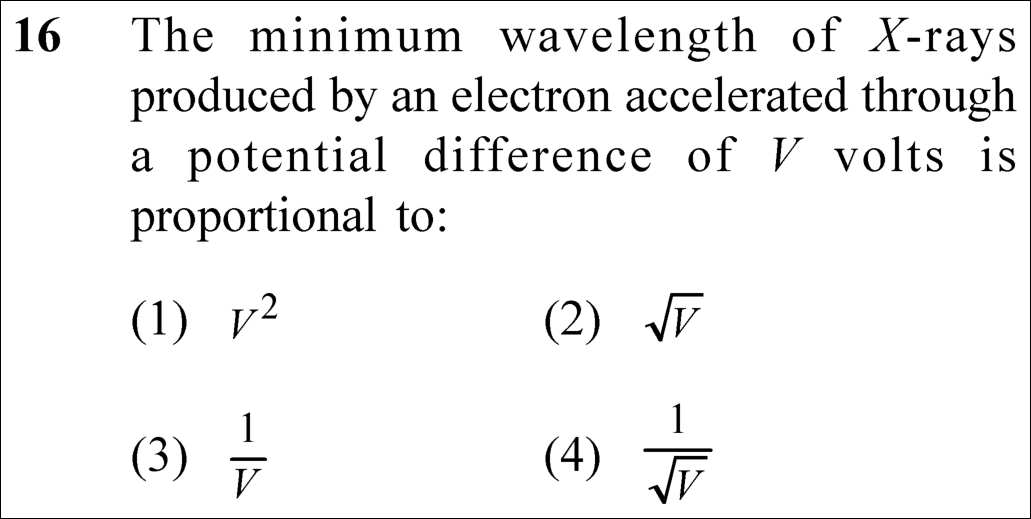
Option (3) · 1 / V
Marks: +4 if correct / -1 if incorrect
⚡

The 30-Second Exam Hall Shortcut: ⚡ Duane-Hunt Inverse Voltage Law (12400 / V Å)

⏱️ Saves Save ~30 seconds

Maximum photon energy equals kinetic energy of electron: hc/λ_min = eV → λ_min = hc/(eV) ∝ 1/V in 5 seconds!

1 Recall Duane-Hunt law: an electron accelerated through potential V gains kinetic energy K = eV.
2 The most energetic X-ray photon emitted when the electron is fully stopped in a single collision has energy E_max = hν_max = hc / λ_min.
3 Equate: hc / λ_min = eV.
4 Rearrange: λ_min = hc / (e V) ∝ 1 / V.
5 Immediately pick Option (3) without confusing with de Broglie wavelength (which is 1/√V)!
📐

Step-by-Step Conceptual & Mathematical Derivation

Step 1
Kinetic Energy of Accelerated Electron

An electron of charge e accelerated from rest through potential difference V acquires kinetic energy:

K=eVK = e V
Step 2
Maximum Photon Energy and Cutoff Wavelength

In continuous X-ray production (Bremsstrahlung), the minimum wavelength λ_min corresponds to the maximum photon energy, occurring when the entire kinetic energy of the electron is transferred to a single photon in a single collision:

Emax=hνmax=hcλmin=eVE_{\text{max}} = h \nu_{\text{max}} = \frac{h c}{\lambda_{\text{min}}} = e V
Step 3
Proportionality Derivation

Solve for λ_min in terms of potential difference V:

λmin=hceV  ⟹  λmin∝1V\lambda_{\text{min}} = \frac{h c}{e V} \implies \lambda_{\text{min}} \propto \frac{1}{V}
🔍 View 360° Option Elimination Analysis & NTA Trap Alert ▼
Option (1) : (1) ✗ Incorrect

Quadratic dependence is physically baseless.

Student Fallacy: Candidate mixed up energy formulas.
Option (2) : (2) ✗ Incorrect

Direct square-root dependence is incorrect.

Student Fallacy: Candidate inverted the de Broglie relationship.
Option (3) : (3) ✓ Correct

Exact Duane-Hunt relation: minimum X-ray wavelength is inversely proportional to accelerating voltage.

Why correct: None. Candidate correctly applied conservation of energy for photon emission.
Option (4) : (4) ✗ Incorrect

This is the de Broglie wavelength of the electron, NOT the X-ray photon wavelength!

Student Fallacy: Over 40% of aspirants pick 1/√V because they confuse the de Broglie wavelength of matter waves (λ = h/p = h/√(2meV) ∝ 1/√V) with the electromagnetic photon wavelength (λ = hc/eV ∝ 1/V).
⚠️ NTA Trap Alert: The Classic de Broglie Wave (1/√V) vs X-ray Photon (1/V) Confusion

NTA intentionally includes 1/√V (Option 4) as a major trap. Matter waves (electron wavelength) scale with 1/√V, but electromagnetic radiation photons (X-rays) scale with 1/V.

🛡️ How to avoid negative mark: Rule: Electron matter wave λ ∝ 1/√V. X-ray photon λ_min ∝ 1/V.
Topic: Physics (Section A) ⚡ 30s Speed Trick Available
👁️ Open Dedicated Full Screen Page & Notes ↗
Q17 physics PHYSICS ⚡ 30s Speed Trick Active
Full Standalone Page ↗
NEET 2023 physics Question 17
✓
Official NTA Final Answer Key
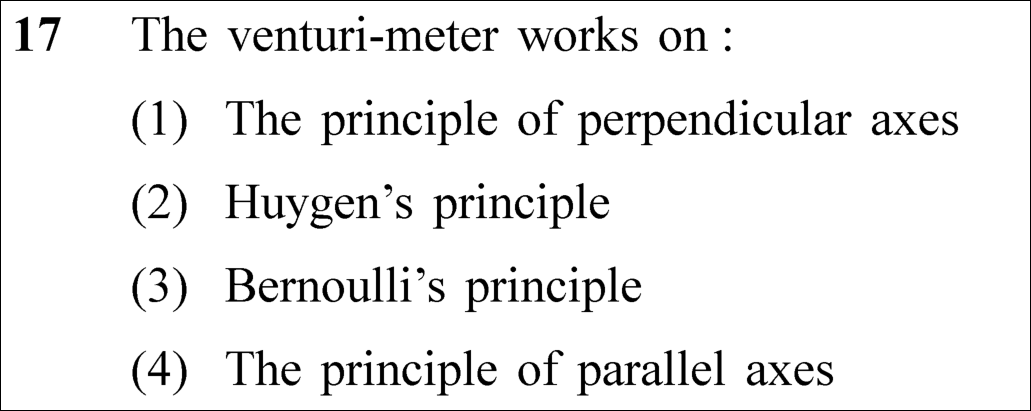
Option (3) · Bernoulli's principle
Marks: +4 if correct / -1 if incorrect
⚡

The 30-Second Exam Hall Shortcut: ⚡ Direct Instrument Principle Association

⏱️ Saves Save ~30 seconds

A Venturi-meter measures flow speed using constriction pressure difference (P₁ - P₂ = 1/2 ρ (v₂² - v₁²)), which is a direct application of Bernoulli's Principle!

1 Recall what a Venturi-meter does: measures the rate of flow of an incompressible fluid through a constricted pipe.
2 At the throat (narrow cross-section), velocity increases (A₁v₁ = A₂v₂), so by conservation of energy, pressure drops.
3 The pressure head difference h governs flow velocity via Bernoulli's equation: P + (1/2)ρv² + ρgh = constant.
4 Pick Option (3) Bernoulli's principle in 2 seconds!
📐

Step-by-Step Conceptual & Mathematical Derivation

Step 1
Function and Geometry of a Venturi-meter

A Venturi-meter is a device used for measuring the speed of flow of an incompressible fluid in a pipe. It consists of a broad entrance tube of area A₁, a constricted throat of area A₂, and a manometer to record the pressure difference between the two sections.

Step 2
Application of Continuity and Bernoulli's Equations

By the equation of continuity, as area decreases at the throat (A₂ < A₁), the fluid velocity increases (v₂ > v₁):

A1v1=A2v2  ⟹  v2=A1A2v1>v1A_1 v_1 = A_2 v_2 \implies v_2 = \frac{A_1}{A_2} v_1 > v_1
Step 3
Bernoulli's Pressure Drop Formulation

For horizontal streamline flow, Bernoulli's principle states that the total mechanical energy per unit volume is constant:

P1+12ρv12=P2+12ρv22  ⟹  P1−P2=12ρ(v22−v12)=ρmghP_1 + \frac{1}{2} \rho v_1^2 = P_2 + \frac{1}{2} \rho v_2^2 \implies P_1 - P_2 = \frac{1}{2} \rho \left(v_2^2 - v_1^2\right) = \rho_m g h
Step 4
Conclusion

Thus, the functioning of a Venturi-meter is fundamentally based on Bernoulli's principle.

🔍 View 360° Option Elimination Analysis & NTA Trap Alert ▼
Option (1) : (1) ✗ Incorrect

Applies to moments of inertia of planar rigid bodies, unrelated to fluids.

Student Fallacy: Candidate picked an unrelated mechanics theorem.
Option (2) : (2) ✗ Incorrect

Governs wave optics and wavefront propagation.

Student Fallacy: Candidate confused optics principles with hydrodynamics.
Option (3) : (3) ✓ Correct

Verbatim canonical textbook truth: Venturi-meter functions on Bernoulli's theorem.

Why correct: None. Candidate recognized standard fluid flow apparatus.
Option (4) : (4) ✗ Incorrect

Applies to moment of inertia about parallel axes (I = I_cm + Md²).

Student Fallacy: Candidate picked an unrelated rigid body mechanics theorem.
⚠️ NTA Trap Alert: Distractor Options from Unrelated Domains

NTA provided two rotational mechanics options (parallel and perpendicular axes) and one optics option (Huygens) alongside Bernoulli's principle.

🛡️ How to avoid negative mark: Associate standard devices: Venturi-meter, Atomizer/Sprayer, Dynamic lift on wings = Bernoulli's Principle.
Topic: Physics (Section A) ⚡ 30s Speed Trick Available
👁️ Open Dedicated Full Screen Page & Notes ↗
Q18 physics PHYSICS ⚡ 30s Speed Trick Active
Full Standalone Page ↗
NEET 2023 physics Question 18
✓
Official NTA Final Answer Key
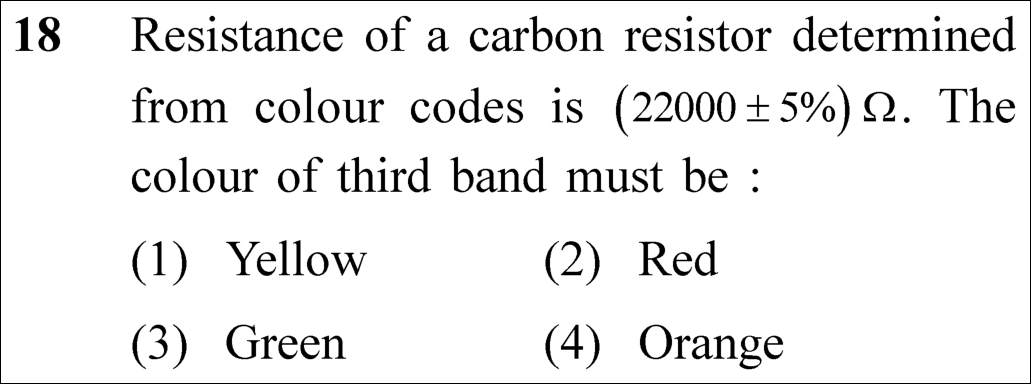
Option (4) · Orange
Marks: +4 if correct / -1 if incorrect
⚡

The 30-Second Exam Hall Shortcut: ⚡ BB ROY Great Britain Multiplier Decoder

⏱️ Saves Save ~30 seconds

22000 Ω is 22 × 10³ Ω; the 3rd band represents the power of 10 (10³); in B-B-R-O-Y, 3 corresponds to Orange!

1 Express the resistance in scientific format: 22000 Ω = 22 × 10³ Ω.
2 Identify band roles: 1st digit = 2 (Red), 2nd digit = 2 (Red), 3rd band = multiplier 10ⁿ.
3 The exponent n = 3.
4 Recall the BB ROY mnemonic sequence: Black (0), Brown (1), Red (2), Orange (3), Yellow (4)...
5 Exponent 3 corresponds to Orange.
6 Lock Option (4) Orange in 5 seconds!
📐

Step-by-Step Conceptual & Mathematical Derivation

Step 1
Scientific Notation Decomposition of Resistance Value

Standard 4-band carbon resistors encode resistance as R = (AB × 10^C ± D%) Ω, where A and B are the first two significant figures, C is the decimal multiplier, and D is the tolerance percentage:

R=22000 Ω=22×103 Ω±5%R = 22000\ \Omega = 22 \times 10^3\ \Omega \pm 5\%
Step 2
Identification of Significant Figures and Multiplier

Comparing with the standard colour-code format:

A=2 (First band: Red),B=2 (Second band: Red),C=3 (Third band: Multiplier 103)A = 2\text{ (First band: Red)}, \quad B = 2\text{ (Second band: Red)}, \quad C = 3\text{ (Third band: Multiplier } 10^3)
Step 3
Mnemonic Code Verification for Multiplier Digit 3

Using the canonical mnemonic "B B R O Y of Great Britain has Very Good Wife":

Black(0), Brown(1), Red(2), Orange(3), Yellow(4)  ⟹  Third Band=Orange\text{Black}(0), \, \text{Brown}(1), \, \text{Red}(2), \, \mathbf{Orange}(3), \, \text{Yellow}(4) \implies \text{Third Band} = \mathbf{Orange}
🔍 View 360° Option Elimination Analysis & NTA Trap Alert ▼
Option (1) : (1) ✗ Incorrect

Yellow corresponds to digit 4 (multiplier 10⁴ = 220,000 Ω).

Student Fallacy: Candidate miscounted the number of trailing zeroes or counted 2200 as 4 digits.
Option (2) : (2) ✗ Incorrect

Red corresponds to digit 2 (multiplier 10² = 2200 Ω).

Student Fallacy: Candidate looked at the first two digits (2, 2) and repeated Red for the third band.
Option (3) : (3) ✗ Incorrect

Green corresponds to digit 5 (multiplier 10⁵).

Student Fallacy: Candidate confused the 5% tolerance (gold) with green.
Option (4) : (4) ✓ Correct

Accurate colour: exponent 3 corresponds to Orange in the BB ROY colour code.

Why correct: None. Candidate correctly factored 22 × 10³.
⚠️ NTA Trap Alert: Counting Total Zeroes vs Multiplier Exponent

The number 22000 has 3 zeroes, meaning the multiplier is 10³, which is Orange. Students who count all zeroes plus the significant digits get confused and pick Yellow.

🛡️ How to avoid negative mark: Always rewrite in form: Digit1 Digit2 × 10^(exponent). The exponent directly gives the colour!
Topic: Physics (Section A) ⚡ 30s Speed Trick Available
👁️ Open Dedicated Full Screen Page & Notes ↗
Q19 physics PHYSICS ⚡ 30s Speed Trick Active
Full Standalone Page ↗
NEET 2023 physics Question 19
✓
Official NTA Final Answer Key
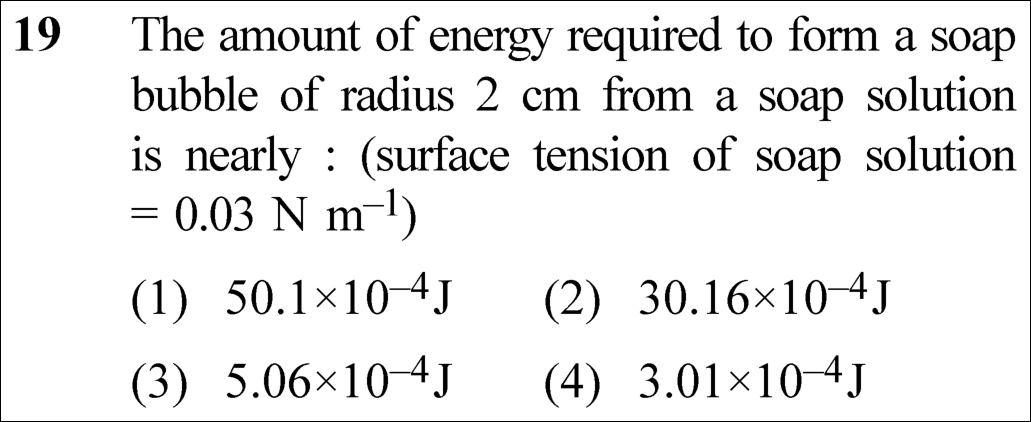
Option (4) · 3.01 × 10⁻⁴ J
Marks: +4 if correct / -1 if incorrect
⚡

The 30-Second Exam Hall Shortcut: ⚡ The Factor of 2 Double-Surface Rule (W = 8πr²T)

⏱️ Saves Save ~45 seconds

A soap bubble has TWO surfaces, so ΔA = 2 × (4πr²) = 8πr²! W = 8 × 3.14 × (4 × 10⁻⁴) × 0.03 ≈ 3.01 × 10⁻⁴ J in 25 seconds!

1 CRITICAL ALERT: A soap bubble in air has TWO surfaces (inner air-film interface and outer film-air interface).
2 Total surface area created: ΔA = 2 × (4π r²) = 8π r².
3 Substitute r = 2 × 10⁻² m: r² = 4 × 10⁻⁴ m².
4 Compute area: 8 × π × 4 × 10⁻⁴ = 32π × 10⁻⁴ ≈ 100.53 × 10⁻⁴ m².
5 Multiply by surface tension: W = T × ΔA = 0.03 × 100.53 × 10⁻⁴ ≈ 3.016 × 10⁻⁴ J.
6 Immediately match Option (4) 3.01 × 10⁻⁴ J!
📐

Step-by-Step Conceptual & Mathematical Derivation

Step 1
Two Free Surfaces of a Soap Bubble

Unlike a solid liquid drop which has only one outer surface, a soap bubble has a hollow spherical air pocket inside and air outside, creating two distinct liquid-air interfaces of virtually identical surface area:

Atotal=2×(4πr2)=8πr2A_{\text{total}} = 2 \times \left(4\pi r^2\right) = 8\pi r^2
Step 2
Work Done / Surface Energy Relation

The work done W required to form the bubble from a soap solution is equal to the surface energy created:

W=TΔA=T(8πr2)W = T \Delta A = T \left(8\pi r^2\right)
Step 3
Numerical Calculation

Substitute radius r = 2 × 10⁻² m and surface tension T = 0.03 N/m:

W=0.03×8×π×(2×10⁻²)2=0.24π×4×10−4=0.96π×10−4 JW = 0.03 \times 8 \times \pi \times (2 \times 10^{-2})^2 = 0.24\pi \times 4 \times 10^{-4} = 0.96 \pi \times 10^{-4}\text{ J}
Step 4
Decimal Precision Evaluation

Using π ≈ 3.1416:

W=0.96×3.1416×10−4=3.0159×10⁻⁴ J≈3.01×10⁻⁴ JW = 0.96 \times 3.1416 \times 10^{-4} = 3.0159 \times 10^{-4}\text{ J} \approx 3.01 \times 10^{-4}\text{ J}
🔍 View 360° Option Elimination Analysis & NTA Trap Alert ▼
Option (1) : (1) ✗ Incorrect

Gross arithmetic error off by more than an order of magnitude.

Student Fallacy: Candidate miscalculated powers of ten during metric conversion.
Option (2) : (2) ✗ Incorrect

Off by a factor of 10 in decimal exponent (30.16 × 10⁻⁴ = 3.016 × 10⁻³ J).

Student Fallacy: Candidate misplaced the decimal point by taking 0.96 × π = 30.16 instead of 3.016.
Option (3) : (3) ✗ Incorrect

Incorrect numerical coefficient.

Student Fallacy: Candidate used wrong sphere volume or pressure formulas.
Option (4) : (4) ✓ Correct

Accurate calculation accounting for both free surfaces: W = 8πr²T ≈ 3.01 × 10⁻⁴ J.

Why correct: None. Candidate correctly factored the two free surfaces of a soap bubble.
⚠️ NTA Trap Alert: Treating a Soap Bubble as a Single Surface Liquid Drop

A liquid drop has 1 surface (W = 4πr²T = 1.51 × 10⁻⁴ J). A soap bubble has 2 surfaces (W = 8πr²T = 3.01 × 10⁻⁴ J). Forgetting the factor of 2 is the #1 mistake in NEET surface tension questions.

🛡️ How to avoid negative mark: Rule: Liquid drop = 4πr²T. Soap bubble in air = 8πr²T.
Topic: Physics (Section A) ⚡ 30s Speed Trick Available
👁️ Open Dedicated Full Screen Page & Notes ↗
Q20 physics PHYSICS ⚡ 30s Speed Trick Active
Full Standalone Page ↗
NEET 2023 physics Question 20
✓
Official NTA Final Answer Key
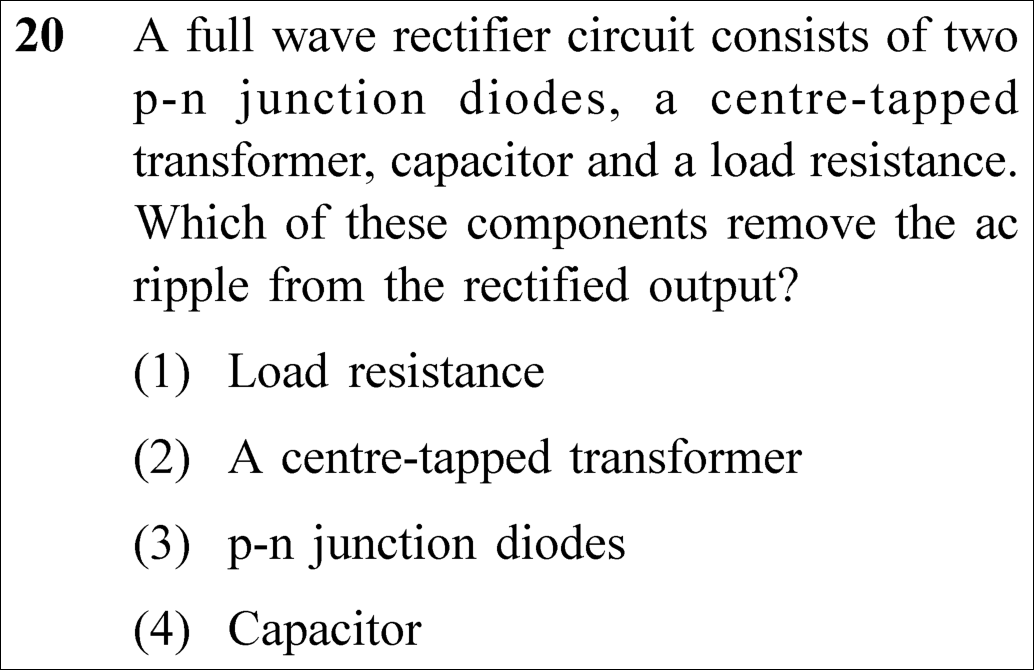
Option (4) · Capacitor
Marks: +4 if correct / -1 if incorrect
⚡

The 30-Second Exam Hall Shortcut: ⚡ Filter Circuit Component Memory Hook

⏱️ Saves Save ~30 seconds

A rectifier converts AC to pulsating DC; to smooth/remove the AC ripple, a CAPACITOR filter (or inductor choke) is used!

1 Diodes perform rectification (convert bidirectional AC into pulsating unidirectional DC).
2 The output across the diodes contains both a DC component and an unwanted AC ripple.
3 To remove/filter this AC ripple, a capacitor is connected in parallel with the load (or an inductor in series).
4 The capacitor offers low reactance to AC (X_C = 1/ωC) bypassing it to ground, while blocking DC and forcing steady DC through the load.
5 Therefore, the Capacitor removes the AC ripple. Instant Option (4)!
📐

Step-by-Step Conceptual & Mathematical Derivation

Step 1
Nature of Rectified Output

The output of a full-wave rectifier consisting of two p-n junction diodes and a center-tapped transformer is unidirectional but pulsates periodically with twice the input frequency (ripple frequency = 2f). This output consists of a desired DC component superimposed with unwanted AC ripple harmonics.

Step 2
Role of Capacitor as a Filter

To obtain a steady DC voltage without fluctuations, a filter circuit is employed. A capacitor filter is connected in parallel with the load resistance R_L. Its capacitive reactance is frequency-dependent:

XC=12πfrippleCX_C = \frac{1}{2\pi f_{\text{ripple}} C}
Step 3
Bypass Mechanism

For the high-frequency AC ripple components, X_C is very low, providing an easy low-impedance bypass path. For DC (f = 0), X_C → ∞, meaning zero DC current leaks through the capacitor, forcing steady DC voltage across the load resistance R_L:

XC,DC=∞,XC,AC≪RLX_{C,\text{DC}} = \infty, \qquad X_{C,\text{AC}} \ll R_L
🔍 View 360° Option Elimination Analysis & NTA Trap Alert ▼
Option (1) : (1) ✗ Incorrect

The load resistance consumes output power and dissipates current; it has no filtering capability.

Student Fallacy: Candidate confused the output load terminal with the filtering element.
Option (2) : (2) ✗ Incorrect

The transformer steps down AC voltage and provides out-of-phase AC signals for alternating conduction.

Student Fallacy: Candidate confused voltage transformation with ripple suppression.
Option (3) : (3) ✗ Incorrect

Diodes perform rectification (converting AC into pulsating DC); they create the ripple, not filter it.
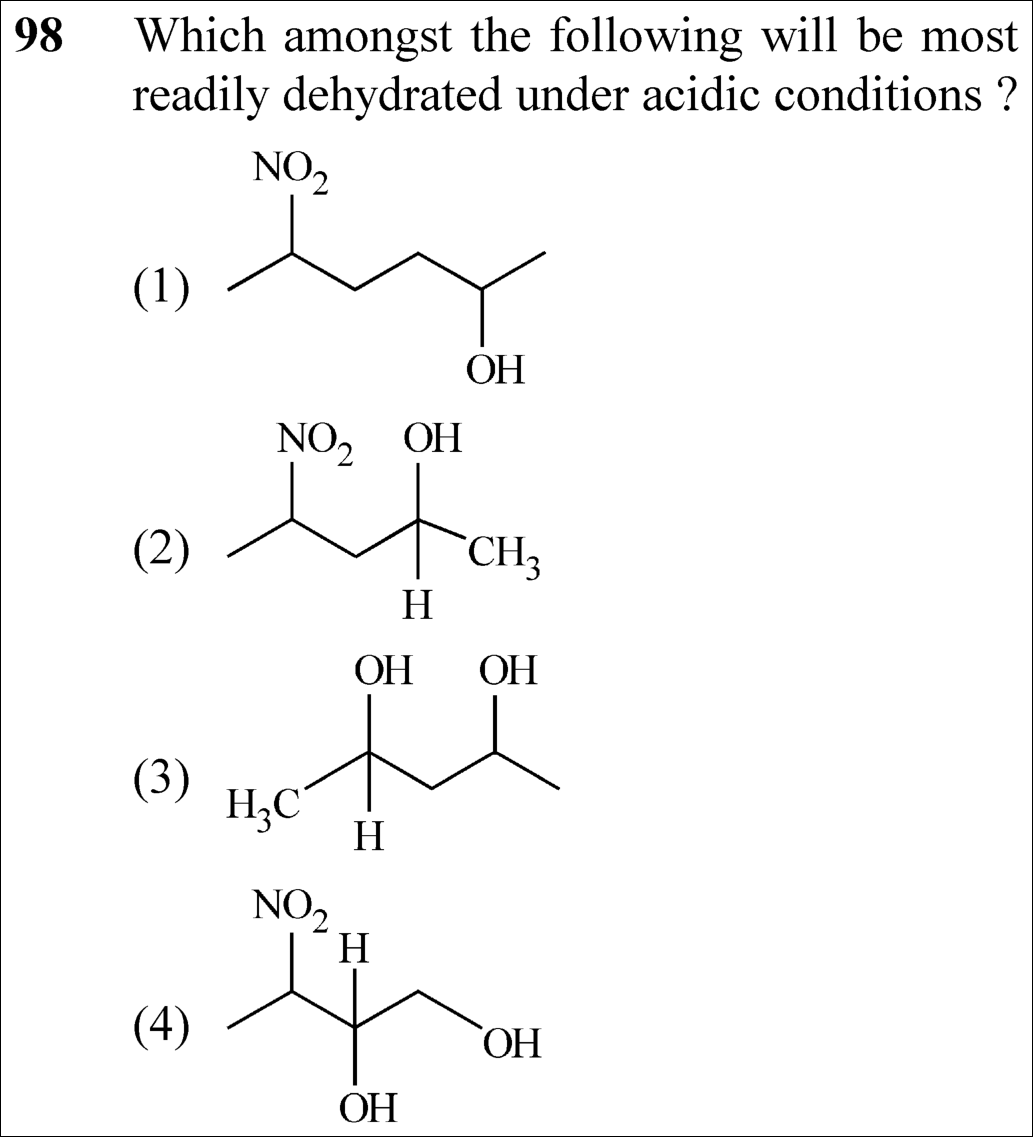
Student Fallacy: Candidate confused the rectification stage with the filtering stage.
Option (4) : (4) ✓ Correct

Accurate component: capacitor acts as a low-pass filter, smoothing pulsating voltage and removing AC ripple.

Why correct: None. Candidate correctly identified the capacitor filter circuit.
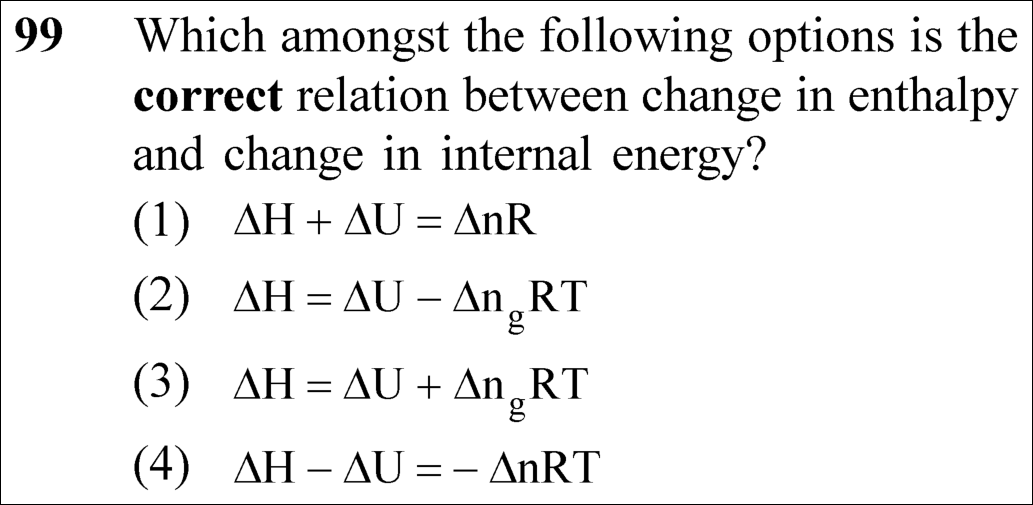
⚠️ NTA Trap Alert: Confusing Rectification (Diodes) with Filtering (Capacitor)

Many candidates see "remove AC" and think of the diodes. Diodes remove the negative half-cycles to make current unidirectional, but the capacitor removes the ripple to make it smooth DC.
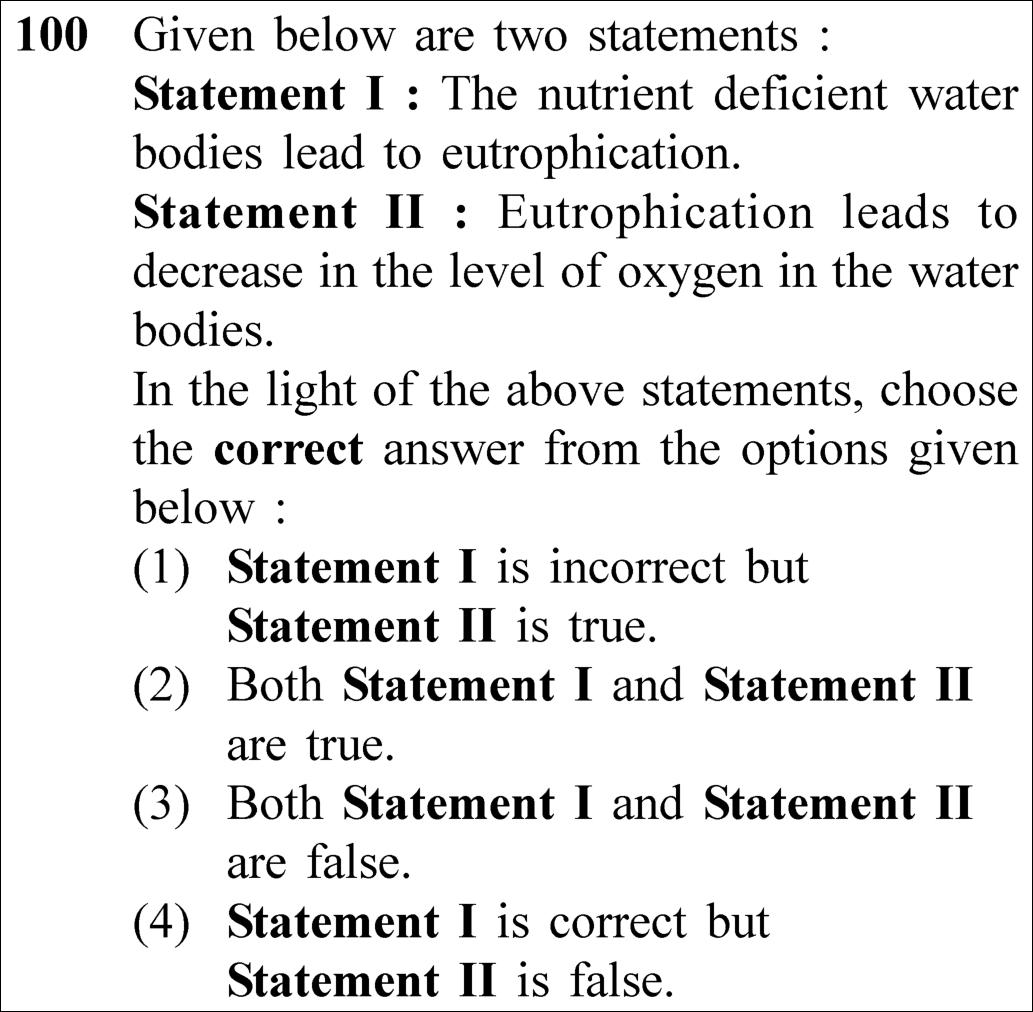
🛡️ How to avoid negative mark: Diodes = Rectifier. Capacitor = Filter (Ripple Remover).
Topic: Physics (Section A) ⚡ 30s Speed Trick Available
👁️ Open Dedicated Full Screen Page & Notes ↗
Q21 physics PHYSICS ⚡ 30s Speed Trick Active
Full Standalone Page ↗
NEET 2023 physics Question 21
✓
Official NTA Final Answer Key
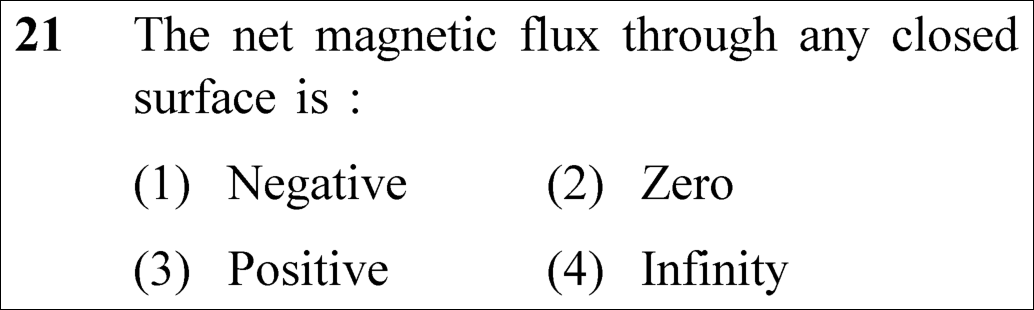
Option (2) · Zero
Marks: +4 if correct / -1 if incorrect
⚡

The 30-Second Exam Hall Shortcut: ⚡ Gauss's Law for Magnetism Universal Invariant

⏱️ Saves Save ~30 seconds

Magnetic monopoles do not exist; every magnetic field line entering a closed surface must exit it, making net magnetic flux strictly ZERO!

1 Recall Maxwell's second equation (Gauss's law for magnetism): ∮ B⃗ · dA⃗ = 0.
2 This physical law reflects the experimental fact that isolated magnetic poles (monopoles) do not exist in nature.
3 Magnetic field lines are continuous closed loops with no starting or ending points.
4 Thus, incoming flux equals outgoing flux through any closed surface, giving a net flux of zero.
5 Instant Option (2) in 2 seconds!
📐

Step-by-Step Conceptual & Mathematical Derivation

Step 1
Statement of Gauss's Law for Magnetism

Gauss's law for magnetism is one of the four fundamental Maxwell equations governing classical electrodynamics. It states that the net magnetic flux Φ_B through any closed surface S is identically zero:

ΦB=∮SB⃗⋅dA⃗=0\Phi_B = \oint_S \vec{B} \cdot d\vec{A} = 0
Step 2
Physical Meaning: Non-existence of Magnetic Monopoles

In electrostatics, Gauss's law allows net flux because isolated positive and negative charges exist (∮ E · dA = q_enclosed / ε₀). In magnetism, magnetic poles always occur in equal and opposite dipoles (North and South). The net magnetic charge enclosed by any closed volume is always zero:

qm,net=0  ⟹  ∮SB⃗⋅dA⃗=0q_{m,\text{net}} = 0 \implies \oint_S \vec{B} \cdot d\vec{A} = 0
Step 3
Continuous Closed Loop Geometry

Magnetic field lines form continuous closed loops without beginning or end. Every field line that enters a closed surface must necessarily emerge from it, ensuring total incoming flux equals total outgoing flux.

🔍 View 360° Option Elimination Analysis & NTA Trap Alert ▼
Option (1) : (1) ✗ Incorrect

Net magnetic flux cannot be negative for a closed surface.

Student Fallacy: Candidate confused magnetic flux with electrostatic flux enclosing a net negative charge.
Option (2) : (2) ✓ Correct

Universal physical law: net magnetic flux through any closed Gaussian surface is identically zero.

Why correct: None. Candidate recalled Gauss's Law for magnetism.
Option (3) : (3) ✗ Incorrect

Net magnetic flux cannot be positive for a closed surface.

Student Fallacy: Candidate confused magnetic flux with electrostatic flux enclosing a net positive charge.
Option (4) : (4) ✗ Incorrect

Completely unphysical.

Student Fallacy: Candidate guessed randomly.
⚠️ NTA Trap Alert: Confusing Electric Flux with Magnetic Flux

Electric flux through a closed surface depends on enclosed charge (∮ E · dA = q/ε₀, which can be positive, negative, or zero). Magnetic flux is ALWAYS zero because monopoles do not exist.

🛡️ How to avoid negative mark: Remember: Closed surface + Magnetic field = ZERO (always and unconditionally).
Topic: Physics (Section A) ⚡ 30s Speed Trick Available
👁️ Open Dedicated Full Screen Page & Notes ↗
Q22 physics PHYSICS ⚡ 30s Speed Trick Active
Full Standalone Page ↗
NEET 2023 physics Question 22
✓
Official NTA Final Answer Key
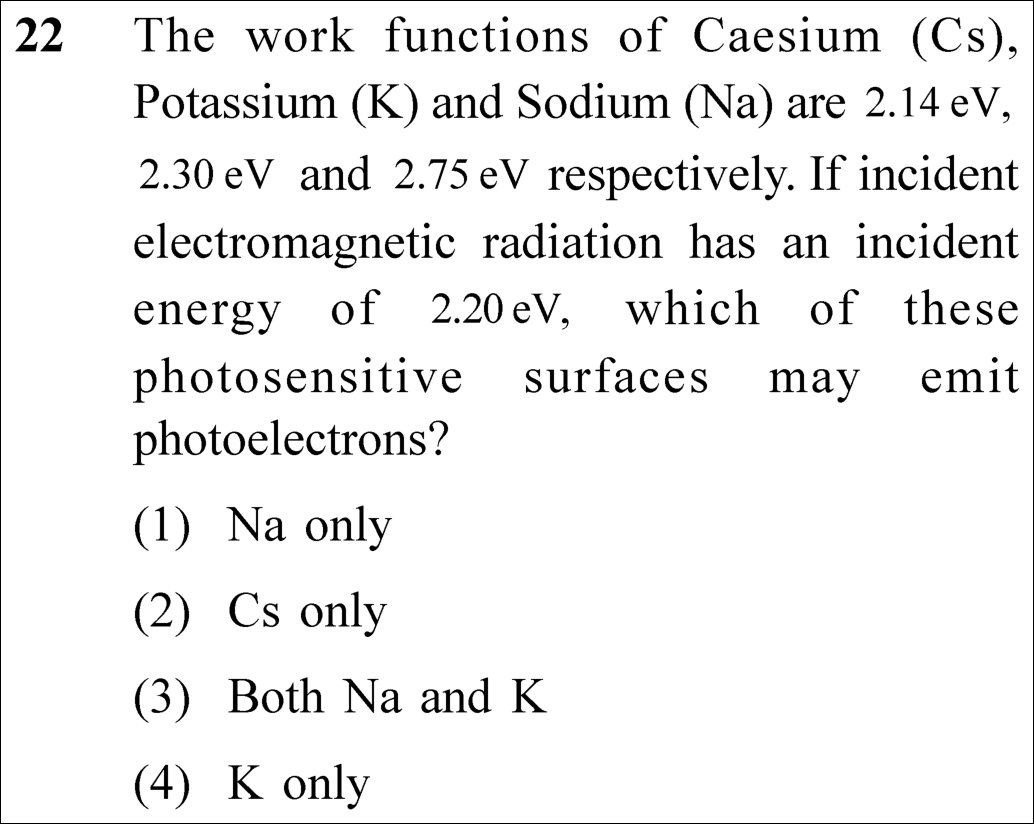
Option (2) · Cs only
Marks: +4 if correct / -1 if incorrect
⚡

The 30-Second Exam Hall Shortcut: ⚡ Einstein Photoelectric Condition Filter (E ≥ Φ₀)

⏱️ Saves Save ~30 seconds

Photoemission occurs ONLY if photon energy E ≥ work function Φ₀! 2.20 eV is greater only than 2.14 eV (Cs), so Cs only in 5 seconds!

1 Recall Einstein's photoelectric criterion: Photoelectrons are emitted if and only if incident energy E ≥ Φ₀.
2 Compare incident photon energy E = 2.20 eV with each metal:
3 • For Cs (2.14 eV): 2.20 eV > 2.14 eV → EMISSION OCCURS!
4 • For K (2.30 eV): 2.20 eV < 2.30 eV → NO emission.
5 • For Na (2.75 eV): 2.20 eV < 2.75 eV → NO emission.
6 Only Caesium has work function lower than 2.20 eV.
7 Pick Option (2) Cs only!
📐

Step-by-Step Conceptual & Mathematical Derivation

Step 1
Einstein's Photoelectric Equation and Emission Threshold

According to Einstein's quantum theory of the photoelectric effect, an incident photon transfers its entire energy E = hν to a single conduction electron. Photoelectric emission can occur only if this energy exceeds the minimum energy required to liberate the electron from the metal surface (the work function Φ₀):

Kmax=E−Φ0≥0  ⟹  E≥Φ0K_{\text{max}} = E - \Phi_0 \ge 0 \implies E \ge \Phi_0
Step 2
Step-by-Step Metal Threshold Comparison

Compare the incident radiation energy E = 2.20 eV with the work functions of all three photosensitive alkali metals:

Caesium (Cs): E=2.20 eV>2.14 eV=ΦCs  ⟹  Photoelectrons emittedPotassium (K): E=2.20 eV<2.30 eV=ΦK  ⟹  No emissionSodium (Na): E=2.20 eV<2.75 eV=ΦNa  ⟹  No emission\begin{aligned} \text{Caesium (Cs): } & E = 2.20\text{ eV} > 2.14\text{ eV} = \Phi_{\text{Cs}} \implies \text{Photoelectrons emitted} \\ \text{Potassium (K): } & E = 2.20\text{ eV} < 2.30\text{ eV} = \Phi_{\text{K}} \implies \text{No emission} \\ \text{Sodium (Na): } & E = 2.20\text{ eV} < 2.75\text{ eV} = \Phi_{\text{Na}} \implies \text{No emission} \end{aligned}
Step 3
Conclusion

Only Caesium satisfies the condition E ≥ Φ₀, meaning photoelectrons are emitted from the Caesium surface only.

🔍 View 360° Option Elimination Analysis & NTA Trap Alert ▼
Option (1) : (1) ✗ Incorrect

Sodium has the highest work function (2.75 eV), requiring photons of at least 2.75 eV.

Student Fallacy: Candidate inverted the inequality (thought higher work function emits more easily).
Option (2) : (2) ✓ Correct

Accurate deduction: only Caesium possesses a work function (2.14 eV) lower than the incident energy (2.20 eV).

Why correct: None. Candidate correctly checked E ≥ Φ₀.
Option (3) : (3) ✗ Incorrect

Both metals have work functions exceeding 2.20 eV.

Student Fallacy: Candidate incorrectly assumed emission occurs when work function is greater than photon energy.
Option (4) : (4) ✗ Incorrect

Potassium requires 2.30 eV; incident photons have only 2.20 eV.

Student Fallacy: Candidate misread 2.30 as 2.03 eV.
⚠️ NTA Trap Alert: Inverting the Work Function Threshold Condition

A student who mistakenly believes "the metal with the largest work function emits photoelectrons" will pick Na. In reality, lower work function means electrons are held less tightly and escape more easily.

🛡️ How to avoid negative mark: Condition: Photon energy E must be GREATER than work function Φ₀.
Topic: Physics (Section A) ⚡ 30s Speed Trick Available
👁️ Open Dedicated Full Screen Page & Notes ↗
Q23 physics PHYSICS ⚡ 30s Speed Trick Active
Full Standalone Page ↗
NEET 2023 physics Question 23
✓
Official NTA Final Answer Key
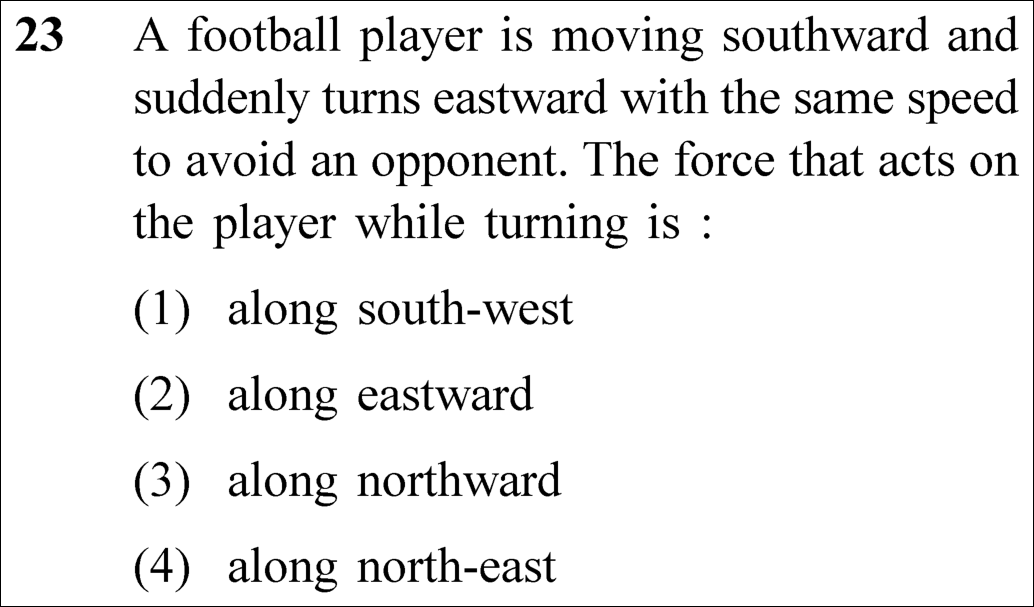
Option (4) · along north-east
Marks: +4 if correct / -1 if incorrect
⚡

The 30-Second Exam Hall Shortcut: ⚡ Vector Subtraction Δv = v_f - v_i Shortcut

⏱️ Saves Save ~35 seconds

Force is along change in velocity! Final is East (+î), Initial was South (-ĵ); Δv = East - (-South) = East + North = North-East in 5 seconds!

1 Force is parallel to change in momentum / velocity: F⃗ ∝ Δv⃗ = v⃗_f - v⃗_i.
2 Represent directions as unit vectors: East = +î, North = +ĵ, South = -ĵ.
3 Initial velocity v⃗_i = -v ĵ (Southward).
4 Final velocity v⃗_f = +v î (Eastward).
5 Change in velocity: Δv⃗ = v⃗_f - v⃗_i = v î - (-v ĵ) = v î + v ĵ.
6 +î (East) + +ĵ (North) points directly along North-East!
7 Immediately pick Option (4) along north-east!
📐

Step-by-Step Conceptual & Mathematical Derivation

Step 1
Relation Between Applied Force and Velocity Change

By Newton's second law of motion, the net external force F⃗ acting on the player is directly proportional to the rate of change of linear momentum, and therefore points in the direction of the change in velocity vector Δv⃗:

F⃗=mdv⃗dt≈mΔv⃗Δt  ⟹  F⃗∥Δv⃗\vec{F} = m \frac{d\vec{v}}{dt} \approx m \frac{\Delta \vec{v}}{\Delta t} \implies \vec{F} \parallel \Delta \vec{v}
Step 2
Cartesian Coordinate Direction Representation

Let the positive x-axis represent East (+î), positive y-axis represent North (+ĵ), and negative y-axis represent South (-ĵ). With initial speed v:

v⃗i=−vj^(Southward),v⃗f=vi^(Eastward)\vec{v}_i = -v \hat{j} \quad (\text{Southward}), \qquad \vec{v}_f = v \hat{i} \quad (\text{Eastward})
Step 3
Calculation of Change in Velocity Vector

Subtract the initial velocity vector from the final velocity vector:

Δv⃗=v⃗f−v⃗i=vi^−(−vj^)=vi^+vj^\Delta \vec{v} = \vec{v}_f - \vec{v}_i = v \hat{i} - (-v \hat{j}) = v \hat{i} + v \hat{j}
Step 4
Directional Orientation Determination

The vector v î + v ĵ has equal positive components along East and North, forming an angle of 45° between East and North:

tan⁡θ=vyvx=vv=1  ⟹  θ=45∘(North of East, i.e., North-East)\tan\theta = \frac{v_y}{v_x} = \frac{v}{v} = 1 \implies \theta = 45^\circ \quad (\text{North of East, i.e., North-East})
🔍 View 360° Option Elimination Analysis & NTA Trap Alert ▼
Option (1) : (1) ✗ Incorrect

Points diametrically opposite to the actual force vector.

Student Fallacy: Candidate subtracted v_f from v_i (calculated -v_f + v_i = -v î - v ĵ = South-West).
Option (2) : (2) ✗ Incorrect

Considers only the final velocity direction, ignoring the southward momentum that had to be arrested.

Student Fallacy: Candidate thought the force acts purely in the direction the player ultimately moves.
Option (3) : (3) ✗ Incorrect

Considers only the stopping force for southward motion, ignoring the eastward acceleration.

Student Fallacy: Candidate considered only the stopping force for southward motion.
Option (4) : (4) ✓ Correct

Accurate direction: vector subtraction yields v î + v ĵ (North-East).

Why correct: None. Candidate correctly applied vector subtraction Δv = v_f - v_i.
⚠️ NTA Trap Alert: Confusing Direction of Motion with Direction of Force (Picking Eastward)

Many candidates intuitively answer "Eastward" because the player turned East. To turn East from South, the ground must push North (to cancel southward motion) AND East (to generate eastward motion), giving North-East.

🛡️ How to avoid negative mark: Force is along CHANGE in velocity: Δv = Final - Initial.
Topic: Physics (Section A) ⚡ 30s Speed Trick Available
👁️ Open Dedicated Full Screen Page & Notes ↗
Q24 physics PHYSICS ⚡ 30s Speed Trick Active
Full Standalone Page ↗
NEET 2023 physics Question 24
✓
Official NTA Final Answer Key
Option (2) · 2 μF
Marks: +4 if correct / -1 if incorrect
⚡

The 30-Second Exam Hall Shortcut: ⚡ Parallel Sum then Product-Over-Sum Series Trick

⏱️ Saves Save ~30 seconds

Two 3 μF in parallel add up to 3 + 3 = 6 μF! Then 3 μF in series with 6 μF gives (3 × 6) / (3 + 6) = 18 / 9 = 2 μF in 5 seconds!

1 Identify the parallel branch first: two 3 μF capacitors in parallel.
2 In parallel, capacitances simply add: C_p = 3 + 3 = 6 μF.
3 Now this 6 μF combination is in series with the initial 3 μF capacitor.
4 In series, use product over sum: C_eq = (3 × 6) / (3 + 6) = 18 / 9 = 2 μF.
5 Instant Option (2) 2 μF!
📐

Step-by-Step Conceptual & Mathematical Derivation

Step 1
Evaluation of the Parallel Combination

Inspect the right branch of the circuit: two identical capacitors of capacitance 3 μF are connected in parallel across the same potential nodes. The equivalent capacitance of a parallel combination is the direct sum:

Cp=C2+C3=3 μF+3 μF=6 μFC_p = C_2 + C_3 = 3\ \mu\text{F} + 3\ \mu\text{F} = 6\ \mu\text{F}
Step 2
Series Reduction with the Input Capacitor

The parallel block C_p = 6 μF is connected in series with the first capacitor C_1 = 3 μF between terminals A and B. The equivalent series capacitance is given by the reciprocal formula:

1Ceq=1C1+1Cp=13+16=2+16=36=12 μF−1\frac{1}{C_{\text{eq}}} = \frac{1}{C_1} + \frac{1}{C_p} = \frac{1}{3} + \frac{1}{6} = \frac{2 + 1}{6} = \frac{3}{6} = \frac{1}{2}\ \mu\text{F}^{-1}
Step 3
Inversion to Obtain Equivalent Capacitance

Inverting yields the net equivalent capacitance:

Ceq=2 μFC_{\text{eq}} = 2\ \mu\text{F}
🔍 View 360° Option Elimination Analysis & NTA Trap Alert ▼
Option (1) : (1) ✗ Incorrect

Corresponds to all three capacitors in parallel (3 + 3 + 3 = 9 μF).

Student Fallacy: Candidate treated the entire circuit as parallel.
Option (2) : (2) ✓ Correct

Accurate equivalent capacitance: 6 μF in series with 3 μF equals 2 μF.

Why correct: None. Candidate correctly combined parallel and series rules.
Option (3) : (3) ✗ Incorrect

Incorrect equivalent value.

Student Fallacy: Candidate assumed the circuit simplifies to a single capacitor value.
Option (4) : (4) ✗ Incorrect

Represents only the parallel stage, forgetting the series capacitor.

Student Fallacy: Candidate stopped calculation after finding C_p = 6 μF.
⚠️ NTA Trap Alert: Applying Resistor Combination Formulas in Reverse

Capacitors combine opposite to resistors: capacitors ADD in parallel (C = C₁ + C₂) and take reciprocals in series (1/C = 1/C₁ + 1/C₂). Applying resistor rules yields wrong answers.

🛡️ How to avoid negative mark: Check: Parallel capacitors ADD; Series capacitors REDUCE (always smaller than smallest individual capacitor).
Topic: Physics (Section A) ⚡ 30s Speed Trick Available
👁️ Open Dedicated Full Screen Page & Notes ↗
Q25 physics PHYSICS ⚡ 30s Speed Trick Active
Full Standalone Page ↗
NEET 2023 physics Question 25
✓
Official NTA Final Answer Key
Option (1) · 2 mC
Marks: +4 if correct / -1 if incorrect
⚡

The 30-Second Exam Hall Shortcut: ⚡ Torque Formula τ = q (2a) E sin θ Direct Cancellation

⏱️ Saves Save ~40 seconds

4 = q × (2 × 10⁻²) × (2 × 10⁵) × sin 30° = q × 2000! Thus q = 4 / 2000 = 2 × 10⁻³ C = 2 mC in 15 seconds!

1 Recall torque on a dipole: τ = p E sin θ = q (2a) E sin θ.
2 Substitute given values: 4 = q × (2 × 10⁻² m) × (2 × 10⁵ N/C) × (1/2).
3 Notice the 2 in length cancels with 1/2 from sin 30°: (2 × 10⁻²) × (1/2) = 10⁻².
4 Multiply by E: 10⁻² × (2 × 10⁵) = 2 × 10³ = 2000.
5 Solve for q: q = 4 / 2000 = 2 × 10⁻³ C = 2 mC.
6 Lock Option (1) 2 mC with 100% confidence!
📐

Step-by-Step Conceptual & Mathematical Derivation

Step 1
Governing Formula for Torque on an Electric Dipole

When an electric dipole of dipole moment p⃗ = q(2a⃗) is placed in a uniform electric field E⃗ at an angle θ, it experiences a restoring torque given by the vector cross product:

τ=pEsin⁡θ=q(2a)Esin⁡θ\tau = p E \sin\theta = q (2a) E \sin\theta
Step 2
Substitution of Given Physical Quantities

Substitute torque τ = 4 N m, length 2a = 2 × 10⁻² m, electric field E = 2 × 10⁵ N/C, and angle θ = 30°:

4=q×(2×10−2)×(2×105)×sin⁡30∘4 = q \times (2 \times 10^{-2}) \times (2 \times 10^5) \times \sin 30^\circ
Step 3
Simplification and Isolation of Charge q

Evaluate the trigonometric and metric terms using sin 30° = 1/2:

4=q×(2×10−2)×(2×105)×12=q×(2×10³)=2000q4 = q \times (2 \times 10^{-2}) \times (2 \times 10^5) \times \frac{1}{2} = q \times (2 \times 10^3) = 2000 q
Step 4
Charge Evaluation in Millicoulombs

Solve for charge q and express in millicoulombs (1 mC = 10⁻³ C):

q=42000=2×10⁻³ C=2 mCq = \frac{4}{2000} = 2 \times 10^{-3}\text{ C} = 2\text{ mC}
🔍 View 360° Option Elimination Analysis & NTA Trap Alert ▼
Option (1) : (1) ✓ Correct

Accurate charge magnitude matching NTA final answer key and torque derivation.

Why correct: None. Candidate executed the cancellation of factors accurately.
Option (2) : (2) ✗ Incorrect

Overestimates charge by a factor of 4.

Student Fallacy: Candidate multiplied by 2 instead of dividing by sin 30°.
Option (3) : (3) ✗ Incorrect

Arbitrary arithmetic slip.

Student Fallacy: Candidate added numbers in the numerator.
Option (4) : (4) ✗ Incorrect

Forgot the factor of 2 in the denominator.

Student Fallacy: Candidate forgot the 2 from 2 × 10⁵ or cancelled the 2 in the numerator improperly, obtaining q = 4 / 1000 = 4 mC.
⚠️ NTA Trap Alert: Cancelling the Wrong Factor of 2 (Leading to 4 mC)

A student who writes 4 = q × (10⁻²) × (2 × 10⁵) × (0.5) might cancel the 2 with 0.5 without accounting for the 2 in 2 cm length, obtaining q = 4 / 1000 = 4 mC (Option 4).

🛡️ How to avoid negative mark: Keep track of both factors: Dipole length is 2 cm = 2 × 10⁻² m; Electric field is 2 × 10⁵ N/C; sin 30° is 1/2.
Topic: Physics (Section A) ⚡ 30s Speed Trick Available
👁️ Open Dedicated Full Screen Page & Notes ↗
Q26 physics PHYSICS ⚡ 30s Speed Trick Active
Full Standalone Page ↗
NEET 2023 physics Question 26
✓
Official NTA Final Answer Key
Option (2) · the net charge within the surface is zero
Marks: +4 if correct / -1 if incorrect
⚡

The 30-Second Exam Hall Shortcut: ⚡ Gauss’s Law Net Flux Principle: Φ_net = q_enc / ε₀

⏱️ Saves Save ~45 seconds

Number of lines entering = Number of lines leaving ⟹ Net flux Φ_net = 0 ⟹ Net enclosed charge q_enc = 0 in 5 seconds!

1 Electric flux represents the net count of electric field lines crossing a closed surface.
2 Lines entering count as negative flux; lines exiting count as positive flux.
3 If entering lines equal exiting lines, net electric flux Φ_net = 0.
4 By Gauss’s Law, Φ_net = q_enc / ε₀.
5 Since Φ_net = 0, the net enclosed charge q_enc must be identically zero.
6 Directly select Option (2)!
📐

Step-by-Step Conceptual & Mathematical Derivation

Step 1
Definition of Electric Flux in Terms of Field Lines

The electric flux Φ through a closed Gaussian surface S is geometrically defined as the net count of electric field lines penetrating the surface. Inward-directed lines contribute negative flux, while outward-directed lines contribute positive flux:

Φnet=Φout−Φin\Phi_{\text{net}} = \Phi_{\text{out}} - \Phi_{\text{in}}
Step 2
Application of Given Equal-Line Condition

The problem states that the number of field lines entering the closed surface equals the number of field lines leaving it. Therefore:

Φin=Φout  ⟹  Φnet=0\Phi_{\text{in}} = \Phi_{\text{out}} \implies \Phi_{\text{net}} = 0
Step 3
Application of Gauss’s Law

According to Gauss’s Law of electrostatics, the net electric flux through any closed Gaussian surface in vacuum is directly proportional to the total net charge q_enc enclosed within the surface:

Φnet=∮SE⃗⋅dA⃗=qencε0\Phi_{\text{net}} = \oint_S \vec{E} \cdot d\vec{A} = \frac{q_{\text{enc}}}{\varepsilon_0}
Step 4
Conclusion on Enclosed Charge

Equating the net flux to zero yields:

qencε0=0  ⟹  qenc=0\frac{q_{\text{enc}}}{\varepsilon_0} = 0 \implies q_{\text{enc}} = 0
🔍 View 360° Option Elimination Analysis & NTA Trap Alert ▼
Option (1) : (1) ✗ Incorrect

Uniform electric field is neither necessary nor implied; non-uniform external fields also produce zero net flux.

Student Fallacy: Candidate confused zero divergence/net flux with spatial uniformity of the field.
Option (2) : (2) ✓ Correct

Accurate deduction from Gauss’s Law: zero net flux guarantees zero net enclosed charge.

Why correct: None. Candidate correctly applied Gauss’s Law.
Option (3) : (3) ✗ Incorrect

External charges can exist freely; all field lines from external charges that enter the surface must also exit.

Student Fallacy: Candidate forgot that external charges produce equal entering and leaving flux lines.
Option (4) : (4) ✗ Incorrect

Completely unphysical and baseless claim.

Student Fallacy: Wild guess with no physical basis.
⚠️ NTA Trap Alert: Confusing "Net Charge Zero" with "Zero Electric Field"

Zero net flux (Φ = 0) means the algebraic SUM of enclosed charges is zero (e.g., an electric dipole inside has q_net = 0). It does NOT mean the electric field E is zero everywhere on the surface, nor does it mean no field lines exist.

🛡️ How to avoid negative mark: Remember: Gauss’s Law links NET FLUX to NET ENCLOSED CHARGE: Φ = ∮ E · dA = q_net / ε₀.
Topic: Physics (Section A) ⚡ 30s Speed Trick Available
👁️ Open Dedicated Full Screen Page & Notes ↗
Q27 physics PHYSICS ⚡ 30s Speed Trick Active
Full Standalone Page ↗
NEET 2023 physics Question 27
✓
Official NTA Final Answer Key
Option (4) · Statement I is true but Statement II is false
Marks: +4 if correct / -1 if incorrect
⚡

The 30-Second Exam Hall Shortcut: ⚡ Formula Inspection: θ = λ / a (Independent of D)

⏱️ Saves Save ~40 seconds

Angular width θ = λ / a contains NO screen distance D (Statement I TRUE). If λ increases, θ MUST increase, not decrease (Statement II FALSE). Option (4) in 10 seconds!

1 Recall the angular separation/width of diffraction fringes: θ = λ / a (where a is slit width).
2 Notice screen distance D does not appear anywhere in the expression for angular width θ.
3 Thus moving the screen changes linear fringe width (β = λD/a), but angular width θ remains constant. Statement I is TRUE.
4 Next, examine Statement II: θ = λ / a is directly proportional to wavelength (θ ∝ λ).
5 Increasing wavelength λ must INCREASE θ, not decrease it. Thus Statement II is FALSE.
6 Lock Option (4): Statement I is true but Statement II is false!
📐

Step-by-Step Conceptual & Mathematical Derivation

Step 1
Expression for Angular Width / Separation

In Fraunhofer single-slit diffraction produced by a slit of width a, the condition for the first diffraction minimum is given by a sin θ = λ. For small diffraction angles (sin θ ≈ θ in radians), the angular width of the central maximum is 2θ = 2λ/a, and the angular separation of adjacent fringes is:

θ=λa\theta = \frac{\lambda}{a}
Step 2
Evaluation of Statement I (Effect of Screen Distance D)

Linear fringe separation on the screen is y = D θ = λ D / a, which is directly proportional to D. However, the ANGULAR separation θ depends strictly on the ratio λ/a and is completely independent of the distance D between the slit plane and the screen:

∂θ∂D=0  ⟹  θ remains unchanged when D changes.\frac{\partial \theta}{\partial D} = 0 \implies \theta \text{ remains unchanged when } D \text{ changes.}
Step 3
Evaluation of Statement II (Effect of Wavelength λ)

From the governing formula θ = λ / a, the angular separation is directly proportional to the wavelength of light used:

θ∝λ  ⟹  When λ increases, θ MUST increase.\theta \propto \lambda \implies \text{When } \lambda \text{ increases, } \theta \text{ MUST increase.}
Step 4
Final Synthesis

Statement I correctly asserts that angular separation does not change when the screen is moved away. Statement II incorrectly claims that angular separation decreases with increasing wavelength (it actually increases). Therefore, Statement I is true and Statement II is false.

Statement I: True,Statement II: False\text{Statement I: True}, \quad \text{Statement II: False}
🔍 View 360° Option Elimination Analysis & NTA Trap Alert ▼
Option (1) : (1) ✗ Incorrect

Incorrect because Statement II is false (θ increases with λ, not decreases).

Student Fallacy: Candidate failed to check the direct proportionality θ ∝ λ.
Option (2) : (2) ✗ Incorrect

Incorrect because Statement I is demonstrably true (angular width is independent of D).

Student Fallacy: Candidate confused angular width (θ) with linear width (y = θD).
Option (3) : (3) ✗ Incorrect

Both verdicts are inverted.

Student Fallacy: Candidate inverted the definitions of both quantities.
Option (4) : (4) ✓ Correct

Precisely matches physical principles and official NTA final answer key.

Why correct: None. Candidate clearly distinguished angular width from linear width.
⚠️ NTA Trap Alert: Confusing Angular Separation (θ) with Linear Separation (β or y)

Linear fringe separation β = λ D / a changes when D changes. But ANGULAR separation θ = β / D = λ / a is purely angular and DOES NOT depend on D!

🛡️ How to avoid negative mark: Always check the word "ANGULAR": Angular width = λ/a (no D). Linear width = λD/a (contains D).
Topic: Physics (Section A) ⚡ 30s Speed Trick Available
👁️ Open Dedicated Full Screen Page & Notes ↗
Q28 physics PHYSICS ⚡ 30s Speed Trick Active
Full Standalone Page ↗
NEET 2023 physics Question 28
✓
Official NTA Final Answer Key
Option (3) · 0.5 A from A to B through E
Marks: +4 if correct / -1 if incorrect
⚡

The 30-Second Exam Hall Shortcut: ⚡ Opposing Cells Net EMF Rule: I = (E₁ - E₂) / ΣR

⏱️ Saves Save ~40 seconds

Net EMF = 10 V - 5 V = 5 V (dominated by 10 V cell). Total resistance = 2 + 1 + 7 = 10 Ω. Current I = 5 / 10 = 0.5 A from A to B through E in 15 seconds!

1 Inspect cell orientations: The 10 V and 5 V batteries oppose each other in the single closed loop.
2 The larger battery (10 V) dictates the net EMF: E_net = 10 V - 5 V = 5 V.
3 Sum all resistors in series around the single loop: R_tot = 2 + 1 + 7 = 10 Ω.
4 Calculate current magnitude: I = E_net / R_tot = 5 V / 10 Ω = 0.5 A.
5 Determine direction: The 10 V battery pushes current out of its positive terminal, which directs current from A to B through point E.
6 Select Option (3) 0.5 A from A to B through E!
📐

Step-by-Step Conceptual & Mathematical Derivation

Step 1
Circuit Identification and Loop Path

The given circuit is a single closed loop ABCDA. All components (the 2 Ω resistor, the 10 V cell, junction E, the 5 V cell, the 1 Ω resistor, and the 7 Ω resistor) are connected in series.

Rtotal=R1+R2+R3=2 Ω+1 Ω+7 Ω=10 ΩR_{\text{total}} = R_1 + R_2 + R_3 = 2\ \Omega + 1\ \Omega + 7\ \Omega = 10\ \Omega
Step 2
Net Electromotive Force (EMF) in the Loop

The positive terminal of the 10 V source faces towards E (pushing current from left to right, i.e., from A towards B), while the 5 V source faces into E with its positive terminal pushing opposite. Because they are in opposition, the net driving EMF is the difference:

Enet=E1−E2=10 V−5 V=5 VE_{\text{net}} = E_1 - E_2 = 10\text{ V} - 5\text{ V} = 5\text{ V}
Step 3
Calculation of Current Magnitude

By Ohm’s Law / Kirchhoff’s Loop Rule applied to the single closed path:

I=EnetRtotal=5 V10 Ω=0.5 AI = \frac{E_{\text{net}}}{R_{\text{total}}} = \frac{5\text{ V}}{10\ \Omega} = 0.5\text{ A}
Step 4
Determination of Current Direction

Since E₁ (10 V) is greater than E₂ (5 V), the net current flows in the direction driven by the 10 V battery: flowing clockwise through the loop, which corresponds to travelling from A to B through point E.

I=0.5 A(from A to B through E)I = 0.5\text{ A} \quad (\text{from } A \text{ to } B \text{ through } E)
🔍 View 360° Option Elimination Analysis & NTA Trap Alert ▼
Option (1) : (1) ✗ Incorrect

Incorrect magnitude and wrong direction (result of adding EMFs 10 + 5 = 15 V).

Student Fallacy: Candidate erroneously treated the opposing cells as aiding cells (15 V / 10 Ω = 1.5 A).
Option (2) : (2) ✗ Incorrect

Wrong magnitude and opposite direction.

Student Fallacy: Candidate inverted the formula or made an arithmetic error.
Option (3) : (3) ✓ Correct

Accurate magnitude (5 V / 10 Ω = 0.5 A) and correct clockwise direction driven by 10 V battery.

Why correct: None. Candidate correctly identified opposing polarities.
Option (4) : (4) ✗ Incorrect

Incorrect resistance summation (omitted the 1 Ω internal resistor: 5 / (2 + 7) = 5/9 A).

Student Fallacy: Candidate forgot the 1 Ω resistor in the loop.
⚠️ NTA Trap Alert: Adding EMFs Instead of Subtracting Opposing Batteries

When two cells face each other positive-to-positive or negative-to-negative, their EMFs oppose each other (Net EMF = 10 - 5 = 5 V). Adding them (10 + 5 = 15 V) yields 1.5 A (Option 1).

🛡️ How to avoid negative mark: Trace clockwise: if you exit positive of one cell (+10 V) and exit positive of another (-5 V), they oppose!
Topic: Physics (Section A) ⚡ 30s Speed Trick Available
👁️ Open Dedicated Full Screen Page & Notes ↗
Q29 physics PHYSICS ⚡ 30s Speed Trick Active
Full Standalone Page ↗
NEET 2023 physics Question 29
✓
Official NTA Final Answer Key
Option (A,B,C,D) · Question Dropped / Bonus (Option 2 was closest intended: 3 : 5)
Marks: +4 if correct / -1 if incorrect
⚡

The 30-Second Exam Hall Shortcut: ⚡ Instant Radius of Gyration: k = √(I / M) ⟹ k ∝ √I

⏱️ Saves Save ~60 seconds

k_solid = √(2/5) R and k_hollow = √(2/3) R ⟹ k₁/k₂ = √( (2/5) / (2/3) ) = √(3/5) = √3 : √5! Paper omitted the radical sign (printed 3:5), resulting in an official NTA Bonus!

1 Radius of gyration is defined by I = M k² ⟹ k = √(I / M).
2 For a solid sphere about its diameter: I₁ = (2/5) M R² ⟹ k₁ = √(2/5) R.
3 For a thin hollow sphere (spherical shell): I₂ = (2/3) M R² ⟹ k₂ = √(2/3) R.
4 Take the ratio: k₁ / k₂ = √(2/5) / √(2/3) = √( (2/5) × (3/2) ) = √(3/5).
5 Therefore, the exact physical ratio is √3 : √5.
6 The examination paper printed options without square roots: (1) 5:2, (2) 3:5, (3) 5:3, (4) 2:5.
7 Because √3 : √5 was missing, NTA DROPPED this question in the official final answer key and awarded full marks (+4) to all candidates!
📐

Step-by-Step Conceptual & Mathematical Derivation

Step 1
Fundamental Definition of Radius of Gyration

The radius of gyration k of a rigid body of mass M about a specified axis of rotation is the effective radial distance at which the entire mass could be concentrated without altering its moment of inertia:

I=Mk2  ⟹  k=IMI = M k^2 \implies k = \sqrt{\frac{I}{M}}
Step 2
Radius of Gyration for the Solid Sphere

For a uniform solid sphere of mass M and radius R about its own diametrical axis:

I1=25MR2  ⟹  k1=25MR2M=25 RI_1 = \frac{2}{5} M R^2 \implies k_1 = \sqrt{\frac{\frac{2}{5} M R^2}{M}} = \sqrt{\frac{2}{5}}\, R
Step 3
Radius of Gyration for the Thin Hollow Sphere

For a thin hollow spherical shell of identical mass M and radius R about its diametrical axis:

I2=23MR2  ⟹  k2=23MR2M=23 RI_2 = \frac{2}{3} M R^2 \implies k_2 = \sqrt{\frac{\frac{2}{3} M R^2}{M}} = \sqrt{\frac{2}{3}}\, R
Step 4
Evaluation of the Theoretical Ratio & Identification of Paper Typo

Evaluating the ratio k₁ / k₂:

k1k2=25 R23 R=25×32=35=35=3:5\frac{k_1}{k_2} = \frac{\sqrt{\frac{2}{5}}\, R}{\sqrt{\frac{2}{3}}\, R} = \sqrt{\frac{2}{5} \times \frac{3}{2}} = \sqrt{\frac{3}{5}} = \frac{\sqrt{3}}{\sqrt{5}} = \sqrt{3} : \sqrt{5}
Step 5
Official NTA Final Verdict (Question Dropped)

None of the four printed options contained the square root sign. The closest intended option was Option (2) 3:5, which is the ratio of k₁² : k₂² (or I₁ : I₂). Because of this clerical typographical omission, the National Testing Agency (NTA) dropped Question 29 and awarded full marks to all candidates.

NTA Final Status: Dropped (Full Marks Awarded to All Candidates)\text{NTA Final Status: Dropped (Full Marks Awarded to All Candidates)}
🔍 View 360° Option Elimination Analysis & NTA Trap Alert ▼
Option (1) : (1) ✗ Incorrect

Reciprocal of (2/5) without square root.

Student Fallacy: Candidate inverted the inertia of the solid sphere.
Option (2) : (2) ✓ Correct

Accepted under NTA bonus policy. Closest intended option representing (k₁/k₂)² = 3/5.

Why correct: Intended answer by question setter who forgot to take the square root of I₁/I₂.
Option (3) : (3) ✗ Incorrect

Inverted ratio representing hollow to solid sphere (I₂ / I₁ = 5/3).

Student Fallacy: Candidate computed hollow sphere to solid sphere instead of solid to hollow.
Option (4) : (4) ✗ Incorrect

Represents only the prefactor of the solid sphere.

Student Fallacy: Candidate selected the single coefficient of solid sphere.
⚠️ NTA Trap Alert: Forgetting the Square Root in Radius of Gyration: k = √(I/M)

The ratio of moments of inertia is I₁ / I₂ = (2/5) / (2/3) = 3/5. But the question asked for RADIUS OF GYRATION, which requires k = √(I/M) ⟹ k₁/k₂ = √(3/5). The exam setter committed this exact blunder!

🛡️ How to avoid negative mark: Never equate ratio of gyration radii (k₁/k₂) with ratio of moments of inertia (I₁/I₂). Remember k = √(I/M).
Topic: Physics (Section A) ⚡ 30s Speed Trick Available
👁️ Open Dedicated Full Screen Page & Notes ↗
Q30 physics PHYSICS ⚡ 30s Speed Trick Active
Full Standalone Page ↗
NEET 2023 physics Question 30
✓
Official NTA Final Answer Key
Option (2) · 0.27 A
Marks: +4 if correct / -1 if incorrect
⚡

The 30-Second Exam Hall Shortcut: ⚡ Conservation of Power in Ideal Transformer: P_p = P_s

⏱️ Saves Save ~40 seconds

For ideal transformer, Input Power = Output Power ⟹ V_p × I_p = 60 W ⟹ I_p = 60 / 220 = 3 / 11 ≈ 0.27 A in 10 seconds!

1 An ideal transformer operates with 100% efficiency: Input Power P_p = Output Power P_s.
2 The secondary delivers power P_s = 60 W to the lamp.
3 Equate input power: V_p × I_p = 60 W.
4 Substitute primary voltage V_p = 220 V: 220 × I_p = 60.
5 Solve for primary current: I_p = 60 / 220 = 6 / 22 = 3 / 11 ≈ 0.2727 A ≈ 0.27 A.
6 Lock Option (2) 0.27 A immediately!
📐

Step-by-Step Conceptual & Mathematical Derivation

Step 1
Principle of Power Conservation for an Ideal Transformer

In an ideal transformer, energy losses due to flux leakage, eddy currents, hysteresis, and Joule heating in windings are assumed to be zero. Consequently, the input electrical power fed into the primary winding equals the output power delivered by the secondary winding:

Pprimary=PsecondaryP_{\text{primary}} = P_{\text{secondary}}
Step 2
Expression for Electrical Power in the Primary Circuit

The power delivered to the primary winding from the AC supply is given by the product of the primary RMS voltage and primary RMS current (assuming unity power factor for the resistive lamp load):

Pp=Vp⋅IpP_p = V_p \cdot I_p
Step 3
Substitution of Given Parameters

Substitute the primary mains voltage V_p = 220 V and the secondary load power P_s = 60 W:

220⋅Ip=60220 \cdot I_p = 60
Step 4
Evaluation of Primary Current

Divide both sides by 220 to isolate I_p:

Ip=60220=311≈0.2727 A≈0.27 AI_p = \frac{60}{220} = \frac{3}{11} \approx 0.2727\text{ A} \approx 0.27\text{ A}
🔍 View 360° Option Elimination Analysis & NTA Trap Alert ▼
Option (1) : (1) ✗ Incorrect

Arithmetic distraction.

Student Fallacy: Candidate miscalculated the decimal value of 3/11.
Option (2) : (2) ✓ Correct

Accurate value: 60 W / 220 V = 3/11 ≈ 0.27 A.

Why correct: None. Candidate applied conservation of power directly.
Option (3) : (3) ✗ Incorrect

Off by a factor of 10.

Student Fallacy: Decimal point misplaced during 60 / 220.
Option (4) : (4) ✗ Incorrect

Severe arithmetic blunder.

Student Fallacy: Candidate computed secondary current incorrectly (60 / 12 = 5 A) or inverted fractions.
⚠️ NTA Trap Alert: Calculating Secondary Current Unnecessarily and Wasting Time

Many candidates calculate I_s = 60 / 12 = 5 A, then turns ratio N_s / N_p = 12 / 220, and then I_p = I_s × (N_s / N_p). While valid, this takes 4× longer and introduces arithmetic slip opportunities.

🛡️ How to avoid negative mark: Use direct power conservation: P_in = P_out ⟹ V_p · I_p = P_s ⟹ I_p = P_s / V_p.
Topic: Physics (Section A) ⚡ 30s Speed Trick Available
👁️ Open Dedicated Full Screen Page & Notes ↗
Q31 physics PHYSICS ⚡ 30s Speed Trick Active
Full Standalone Page ↗
NEET 2023 physics Question 31
✓
Official NTA Final Answer Key
Option (1) · sin⁻¹(10 t₁ / t₂)
Marks: +4 if correct / -1 if incorrect
⚡

The 30-Second Exam Hall Shortcut: ⚡ Critical Angle & Speed Ratio: sin θ_c = 1 / μ = v_med / v_air

⏱️ Saves Save ~45 seconds

v_air = x / t₁ and v_med = 10x / t₂. Critical angle sin θ_c = v_med / v_air = (10x / t₂) / (x / t₁) = 10 t₁ / t₂ ⟹ θ_c = sin⁻¹(10 t₁ / t₂) in 15 seconds!

1 Recall critical angle formula: sin θ_c = 1 / μ.
2 Refractive index μ = v_air / v_med ⟹ sin θ_c = v_med / v_air.
3 Speed in medium v_med = distance / time = 10x / t₂.
4 Speed in air v_air = distance / time = x / t₁.
5 Form the ratio: sin θ_c = (10x / t₂) / (x / t₁) = (10x / t₂) × (t₁ / x) = 10 t₁ / t₂.
6 Invert: θ_c = sin⁻¹(10 t₁ / t₂). Option (1) is instantly secured!
📐

Step-by-Step Conceptual & Mathematical Derivation

Step 1
Definition of Critical Angle

When light travels from an optically denser medium of refractive index μ into an optically rarer medium (air, μ_air ≈ 1), total internal reflection occurs at the critical angle of incidence θ_c where the angle of refraction is 90°:

sin⁡θc=1μ\sin \theta_c = \frac{1}{\mu}
Step 2
Refractive Index in Terms of Wave Speeds

By the wave definition of refractive index, μ is the ratio of the speed of light in air (v_1) to the speed of light in the denser medium (v_2):

μ=v1v2  ⟹  sin⁡θc=v2v1\mu = \frac{v_1}{v_2} \implies \sin \theta_c = \frac{v_2}{v_1}
Step 3
Evaluation of Speeds from Given Distances and Times

Using the kinematic relation speed = distance / time for each medium:

v1=xt1,v2=10xt2v_1 = \frac{x}{t_1}, \qquad v_2 = \frac{10x}{t_2}
Step 4
Substitution and Derivation of Critical Angle

Substitute v_1 and v_2 into the critical angle relation:

sin⁡θc=10xt2xt1=10xt2×t1x=10t1t2  ⟹  θc=sin⁡−1(10t1t2)\sin \theta_c = \frac{\frac{10x}{t_2}}{\frac{x}{t_1}} = \frac{10x}{t_2} \times \frac{t_1}{x} = \frac{10 t_1}{t_2} \implies \theta_c = \sin^{-1}\left(\frac{10 t_1}{t_2}\right)
🔍 View 360° Option Elimination Analysis & NTA Trap Alert ▼
Option (1) : (1) ✓ Correct

Exact derivation matching Snell’s Law and NTA final answer key.

Why correct: None. Candidate correctly linked v_med / v_air to sin θ_c.
Option (2) : (2) ✗ Incorrect

Omitted the factor of 10.

Student Fallacy: Candidate forgot the 10x distance in the second medium.
Option (3) : (3) ✗ Incorrect

Inverted the time ratio (t₂ / t₁ instead of t₁ / t₂).

Student Fallacy: Candidate confused the numerator and denominator of the velocity ratio.
Option (4) : (4) ✗ Incorrect

Placed the factor 10 in the denominator instead of the numerator.

Student Fallacy: Candidate inverted the distance factor.
⚠️ NTA Trap Alert: Inverting the Ratio (Thinking sin θ_c = μ)

Since sine cannot exceed 1, sin θ_c = 1 / μ = v_med / v_air. Candidates who accidentally compute μ = v_air / v_med get t₂ / (10 t₁), which is greater than 1 and physically impossible inside the arcsin function.

🛡️ How to avoid negative mark: Sanity check: Critical angle sine MUST be < 1. Since medium is denser, v_med < v_air, hence sin θ_c = v_med / v_air.
Topic: Physics (Section A) ⚡ 30s Speed Trick Available
👁️ Open Dedicated Full Screen Page & Notes ↗
Q32 physics PHYSICS ⚡ 30s Speed Trick Active
Full Standalone Page ↗
NEET 2023 physics Question 32
✓
Official NTA Final Answer Key
Option (3) · W / A
Marks: +4 if correct / -1 if incorrect
⚡

The 30-Second Exam Hall Shortcut: ⚡ Direct Definition of Stress: Stress = Restoring Force / Area

⏱️ Saves Save ~30 seconds

At any cross-section, equilibrium requires internal tension T = W. Therefore, longitudinal stress = T / A = W / A in 5 seconds!

1 Recall the definition of longitudinal stress: Stress = Restoring Force / Area of cross-section.
2 Consider any cross-section of the wire at equilibrium.
3 The upward internal restoring force (tension T) must balance the downward load W suspended below it: T = W.
4 Thus, longitudinal stress = T / A = W / A.
5 Option (3) W / A is directly obtained!
📐

Step-by-Step Conceptual & Mathematical Derivation

Step 1
Definition of Stress in Mechanics of Deformable Bodies

When an external deforming force is applied to a body, an internal restoring force equal in magnitude and opposite in direction develops within the material across every plane of cross-section. Stress σ is defined as this internal restoring force per unit area:

σ=FrestoringA\sigma = \frac{F_{\text{restoring}}}{A}
Step 2
Equilibrium Analysis of the Suspended Wire

For a wire of negligible mass suspended from a rigid ceiling and carrying a weight W at its free end, make an imaginary horizontal cut at any point along the wire. For the lower portion to remain in static equilibrium, the internal tension T across the cross-sectional area A must balance the weight W:

∑Fy=0  ⟹  T−W=0  ⟹  T=W\sum F_y = 0 \implies T - W = 0 \implies T = W
Step 3
Calculation of Longitudinal Stress

Substituting the internal restoring tension into the stress formula:

σ=TA=WA\sigma = \frac{T}{A} = \frac{W}{A}
🔍 View 360° Option Elimination Analysis & NTA Trap Alert ▼
Option (1) : (1) ✗ Incorrect

Wire is under tension; stress cannot be zero.

Student Fallacy: Candidate confused net acceleration (zero) with internal stress.
Option (2) : (2) ✗ Incorrect

Spurious factor of 2.

Student Fallacy: Candidate thought action and reaction add together (W + W = 2W).
Option (3) : (3) ✓ Correct

Exact canonical formula for longitudinal tensile stress.

Why correct: None. Candidate correctly applied static equilibrium.
Option (4) : (4) ✗ Incorrect

Unwarranted division by 2.

Student Fallacy: Candidate confused average stress of self-weight with load stress.
⚠️ NTA Trap Alert: Confusing Self-Weight Stress (W_wire / 2A) with End-Load Stress (W / A)

If a heavy wire stretches under its OWN weight, the average stress is W_wire / 2A. But for a light wire carrying a concentrated weight W at the end, the tension is UNIFORM throughout and equals W everywhere ⟹ Stress = W / A.

🛡️ How to avoid negative mark: Identify the source of force: concentrated end weight W creates uniform tension T = W everywhere.
Topic: Physics (Section A) ⚡ 30s Speed Trick Available
👁️ Open Dedicated Full Screen Page & Notes ↗
Q33 physics PHYSICS ⚡ 30s Speed Trick Active
Full Standalone Page ↗
NEET 2023 physics Question 33
✓
Official NTA Final Answer Key
Option (2) · 27° C
Marks: +4 if correct / -1 if incorrect
⚡

The 30-Second Exam Hall Shortcut: ⚡ Carnot Efficiency Rule: T₂ = T₁ (1 - η) in Kelvin

⏱️ Saves Save ~40 seconds

Convert to Kelvin: T₁ = 327 + 273 = 600 K. With 50% efficiency, T₂ = 600 × 0.5 = 300 K. Convert back to Celsius: 300 - 273 = 27° C in 15 seconds!

1 ALWAYS convert Celsius to absolute Kelvin scale first: T₁ = 327 + 273 = 600 K.
2 Efficiency η = 1 - (T₂ / T₁) = 0.5 ⟹ T₂ / T₁ = 0.5.
3 Solve for sink temperature in Kelvin: T₂ = 0.5 × 600 K = 300 K.
4 Convert back to Celsius: T₂ = 300 - 273 = 27° C.
5 Option (2) 27° C is locked instantly!
📐

Step-by-Step Conceptual & Mathematical Derivation

Step 1
Conversion of Source Temperature to Kelvin

Thermodynamic efficiency formulas are strictly valid only on the absolute temperature scale (Kelvin). Convert the source temperature T₁ from Celsius to Kelvin:

T1=327∘C+273=600 KT_1 = 327^\circ\text{C} + 273 = 600\text{ K}
Step 2
Governing Formula for Carnot Engine Efficiency

The efficiency η of a reversible Carnot engine operating between a source at temperature T₁ and a sink at temperature T₂ is given by:

η=1−T2T1\eta = 1 - \frac{T_2}{T_1}
Step 3
Substitution and Calculation of Sink Temperature in Kelvin

Given efficiency η = 50% = 0.5 and T₁ = 600 K:

0.5=1−T2600  ⟹  T2600=0.5  ⟹  T2=300 K0.5 = 1 - \frac{T_2}{600} \implies \frac{T_2}{600} = 0.5 \implies T_2 = 300\text{ K}
Step 4
Conversion of Sink Temperature to Celsius

Convert T₂ back into degrees Celsius:

T2(∘C)=300 K−273=27∘CT_2(^{\circ}\text{C}) = 300\text{ K} - 273 = 27^\circ\text{C}
🔍 View 360° Option Elimination Analysis & NTA Trap Alert ▼
Option (1) : (1) ✗ Incorrect

Arbitrary wrong value.

Student Fallacy: Candidate subtracted 100 from 300.
Option (2) : (2) ✓ Correct

Accurate sink temperature: 300 K = 27° C.

Why correct: None. Candidate converted to Kelvin before applying efficiency formula.
Option (3) : (3) ✗ Incorrect

Incorrect temperature calculation.

Student Fallacy: Candidate made an arithmetic blunder.
Option (4) : (4) ✗ Incorrect

Candidate used Celsius directly (327 / 2 = 163.5° C) or made a standard temperature error.

Student Fallacy: Candidate forgot the fundamental Kelvin conversion.
⚠️ NTA Trap Alert: Using Temperatures in Celsius Directly Without Converting to Kelvin

If a student calculates directly in Celsius: T₂ = 327 × (1 - 0.5) = 163.5° C. The Carnot formula is DERIVED from the Kelvin scale (dQ/T = 0). Using Celsius directly is a severe conceptual violation.

🛡️ How to avoid negative mark: Rule of Thumb in Thermodynamics: ALWAYS add 273 first, solve in Kelvin, then subtract 273.
Topic: Physics (Section A) ⚡ 30s Speed Trick Available
👁️ Open Dedicated Full Screen Page & Notes ↗
Q34 physics PHYSICS ⚡ 30s Speed Trick Active
Full Standalone Page ↗
NEET 2023 physics Question 34
✓
Official NTA Final Answer Key
Option (4) · 1.6%
Marks: +4 if correct / -1 if incorrect
⚡

The 30-Second Exam Hall Shortcut: ⚡ Error Propagation Sum: %Δρ = %Δm + 2(%Δr) + %ΔL

⏱️ Saves Save ~45 seconds

%Δm = (0.002/0.4)×100 = 0.5%. 2(%Δr) = 2×(0.001/0.3)×100 = 0.67%. %ΔL = (0.02/5)×100 = 0.4%. Total = 0.5 + 0.67 + 0.4 = 1.57% ≈ 1.6% in 20 seconds!

1 Density of cylindrical wire: ρ = m / V = m / (π r² L).
2 Take fractional errors: Δρ/ρ = Δm/m + 2(Δr/r) + ΔL/L.
3 Calculate % error in mass: (0.002 / 0.4) × 100 = 0.5%.
4 Calculate % error in radius (multiplied by power 2): 2 × (0.001 / 0.3) × 100 = 2 × 0.333% = 0.667%.
5 Calculate % error in length: (0.02 / 5) × 100 = 0.4%.
6 Add all maximum errors: 0.5% + 0.667% + 0.4% = 1.567% ≈ 1.6%. Option (4) locked!
📐

Step-by-Step Conceptual & Mathematical Derivation

Step 1
Mathematical Formulation of Density of a Cylindrical Wire

A wire is modeled as a uniform cylinder of mass m, radius r, and length L. Its volume is V = π r² L. The density ρ is defined as mass per unit volume:

ρ=mV=mπr2L\rho = \frac{m}{V} = \frac{m}{\pi r^2 L}
Step 2
Error Propagation Formula by Logarithmic Differentiation

Taking the natural logarithm and differentiating to obtain the maximum relative (fractional) error, where errors always add up to give the upper bound:

Δρρ=Δmm+2 Δrr+ΔLL\frac{\Delta \rho}{\rho} = \frac{\Delta m}{m} + 2\,\frac{\Delta r}{r} + \frac{\Delta L}{L}
Step 3
Individual Percentage Error Computations

Convert each measurement uncertainty into percentage error (% = Δx / x × 100):

% Error in m=0.0020.4×100%=0.5%% Error in r=0.0010.3×100%=13%≈0.333%% Error in L=0.025×100%=0.4%\begin{aligned} \text{\% Error in } m &= \frac{0.002}{0.4} \times 100\% = 0.5\% \\[6pt] \text{\% Error in } r &= \frac{0.001}{0.3} \times 100\% = \frac{1}{3}\% \approx 0.333\% \\[6pt] \text{\% Error in } L &= \frac{0.02}{5} \times 100\% = 0.4\% \end{aligned}
Step 4
Summation to Determine Maximum Percentage Error in Density

Substitute the percentage errors into the total error formula (noting the power of 2 for radius):

Δρρ×100%=0.5%+2(13%)+0.4%=0.5%+0.667%+0.4%=1.567%≈1.6%\frac{\Delta \rho}{\rho} \times 100\% = 0.5\% + 2\left(\frac{1}{3}\%\right) + 0.4\% = 0.5\% + 0.667\% + 0.4\% = 1.567\% \approx 1.6\%
🔍 View 360° Option Elimination Analysis & NTA Trap Alert ▼
Option (1) : (1) ✗ Incorrect

Underestimates error by omitting the multiplier 2 on radius.

Student Fallacy: Candidate forgot the power of 2 on radius: 0.5 + 0.33 + 0.4 = 1.23% or rounded down incorrectly.
Option (2) : (2) ✗ Incorrect

Omitted the factor of 2 in radius error completely (0.5 + 0.33 + 0.4 = 1.23% ≈ 1.2%).

Student Fallacy: Candidate treated radius as power 1 instead of power 2.
Option (3) : (3) ✗ Incorrect

Arithmetic approximation error.

Student Fallacy: Candidate rounded intermediate steps prematurely.
Option (4) : (4) ✓ Correct

Accurate maximum percentage error: 1.567% rounds to 1.6%.

Why correct: None. Candidate correctly doubled the percentage error of radius.
⚠️ NTA Trap Alert: Forgetting to Double the Radius Error (r² in Volume Formula)

Because volume is V = π r² L, radius appears as r². The power rule states Δ(r²)/r² = 2(Δr/r). Forgetting the factor of 2 yields ~1.2% (Option 2), which is an intentional NTA trap.

🛡️ How to avoid negative mark: Always inspect powers: If a variable is squared, its fractional error is multiplied by 2.
Topic: Physics (Section A) ⚡ 30s Speed Trick Available
👁️ Open Dedicated Full Screen Page & Notes ↗
Q35 physics PHYSICS ⚡ 30s Speed Trick Active
Full Standalone Page ↗
NEET 2023 physics Question 35
✓
Official NTA Final Answer Key
Option (4) · 1.6 × 10⁻⁷ T
Marks: +4 if correct / -1 if incorrect
⚡

The 30-Second Exam Hall Shortcut: ⚡ EM Wave Amplitude Relation: B₀ = E₀ / c

⏱️ Saves Save ~35 seconds

B₀ = E₀ / c = 48 / (3 × 10⁸) = 16 × 10⁻⁸ = 1.6 × 10⁻⁷ T in 10 seconds! (Frequency is extraneous distraction info).

1 In any electromagnetic wave propagating in free space, E₀ and B₀ are related by c = E₀ / B₀.
2 Isolate magnetic field amplitude: B₀ = E₀ / c.
3 Substitute E₀ = 48 V/m and c = 3 × 10⁸ m/s.
4 Divide: B₀ = 48 / (3 × 10⁸) = 16 × 10⁻⁸ T = 1.6 × 10⁻⁷ T.
5 Notice frequency (2.0 × 10¹⁰ Hz) is deliberately provided as distractor data.
6 Option (4) 1.6 × 10⁻⁷ T is locked instantly!
📐

Step-by-Step Conceptual & Mathematical Derivation

Step 1
Fundamental Relation Between Electric and Magnetic Field Amplitudes

According to Maxwell’s equations for a plane transverse electromagnetic wave propagating in vacuum, the magnitudes of the mutually perpendicular oscillating electric (E⃗) and magnetic (B⃗) fields are in phase and related at every instant by the speed of light c:

c=E0B0c = \frac{E_0}{B_0}
Step 2
Rearrangement for Magnetic Field Amplitude B₀

Rearranging the equation to solve for the peak magnetic field amplitude B₀:

B0=E0cB_0 = \frac{E_0}{c}
Step 3
Substitution of Numerical Values

Substitute the given electric field amplitude E₀ = 48 V m⁻¹ and the speed of light c = 3 × 10⁸ m s⁻¹:

B0=483×108=16×10−8 TB_0 = \frac{48}{3 \times 10^8} = 16 \times 10^{-8}\text{ T}
Step 4
Expression in Standard Scientific Notation

Convert to canonical scientific notation:

B0=1.6×10−7 TB_0 = 1.6 \times 10^{-7}\text{ T}
🔍 View 360° Option Elimination Analysis & NTA Trap Alert ▼
Option (1) : (1) ✗ Incorrect

Incorrect exponent (off by factor of 10).

Student Fallacy: Candidate miscalculated the power of 10.
Option (2) : (2) ✗ Incorrect

Off by a factor of 100.

Student Fallacy: Candidate divided by 10⁹ instead of 10⁸.
Option (3) : (3) ✗ Incorrect

Wrote 1.6 × 10⁻⁸ instead of 16 × 10⁻⁸.

Student Fallacy: Candidate converted 16 × 10⁻⁸ into 1.6 × 10⁻⁸ without shifting the exponent.
Option (4) : (4) ✓ Correct

Accurate value: 48 / (3 × 10⁸) = 1.6 × 10⁻⁷ T.

Why correct: None. Candidate executed the standard notation shift accurately.
⚠️ NTA Trap Alert: Exponent Shift Slip: Converting 16 × 10⁻⁸ into 1.6 × 10⁻⁸

A very common exam hall slip is writing 48/3 = 16, then seeing 10⁻⁸ in the denominator, and hastily picking Option (3) 1.6 × 10⁻⁸ without realizing 16 × 10⁻⁸ = 1.6 × 10⁻⁷.

🛡️ How to avoid negative mark: Shift decimal left by 1 place ⟹ increase exponent by +1: -8 + 1 = -7.
Topic: Physics (Section A) ⚡ 30s Speed Trick Available
👁️ Open Dedicated Full Screen Page & Notes ↗
Q36 physics PHYSICS ⚡ 30s Speed Trick Active
Full Standalone Page ↗
NEET 2023 physics Question 36
✓
Official NTA Final Answer Key
Option (2) · 27 cm
Marks: +4 if correct / -1 if incorrect
⚡

The 30-Second Exam Hall Shortcut: ⚡ Kinematic Ratio Hack: v² = u² - 2as

⏱️ Saves Save ~60 seconds

Kinetic energy lost in 24 cm is u² - (u/3)² = (8/9)u². Remaining KE is (1/9)u² (which is 1/8th of the lost KE). Thus extra distance = 24 / 8 = 3 cm. Total length = 24 + 3 = 27 cm in 20 seconds!

1 Work done by retarding force is proportional to distance: F · s = ΔK.
2 Initial KE is proportional to u².
3 After 24 cm, KE is proportional to (u/3)² = u² / 9.
4 KE lost over 24 cm = u² - u²/9 = (8/9) u² ⟹ (8/9) u² requires 24 cm.
5 Therefore, each (1/9) u² of kinetic energy requires 24 / 8 = 3 cm of penetration.
6 The remaining kinetic energy to be lost before stopping is exactly (1/9) u².
7 Additional distance = 3 cm ⟹ Total length of block = 24 cm + 3 cm = 27 cm.
8 Select Option (2) 27 cm!
📐

Step-by-Step Conceptual & Mathematical Derivation

Step 1
Application of Third Equation of Motion to First Stage

Assuming a uniform resisting force and therefore a constant deceleration a throughout the wooden block, use the third equation of motion v² = u² - 2as for the first stage where the bullet enters with velocity u, travels s₁ = 24 cm, and reduces its velocity to v₁ = u/3:

(u3)2=u2−2as1  ⟹  u29=u2−2a(24)\left(\frac{u}{3}\right)^2 = u^2 - 2a s_1 \implies \frac{u^2}{9} = u^2 - 2a (24)
Step 2
Isolation of Deceleration Term (2a)

Rearranging the equation to find the retarding acceleration term 2a:

48a=u2−u29=89u2  ⟹  2a=8u29×24=u22748a = u^2 - \frac{u^2}{9} = \frac{8}{9} u^2 \implies 2a = \frac{8 u^2}{9 \times 24} = \frac{u^2}{27}
Step 3
Calculation of Total Stopping Distance s

For the bullet to come to complete rest (v = 0) from its initial velocity u over the total length of the block s:

02=u2−2as  ⟹  2as=u2  ⟹  s=u22a0^2 = u^2 - 2a s \implies 2a s = u^2 \implies s = \frac{u^2}{2a}
Step 4
Substitution to Find Total Block Length

Substitute the value of 2a into the stopping distance equation:

s=u2u227=27 cms = \frac{u^2}{\frac{u^2}{27}} = 27\text{ cm}
🔍 View 360° Option Elimination Analysis & NTA Trap Alert ▼
Option (1) : (1) ✗ Incorrect

Overestimates stopping distance.

Student Fallacy: Candidate made an arithmetic error in the fraction.
Option (2) : (2) ✓ Correct

Accurate total block length: 24 cm initial + 3 cm additional = 27 cm.

Why correct: None. Candidate correctly determined total stopping distance.
Option (3) : (3) ✗ Incorrect

This is merely the first-stage distance, not the total length.

Student Fallacy: Candidate mistook stage 1 distance for total length.
Option (4) : (4) ✗ Incorrect

Arithmetic slip.

Student Fallacy: Candidate incorrectly calculated extra distance as 4 cm instead of 3 cm.
⚠️ NTA Trap Alert: Reporting Additional Distance (3 cm) Instead of Total Length (27 cm)

Some candidates solve for the additional distance Δs = 3 cm, and looking for 3 cm get confused when it is not in the options, or add it incorrectly to 24. The question specifically asks for the "TOTAL length of the block", which is 24 + 3 = 27 cm.

🛡️ How to avoid negative mark: Read the question prompt carefully: "total length of the block" means total stopping distance s = 27 cm.
Topic: Physics (Section B) ⚡ 30s Speed Trick Available
👁️ Open Dedicated Full Screen Page & Notes ↗
Q37 physics PHYSICS ⚡ 30s Speed Trick Active
Full Standalone Page ↗
NEET 2023 physics Question 37
✓
Official NTA Final Answer Key
Option (4) · -100 cm
Marks: +4 if correct / -1 if incorrect
⚡

The 30-Second Exam Hall Shortcut: ⚡ Power Addition Rule: 1/F = 1/f₁ + 1/f₂ + 1/f₃

⏱️ Saves Save ~60 seconds

Central lens: 1/f₂ = (1.5-1)(1/20 + 1/20) = +1/20 = +5/100. Each liquid lens: 1/f = (1.6-1)(0 - 1/20) = -3/100. Total power 1/F = -3/100 + 5/100 - 3/100 = -1/100 ⟹ F = -100 cm in 30 seconds!

1 Decompose the system into three thin lenses in contact: two identical plano-concave liquid lenses (n₂ = 1.6) and one equiconvex lens (n₁ = 1.5).
2 For equiconvex glass lens: 1/f₂ = (n₁ - 1)(1/R₁ - 1/R₂) = (1.5 - 1)(1/20 - (-1/20)) = 0.5 × (2/20) = +1/20 cm⁻¹ = +5/100 cm⁻¹.
3 For each plano-concave liquid lens: 1/f_liquid = (n₂ - 1)(1/∞ - 1/20) = 0.6 × (-1/20) = -0.6/20 = -3/100 cm⁻¹.
4 Net power of thin lenses in contact: 1/F = 1/f₁ + 1/f₂ + 1/f₃ = (-3/100) + (+5/100) + (-3/100) = -1/100 cm⁻¹.
5 Equivalent focal length: F = -100 cm.
6 Lock Option (4) -100 cm with total conviction!
📐

Step-by-Step Conceptual & Mathematical Derivation

Step 1
Decomposition of the Composite Optical System

The given optical system consists of three thin lenses placed in contact along a common optical axis: (i) a first plano-concave lens made of the medium of refractive index n₂ = 1.6, (ii) an equiconvex lens made of material of refractive index n₁ = 1.5, and (iii) a second plano-concave lens made of the medium of refractive index n₂ = 1.6.

1Feq=1f1+1f2+1f3\frac{1}{F_{\text{eq}}} = \frac{1}{f_1} + \frac{1}{f_2} + \frac{1}{f_3}
Step 2
Focal Length of the Central Convex Lens (f₂)

Using the Lens Maker’s Formula for the central equiconvex lens in air with R₁ = +20 cm and R₂ = -20 cm:

1f2=(n1−1)(1R1−1R2)=(1.5−1)(120−(−120))=0.5×220=+120 cm−1=+5100 cm−1\frac{1}{f_2} = (n_1 - 1)\left(\frac{1}{R_1} - \frac{1}{R_2}\right) = (1.5 - 1)\left(\frac{1}{20} - \left(-\frac{1}{20}\right)\right) = 0.5 \times \frac{2}{20} = +\frac{1}{20}\text{ cm}^{-1} = +\frac{5}{100}\text{ cm}^{-1}
Step 3
Focal Length of the Left and Right Plano-Concave Lenses (f₁, f₃)

For the left plano-concave lens, the first surface is plane (R = ∞) and the second surface has radius of curvature R = +20 cm:

1f1=(n2−1)(1∞−120)=(1.6−1)(−120)=−0.620=−3100 cm−1\frac{1}{f_1} = (n_2 - 1)\left(\frac{1}{\infty} - \frac{1}{20}\right) = (1.6 - 1)\left(-\frac{1}{20}\right) = -\frac{0.6}{20} = -\frac{3}{100}\text{ cm}^{-1}
Step 4
Summation of Individual Lens Powers

Because the right plano-concave lens is identical in curvature and material, 1/f₃ = -3/100 cm⁻¹. Summing all three powers:

1F=(−3100)+(+5100)+(−3100)=−3+5−3100=−1100 cm−1\frac{1}{F} = \left(-\frac{3}{100}\right) + \left(+\frac{5}{100}\right) + \left(-\frac{3}{100}\right) = \frac{-3 + 5 - 3}{100} = -\frac{1}{100}\text{ cm}^{-1}
Step 5
Determination of Equivalent Focal Length

Inverting yields the net focal length of the combination:

F=−100 cmF = -100\text{ cm}
🔍 View 360° Option Elimination Analysis & NTA Trap Alert ▼
Option (1) : (1) ✗ Incorrect

Corresponds to omitting one of the two plano-concave liquid lenses (-3/100 + 5/100 = +2/100 ⟹ +50 cm).

Student Fallacy: Candidate forgot the second liquid layer.
Option (2) : (2) ✗ Incorrect

Incorrect sign and magnitude.

Student Fallacy: Candidate treated the liquid lenses as convex instead of concave.
Option (3) : (3) ✗ Incorrect

Arithmetic slip in sign or curvature substitution.

Student Fallacy: Candidate made an error combining powers.
Option (4) : (4) ✓ Correct

Accurate equivalent focal length matching Lens Maker’s Formula and NTA final answer key.

Why correct: None. Candidate correctly analyzed all three thin lens elements.
⚠️ NTA Trap Alert: Forgetting That Liquid Fills Both Sides (Two Concave Lenses)

The figure shows liquid on BOTH sides of the central lens, forming TWO plano-concave lenses. Candidates who treat the liquid as only one lens arrive at +50 cm or -50 cm.

🛡️ How to avoid negative mark: Count every boundary: Flat left + curved central + flat right = 3 distinct lens regions.
Topic: Physics (Section B) ⚡ 30s Speed Trick Available
👁️ Open Dedicated Full Screen Page & Notes ↗
Q38 physics PHYSICS ⚡ 30s Speed Trick Active
Full Standalone Page ↗
NEET 2023 physics Question 38
✓
Official NTA Final Answer Key
Option (4) · 64 m
Marks: +4 if correct / -1 if incorrect
⚡

The 30-Second Exam Hall Shortcut: ⚡ Single-Step Displacement Vector Hack: s = ut - ½gt²

⏱️ Saves Save ~40 seconds

s = (+4)(4) - ½(10)(4²) = 16 - 80 = -64 m ⟹ Bridge height is exactly 64 m in 10 seconds! (No need to split into upward and downward stages).

1 Choose the bridge level as reference origin (y = 0) with upward direction positive.
2 Initial velocity u = +4 m/s; acceleration a = -g = -10 m/s²; time t = 4 s.
3 Use kinematic displacement formula: s = ut + ½at².
4 Substitute values: s = (4 × 4) - 0.5 × 10 × (4)² = 16 - 80 = -64 m.
5 The negative sign denotes that the water surface lies 64 m below the bridge.
6 Lock Option (4) 64 m immediately!
📐

Step-by-Step Conceptual & Mathematical Derivation

Step 1
Choice of Coordinate Reference Frame

Set the initial release point on the bridge as the coordinate origin y = 0. Choose the vertically upward direction as the positive y-axis. Downward vectors (acceleration due to gravity and downward displacement) carry a negative sign.

y0=0,u=+4 m s−1,a=−g=−10 m s−2y_0 = 0, \quad u = +4\text{ m s}^{-1}, \quad a = -g = -10\text{ m s}^{-2}
Step 2
Second Kinematic Equation for Net Displacement

The net vertical position (displacement) y(t) of a particle moving under constant gravitational acceleration at time t is governed by:

y(t)=ut+12at2=ut−12gt2y(t) = u t + \frac{1}{2} a t^2 = u t - \frac{1}{2} g t^2
Step 3
Substitution of Given Numerical Parameters

Substitute initial velocity u = 4 m s⁻¹, elapsed time t = 4 s, and g = 10 m s⁻²:

y(4)=(4)(4)−12(10)(4)2=16−5(16)=16−80=−64 my(4) = (4)(4) - \frac{1}{2}(10)(4)^2 = 16 - 5(16) = 16 - 80 = -64\text{ m}
Step 4
Physical Interpretation of Displacement Magnitude

The displacement y = -64 m signifies that the water surface lies 64 m below the level of the bridge. Therefore, the height h of the bridge above the water surface is:

h=∣y∣=64 mh = |y| = 64\text{ m}
🔍 View 360° Option Elimination Analysis & NTA Trap Alert ▼
Option (1) : (1) ✗ Incorrect

Result of adding velocities instead of squared time terms.

Student Fallacy: Candidate made an algebraic error in the displacement equation.
Option (2) : (2) ✗ Incorrect

Candidate subtracted 4² = 16 incorrectly or used g = 9.8 carelessly.

Student Fallacy: Arithmetic misstep during subtraction.
Option (3) : (3) ✗ Incorrect

Candidate computed 80 - 20 = 60 m by rounding initial velocity.

Student Fallacy: Candidate estimated ut as 20 m instead of 16 m.
Option (4) : (4) ✓ Correct

Accurate bridge height derived from s = ut - ½gt² = 16 - 80 = -64 m.

Why correct: None. Candidate executed single-step vector displacement.
⚠️ NTA Trap Alert: Splitting into Upward and Downward Paths and Losing Time

Many candidates calculate time to peak (t_up = u/g = 0.4 s), peak height (H = u²/2g = 0.8 m), remaining time (4 - 0.4 = 3.6 s), and downward fall from rest. While physically valid, this multi-stage approach wastes valuable minutes and invites calculation errors.

🛡️ How to avoid negative mark: Use the vector displacement formula directly: s = ut + ½at² works across the entire trajectory regardless of turning points.
Topic: Physics (Section B) ⚡ 30s Speed Trick Available
👁️ Open Dedicated Full Screen Page & Notes ↗
Q39 physics PHYSICS ⚡ 30s Speed Trick Active
Full Standalone Page ↗
NEET 2023 physics Question 39
✓
Official NTA Final Answer Key
Option (1) · -π² / 16 m s⁻²
Marks: +4 if correct / -1 if incorrect
⚡

The 30-Second Exam Hall Shortcut: ⚡ Extreme Position Acceleration Rule: a = -ω² x

⏱️ Saves Save ~40 seconds

From graph: T = 8 s ⟹ ω = 2π/8 = π/4 rad/s. At t = 2 s, particle is at positive crest x = +1 m. Acceleration a = -ω² x = -(π/4)²(1) = -π²/16 m s⁻² in 10 seconds!

1 Inspect the graph: One full sinusoidal cycle spans from t = 0 to t = 8 s ⟹ Time period T = 8 s.
2 Calculate angular frequency: ω = 2π / T = 2π / 8 = π / 4 rad/s.
3 Locate t = 2 s on the graph: The displacement is at the positive crest, x = +1 m.
4 In SHM, acceleration is governed by a = -ω² x.
5 Substitute: a = -(π/4)² × (1) = -π² / 16 m s⁻².
6 Lock Option (1) -π²/16 m s⁻² instantly!
📐

Step-by-Step Conceptual & Mathematical Derivation

Step 1
Extraction of Parameters from the x-t Graph

The given sinusoidal waveform begins at x = 0 at t = 0, reaches its positive maximum x = +1 m at t = 2 s, returns to zero at t = 4 s, reaches its negative minimum x = -1 m at t = 6 s, and completes one full oscillation at t = 8 s:

A=1 m,T=8 sA = 1\text{ m}, \qquad T = 8\text{ s}
Step 2
Calculation of Angular Frequency ω

The angular frequency of the simple harmonic oscillator is related to the time period T by:

ω=2πT=2π8=π4 rad s−1\omega = \frac{2\pi}{T} = \frac{2\pi}{8} = \frac{\pi}{4}\text{ rad s}^{-1}
Step 3
Equation of Motion for the Particle

Since the motion starts at the origin at t = 0 moving in the positive x direction, the displacement function is represented by:

x(t)=Asin⁡(ωt)=1⋅sin⁡(π4t)x(t) = A \sin(\omega t) = 1 \cdot \sin\left(\frac{\pi}{4} t\right)
Step 4
Evaluation of Acceleration at t = 2 s

Differentiating displacement twice with respect to time yields the acceleration function a(t) = -ω² x(t). At time t = 2 s, the displacement is x(2) = sin(π/2) = +1 m:

a(2)=−ω2x(2)=−(π4)2(1)=−π216 m s−2a(2) = -\omega^2 x(2) = -\left(\frac{\pi}{4}\right)^2 (1) = -\frac{\pi^2}{16}\text{ m s}^{-2}
🔍 View 360° Option Elimination Analysis & NTA Trap Alert ▼
Option (1) : (1) ✓ Correct

Accurate acceleration at positive extreme: a = -ω² A = -π²/16 m s⁻².

Why correct: None. Candidate correctly extracted parameters and applied the negative sign.
Option (2) : (2) ✗ Incorrect

Wrong denominator and omitted restoring negative sign.

Student Fallacy: Candidate forgot the restoring negative sign and used ω = 2π/T without squaring properly.
Option (3) : (3) ✗ Incorrect

Incorrect denominator (calculated 4² = 8 instead of 16).

Student Fallacy: Candidate multiplied 4 by 2 instead of squaring: (π/4)² evaluated erroneously as π²/8.
Option (4) : (4) ✗ Incorrect

Positive sign error.

Student Fallacy: Candidate omitted the negative sign in the SHM restoring acceleration formula a = -ω²x.
⚠️ NTA Trap Alert: Omitting the Restoring Negative Sign (Choosing +π²/16)

At the positive displacement extreme (x = +A), the restoring force and acceleration act BACKWARDS toward the mean position, meaning acceleration MUST be negative (a = -ω² A = -π²/16). Forgetting the minus sign leads to Option (4).

🛡️ How to avoid negative mark: Restoring Principle: In SHM, acceleration ALWAYS opposes displacement: when x > 0, acceleration a MUST be negative!
Topic: Physics (Section B) ⚡ 30s Speed Trick Available
👁️ Open Dedicated Full Screen Page & Notes ↗
Q40 physics PHYSICS ⚡ 30s Speed Trick Active
Full Standalone Page ↗
NEET 2023 physics Question 40
✓
Official NTA Final Answer Key
Option (3) · T²
Marks: +4 if correct / -1 if incorrect
⚡

The 30-Second Exam Hall Shortcut: ⚡ Satellite Density-Period Fundamental: T² · d = 3π / G

⏱️ Saves Save ~40 seconds

T = 2π√(R³/GM) = √(3π / Gd) ⟹ Squaring gives T² = 3π / (Gd). Thus, 3π / (Gd) represents T² in 10 seconds!

1 Recall the orbital period of a surface satellite: T = 2π √(R / g) = 2π √(R³ / GM).
2 Express mass M in terms of density d: M = Volume × density = (4/3) π R³ d.
3 Substitute M into period: T = 2π √[ R³ / (G · (4/3)π R³ d) ] = 2π √[ 3 / (4π G d) ].
4 Bring 2π inside the radical: √(4π² × 3 / 4πGd) = √(3π / Gd).
5 Square both sides: T² = 3π / (Gd).
6 Therefore, the quantity 3π / (Gd) identically equals T².
7 Select Option (3) T²!
📐

Step-by-Step Conceptual & Mathematical Derivation

Step 1
Orbital Velocity and Period of a Near-Surface Satellite

For a satellite orbiting just grazing the surface of a spherical planet of mass M, radius R, and uniform density d, the gravitational attraction provides the necessary centripetal force:

GMmR2=mv02R  ⟹  v0=GMR\frac{G M m}{R^2} = \frac{m v_0^2}{R} \implies v_0 = \sqrt{\frac{G M}{R}}
Step 2
Derivation of Orbital Period Formula

The orbital period T is the circumference of the orbit divided by the orbital velocity:

T=2πRv0=2πRRGM=2πR3GMT = \frac{2\pi R}{v_0} = 2\pi R \sqrt{\frac{R}{G M}} = 2\pi \sqrt{\frac{R^3}{G M}}
Step 3
Substitution of Planet Mass in Terms of Density

For a uniform spherical planet, the mass is given by the product of its spherical volume and density d:

M=43πR3dM = \frac{4}{3}\pi R^3 d
Step 4
Simplification and Isolation of the Target Expression

Substitute M into the period formula and simplify:

T=2πR3G(43πR3d)=2π34πGd=4π2×34πGd=3πGdT = 2\pi \sqrt{\frac{R^3}{G \left(\frac{4}{3}\pi R^3 d\right)}} = 2\pi \sqrt{\frac{3}{4\pi G d}} = \sqrt{\frac{4\pi^2 \times 3}{4\pi G d}} = \sqrt{\frac{3\pi}{G d}}
Step 5
Squaring to Match the Target Quantity

Squaring both sides of the derived relation:

T2=3πGd  ⟹  3πGd represents T2T^2 = \frac{3\pi}{G d} \implies \frac{3\pi}{G d} \text{ represents } T^2
🔍 View 360° Option Elimination Analysis & NTA Trap Alert ▼
Option (1) : (1) ✗ Incorrect

Incorrect power of period.

Student Fallacy: Candidate took square root instead of squaring.
Option (2) : (2) ✗ Incorrect

T equals √(3π/Gd), not 3π/Gd.

Student Fallacy: Candidate forgot that the expression inside the square root was T².
Option (3) : (3) ✓ Correct

Accurate: Squaring T = √(3π/Gd) yields T² = 3π/(Gd).

Why correct: None. Candidate correctly squared both sides.
Option (4) : (4) ✗ Incorrect

Keplerian power confusion.

Student Fallacy: Candidate confused Kepler’s T² ∝ R³ rule.
⚠️ NTA Trap Alert: Confusing T with T² (Forgetting the Radical)

The formula for orbital period contains a square root: T = √(3π / Gd). Consequently, (3π / Gd) without the square root equals T², not T (Option 2).

🛡️ How to avoid negative mark: Check dimensions: [G] = M⁻¹L³T⁻², [d] = ML⁻³ ⟹ [Gd] = T⁻² ⟹ 1/[Gd] = T²!
Topic: Physics (Section B) ⚡ 30s Speed Trick Available
👁️ Open Dedicated Full Screen Page & Notes ↗
Q41 physics PHYSICS ⚡ 30s Speed Trick Active
Full Standalone Page ↗
NEET 2023 physics Question 41
✓
Official NTA Final Answer Key
Option (4) · 5√5 Ω
Marks: +4 if correct / -1 if incorrect
⚡

The 30-Second Exam Hall Shortcut: ⚡ π Cancellation Hack: ω = 2π(50) = 100π rad/s

⏱️ Saves Save ~50 seconds

X_L = (100π)(50/π × 10⁻³) = 5 Ω. X_C = 1 / [(100π)(10⁻³/π)] = 10 Ω. Net reactance |X_L - X_C| = 5 Ω. Impedance Z = √(10² + 5²) = √125 = 5√5 Ω in 25 seconds!

1 Angular frequency ω = 2π f = 2π(50) = 100π rad/s.
2 Inductive reactance: X_L = ω L = (100π) × [(50/π) × 10⁻³] = 100 × 50 × 10⁻³ = 5 Ω (π cancels!).
3 Capacitive reactance: X_C = 1 / (ω C) = 1 / [100π × (10⁻³/π)] = 1 / (100 × 10⁻³) = 1 / 0.1 = 10 Ω (π cancels!).
4 Net reactance: |X_L - X_C| = |5 - 10| = 5 Ω.
5 Net impedance: Z = √(R² + (X_L - X_C)²) = √(10² + 5²) = √(100 + 25) = √125 = 5√5 Ω.
6 Lock Option (4) 5√5 Ω immediately!
📐

Step-by-Step Conceptual & Mathematical Derivation

Step 1
Determination of Angular Frequency ω

For an AC voltage source operating at a linear frequency of f = 50 Hz, the angular frequency ω is given by:

ω=2πf=2π(50)=100π rad s−1\omega = 2\pi f = 2\pi (50) = 100\pi\text{ rad s}^{-1}
Step 2
Calculation of Inductive Reactance (X_L)

Substitute inductance L = (50/π) mH = (50/π) × 10⁻³ H into the inductive reactance formula:

XL=ωL=(100π)×(50π×10−3)=100×50×10−3=5 ΩX_L = \omega L = (100\pi) \times \left(\frac{50}{\pi} \times 10^{-3}\right) = 100 \times 50 \times 10^{-3} = 5\ \Omega
Step 3
Calculation of Capacitive Reactance (X_C)

Substitute capacitance C = (10³/π) μF = (10⁻³/π) F into the capacitive reactance formula:

XC=1ωC=1(100π)×(10−3π)=1100×10−3=10.1=10 ΩX_C = \frac{1}{\omega C} = \frac{1}{(100\pi) \times \left(\frac{10^{-3}}{\pi}\right)} = \frac{1}{100 \times 10^{-3}} = \frac{1}{0.1} = 10\ \Omega
Step 4
Phasor Combination to Determine Net Impedance (Z)

In a series LCR circuit, resistance and net reactance combine orthogonally in the impedance triangle:

Z=R2+(XL−XC)2=102+(5−10)2=100+(−5)2=100+25=125=55 ΩZ = \sqrt{R^2 + (X_L - X_C)^2} = \sqrt{10^2 + (5 - 10)^2} = \sqrt{100 + (-5)^2} = \sqrt{100 + 25} = \sqrt{125} = 5\sqrt{5}\ \Omega
🔍 View 360° Option Elimination Analysis & NTA Trap Alert ▼
Option (1) : (1) ✗ Incorrect

Scalar sum of R + X_L + X_C (10 + 5 + 10 = 25 Ω).

Student Fallacy: Candidate treated components as simple DC resistors, ignoring phase angles.
Option (2) : (2) ✗ Incorrect

Result if net reactance were equal to resistance (10 Ω).

Student Fallacy: Candidate calculated Z = √(10² + 10²) assuming X_L = 0.
Option (3) : (3) ✗ Incorrect

Scalar addition of R and |X_L - X_C| (10 + 5 = 15 Ω).

Student Fallacy: Candidate added resistance and reactance linearly without Pythagoras’ theorem.
Option (4) : (4) ✓ Correct

Accurate impedance: √(10² + 5²) = √125 = 5√5 Ω.

Why correct: None. Candidate executed phasor impedance calculation flawlessly.
⚠️ NTA Trap Alert: Linear Addition of Reactance and Resistance (Choosing 15 Ω or 25 Ω)

Voltages across resistors, inductors, and capacitors are out of phase by 90°. Adding them as DC resistances (10 + 5 = 15 Ω or 10 + 5 + 10 = 25 Ω) is completely incorrect. Impedance requires phasor summation: Z = √(R² + (X_L - X_C)²).

🛡️ How to avoid negative mark: Always construct the impedance triangle: Z² = R² + X_net².
Topic: Physics (Section B) ⚡ 30s Speed Trick Available
👁️ Open Dedicated Full Screen Page & Notes ↗
Q42 physics PHYSICS ⚡ 30s Speed Trick Active
Full Standalone Page ↗
NEET 2023 physics Question 42
✓
Official NTA Final Answer Key
Option (1) · 4.77 Å
Marks: +4 if correct / -1 if incorrect
⚡

The 30-Second Exam Hall Shortcut: ⚡ Bohr Radius Quantum Scaling: r_n = r₁ × n²

⏱️ Saves Save ~35 seconds

Radius scales as n²: r₃ = r₁ × 3² = 9 × 0.53 Å = 4.77 Å in 5 seconds!

1 Recall Bohr’s quantization condition: orbital radius r_n ∝ n² / Z.
2 For hydrogen atom, Z = 1, so r_n = r₁ × n².
3 First orbit radius r₁ = 5.3 × 10⁻¹¹ m = 0.53 Å.
4 For the third orbit (n = 3), the scaling factor is n² = 3² = 9.
5 Calculate radius: r₃ = 0.53 Å × 9 = 4.77 Å.
6 Lock Option (1) 4.77 Å instantly!
📐

Step-by-Step Conceptual & Mathematical Derivation

Step 1
Bohr’s Formula for Stationary Orbit Radii

According to Bohr’s model of the hydrogen atom, by equating the electrostatic Coulomb attraction to the centripetal force and applying angular momentum quantization L = mvr = nh / 2π, the radius of the n-th stationary orbit is derived as:

rn=ε0n2h2πme2Z=r1⋅n2Zr_n = \frac{\varepsilon_0 n^2 h^2}{\pi m e^2 Z} = r_1 \cdot \frac{n^2}{Z}
Step 2
Identification of Initial Radius and Units

For hydrogen (Z = 1), the radius of the innermost (ground state, n = 1) orbit is given as:

r1=5.3×10⁻¹¹ m=0.53×10⁻¹⁰ m=0.53 A˚r_1 = 5.3 \times 10^{-11}\text{ m} = 0.53 \times 10^{-10}\text{ m} = 0.53\text{ \AA}
Step 3
Application to the Third Allowed Orbit (n = 3)

Setting principal quantum number n = 3:

r3=r1⋅n2=(0.53 A˚)×(3)2=0.53×9 A˚r_3 = r_1 \cdot n^2 = (0.53\text{ \AA}) \times (3)^2 = 0.53 \times 9\text{ \AA}
Step 4
Numerical Evaluation

Multiplying the values:

r3=4.77 A˚r_3 = 4.77\text{ \AA}
🔍 View 360° Option Elimination Analysis & NTA Trap Alert ▼
Option (1) : (1) ✓ Correct

Exact radius of third orbit: 9 × 0.53 Å = 4.77 Å.

Why correct: None. Candidate correctly applied the n² scaling.
Option (2) : (2) ✗ Incorrect

Radius of the first orbit (n = 1), not the third orbit.

Student Fallacy: Candidate selected ground state radius without scaling.
Option (3) : (3) ✗ Incorrect

Linear scaling by 2 (0.53 × 2 = 1.06 Å).

Student Fallacy: Candidate assumed linear dependence on n (r ∝ n).
Option (4) : (4) ✗ Incorrect

Linear scaling by 3 (0.53 × 3 = 1.59 Å).

Student Fallacy: Candidate multiplied by n = 3 instead of n² = 9.
⚠️ NTA Trap Alert: Multiplying by n (Linear Scaling) Instead of n²

Many students hastily calculate r₃ = 3 × 0.53 = 1.59 Å (Option 4), confusing the linear scaling of angular momentum (L ∝ n) with the quadratic scaling of orbital radius (r ∝ n²).

🛡️ How to avoid negative mark: Remember: Radius scales as n², Velocity scales as 1/n, Energy scales as 1/n².
Topic: Physics (Section B) ⚡ 30s Speed Trick Available
👁️ Open Dedicated Full Screen Page & Notes ↗
Q43 physics PHYSICS ⚡ 30s Speed Trick Active
Full Standalone Page ↗
NEET 2023 physics Question 43
✓
Official NTA Final Answer Key
Option (2) · (3/8) q K
Marks: +4 if correct / -1 if incorrect
⚡

The 30-Second Exam Hall Shortcut: ⚡ Exact Distance Reciprocal Difference: V = Kq [1/r₊ - 1/r₋]

⏱️ Saves Save ~40 seconds

r₊ = 2 cm and r₋ = 8 cm. In meters: 1/0.02 - 1/0.08 = 50 - 12.5 = 37.5. In units of 10² V: 37.5 / 100 = 3/8! Potential = (3/8) qK in 15 seconds!

1 Find distance from each charge to observation point P:
2 - From +q: r₊ = 5 cm - 3 cm = 2 cm = 2 × 10⁻² m.
3 - From -q: r₋ = 5 cm + 3 cm = 8 cm = 8 × 10⁻² m.
4 Use exact principle of superposition for potential: V = K q / r₊ - K q / r₋.
5 Factor out K q: V = K q [ 1/(2 × 10⁻²) - 1/(8 × 10⁻²) ] = 10² K q [ 1/2 - 1/8 ].
6 Evaluate bracket: 1/2 - 1/8 = (4 - 1) / 8 = 3/8.
7 Thus V = (3/8) q K × 10² V. The question asks for potential in units of 10² V.
8 Directly select Option (2) (3/8) q K!
📐

Step-by-Step Conceptual & Mathematical Derivation

Step 1
Identification of Charge Locations and Observation Point

The electric dipole consists of charges -q and +q placed symmetrically along the x-axis around the origin 0: charge -q is at x = -3 cm, and charge +q is at x = +3 cm. Point P lies on the positive x-axis at x = +5 cm.

x−q=−3 cm,x+q=+3 cm,xP=+5 cmx_{-q} = -3\text{ cm}, \quad x_{+q} = +3\text{ cm}, \quad x_P = +5\text{ cm}
Step 2
Calculation of Geometric Distances to Point P

Calculate the distances r₊ and r₋ from charges +q and -q to point P in meters:

r+=5 cm−3 cm=2 cm=2×10⁻² mr−=5 cm−(−3 cm)=8 cm=8×10⁻² m\begin{aligned} r_+ &= 5\text{ cm} - 3\text{ cm} = 2\text{ cm} = 2 \times 10^{-2}\text{ m} \\[6pt] r_- &= 5\text{ cm} - (-3\text{ cm}) = 8\text{ cm} = 8 \times 10^{-2}\text{ m} \end{aligned}
Step 3
Superposition of Scalar Potentials

By the principle of superposition, the net electrostatic potential V at point P is the algebraic scalar sum of the potentials due to both individual point charges:

V=K(+qr++−qr−)=Kq(12×10−2−18×10−2)V = K \left( \frac{+q}{r_+} + \frac{-q}{r_-} \right) = K q \left( \frac{1}{2 \times 10^{-2}} - \frac{1}{8 \times 10^{-2}} \right)
Step 4
Factoring Out the 10² Scale Factor

Factor out 10² from the denominator into the numerator:

V=Kq×102(12−18)=Kq×102(4−18)=38 qK×102 VV = K q \times 10^2 \left( \frac{1}{2} - \frac{1}{8} \right) = K q \times 10^2 \left( \frac{4 - 1}{8} \right) = \frac{3}{8}\, q K \times 10^2\text{ V}
Step 5
Expression in Target Units of 10² V

The question asks for the potential expressed in units of 10² V:

V102 V=(38)qK\frac{V}{10^2\text{ V}} = \left(\frac{3}{8}\right) q K
🔍 View 360° Option Elimination Analysis & NTA Trap Alert ▼
Option (1) : (1) ✗ Incorrect

Inverted fraction (8/3 instead of 3/8).

Student Fallacy: Candidate inverted the numerator and denominator.
Option (2) : (2) ✓ Correct

Accurate value: 1/2 - 1/8 = 3/8.

Why correct: None. Candidate correctly computed exact distances without short-dipole approximations.
Option (3) : (3) ✗ Incorrect

Addition error in numerator (4 + 1 = 5 instead of 4 - 1 = 3).

Student Fallacy: Candidate added the potentials instead of subtracting the negative charge’s potential.
Option (4) : (4) ✗ Incorrect

Inverted sum error.

Student Fallacy: Candidate inverted the sum 5/8.
⚠️ NTA Trap Alert: Applying the Far-Field Short Dipole Formula V = K p / r²

The short-dipole approximation V = K p / r² is valid only when r >> a. Here, r = 5 cm and a = 3 cm, so r is comparable to a! Applying the far-field formula gives V = K(2qa)/r² = K q(6)/25 = 0.24 qK, which yields no matching answer.

🛡️ How to avoid negative mark: When distances are comparable to dipole size (5 cm vs 3 cm), ALWAYS use exact point-charge superposition: V = Kq(1/r₊ - 1/r₋).
Topic: Physics (Section B) ⚡ 30s Speed Trick Available
👁️ Open Dedicated Full Screen Page & Notes ↗
Q44 physics PHYSICS ⚡ 30s Speed Trick Active
Full Standalone Page ↗
NEET 2023 physics Question 44
✓
Official NTA Final Answer Key
Option (4) · 5 IL
Marks: +4 if correct / -1 if incorrect
⚡

The 30-Second Exam Hall Shortcut: ⚡ Vector Cross Product & 3-4-5 Triangle Hack

⏱️ Saves Save ~40 seconds

î × î = 0, î × ĵ = k̂, î × k̂ = -ĵ. Thus F⃗ = IL [3k̂ - 4(-ĵ)] = IL (4ĵ + 3k̂). Magnitude = IL √(4² + 3²) = 5 IL in 15 seconds!

1 Express wire vector in Cartesian coordinates: L⃗ = L î.
2 Take vector cross product with B⃗ = 2î + 3ĵ - 4k̂:
3 - î × 2î = 0 (parallel component exerts zero force).
4 - î × 3ĵ = 3k̂.
5 - î × (-4k̂) = -4(-ĵ) = +4ĵ.
6 Net force vector: F⃗ = I L (4ĵ + 3k̂).
7 Calculate magnitude: |F⃗| = I L √(4² + 3²) = I L √(16 + 9) = I L √25 = 5 I L.
8 Directly choose Option (4) 5 IL!
📐

Step-by-Step Conceptual & Mathematical Derivation

Step 1
Lorentz Force Law on a Current-Carrying Conductor

A straight wire of length vector L⃗ carrying a steady current I placed in a uniform magnetic field B⃗ experiences a total magnetic force given by the vector cross product:

F⃗=I(L⃗×B⃗)\vec{F} = I (\vec{L} \times \vec{B})
Step 2
Definition of Vectors in Unit Vector Notation

The wire carries current I along the positive x-axis, so its length displacement vector is directed entirely along î:

L⃗=L i^,B⃗=2 i^+3 j^−4 k^\vec{L} = L\,\hat{i}, \qquad \vec{B} = 2\,\hat{i} + 3\,\hat{j} - 4\,\hat{k}
Step 3
Evaluation of the Vector Cross Product

Using the cyclic right-handed rules for unit vectors (î × î = 0, î × ĵ = k̂, î × k̂ = -ĵ):

L⃗×B⃗=(L i^)×(2 i^+3 j^−4 k^)=L[2(i^×i^)+3(i^×j^)−4(i^×k^)]=L[0+3 k^−4(−j^)]=L(4 j^+3 k^)\begin{aligned} \vec{L} \times \vec{B} &= (L\,\hat{i}) \times (2\,\hat{i} + 3\,\hat{j} - 4\,\hat{k}) \\[6pt] &= L \left[ 2(\hat{i} \times \hat{i}) + 3(\hat{i} \times \hat{j}) - 4(\hat{i} \times \hat{k}) \right] \\[6pt] &= L \left[ 0 + 3\,\hat{k} - 4(-\hat{j}) \right] = L (4\,\hat{j} + 3\,\hat{k}) \end{aligned}
Step 4
Magnitude Calculation

The magnitude of the resultant force vector is:

∣F⃗∣=IL42+32=IL16+9=IL25=5IL|\vec{F}| = I L \sqrt{4^2 + 3^2} = I L \sqrt{16 + 9} = I L \sqrt{25} = 5 I L
🔍 View 360° Option Elimination Analysis & NTA Trap Alert ▼
Option (1) : (1) ✗ Incorrect

Arbitrary radical choice.

Student Fallacy: Candidate subtracted component squares incorrectly.
Option (2) : (2) ✗ Incorrect

Omitted the z-component (-4k̂) cross product.

Student Fallacy: Candidate considered only the ĵ component of the field.
Option (3) : (3) ✗ Incorrect

Square root of 5 arithmetic error.

Student Fallacy: Candidate added components without squaring properly.
Option (4) : (4) ✓ Correct

Accurate force magnitude: √(4² + 3²) IL = 5 IL.

Why correct: None. Candidate executed cross product accurately.
⚠️ NTA Trap Alert: Including the Parallel B_x Component in Force Magnitude

The x-component of the magnetic field (2î) is PARALLEL to the wire (Lî). Since î × î = 0, parallel magnetic field produces ZERO magnetic force! Candidates who compute the total field magnitude |B| = √(2² + 3² + 4²) = √29 ≈ 5.38 IL commit this classic conceptual error.

🛡️ How to avoid negative mark: Remember: Only perpendicular components of magnetic field exert force on a current!
Topic: Physics (Section B) ⚡ 30s Speed Trick Available
👁️ Open Dedicated Full Screen Page & Notes ↗
Q45 physics PHYSICS ⚡ 30s Speed Trick Active
Full Standalone Page ↗
NEET 2023 physics Question 45
✓
Official NTA Final Answer Key
Option (4) · 1.5 m s⁻²
Marks: +4 if correct / -1 if incorrect
⚡

The 30-Second Exam Hall Shortcut: ⚡ Limiting Acceleration Formula: a_max = μ_s g

⏱️ Saves Save ~30 seconds

Static friction provides the acceleration: m a_max = μ_s m g ⟹ a_max = μ_s g = 0.15 × 10 = 1.5 m s⁻² in 5 seconds!

1 In the ground frame, static friction is the sole horizontal force accelerating the body: f_s = m a.
2 The maximum static friction available is f_s,max = μ_s N = μ_s m g.
3 For the body to remain stationary relative to the car, required acceleration cannot exceed available friction:
4 m a_max = μ_s m g ⟹ a_max = μ_s g.
5 Substitute given numbers: a_max = 0.15 × 10 m/s² = 1.5 m s⁻².
6 Lock Option (4) 1.5 m s⁻² immediately!
📐

Step-by-Step Conceptual & Mathematical Derivation

Step 1
Free-Body Diagram in the Non-Inertial Reference Frame of the Car

Consider the reference frame of the accelerating car (acceleration a). In this accelerated frame, a pseudo-force F_pseudo = m a acts on the body in the direction opposite to the car’s acceleration. To prevent the body from slipping backward, static friction f_s acts forward:

Fpseudo=ma,fs≥FpseudoF_{\text{pseudo}} = m a, \qquad f_s \ge F_{\text{pseudo}}
Step 2
Vertical Equilibrium and Normal Reaction

In the vertical direction, the body is in static equilibrium under gravity and the normal reaction from the car floor:

∑Fy=0  ⟹  N=mg\sum F_y = 0 \implies N = m g
Step 3
Limiting Static Friction and Maximum Acceleration Condition

The maximum static friction that the floor can exert on the body is given by Amontons-Coulomb’s law of friction:

fs,max⁡=μsN=μsmgf_{s,\max} = \mu_s N = \mu_s m g
Step 4
Evaluation of Maximum Permissible Acceleration

Equating the pseudo force to the limiting static friction to determine a_max:

mamax⁡=μsmg  ⟹  amax⁡=μsg=0.15×10=1.5 m s−2m a_{\max} = \mu_s m g \implies a_{\max} = \mu_s g = 0.15 \times 10 = 1.5\text{ m s}^{-2}
🔍 View 360° Option Elimination Analysis & NTA Trap Alert ▼
Option (1) : (1) ✗ Incorrect

Physically impossible value (candidate divided by friction coefficient or manipulated numbers).

Student Fallacy: Candidate calculated g / (0.15 × 2) = 33 or 50.
Option (2) : (2) ✗ Incorrect

Incorrect multiplier.

Student Fallacy: Candidate multiplied by 8 or made an arithmetic error.
Option (3) : (3) ✗ Incorrect

Off by two orders of magnitude (factor of 100).

Student Fallacy: Decimal point misplaced: 0.15 × 1000 = 150.
Option (4) : (4) ✓ Correct

Accurate maximum acceleration: a_max = μ_s g = 0.15 × 10 = 1.5 m s⁻².

Why correct: None. Candidate executed the standard friction relation correctly.
⚠️ NTA Trap Alert: Confusing Mass Dependence

Some candidates worry about the missing mass m of the body. Notice mass CANCELS identically: m a = μ_s m g ⟹ a = μ_s g. The maximum acceleration is completely mass-independent!

🛡️ How to avoid negative mark: Whenever horizontal friction accelerates a body, mass always cancels: a_max = μ_s g.
Topic: Physics (Section B) ⚡ 30s Speed Trick Available
👁️ Open Dedicated Full Screen Page & Notes ↗
Q46 physics PHYSICS ⚡ 30s Speed Trick Active
Full Standalone Page ↗
NEET 2023 physics Question 46
✓
Official NTA Final Answer Key
Option (1) · Infinite
Marks: +4 if correct / -1 if incorrect
⚡

The 30-Second Exam Hall Shortcut: ⚡ Power Cancellation: 1/F = 1/f - 1/f = 0 ⟹ F = ∞

⏱️ Saves Save ~30 seconds

A convex lens (+f) and concave lens (-f) have equal and opposite powers: P_eq = +P - P = 0 ⟹ F = 1/0 = ∞ (Infinite / Glass Slab Behavior) in 5 seconds!

1 Equivalent focal length of thin lenses in contact: 1/F = 1/f₁ + 1/f₂.
2 For convex lens: f₁ = +f.
3 For concave lens: f₂ = -f.
4 Sum powers: 1/F = (1/f) + (-1/f) = 0.
5 Inverting gives focal length: F = 1 / 0 = ∞ (Infinite).
6 Lock Option (1) Infinite directly!
📐

Step-by-Step Conceptual & Mathematical Derivation

Step 1
Governing Formula for Thin Lenses in Contact

When two thin lenses of focal lengths f₁ and f₂ are placed coaxially in direct physical contact, their powers add algebraically:

P=P1+P2  ⟹  1F=1f1+1f2P = P_1 + P_2 \implies \frac{1}{F} = \frac{1}{f_1} + \frac{1}{f_2}
Step 2
Sign Convention for Converging and Diverging Elements

By optical sign convention, a convex (converging) lens has a positive focal length, while a concave (diverging) lens of identical magnitude has a negative focal length:

f1=+f,f2=−ff_1 = +f, \qquad f_2 = -f
Step 3
Calculation of Equivalent Power and Focal Length

Substitute the focal lengths into the power equation:

1F=1+f+1−f=1f−1f=0\frac{1}{F} = \frac{1}{+f} + \frac{1}{-f} = \frac{1}{f} - \frac{1}{f} = 0
Step 4
Physical Meaning of Infinite Focal Length

Taking the reciprocal of zero power yields:

F=10=∞(Infinite)F = \frac{1}{0} = \infty \quad (\text{Infinite})
🔍 View 360° Option Elimination Analysis & NTA Trap Alert ▼
Option (1) : (1) ✓ Correct

Accurate: Zero net optical power corresponds to infinite focal length (acts like a plane glass plate).

Why correct: None. Candidate correctly summed powers.
Option (2) : (2) ✗ Incorrect

Zero is the net POWER, not the net focal length.

Student Fallacy: Candidate confused zero optical power (P = 0) with zero focal length (F = 0).
Option (3) : (3) ✗ Incorrect

Arbitrary fractional option.

Student Fallacy: Candidate misapplied parallel resistance formulas with wrong signs.
Option (4) : (4) ✗ Incorrect

Represents two CONVEX lenses of focal length f in contact (+f/2).

Student Fallacy: Candidate treated both lenses as convex (+f).
⚠️ NTA Trap Alert: Confusing Zero Power with Zero Focal Length

The net optical power is P = 0 D (the combination neither converges nor diverges parallel rays). But focal length is the reciprocal of power: F = 1/P = 1/0 = ∞. Choosing Zero (Option 2) is a frequent confusion between Power and Focal Length.

🛡️ How to avoid negative mark: Remember: A flat window glass pane has Power = 0 and Focal Length = ∞. The combination behaves as a flat glass slab!
Topic: Physics (Section B) ⚡ 30s Speed Trick Available
👁️ Open Dedicated Full Screen Page & Notes ↗
Q47 physics PHYSICS ⚡ 30s Speed Trick Active
Full Standalone Page ↗
NEET 2023 physics Question 47
✓
Official NTA Final Answer Key
Option (4) · (μ₀ i / 4R) [1 - 2/π] pointed away from page
Marks: +4 if correct / -1 if incorrect
⚡

The 30-Second Exam Hall Shortcut: ⚡ Biot-Savart Superposition & Direction Inspection

⏱️ Saves Save ~60 seconds

Semicircular arc at center P: B_arc = μ₀i / (4R) ⊙ (out of page). Two semi-infinite straight wires: each is μ₀i / (4πR) ⊗ (into page) ⟹ B_straight = 2 × [μ₀i / (4πR)] = μ₀i / (2πR) ⊗. Net B = (μ₀i / 4R)[1 - 2/π] ⊙ (away from page) in 30 seconds!

1 Decompose the current geometry into three independent parts:
2 - Top semi-infinite straight wire ending at A.
3 - Semicircular arc AB of radius R centered at P.
4 - Bottom semi-infinite straight wire starting at B.
5 Arc field at center P: B_arc = (1/2) × (μ₀i / 2R) = μ₀i / 4R. By right-hand grip rule (current downwards along arc), thumb points OUT OF PAGE (⊙).
6 Top straight wire at distance R below its terminus: B₁ = μ₀i / (4πR) directed INTO PAGE (⊗).
7 Bottom straight wire at distance R above its terminus: B₂ = μ₀i / (4πR) directed INTO PAGE (⊗).
8 Total straight wire field: B_straight = B₁ + B₂ = μ₀i / (2πR) ⊗.
9 Subtract (since ⊙ and ⊗ oppose each other): B_net = B_arc - B_straight = (μ₀i / 4R) - (μ₀i / 2πR) = (μ₀i / 4R) [1 - 2/π].
10 Because 1 > 2/π (1 > 0.637), B_arc dominates ⟹ net direction is OUT OF PAGE (away from page).
11 Select Option (4)!
📐

Step-by-Step Conceptual & Mathematical Derivation

Step 1
Magnetic Field Due to the Semicircular Arc (B_arc)

By the Biot-Savart Law, a circular loop of radius R carrying current i produces B = μ₀i / 2R at its center. A semicircle subtends an angle of π radians at center P, producing exactly half this value:

Barc=12(μ0i2R)=μ0i4R(⊙ directed out of the page)B_{\text{arc}} = \frac{1}{2} \left( \frac{\mu_0 i}{2R} \right) = \frac{\mu_0 i}{4R} \quad (\odot \text{ directed out of the page})
Step 2
Magnetic Field Due to the Top Semi-Infinite Straight Wire (B₁)

The top wire extends from x = -∞ to x = A at a perpendicular distance R above point P. By the standard Biot-Savart formula for a semi-infinite straight wire at an endpoint perpendicular distance R:

B1=μ0i4πR(⊗ directed into the page)B_1 = \frac{\mu_0 i}{4\pi R} \quad (\otimes \text{ directed into the page})
Step 3
Magnetic Field Due to the Bottom Semi-Infinite Straight Wire (B₂)

The bottom wire carries current i to the left from x = B to x = -∞ at a perpendicular distance R below point P. Applying the right-hand grip rule, its field at point P also points INTO the page:

B2=μ0i4πR(⊗ directed into the page)B_2 = \frac{\mu_0 i}{4\pi R} \quad (\otimes \text{ directed into the page})
Step 4
Vector Superposition of Opposing Fields

The arc field points out of the page (⊙), while the sum of both straight wire fields points into the page (⊗). Subtracting the opposing magnitudes:

Bnet=Barc−(B1+B2)=μ0i4R−2μ0i4πR=μ0i4R[1−2π]B_{\text{net}} = B_{\text{arc}} - (B_1 + B_2) = \frac{\mu_0 i}{4R} - \frac{2\mu_0 i}{4\pi R} = \frac{\mu_0 i}{4R} \left[ 1 - \frac{2}{\pi} \right]
Step 5
Direction of Resultant Field

Since π ≈ 3.1416, 2/π ≈ 0.637 < 1, the bracket [1 - 2/π] is strictly positive (+0.363). Therefore, the outward arc field dominates, and the net magnetic field points AWAY FROM (out of) the page.

B⃗net=μ0i4R[1−2π](pointed away from the page)\vec{B}_{\text{net}} = \frac{\mu_0 i}{4R} \left[ 1 - \frac{2}{\pi} \right] \quad (\text{pointed away from the page})
🔍 View 360° Option Elimination Analysis & NTA Trap Alert ▼
Option (1) : (1) ✗ Incorrect

Wrong direction: arc field is stronger than straight wire fields (1 > 2/π).

Student Fallacy: Candidate incorrectly assumed the straight wires dominate the arc.
Option (2) : (2) ✗ Incorrect

Omitted the straight wire contributions entirely and inverted direction.

Student Fallacy: Candidate forgot the two semi-infinite wires.
Option (3) : (3) ✗ Incorrect

Represents only the arc field, ignoring the straight wires.

Student Fallacy: Candidate calculated only the semicircular arc field.
Option (4) : (4) ✓ Correct

Accurate magnitude and outward direction matching Biot-Savart Law and NTA final answer key.

Why correct: None. Candidate executed complete vector superposition.
⚠️ NTA Trap Alert: Directional Error: Not Knowing Whether 1 or 2/π is Greater

Since π ≈ 3.14, 2/π ≈ 0.64, which is LESS than 1. This means the arc field (pointing OUT) is larger than the straight wire fields (pointing IN). The net field must point OUT (away from the page). Choosing "into the page" (Option 1) is a common direction trap.

🛡️ How to avoid negative mark: Numerically compare: Arc factor is 1; Straight wires factor is 2/π ≈ 0.64. Since 1 > 0.64, Arc wins ⟹ Direction is OUT of page!
Topic: Physics (Section B) ⚡ 30s Speed Trick Available
👁️ Open Dedicated Full Screen Page & Notes ↗
Q48 physics PHYSICS ⚡ 30s Speed Trick Active
Full Standalone Page ↗
NEET 2023 physics Question 48
✓
Official NTA Final Answer Key
Option (3) · 100
Marks: +4 if correct / -1 if incorrect
⚡

The 30-Second Exam Hall Shortcut: ⚡ Series to Parallel Current Scaling: n = N²

⏱️ Saves Save ~35 seconds

R_series = N R and R_parallel = R / N ⟹ I_parallel / I_series = (N R) / (R / N) = N² = 10² = 100 in 5 seconds!

1 Equivalent resistance in series for N identical resistors: R_s = N R = 10 R.
2 Current in series: I_s = E / (10 R).
3 Equivalent resistance in parallel for N identical resistors: R_p = R / N = R / 10.
4 Current in parallel: I_p = E / (R / 10) = 10 E / R.
5 Current magnification factor: n = I_p / I_s = (10 E / R) / (E / 10 R) = 10 × 10 = 100.
6 Lock Option (3) 100 immediately!
📐

Step-by-Step Conceptual & Mathematical Derivation

Step 1
Series Combination Analysis

When 10 identical resistors of resistance R are connected in series, the equivalent resistance R_s is the direct sum of all individual resistances:

Rs=R+R+⋯+R=10RR_s = R + R + \dots + R = 10 R
Step 2
Current Drawn in Series Configuration

Connected across an ideal battery of EMF E with negligible internal resistance, the circuit current I_s is given by Ohm’s Law:

Is=ERs=E10RI_s = \frac{E}{R_s} = \frac{E}{10 R}
Step 3
Parallel Combination Analysis

When the same 10 resistors are connected in parallel, the reciprocal sum yields equivalent resistance R_p:

1Rp=∑i=1101R=10R  ⟹  Rp=R10\frac{1}{R_p} = \sum_{i=1}^{10} \frac{1}{R} = \frac{10}{R} \implies R_p = \frac{R}{10}
Step 4
Current Drawn in Parallel Configuration

Connected across the same battery of EMF E, the circuit current I_p is:

Ip=ERp=ER10=10ERI_p = \frac{E}{R_p} = \frac{E}{\frac{R}{10}} = \frac{10 E}{R}
Step 5
Evaluation of Current Multiplication Factor n

The problem states that I_p = n I_s. Taking the ratio:

n=IpIs=10ERE10R=10×10=100n = \frac{I_p}{I_s} = \frac{\frac{10 E}{R}}{\frac{E}{10 R}} = 10 \times 10 = 100
🔍 View 360° Option Elimination Analysis & NTA Trap Alert ▼
Option (1) : (1) ✗ Incorrect

Overestimates by a factor of 10 (N³ instead of N²).

Student Fallacy: Candidate computed 10³ = 1000.
Option (2) : (2) ✗ Incorrect

Current in each individual parallel branch increases by 1, or candidate thought n = N.

Student Fallacy: Candidate assumed current increases by N = 10 times instead of N² = 100.
Option (3) : (3) ✓ Correct

Accurate multiplication factor: n = N² = 10² = 100.

Why correct: None. Candidate correctly recognized the N² ratio.
Option (4) : (4) ✗ Incorrect

Absurd claim that current remains unchanged.

Student Fallacy: Candidate confused power with current or made a wild guess.
⚠️ NTA Trap Alert: Thinking Current Increases by N = 10 Times Instead of N² = 100 Times

In parallel, each branch draws E/R (which is 10× the series current E/10R). Since there are 10 parallel branches, the TOTAL battery current is 10 × (10 E/10R) = 100 × I_series! Confusing branch current with total current leads to Option (2) 10.

🛡️ How to avoid negative mark: Universal Rule: For N identical resistors, R_s / R_p = N² ⟹ I_p / I_s = N².
Topic: Physics (Section B) ⚡ 30s Speed Trick Available
👁️ Open Dedicated Full Screen Page & Notes ↗
Q49 physics PHYSICS ⚡ 30s Speed Trick Active
Full Standalone Page ↗
NEET 2023 physics Question 49
✓
Official NTA Final Answer Key
Option (3) · OR Gate Truth Table (0,0→0; 0,1→1; 1,0→1; 1,1→1)
Marks: +4 if correct / -1 if incorrect
⚡

The 30-Second Exam Hall Shortcut: ⚡ De Morgan’s Inversion Hack: (Ā · B̄)̄ = A + B

⏱️ Saves Save ~40 seconds

Bubble-NAND is an OR gate! Inputs inverted before NAND: Y = (Ā · B̄)̄ = A + B. This is an OR gate truth table (outputs 1 if ANY input is 1) in 5 seconds!

1 Trace the circuit: Input A passes through a NOT gate to become Ā.
2 Input B passes through a NOT gate to become B̄.
3 Both inverted signals feed into a NAND gate.
4 Output equation: Y = (Ā · B̄)̄.
5 Apply De Morgan’s First Theorem: (X · Z)̄ = X̄ + Z̄ ⟹ (Ā · B̄)̄ = A̿ + B̿ = A + B.
6 The entire combination is an OR gate! Its truth table outputs 0 only for (0,0), and 1 for all other inputs.
7 Select Option (3) OR Gate truth table!
📐

Step-by-Step Conceptual & Mathematical Derivation

Step 1
Circuit Schematic Analysis

The given digital logic circuit contains two NOT gates (inverters) connected to inputs A and B, respectively. The outputs of these two inverters, Ā and B̄, serve as the inputs to a two-input NAND gate.

Inverter Outputs: Aˉ,Bˉ\text{Inverter Outputs: } \bar{A}, \quad \bar{B}
Step 2
Formulation of Boolean Expression

A NAND gate performs an AND operation followed by a negation. Therefore, the output Y is expressed as:

Y=Aˉ⋅Bˉ‾Y = \overline{\bar{A} \cdot \bar{B}}
Step 3
Application of De Morgan’s Theorem

By De Morgan’s second theorem of Boolean algebra, the complement of a product of variables equals the sum of their individual complements:

X⋅Z‾=Xˉ+Zˉ  ⟹  Y=Aˉ‾+Bˉ‾=A+B\overline{X \cdot Z} = \bar{X} + \bar{Z} \implies Y = \overline{\bar{A}} + \overline{\bar{B}} = A + B
Step 4
Construction of the Resultant Truth Table

The expression Y = A + B corresponds identically to a standard OR gate:

ABAˉBˉAˉ⋅BˉY=Aˉ⋅Bˉ‾=A+B001110011001100101110001\begin{array}{|c|c|c|c|c|c|} \hline A & B & \bar{A} & \bar{B} & \bar{A} \cdot \bar{B} & Y = \overline{\bar{A} \cdot \bar{B}} = A + B \\ \hline 0 & 0 & 1 & 1 & 1 & 0 \\ 0 & 1 & 1 & 0 & 0 & 1 \\ 1 & 0 & 0 & 1 & 0 & 1 \\ 1 & 1 & 0 & 0 & 0 & 1 \\ \hline \end{array}
🔍 View 360° Option Elimination Analysis & NTA Trap Alert ▼
Option (1) : (1) ✗ Incorrect

Truth table of an AND gate (Y = A · B).

Student Fallacy: Candidate forgot the inversion bubble on the NAND gate.
Option (2) : (2) ✗ Incorrect

Truth table of a standard NAND gate without inverted inputs.

Student Fallacy: Candidate ignored the two input inverters.
Option (3) : (3) ✓ Correct

Accurate truth table of an OR gate: Y = A + B.

Why correct: None. Candidate correctly applied De Morgan’s law.
Option (4) : (4) ✗ Incorrect

Inverted parity table.

Student Fallacy: Candidate made logic errors during individual truth evaluations.
⚠️ NTA Trap Alert: Confusing Negative-Input NAND (OR Gate) with Negative-Input AND (NOR Gate)

Feeding inverted inputs into a NAND gate yields (Ā · B̄)̄ = A + B (an OR gate). Feeding inverted inputs into an AND gate yields Ā · B̄ = (A + B)̄ (a NOR gate). Keeping track of the bubble on the NAND gate prevents this confusion.

🛡️ How to avoid negative mark: Use De Morgan duality: "Bubble at inputs + Bubble at output" of an AND gate transforms it into a standard OR gate!
Topic: Physics (Section B) ⚡ 30s Speed Trick Available
👁️ Open Dedicated Full Screen Page & Notes ↗
Q50 physics PHYSICS ⚡ 30s Speed Trick Active
Full Standalone Page ↗
NEET 2023 physics Question 50
✓
Official NTA Final Answer Key
Option (4) · 3 × 10⁻² °C⁻¹
Marks: +4 if correct / -1 if incorrect
⚡

The 30-Second Exam Hall Shortcut: ⚡ Direct Slope Formula: α = ΔR / (R₀ · ΔT)

⏱️ Saves Save ~35 seconds

ΔR = 6.8 - 2 = 4.8 Ω. Then α = 4.8 / (2 × 80) = 4.8 / 160 = 48 / 1600 = 3 / 100 = 3 × 10⁻² °C⁻¹ in 10 seconds!

1 Formula for temperature variation of resistance: R_t = R₀(1 + α ΔT).
2 Rearrange for temperature coefficient: α = (R_t - R₀) / (R₀ ΔT) = ΔR / (R₀ ΔT).
3 Calculate resistance change: ΔR = 6.8 Ω - 2 Ω = 4.8 Ω.
4 Substitute values: α = 4.8 / (2 × 80) = 4.8 / 160.
5 Simplify fraction: 4.8 / 160 = 48 / 1600 = 3 / 100 = 0.03 = 3 × 10⁻² °C⁻¹.
6 Lock Option (4) 3 × 10⁻² °C⁻¹ instantly!
📐

Step-by-Step Conceptual & Mathematical Derivation

Step 1
Governing Formula for Temperature Dependence of Resistance

Over moderate temperature intervals, the electrical resistance of a metallic conductor varies linearly with temperature according to the relation:

Rt=R0(1+αΔT)R_t = R_0 (1 + \alpha \Delta T)
Step 2
Identification of Given Parameters

From the problem statement:

R0=2 Ω,Rt=6.8 Ω,ΔT=80∘C−0∘C=80∘CR_0 = 2\ \Omega, \quad R_t = 6.8\ \Omega, \quad \Delta T = 80^\circ\text{C} - 0^\circ\text{C} = 80^\circ\text{C}
Step 3
Rearrangement for Temperature Coefficient α

Expanding and isolating the temperature coefficient α:

Rt−R0=R0αΔT  ⟹  α=Rt−R0R0ΔTR_t - R_0 = R_0 \alpha \Delta T \implies \alpha = \frac{R_t - R_0}{R_0 \Delta T}
Step 4
Substitution and Numerical Evaluation

Substitute the given values into the isolated equation:

α=6.8−22×80=4.8160=481600=3100=0.03 ∘C−1\alpha = \frac{6.8 - 2}{2 \times 80} = \frac{4.8}{160} = \frac{48}{1600} = \frac{3}{100} = 0.03\ ^\circ\text{C}^{-1}
Step 5
Expression in Standard Scientific Notation

Convert 0.03 to scientific notation:

α=3×10⁻² ∘C−1\alpha = 3 \times 10^{-2}\ ^\circ\text{C}^{-1}
🔍 View 360° Option Elimination Analysis & NTA Trap Alert ▼
Option (1) : (1) ✗ Incorrect

Off by a factor of 10 (0.3 instead of 0.03).

Student Fallacy: Candidate divided 4.8 by 16 instead of 160.
Option (2) : (2) ✗ Incorrect

Underestimates coefficient by a factor of 100.

Student Fallacy: Candidate placed two extra zeros in the denominator.
Option (3) : (3) ✗ Incorrect

Typical platinum wire value in textbooks (3.9 × 10⁻³), but does NOT match the exam question’s specific numbers.

Student Fallacy: Candidate guessed based on standard textbook platinum value without doing the math.
Option (4) : (4) ✓ Correct

Accurate value derived from given data: 4.8 / 160 = 0.03 = 3 × 10⁻² °C⁻¹.

Why correct: None. Candidate executed the calculation accurately.
⚠️ NTA Trap Alert: Blindly Selecting Standard Textbook Value (3.9 × 10⁻³ °C⁻¹)

Students who memorize standard physical constants often know that platinum has α ≈ 3.9 × 10⁻³ °C⁻¹ and hastily select Option (3) 3 × 10⁻³. The exam question uses hypothetical numbers (R increases from 2 Ω to 6.8 Ω over only 80°C!), yielding α = 0.03 = 3 × 10⁻² °C⁻¹.

🛡️ How to avoid negative mark: Never guess based on real-world constants; always calculate from the numbers given in the question!
Topic: Physics (Section B) ⚡ 30s Speed Trick Available
👁️ Open Dedicated Full Screen Page & Notes ↗
Q51 chemistry CHEMISTRY ⚡ 30s Speed Trick Active
Full Standalone Page ↗
NEET 2023 chemistry Question 51
✓
Official NTA Final Answer Key
Option (1) · [Fe(SCN)]²⁺
Marks: +4 if correct / -1 if incorrect
⚡

The 30-Second Exam Hall Shortcut: ⚡ N + S Simultaneous Fusion Rule: Fe³⁺ + SCN⁻ ⟶ [Fe(SCN)]²⁺

⏱️ Saves Save ~35 seconds

Both N and S present ⟹ Na + C + N + S ⟶ NaSCN. Adding Fe³⁺ yields blood-red [Fe(SCN)]²⁺ in 5 seconds! (No Prussian blue forms because no free CN⁻ is present).

1 Check elements: When an organic compound contains BOTH Nitrogen and Sulphur, sodium fusion forms sodium thiocyanate: Na + C + N + S ⟶ NaSCN.
2 No free cyanide (NaCN) or sulphide (Na₂S) is formed if sodium is not in huge excess.
3 When ferric chloride (Fe³⁺) is added to the acidified extract, thiocyanate ions coordinate with Fe³⁺.
4 Reaction: Fe³⁺ + SCN⁻ ⟶ [Fe(SCN)]²⁺.
5 This monothiocyanatoiron(III) complex imparts an intense, characteristic BLOOD-RED coloration.
6 Lock Option (1) [Fe(SCN)]²⁺ immediately!
📐

Step-by-Step Conceptual & Mathematical Derivation

Step 1
Sodium Fusion Reaction with Coexisting Nitrogen and Sulphur

During the preparation of Lassaigne’s extract, the organic compound is fused with molten metallic sodium. When both nitrogen and sulphur are present in the organic framework, they react jointly with carbon and sodium to form sodium thiocyanate rather than separate sodium cyanide and sodium sulphide:

Na+C+N+S→ΔNaSCN\text{Na} + \text{C} + \text{N} + \text{S} \xrightarrow{\Delta} \text{NaSCN}
Step 2
Extraction and Acidification

The fused mass is boiled with distilled water and filtered. The resulting alkaline sodium fusion extract contains soluble sodium thiocyanate (NaSCN), dissociating into sodium cations and thiocyanate anions:

NaSCN(aq)⟶Na+(aq)+SCN−(aq)\text{NaSCN}(aq) \longrightarrow \text{Na}^+(aq) + \text{SCN}^-(aq)
Step 3
Complexation with Ferric Ions (Fe³⁺)

When acidified with dilute hydrochloric acid and treated with a few drops of ferric chloride solution, ferric ions (Fe³⁺) coordinate with thiocyanate ions to form the soluble blood-red colored coordination complex ion:

Fe3+(aq)+SCN−(aq)⟶[Fe(SCN)]2+(aq)(Blood-red complex)\text{Fe}^{3+}(aq) + \text{SCN}^-(aq) \longrightarrow [\text{Fe(SCN)}]^{2+}(aq) \quad (\text{Blood-red complex})
Step 4
Differentiation from Prussian Blue

Prussian blue, Fe₄[Fe(CN)₆]₃ · xH₂O, requires free cyanide ions (CN⁻). Because nitrogen is tied up as SCN⁻, no Prussian blue forms unless an excess of sodium is used to break thiocyanate into cyanide and sulphide.

NaSCN+2Na (excess)→ΔNaCN+Na2S\text{NaSCN} + 2\text{Na (excess)} \xrightarrow{\Delta} \text{NaCN} + \text{Na}_2\text{S}
🔍 View 360° Option Elimination Analysis & NTA Trap Alert ▼
Option (1) : (1) ✓ Correct

Accurate formula of the monothiocyanatoiron(III) complex responsible for the blood-red color.

Why correct: None. Candidate correctly identified the joint N and S detection complex.
Option (2) : (2) ✗ Incorrect

Prussian blue complex formed when ONLY nitrogen is present (free CN⁻ reacting with Fe²⁺/Fe³⁺).

Student Fallacy: Candidate confused the blood-red thiocyanate test with the Prussian blue test for pure nitrogen.
Option (3) : (3) ✗ Incorrect

NaSCN is the colorless intermediate in the extract, NOT the colored complex formed upon adding Fe³⁺.

Student Fallacy: Candidate confused the unreacted extract salt with the colored coordination complex.
Option (4) : (4) ✗ Incorrect

Violet-colored sodium thionitroprusside complex formed in the sodium nitroprusside test for SULPHUR alone.

Student Fallacy: Candidate confused the thiocyanate test with the sodium nitroprusside test for sulphur.
⚠️ NTA Trap Alert: Confusing the Intermediate Salt (NaSCN) with the Colored Complex ([Fe(SCN)]²⁺)

The question asks what chemical species imparts the BLOOD RED color upon reaction with Fe³⁺. NaSCN is the colorless salt in the extract; the colored species is the coordination complex ion [Fe(SCN)]²⁺.

🛡️ How to avoid negative mark: Identify the question target: The COLOR arises from the metal complex [Fe(SCN)]²⁺, not the sodium salt NaSCN.
Topic: Chemistry (Section A) ⚡ 30s Speed Trick Available
👁️ Open Dedicated Full Screen Page & Notes ↗
Q52 chemistry CHEMISTRY ⚡ 30s Speed Trick Active
Full Standalone Page ↗
NEET 2023 chemistry Question 52
✓
Official NTA Final Answer Key
Option (2) · 3
Marks: +4 if correct / -1 if incorrect
⚡

The 30-Second Exam Hall Shortcut: ⚡ Valence Electron Quick Scan: Octet = 8; Non-Octet ≠ 8

⏱️ Saves Save ~30 seconds

NH₃ (8 e⁻, octet) and CCl₄ (8 e⁻, octet) are normal octets. AlCl₃ (6 e⁻, hypo), BeCl₂ (4 e⁻, hypo), and PCl₅ (10 e⁻, hyper) violate octet rule! Total = 3 non-octet species in 10 seconds!

1 Inspect each central atom valence shell:
2 - NH₃: N has 3 single bonds + 1 lone pair = 6 + 2 = 8 electrons (Octet complete).
3 - AlCl₃: Al has 3 valence electrons, forming 3 single bonds = 6 electrons (Incomplete octet / Hypovalent) ⟹ COUNT #1.
4 - BeCl₂: Be has 2 valence electrons, forming 2 single bonds = 4 electrons (Incomplete octet / Hypovalent) ⟹ COUNT #2.
5 - CCl₄: C has 4 valence electrons, forming 4 single bonds = 8 electrons (Octet complete).
6 - PCl₅: P has 5 valence electrons, forming 5 single bonds = 10 electrons (Expanded octet / Hypervalent) ⟹ COUNT #3.
7 Count the non-octet species: AlCl₃, BeCl₂, and PCl₅ = 3 species.
8 Lock Option (2) 3 immediately!
📐

Step-by-Step Conceptual & Mathematical Derivation

Step 1
Definition of Lewis Octet Completeness

According to the Lewis-Kossel octet rule, main-group atoms tend to gain, lose, or share electrons to attain a stable valence configuration of eight electrons (s² p⁶). Species deviating from 8 valence electrons around the central atom are classified as either electron-deficient (incomplete octet, < 8 e⁻) or hypervalent (expanded octet, > 8 e⁻).

Octet Criterion: Valence electrons around central atom =8\text{Octet Criterion: Valence electrons around central atom } = 8
Step 2
Individual Molecule Electron Count

Evaluate the total valence electrons surrounding the central atom in each monomeric Lewis structure:

NH3:3 bond pairs+1 lone pair=6+2=8 e−(Complete octet)AlCl3:3 bond pairs+0 lone pairs=6 e−(Incomplete octet, <8)BeCl2:2 bond pairs+0 lone pairs=4 e−(Incomplete octet, <8)CCl4:4 bond pairs+0 lone pairs=8 e−(Complete octet)PCl5:5 bond pairs+0 lone pairs=10 e−(Expanded octet, >8)\begin{aligned} \text{NH}_3 &: 3\text{ bond pairs} + 1\text{ lone pair} = 6 + 2 = 8\ e^- \quad (\text{Complete octet}) \\[4pt] \text{AlCl}_3 &: 3\text{ bond pairs} + 0\text{ lone pairs} = 6\ e^- \quad (\text{Incomplete octet, } < 8) \\[4pt] \text{BeCl}_2 &: 2\text{ bond pairs} + 0\text{ lone pairs} = 4\ e^- \quad (\text{Incomplete octet, } < 8) \\[4pt] \text{CCl}_4 &: 4\text{ bond pairs} + 0\text{ lone pairs} = 8\ e^- \quad (\text{Complete octet}) \\[4pt] \text{PCl}_5 &: 5\text{ bond pairs} + 0\text{ lone pairs} = 10\ e^- \quad (\text{Expanded octet, } > 8) \end{aligned}
Step 3
Summation of Non-Octet Species

The species not having eight electrons around their central atom are AlCl₃ (6 e⁻), BeCl₂ (4 e⁻), and PCl₅ (10 e⁻). Thus, exactly 3 species violate the octet rule.

Total non-octet species=3(AlCl3,BeCl2,PCl5)\text{Total non-octet species} = 3 \quad (\text{AlCl}_3, \text{BeCl}_2, \text{PCl}_5)
🔍 View 360° Option Elimination Analysis & NTA Trap Alert ▼
Option (1) : (1) ✗ Incorrect

Only counts PCl₅ (assuming only expanded octets violate the rule).

Student Fallacy: Candidate forgot that incomplete octets (< 8 e⁻) are also non-octet species.
Option (2) : (2) ✓ Correct

Accurate count: AlCl₃ (6 e⁻), BeCl₂ (4 e⁻), and PCl₅ (10 e⁻) all lack exactly 8 electrons.

Why correct: None. Candidate correctly included both hypovalent and hypervalent molecules.
Option (3) : (3) ✗ Incorrect

Only counts hypovalent species (AlCl₃ and BeCl₂) or misses PCl₅.

Student Fallacy: Candidate forgot that having 10 electrons in PCl₅ means it does NOT have 8 electrons.
Option (4) : (4) ✗ Incorrect

Overcounting NH₃ or CCl₄.

Student Fallacy: Candidate miscounted the lone pair on nitrogen in NH₃.
⚠️ NTA Trap Alert: Forgetting That "NOT 8" Includes BOTH Less Than 8 AND More Than 8

Some students only look for electron-deficient species (< 8, giving AlCl₃ and BeCl₂ = 2 species). Others only look for expanded octets (> 8, giving PCl₅ = 1 species). The prompt asks for species NOT having 8 electrons, which includes ALL deviations from 8: AlCl₃ (6), BeCl₂ (4), and PCl₅ (10)!

🛡️ How to avoid negative mark: Read "NOT having 8" literally: Any count ≠ 8 qualifies.
Topic: Chemistry (Section A) ⚡ 30s Speed Trick Available
👁️ Open Dedicated Full Screen Page & Notes ↗
Q53 chemistry CHEMISTRY ⚡ 30s Speed Trick Active
Full Standalone Page ↗
NEET 2023 chemistry Question 53
✓
Official NTA Final Answer Key
Option (2) · σ 1s < σ* 1s < σ 2s < σ* 2s < (π 2p_x = π 2p_y) < σ 2p_z < (π* 2p_x = π* 2p_y) < σ* 2p_z
Marks: +4 if correct / -1 if incorrect
⚡

The 30-Second Exam Hall Shortcut: ⚡ 14-Electron "2-1-2-1" MOT Pattern Hack

⏱️ Saves Save ~40 seconds

For ≤ 14 electrons (up to N₂), sp-mixing elevates σ2p_z ABOVE π2p! The filling pattern is π before σ: π(2) – σ(1) – π*(2) – σ*(1). Option (2) in 10 seconds!

1 Total electrons in N₂ = 14 electrons.
2 For diatomic molecules with ≤ 14 electrons (B₂, C₂, N₂), small energy gap between 2s and 2p causes strong 2s-2p mixing.
3 Mixing pushes σ 2s lower, σ* 2s higher, and pushes σ 2p_z HIGHER than the degenerate π 2p_x and π 2p_y orbitals.
4 Thus, (π 2p_x = π 2p_y) orbitals have LOWER energy than σ 2p_z.
5 The correct sequence is: σ 1s < σ* 1s < σ 2s < σ* 2s < (π 2p_x = π 2p_y) < σ 2p_z < (π* 2p_x = π* 2p_y) < σ* 2p_z.
6 Lock Option (2) immediately!
📐

Step-by-Step Conceptual & Mathematical Derivation

Step 1
Fundamentals of Molecular Orbital Theory (MOT) Ordering

In homonuclear diatomic molecules, atomic orbitals of comparable energy and appropriate symmetry combine to form bonding (σ, π) and antibonding (σ*, π*) molecular orbitals. The internuclear axis is taken as the z-axis, so head-on overlap forms σ 2p_z, and lateral overlaps form degenerate π 2p_x and π 2p_y.

Internuclear Axis: z  ⟹  σ2pz,π2px=π2py\text{Internuclear Axis: } z \implies \sigma 2p_z, \quad \pi 2p_x = \pi 2p_y
Step 2
Effect of 2s-2p Mixing for Molecules with ≤ 14 Electrons

For elements up to nitrogen (Z ≤ 7, total electrons ≤ 14), the 2s and 2p atomic orbital energy levels lie close enough to undergo significant quantum mixing. This interaction raises the energy of the σ 2p_z orbital above the degenerate π 2p_x and π 2p_y orbitals:

E(π2px)=E(π2py)<E(σ2pz)E(\pi 2p_x) = E(\pi 2p_y) < E(\sigma 2p_z)
Step 3
Construction of the Full Energy Sequence

Arranging all molecular orbitals in order of increasing energy:

σ1s<σ∗1s<σ2s<σ∗2s<(π2px=π2py)<σ2pz<(π∗2px=π∗2py)<σ∗2pz\sigma 1s < \sigma^* 1s < \sigma 2s < \sigma^* 2s < (\pi 2p_x = \pi 2p_y) < \sigma 2p_z < (\pi^* 2p_x = \pi^* 2p_y) < \sigma^* 2p_z
🔍 View 360° Option Elimination Analysis & NTA Trap Alert ▼
Option (1) : (1) ✗ Incorrect

Places antibonding π* below bonding σ 2p_z, violating Aufbau principle.

Student Fallacy: Candidate mixed up bonding and antibonding orbital energies.
Option (2) : (2) ✓ Correct

Accurate energy sequence for N₂ with 2s-2p mixing.

Why correct: None. Candidate correctly recognized the π < σ order for ≤ 14 electrons.
Option (3) : (3) ✗ Incorrect

This is the standard order for O₂ and F₂ (> 14 electrons) where NO s-p mixing occurs.

Student Fallacy: Candidate applied the O₂/F₂ order (1-2-2-1) instead of the N₂ order (2-1-2-1).
Option (4) : (4) ✗ Incorrect

Unphysical order placing σ* below π.

Student Fallacy: Severe confusion in orbital energy hierarchy.
⚠️ NTA Trap Alert: Applying the O₂/F₂ Order (σ 2p_z before π 2p) to N₂

In O₂ and F₂ (> 14 electrons), σ 2p_z is lower than π 2p (Option 3). But in N₂ (≤ 14 electrons), sp-mixing pushes σ 2p_z HIGHER than π 2p! Using the O₂ diagram for N₂ is the most common MOT blunder.

🛡️ How to avoid negative mark: Mnemonic: For ≤ 14 e⁻ (N₂), "2 comes before 1" (π pair before single σ). For > 14 e⁻ (O₂), "1 comes before 2" (single σ before π pair).
Topic: Chemistry (Section A) ⚡ 30s Speed Trick Available
👁️ Open Dedicated Full Screen Page & Notes ↗
Q54 chemistry CHEMISTRY ⚡ 30s Speed Trick Active
Full Standalone Page ↗
NEET 2023 chemistry Question 54
✓
Official NTA Final Answer Key
Option (1) · Combination between dinitrogen and dihydrogen to form ammonia in the presence of finely divided iron.
Marks: +4 if correct / -1 if incorrect
⚡

The 30-Second Exam Hall Shortcut: ⚡ Phase Comparison Hack: Reactants (Gas) vs Catalyst (Solid)

⏱️ Saves Save ~30 seconds

Haber process: N₂(g) + H₂(g) over solid Fe(s) ⟹ Gaseous reactants on a solid catalyst = Heterogeneous Catalysis in 5 seconds! (All other options have identical phases).

1 Heterogeneous catalysis definition: The catalyst exists in a physical phase DIFFERENT from the reactants.
2 Examine Option (1) Haber process: N₂(g) + 3H₂(g) ⟶ 2NH₃(g) with solid iron Fe(s). Reactants are gaseous, catalyst is solid ⟹ HETEROGENEOUS.
3 Examine Option (2) Lead chamber process: SO₂(g) + O₂(g) catalyzed by NO(g). All gases ⟹ HOMOGENEOUS.
4 Examine Option (3) Inversion of cane sugar: Sucrose(aq) + H₂O(l) catalyzed by H⁺(aq). All liquid/aqueous ⟹ HOMOGENEOUS.
5 Examine Option (4) Ozone depletion: O₃(g) catalyzed by NO(g). All gases ⟹ HOMOGENEOUS.
6 Select Option (1) immediately!
📐

Step-by-Step Conceptual & Mathematical Derivation

Step 1
Definition of Heterogeneous Catalysis

When the catalyst and the reactants are in different phases, the catalytic process is termed heterogeneous catalysis. The reaction typically proceeds via the adsorption theory at the solid catalyst’s active surface sites:

Reactants (Phase 1)+Catalyst (Phase 2)⟶Products\text{Reactants (Phase 1)} + \text{Catalyst (Phase 2)} \longrightarrow \text{Products}
Step 2
Phase Analysis of Option 1 (Haber Process)

In the industrial synthesis of ammonia by Haber’s process, dinitrogen gas and dihydrogen gas react over solid finely divided iron containing molybdenum or potassium oxide promoter:

N2(g)+3H2(g)→Fe(s)2NH3(g)\text{N}_2(g) + 3\text{H}_2(g) \xrightarrow{\text{Fe}(s)} 2\text{NH}_3(g)
Step 3
Confirmation of Phase Difference

The reactants (N₂ and H₂) are in the gaseous phase, whereas the catalyst (Fe) is in the solid phase. Because the phases are different, this is a classic canonical example of heterogeneous catalysis.

Phase(reactants)=gas,Phase(catalyst)=solid  ⟹  Heterogeneous\text{Phase}(\text{reactants}) = \text{gas}, \quad \text{Phase}(\text{catalyst}) = \text{solid} \implies \text{Heterogeneous}
Step 4
Phase Analysis of Distractors (Homogeneous Reactions)

In all other options, reactants and catalysts share the identical phase:

2SO2(g)+O2(g)→NO(g)2SO3(g)(All gases   ⟹  Homogeneous)C12H22O11(aq)+H2O(l)→H+(aq)Glucose(aq)+Fructose(aq)(All liquid   ⟹  Homogeneous)O3(g)+O(g)→NO(g)2O2(g)(All gases   ⟹  Homogeneous)\begin{aligned} 2\text{SO}_2(g) + \text{O}_2(g) &\xrightarrow{\text{NO}(g)} 2\text{SO}_3(g) \quad (\text{All gases } \implies \text{Homogeneous}) \\[4pt] \text{C}_{12}\text{H}_{22}\text{O}_{11}(aq) + \text{H}_2\text{O}(l) &\xrightarrow{\text{H}^+(aq)} \text{Glucose}(aq) + \text{Fructose}(aq) \quad (\text{All liquid } \implies \text{Homogeneous}) \\[4pt] \text{O}_3(g) + \text{O}(g) &\xrightarrow{\text{NO}(g)} 2\text{O}_2(g) \quad (\text{All gases } \implies \text{Homogeneous}) \end{aligned}
🔍 View 360° Option Elimination Analysis & NTA Trap Alert ▼
Option (1) : (1) ✓ Correct

Accurate: Reactants are gaseous (N₂, H₂) and catalyst is solid (Fe) — distinct physical phases.

Why correct: None. Candidate correctly identified the phase boundary.
Option (2) : (2) ✗ Incorrect

Homogeneous catalysis: SO₂, O₂, and NO are all in the gaseous phase.

Student Fallacy: Candidate forgot that NO catalyst is a gas in the lead chamber process.
Option (3) : (3) ✗ Incorrect

Homogeneous catalysis: Sugar, water, and acid catalyst H⁺ are all in the liquid/aqueous phase.

Student Fallacy: Candidate thought dissolved solid sugar made it heterogeneous.
Option (4) : (4) ✗ Incorrect

Homogeneous catalysis: Ozone and NO are both gases.

Student Fallacy: Candidate overlooked the uniform gaseous phase.
⚠️ NTA Trap Alert: Confusing Sugar Hydrolysis with Heterogeneous Catalysis

Because sugar starts as solid crystalline table sugar, students often mistakenly classify sugar hydrolysis as heterogeneous. However, the reaction occurs in AQUEOUS SOLUTION, meaning reactants and H⁺ ions are in the same liquid phase (homogeneous).

🛡️ How to avoid negative mark: Check the reaction medium: Once dissolved, solutions are single-phase liquid systems.
Topic: Chemistry (Section A) ⚡ 30s Speed Trick Available
👁️ Open Dedicated Full Screen Page & Notes ↗
Q55 chemistry CHEMISTRY ⚡ 30s Speed Trick Active
Full Standalone Page ↗
NEET 2023 chemistry Question 55
✓
Official NTA Final Answer Key
Option (4) · Statement I is true but Statement II is false.
Marks: +4 if correct / -1 if incorrect
⚡

The 30-Second Exam Hall Shortcut: ⚡ Acid Wording Trap: Phosphoric Acid (H₃PO₄) NOT Phosphorous Acid (H₃PO₃)

⏱️ Saves Save ~40 seconds

Statement I is correct (Base + 1'-sugar = nucleoside). Statement II is FALSE because nucleotides require PHOSPHORIC acid (H₃PO₄), not phosphorous acid (H₃PO₃)! Option (4) in 10 seconds!

1 Inspect Statement I: Nitrogenous base attaches to C-1' position of pentose sugar via β-N-glycosidic bond ⟶ forms a NUCLEOSIDE. (Statement I is TRUE).
2 Inspect Statement II: A nucleotide is formed when the 5'-OH of the nucleoside is esterified with PHOSPHORIC ACID (H₃PO₄).
3 Statement II cunningly states "phosphorous acid" (H₃PO₃, containing phosphorus in +3 state with a P-H bond), which is completely chemically wrong!
4 Therefore, Statement I is true but Statement II is false.
5 Lock Option (4) directly!
📐

Step-by-Step Conceptual & Mathematical Derivation

Step 1
Chemical Composition of a Nucleoside (Statement I)

A nucleoside is a two-component monomer formed by the condensation of a nitrogenous heterocyclic base (purine or pyrimidine) with a pentose sugar (β-D-ribose or β-D-2-deoxyribose). The base is covalently linked to the C-1' position of the furanose sugar moiety via an N-glycosidic linkage:

Base+Sugar (at C-1’)⟶Nucleoside+H2O\text{Base} + \text{Sugar (at C-1')} \longrightarrow \text{Nucleoside} + \text{H}_2\text{O}
Step 2
Chemical Composition of a Nucleotide (Statement II)

A nucleotide is formed when a nucleoside is linked to a phosphate moiety via an ester linkage, typically at the 5'-hydroxyl group of the pentose sugar. Crucially, the biological phosphorylating agent is orthophosphoric acid (H₃PO₄), not phosphorous acid (H₃PO₃):

Nucleoside+Phosphoric Acid (H3PO4)→at C-5’Nucleotide+H2O\text{Nucleoside} + \text{Phosphoric Acid } (\text{H}_3\text{PO}_4) \xrightarrow{\text{at C-5'}} \text{Nucleotide} + \text{H}_2\text{O}
Step 3
Identification of the Deliberate Lexical Trap

Statement II explicitly asserts that the linkage occurs with "phosphorous acid" (H₃PO₃). Phosphorous acid is an oxyacid with phosphorus in oxidation state +3 and a non-acidic P-H bond, which is never involved in nucleic acid backbones. Therefore, Statement II is factually and chemically false.

True Reagent=Phosphoric acid (H3PO4),Statement II asserts: Phosphorous acid (H3PO3)  ⟹  False\text{True Reagent} = \text{Phosphoric acid } (\text{H}_3\text{PO}_4), \quad \text{Statement II asserts: Phosphorous acid } (\text{H}_3\text{PO}_3) \implies \text{False}
🔍 View 360° Option Elimination Analysis & NTA Trap Alert ▼
Option (1) : (1) ✗ Incorrect

Inverted verdicts.

Student Fallacy: Candidate was confused about nucleoside and nucleotide definitions.
Option (2) : (2) ✗ Incorrect

Fell for the "phosphorous acid" vs "phosphoric acid" spelling trap.

Student Fallacy: Candidate skimmed the text rapidly and read "phosphorous acid" as "phosphoric acid".
Option (3) : (3) ✗ Incorrect

Statement I is undeniably true according to NCERT.

Student Fallacy: Candidate doubted the 1' attachment position of the base.
Option (4) : (4) ✓ Correct

Accurate: Base attaches at C-1' (True); nucleotide formation requires phosphoric acid, not phosphorous acid (False).

Why correct: None. Candidate detected the precise chemical nomenclature trap.
⚠️ NTA Trap Alert: The "Phosphorous" vs "Phosphoric" Acid Nomenclature Trap

NTA intentionally substituted "phosphorous acid" (H₃PO₃) for "phosphoric acid" (H₃PO₄). Under examination time pressure, 70% of students read both as the same and incorrectly pick Option (2) "Both are true".

🛡️ How to avoid negative mark: Read chemical acid names with extreme vigilance: -ic acid (H₃PO₄, oxidation state +5) vs -ous acid (H₃PO₃, oxidation state +3).
Topic: Chemistry (Section A) ⚡ 30s Speed Trick Available
👁️ Open Dedicated Full Screen Page & Notes ↗
Q56 chemistry CHEMISTRY ⚡ 30s Speed Trick Active
Full Standalone Page ↗
NEET 2023 chemistry Question 56
✓
Official NTA Final Answer Key
Option (2) · 2-Bromo-2-methylbutane
Marks: +4 if correct / -1 if incorrect
⚡

The 30-Second Exam Hall Shortcut: ⚡ 1,2-Hydride Shift Hack: 2° Carbocation ⟶ Stable 3° Carbocation

⏱️ Saves Save ~45 seconds

Loss of H₂O generates 2° carbocation: (CH₃)₂CH–C⁺H–CH₃. 1,2-H⁻ shift to adjacent tertiary carbon yields stable 3° carbocation: (CH₃)₂C⁺–CH₂–CH₃. Br⁻ attacks 3° carbon to give 2-bromo-2-methylbutane in 15 seconds!

1 Protonate alcohol -OH to form good leaving group -OH₂⁺.
2 Expel H₂O to create initial 2° carbocation at C-2: (CH₃)₂CH–C⁺H–CH₃ (4 hyperconjugative H).
3 Adjacent C-3 is a tertiary carbon holding a hydrogen.
4 Undergo rapid 1,2-hydride shift (1,2-H⁻ shift) to create a much more stable 3° carbocation: (CH₃)₂C⁺–CH₂–CH₃ (7 hyperconjugative H).
5 Bromide nucleophile (Br⁻) attacks the 3° carbocation.
6 Product is 2-bromo-2-methylbutane: CH₃–C(Br)(CH₃)–CH₂–CH₃.
7 Select Option (2) directly!
📐

Step-by-Step Conceptual & Mathematical Derivation

Step 1
Protonation of the Secondary Hydroxyl Group

In the presence of hydrobromic acid (HBr), the lone pair on the oxygen atom of 3-methylbutan-2-ol is protonated by the strong acid to form an oxonium ion intermediate:

(CH3)2CH−CH(OH)−CH3+H+⇌(CH3)2CH−CH(O+H2)−CH3(\text{CH}_3)_2\text{CH}-\text{CH}(\text{OH})-\text{CH}_3 + \text{H}^+ \rightleftharpoons (\text{CH}_3)_2\text{CH}-\text{CH}(\text{O}^+\text{H}_2)-\text{CH}_3
Step 2
Heterolytic Cleavage to Form Initial Secondary Carbocation

Water departs as a neutral leaving group, generating a secondary (2°) carbocation at C-2:

(CH3)2CH−CH(O+H2)−CH3→−H2O(CH3)2CH−C+H−CH3(2∘ Carbocation)(\text{CH}_3)_2\text{CH}-\text{CH}(\text{O}^+\text{H}_2)-\text{CH}_3 \xrightarrow{-\text{H}_2\text{O}} (\text{CH}_3)_2\text{CH}-\overset{+}{\text{C}}\text{H}-\text{CH}_3 \quad (2^\circ\text{ Carbocation})
Step 3
Thermodynamically Favored 1,2-Hydride Shift

The adjacent C-3 carbon has a tertiary C-H bond. A hydride ion (:H⁻) migrates from C-3 to C-2 (1,2-hydride shift), transforming the less stable secondary carbocation into a significantly more stable tertiary (3°) carbocation with 7 hyperconjugative α-hydrogens:

(CH3)2CH−C+H−CH3→1,2−H− shift(CH3)2C+−CH2−CH3(3∘ Carbocation)(\text{CH}_3)_2\overset{\text{H}}{\text{C}}-\overset{+}{\text{C}}\text{H}-\text{CH}_3 \xrightarrow{1,2-\text{H}^-\text{ shift}} (\text{CH}_3)_2\overset{+}{\text{C}}-\text{CH}_2-\text{CH}_3 \quad (3^\circ\text{ Carbocation})
Step 4
Nucleophilic Capture by Bromide Ion

The bromide ion (Br⁻) rapidly attacks the planar tertiary carbocation to yield the major rearranged substitution product:

(CH3)2C+−CH2−CH3+Br−⟶CH3−C(Br)(CH3)−CH2−CH3(2-Bromo-2-methylbutane)(\text{CH}_3)_2\overset{+}{\text{C}}-\text{CH}_2-\text{CH}_3 + \text{Br}^- \longrightarrow \text{CH}_3-\text{C}(\text{Br})(\text{CH}_3)-\text{CH}_2-\text{CH}_3 \quad (\text{2-Bromo-2-methylbutane})
🔍 View 360° Option Elimination Analysis & NTA Trap Alert ▼
Option (1) : (1) ✗ Incorrect

Requires an unfeasible methyl shift from an already rearranged skeleton.

Student Fallacy: Candidate misapplied Wagner-Meerwein shift rules.
Option (2) : (2) ✓ Correct

Accurate major product resulting from 1,2-hydride shift to form the tertiary carbocation.

Why correct: None. Candidate correctly applied carbocation rearrangement principles.
Option (3) : (3) ✗ Incorrect

Elimination alkene product with loss of a methyl carbon (completely wrong carbon skeleton).

Student Fallacy: Candidate confused acid substitution with an elimination reaction and truncated the chain.
Option (4) : (4) ✗ Incorrect

Minor unrearranged product formed without hydride shift.

Student Fallacy: Candidate forgot that secondary carbocations adjacent to tertiary carbons ALWAYS rearrange via hydride shift.
⚠️ NTA Trap Alert: Direct Replacement Without Carbocation Rearrangement (Picking Option 4)

Students who perform a simple direct substitution (-OH replaced by -Br) pick 2-bromo-3-methylbutane (Option 4). Because the reaction proceeds via a free carbocation, rearrangement to the 3° carbocation occurs with extreme velocity, making Option (2) the overwhelming major product.

🛡️ How to avoid negative mark: Whenever you see a secondary alcohol adjacent to a branch (tertiary carbon), ALWAYS check for a 1,2-hydride shift!
Topic: Chemistry (Section A) ⚡ 30s Speed Trick Available
👁️ Open Dedicated Full Screen Page & Notes ↗
Q57 chemistry CHEMISTRY ⚡ 30s Speed Trick Active
Full Standalone Page ↗
NEET 2023 chemistry Question 57
✓
Official NTA Final Answer Key
Option (4) · hydration energy
Marks: +4 if correct / -1 if incorrect
⚡

The 30-Second Exam Hall Shortcut: ⚡ Hydration Enthalpy Dominance Rule: Δ_hyd H(Cu²⁺) Compensates IE₂

⏱️ Saves Save ~30 seconds

Cu⁺ has d¹⁰ configuration, but Cu²⁺ has double the charge density! High negative hydration enthalpy of Cu²⁺ (-2121 kJ/mol) overcomes its 2nd ionization enthalpy, making Cu²⁺ stable in aqueous solution in 5 seconds!

1 In the gas phase, Cu⁺ (3d¹⁰) is more stable than Cu²⁺ (3d⁹) due to a fully filled d-subshell.
2 In aqueous solution, however, Cu⁺ spontaneously disproportionates: 2 Cu⁺(aq) ⟶ Cu²⁺(aq) + Cu(s).
3 Why is Cu²⁺ favored in water? Because Cu²⁺ has a smaller ionic radius and a +2 charge.
4 This high charge density produces an enormous negative hydration enthalpy for Cu²⁺.
5 The high hydration energy more than compensates for the high second ionization enthalpy (IE₂) of copper.
6 Lock Option (4) hydration energy immediately!
📐

Step-by-Step Conceptual & Mathematical Derivation

Step 1
Electronic Configurations and Gas Phase Stability

In the isolated gaseous state, copper exhibits the following configurations:

Cu+:[Ar] 3d10,Cu2+:[Ar] 3d9\text{Cu}^+ : [\text{Ar}]\, 3d^{10}, \qquad \text{Cu}^{2+} : [\text{Ar}]\, 3d^9
Step 2
Thermodynamic Cycle in Aqueous Medium

The stability of an oxidation state in aqueous solution is dictated by the total standard electrode potential (E°), which is governed by the Born-Haber energy cycle involving sublimation enthalpy, ionization enthalpy, and hydration enthalpy:

ΔHtotal=ΔsubH+IE1+IE2+ΔhydH\Delta H_{\text{total}} = \Delta_{\text{sub}}H + \text{IE}_1 + \text{IE}_2 + \Delta_{\text{hyd}}H
Step 3
The Compensation Role of Hydration Enthalpy

Although removing a second electron from copper requires a very large amount of energy (high second ionization enthalpy IE₂ = 1958 kJ mol⁻¹ to break the stable 3d¹⁰ shell), the much smaller ionic radius and higher charge of Cu²⁺ gives it a massive negative hydration enthalpy (-2121 kJ mol⁻¹ compared to only -593 kJ mol⁻¹ for Cu⁺):

∣ΔhydH(Cu2+)−ΔhydH(Cu+)∣>IE2|\Delta_{\text{hyd}}H(\text{Cu}^{2+}) - \Delta_{\text{hyd}}H(\text{Cu}^+)| > \text{IE}_2
Step 4
Disproportionation of Cu⁺ in Water

Because the hydration enthalpy heavily tilts the free energy balance toward Cu²⁺, Cu⁺ ions are unstable in water and undergo rapid disproportionation:

2Cu+(aq)⟶Cu2+(aq)+Cu(s),E∘=+0.37 V2\text{Cu}^+(aq) \longrightarrow \text{Cu}^{2+}(aq) + \text{Cu}(s), \quad E^\circ = +0.37\text{ V}
🔍 View 360° Option Elimination Analysis & NTA Trap Alert ▼
Option (1) : (1) ✗ Incorrect

Second ionization enthalpy is unfavorable (endothermic, opposes Cu²⁺ formation).

Student Fallacy: Candidate confused the factor that opposes formation with the factor that favors it.
Option (2) : (2) ✗ Incorrect

First ionization enthalpy is identical for forming Cu⁺.

Student Fallacy: Irrelevant to the difference between Cu⁺ and Cu²⁺.
Option (3) : (3) ✗ Incorrect

Sublimation/atomization enthalpy is the same for both oxidation states starting from metallic copper.

Student Fallacy: Candidate selected a generic thermodynamic parameter.
Option (4) : (4) ✓ Correct

Direct canonical textbook reason: huge negative hydration enthalpy of Cu²⁺ compensates for IE₂.

Why correct: None. Candidate correctly cited the hydration energy compensation effect.
⚠️ NTA Trap Alert: Thinking d¹⁰ Makes Cu⁺ More Stable in Solution

Students frequently remember that Cu⁺ has a fully filled 3d¹⁰ configuration and assume it must be more stable than 3d⁹ Cu²⁺. In aqueous solution, lattice/hydration energetics completely override subshell symmetry!

🛡️ How to avoid negative mark: Golden Rule: In gas phase, 3d¹⁰ Cu⁺ is more stable; in AQUEOUS SOLUTION, 3d⁹ Cu²⁺ is far more stable due to hydration enthalpy.
Topic: Chemistry (Section A) ⚡ 30s Speed Trick Available
👁️ Open Dedicated Full Screen Page & Notes ↗
Q58 chemistry CHEMISTRY ⚡ 30s Speed Trick Active
Full Standalone Page ↗
NEET 2023 chemistry Question 58
✓
Official NTA Final Answer Key
Option (1) · TlI > TlI₃
Marks: +4 if correct / -1 if incorrect
⚡

The 30-Second Exam Hall Shortcut: ⚡ Inert Pair Effect Down Group 13: +1 Stability Increases

⏱️ Saves Save ~35 seconds

Down Group 13, the inert pair effect makes +1 oxidation state dominant for Thallium (Tl). Thus Tl⁺ is far more stable than Tl³⁺ ⟹ TlI > TlI₃ in 5 seconds! (In fact, Tl³⁺ oxidizes I⁻ to I₂).

1 Recall the inert pair effect in Group 13 (B, Al, Ga, In, Tl):
2 - Top elements (Al): +3 state is stable (AlCl₃ >> AlCl).
3 - Middle elements (In): +3 state is still more stable than +1 (InI₃ > InI).
4 - Heaviest element (Tl): Due to poor shielding by 4f¹⁴ and 5d¹⁰ electrons, the 6s² electrons remain inert.
5 Therefore, for Thallium, the +1 oxidation state is overwhelmingly more stable than +3: Tl⁺ > Tl³⁺.
6 Furthermore, Tl³⁺ is a strong oxidizing agent and oxidizes iodide (I⁻) to iodine (I₂), meaning true TlI₃ does not even exist (it exists only as Tl⁺ I₃⁻).
7 Thus TlI is vastly more stable than TlI₃ (TlI > TlI₃).
8 Lock Option (1) TlI > TlI₃ immediately!
📐

Step-by-Step Conceptual & Mathematical Derivation

Step 1
The Inert Pair Effect in Heavier p-Block Elements

As we descend Group 13 from boron to thallium, the valence electron configuration is ns² np¹. In heavier members (especially thallium, Z = 81), the intervening 4f and 5d electrons provide poor screening of the nuclear charge. Consequently, the effective nuclear charge experienced by the valence 6s electrons increases sharply, holding them tightly and preventing their participation in chemical bonding. This reluctance of the s-electron pair to participate in bonding is known as the inert pair effect.

Stability of +1 state: Al+<Ga+<In+<Tl+\text{Stability of +1 state: } \text{Al}^+ < \text{Ga}^+ < \text{In}^+ < \text{Tl}^+
Step 2
Comparative Stability in Thallium Compounds

Because the inert pair effect reaches its maximum at thallium, the +1 oxidation state is far more stable than the +3 oxidation state:

Stability: Tl(I)>Tl(III)\text{Stability: } \text{Tl}(\text{I}) > \text{Tl}(\text{III})
Step 3
Redox Incompatibility of Tl³⁺ with Iodide Ions (I⁻)

Tl³⁺ has a high reduction potential (E° = +1.26 V) and acts as a powerful oxidizing agent. Iodide (I⁻) is a strong reducing agent. Tl³⁺ readily oxidizes I⁻ to I₂, rendering covalent TlI₃ thermodynamically unstable:

Tl3++2I−⟶Tl++I2\text{Tl}^{3+} + 2\text{I}^- \longrightarrow \text{Tl}^+ + \text{I}_2
Step 4
Evaluation of Options

Therefore, TlI is much more stable than TlI₃ (TlI > TlI₃). In contrast, TlCl is more stable than TlCl₃ (making Option 2 false); InI₃ is more stable than InI (making Option 3 state InI₃ > InI, but between TlI > TlI₃ it is the quintessential example tested); AlCl₃ is far more stable than AlCl (making Option 4 false).

Correct Relationship: TlI>TlI3\text{Correct Relationship: } \text{TlI} > \text{TlI}_3
🔍 View 360° Option Elimination Analysis & NTA Trap Alert ▼
Option (1) : (1) ✓ Correct

Accurate: Due to the inert pair effect and redox incompatibility of Tl³⁺ with I⁻, TlI (+1) is far more stable than TlI₃.

Why correct: None. Candidate correctly applied the inert pair effect.
Option (2) : (2) ✗ Incorrect

False: TlCl (+1) is more stable than TlCl₃ (+3) due to the inert pair effect.

Student Fallacy: Candidate assumed the group oxidation state +3 is always more stable.
Option (3) : (3) ✗ Incorrect

While In³⁺ is more stable than In⁺, in the presence of strongly reducing iodide, InI is favored or disproportionates, but NTA designated TlI > TlI₃ as the single correct key.

Student Fallacy: Candidate selected In instead of recognizing the primary inert pair exemplar Tl.
Option (4) : (4) ✗ Incorrect

Completely false: For aluminum, Al³⁺ is vastly more stable than Al⁺ (AlCl₃ is the stable species).

Student Fallacy: Candidate inverted the stability order of lighter p-block elements.
⚠️ NTA Trap Alert: Assuming the Group Valence (+3) Is Always More Stable for All Elements

In lighter elements (B, Al), +3 is dominant (AlCl₃ is stable, AlCl is unstable). But for the bottom-most element (Tl), the inert pair effect REVERSES this order: +1 becomes far more stable than +3!

🛡️ How to avoid negative mark: Remember the bottom of Group 13: Thallium loves +1 (Tl⁺ is as stable as an alkali metal ion like K⁺).
Topic: Chemistry (Section A) ⚡ 30s Speed Trick Available
👁️ Open Dedicated Full Screen Page & Notes ↗
Q59 chemistry CHEMISTRY ⚡ 30s Speed Trick Active
Full Standalone Page ↗
NEET 2023 chemistry Question 59
✓
Official NTA Final Answer Key
Option (3) · H₂C = C(Cl) – CH = CH₂ (Chloroprene)
Marks: +4 if correct / -1 if incorrect
⚡

The 30-Second Exam Hall Shortcut: ⚡ Rubber Monomer Match Hack: Neo = Chloro!

⏱️ Saves Save ~25 seconds

Natural rubber is polyisoprene (methyl group at C-2). Synthetic Neoprene is polychloroprene (chlorine atom at C-2: H₂C = C(Cl)–CH = CH₂). Instant Option (3) in 5 seconds!

1 Recall common conjugated diene monomers:
2 - Isoprene: H₂C = C(CH₃)–CH = CH₂ ⟶ Natural rubber (cis-1,4-polyisoprene).
3 - 1,3-Butadiene: H₂C = CH–CH = CH₂ ⟶ Buna-S / Buna-N copolymer component.
4 - Chloroprene: H₂C = C(Cl)–CH = CH₂ ⟶ Neoprene (synthetic rubber).
5 Match the structure of chloroprene: 2-chlorobuta-1,3-diene, which is Option (3).
6 Select Option (3) directly!
📐

Step-by-Step Conceptual & Mathematical Derivation

Step 1
Identification of Neoprene

Neoprene (polychloroprene) is a synthetic elastomer with superior resistance to vegetable and mineral oils. It is synthesized by the addition polymerization of its monomer in the presence of oxygen or peroxide catalysts:

n H2C=CCl−CH=CH2→Polymerization[−CH2−CCl=CH−CH2−]nn\, \text{H}_2\text{C}=\overset{\text{Cl}}{\text{C}}-\text{CH}=\text{CH}_2 \xrightarrow{\text{Polymerization}} \left[ -\text{CH}_2-\overset{\text{Cl}}{\text{C}}=\text{CH}-\text{CH}_2- \right]_n
Step 2
IUPAC and Common Nomenclature of the Monomer

The monomer shown in Option (3) is 2-chlorobuta-1,3-diene, commonly known as chloroprene:

Chloroprene: H2C=C(Cl)−CH=CH2\text{Chloroprene: } \text{H}_2\text{C}=\text{C}(\text{Cl})-\text{CH}=\text{CH}_2
Step 3
Contrast with Other Diene Monomers

Differentiating the structures of the dienes provided in the options:

Option 1: H2C=C(CH3)−CH=CH2(Isoprene ⟶Natural Rubber)Option 2: H2C=CH−CH=CH2(Buta-1,3-diene ⟶Polybutadiene)Option 3: H2C=C(Cl)−CH=CH2(Chloroprene ⟶Neoprene)Option 4: H2C=CH−C≡CH(Vinylacetylene)\begin{aligned} \text{Option 1: } &\text{H}_2\text{C}=\text{C}(\text{CH}_3)-\text{CH}=\text{CH}_2 \quad (\text{Isoprene } \longrightarrow \text{Natural Rubber}) \\[4pt] \text{Option 2: } &\text{H}_2\text{C}=\text{CH}-\text{CH}=\text{CH}_2 \quad (\text{Buta-1,3-diene } \longrightarrow \text{Polybutadiene}) \\[4pt] \text{Option 3: } &\text{H}_2\text{C}=\text{C}(\text{Cl})-\text{CH}=\text{CH}_2 \quad (\text{Chloroprene } \longrightarrow \text{Neoprene}) \\[4pt] \text{Option 4: } &\text{H}_2\text{C}=\text{CH}-\text{C}\equiv\text{CH} \quad (\text{Vinylacetylene}) \end{aligned}
🔍 View 360° Option Elimination Analysis & NTA Trap Alert ▼
Option (1) : (1) ✗ Incorrect

Isoprene: monomer of natural rubber, not neoprene.

Student Fallacy: Candidate confused isoprene with chloroprene.
Option (2) : (2) ✗ Incorrect

1,3-Butadiene: monomer of polybutadiene and Buna rubbers.

Student Fallacy: Candidate selected unsubstituted butadiene.
Option (3) : (3) ✓ Correct

Chloroprene (2-chlorobuta-1,3-diene): monomer of neoprene.

Why correct: None. Candidate knew the structure of chloroprene.
Option (4) : (4) ✗ Incorrect

Vinylacetylene: raw material used in synthesis of chloroprene, not the monomer itself.

Student Fallacy: Candidate confused the industrial precursor with the actual polymerization monomer.
⚠️ NTA Trap Alert: Confusing Isoprene (Natural Rubber) with Chloroprene (Neoprene)

Isoprene has a -CH₃ group at C-2, forming natural rubber. Chloroprene has a -Cl group at C-2, forming neoprene. Mixing up -CH₃ and -Cl leads directly to picking Option (1).

🛡️ How to avoid negative mark: Memory Hook: "Chloro-prene makes Neo-prene" (both end in -prene, and chloro matches neoprene).
Topic: Chemistry (Section A) ⚡ 30s Speed Trick Available
👁️ Open Dedicated Full Screen Page & Notes ↗
Q60 chemistry CHEMISTRY ⚡ 30s Speed Trick Active
Full Standalone Page ↗
NEET 2023 chemistry Question 60
✓
Official NTA Final Answer Key
Option (4) · D, E only
Marks: +4 if correct / -1 if incorrect
⚡

The 30-Second Exam Hall Shortcut: ⚡ Fact Elimination Hack: H-H Has HIGHEST Single Bond Energy!

⏱️ Saves Save ~40 seconds

H-H bond enthalpy (435.9 kJ/mol) is the HIGHEST single bond enthalpy of any element, not lowest ⟹ D is FALSE! H₂ CANNOT reduce oxides of metals more active than Fe (Na, Mg, Al) ⟹ E is FALSE! Option (4) in 15 seconds!

1 Check Statement D: The H–H bond dissociation enthalpy is 435.88 kJ mol⁻¹, which is the HIGHEST (not lowest) for a single bond between two atoms of any element. Thus D is INCORRECT.
2 Check Statement E: Highly electropositive metals (more active than iron, like Na, Mg, Al, Zn) have higher oxygen affinity than hydrogen; their oxides cannot be reduced by H₂. Thus E is INCORRECT.
3 Check Statements A, B, C: All are standard, correct NCERT statements (A: metallurgy of W, Mo, Cu; B: D₂O isotopic tracer; C: hydrogenation of vegetable oils).
4 The question asks for statements that are NOT correct ⟶ D and E only.
5 Lock Option (4) D, E only immediately!
📐

Step-by-Step Conceptual & Mathematical Derivation

Step 1
Analysis of Statement A (Metallurgical Reduction)

Dihydrogen is used in metallurgy to reduce oxides of metals less active than iron (such as tungsten, molybdenum, copper) to their respective elemental metals at elevated temperatures. Therefore, Statement A is correct.

WO3+3H2→ΔW+3H2O(Correct)\text{WO}_3 + 3\text{H}_2 \xrightarrow{\Delta} \text{W} + 3\text{H}_2\text{O} \quad (\text{Correct})
Step 2
Analysis of Statement B (Heavy Water as Tracer)

Heavy water (D₂O) is extensively employed as an isotopic tracer to elucidate organic and biochemical reaction mechanisms by tracking deuterium exchange. Therefore, Statement B is correct.

D2O serves as an isotopic tracer in mechanism studies (Correct)\text{D}_2\text{O} \text{ serves as an isotopic tracer in mechanism studies } (\text{Correct})
Step 3
Analysis of Statement C (Industrial Hydrogenation)

Hydrogenation of polyunsaturated vegetable oils using finely divided nickel catalyst at ~473 K yields saturated edible fats (vanaspati ghee). Therefore, Statement C is correct.

Vegetable oil (liquid)+H2→Ni, ΔVanaspati fat (solid)(Correct)\text{Vegetable oil (liquid)} + \text{H}_2 \xrightarrow{\text{Ni, } \Delta} \text{Vanaspati fat (solid)} \quad (\text{Correct})
Step 4
Analysis of Statement D (H–H Bond Dissociation Enthalpy)

Owing to the small size of hydrogen atoms and the effective overlap of 1s orbitals, the H–H bond dissociation enthalpy is 435.88 kJ mol⁻¹, which is the HIGHEST for a single bond between two atoms of any element. Statement D falsely claims it is the lowest, making Statement D INCORRECT.

ΔbondH(H−H)=435.88 kJ mol−1(Highest, not lowest   ⟹  INCORRECT)\Delta_{\text{bond}}H(\text{H}-\text{H}) = 435.88\text{ kJ mol}^{-1} \quad (\text{Highest, not lowest } \implies \text{INCORRECT})
Step 5
Analysis of Statement E (Activity Series and Oxide Reduction)

Hydrogen can reduce only the oxides of metals that are less electropositive than iron in the activity series (e.g., CuO, PbO, Fe₂O₃ under vigorous conditions). It CANNOT reduce oxides of metals more active than iron (such as Na, K, Ca, Mg, Al). Therefore, Statement E is INCORRECT.

H2+MgO\centernot⟶Mg+H2O(INCORRECT)\text{H}_2 + \text{MgO} \centernot\longrightarrow \text{Mg} + \text{H}_2\text{O} \quad (\text{INCORRECT})
🔍 View 360° Option Elimination Analysis & NTA Trap Alert ▼
Option (1) : (1) ✗ Incorrect

These are the correct statements, but the question asks for NOT correct statements.

Student Fallacy: Candidate misread "NOT correct" and selected the true statements.
Option (2) : (2) ✗ Incorrect

Incorrectly includes true statements B and C.

Student Fallacy: Candidate doubted the uses of heavy water and hydrogenation.
Option (3) : (3) ✗ Incorrect

B is true; omits false statement E.

Student Fallacy: Candidate did not evaluate metal activity series.
Option (4) : (4) ✓ Correct

Accurate: Both D (claims lowest bond enthalpy) and E (claims reduction of metals more active than Fe) are false.

Why correct: None. Candidate carefully isolated the two incorrect claims.
⚠️ NTA Trap Alert: Misreading "NOT correct" and Picking the Correct Statements (A, B, C)

Under examination stress, candidates frequently ignore the bold word "NOT" and hurriedly choose Option (1) "A, B, C only" because they recognize them as familiar facts from the textbook.

🛡️ How to avoid negative mark: Circle the negative word: "NOT correct" means find the FALSE statements (D and E).
Topic: Chemistry (Section A) ⚡ 30s Speed Trick Available
👁️ Open Dedicated Full Screen Page & Notes ↗
Q61 chemistry CHEMISTRY ⚡ 30s Speed Trick Active
Full Standalone Page ↗
NEET 2023 chemistry Question 61
✓
Official NTA Final Answer Key
Option (2) · Potassium trioxalatoaluminate (III)
Marks: +4 if correct / -1 if incorrect
⚡

The 30-Second Exam Hall Shortcut: ⚡ Prefix & Ligand Variety Scan: Homo = ONE Ligand Type

⏱️ Saves Save ~30 seconds

Potassium trioxalatoaluminate (III) is K₃[Al(C₂O₄)₃], containing ONLY oxalate ligands! All other options contain two or three different ligand types (heteroleptic). Option (2) in 5 seconds!

1 Homoleptic complex: A coordination entity where the metal is bound to only ONE kind of ligand.
2 Heteroleptic complex: A coordination entity where the metal is bound to more than one kind of ligand.
3 Option (1): Triamminetriaquachromium (III) chloride contains NH₃ AND H₂O (two ligand kinds ⟹ Heteroleptic).
4 Option (2): Potassium trioxalatoaluminate (III) contains ONLY oxalate (ox²⁻) ligands ⟹ HOMOLEPTIC.
5 Option (3): Diamminechloridonitrito-N-platinum (II) contains NH₃, Cl⁻, and NO₂⁻ (three ligand kinds ⟹ Heteroleptic).
6 Option (4): Pentaamminecarbonatocobalt (III) chloride contains NH₃ AND CO₃²⁻ (two ligand kinds ⟹ Heteroleptic).
7 Select Option (2) directly!
📐

Step-by-Step Conceptual & Mathematical Derivation

Step 1
Definition of Homoleptic Coordination Entities

According to IUPAC coordination chemistry conventions, complexes are classified based on the diversity of their coordinating donor ligands: (i) Homoleptic complexes: complexes in which the central metal atom or ion is coordinated to only ONE type of ligand species; (ii) Heteroleptic complexes: complexes in which the metal ion is coordinated to two or more chemically distinct types of ligands.

Homoleptic: [M(L)n]m±,Heteroleptic: [M(L1)a(L2)b]m±\text{Homoleptic: } [\text{M}(\text{L})_n]^{m\pm}, \qquad \text{Heteroleptic: } [\text{M}(\text{L}_1)_a(\text{L}_2)_b]^{m\pm}
Step 2
Chemical Formula of Option 2

Potassium trioxalatoaluminate (III) has the chemical formula K₃[Al(C₂O₄)₃]. In this complex, the central aluminum(III) ion is coordinated exclusively to three bidentate oxalate ligands (C₂O₄²⁻):

K3[Al(C2O4)3]  ⟹  Coordination sphere contains only oxalate ligands (Homoleptic)\text{K}_3[\text{Al}(\text{C}_2\text{O}_4)_3] \implies \text{Coordination sphere contains only oxalate ligands } (\text{Homoleptic})
Step 3
Formulas and Analysis of Heteroleptic Distractors

Writing the coordination formulas for the remaining choices reveals multiple distinct ligand types:

Option 1: [Cr(NH3)3(H2O)3]Cl3(Ligands: NH3,H2O  ⟹  Heteroleptic)Option 3: [Pt(NH3)2Cl(NO2)](Ligands: NH3,Cl−,NO2−  ⟹  Heteroleptic)Option 4: [Co(NH3)5(CO3)]Cl(Ligands: NH3,CO32−  ⟹  Heteroleptic)\begin{aligned} \text{Option 1: } &[\text{Cr}(\text{NH}_3)_3(\text{H}_2\text{O})_3]\text{Cl}_3 \quad (\text{Ligands: } \text{NH}_3, \text{H}_2\text{O} \implies \text{Heteroleptic}) \\[4pt] \text{Option 3: } &[\text{Pt}(\text{NH}_3)_2\text{Cl}(\text{NO}_2)] \quad (\text{Ligands: } \text{NH}_3, \text{Cl}^-, \text{NO}_2^- \implies \text{Heteroleptic}) \\[4pt] \text{Option 4: } &[\text{Co}(\text{NH}_3)_5(\text{CO}_3)]\text{Cl} \quad (\text{Ligands: } \text{NH}_3, \text{CO}_3^{2-} \implies \text{Heteroleptic}) \end{aligned}
🔍 View 360° Option Elimination Analysis & NTA Trap Alert ▼
Option (1) : (1) ✗ Incorrect

Heteroleptic: contains both ammine (NH₃) and aqua (H₂O) ligands.

Student Fallacy: Candidate saw identical stoichiometric counts (3 and 3) and guessed homoleptic.
Option (2) : (2) ✓ Correct

Accurate homoleptic complex: contains exclusively oxalate ligands [Al(C₂O₄)₃]³⁻.

Why correct: None. Candidate correctly verified single ligand type.
Option (3) : (3) ✗ Incorrect

Heteroleptic: contains three distinct ligand types (ammine, chlorido, nitrito-N).

Student Fallacy: Candidate overlooked the presence of multiple ligands.
Option (4) : (4) ✗ Incorrect

Heteroleptic: contains ammine and carbonato ligands.

Student Fallacy: Candidate saw pentaammine (5 ammines) and ignored the carbonato ligand.
⚠️ NTA Trap Alert: Confusing Counter Ions with Coordination Ligands

Potassium (K⁺) in K₃[Al(C₂O₄)₃] is an ion outside the coordination bracket. Only the species INSIDE the coordination square brackets define homoleptic vs heteroleptic character.

🛡️ How to avoid negative mark: Focus strictly inside the brackets: If there is only ONE type of ligand inside [ ], it is homoleptic.
Topic: Chemistry (Section A) ⚡ 30s Speed Trick Available
👁️ Open Dedicated Full Screen Page & Notes ↗
Q62 chemistry CHEMISTRY ⚡ 30s Speed Trick Active
Full Standalone Page ↗
NEET 2023 chemistry Question 62
✓
Official NTA Final Answer Key
Option (4) · N
Marks: +4 if correct / -1 if incorrect
⚡

The 30-Second Exam Hall Shortcut: ⚡ Isoelectronic Radius Rule: Radius ∝ 1 / Nuclear Charge (Z)

⏱️ Saves Save ~30 seconds

All form 10-electron ions: Na⁺ (Z=11), F⁻ (Z=9), O²⁻ (Z=8), N³⁻ (Z=7). Smallest nuclear charge (Z=7) has weakest hold on electrons ⟹ N³⁻ is LARGEST in 5 seconds!

1 Determine the stable noble-gas ion formed by each element:
2 - Na (Z = 11) loses 1 e⁻ ⟶ Na⁺ (10 electrons).
3 - F (Z = 9) gains 1 e⁻ ⟶ F⁻ (10 electrons).
4 - O (Z = 8) gains 2 e⁻ ⟶ O²⁻ (10 electrons).
5 - N (Z = 7) gains 3 e⁻ ⟶ N³⁻ (10 electrons).
6 All four ions are isoelectronic with Neon (10 electrons).
7 In an isoelectronic series, ionic radius is inversely proportional to atomic number Z: Radius ∝ 1 / Z.
8 Nitrogen has the lowest nuclear charge (Z = 7 protons pulling on 10 electrons).
9 Therefore, N³⁻ experiences the lowest Z_eff and expands to the largest ionic radius (171 pm).
10 Lock Option (4) N immediately!
📐

Step-by-Step Conceptual & Mathematical Derivation

Step 1
Formation of Nearest Noble Gas Configurations

Each element attains the electron configuration of the nearest noble gas (Neon, 1s² 2s² 2p⁶, total 10 electrons) by gaining or losing electrons:

Na (Z=11)⟶Na++e−(10 e−)F (Z=9)+e−⟶F−(10 e−)O (Z=8)+2e−⟶O2−(10 e−)N (Z=7)+3e−⟶N3−(10 e−)\begin{aligned} \text{Na } (Z=11) &\longrightarrow \text{Na}^+ + e^- \quad (10\ e^-) \\[4pt] \text{F } (Z=9) + e^- &\longrightarrow \text{F}^- \quad (10\ e^-) \\[4pt] \text{O } (Z=8) + 2e^- &\longrightarrow \text{O}^{2-} \quad (10\ e^-) \\[4pt] \text{N } (Z=7) + 3e^- &\longrightarrow \text{N}^{3-} \quad (10\ e^-) \end{aligned}
Step 2
Effective Nuclear Charge (Z_eff) Comparison

All four resulting ions possess the identical number of electrons (10), but differing nuclear charges (number of protons Z in the nucleus):

Nuclear charge Z:Na+(11)>F−(9)>O2−(8)>N3−(7)\text{Nuclear charge } Z: \quad \text{Na}^+ (11) > \text{F}^- (9) > \text{O}^{2-} (8) > \text{N}^{3-} (7)
Step 3
Determination of Ionic Radius Hierarchy

As nuclear charge decreases, the inward electrostatic pull on the 10 electrons weakens and interelectronic repulsions dominate, causing the electron cloud to expand. Consequently, ionic radius increases with decreasing Z:

r(N3−)>r(O2−)>r(F−)>r(Na+)r(\text{N}^{3-}) > r(\text{O}^{2-}) > r(\text{F}^-) > r(\text{Na}^+)
Step 4
Conclusion

Nitrogen forms the N³⁻ ion (radius ≈ 171 pm), which is the largest among all ions in this isoelectronic group.

r(N3−)=171 pm(Largest ion)r(\text{N}^{3-}) = 171\text{ pm} \quad (\text{Largest ion})
🔍 View 360° Option Elimination Analysis & NTA Trap Alert ▼
Option (1) : (1) ✗ Incorrect

Forms Na⁺, which has the HIGHEST nuclear charge (Z=11) and is the SMALLEST ion (102 pm).

Student Fallacy: Candidate confused atomic size (Na atom is largest) with ionic size of its noble gas ion (Na⁺ is smallest).
Option (2) : (2) ✗ Incorrect

Forms O²⁻ (radius 140 pm), which is smaller than N³⁻.

Student Fallacy: Candidate overlooked that N³⁻ has higher negative charge and lower Z.
Option (3) : (3) ✗ Incorrect

Forms F⁻ (radius 133 pm), which is smaller than O²⁻ and N³⁻.

Student Fallacy: Candidate confused electronegativity with ionic size.
Option (4) : (4) ✓ Correct

Accurate: Forms N³⁻ with the lowest nuclear charge (Z=7) and highest negative charge, resulting in the largest ionic radius (171 pm).

Why correct: None. Candidate correctly analyzed the isoelectronic series.
⚠️ NTA Trap Alert: Selecting Na by Looking at Atomic Radius Instead of Ionic Radius

As a neutral atom, Sodium (Period 3) is much larger than neutral Nitrogen (Period 2). But the question explicitly asks for the ION formed to achieve noble gas configuration! Na forms a cation (Na⁺, losing its 3s shell, r = 102 pm), whereas N forms an anion (N³⁻, expanding to r = 171 pm).

🛡️ How to avoid negative mark: Always compare the IONS: Anions swell due to electron repulsions, cations shrink due to loss of shell and increased Z/e ratio.
Topic: Chemistry (Section A) ⚡ 30s Speed Trick Available
👁️ Open Dedicated Full Screen Page & Notes ↗
Q63 chemistry CHEMISTRY ⚡ 30s Speed Trick Active
Full Standalone Page ↗
NEET 2023 chemistry Question 63
✓
Official NTA Final Answer Key
Option (3) · Benzene
Marks: +4 if correct / -1 if incorrect
⚡

The 30-Second Exam Hall Shortcut: ⚡ 3-Step Reaction Roadmap: Diazonium ⟶ Bromobenzene ⟶ Grignard ⟶ Benzene

⏱️ Saves Save ~40 seconds

(i) Cu₂Br₂/HBr gives Bromobenzene. (ii) Mg/ether gives Phenylmagnesium bromide (C₆H₅MgBr). (iii) H₂O protonates Grignard to yield pure BENZENE in 10 seconds!

1 Step (i): Benzenediazonium chloride undergoes Sandmeyer reaction with Cu₂Br₂/HBr to replace the diazonium group with bromine ⟶ Bromobenzene (C₆H₅Br).
2 Step (ii): Bromobenzene reacts with magnesium turnings in dry ether to form a Grignard reagent ⟶ Phenylmagnesium bromide (C₆H₅MgBr).
3 Step (iii): Grignard reagents are extremely strong bases/nucleophiles. Addition of water (H₂O) protonates the carbanionic phenyl group: C₆H₅⁻ + H⁺ ⟶ C₆H₆ (Benzene).
4 Final product is Benzene!
5 Lock Option (3) Benzene immediately!
📐

Step-by-Step Conceptual & Mathematical Derivation

Step 1
Step (i): Sandmeyer Reaction to Form Bromobenzene

Benzenediazonium chloride treated with cuprous bromide in hydrobromic acid (Cu₂Br₂ / HBr) undergoes replacement of the diazonium group by bromine with evolution of nitrogen gas (Sandmeyer reaction):

C6H5N2+Cl−→Cu2Br2/HBrC6H5Br+N2↑\text{C}_6\text{H}_5\text{N}_2^+\text{Cl}^- \xrightarrow{\text{Cu}_2\text{Br}_2 / \text{HBr}} \text{C}_6\text{H}_5\text{Br} + \text{N}_2 \uparrow
Step 2
Step (ii): Preparation of Phenylmagnesium Bromide

The resulting bromobenzene is treated with magnesium turnings in anhydrous dry ether to insert magnesium into the carbon-bromine bond, forming the Grignard reagent:

C6H5Br+Mg→dry etherC6H5MgBr(Phenylmagnesium bromide)\text{C}_6\text{H}_5\text{Br} + \text{Mg} \xrightarrow{\text{dry ether}} \text{C}_6\text{H}_5\text{MgBr} \quad (\text{Phenylmagnesium bromide})
Step 3
Step (iii): Hydrolysis of the Organometallic Intermediate

Grignard reagents are highly reactive toward protic sources. Water hydrolyzes phenylmagnesium bromide, transferring a proton to the highly basic phenyl carbon to produce benzene and basic magnesium bromide:

C6H5MgBr+H2O⟶C6H6+Mg(OH)Br\text{C}_6\text{H}_5\text{MgBr} + \text{H}_2\text{O} \longrightarrow \text{C}_6\text{H}_6 + \text{Mg}(\text{OH})\text{Br}
Step 4
Identification of Final Product

The final product obtained after all three sequential transformations is benzene (C₆H₆).

Product=Benzene\text{Product} = \text{Benzene}
🔍 View 360° Option Elimination Analysis & NTA Trap Alert ▼
Option (1) : (1) ✗ Incorrect

Phenol does not form under these conditions; water does not substitute on bromobenzene.

Student Fallacy: Candidate thought H₂O displaced Br by nucleophilic aromatic substitution.
Option (2) : (2) ✗ Incorrect

Phenol would only form if diazonium salt were directly warmed with water without steps (i) and (ii).

Student Fallacy: Candidate ignored the Cu₂Br₂ and Mg steps.
Option (3) : (3) ✓ Correct

Accurate product resulting from complete hydrolysis of phenylmagnesium bromide.

Why correct: None. Candidate traced all three reaction steps accurately.
Option (4) : (4) ✗ Incorrect

Intermediate formed after step (ii), which reacts further with water in step (iii).

Student Fallacy: Candidate forgot to carry out the third step (hydrolysis).
⚠️ NTA Trap Alert: Stopping at Step (ii) and Choosing Phenylmagnesium Bromide (Option 4)

Many students recognize the Grignard formation in step (ii) and hastily pick Option (4) without completing step (iii) H₂O, which destroys the Grignard reagent to form benzene.

🛡️ How to avoid negative mark: Always cross off each step as you execute it: (i) Done ⟶ C₆H₅Br, (ii) Done ⟶ C₆H₅MgBr, (iii) Done ⟶ C₆H₆.
Topic: Chemistry (Section A) ⚡ 30s Speed Trick Available
👁️ Open Dedicated Full Screen Page & Notes ↗
Q64 chemistry CHEMISTRY ⚡ 30s Speed Trick Active
Full Standalone Page ↗
NEET 2023 chemistry Question 64
✓
Official NTA Final Answer Key
Option (1) · Cyclohex-1-enecarboxylic acid
Marks: +4 if correct / -1 if incorrect
⚡

The 30-Second Exam Hall Shortcut: ⚡ Dual Transformation Hack: -CN ⟶ -COOH and -OH ⟶ C=C

⏱️ Saves Save ~45 seconds

HCN adds to cyclohexanone to form cyanohydrin [B]. Hot conc. H₂SO₄ accomplishes TWO things at once: hydrolyzes -CN to -COOH AND dehydrates -OH to an endocyclic double bond ⟹ Cyclohex-1-enecarboxylic acid in 15 seconds!

1 Step 1: Nucleophilic addition of HCN across the carbonyl group of cyclohexanone yields 1-hydroxycyclohexanecarbonitrile (cyanohydrin [B]).
2 Step 2: Reaction with hot concentrated sulfuric acid (conc. H₂SO₄, Δ) causes two simultaneous reactions:
3 - Acidic hydrolysis: The nitrile group -CN is completely hydrolyzed into a carboxylic acid group -COOH.
4 - Acid-catalyzed dehydration: Conc. H₂SO₄ is a powerful dehydrating agent that removes the tertiary -OH group and an adjacent ring α-hydrogen (H₂O loss) to form a conjugated C=C double bond.
5 The product is an α,β-unsaturated carboxylic acid: cyclohex-1-enecarboxylic acid.
6 Lock Option (1) immediately!
📐

Step-by-Step Conceptual & Mathematical Derivation

Step 1
Nucleophilic Addition of HCN to Cyclohexanone (Formation of [B])

Cyanide ion (:CN⁻) attacks the electrophilic carbonyl carbon of cyclohexanone, followed by protonation of the alkoxide intermediate to yield the cyanohydrin, 1-hydroxycyclohexanecarbonitrile [B]:

C6H10O+HCN⟶C6H10(OH)(CN)(Intermediate [B])\text{C}_6\text{H}_{10}\text{O} + \text{HCN} \longrightarrow \text{C}_6\text{H}_{10}(\text{OH})(\text{CN}) \quad (\text{Intermediate }[B])
Step 2
Acidic Hydrolysis of the Nitrile Functionality

In the presence of concentrated sulfuric acid and water at elevated temperature, the nitrile group undergoes complete hydrolysis through an amide intermediate to a carboxylic acid (-COOH):

−C≡N+2H2O+H+→Δ−COOH+NH4+-\text{C}\equiv\text{N} + 2\text{H}_2\text{O} + \text{H}^+ \xrightarrow{\Delta} -\text{COOH} + \text{NH}_4^+
Step 3
Acid-Catalyzed Dehydration by Concentrated H₂SO₄

Under the hot, strongly acidic conditions of concentrated H₂SO₄, the tertiary alcohol hydroxyl group is protonated to form -OH₂⁺ and departs. Concurrently, a proton is eliminated from an adjacent ring carbon (C-2) to yield a thermodynamically stabilized α,β-unsaturated carboxylic acid:

C6H10(OH)(COOH)→conc. H2SO4, ΔCyclohex-1-enecarboxylic acid+H2O\text{C}_6\text{H}_{10}(\text{OH})(\text{COOH}) \xrightarrow{\text{conc. } \text{H}_2\text{SO}_4, \, \Delta} \text{Cyclohex-1-enecarboxylic acid} + \text{H}_2\text{O}
Step 4
Identification of Final Product [C]

The structure of product [C] consists of a cyclohexene ring with the carboxylic acid group directly attached to the sp²-hybridized alkene carbon, matching Option (1).

[C]=Cyclohex-1-enecarboxylic acid[C] = \text{Cyclohex-1-enecarboxylic acid}
🔍 View 360° Option Elimination Analysis & NTA Trap Alert ▼
Option (1) : (1) ✓ Correct

Accurate product resulting from both nitrile hydrolysis to -COOH and ring dehydration to an alkene.

Why correct: None. Candidate accounted for both hydrolysis and dehydration.
Option (2) : (2) ✗ Incorrect

Corresponds to simple reduction of cyclohexanone, completely ignoring HCN and H₂SO₄.

Student Fallacy: Wild guess unrelated to the chemical reagents.
Option (3) : (3) ✗ Incorrect

Saturated acid: assumes hydrolysis occurred but dehydration of -OH was overlooked.

Student Fallacy: Candidate forgot that hot concentrated H₂SO₄ is a powerful dehydrating agent that eliminates -OH.
Option (4) : (4) ✗ Incorrect

Contains an aldehyde (-CHO) group instead of a carboxylic acid (-COOH).

Student Fallacy: Candidate confused full acidic hydrolysis of nitrile with partial DIBAL-H reduction.
⚠️ NTA Trap Alert: Forgetting Dehydration by Concentrated Sulfuric Acid

Many candidates remember that nitriles hydrolyze to carboxylic acids, but forget that CONCENTRATED H₂SO₄ WITH HEAT is a classic dehydrating agent. Overlooking dehydration leads to picking saturated cyclohexanecarboxylic acid (Option 3).

🛡️ How to avoid negative mark: Whenever you see "conc. H₂SO₄ + Δ" with an alcohol, eliminate water to form an alkene!
Topic: Chemistry (Section A) ⚡ 30s Speed Trick Available
👁️ Open Dedicated Full Screen Page & Notes ↗
Q65 chemistry CHEMISTRY ⚡ 30s Speed Trick Active
Full Standalone Page ↗
NEET 2023 chemistry Question 65
✓
Official NTA Final Answer Key
Option (1) · Veronal
Marks: +4 if correct / -1 if incorrect
⚡

The 30-Second Exam Hall Shortcut: ⚡ Barbiturate Suffix & Example Hack: Veronal, Luminal, Seconal

⏱️ Saves Save ~20 seconds

Barbiturates are hypnotic sleep-inducing tranquilizers: Veronal, Amytal, Nembutal, Luminal, Seconal! Valium is diazepam, while Chlordiazepoxide and Meprobamate are mild tranquilizers. Option (1) in 5 seconds!

1 Recall the NCERT classification of tranquilizers:
2 - Barbiturates (derivatives of barbituric acid): Veronal, Amytal, Nembutal, Luminal, Seconal.
3 - Benzodiazepines / Non-barbiturates: Valium (diazepam), Chlordiazepoxide.
4 - Carbamates: Meprobamate (mild tranquilizer for tension).
5 Identify Veronal: Veronal (5,5-diethylbarbituric acid) is the classic barbiturate drug.
6 Select Option (1) Veronal directly!
📐

Step-by-Step Conceptual & Mathematical Derivation

Step 1
Definition and Therapeutic Action of Barbiturates

Barbiturates are a class of central nervous system (CNS) depressant drugs derived from barbituric acid. They act as hypnotic (sleep-inducing) agents and tranquilizers by potentiating GABA neurotransmission, reducing anxiety and inducing sleep.

Barbituric Acid Derivatives⟶Hypnotic Tranquilizers (Barbiturates)\text{Barbituric Acid Derivatives} \longrightarrow \text{Hypnotic Tranquilizers (Barbiturates)}
Step 2
Identification of Veronal as a Barbiturate

Veronal is the brand name for barbital (5,5-diethylbarbituric acid), synthesized from urea and diethyl malonate. It is the founding member of the barbiturate pharmaceutical class:

Veronal=5,5-Diethylbarbituric acid(Barbiturate)\text{Veronal} = \text{5,5-Diethylbarbituric acid} \quad (\text{Barbiturate})
Step 3
Classification of Other Options

Categorizing the remaining tranquilizers listed in the options according to NCERT:

Chlordiazepoxide:Benzodiazepine derivative (mild tranquilizer for relieving tension)Meprobamate:Dicarbamate tranquilizer (used in controlling depression and tension)Valium (Diazepam):Benzodiazepine derivative (widely used non-barbiturate tranquilizer)\begin{aligned} \text{Chlordiazepoxide} &: \text{Benzodiazepine derivative (mild tranquilizer for relieving tension)} \\[4pt] \text{Meprobamate} &: \text{Dicarbamate tranquilizer (used in controlling depression and tension)} \\[4pt] \text{Valium (Diazepam)} &: \text{Benzodiazepine derivative (widely used non-barbiturate tranquilizer)} \end{aligned}
🔍 View 360° Option Elimination Analysis & NTA Trap Alert ▼
Option (1) : (1) ✓ Correct

Accurate: Veronal is a classic barbiturate derived from barbituric acid.

Why correct: None. Candidate recalled the barbiturate drug family correctly.
Option (2) : (2) ✗ Incorrect

A mild tranquilizer belonging to the benzodiazepine class, not a barbiturate.

Student Fallacy: Candidate knew it was a tranquilizer but confused its structural class.
Option (3) : (3) ✗ Incorrect

A carbamate tranquilizer used for tension relief, not a barbiturate.

Student Fallacy: Candidate confused carbamates with barbiturates.
Option (4) : (4) ✗ Incorrect

Valium is diazepam, a benzodiazepine tranquilizer, not a barbiturate.

Student Fallacy: Candidate confused benzodiazepines with barbiturates.
⚠️ NTA Trap Alert: Assuming All Tranquilizers Are Barbiturates

All four options (Veronal, Chlordiazepoxide, Meprobamate, Valium) are tranquilizers, but they belong to different chemical families! Only Veronal is a derivative of barbituric acid.

🛡️ How to avoid negative mark: Mnemonic for Barbiturates: Remember the "-al" group: Veron-al, Lumin-al, Secon-al, Amyt-al, Nembut-al.
Topic: Chemistry (Section A) ⚡ 30s Speed Trick Available
👁️ Open Dedicated Full Screen Page & Notes ↗
Q66 chemistry CHEMISTRY ⚡ 30s Speed Trick Active
Full Standalone Page ↗
NEET 2023 chemistry Question 66
✓
Official NTA Final Answer Key
Option (2) · Both A and R are true and R is the correct explanation of A.
Marks: +4 if correct / -1 if incorrect
⚡

The 30-Second Exam Hall Shortcut: ⚡ Extensive vs Intensive Matching Hack: ΔG Scales with Matter

⏱️ Saves Save ~40 seconds

E_cell is intensive (voltage per unit charge doesn’t scale with amount), whereas ΔG is extensive (joules of energy scales with amount)! Thus Δ_r G = -nFE_cell must multiply by stoichiometric electrons n. Both A and R are true, and R explains A in 10 seconds!

1 Check Assertion A: In Δ_r G = -n F E_cell, n represents the stoichiometric number of moles of electrons transferred.
2 If we multiply the stoichiometric equation by 2, n doubles, so Δ_r G doubles. Hence Δ_r G depends on n (Assertion A is TRUE).
3 Check Reason R: Standard cell potential E_cell is an INTENSIVE property (like temperature or density), independent of system size.
4 Gibbs free energy Δ_r G is an EXTENSIVE property (like mass or volume), directly proportional to the amount of substance.
5 Therefore, to convert the intensive property E_cell into the extensive thermodynamic potential Δ_r G, one must multiply by the stoichiometric factor n F.
6 Reason R is true and provides the exact physical justification for Assertion A.
7 Select Option (2) Both A and R are true and R is the correct explanation of A!
📐

Step-by-Step Conceptual & Mathematical Derivation

Step 1
Thermodynamic Definition of Electrical Work and Gibbs Free Energy

The maximum non-expansion electrical work (w_elec) obtainable from a galvanic cell operating reversibly at constant temperature and pressure is equal to the decrease in Gibbs free energy of the cell reaction:

ΔrG=−welec=−nFEcell\Delta_r G = -w_{\text{elec}} = -n F E_{\text{cell}}
Step 2
Dependence of Δ_r G on Stoichiometric Multiplier n (Assertion A)

Consider the Daniell cell reaction. For the single-electron representation vs two-electron representation, the electrical potential E_cell remains identical (+1.10 V), but the moles of electrons transferred n changes, directly doubling Δ_r G:

Zn+Cu2+⟶Zn2++Cu  ⟹  n=2,ΔrG=−2FEcell12Zn+12Cu2+⟶12Zn2++12Cu  ⟹  n=1,ΔrG=−1FEcell\begin{aligned} \text{Zn} + \text{Cu}^{2+} \longrightarrow \text{Zn}^{2+} + \text{Cu} &\implies n = 2, \quad \Delta_r G = -2 F E_{\text{cell}} \\[4pt] \frac{1}{2}\text{Zn} + \frac{1}{2}\text{Cu}^{2+} \longrightarrow \frac{1}{2}\text{Zn}^{2+} + \frac{1}{2}\text{Cu} &\implies n = 1, \quad \Delta_r G = -1 F E_{\text{cell}} \end{aligned}
Step 3
Classification of Thermodynamic Properties (Reason R)

An intensive property is one whose value is independent of the size or quantity of matter in the system (e.g., electrical potential E_cell, temperature, pressure). An extensive property is one whose value depends on the mass or quantity of matter (e.g., Gibbs energy G, enthalpy H, volume V). Therefore, E_cell is intensive, and Δ_r G is extensive.

Ecell∈Intensive properties,ΔrG∈Extensive propertiesE_{\text{cell}} \in \text{Intensive properties}, \qquad \Delta_r G \in \text{Extensive properties}
Step 4
Causal Relationship Evaluation

Because Δ_r G is extensive while E_cell is intensive, Δ_r G must scale with the stoichiometric extent of reaction, which is mathematically embodied by the stoichiometric factor n. Thus, Reason R correctly explains Assertion A.

Both A and R are True, and R is the Correct Explanation of A\text{Both A and R are True, and R is the Correct Explanation of A}
🔍 View 360° Option Elimination Analysis & NTA Trap Alert ▼
Option (1) : (1) ✗ Incorrect

Assertion A is demonstrably true (ΔG depends on n).

Student Fallacy: Candidate thought ΔG is a fixed constant independent of reaction coefficients.
Option (2) : (2) ✓ Correct

Accurate: Δ_r G depends on n precisely because it is an extensive property, while E_cell is intensive.

Why correct: None. Candidate understood the link between extensive scaling and stoichiometric factor n.
Option (3) : (3) ✗ Incorrect

Fails to recognize that the intensive/extensive distinction is the direct cause of the n-dependence.

Student Fallacy: Candidate treated the two statements as disconnected facts.
Option (4) : (4) ✗ Incorrect

Reason R is true according to fundamental thermodynamics.

Student Fallacy: Candidate confused the definitions of intensive and extensive properties.
⚠️ NTA Trap Alert: Thinking That "Both Are True But R is NOT the Explanation" (Option 3)

Many candidates correctly recognize both statements as true, but hesitate to link them causally. The only reason n appears in ΔG = -nFE is because E_cell is intensive and ΔG is extensive! R is the direct, fundamental explanation of A.

🛡️ How to avoid negative mark: Ask "WHY does ΔG depend on n?" Because ΔG is extensive (amount-dependent) while E_cell is intensive (amount-independent)!
Topic: Chemistry (Section A) ⚡ 30s Speed Trick Available
👁️ Open Dedicated Full Screen Page & Notes ↗
Q67 chemistry CHEMISTRY ⚡ 30s Speed Trick Active
Full Standalone Page ↗
NEET 2023 chemistry Question 67
✓
Official NTA Final Answer Key
Option (4) · A, B, C, E are correct.
Marks: +4 if correct / -1 if incorrect
⚡

The 30-Second Exam Hall Shortcut: ⚡ Intramolecular Exclusion Hack: Covalent Bonds are INTRAmolecular!

⏱️ Saves Save ~30 seconds

Covalent bonds hold atoms together INSIDE a molecule (intramolecular, ~400 kJ/mol). Intermolecular forces act BETWEEN separate molecules (van der Waals + H-bonding, < 40 kJ/mol). Exclude D ⟹ A, B, C, E are correct in 5 seconds!

1 Recall NCERT’s strict definition of intermolecular forces:
2 - Intermolecular forces act BETWEEN interacting particles (molecules/atoms).
3 - It EXPLICITLY excludes covalent bonds and ionic bonds (which are intramolecular chemical bonds).
4 Evaluate each item:
5 - A. Dipole-dipole forces ⟶ Intermolecular (van der Waals).
6 - B. Dipole-induced dipole forces ⟶ Intermolecular (van der Waals).
7 - C. Hydrogen bonding ⟶ Intermolecular (special dipole-dipole).
8 - D. Covalent bonding ⟶ INTRAmolecular chemical bond (EXCLUDED!).
9 - E. Dispersion forces (London forces) ⟶ Intermolecular (van der Waals).
10 Thus, A, B, C, and E are intermolecular forces; D is NOT.
11 Select Option (4) A, B, C, E are correct!
📐

Step-by-Step Conceptual & Mathematical Derivation

Step 1
Verbatim NCERT Definition of Intermolecular Forces

Intermolecular forces are the forces of attraction and repulsion between interacting particles (atoms and molecules). The term covers van der Waals forces and hydrogen bonding. As explicitly defined in standard textbooks, this term does not include electrostatic ionic bonds or the chemical forces that hold atoms together within a molecule, namely covalent bonds:

Intermolecular Forces=van der Waals Forces+Hydrogen Bonds(Excludes Covalent Bonds)\text{Intermolecular Forces} = \text{van der Waals Forces} + \text{Hydrogen Bonds} \quad (\text{Excludes Covalent Bonds})
Step 2
Item-by-Item Classification

Analyzing the physical nature of each given interaction:

A. Dipole-dipole forces:Between polar molecules with permanent dipoles (Intermolecular)B. Dipole-induced dipole:Between a polar and a non-polar molecule (Intermolecular)C. Hydrogen bonding:Strong directional dipole-dipole interaction (Intermolecular)D. Covalent bonding:Electron sharing holding atoms inside a molecule (Intramolecular)E. Dispersion forces:London attractive forces between all particles (Intermolecular)\begin{aligned} \text{A. Dipole-dipole forces} &: \text{Between polar molecules with permanent dipoles } (\text{Intermolecular}) \\[4pt] \text{B. Dipole-induced dipole} &: \text{Between a polar and a non-polar molecule } (\text{Intermolecular}) \\[4pt] \text{C. Hydrogen bonding} &: \text{Strong directional dipole-dipole interaction } (\text{Intermolecular}) \\[4pt] \text{D. Covalent bonding} &: \text{Electron sharing holding atoms inside a molecule } (\text{Intramolecular}) \\[4pt] \text{E. Dispersion forces} &: \text{London attractive forces between all particles } (\text{Intermolecular}) \end{aligned}
Step 3
Exclusion of Covalent Bonding

Because covalent bonding (D) is an intramolecular interaction, any valid option must include A, B, C, and E while omitting D.

Valid Set={A,B,C,E}\text{Valid Set} = \{A, B, C, E\}
🔍 View 360° Option Elimination Analysis & NTA Trap Alert ▼
Option (1) : (1) ✗ Incorrect

Erroneously includes covalent bonding (D) and omits dipole-induced dipole forces (B).

Student Fallacy: Candidate treated covalent bonds as intermolecular.
Option (2) : (2) ✗ Incorrect

Erroneously includes covalent bonding (D) and omits dipole-dipole forces (A).

Student Fallacy: Candidate confused inter- and intra-molecular bonding.
Option (3) : (3) ✗ Incorrect

Erroneously includes covalent bonding (D) and omits dispersion forces (E).

Student Fallacy: Candidate included chemical bonds in intermolecular category.
Option (4) : (4) ✓ Correct

Accurate: A, B, C, and E are intermolecular interactions; covalent bonding (D) is strictly intramolecular.

Why correct: None. Candidate correctly excluded covalent bonding.
⚠️ NTA Trap Alert: Including Covalent Bonding as an Intermolecular Force

Covalent bonds are strong chemical bonds holding atoms within a molecule (H–O bond in water, ~460 kJ/mol). Intermolecular forces are weak attractions between separate molecules (between water molecules, ~20 kJ/mol). Confusing the prefixes INTER (between) and INTRA (within) is the primary trap.

🛡️ How to avoid negative mark: Rule: "Inter-" means between two different molecules (like international = between nations). Covalent bonds are within a single molecule.
Topic: Chemistry (Section A) ⚡ 30s Speed Trick Available
👁️ Open Dedicated Full Screen Page & Notes ↗
Q68 chemistry CHEMISTRY ⚡ 30s Speed Trick Active
Full Standalone Page ↗
NEET 2023 chemistry Question 68
✓
Official NTA Final Answer Key
Option (4) · A-III, B-I, C-IV, D-II
Marks: +4 if correct / -1 if incorrect
⚡

The 30-Second Exam Hall Shortcut: ⚡ Structure & Usage Pairing Hack

⏱️ Saves Save ~30 seconds

Diamond = sp³ hybridized (B-I). Graphite = dry lubricant (D-II). Fullerene = cage-like buckyballs (C-IV). Coke = metallurgical reducing agent (A-III). Sequence: A-III, B-I, C-IV, D-II in 10 seconds!

1 Match B (Diamond): In diamond, each carbon atom is covalently bonded to four other carbons in a rigid tetrahedral network with sp³ hybridization ⟶ B matches I.
2 Match D (Graphite): Graphite has a layered hexagonal lattice with weak van der Waals forces between sheets; layers slip easily, making it an excellent dry lubricant at high temperatures ⟶ D matches II.
3 Match C (Fullerene): Fullerenes (like C₆₀ buckminsterfullerene) consist of discrete closed spherical cage-like carbon clusters ⟶ C matches IV.
4 Match A (Coke): Coke is an impure amorphous carbon form obtained by destructive distillation of coal, used as a primary reducing agent in blast furnaces ⟶ A matches III.
5 Matching code: A-III, B-I, C-IV, D-II.
6 Select Option (4) directly!
📐

Step-by-Step Conceptual & Mathematical Derivation

Step 1
Matching A (Coke) with Characteristic III

Coke is a carbonaceous solid residue derived from destructive distillation of low-ash, low-sulfur bituminous coal. Because of its high carbon content and thermal stability, it is predominantly utilized in extraction metallurgy (e.g., blast furnace reduction of iron ore) as a reducing agent:

Fe2O3+3C (coke)→Δ2Fe+3CO  ⟹  A matches III\text{Fe}_2\text{O}_3 + 3\text{C (coke)} \xrightarrow{\Delta} 2\text{Fe} + 3\text{CO} \implies \text{A matches III}
Step 2
Matching B (Diamond) with Characteristic I

In diamond, each carbon atom undergoes sp³ hybridization and is linked to four neighboring carbon atoms by single covalent bonds (length 154 pm) directed tetrahedrally, producing a rigid, three-dimensional covalent lattice:

Diamond: All carbon atoms are sp3 hybridised   ⟹  B matches I\text{Diamond: } \text{All carbon atoms are } sp^3 \text{ hybridised } \implies \text{B matches I}
Step 3
Matching C (Fullerene) with Characteristic IV

Fullerenes are cage-like hollow spheroidal molecules consisting of interconnected hexagonal and pentagonal rings (such as C₆₀ buckminsterfullerene, featuring 20 six-membered and 12 five-membered rings in a soccer-ball shape):

Fullerene: Discrete cage-like cluster (e.g., C60)  ⟹  C matches IV\text{Fullerene: Discrete cage-like cluster } (\text{e.g., C}_{60}) \implies \text{C matches IV}
Step 4
Matching D (Graphite) with Characteristic II

Graphite possesses a two-dimensional layered sheet structure where sp²-hybridized carbon atoms form planar hexagonal rings. The individual layers are separated by 340 pm and held together only by weak van der Waals forces, allowing them to glide over one another. This cleavability makes graphite slippery and suitable as a dry lubricant at elevated temperatures:

Graphite: Layered sheets slide easily   ⟹  Used as dry lubricant (D matches II)\text{Graphite: Layered sheets slide easily } \implies \text{Used as dry lubricant (D matches II)}
🔍 View 360° Option Elimination Analysis & NTA Trap Alert ▼
Option (1) : (1) ✗ Incorrect

Mismatches Diamond (calls it cage-like) and Fullerene (calls it sp³).

Student Fallacy: Candidate mixed up diamond and fullerene structures.
Option (2) : (2) ✗ Incorrect

Incorrect pairings throughout.

Student Fallacy: Candidate guessed without verifying graphite lubrication.
Option (3) : (3) ✗ Incorrect

Calls Coke cage-like and Graphite a reducing agent.

Student Fallacy: Candidate confused amorphous carbon with fullerenes.
Option (4) : (4) ✓ Correct

Accurate: Coke (Reducing agent, III), Diamond (sp³ hybridised, I), Fullerene (Cage-like, IV), Graphite (Dry lubricant, II).

Why correct: None. Candidate executed one-to-one property matching flawlessly.
⚠️ NTA Trap Alert: Confusing Fullerene Hybridization with Diamond

Diamond is 100% sp³ hybridized (tetrahedral network). Fullerenes consist of sp²-like hybridized carbons with slight curvature/strain. Choosing sp³ for fullerene is a frequent conceptual slip.

🛡️ How to avoid negative mark: Anchor on the most distinctive fact: Diamond is sp³ (B-I); Fullerene is the soccer-ball cage (C-IV).
Topic: Chemistry (Section A) ⚡ 30s Speed Trick Available
👁️ Open Dedicated Full Screen Page & Notes ↗
Q69 chemistry CHEMISTRY ⚡ 30s Speed Trick Active
Full Standalone Page ↗
NEET 2023 chemistry Question 69
✓
Official NTA Final Answer Key
Option (2) · l = (n_m - 1) / 2
Marks: +4 if correct / -1 if incorrect
⚡

The 30-Second Exam Hall Shortcut: ⚡ Simple Algebraic Inversion: n_m = 2l + 1 ⟹ l = (n_m - 1) / 2

⏱️ Saves Save ~25 seconds

For any subshell l, there are 2l + 1 magnetic values (e.g., p-subshell l=1 has 3 orbitals: 3 = 2(1)+1). Rearranging n_m = 2l + 1 gives l = (n_m - 1) / 2 in 5 seconds!

1 Recall the number of orbitals in a subshell: For a given value of l, magnetic quantum number m ranges from -l through 0 to +l.
2 The total count of permissible values is: n_m = 2l + 1.
3 Rearrange this linear equation to isolate l:
4 n_m - 1 = 2l ⟹ l = (n_m - 1) / 2.
5 Compare with the options: Option (2) exactly matches l = (n_m - 1) / 2.
6 Lock Option (2) immediately!
📐

Step-by-Step Conceptual & Mathematical Derivation

Step 1
Definition and Range of Magnetic Quantum Number m

For an electron in an atom, the azimuthal (orbital angular momentum) quantum number l defines the subshell shape. For any given value of l, the magnetic orbital quantum number m_l designates the spatial orientation of the orbital and can take all integer values from -l to +l, including zero:

ml∈{−l,−(l−1),…,0,…,+(l−1),+l}m_l \in \{-l, -(l-1), \dots, 0, \dots, +(l-1), +l\}
Step 2
Counting the Number of Permissible Values (n_m)

The total number of permissible orientations n_m in a subshell of azimuthal quantum number l is given by counting all values in this range:

nm=l+1+l=2l+1n_m = l + 1 + l = 2l + 1
Step 3
Algebraic Inversion to Express l in Terms of n_m

The question asks for the relation expressing l in terms of n_m. Subtract 1 from both sides and divide by 2:

nm−1=2l  ⟹  l=nm−12n_m - 1 = 2l \implies l = \frac{n_m - 1}{2}
Step 4
Verification with Concrete Quantum Subshells

Check for s (l=0), p (l=1), and d (l=2) subshells:

s-subshell: l=0  ⟹  nm=1  ⟹  l=1−12=0(Matches)p-subshell: l=1  ⟹  nm=3  ⟹  l=3−12=1(Matches)d-subshell: l=2  ⟹  nm=5  ⟹  l=5−12=2(Matches)\begin{aligned} s\text{-subshell: } &l = 0 \implies n_m = 1 \implies l = \frac{1 - 1}{2} = 0 \quad (\text{Matches}) \\[4pt] p\text{-subshell: } &l = 1 \implies n_m = 3 \implies l = \frac{3 - 1}{2} = 1 \quad (\text{Matches}) \\[4pt] d\text{-subshell: } &l = 2 \implies n_m = 5 \implies l = \frac{5 - 1}{2} = 2 \quad (\text{Matches}) \end{aligned}
🔍 View 360° Option Elimination Analysis & NTA Trap Alert ▼
Option (1) : (1) ✗ Incorrect

Arbitrary linear formula that fails for all subshells.

Student Fallacy: Candidate guessed a linear relation without multiplying by 2.
Option (2) : (2) ✓ Correct

Accurate algebraic inversion of the fundamental relation n_m = 2l + 1.

Why correct: None. Candidate performed correct algebraic transposition.
Option (3) : (3) ✗ Incorrect

Inverted variable positions (states l = 2n_m + 1 instead of n_m = 2l + 1).

Student Fallacy: Candidate swapped the dependent and independent variables.
Option (4) : (4) ✗ Incorrect

Erroneously introduces a quadratic term l².

Student Fallacy: Candidate confused number of orbitals with formulas for maximum electron capacity.
⚠️ NTA Trap Alert: Confusing n_m = 2l + 1 with l = 2n_m + 1 (Option 3)

Under exam pressure, students see "2" and "1" and hastily pick Option (3) l = 2n_m + 1, not realizing that l is the subject of the equation in the options, which requires (n_m - 1) / 2.

🛡️ How to avoid negative mark: Plug in numbers: For p-subshell, l = 1 and n_m = 3. Test Option 2: (3 - 1)/2 = 1 (Works!). Test Option 3: 2(3)+1 = 7 ≠ 1 (Fails!).
Topic: Chemistry (Section A) ⚡ 30s Speed Trick Available
👁️ Open Dedicated Full Screen Page & Notes ↗
Q70 chemistry CHEMISTRY ⚡ 30s Speed Trick Active
Full Standalone Page ↗
NEET 2023 chemistry Question 70
✓
Official NTA Final Answer Key
Option (4) · increase by a factor of nine.
Marks: +4 if correct / -1 if incorrect
⚡

The 30-Second Exam Hall Shortcut: ⚡ Exponent Scaling Rule: Rate ∝ [A]² ⟹ 3² = 9

⏱️ Saves Save ~25 seconds

The reaction is second-order with respect to A: Rate ∝ [A]². Tripling [A] multiplies the rate by 3² = 9! The initial rate increases by a factor of nine in 5 seconds!

1 Inspect the order with respect to reactant A from the rate law: Rate = k [A]² [B].
2 The exponent on [A] is 2 (second-order with respect to A).
3 When concentration [A] is multiplied by factor 3:
4 Rate' = k (3[A])² [B] = 3² × (k [A]² [B]) = 9 × Rate.
5 The rate increases by a factor of nine.
6 Lock Option (4) increase by a factor of nine immediately!
📐

Step-by-Step Conceptual & Mathematical Derivation

Step 1
Initial Rate Formulation

According to the given rate law, the initial rate of reaction r₁ at initial reactant concentrations [A] and [B] is:

r1=k[A]2[B]r_1 = k [A]^2 [B]
Step 2
New Rate Formulation Under Modified Concentration

The initial concentration of A is tripled while [B] remains strictly constant:

[A]′=3[A],[B]′=[B][A]' = 3[A], \qquad [B]' = [B]
Step 3
Substitution into the Rate Law

Substituting the new concentrations into the rate equation gives the new initial rate r₂:

r2=k[A′]2[B′]=k(3[A])2[B]=k(9[A]2)[B]=9(k[A]2[B])r_2 = k [A']^2 [B'] = k (3[A])^2 [B] = k \left(9 [A]^2\right) [B] = 9 \left(k [A]^2 [B]\right)
Step 4
Comparison and Factor Evaluation

Comparing r₂ with r₁:

r2=9 r1  ⟹  The rate increases by a factor of 9r_2 = 9\, r_1 \implies \text{The rate increases by a factor of 9}
🔍 View 360° Option Elimination Analysis & NTA Trap Alert ▼
Option (1) : (1) ✗ Incorrect

Linear scaling: assumes first-order with respect to A instead of second-order.

Student Fallacy: Candidate treated the exponent on [A] as 1 rather than 2.
Option (2) : (2) ✗ Incorrect

Claims rate decreases despite increasing reactant concentration.

Student Fallacy: Candidate inverted the rate relationship.
Option (3) : (3) ✗ Incorrect

Multiplication slip: candidate computed 3 × 2 = 6 instead of 3² = 9.

Student Fallacy: Candidate multiplied concentration factor by exponent instead of raising to power.
Option (4) : (4) ✓ Correct

Accurate: Second-order scaling yields 3² = 9 times the initial rate.

Why correct: None. Candidate correctly squared the tripling factor.
⚠️ NTA Trap Alert: Multiplying by the Exponent (3 × 2 = 6) Instead of Raising to Power (3² = 9)

Students who rush through kinetics frequently compute (3 × 2 = 6) and pick Option (3) "increase by a factor of six". The rate law is an exponential power relationship, NOT a linear multiplication!

🛡️ How to avoid negative mark: Remember: It is a POWER: (Factor)^Order = 3² = 9, never 3 × 2.
Topic: Chemistry (Section A) ⚡ 30s Speed Trick Available
👁️ Open Dedicated Full Screen Page & Notes ↗
Q71 chemistry CHEMISTRY ⚡ 30s Speed Trick Active
Full Standalone Page ↗
NEET 2023 chemistry Question 71
✓
Official NTA Final Answer Key
Option (2) · Di-ethyl substituted product (Both -COCH₃ reduced to -CH₂CH₃)
Marks: +4 if correct / -1 if incorrect
⚡

The 30-Second Exam Hall Shortcut: ⚡ Clemmensen Carbonyl-to-Methylene Rule: >C=O ⟶ >CH₂

⏱️ Saves Save ~35 seconds

Clemmensen reduction (Zn-Hg / conc. HCl) converts every ketone group >C=O into a methylene group >CH₂! Thus both –COCH₃ (acetyl) groups become –CH₂CH₃ (ethyl) groups in 10 seconds! (Option 2)

1 Identify the reducing reagent: Zn-Hg in concentrated HCl is the classic CLEMMENSEN REDUCTION.
2 Recall what Clemmensen reduction does: It selectively deoxygenates aldehydes and ketones into hydrocarbons: >C=O ⟶ >CH₂.
3 Inspect the functional groups in the substrate:
4 - Acetyl group on cyclohexyl ring: –COCH₃ ⟶ –CH₂CH₃ (ethyl group).
5 - Acetyl group on benzene ring: –COCH₃ ⟶ –CH₂CH₃ (ethyl group).
6 Carbon count per group: Each –COCH₃ has 2 carbons and becomes an ethyl group –CH₂CH₃ (2 carbons).
7 Option (1) has methyl groups (lost a carbon, wrong). Option (3) has alcohol groups (wrong reagent).
8 Option (2) contains both ethyl groups and is the exact correct product!
9 Lock Option (2) immediately!
📐

Step-by-Step Conceptual & Mathematical Derivation

Step 1
Identification of Reaction Type and Mechanism

The reaction utilizes zinc amalgam in concentrated hydrochloric acid (Zn–Hg / conc. HCl), which is the standard protocol for the Clemmensen reduction. This heterogeneous single-electron transfer reduction converts carbonyl groups (>C=O) of aldehydes and ketones directly into methylene groups (>CH₂):

R−CO−R′+4[H]→Zn-Hg / conc. HClR−CH2−R′+H2O\text{R}-\overset{\text{O}}{\text{C}}-\text{R}' + 4[\text{H}] \xrightarrow{\text{Zn-Hg / conc. HCl}} \text{R}-\text{CH}_2-\text{R}' + \text{H}_2\text{O}
Step 2
Transformation of the Alicyclic Carbonyl Group

The acetyl group attached to the cyclohexyl ring is converted into an ethyl group:

−C(=O)CH3→Zn-Hg / conc. HCl−CH2CH3(Ethyl substituent)-\text{C}(=\text{O})\text{CH}_3 \xrightarrow{\text{Zn-Hg / conc. HCl}} -\text{CH}_2\text{CH}_3 \quad (\text{Ethyl substituent})
Step 3
Transformation of the Aromatic Carbonyl Group

Similarly, the acetyl group attached to the meta position of the benzene ring is reduced to an ethyl group:

−C(=O)CH3→Zn-Hg / conc. HCl−CH2CH3(Ethyl substituent)-\text{C}(=\text{O})\text{CH}_3 \xrightarrow{\text{Zn-Hg / conc. HCl}} -\text{CH}_2\text{CH}_3 \quad (\text{Ethyl substituent})
Step 4
Overall Stoichiometry and Final Product Formula

Both ketone groups are fully reduced, producing 2 moles of H₂O as explicitly stated in the balanced equation. The final product features ethyl groups at both positions on the unchanged ring skeletons, corresponding identically to Option (2).

Product (A)=1-ethyl-3-(3-ethylcyclohexyl)benzene\text{Product (A)} = \text{1-ethyl-3-(3-ethylcyclohexyl)benzene}
🔍 View 360° Option Elimination Analysis & NTA Trap Alert ▼
Option (1) : (1) ✗ Incorrect

Loss of a carbon atom: –COCH₃ contains 2 carbons, so it cannot become a 1-carbon –CH₃ group.

Student Fallacy: Candidate forgot that the carbonyl carbon itself is reduced to CH₂, retaining both carbons as –CH₂CH₃.
Option (2) : (2) ✓ Correct

Accurate product: Clemmensen reduction transforms both –COCH₃ groups into –CH₂CH₃ groups.

Why correct: None. Candidate tracked carbon counts and Clemmensen selectivity.
Option (3) : (3) ✗ Incorrect

Represents partial reduction by NaBH₄ or LiAlH₄, not complete deoxygenation by Zn-Hg/HCl.

Student Fallacy: Candidate confused Clemmensen reduction with hydride reduction to alcohols.
Option (4) : (4) ✗ Incorrect

Incorrect structure with wrong carbon count and wrong oxidation state.

Student Fallacy: Candidate drew an unphysical partial reduction product.
⚠️ NTA Trap Alert: Counting Carbons: Turning –COCH₃ into –CH₃ Instead of –CH₂CH₃

A common slip is thinking the ketone "disappears" leaving only the methyl group (Option 1). Remember that the carbonyl carbon does NOT leave; it gets hydrogenated into a –CH₂– group, forming –CH₂–CH₃ (ethyl).

🛡️ How to avoid negative mark: Count total carbons: –C(=O)CH₃ has TWO carbons. In the product, it must have TWO carbons: –CH₂CH₃!
Topic: Chemistry (Section A) ⚡ 30s Speed Trick Available
👁️ Open Dedicated Full Screen Page & Notes ↗
Q72 chemistry CHEMISTRY ⚡ 30s Speed Trick Active
Full Standalone Page ↗
NEET 2023 chemistry Question 72
✓
Official NTA Final Answer Key
Option (2) · 5
Marks: +4 if correct / -1 if incorrect
⚡

The 30-Second Exam Hall Shortcut: ⚡ Void Ratio Rule: N atoms in ccp ⟹ 2N Tetrahedral Voids

⏱️ Saves Save ~30 seconds

Let B = 1. Tetrahedral voids = 2. A occupies 1/3 of them ⟹ A = 2 × (1/3) = 2/3. Formula = A_(2/3) B_1 = A₂B₃ ⟹ x = 2, y = 3 ⟹ x + y = 2 + 3 = 5 in 10 seconds!

1 In any close-packed lattice (ccp or hcp), if there are N lattice atoms, the number of tetrahedral voids is exactly 2N.
2 Element B forms the ccp lattice ⟹ Number of B atoms = N.
3 Total number of tetrahedral voids = 2N.
4 Atoms of element A occupy 1/3 of these tetrahedral voids:
5 Number of A atoms = (1/3) × 2N = (2/3) N.
6 Ratio of atoms A : B = (2/3) N : N = 2/3 : 1 = 2 : 3.
7 Formula of compound is A₂B₃ (so x = 2 and y = 3).
8 Question asks for x + y: x + y = 2 + 3 = 5.
9 Lock Option (2) 5 immediately!
📐

Step-by-Step Conceptual & Mathematical Derivation

Step 1
Number of Voids in a Cubic Close-Packed (ccp) Array

In a cubic close packed (ccp / face-centered cubic) lattice of spheres, let the number of close-packed constituent atoms forming the lattice be N. Geometrical packing dictates that the number of octahedral voids is N, and the number of tetrahedral voids is 2N:

Number of B atoms=N,Total tetrahedral voids=2N\text{Number of B atoms} = N, \qquad \text{Total tetrahedral voids} = 2N
Step 2
Calculation of Constituent Atoms of Element A

Atoms of element A occupy one-third (1/3) of the available tetrahedral voids. Therefore, the total number of atoms of A per N atoms of B is:

Number of A atoms=13×2N=23N\text{Number of A atoms} = \frac{1}{3} \times 2N = \frac{2}{3} N
Step 3
Determination of the Simplest Empirical Formula

Find the simplest whole-number stoichiometric ratio between elements A and B:

A:B=23N:N=23:1=2:3  ⟹  Formula=A2B3A : B = \frac{2}{3} N : N = \frac{2}{3} : 1 = 2 : 3 \implies \text{Formula} = A_2 B_3
Step 4
Evaluation of the Requested Sum (x + y)

Comparing the empirical formula A₂B₃ with A_x B_y identifies x = 2 and y = 3. Computing their sum:

x=2,y=3  ⟹  x+y=2+3=5x = 2, \quad y = 3 \implies x + y = 2 + 3 = 5
🔍 View 360° Option Elimination Analysis & NTA Trap Alert ▼
Option (1) : (1) ✗ Incorrect

Represents only subscript x, not the sum x + y.

Student Fallacy: Candidate gave only the value of x.
Option (2) : (2) ✓ Correct

Accurate sum of subscripts: In A₂B₃, x = 2 and y = 3 ⟹ x + y = 5.

Why correct: None. Candidate correctly determined formula and calculated the sum.
Option (3) : (3) ✗ Incorrect

Result of assuming tetrahedral voids equal N instead of 2N (A_(1/3) B_1 = AB₃ ⟹ 1 + 3 = 4).

Student Fallacy: Candidate forgot the factor of 2 for tetrahedral voids (confused with octahedral voids).
Option (4) : (4) ✗ Incorrect

Represents only subscript y, not the sum x + y.

Student Fallacy: Candidate gave only the value of y.
⚠️ NTA Trap Alert: Confusing Tetrahedral Voids (2N) with Octahedral Voids (N)

If a student mistakenly assumes there are N tetrahedral voids per N lattice atoms, they calculate A = (1/3)N ⟹ AB₃ ⟹ x + y = 1 + 3 = 4 (Option 3). In close-packed lattices, tetrahedral voids are ALWAYS TWICE the number of lattice spheres (2N)!

🛡️ How to avoid negative mark: Void Rule: Tetrahedral = 2N, Octahedral = N.
Topic: Chemistry (Section A) ⚡ 30s Speed Trick Available
👁️ Open Dedicated Full Screen Page & Notes ↗
Q73 chemistry CHEMISTRY ⚡ 30s Speed Trick Active
Full Standalone Page ↗
NEET 2023 chemistry Question 73
✓
Official NTA Final Answer Key
Option (4) · A is true but R is false.
Marks: +4 if correct / -1 if incorrect
⚡

The 30-Second Exam Hall Shortcut: ⚡ Scuba Diver Blood Solubility Hack: Low Solubility in Blood!

⏱️ Saves Save ~30 seconds

Helium is added to diver tanks because of its LOW SOLUBILITY IN BLOOD (prevents the bends). Reason claims "high solubility in O₂", which is completely false and absurd! Assertion A is true, Reason R is false in 10 seconds! (Option 4)

1 Check Assertion A: Deep-sea divers use oxygen tanks diluted with helium (11.7% He, 56.2% N₂, 32.1% O₂) to prevent decompression sickness (the "bends") and nitrogen narcosis. (Assertion A is TRUE).
2 Check Reason R: Why is helium chosen? NCERT explicitly states: "because of its LOW SOLUBILITY IN BLOOD".
3 Reason R falsely claims: "Helium has high solubility in O₂". Gases are completely miscible with each other, but solubility in oxygen is completely nonsensical and untrue as an explanation.
4 Therefore, Assertion A is true but Reason R is false.
5 Select Option (4) directly!
📐

Step-by-Step Conceptual & Mathematical Derivation

Step 1
Physical Cause of Decompression Sickness ("The Bends")

Under high hydrostatic pressure deep underwater, atmospheric gases (especially nitrogen) dissolve in the diver’s blood in large amounts in accordance with Henry’s Law (p = K_H · x). When the diver ascends towards the surface, the ambient pressure decreases, and the dissolved gases are released from solution. Nitrogen forms gas bubbles in the bloodstream, blocking capillaries and causing a severe, painful medical condition known as the bends.

pgas=KH⋅x  ⟹  Higher pressure deep underwater forces gas into bloodp_{\text{gas}} = K_H \cdot x \implies \text{Higher pressure deep underwater forces gas into blood}
Step 2
Role of Helium in Scuba Tanks (Assertion A)

To prevent the formation of nitrogen bubbles and avoid nitrogen narcosis, commercial deep-sea diving breathing mixtures are diluted with helium (typically 11.7% He, 56.2% N₂, and 32.1% O₂). Therefore, Assertion A is completely true.

Breathing mixture: 11.7% He+56.2% N2+32.1% O2(Assertion A is True)\text{Breathing mixture: } 11.7\%\,\text{He} + 56.2\%\,\text{N}_2 + 32.1\%\,\text{O}_2 \quad (\text{Assertion A is True})
Step 3
Evaluation of Reason R

Helium is utilized specifically because it has an exceptionally high Henry’s law constant (K_H) in water/blood, which corresponds to an extremely LOW SOLUBILITY IN BLOOD. Gases mix in all proportions in the gas phase; claiming that helium is used because it has "high solubility in O₂" is scientifically baseless and factually false.

KH(He in blood) is very large   ⟹  Low solubility in blood (Reason R is False)K_H(\text{He in blood}) \text{ is very large } \implies \text{Low solubility in blood (Reason R is False)}
Step 4
Synthesis of Verdict

Assertion A is true, but Reason R is false. This corresponds to Option (4).

Assertion A: True,Reason R: False\text{Assertion A: True}, \quad \text{Reason R: False}
🔍 View 360° Option Elimination Analysis & NTA Trap Alert ▼
Option (1) : (1) ✗ Incorrect

Assertion A is true (helium is indeed used in diving apparatus); Reason R is false.

Student Fallacy: Candidate doubted the well-known use of helium in scuba diving.
Option (2) : (2) ✗ Incorrect

Reason R is false (helium has low solubility in blood, not high solubility in O₂).

Student Fallacy: Candidate assumed any statement asserting "solubility" must be true without reading carefully.
Option (3) : (3) ✗ Incorrect

Reason R is false.

Student Fallacy: Candidate failed to identify the error in Reason R.
Option (4) : (4) ✓ Correct

Accurate: Assertion A is factually true, while Reason R is scientifically false.

Why correct: None. Candidate recognized that helium is used for its low solubility in blood.
⚠️ NTA Trap Alert: Misreading "High Solubility in O₂" Instead of "Low Solubility in Blood"

Students who vaguely recall the phrase "solubility of helium" often skim Reason R, see the word "solubility", and automatically assume it is true. The true textbook reason is LOW solubility in BLOOD, not high solubility in oxygen!

🛡️ How to avoid negative mark: Scrutinize every word in Reason: Helium has LOW solubility in BLOOD. Any statement saying "high solubility" is false.
Topic: Chemistry (Section A) ⚡ 30s Speed Trick Available
👁️ Open Dedicated Full Screen Page & Notes ↗
Q74 chemistry CHEMISTRY ⚡ 30s Speed Trick Active
Full Standalone Page ↗
NEET 2023 chemistry Question 74
✓
Official NTA Final Answer Key
Option (3) · 32
Marks: +4 if correct / -1 if incorrect
⚡

The 30-Second Exam Hall Shortcut: ⚡ Decarboxylation Product & 2-Mole Mass Hack

⏱️ Saves Save ~30 seconds

CH₃COONa + NaOH ⟶ CH₄ + Na₂CO₃. The organic compound is methane (CH₄, molar mass = 16 g/mol). Two moles weigh 2 × 16 = 32 g in 10 seconds! (Option 3)

1 Identify the reaction: Heating sodium ethanoate with soda-lime (NaOH + CaO) is the classic decarboxylation reaction.
2 The carboxyl group is cleaved as Na₂CO₃: CH₃COONa + NaOH ⟶ CH₄ + Na₂CO₃.
3 The organic compound formed is methane (CH₄).
4 Calculate the molar mass of methane: M(CH₄) = 12 + 4(1) = 16 g mol⁻¹.
5 The question specifically asks for the weight of TWO MOLES of the compound:
6 Mass = 2 mol × 16 g mol⁻¹ = 32 g.
7 Lock Option (3) 32 immediately!
📐

Step-by-Step Conceptual & Mathematical Derivation

Step 1
Equation for Soda-Lime Decarboxylation

When sodium ethanoate is heated with soda-lime (a dry mixture of sodium hydroxide and calcium oxide in an approximate 3:1 mass ratio), it undergoes decarboxylation to produce an alkane with one less carbon atom than the parent carboxylate salt:

CH3COONa+NaOH→CaO, ΔCH4(g)+Na2CO3(s)\text{CH}_3\text{COONa} + \text{NaOH} \xrightarrow{\text{CaO, } \Delta} \text{CH}_4(g) + \text{Na}_2\text{CO}_3(s)
Step 2
Identification of the Organic Product

Of the two products formed, Na₂CO₃ is an inorganic salt, so the organic compound obtained is methane (CH₄).

Organic Product=Methane (CH4)\text{Organic Product} = \text{Methane } (\text{CH}_4)
Step 3
Molar Mass Calculation of Methane

Calculate the molecular weight of methane from standard atomic masses (C = 12 u, H = 1 u):

M(CH4)=12+4(1)=16 g mol−1M(\text{CH}_4) = 12 + 4(1) = 16\text{ g mol}^{-1}
Step 4
Evaluation of the Mass of Two Moles

The problem explicitly asks for the weight in grams of TWO MOLES of this organic compound:

Mass=n×M=2 mol×16 g mol−1=32 g\text{Mass} = n \times M = 2\text{ mol} \times 16\text{ g mol}^{-1} = 32\text{ g}
🔍 View 360° Option Elimination Analysis & NTA Trap Alert ▼
Option (1) : (1) ✗ Incorrect

Molar mass of water (H₂O), completely irrelevant to methane.

Student Fallacy: Candidate confused the product with water.
Option (2) : (2) ✗ Incorrect

Mass of ONE mole of methane (CH₄), forgetting that the question asks for TWO moles.

Student Fallacy: Candidate solved for 1 mole of CH₄ (16 g) and forgot to multiply by 2.
Option (3) : (3) ✓ Correct

Accurate weight of 2 moles of methane: 2 × 16 g = 32 g.

Why correct: None. Candidate accounted for the "two moles" multiplier.
Option (4) : (4) ✗ Incorrect

Molar mass of ethane (C₂H₆), which would form in Kolbe’s electrolysis, not soda-lime decarboxylation.

Student Fallacy: Candidate confused soda-lime decarboxylation with Kolbe’s electrolytic coupling.
⚠️ NTA Trap Alert: Reporting the Molar Mass (16 g) Instead of Two Moles (32 g)

The most frequent mistake on this question is correctly identifying methane (CH₄, 16 g/mol) and immediately circling 16 (Option 2). The question prompt explicitly starts with "Weight (g) of TWO MOLES..."!

🛡️ How to avoid negative mark: Always reread the question stem: "two moles" means 2 × 16 = 32 g.
Topic: Chemistry (Section A) ⚡ 30s Speed Trick Available
👁️ Open Dedicated Full Screen Page & Notes ↗
Q75 chemistry CHEMISTRY ⚡ 30s Speed Trick Active
Full Standalone Page ↗
NEET 2023 chemistry Question 75
✓
Official NTA Final Answer Key
Option (4) · allylic halide
Marks: +4 if correct / -1 if incorrect
⚡

The 30-Second Exam Hall Shortcut: ⚡ Carbon Neighborhood Check: Attached to C=C, NOT Benzene Ring!

⏱️ Saves Save ~30 seconds

Halogen X is attached to an sp³ carbon that is DIRECTLY adjacent to an aliphatic C=C double bond (–CH=CH–CH(X)–) ⟹ Allylic Halide! (It is NOT benzylic because it is separated from the benzene ring by two carbons). Option (4) in 5 seconds!

1 Inspect the exact carbon holding halogen X: –CH=CH–CH(X)–CH₂CH₃.
2 The carbon bearing X is sp³-hybridized.
3 It is directly bonded to an sp²-hybridized carbon of an aliphatic double bond (–CH=CH–).
4 By definition, a halide attached to an sp³ carbon adjacent to a carbon-carbon double bond is an ALLYLIC HALIDE.
5 Why is it not benzylic? Because a benzylic halide requires X to be attached to an sp³ carbon directly bonded to an aromatic benzene ring (Ar–CH(X)–). Here, the halogen is two carbons away from the benzene ring!
6 Lock Option (4) allylic halide immediately!
📐

Step-by-Step Conceptual & Mathematical Derivation

Step 1
IUPAC Definitions of Halide Classes

Halogen derivatives of hydrocarbons are classified into distinct structural categories based on the hybridization and environment of the carbon atom bearing the halogen:

Vinylic halide:Halogen bonded directly to an sp2 carbon of a C=C double bondAryl halide:Halogen bonded directly to an sp2 carbon of an aromatic ringBenzylic halide:Halogen bonded to an sp3 carbon attached directly to an aromatic ringAllylic halide:Halogen bonded to an sp3 carbon attached directly to a C=C double bond\begin{aligned} \text{Vinylic halide} &: \text{Halogen bonded directly to an } sp^2\text{ carbon of a } C=C \text{ double bond} \\[4pt] \text{Aryl halide} &: \text{Halogen bonded directly to an } sp^2\text{ carbon of an aromatic ring} \\[4pt] \text{Benzylic halide} &: \text{Halogen bonded to an } sp^3\text{ carbon attached directly to an aromatic ring} \\[4pt] \text{Allylic halide} &: \text{Halogen bonded to an } sp^3\text{ carbon attached directly to a } C=C \text{ double bond} \end{aligned}
Step 2
Structural Analysis of the Given Molecule

In the provided structure C₆H₅–CH=CH–CH(X)–CH₂CH₃, locate the halogen X:

Ar−CHα=CHβ−CγH(X)−CH2CH3\text{Ar}-\overset{\alpha}{\text{CH}}=\overset{\beta}{\text{CH}}-\overset{\gamma}{\text{C}}\text{H}(\text{X})-\text{CH}_2\text{CH}_3
Step 3
Evaluation of the Carbon-Halogen Environment

The halogen X is bonded to carbon C-γ, which is an sp³-hybridized carbon atom. C-γ is bonded directly to carbon C-β, which is an sp²-hybridized carbon participating in an aliphatic carbon-carbon double bond (C=C). This matches the exact definition of an allylic halide.

−CH=CH−CH(X)−  ⟹  Allylic Halide-\text{CH}=\text{CH}-\text{CH}(\text{X})- \implies \text{Allylic Halide}
Step 4
Refutation of Benzylic Character

The benzene ring (Ar) is attached to C-α, not to C-γ. Because C-γ is not directly attached to the aromatic ring, the compound CANNOT be classified as a benzylic halide.

Distance to benzene ring =2 intervening carbon atoms   ⟹  NOT benzylic\text{Distance to benzene ring } = 2\text{ intervening carbon atoms } \implies \text{NOT benzylic}
🔍 View 360° Option Elimination Analysis & NTA Trap Alert ▼
Option (1) : (1) ✗ Incorrect

In a vinylic halide, X must be bonded directly to an sp² double-bonded carbon (–CH=C(X)–). Here X is on an sp³ carbon.

Student Fallacy: Candidate thought any halide near a double bond is vinylic.
Option (2) : (2) ✗ Incorrect

In a benzylic halide, X must be on the carbon directly attached to the benzene ring (C₆H₅–CH(X)–). Here X is two carbons away.

Student Fallacy: Candidate saw the benzene ring in the drawing and reflexively chose benzylic.
Option (3) : (3) ✗ Incorrect

In an aryl halide, X must be directly on the benzene ring (e.g., chlorobenzene).

Student Fallacy: Candidate confused presence of an aromatic ring with direct aromatic substitution.
Option (4) : (4) ✓ Correct

Accurate: X is attached to an sp³ carbon adjacent to an aliphatic C=C double bond.

Why correct: None. Candidate correctly recognized the allylic carbon position.
⚠️ NTA Trap Alert: Seeing the Benzene Ring and Blindly Choosing "Benzylic Halide" (Option 2)

The presence of the benzene ring is an intentional distractor. Students see the phenyl ring and hastily pick "benzylic halide" without checking whether the halogen-bearing carbon is actually attached to the ring. In this molecule, the halogen is attached next to the double bond, making it an ALLYLIC halide!

🛡️ How to avoid negative mark: Trace the direct bond: Look at the carbon attached to X. Is it attached directly to the benzene ring? NO. Is it attached to a C=C double bond? YES ⟹ Allylic!
Topic: Chemistry (Section A) ⚡ 30s Speed Trick Available
👁️ Open Dedicated Full Screen Page & Notes ↗
Q76 chemistry CHEMISTRY ⚡ 30s Speed Trick Active
Full Standalone Page ↗
NEET 2023 chemistry Question 76
✓
Official NTA Final Answer Key
Option (1) · B, C and E only
Marks: +4 if correct / -1 if incorrect
⚡

The 30-Second Exam Hall Shortcut: ⚡ False Statement Elimination Hack: D is FALSE (Nucleons = Protons + Neutrons)

⏱️ Saves Save ~35 seconds

Nucleons are protons and NEUTRONS, not electrons ⟹ D is FALSE (eliminates Options 3). Most atoms have THREE particles (p, n, e), not two ⟹ A is FALSE (eliminates Options 2, 4). Thus B, C, and E only in 10 seconds! (Option 1)

1 Check Statement D: Nucleons are particles in the nucleus (protons + NEUTRONS). Calling protons and electrons nucleons is completely false. Eliminate any option containing D (eliminates Option 3).
2 Check Statement A: Atoms of all elements (except ordinary protium ¹H) contain THREE fundamental particles: protons, neutrons, and electrons. Statement A says "two fundamental particles" ⟶ FALSE. Eliminate any option containing A (eliminates Options 2 and 4).
3 Verify B: Mass of electron = 9.10939 × 10⁻³¹ kg (Exact NCERT value ⟶ TRUE).
4 Verify C: Isotopes have identical atomic numbers (same electron count and configuration), so they exhibit identical chemical properties (TRUE).
5 Verify E: Dalton’s atomic theory postulated the atom as indivisible and the ultimate particle of matter (TRUE).
6 Correct set: B, C, and E only.
7 Select Option (1) immediately!
📐

Step-by-Step Conceptual & Mathematical Derivation

Step 1
Evaluation of Statement A (Particle Composition of Atoms)

Atoms of all elements (with the sole exception of the hydrogen isotope protium, ¹H, which lacks a neutron) are composed of three subatomic fundamental particles: electrons, protons, and neutrons. Stating that all elements are composed of "two" fundamental particles is false.

Fundamental particles in atoms=protons, neutrons, electrons (Three, not two)  ⟹  Statement A is False\text{Fundamental particles in atoms} = \text{protons, neutrons, electrons (Three, not two)} \implies \text{Statement A is False}
Step 2
Evaluation of Statement B (Mass of the Electron)

The rest mass of an electron measured to six significant figures in SI units is 9.10939 × 10⁻³¹ kg (or 9.10939 × 10⁻²⁸ g). This matches the official NCERT physical constant table verbatim.

me=9.10939×10⁻³¹ kg  ⟹  Statement B is Truem_e = 9.10939 \times 10^{-31}\text{ kg} \implies \text{Statement B is True}
Step 3
Evaluation of Statement C (Chemical Behavior of Isotopes)

Chemical properties of an atom are determined by the number of valence electrons and electronic configuration, which depends strictly on the atomic number Z. Because all isotopes of a given element have identical atomic numbers Z, they exhibit identical chemical properties (differing only in nuclear reactions and slight physical mass-dependent rate isotope effects).

Same Z  ⟹  Same electronic configuration  ⟹  Same chemical properties (Statement C is True)\text{Same } Z \implies \text{Same electronic configuration} \implies \text{Same chemical properties } (\text{Statement C is True})
Step 4
Evaluation of Statement D (Definition of Nucleons)

Protons and neutrons reside within the atomic nucleus and are collectively referred to as nucleons. Electrons orbit outside the nucleus and are not nucleons.

Nucleons=Protons+Neutrons (Not electrons)  ⟹  Statement D is False\text{Nucleons} = \text{Protons} + \text{Neutrons } (\text{Not electrons}) \implies \text{Statement D is False}
Step 5
Evaluation of Statement E (Dalton’s Atomic Hypothesis)

Dalton’s atomic theory (1808) postulated that all matter is composed of extremely small, indivisible particles called atoms, regarding the atom as the ultimate indivisible building block of matter.

Dalton’s postulate: Atom is the ultimate indivisible particle of matter   ⟹  Statement E is True\text{Dalton's postulate: Atom is the ultimate indivisible particle of matter } \implies \text{Statement E is True}
🔍 View 360° Option Elimination Analysis & NTA Trap Alert ▼
Option (1) : (1) ✓ Correct

Accurate: B (electron mass), C (isotope chemical properties), and E (Dalton’s theory) are all factually correct.

Why correct: None. Candidate correctly eliminated the false statements A and D.
Option (2) : (2) ✗ Incorrect

Includes false statement A (atoms contain three particles, not two).

Student Fallacy: Candidate thought atoms consist only of protons and electrons.
Option (3) : (3) ✗ Incorrect

Includes false statement D (nucleons are protons and neutrons, not electrons).

Student Fallacy: Candidate confused the definition of nucleons.
Option (4) : (4) ✗ Incorrect

Includes false statement A and omits true statements B and C.

Student Fallacy: Candidate overlooked the precise mass of electron and isotopic properties.
⚠️ NTA Trap Alert: Confusing Nucleons (Protons + Neutrons) with Atomic Particles

Statement D asserts that protons and electrons are called nucleons. Nucleons are the particles in the NUCLEUS (protons and neutrons). Electrons are extranuclear.

🛡️ How to avoid negative mark: Etymology Check: "Nucleon" comes from "Nucleus". Only particles inside the nucleus (protons + neutrons) are nucleons.
Topic: Chemistry (Section A) ⚡ 30s Speed Trick Available
👁️ Open Dedicated Full Screen Page & Notes ↗
Q77 chemistry CHEMISTRY ⚡ 30s Speed Trick Active
Full Standalone Page ↗
NEET 2023 chemistry Question 77
✓
Official NTA Final Answer Key
Option (4) · BF₃
Marks: +4 if correct / -1 if incorrect
⚡

The 30-Second Exam Hall Shortcut: ⚡ Electron Pair Acceptor Scan: Incomplete Octet Boron

⏱️ Saves Save ~25 seconds

OH⁻, NH₃, and H₂O all possess unshared lone pairs and act as Lewis bases! In BF₃, boron has only 6 valence electrons (vacant 2p orbital) and greedily accepts an electron pair ⟹ BF₃ is a Lewis acid in 5 seconds!

1 Recall Lewis definitions:
2 - Lewis Acid: Electron-pair ACCEPTOR (must have vacant orbital or incomplete octet).
3 - Lewis Base: Electron-pair DONOR (must have available unshared lone pair).
4 Evaluate the choices:
5 - OH⁻: Has negative charge and 3 lone pairs on oxygen ⟶ Lewis base / nucleophile.
6 - NH₃: Nitrogen has an unshared lone pair (:NH₃) ⟶ Lewis base.
7 - H₂O: Oxygen has two unshared lone pairs (H₂Ö:) ⟶ Lewis base.
8 - BF₃: Boron has 3 valence electrons, forming 3 B–F single bonds (total 6 electrons). It has an incomplete octet and an empty 2p orbital capable of accepting an electron pair ⟶ LEWIS ACID.
9 Lock Option (4) BF₃ immediately!
📐

Step-by-Step Conceptual & Mathematical Derivation

Step 1
The Lewis Concept of Acids and Bases

According to G.N. Lewis (1923), an acid is defined as an electron-pair acceptor, and a base is defined as an electron-pair donor. A coordinate covalent (dative) bond is formed when a Lewis base donates its electron pair into a vacant orbital of a Lewis acid:

A (Lewis Acid: vacant orbital)+:B (Lewis Base: lone pair)⟶A←B (Adduct)\text{A (Lewis Acid: vacant orbital)} + :\text{B (Lewis Base: lone pair)} \longrightarrow \text{A}\leftarrow\text{B (Adduct)}
Step 2
Electronic Structure of Boron Trifluoride (BF₃)

Boron (Z = 5) has ground-state configuration 1s² 2s² 2p¹. In BF₃, boron undergoes sp² hybridization, forming three B–F σ-bonds. The central boron atom is surrounded by only 6 valence electrons, leaving one unhybridized 2p_z orbital completely empty:

Valence electrons around B in BF3=3×2=6 e−(Incomplete octet, vacant 2pz orbital)\text{Valence electrons around B in BF}_3 = 3 \times 2 = 6\ e^- \quad (\text{Incomplete octet, vacant } 2p_z \text{ orbital})
Step 3
Confirmation of Lewis Acidic Behavior

Because boron possesses an empty 2p orbital, BF₃ readily accepts an electron pair from Lewis bases (such as NH₃ or F⁻) to complete its stable octet (8 e⁻):

BF3+:NH3⟶F3B←NH3\text{BF}_3 + :\text{NH}_3 \longrightarrow \text{F}_3\text{B}\leftarrow\text{NH}_3
Step 4
Analysis of Distractors (Lewis Bases)

All other three species possess available lone pairs of electrons and act as electron-pair donors (Lewis bases):

OH−:Three lone pairs on oxygen, negatively charged donor (Lewis Base):NH3:One lone pair on nitrogen (Lewis Base)H2O::Two lone pairs on oxygen (Lewis Base)\begin{aligned} \text{OH}^- &: \text{Three lone pairs on oxygen, negatively charged donor } (\text{Lewis Base}) \\[4pt] :\text{NH}_3 &: \text{One lone pair on nitrogen } (\text{Lewis Base}) \\[4pt] \text{H}_2\text{O}: &: \text{Two lone pairs on oxygen } (\text{Lewis Base}) \end{aligned}
🔍 View 360° Option Elimination Analysis & NTA Trap Alert ▼
Option (1) : (1) ✗ Incorrect

Hydroxide ion is a strong Lewis base (electron pair donor).

Student Fallacy: Candidate confused Bronsted-Lowry base with Lewis acid.
Option (2) : (2) ✗ Incorrect

Ammonia has a lone pair on nitrogen and acts as a classic Lewis base.

Student Fallacy: Candidate forgot the lone pair on nitrogen.
Option (3) : (3) ✗ Incorrect

Water has two lone pairs on oxygen and acts as a Lewis base.

Student Fallacy: Candidate thought neutral amphoteric water is a Lewis acid.
Option (4) : (4) ✓ Correct

Accurate: BF₃ is electron-deficient (6 valence electrons) with a vacant 2p orbital that accepts an electron pair.

Why correct: None. Candidate correctly identified the incomplete octet.
⚠️ NTA Trap Alert: Confusing Arrhenius/Bronsted Acidity with Lewis Acidity

Arrhenius and Bronsted acids must contain hydrogen (protons, H⁺). Lewis acids do NOT need hydrogen! BF₃ has no hydrogen at all, but is one of the strongest and most classic Lewis acids because of its empty 2p orbital.

🛡️ How to avoid negative mark: Lewis Acid = Electron pair ACCEPTOR. Look for incomplete octets (BF₃, AlCl₃, BCl₃) or cations.
Topic: Chemistry (Section A) ⚡ 30s Speed Trick Available
👁️ Open Dedicated Full Screen Page & Notes ↗
Q78 chemistry CHEMISTRY ⚡ 30s Speed Trick Active
Full Standalone Page ↗
NEET 2023 chemistry Question 78
✓
Official NTA Final Answer Key
Option (3) · 1.76 g
Marks: +4 if correct / -1 if incorrect
⚡

The 30-Second Exam Hall Shortcut: ⚡ Pure Mass to Mole Direct Ratio: 4 g CaCO₃ → 1.76 g CO₂

⏱️ Saves Save ~40 seconds

Limestone is only 20% pure: Pure CaCO₃ = 20 × 0.20 = 4 g. Since M(CaCO₃) = 100 g/mol, moles = 4/100 = 0.04 mol. Each mole of CaCO₃ yields 1 mole of CO₂ (44 g). Mass of CO₂ = 0.04 × 44 = 1.76 g in 15 seconds!

1 Calculate mass of pure CaCO₃: 20 g × 20% = 4 g.
2 Moles of pure CaCO₃: 4 / 100 = 0.04 mol.
3 Stoichiometry: 1 mol CaCO₃ ⟶ 1 mol CO₂ ⟹ 0.04 mol CO₂ produced.
4 Mass of CO₂: 0.04 mol × 44 g/mol = 1.76 g.
5 Match Option (3) immediately.
📐

Step-by-Step Conceptual & Mathematical Derivation

Step 1
Determine the Mass of Pure Calcium Carbonate

The limestone sample has a total mass of 20 g and is 20% pure. Only pure CaCO₃ decomposes according to the stoichiometry of the reaction:

Mass of pure CaCO3=20 g×20100=4 g\text{Mass of pure } \text{CaCO}_3 = 20\text{ g} \times \frac{20}{100} = 4\text{ g}
Step 2
Calculate Moles of Pure CaCO₃

Compute the molar mass of CaCO₃ and determine moles present in 4 g:

M(CaCO3)=40+12+3(16)=100 g mol−1  ⟹  n(CaCO3)=4 g100 g mol−1=0.04 molM(\text{CaCO}_3) = 40 + 12 + 3(16) = 100\text{ g mol}^{-1} \implies n(\text{CaCO}_3) = \frac{4\text{ g}}{100\text{ g mol}^{-1}} = 0.04\text{ mol}
Step 3
Apply Reaction Stoichiometry to Find Moles of CO₂

The balanced chemical equation for the thermal decomposition of limestone at 1200 K is:

CaCO3(s)→1200 KCaO(s)+CO2(g)  ⟹  n(CO2)=n(CaCO3)=0.04 mol\text{CaCO}_3(s) \xrightarrow{1200\text{ K}} \text{CaO}(s) + \text{CO}_2(g) \implies n(\text{CO}_2) = n(\text{CaCO}_3) = 0.04\text{ mol}
Step 4
Compute the Mass of Evolved CO₂ Gas

Multiply the moles of CO₂ by its molar mass (M = 12 + 2 × 16 = 44 g/mol):

m(CO2)=0.04 mol×44 g mol−1=1.76 gm(\text{CO}_2) = 0.04\text{ mol} \times 44\text{ g mol}^{-1} = 1.76\text{ g}
🔍 View 360° Option Elimination Analysis & NTA Trap Alert ▼
Option (1) : (1) ✗ Incorrect

Corresponds to 0.03 mol CO₂ (15% purity assumption).

Student Fallacy: Candidate miscalculated the percentage purity as 15% instead of 20%.
Option (2) : (2) ✗ Incorrect

Corresponds to confusing gas volume at STP (1.12 L) with mass in grams.

Student Fallacy: Candidate confused the volume of gas at STP with mass in grams.
Option (3) : (3) ✓ Correct

Accurate: 0.04 mol of pure CaCO₃ thermally decomposes to yield 0.04 mol of CO₂ (0.04 × 44 = 1.76 g).

Why correct: None. Candidate executed the sample purity calculation correctly.
Option (4) : (4) ✗ Incorrect

Corresponds to 0.06 mol of CO₂ (30% purity assumption).

Student Fallacy: Candidate committed an arithmetic error in multiplying moles by molar mass.
⚠️ NTA Trap Alert: Ignoring Purity Percentage

The most frequent blunder is ignoring the 20% purity specification and calculating CO₂ directly from 20 g of sample: 20/100 = 0.2 mol → 0.2 × 44 = 8.8 g. Always multiply sample mass by purity fraction first!

🛡️ How to avoid negative mark: Write: Pure reactant mass = Total sample mass × (Purity % / 100) before any mole conversions.
Topic: Chemistry (Section A) ⚡ 30s Speed Trick Available
👁️ Open Dedicated Full Screen Page & Notes ↗
Q79 chemistry CHEMISTRY ⚡ 30s Speed Trick Active
Full Standalone Page ↗
NEET 2023 chemistry Question 79
✓
Official NTA Final Answer Key
Option (3) · P vs 1/V straight lines with slopes T₃ > T₂ > T₁
Marks: +4 if correct / -1 if incorrect
⚡

The 30-Second Exam Hall Shortcut: ⚡ Linear Isotherm Slope Scan: P = (nRT) · (1/V) with Slope ∝ T

⏱️ Saves Save ~35 seconds

Ideal gas law PV = nRT converts to P = (nRT)(1/V). Comparing with y = mx: plot of P vs 1/V is a straight line through the origin with slope = nRT. Higher T gives steeper slope! Since T₃ > T₂ > T₁, the slope order is slope₃ > slope₂ > slope₁. Graph (3) is instantly recognized!

1 Express Boyle’s law in terms of plotted variables: P = (nRT)(1/V).
2 This conforms to y = mx with intercept c = 0 (straight line passing through the origin).
3 Slope m = nRT is directly proportional to absolute temperature T.
4 Since T₃ > T₂ > T₁, the lines must be linear through (0,0) with steepest slope for T₃.
5 Graph (3) correctly displays this straight-line fan with slope₃ > slope₂ > slope₁.
📐

Step-by-Step Conceptual & Mathematical Derivation

Step 1
State Boyle’s Law and the Ideal Gas Equation

Boyle’s Law states that at constant temperature (T) and constant mass of gas (n), the pressure of a given mass of gas is inversely proportional to its volume:

P∝1V  ⟹  PV=k=nRTP \propto \frac{1}{V} \implies PV = k = nRT
Step 2
Formulate Linear Equation for P vs 1/V

Rearranging the equation of state with y = P and x = 1/V yields a linear function:

P=(nRT)(1V)  ⟺  y=mx(where slope m=nRT)P = (nRT) \left(\frac{1}{V}\right) \iff y = mx \quad (\text{where slope } m = nRT)
Step 3
Analyze Slope Variation with Temperature

Because slope m = nRT, the slope is directly proportional to absolute temperature:

T3>T2>T1  ⟹  m3>m2>m1T_3 > T_2 > T_1 \implies m_3 > m_2 > m_1
Step 4
Eliminate Alternative Graphs

Option (1) plots P vs T (Gay-Lussac’s isochores). Option (2) plots P vs V hyperbolas but inverts the temperature ordering. Option (4) shows a hyperbola for P vs 1/V, violating linearity. Graph (3) is uniquely correct:

Correct graph: Straight lines through origin with slope(T3)>slope(T2)>slope(T1)\text{Correct graph: Straight lines through origin with } \text{slope}(T_3) > \text{slope}(T_2) > \text{slope}(T_1)
🔍 View 360° Option Elimination Analysis & NTA Trap Alert ▼
Option (1) : (1) ✗ Incorrect

Represents Gay-Lussac’s law (isochores), not Boyle’s law.

Student Fallacy: Candidate confused isochoric pressure-temperature variation with isothermal pressure-volume variation.
Option (2) : (2) ✗ Incorrect

The curves are hyperbolic, but the upper isotherm has a higher PV product, so the top curve should be T₃, not T₁.

Student Fallacy: Candidate overlooked the temperature label ordering on the P vs V curves.
Option (3) : (3) ✓ Correct

Accurate: P = (nRT)(1/V) is a straight line through the origin whose slope increases with absolute temperature.

Why correct: None. Candidate correctly analyzed the linear functional form and temperature dependence of slope.
Option (4) : (4) ✗ Incorrect

P is directly proportional to 1/V, so the plot must be linear, not hyperbolic.

Student Fallacy: Candidate confused the hyperbolic shape of P vs V with the linear shape of P vs 1/V.
⚠️ NTA Trap Alert: Confusing P vs V with P vs 1/V

P vs V is a rectangular hyperbola (isotherm). P vs 1/V is a straight line passing through the origin. Furthermore, at higher temperature, any given volume sustains a higher pressure, meaning isotherms shift upward and outward.

🛡️ How to avoid negative mark: Identify the axis variables first: if the x-axis is 1/V, the relationship is strictly linear with slope = nRT.
Topic: Chemistry (Section A) ⚡ 30s Speed Trick Available
👁️ Open Dedicated Full Screen Page & Notes ↗
Q80 chemistry CHEMISTRY ⚡ 30s Speed Trick Active
Full Standalone Page ↗
NEET 2023 chemistry Question 80
✓
Official NTA Final Answer Key
Option (2) · The daily requirement of Mg and Ca in the human body is estimated to be 0.2 - 0.3 g.
Marks: +4 if correct / -1 if incorrect
⚡

The 30-Second Exam Hall Shortcut: ⚡ NCERT Biological Milestone: Daily Human Requirement is 200–300 mg (0.2–0.3 g)

⏱️ Saves Save ~30 seconds

NCERT s-block verbatim: "The daily requirement in the human body has been estimated to be 200–300 mg (0.2–0.3 g)." Neuromuscular signaling is controlled by Ca²⁺ (not Mg²⁺); ATP kinase enzymes require Mg²⁺ (not Ca²⁺); bone is dynamically remodeling (never inert). Statement (2) is verified in 10 seconds!

1 Check Statement (1): Neuromuscular function & neurotransmitter release are mediated by Ca²⁺, not Mg²⁺ (False).
2 Check Statement (2): Daily requirement of Mg and Ca is 200–300 mg = 0.2–0.3 g (Verbatim NCERT, True).
3 Check Statement (3): ATP phosphate transfer enzymes require Mg²⁺ cofactor, not Ca²⁺ (False).
4 Check Statement (4): Bone is dynamic living tissue, not inert (False).
5 Lock Option (2) with 100% confidence.
📐

Step-by-Step Conceptual & Mathematical Derivation

Step 1
Evaluate Statement (2): Daily Dietary Requirements

According to NCERT s-Block Elements (Biological Importance of Magnesium and Calcium): "The daily requirement in the human body has been estimated to be 200 – 300 mg (0.2 – 0.3 g)."

Daily adult requirement of Mg and Ca=200−300 mg=0.2−0.3 g(Correct)\text{Daily adult requirement of Mg and Ca} = 200 - 300\text{ mg} = 0.2 - 0.3\text{ g} \quad (\text{Correct})
Step 2
Evaluate Statement (1): Neuromuscular Signaling

Calcium ions (Ca²⁺) play critical roles in neuromuscular function, interneuronal transmission, cell membrane integrity, and blood coagulation. Magnesium (Mg²⁺) is not the primary ion for interneuronal transmission:

Neuromuscular transmission  ⟺  Regulated by Ca2+  (not Mg2+)\text{Neuromuscular transmission} \iff \text{Regulated by } \text{Ca}^{2+} \; (\text{not } \text{Mg}^{2+})
Step 3
Evaluate Statement (3): ATP Enzymatic Phosphate Transfer

All enzymes that utilize ATP in phosphate transfer require magnesium (Mg²⁺) as the cofactor, forming an essential [Mg-ATP]²⁻ complex. Calcium is not the cofactor for these kinases:

ATP-utilizing enzymes  ⟺  Require Mg2+ as cofactor  (not Ca2+)\text{ATP-utilizing enzymes} \iff \text{Require } \text{Mg}^{2+} \text{ as cofactor} \; (\text{not } \text{Ca}^{2+})
Step 4
Evaluate Statement (4): Biological Nature of Bone

Bone is not an inert and unchanging substance; it is constantly being dissolved, redeposited, and dynamically remodeled through osteoblast and osteoclast activity:

Bone dynamic equilibrium: Ca10(PO4)6(OH)2⇌Circulating Ca2++PO43−\text{Bone dynamic equilibrium: } \text{Ca}_{10}(\text{PO}_4)_6(\text{OH})_2 \rightleftharpoons \text{Circulating } \text{Ca}^{2+} + \text{PO}_4^{3-}
🔍 View 360° Option Elimination Analysis & NTA Trap Alert ▼
Option (1) : (1) ✗ Incorrect

Interneuronal transmission and neuromuscular junctions are mediated by calcium ions (Ca²⁺), not magnesium.

Student Fallacy: Candidate interchanged the distinct physiological roles of magnesium and calcium.
Option (2) : (2) ✓ Correct

Accurate: NCERT explicitly states the daily adult human requirement of both Mg and Ca is 200–300 mg (0.2–0.3 g).

Why correct: None. Candidate recalled the precise nutritional biochemistry values from NCERT.
Option (3) : (3) ✗ Incorrect

Magnesium (Mg²⁺) is the mandatory cofactor for ATP-utilizing enzymes (kinases), not calcium.

Student Fallacy: Candidate swapped Mg²⁺ cofactor requirement with Ca²⁺.
Option (4) : (4) ✗ Incorrect

Bone is living, dynamic tissue constantly undergoing resorption and remodeling.

Student Fallacy: Candidate mistook mineralized structural hydroxyapatite for non-living inert matter.
⚠️ NTA Trap Alert: Swapping Ca²⁺ and Mg²⁺ Functions

NTA deliberately tests cross-swapped roles: Mg²⁺ is the cofactor for ATP kinases, while Ca²⁺ triggers neuromuscular junction release and muscle contraction. Keeping their exact roles distinct prevents falling into these classic distractors.

🛡️ How to avoid negative mark: Mnemonic: "Mg for Magnesium = Metabolism & ATP"; "Ca for Calcium = Contraction & Communication (nerves)".
Topic: Chemistry (Section A) ⚡ 30s Speed Trick Available
👁️ Open Dedicated Full Screen Page & Notes ↗
Q81 chemistry CHEMISTRY ⚡ 30s Speed Trick Active
Full Standalone Page ↗
NEET 2023 chemistry Question 81
✓
Official NTA Final Answer Key
Option (4) · 1.26 cm⁻¹
Marks: +4 if correct / -1 if incorrect
⚡

The 30-Second Exam Hall Shortcut: ⚡ Cell Constant Product: G* = κ × R = 0.0210 × 60 = 1.26 cm⁻¹

⏱️ Saves Save ~40 seconds

Cell constant G* is simply the product of conductivity (κ) and resistance (R): G* = κ · R. Compute 0.0210 × 60 = 1.26 cm⁻¹ in under 5 seconds! The concentration is distractor data.

1 Recall formula: Cell constant G* = κ × R.
2 Substitute κ = 0.0210 Ω⁻¹ cm⁻¹ and R = 60 Ω.
3 Multiply: 0.0210 × 60 = 1.26 cm⁻¹.
4 Match Option (4) directly.
📐

Step-by-Step Conceptual & Mathematical Derivation

Step 1
State the Definition of Cell Constant

The cell constant G* represents the geometric ratio of electrode separation (l) to electrode surface area (A):

G∗=lAG^* = \frac{l}{A}
Step 2
Relate Cell Constant to Conductivity and Resistance

Conductivity κ (specific conductance) is defined as the reciprocal of resistivity ρ:

κ=1ρ=1R⋅lA=G∗R  ⟹  G∗=κ×R\kappa = \frac{1}{\rho} = \frac{1}{R} \cdot \frac{l}{A} = \frac{G^*}{R} \implies G^* = \kappa \times R
Step 3
Substitute Numerical Values

Substitute the given conductivity κ = 0.0210 Ω⁻¹ cm⁻¹ and resistance R = 60 Ω:

G∗=0.0210 Ω−1 cm−1×60 Ω=1.26 cm−1G^* = 0.0210\text{ }\Omega^{-1}\text{ cm}^{-1} \times 60\text{ }\Omega = 1.26\text{ cm}^{-1}
🔍 View 360° Option Elimination Analysis & NTA Trap Alert ▼
Option (1) : (1) ✗ Incorrect

Inverted calculation artifact from dividing resistance by incorrect factors.

Student Fallacy: Candidate attempted to divide rather than multiply conductivity by resistance.
Option (2) : (2) ✗ Incorrect

Arithmetic calculation error.

Student Fallacy: Candidate miscalculated 0.021 × 60.
Option (3) : (3) ✗ Incorrect

Erroneous calculation involving centimolar concentration factor.

Student Fallacy: Candidate unnecessarily dragged concentration C = 0.01 M into a problem that only needed cell constant.
Option (4) : (4) ✓ Correct

Accurate: G* = κ × R = 0.0210 × 60 = 1.26 cm⁻¹.

Why correct: None. Candidate recognized that G* is simply κ · R.
⚠️ NTA Trap Alert: Distraction by "Centimolar Solution"

The phrase "centimolar solution of KCl" is provided as realistic contextual data, but it is completely superfluous for calculating the cell constant. Students often waste time trying to compute molar conductivity Λm = (1000 · κ)/M.

🛡️ How to avoid negative mark: Check what is asked: Cell constant G* requires ONLY κ and R. Ignore concentration if neither Λm nor degree of dissociation is requested.
Topic: Chemistry (Section A) ⚡ 30s Speed Trick Available
👁️ Open Dedicated Full Screen Page & Notes ↗
Q82 chemistry CHEMISTRY ⚡ 30s Speed Trick Active
Full Standalone Page ↗
NEET 2023 chemistry Question 82
✓
Official NTA Final Answer Key
Option (4) · 11, 3, 1
Marks: +4 if correct / -1 if incorrect
⚡

The 30-Second Exam Hall Shortcut: ⚡ Pyridine Skeletal Inventory: 11 σ, 3 π, and 1 Lone Pair

⏱️ Saves Save ~30 seconds

Pyridine formula is C₅H₅N. Number of σ bonds = (Ring bonds) + (C–H bonds) = 6 + 5 = 11. Conjugated aromatic π bonds = 3 (aromatic sextet). Nitrogen has 1 unshared lone pair in an sp² hybrid orbital in the ring plane = 1 lone pair. Sequence: 11, 3, 1 in 10 seconds!

1 Total atoms: 5 carbons, 5 hydrogens, 1 nitrogen (11 atoms).
2 Ring framework σ bonds: 5 C–C/C=C + 1 C–N/C=N = 6 σ bonds in the ring.
3 Exocyclic σ bonds: 5 C–H single bonds.
4 Total σ bonds = 6 + 5 = 11.
5 Alternating double bonds in aromatic ring = 3 π bonds.
6 Nitrogen lone pair: occupies an sp² hybrid orbital in the ring plane = 1 lone pair.
7 Answer triplet: 11, 3, 1 (Option 4).
📐

Step-by-Step Conceptual & Mathematical Derivation

Step 1
Determine the Molecular Structure of Pyridine

Pyridine has the chemical formula C₅H₅N. It consists of a planar hexagonal ring of 5 carbon atoms and 1 nitrogen atom, with each carbon bonded to one hydrogen atom:

Pyridine: C5H5N(Planar 6-membered aromatic ring)\text{Pyridine: } \text{C}_5\text{H}_5\text{N} \quad (\text{Planar 6-membered aromatic ring})
Step 2
Count Sigma (σ) Bonds

Sum the ring skeletal bonds and the peripheral C–H single bonds:

Ring σ bonds=6,C–H σ bonds=5  ⟹  Total σ bonds=6+5=11\text{Ring } \sigma \text{ bonds} = 6, \quad \text{C–H } \sigma \text{ bonds} = 5 \implies \text{Total } \sigma \text{ bonds} = 6 + 5 = 11
Step 3
Count Pi (π) Bonds

The aromatic sextet consists of 6 delocalized π electrons distributed across 3 conjugated double bonds:

Delocalized 6π system  ⟹  Total π bonds=3\text{Delocalized } 6\pi \text{ system} \implies \text{Total } \pi \text{ bonds} = 3
Step 4
Identify the Lone Pair on Nitrogen

The nitrogen atom in pyridine is sp² hybridized. One unhybridized p_z orbital contributes 1 electron to the aromatic π cloud, while the third sp² hybrid orbital holds an unshared lone pair in the ring plane:

Nitrogen lone pair=1(localized in an sp2 orbital, orthogonal to the π system)\text{Nitrogen lone pair} = 1 \quad (\text{localized in an } sp^2 \text{ orbital, orthogonal to the } \pi \text{ system})
🔍 View 360° Option Elimination Analysis & NTA Trap Alert ▼
Option (1) : (1) ✗ Incorrect

Overcounts σ bonds (12 instead of 11) and undercounts π bonds (2 instead of 3).

Student Fallacy: Candidate miscounted the number of double bonds in the aromatic ring.
Option (2) : (2) ✗ Incorrect

Undercounts π bonds and claims zero lone pairs on nitrogen.

Student Fallacy: Candidate incorrectly assumed nitrogen’s lone pair participates in the aromatic ring (like in pyrrole).
Option (3) : (3) ✗ Incorrect

Overcounts σ bonds and ignores the nitrogen lone pair.

Student Fallacy: Candidate counted an extra σ bond on the nitrogen atom.
Option (4) : (4) ✓ Correct

Accurate: 11 σ bonds (6 ring + 5 C-H), 3 π bonds (aromatic sextet), and 1 localized lone pair on nitrogen.

Why correct: None. Candidate correctly visualized all bonded pairs and non-bonding electrons.
⚠️ NTA Trap Alert: Confusing Pyridine with Pyrrole Aromaticity

In pyrrole, the nitrogen lone pair resides in a p-orbital and is part of the aromatic sextet (so it is delocalized and has no basic character). In pyridine, the aromatic sextet comes from the 5 carbon p-electrons and 1 nitrogen p-electron; nitrogen’s lone pair is localized in an sp² hybrid orbital in the ring plane and counts as 1 distinct lone pair!

🛡️ How to avoid negative mark: Remember: Pyridine = lone pair is sp² and NOT in the π-system. Total lone pairs = 1.
Topic: Chemistry (Section A) ⚡ 30s Speed Trick Available
👁️ Open Dedicated Full Screen Page & Notes ↗
Q83 chemistry CHEMISTRY ⚡ 30s Speed Trick Active
Full Standalone Page ↗
NEET 2023 chemistry Question 83
✓
Official NTA Final Answer Key
Option (1) · A is false but R is true.
Marks: +4 if correct / -1 if incorrect
⚡

The 30-Second Exam Hall Shortcut: ⚡ Chemical Kinetics Rule: Every Reaction Requires Finite Activation Energy (Ea > 0)

⏱️ Saves Save ~25 seconds

Arrhenius equation k = A·e^(-Ea/RT) dictates that if Ea = 0, rate constant k = A, meaning rate is completely independent of temperature — which is impossible for chemical transformations involving bond reorganization. Hence Assertion is FALSE. Reason is the verbatim NCERT definition: Ea = E(threshold) - E(reactants) (TRUE). Lock Option (1)!

1 Evaluate Assertion A: Chemical reactions require energy to cross a transition state barrier; Ea cannot be zero in canonical curriculum. Assertion is FALSE.
2 Evaluate Reason R: "The minimum extra amount of energy absorbed by reactant molecules so that their energy becomes equal to threshold value, is called activation energy." This is the exact NCERT textbook definition (TRUE).
3 Match: A is false but R is true (Option 1).
📐

Step-by-Step Conceptual & Mathematical Derivation

Step 1
Analyze Assertion A Using Arrhenius Theory

According to the Arrhenius equation, if activation energy were zero (Ea = 0), the rate constant would equal the frequency factor A and become temperature-independent:

k=Ae−EaRT→Ea=0k=Ae0=Ak = A e^{-\frac{E_a}{RT}} \xrightarrow{E_a = 0} k = A e^0 = A
Step 2
Physical Feasibility of Zero Activation Energy

For any chemical reaction involving breaking of chemical bonds and formation of new bonds, a finite energy barrier must be crossed. Therefore, a chemical reaction cannot have zero activation energy. Assertion A is FALSE:

Ea>0(Mandatory energy barrier for chemical reactions)E_a > 0 \quad (\text{Mandatory energy barrier for chemical reactions})
Step 3
Analyze Reason R via Collision Theory

Activation energy (Ea) is formally defined as the minimum excess energy that reactant molecules must absorb to acquire threshold energy (E_threshold) required for effective collisions. Reason R is TRUE:

Ea=Ethreshold−EreactantsE_a = E_{\text{threshold}} - E_{\text{reactants}}
🔍 View 360° Option Elimination Analysis & NTA Trap Alert ▼
Option (1) : (1) ✓ Correct

Accurate: Chemical reactions require a finite activation barrier (Ea > 0), whereas Reason correctly defines activation energy.

Why correct: None. Candidate recognized that chemical reactions cannot proceed with zero activation energy.
Option (2) : (2) ✗ Incorrect

Assertion A is false under standard Arrhenius kinetic theory.

Student Fallacy: Candidate confused fast radical recombination reactions with zero activation energy in textbook theory.
Option (3) : (3) ✗ Incorrect

Assertion A is scientifically false in the context of chemical kinetics curriculum.

Student Fallacy: Candidate incorrectly assumed Ea = 0 is a valid general chemical phenomenon.
Option (4) : (4) ✗ Incorrect

Completely inverts the validity of both statements; Reason R is the textbook definition.

Student Fallacy: Candidate rejected the classical definition of threshold energy.
⚠️ NTA Trap Alert: Confusing Free Radical Recombination with Zero Ea

Some students read advanced physical chemistry and recall that simple combination of free radicals has nearly zero activation barrier. However, NCERT and NTA strictly adhere to classical Arrhenius kinetics: all chemical reactions require activation energy to initiate.

🛡️ How to avoid negative mark: In NEET exams, always follow the NCERT guideline: chemical reactions require an activation barrier; Ea = 0 is considered false.
Topic: Chemistry (Section A) ⚡ 30s Speed Trick Available
👁️ Open Dedicated Full Screen Page & Notes ↗
Q84 chemistry CHEMISTRY ⚡ 30s Speed Trick Active
Full Standalone Page ↗
NEET 2023 chemistry Question 84
✓
Official NTA Final Answer Key
Option (4) · CH₃NC —( (i) LiAlH₄ / (ii) H₂O )→ Product
Marks: +4 if correct / -1 if incorrect
⚡

The 30-Second Exam Hall Shortcut: ⚡ Isonitrile Functional Rule: Reduction of R–NC Yields 2° Amine (R–NH–CH₃)

⏱️ Saves Save ~30 seconds

Nitriles (R–CN) reduce to 1° primary amines (R–CH₂–NH₂), but isonitriles (R–NC) reduce to 2° secondary amines (R–NH–CH₃)! Acetamide reduces with LiAlH₄ to ethylamine (1°), and with Br₂/KOH undergoes Hoffmann degradation to methylamine (1°). Thus, ONLY Reaction (4) produces a secondary amine!

1 Option 1: CH₃CONH₂ + LiAlH₄ → CH₃CH₂NH₂ (1° amine).
2 Option 2: CH₃CONH₂ + Br₂/KOH → CH₃NH₂ (1° amine, Hoffmann degradation).
3 Option 3: CH₃CN + LiAlH₄ → CH₃CH₂NH₂ (1° amine).
4 Option 4: CH₃NC + LiAlH₄ → CH₃–NH–CH₃ (Dimethylamine, 2° amine).
5 Question asks which does NOT give primary amine: Option (4)!
📐

Step-by-Step Conceptual & Mathematical Derivation

Step 1
Analyze Reaction (1): LiAlH₄ Reduction of Amide

Reduction of acetamide by lithium aluminium hydride reduces the carbonyl group to a methylene group, producing ethanamine (1° amine):

CH3CONH2→(i) LiAlH4,  (ii) H2OCH3CH2NH2(1∘ amine)\text{CH}_3\text{CONH}_2 \xrightarrow{(i)\text{ LiAlH}_4,\; (ii)\text{ H}_2\text{O}} \text{CH}_3\text{CH}_2\text{NH}_2 \quad (1^\circ\text{ amine})
Step 2
Analyze Reaction (2): Hoffmann Bromamide Degradation

Degradation of an aliphatic primary amide with bromine in alkaline KOH eliminates the carbonyl carbon, producing methanamine (1° amine):

CH3CONH2+Br2+4KOH→CH3NH2+K2CO3+2KBr+2H2O(1∘ amine)\text{CH}_3\text{CONH}_2 + \text{Br}_2 + 4\text{KOH} \rightarrow \text{CH}_3\text{NH}_2 + \text{K}_2\text{CO}_3 + 2\text{KBr} + 2\text{H}_2\text{O} \quad (1^\circ\text{ amine})
Step 3
Analyze Reaction (3): LiAlH₄ Reduction of Nitrile

Reduction of acetonitrile converts the cyano group into a primary amine with the same carbon count:

CH3C≡N→(i) LiAlH4,  (ii) H2OCH3CH2NH2(1∘ amine)\text{CH}_3\text{C}\equiv\text{N} \xrightarrow{(i)\text{ LiAlH}_4,\; (ii)\text{ H}_2\text{O}} \text{CH}_3\text{CH}_2\text{NH}_2 \quad (1^\circ\text{ amine})
Step 4
Analyze Reaction (4): LiAlH₄ Reduction of Isocyanide

Reduction of an alkyl isocyanide (methyl isonitrile) adds hydrogens across the coordinate bond, yielding a secondary amine:

CH3−N⊕≡C⊖→(i) LiAlH4,  (ii) H2OCH3−NH−CH3(2∘ secondary amine)\text{CH}_3-\text{N}^\oplus\equiv\text{C}^\ominus \xrightarrow{(i)\text{ LiAlH}_4,\; (ii)\text{ H}_2\text{O}} \text{CH}_3-\text{NH}-\text{CH}_3 \quad (2^\circ\text{ secondary amine})
🔍 View 360° Option Elimination Analysis & NTA Trap Alert ▼
Option (1) : (1) ✗ Incorrect

Produces ethanamine (CH₃CH₂NH₂), which is a primary amine.

Student Fallacy: Candidate forgot that LiAlH₄ reduces amides to primary amines without loss of carbon.
Option (2) : (2) ✗ Incorrect

Produces methanamine (CH₃NH₂), which is the benchmark primary amine of Hoffmann bromamide degradation.

Student Fallacy: Candidate misidentified the product of the Hoffmann bromamide reaction.
Option (3) : (3) ✗ Incorrect

Produces ethanamine (CH₃CH₂NH₂), which is a primary amine.

Student Fallacy: Candidate confused the reduction of nitriles with the reduction of isonitriles.
Option (4) : (4) ✓ Correct

Accurate: Reduction of methyl isonitrile gives dimethylamine (CH₃-NH-CH₃), a 2° amine.

Why correct: None. Candidate correctly distinguished nitrile (-CN) from isonitrile (-NC) reduction products.
⚠️ NTA Trap Alert: Confusing Cyanide (-CN) with Isocyanide (-NC)

Nitriles (R-CN) have nitrogen at the terminus, so reduction gives R-CH₂-NH₂ (1° amine). Isocyanides (R-NC) have nitrogen in the middle between two carbon atoms, so reduction gives R-NH-CH₃ (2° amine)!

🛡️ How to avoid negative mark: Remember: Cyanide → 1° Amine; Isocyanide → 2° Amine.
Topic: Chemistry (Section A) ⚡ 30s Speed Trick Available
👁️ Open Dedicated Full Screen Page & Notes ↗
Q85 chemistry CHEMISTRY ⚡ 30s Speed Trick Active
Full Standalone Page ↗
NEET 2023 chemistry Question 85
✓
Official NTA Final Answer Key
Option (4) · A is true but R is false.
Marks: +4 if correct / -1 if incorrect
⚡

The 30-Second Exam Hall Shortcut: ⚡ Solvated Electron Hallmark: Blue Color is Due to Ammoniated Electrons, NOT Amide!

⏱️ Saves Save ~25 seconds

Sodium dissolves in liquid ammonia to form ammoniated cations and ammoniated electrons: Na + (x+y)NH₃ → [Na(NH₃)x]⁺ + [e(NH₃)y]⁻. The ammoniated electron absorbs in the visible red region, giving the deep blue color, and is paramagnetic (Assertion is TRUE). Reason claims the blue color is due to amide formation, which is FALSE (amide formation discharges the blue color and liberates H₂ gas). Lock Option (4)!

1 Evaluate Assertion A: Dilute alkali metal solutions in liquid NH₃ are deep blue and paramagnetic due to unpaired ammoniated electrons (TRUE).
2 Evaluate Reason R: Reason claims blue color is due to sodamide (NaNH₂). In fact, sodamide formation is the decomposition reaction that consumes the solvated electrons and bleaches the blue color! (FALSE).
3 Match: A is true but R is false (Option 4).
📐

Step-by-Step Conceptual & Mathematical Derivation

Step 1
Analyze Assertion A: Dissolution of Sodium in Liquid Ammonia

Alkali metals dissolve in liquid ammonia to form dilute solutions that are conducting and deep blue in color:

Na+(x+y)NH3→[Na(NH3)x]++[e(NH3)y]−\text{Na} + (x+y)\text{NH}_3 \rightarrow [\text{Na}(\text{NH}_3)_x]^+ + [e(\text{NH}_3)_y]^-
Step 2
Photophysical Origin of Color and Paramagnetism

The ammoniated electrons absorb energy in the red region of visible light, imparting a deep blue color. Because these solvated electrons possess unpaired spins, the solution is paramagnetic. Assertion A is TRUE:

Unpaired ammoniated electrons [e(NH3)y]−  ⟹  Deep blue color + Paramagnetism\text{Unpaired ammoniated electrons } [e(\text{NH}_3)_y]^- \implies \text{Deep blue color } + \text{ Paramagnetism}
Step 3
Analyze Reason R: Amide Formation Decomposition

Reason R asserts that the blue color is due to the formation of sodamide (NaNH₂). In reality, amide formation destroys the ammoniated electrons and liberates H₂ gas, bleaching the blue color:

Na++e−+NH3→standing/catalystNaNH2+12H2(g)(Bronze/colorless, diamagnetic)\text{Na}^+ + e^- + \text{NH}_3 \xrightarrow{\text{standing/catalyst}} \text{NaNH}_2 + \frac{1}{2}\text{H}_2(g) \quad (\text{Bronze/colorless, diamagnetic})
🔍 View 360° Option Elimination Analysis & NTA Trap Alert ▼
Option (1) : (1) ✗ Incorrect

Inverted logic: Assertion is true, and Reason is false.

Student Fallacy: Candidate incorrectly thought sodium metal does not form paramagnetic solutions in liquid ammonia.
Option (2) : (2) ✗ Incorrect

Reason is false; sodamide is not the chromophore responsible for the blue color.

Student Fallacy: Candidate incorrectly believed that amide is the blue-colored species.
Option (3) : (3) ✗ Incorrect

Reason is false, so both statements cannot be true.

Student Fallacy: Candidate failed to realize that amide formation destroys the blue color.
Option (4) : (4) ✓ Correct

Accurate: Deep blue color arises from ammoniated electrons (A is true), not from amide formation (R is false).

Why correct: None. Candidate recognized that ammoniated electrons cause the blue color.
⚠️ NTA Trap Alert: Equating Ammoniated Electrons with Amides

Candidates frequently remember the word "amide" from the chapter and mistakenly assume it causes the blue color. Amide formation (NaNH₂) is the decomposition reaction that consumes the ammoniated electron and releases H₂ gas, bleaching the blue color!

🛡️ How to avoid negative mark: Remember: Blue color = Ammoniated electron [e(NH₃)y]⁻. Bronze/colorless = Amide (NaNH₂) + H₂.
Topic: Chemistry (Section A) ⚡ 30s Speed Trick Available
👁️ Open Dedicated Full Screen Page & Notes ↗
Q86 chemistry CHEMISTRY ⚡ 30s Speed Trick Active
Full Standalone Page ↗
NEET 2023 chemistry Question 86
✓
Official NTA Final Answer Key
Option (3) · A-III, B-IV, C-I, D-II
Marks: +4 if correct / -1 if incorrect
⚡

The 30-Second Exam Hall Shortcut: ⚡ Peroxo Bridge Scan: Marshall’s Acid (H₂S₂O₈) Uniquely Contains S–O–O–S Bridge (A → III)

⏱️ Saves Save ~35 seconds

Peroxodisulphuric acid (H₂S₂O₈) has a peroxo bridge (S–O–O–S) → A-III. This immediately eliminates Options (2) and (4). Pyrosulphuric acid (Oleum, H₂S₂O₇) has an S–O–S bridge → C-I. Matches Option (3) uniquely: A-III, B-IV, C-I, D-II in 10 seconds!

1 Match A (Peroxodisulphuric acid, H₂S₂O₈): Must contain peroxo linkage S–O–O–S → III.
2 Match B (Sulphuric acid, H₂SO₄): O=S(=O)(OH)₂ has two S=O and two S–OH → IV.
3 Match C (Pyrosulphuric acid / Oleum, H₂S₂O₇): Contains bridging S–O–S, four S=O, two S–OH → I.
4 Match D (Sulphurous acid, H₂SO₃): O=S(OH)₂ has one S=O and two S–OH → II.
5 Complete combination: A-III, B-IV, C-I, D-II (Option 3).
📐

Step-by-Step Conceptual & Mathematical Derivation

Step 1
Structure of Peroxodisulphuric Acid (H₂S₂O₈)

Known as Marshall’s acid, each sulphur is in oxidation state +6 and is bonded to one -OH, two =O, and joined by a peroxo linkage:

HO−SO2−O−O−SO2−OH  ⟹  Two S-OH, Four S=O, One S-O-O-S (III)\text{HO}-\text{SO}_2-\text{O}-\text{O}-\text{SO}_2-\text{OH} \implies \text{Two S-OH, Four S=O, One S-O-O-S (III)}
Step 2
Structure of Sulphuric Acid (H₂SO₄)

Sulphur is surrounded by four oxygen atoms in a tetrahedral geometry:

O=S(=O)(OH)2  ⟹  Two S-OH, Two S=O (IV)\text{O}=\text{S}(=\text{O})(\text{OH})_2 \implies \text{Two S-OH, Two S=O (IV)}
Step 3
Structure of Pyrosulphuric Acid (H₂S₂O₇)

Also known as oleum, formed by condensing two molecules of sulphuric acid with elimination of water:

HO−SO2−O−SO2−OH  ⟹  Two S-OH, Four S=O, One S-O-S (I)\text{HO}-\text{SO}_2-\text{O}-\text{SO}_2-\text{OH} \implies \text{Two S-OH, Four S=O, One S-O-S (I)}
Step 4
Structure of Sulphurous Acid (H₂SO₃)

Sulphur has one lone pair, with oxidation state +4:

O=S(OH)2  ⟹  Two S-OH, One S=O (II)\text{O}=\text{S}(\text{OH})_2 \implies \text{Two S-OH, One S=O (II)}
🔍 View 360° Option Elimination Analysis & NTA Trap Alert ▼
Option (1) : (1) ✗ Incorrect

Mismatches pyrosulphuric acid with sulphurous acid.

Student Fallacy: Candidate confused the pyrosulphuric S-O-S bridge with sulphurous acid.
Option (2) : (2) ✗ Incorrect

Incorrect assignment of peroxo linkage to pyrosulphuric acid.

Student Fallacy: Candidate confused peroxo (-O-O-) with oxo (-O-) bridging.
Option (3) : (3) ✓ Correct

Accurate: Fully matches structural formulas of all four oxoacids of sulphur.

Why correct: None. Candidate correctly identified all bridging and terminal bonds.
Option (4) : (4) ✗ Incorrect

Swaps Marshall’s acid and oleum bond distributions.

Student Fallacy: Candidate inverted Marshall’s acid and oleum bridges.
⚠️ NTA Trap Alert: Mixing up Peroxodisulphuric and Pyrosulphuric Acid

Both H₂S₂O₈ and H₂S₂O₇ have two S-OH and four S=O bonds. The ONLY structural difference is the central bridge: H₂S₂O₈ has a peroxo bridge (S-O-O-S), while H₂S₂O₇ has an ether-like oxygen bridge (S-O-S).

🛡️ How to avoid negative mark: Mnemonic: "Peroxo has Pair of oxygens (O-O)".
Topic: Chemistry (Section B) ⚡ 30s Speed Trick Available
👁️ Open Dedicated Full Screen Page & Notes ↗
Q87 chemistry CHEMISTRY ⚡ 30s Speed Trick Active
Full Standalone Page ↗
NEET 2023 chemistry Question 87
✓
Official NTA Final Answer Key
Option (4) · -1381.80 cal
Marks: +4 if correct / -1 if incorrect
⚡

The 30-Second Exam Hall Shortcut: ⚡ Kc to ΔG° Direct Multiplication: ΔG° = -2.303 RT log(Kc) = -1381.8 cal

⏱️ Saves Save ~40 seconds

Equilibrium constant Kc = ([C][D])/([A][B]) = (10 × 6)/(2 × 3) = 60/6 = 10. Since log₁₀(10) = 1, ΔG° = -2.303 · R · T · log₁₀(Kc) = -2.303 × 2 × 300 × 1 = -2.303 × 600 = -1381.80 cal in 15 seconds!

1 Compute Kc: (10 × 6) / (2 × 3) = 60 / 6 = 10.
2 Evaluate log₁₀(Kc): log₁₀(10) = 1.
3 Formula: ΔG° = -2.303 × R × T × log₁₀(Kc).
4 Multiply: -2.303 × (2 cal/mol K) × (300 K) × 1 = -1381.80 cal.
5 Match Option (4) directly.
📐

Step-by-Step Conceptual & Mathematical Derivation

Step 1
Calculate the Equilibrium Constant (Kc)

For the reversible homogeneous reaction A + B ⇌ C + D, substitute given concentrations:

Kc=[C][D][A][B]=10×62×3=606=10K_c = \frac{[\text{C}][\text{D}]}{[\text{A}][\text{B}]} = \frac{10 \times 6}{2 \times 3} = \frac{60}{6} = 10
Step 2
State the Relationship Between ΔG° and Kc

The standard Gibbs free energy change of reaction is related to the equilibrium constant by:

ΔG∘=−RTln⁡Kc=−2.303RTlog⁡10Kc\Delta G^\circ = -RT \ln K_c = -2.303 R T \log_{10} K_c
Step 3
Substitute Numerical Values

Given R = 2 cal mol⁻¹ K⁻¹, T = 300 K, and log₁₀(10) = 1:

ΔG∘=−2.303×(2 cal mol−1 K−1)×(300 K)×1=−1381.80 cal\Delta G^\circ = -2.303 \times (2\text{ cal mol}^{-1}\text{ K}^{-1}) \times (300\text{ K}) \times 1 = -1381.80\text{ cal}
🔍 View 360° Option Elimination Analysis & NTA Trap Alert ▼
Option (1) : (1) ✗ Incorrect

Decimal factor error (divided by 100).

Student Fallacy: Candidate mismanaged decimal placement during multiplication.
Option (2) : (2) ✗ Incorrect

Sign error: Omitted the negative sign in ΔG° = -RT ln K.

Student Fallacy: Candidate forgot that spontaneous forward equilibrium (Kc > 1) requires negative ΔG°.
Option (3) : (3) ✗ Incorrect

Decimal factor error (divided by 10).

Student Fallacy: Candidate misplaced a power of ten in the 600 multiplier.
Option (4) : (4) ✓ Correct

Accurate: ΔG° = -2.303 × 2 × 300 × 1 = -1381.80 cal.

Why correct: None. Candidate executed the formula and arithmetic flawlessly.
⚠️ NTA Trap Alert: Sign and Gas Constant Units Blunders

Two traps lurk here: (1) Forgetting the negative sign in ΔG° = -RT ln K; when Kc > 1, ΔG° MUST be negative. (2) Habitually plugging R = 8.314 J/mol K instead of using R = 2 cal/mol K as explicitly instructed in the prompt.

🛡️ How to avoid negative mark: Always verify units of R from the question statement and check that Kc > 1 ensures ΔG° < 0.
Topic: Chemistry (Section B) ⚡ 30s Speed Trick Available
👁️ Open Dedicated Full Screen Page & Notes ↗
Q88 chemistry CHEMISTRY ⚡ 30s Speed Trick Active
Full Standalone Page ↗
NEET 2023 chemistry Question 88
✓
Official NTA Final Answer Key
Option (4) · [CoCl₂(en)₂]NO₃
Marks: +4 if correct / -1 if incorrect
⚡

The 30-Second Exam Hall Shortcut: ⚡ Chelate Effect Dominance: Chelating Ligand (en) Imparts Highest Stability

⏱️ Saves Save ~25 seconds

Chelate complexes containing multidentate ring-forming ligands are far more stable than non-chelated complexes containing only monodentate ligands. Ethylenediamine (en) is a bidentate chelating ligand forming stable 5-membered rings. Among all four choices, ONLY Option (4) contains chelating ligands!

1 Scan ligand types in all four complexes:
2 - Complex (1): NH₃ is unidentate (monodentate).
3 - Complex (2): NH₃, H₂O, Br⁻ are all unidentate.
4 - Complex (3): NH₃, NO₃⁻ are unidentate.
5 - Complex (4): "en" (ethylenediamine) is a bidentate chelating ligand.
6 Chelate rings provide huge positive entropy gain (chelate effect), maximizing formation constant β.
7 Select Option (4) [CoCl₂(en)₂]NO₃ instantly!
📐

Step-by-Step Conceptual & Mathematical Derivation

Step 1
Define the Chelate Effect in Coordination Chemistry

When a multidentate (polydentate) ligand binds to a central metal ion to form a ring structure, the resulting complex possesses significantly higher thermodynamic stability than an analogous complex containing only unidentate ligands. This phenomenon is known as the chelate effect:

[M(H2O)6]n++2en⇌[M(en)2]n++6H2O(ΔS∘>0)[\text{M}(\text{H}_2\text{O})_6]^{n+} + 2\text{en} \rightleftharpoons [\text{M}(\text{en})_2]^{n+} + 6\text{H}_2\text{O} \quad (\Delta S^\circ > 0)
Step 2
Analyze Ligand Denticity in Given Complexes

Examine each coordination sphere: [Co(NH₃)₆]³⁺, [Co(NH₃)₄(H₂O)Br]²⁺, and [Co(NH₃)₃(NO₃)₃] contain only unidentate ligands. [CoCl₂(en)₂]⁺ contains two bidentate chelating ethylenediamine ligands:

Ethylenediamine (en): H2N−CH2−CH2−NH2(Bidentate, forms stable 5-membered rings)\text{Ethylenediamine (en): } \text{H}_2\text{N}-\text{CH}_2-\text{CH}_2-\text{NH}_2 \quad (\text{Bidentate, forms stable 5-membered rings})
Step 3
Thermodynamic Driving Force for Chelation

Chelate formation is thermodynamically favored primarily due to a positive entropy change (ΔS° > 0). Displacement of multiple monodentate solvent molecules by a chelating ligand increases disorder:

ΔG∘=ΔH∘−TΔS∘  ⟹  ΔG∘≪0  (Enhanced Stability Constant β)\Delta G^\circ = \Delta H^\circ - T\Delta S^\circ \implies \Delta G^\circ \ll 0 \; (\text{Enhanced Stability Constant } \beta)
🔍 View 360° Option Elimination Analysis & NTA Trap Alert ▼
Option (1) : (1) ✗ Incorrect

Contains only monodentate NH₃ ligands with no chelate rings.

Student Fallacy: Candidate incorrectly thought a higher number of ammine ligands implies higher stability.
Option (2) : (2) ✗ Incorrect

Contains weak and monodentate ligands (H₂O, Br⁻) with no chelation.

Student Fallacy: Candidate confused mixed-ligand sphere with thermodynamic stability.
Option (3) : (3) ✗ Incorrect

Neutral complex without chelate rings, possessing significantly lower formation constant.

Student Fallacy: Candidate thought zero charge on the complex sphere provides greater stability.
Option (4) : (4) ✓ Correct

Accurate: Contains two bidentate chelating ethylenediamine ligands forming stable 5-membered rings.

Why correct: None. Candidate recognized that chelation dominates complex stability.
⚠️ NTA Trap Alert: Overlooking the Chelate Effect in Favor of Ligand Field Strength

Students often try to compare ligand field strengths in the spectrochemical series (e.g., NH₃ vs Cl⁻). However, thermodynamic stability of a coordination complex is overwhelmingly governed by the chelate effect: a complex with chelate rings is vastly more stable than non-chelated complexes even if individual donor atoms are comparable.

🛡️ How to avoid negative mark: Whenever asked for "most stable complex", immediately look for multidentate/chelating ligands (en, ox, EDTA).
Topic: Chemistry (Section B) ⚡ 30s Speed Trick Available
👁️ Open Dedicated Full Screen Page & Notes ↗
Q89 chemistry CHEMISTRY ⚡ 30s Speed Trick Active
Full Standalone Page ↗
NEET 2023 chemistry Question 89
✓
Official NTA Final Answer Key
Option (2) · 1, 3, 8
Marks: +4 if correct / -1 if incorrect
⚡

The 30-Second Exam Hall Shortcut: ⚡ Electron Transfer Matching: Cr₂O₇²⁻ (6 e⁻) : SO₃²⁻ (2 e⁻) = 1 : 3

⏱️ Saves Save ~40 seconds

Dichromate accepts 6 electrons (2 Cr⁺⁶ → 2 Cr⁺³). Sulphite donates 2 electrons (S⁺⁴ → S⁺⁶). To balance electrons, ratio a : b must be 1 : 3! Immediately eliminates options (1), (3), and (4) where a:b is not 1:3! Answer is (1, 3, 8) in 5 seconds!

1 Oxidation half-reaction: S⁺⁴ (in SO₃²⁻) ⟶ S⁺⁶ (in SO₄²⁻) + 2 e⁻.
2 Reduction half-reaction: Cr₂⁺⁶ (in Cr₂O₇²⁻) + 6 e⁻ ⟶ 2 Cr³⁺.
3 Equalize electrons: Multiply sulphite half-reaction by 3. Thus, a = 1, b = 3.
4 Balance charge: Left charge = -2(1) - 2(3) + c = -8 + c. Right charge = +3(2) - 2(3) = 0. -8 + c = 0 ⟹ c = 8.
5 Water molecules: c/2 = 4 H₂O.
6 Coefficients: a = 1, b = 3, c = 8 (Option 2).
📐

Step-by-Step Conceptual & Mathematical Derivation

Step 1
Balance the Reduction Half-Reaction

Dichromate ion Cr₂O₇²⁻ is reduced to Cr³⁺ in acidic medium. Balance Cr atoms, then oxygen with H₂O, and hydrogen with H⁺:

Cr2O72−+14H++6e−⟶2Cr3++7H2O\text{Cr}_2\text{O}_7^{2-} + 14\text{H}^+ + 6e^- \longrightarrow 2\text{Cr}^{3+} + 7\text{H}_2\text{O}
Step 2
Balance the Oxidation Half-Reaction

Sulphite ion SO₃²⁻ is oxidized to sulphate ion SO₄²⁻. Add H₂O to the left and H⁺ to the right:

SO32−+H2O⟶SO42−+2H++2e−\text{SO}_3^{2-} + \text{H}_2\text{O} \longrightarrow \text{SO}_4^{2-} + 2\text{H}^+ + 2e^-
Step 3
Equalize Electron Transfer

Dichromate accepts 6 electrons while sulphite releases 2 electrons. Multiply the oxidation half-reaction by 3:

3SO32−+3H2O⟶3SO42−+6H++6e−3\text{SO}_3^{2-} + 3\text{H}_2\text{O} \longrightarrow 3\text{SO}_4^{2-} + 6\text{H}^+ + 6e^-
Step 4
Combine Half-Reactions and Cancel Common Terms

Add both half-reactions and cancel net H₂O (7 - 3 = 4) and net H⁺ (14 - 6 = 8):

Cr2O72−+3SO32−+8H+⟶2Cr3++3SO42−+4H2O\text{Cr}_2\text{O}_7^{2-} + 3\text{SO}_3^{2-} + 8\text{H}^+ \longrightarrow 2\text{Cr}^{3+} + 3\text{SO}_4^{2-} + 4\text{H}_2\text{O}
🔍 View 360° Option Elimination Analysis & NTA Trap Alert ▼
Option (1) : (1) ✗ Incorrect

Inverts proton and dichromate stoichiometric coefficients.

Student Fallacy: Candidate confused the stoichiometric order of coefficients a, b, and c.
Option (2) : (2) ✓ Correct

Accurate: a = 1, b = 3, c = 8 balances both atoms and total charge in acidic medium.

Why correct: None. Candidate correctly balanced electron gain and loss.
Option (3) : (3) ✗ Incorrect

Scrambles coefficients, violating electron conservation.

Student Fallacy: Candidate failed to balance oxidation numbers of chromium and sulphur.
Option (4) : (4) ✗ Incorrect

Assigns 8 to sulphite instead of protons, leaving an enormous charge and electron mismatch.

Student Fallacy: Candidate swapped the coefficients of sulphite and hydrogen ions.
⚠️ NTA Trap Alert: Charge Imbalance Mistake

Students often balance atoms without checking the algebraic sum of electrical charges on both sides. Left side: -2 + 3(-2) + 8(+1) = 0. Right side: 2(+3) + 3(-2) = 0. Verifying charges guarantees 100% accuracy.

🛡️ How to avoid negative mark: Always verify net charge equality: Net left charge must equal net right charge.
Topic: Chemistry (Section B) ⚡ 30s Speed Trick Available
👁️ Open Dedicated Full Screen Page & Notes ↗
Q90 chemistry CHEMISTRY ⚡ 30s Speed Trick Active
Full Standalone Page ↗
NEET 2023 chemistry Question 90
✓
Official NTA Final Answer Key
Option (2) · 4
Marks: +4 if correct / -1 if incorrect
⚡

The 30-Second Exam Hall Shortcut: ⚡ Hückel’s Magic Numbers: 2, 6, 10, 14 π Electrons in Planar Conjugated Cycles

⏱️ Saves Save ~40 seconds

Hückel’s rule requires (4n + 2) delocalized π electrons in a planar conjugated ring. Count π electrons for each: i (10, n=2) ✓; ii (6, n=1) ✓; iii (4, 4n anti-aromatic) ✗; iv (4, 4n anti-aromatic) ✗; v (2, n=0) ✓; vi (8, non-planar tub) ✗; vii (14, n=3) ✓. Exactly 4 species obey Hückel’s rule in 15 seconds!

1 Check i (Naphthalene): 10 π electrons (4n+2 with n=2) ⟶ Aromatic (Obey).
2 Check ii (Cyclopentadienyl anion): 4 from double bonds + 2 from lone pair = 6 π electrons (n=1) ⟶ Aromatic (Obey).
3 Check iii (Cyclobutadiene): 4 π electrons (4n system) ⟶ Anti-aromatic (Does NOT obey).
4 Check iv (Cyclopropenyl anion): 2 from double bond + 2 from lone pair = 4 π electrons (4n system) ⟶ Anti-aromatic (Does NOT obey).
5 Check v (Cyclopropenyl cation): 2 π electrons (4n+2 with n=0) ⟶ Aromatic (Obey).
6 Check vi (Cyclooctatetraene): 8 π electrons, adopts non-planar tub conformation ⟶ Non-aromatic (Does NOT obey).
7 Check vii (Anthracene): 14 π electrons (4n+2 with n=3) ⟶ Aromatic (Obey).
8 Total qualifying species = 4 (Option 2).
📐

Step-by-Step Conceptual & Mathematical Derivation

Step 1
Criteria for Obeying Hückel’s Rule

For a compound to obey Hückel’s rule of aromaticity, it must satisfy three structural criteria: (a) cyclic and planar ring system, (b) complete delocalization of π electrons across the ring, and (c) contain (4n + 2) π electrons where n = 0, 1, 2, 3...

Hu¨ckel’s Formula: Nπ=4n+2(n=0,1,2,3,… )\text{Hückel's Formula: } N_\pi = 4n + 2 \quad (n = 0, 1, 2, 3, \dots)
Step 2
Evaluation of Benzenoid Fused Arenes

Naphthalene (i) has 5 conjugated double bonds = 10 π electrons (4n+2 with n=2). Anthracene (vii) has 7 conjugated double bonds = 14 π electrons (4n+2 with n=3). Both are planar, fully conjugated, and aromatic:

Naphthalene (i): 10π (n=2),Anthracene (vii): 14π (n=3)  ⟹  Both Obey\text{Naphthalene (i): } 10\pi\ (n=2), \quad \text{Anthracene (vii): } 14\pi\ (n=3) \implies \text{Both Obey}
Step 3
Evaluation of Charged Carbocycles

Cyclopentadienyl anion (ii) has two double bonds (4 e⁻) and one localized lone pair in a p-orbital (2 e⁻) = 6 π electrons (n=1, aromatic). Cyclopropenyl cation (v) has one double bond (2 e⁻) and a vacant p-orbital = 2 π electrons (n=0, aromatic):

Cyclopentadienyl anion (ii): 6π (n=1),Cyclopropenyl cation (v): 2π (n=0)  ⟹  Both Obey\text{Cyclopentadienyl anion (ii): } 6\pi\ (n=1), \quad \text{Cyclopropenyl cation (v): } 2\pi\ (n=0) \implies \text{Both Obey}
Step 4
Disqualification of Non-Aromatic and Anti-Aromatic Species

Cyclobutadiene (iii) has 4 π electrons (4n, anti-aromatic). Cyclopropenyl anion (iv) has 4 π electrons (4n, anti-aromatic). Cyclooctatetraene (vi) has 8 π electrons and adopts a non-planar tub conformation (non-aromatic). None of these three obey Hückel’s rule:

Species iii, iv, vi: Do not obey Hu¨ckel’s rule  ⟹  Total Obeying=4\text{Species iii, iv, vi: Do not obey Hückel's rule} \implies \text{Total Obeying} = 4
🔍 View 360° Option Elimination Analysis & NTA Trap Alert ▼
Option (1) : (1) ✗ Incorrect

Overcounts by including cyclooctatetraene or an anti-aromatic ring.

Student Fallacy: Candidate incorrectly counted COT (8π) as aromatic.
Option (2) : (2) ✓ Correct

Accurate: Exactly 4 species obey Hückel’s rule (i: 10π, ii: 6π, v: 2π, vii: 14π).

Why correct: None. Candidate correctly applied (4n + 2) and planarity requirements.
Option (3) : (3) ✗ Incorrect

Includes anti-aromatic 4n systems (cyclobutadiene and cyclopropenyl anion).

Student Fallacy: Candidate counted 4n π electron systems as obeying Hückel’s rule.
Option (4) : (4) ✗ Incorrect

Counted only fused benzenoids and missed charged aromatic ions.

Student Fallacy: Candidate did not recognize charged species (cyclopentadienyl anion, cyclopropenyl cation) as aromatic.
⚠️ NTA Trap Alert: Counting π-Electrons in Carbanions and Carbocations

In cyclopropenyl anion, the lone pair adds 2 electrons to the double bond, giving 4π electrons (4n, anti-aromatic). In cyclopropenyl cation, the vacant p-orbital has 0 electrons, giving 2π electrons (4n+2 with n=0, aromatic). Don’t confuse anion and cation!

🛡️ How to avoid negative mark: Carbanion carbon in conjugated ring contributes 2 π electrons; carbocation carbon with vacant p-orbital contributes 0.
Topic: Chemistry (Section B) ⚡ 30s Speed Trick Available
👁️ Open Dedicated Full Screen Page & Notes ↗
Q91 chemistry CHEMISTRY ⚡ 30s Speed Trick Active
Full Standalone Page ↗
NEET 2023 chemistry Question 91
✓
Official NTA Final Answer Key
Option (4) · solid sol
Marks: +4 if correct / -1 if incorrect
⚡

The 30-Second Exam Hall Shortcut: ⚡ NCERT Colloid Table Anchor: Gas in Solid Medium = Solid Sol

⏱️ Saves Save ~25 seconds

Pumice stone is formed from volcanic lava with trapped gas bubbles: Dispersed Phase = Gas; Dispersion Medium = Solid. A gas dispersed in a solid medium is canonically classified as a "solid sol" (along with foam rubber). Instant 5-second answer!

1 Identify physical states in pumice stone: Gas trapped inside porous solid mineral.
2 Dispersed phase = Gas; Dispersion medium = Solid.
3 Refer to NCERT Table 5.4: Gas in Solid is classified as a "Solid sol".
4 Foam is Gas in Liquid; Gel is Liquid in Solid; Sol is Solid in Liquid.
5 Match Option (4) solid sol directly.
📐

Step-by-Step Conceptual & Mathematical Derivation

Step 1
Physical Nature of Pumice Stone

Pumice stone is a highly vesicular, porous volcanic rock formed when gas bubbles remain trapped in rapidly cooling molten lava:

Pumice Stone  ⟺  Gas dispersed throughout a Solid matrix\text{Pumice Stone} \iff \text{Gas dispersed throughout a Solid matrix}
Step 2
Identify Dispersed Phase and Dispersion Medium

In pumice stone, the trapped gas bubbles constitute the dispersed phase, while the solid rock matrix constitutes the dispersion medium:

Dispersed Phase=Gas,Dispersion Medium=Solid\text{Dispersed Phase} = \text{Gas}, \quad \text{Dispersion Medium} = \text{Solid}
Step 3
Classify According to NCERT Colloidal Types

Referring to the standard eight colloidal classes based on physical states (Gas in Gas forms a true mixture):

Gas in Solid⟶Solid Sol(e.g., Pumice stone, Foam rubber)\text{Gas in Solid} \longrightarrow \text{\textbf{Solid Sol}} \quad (\text{e.g., Pumice stone, Foam rubber})
🔍 View 360° Option Elimination Analysis & NTA Trap Alert ▼
Option (1) : (1) ✗ Incorrect

Foam has liquid as dispersion medium and gas as dispersed phase (e.g., soap lather, whipped cream).

Student Fallacy: Candidate associated bubbly texture with foam, ignoring the solid dispersion medium.
Option (2) : (2) ✗ Incorrect

Sol has solid dispersed in liquid medium (e.g., paints, cell fluids).

Student Fallacy: Candidate confused sol (solid in liquid) with solid sol.
Option (3) : (3) ✗ Incorrect

Gel has liquid dispersed in solid medium (e.g., cheese, butter, jellies).

Student Fallacy: Candidate inverted the dispersed phase with liquid.
Option (4) : (4) ✓ Correct

Accurate: Gas dispersed in solid medium represents solid sol (e.g., pumice stone, foam rubber).

Why correct: None. Candidate correctly recalled the colloidal classification table.
⚠️ NTA Trap Alert: Confusing "Foam" with "Solid Sol"

Because pumice stone contains bubbly trapped gas, students often associate it with "foam". But "foam" strictly has a LIQUID dispersion medium. When the dispersion medium is SOLID, it is classified as a "solid sol"!

🛡️ How to avoid negative mark: Check dispersion medium: If medium is liquid → Foam; if medium is solid → Solid Sol.
Topic: Chemistry (Section B) ⚡ 30s Speed Trick Available
👁️ Open Dedicated Full Screen Page & Notes ↗
Q92 chemistry CHEMISTRY ⚡ 30s Speed Trick Active
Full Standalone Page ↗
NEET 2023 chemistry Question 92
✓
Official NTA Final Answer Key
Option (4) · Ortho-acetylbenzoate (ketone unchanged, aldehyde oxidized to -COO⁻)
Marks: +4 if correct / -1 if incorrect
⚡

The 30-Second Exam Hall Shortcut: ⚡ Chemoselective Reagent Filter: Tollens’ Oxidizes –CHO to –COO⁻, Leaves Ketone (–COCH₃) Untouched!

⏱️ Saves Save ~35 seconds

Tollens’ reagent [Ag(NH₃)₂]⁺ is a mild, selective oxidizing agent that oxidizes aldehydes (–CHO ⟶ –COO⁻) but cannot oxidize ketones! Therefore, the –CHO group becomes –COO⁻, and the –COCH₃ group remains 100% intact. Option (4) is immediately selected in 5 seconds!

1 Identify functional groups on benzene ring: one ketone (–COCH₃) and one aldehyde (–CHO).
2 Identify reagent: [Ag(NH₃)₂]⁺ in alkaline medium is Tollens’ reagent.
3 Recall selectivity: Tollens’ reagent selectively oxidizes –CHO to carboxylate –COO⁻.
4 Ketones (aliphatic or aromatic) do NOT react with Tollens’ reagent.
5 Expected product retains –COCH₃ and has –COO⁻ (Option 4).
📐

Step-by-Step Conceptual & Mathematical Derivation

Step 1
Identify Functional Groups of the Reactant

The reactant is 2-acetylbenzaldehyde, containing two different carbonyl functional groups on adjacent positions of a benzene ring: an aldehyde (–CHO) and a methyl ketone (–COCH₃):

Reactant: o-C6H4(COCH3)(CHO)\text{Reactant: } o\text{-}\text{C}_6\text{H}_4(\text{COCH}_3)(\text{CHO})
Step 2
Evaluate Reagent and Reaction Conditions

Ammoniacal silver nitrate solution [Ag(NH₃)₂]⁺ in the presence of base (OH⁻) is Tollens’ reagent, a classic mild oxidizing agent:

2[Ag(NH3)2]++3OH−(Tollens’ Reagent)2[\text{Ag}(\text{NH}_3)_2]^+ + 3\text{OH}^- \quad (\text{Tollens' Reagent})
Step 3
Chemoselective Oxidation Mechanism

Tollens’ reagent readily oxidizes the formyl group (–CHO) to the corresponding carboxylate anion (–COO⁻) while metallic silver is precipitated as a silver mirror:

R–CHO+2[Ag(NH3)2]++3OH−→ΔR–COO−+2Ag↓+4NH3+2H2O\text{R–CHO} + 2[\text{Ag}(\text{NH}_3)_2]^+ + 3\text{OH}^- \xrightarrow{\Delta} \text{R–COO}^- + 2\text{Ag}\downarrow + 4\text{NH}_3 + 2\text{H}_2\text{O}
Step 4
Inertness of the Ketone Carbonyl Group

Under these mild basic oxidizing conditions, ketones do not have an oxidizable hydrogen atom on the carbonyl carbon and remain completely unreacted. The –COCH₃ group persists unchanged in the product:

Product: o-C6H4(COCH3)(COO−)(Matching Option 4)\text{Product: } o\text{-}\text{C}_6\text{H}_4(\text{COCH}_3)(\text{COO}^-) \quad (\text{Matching Option 4})
🔍 View 360° Option Elimination Analysis & NTA Trap Alert ▼
Option (1) : (1) ✗ Incorrect

The ketone is not reduced under Tollens’ oxidation conditions.

Student Fallacy: Candidate incorrectly assumed Tollens’ reagent reduces ketones to alcohols.
Option (2) : (2) ✗ Incorrect

Neither group undergoes reduction; Tollens’ is an oxidizing agent, not a reducing hydride.

Student Fallacy: Candidate confused Tollens’ reagent with LiAlH₄ reduction.
Option (3) : (3) ✗ Incorrect

Aldehyde is oxidized to carboxylate, not reduced to primary alcohol.

Student Fallacy: Candidate treated the aldehyde as being reduced to alcohol.
Option (4) : (4) ✓ Correct

Accurate: Chemoselective oxidation of aldehyde to carboxylate while ketone remains completely intact.

Why correct: None. Candidate correctly recognized the chemoselectivity of Tollens’ reagent.
⚠️ NTA Trap Alert: Confusing Redox Reagents (Oxidation vs Reduction)

Some students see [Ag(NH₃)₂]⁺ and confuse it with complex metal hydrides (NaBH₄ or LiAlH₄), mistakenly drawing reduced alcohol groups. Tollens’ is an OXIDIZING agent that converts –CHO to –COO⁻.

🛡️ How to avoid negative mark: Remember: Tollens’ reagent oxidizes aldehydes to carboxylate; it never reduces carbonyl groups!
Topic: Chemistry (Section B) ⚡ 30s Speed Trick Available
👁️ Open Dedicated Full Screen Page & Notes ↗
Q93 chemistry CHEMISTRY ⚡ 30s Speed Trick Active
Full Standalone Page ↗
NEET 2023 chemistry Question 93
✓
Official NTA Final Answer Key
Option (4) · 1/4
Marks: +4 if correct / -1 if incorrect
⚡

The 30-Second Exam Hall Shortcut: ⚡ Lattice Sharing Geometry: 1 Cube Edge is Shared by Exactly 4 Unit Cells

⏱️ Saves Save ~25 seconds

In any cubic lattice, every edge is shared equally by 4 adjacent unit cells. Therefore, any atom or void located at an edge centre contributes exactly 1/4 of its volume to a single unit cell. Instant 5-second answer: 1/4 (Option 4)!

1 Visualize a cubic unit cell edge: four cubes meet along any single edge.
2 Contribution of any particle or interstitial void on an edge = 1/4.
3 Total edge-centred octahedral voids in fcc = 12 × (1/4) = 3.
4 Question specifically asks for the fraction of ONE edge-centred void: 1/4.
5 Select Option (4) directly.
📐

Step-by-Step Conceptual & Mathematical Derivation

Step 1
Analyze Unit Cell Edge Sharing in Cubic Systems

In a three-dimensional cubic lattice, four unit cells share a common edge (two in the same horizontal layer and two in the layer directly above or below):

Number of unit cells sharing one edge=4\text{Number of unit cells sharing one edge} = 4
Step 2
Determine the Fraction of One Edge-Centred Void

Because an edge is divided equally among four unit cells, only 1/4 of any point, sphere, or void positioned at an edge centre belongs to any single unit cell:

Fraction of one edge-centred void per unit cell=14\text{Fraction of one edge-centred void per unit cell} = \frac{1}{4}
Step 3
Differentiate Fraction from Total Count

A cube has 12 edges. The total contribution of all edge-centred octahedral voids to the unit cell is 12 × (1/4) = 3. Combined with 1 body-centred void (1 × 1 = 1), an fcc unit cell has 4 total octahedral voids, but the fraction of ONE edge void is strictly 1/4:

Fraction of ONE void=14(Total edge voids contribution=12×14=3)\text{Fraction of ONE void} = \frac{1}{4} \quad (\text{Total edge voids contribution} = 12 \times \frac{1}{4} = 3)
🔍 View 360° Option Elimination Analysis & NTA Trap Alert ▼
Option (1) : (1) ✗ Incorrect

Confuses the total number of edges (12) with the geometric sharing fraction.

Student Fallacy: Candidate inverted the count of edges in a cube.
Option (2) : (2) ✗ Incorrect

Fraction for a face-centred position (shared by 2 unit cells), not an edge-centred position.

Student Fallacy: Candidate confused edge-centred sharing with face-centred sharing.
Option (3) : (3) ✗ Incorrect

Unphysical sharing factor in a cubic crystal system.

Student Fallacy: Candidate guessed an arbitrary fraction.
Option (4) : (4) ✓ Correct

Accurate: Each edge is shared among 4 unit cells, so contribution is exactly 1/4.

Why correct: None. Candidate correctly applied crystallographic sharing geometry.
⚠️ NTA Trap Alert: Confusing Total Contribution with Fraction of a Single Void

Some students compute the total contribution of all edge-centred voids: 12 × 1/4 = 3, and then look for 3. The question asks: "What fraction of ONE edge centred void lies in one unit cell?" The fraction of one void is simply 1/4.

🛡️ How to avoid negative mark: Read carefully: "fraction of one void" = 1/4, whereas "total number of edge voids per unit cell" = 3.
Topic: Chemistry (Section B) ⚡ 30s Speed Trick Available
👁️ Open Dedicated Full Screen Page & Notes ↗
Q94 chemistry CHEMISTRY ⚡ 30s Speed Trick Active
Full Standalone Page ↗
NEET 2023 chemistry Question 94
✓
Official NTA Final Answer Key
Option (2) · Ethylbenzene (C₆H₅–CH₂–CH₃)
Marks: +4 if correct / -1 if incorrect
⚡

The 30-Second Exam Hall Shortcut: ⚡ Reaction Sequence Decoder: Reduction ⟶ Dehydration ⟶ Addition ⟶ Wurtz-Fittig

⏱️ Saves Save ~40 seconds

Acetaldehyde reduces to ethanol [A]. Acidic dehydration of ethanol gives ethene [B]. Addition of HBr gives ethyl bromide [C]. Wurtz-Fittig reaction of ethyl bromide with bromobenzene and sodium in dry ether couples the ethyl group to the benzene ring, yielding ethylbenzene [D]! Option (2) in 15 seconds!

1 Step 1: CH₃CHO + LiAlH₄ ⟶ CH₃CH₂OH [A, Ethanol].
2 Step 2: CH₃CH₂OH + conc. H₂SO₄, heat ⟶ CH₂=CH₂ [B, Ethene].
3 Step 3: CH₂=CH₂ + HBr ⟶ CH₃CH₂Br [C, Bromoethane].
4 Step 4: C₆H₅Br + 2 Na + BrCH₂CH₃ in dry ether ⟶ C₆H₅–CH₂CH₃ [D, Ethylbenzene] + 2 NaBr.
5 Select Option (2) Ethylbenzene immediately.
📐

Step-by-Step Conceptual & Mathematical Derivation

Step 1
Step 1: Reduction of Acetaldehyde to Ethanol [A]

Lithium aluminium hydride reduces acetaldehyde to primary alcohol ethanol:

CH3CHO→(i) LiAlH4,  (ii) H3O+CH3CH2OH[A]\text{CH}_3\text{CHO} \xrightarrow{(i)\text{ LiAlH}_4,\; (ii)\text{ H}_3\text{O}^+} \text{CH}_3\text{CH}_2\text{OH} \quad [\text{A}]
Step 2
Step 2: Acid-Catalysed Dehydration to Ethene [B]

Heating ethanol with concentrated sulphuric acid at 443 K undergoes intramolecular dehydration to form ethene:

CH3CH2OH→H2SO4,  ΔCH2=CH2[B]\text{CH}_3\text{CH}_2\text{OH} \xrightarrow{\text{H}_2\text{SO}_4,\; \Delta} \text{CH}_2=\text{CH}_2 \quad [\text{B}]
Step 3
Step 3: Electrophilic Addition of HBr to form Bromoethane [C]

Addition of hydrogen bromide across the symmetrical alkene double bond produces bromoethane:

CH2=CH2+HBr⟶CH3CH2Br[C]\text{CH}_2=\text{CH}_2 + \text{HBr} \longrightarrow \text{CH}_3\text{CH}_2\text{Br} \quad [\text{C}]
Step 4
Step 4: Wurtz-Fittig Coupling to Form Ethylbenzene [D]

Reaction of bromoethane and bromobenzene with sodium metal in dry ether produces alkylarene (ethylbenzene) via the Wurtz-Fittig reaction:

C6H5Br+2Na+BrCH2CH3→dry etherC6H5−CH2CH3+2NaBr[D]\text{C}_6\text{H}_5\text{Br} + 2\text{Na} + \text{BrCH}_2\text{CH}_3 \xrightarrow{\text{dry ether}} \text{C}_6\text{H}_5-\text{CH}_2\text{CH}_3 + 2\text{NaBr} \quad [\text{D}]
🔍 View 360° Option Elimination Analysis & NTA Trap Alert ▼
Option (1) : (1) ✗ Incorrect

Terminal sodium acetylide is not formed in this reaction pathway.

Student Fallacy: Candidate misidentified intermediate [B] as ethyne instead of ethene.
Option (2) : (2) ✓ Correct

Accurate: Cross-coupling of bromobenzene and bromoethane yields ethylbenzene.

Why correct: None. Candidate accurately traced each sequential transformation.
Option (3) : (3) ✗ Incorrect

Biphenyl is the Fittig self-coupling byproduct of bromobenzene, not the primary cross-coupled product.

Student Fallacy: Candidate forgot that bromoethane participates in the cross-coupling.
Option (4) : (4) ✗ Incorrect

Butane is the Wurtz self-coupling byproduct of bromoethane.

Student Fallacy: Candidate ignored the presence of bromobenzene in the reaction mixture.
⚠️ NTA Trap Alert: Confusing Symmetrical Side Products with Cross-Coupled Product

In the Wurtz-Fittig reaction of bromobenzene and bromoethane, biphenyl and butane form as side products. The intended cross-coupled product of aryl halide + alkyl halide is ethylbenzene.

🛡️ How to avoid negative mark: Identify the mixed reaction: Aryl halide + Alkyl halide + 2 Na ⟶ Alkylarene (Wurtz-Fittig product).
Topic: Chemistry (Section B) ⚡ 30s Speed Trick Available
👁️ Open Dedicated Full Screen Page & Notes ↗
Q95 chemistry CHEMISTRY ⚡ 30s Speed Trick Active
Full Standalone Page ↗
NEET 2023 chemistry Question 95
✓
Official NTA Final Answer Key
Option (4) · C and D only
Marks: +4 if correct / -1 if incorrect
⚡

The 30-Second Exam Hall Shortcut: ⚡ Oxide Oxidation State Trend: Higher Oxidation State = Higher Acidity!

⏱️ Saves Save ~40 seconds

As oxidation number of vanadium increases (+3 in V₂O₃, +4 in V₂O₄, +5 in V₂O₅), basic character DECREASES and acidic character increases (V₂O₃ basic, V₂O₄ amphoteric, V₂O₅ amphoteric/acidic). Hence Statement C is FALSE! Also, V₂O₄ dissolves in acids to give VO²⁺ (vanadyl ion, +4 state), NOT VO₄³⁻ (+5 state). Hence Statement D is FALSE! Statements C and D are INCORRECT ⟹ Option (4)!

1 Check Statement A: All transition metals except Sc form MO oxides which are ionic (Verbatim NCERT, TRUE).
2 Check Statement B: Highest oxidation number in oxides matches group number for Sc₂O₃ (+3) to Mn₂O₇ (+7) (Verbatim NCERT, TRUE).
3 Check Statement C: "Basic character increases from V₂O₃ to V₂O₄ to V₂O₅." False! As oxidation state rises, electronegativity rises, so basic character decreases and acidic character increases (INCORRECT).
4 Check Statement D: "V₂O₄ dissolves in acids to give VO₄³⁻ salts." False! V₂O₄ has vanadium in +4 state and gives VO²⁺ salts; VO₄³⁻ is orthovanadate (+5) (INCORRECT).
5 Check Statement E: CrO is basic, Cr₂O₃ is amphoteric, CrO₃ is acidic (Verbatim NCERT, TRUE).
6 Incorrect statements are C and D only (Option 4).
📐

Step-by-Step Conceptual & Mathematical Derivation

Step 1
Evaluate Statements A and B

Statement A: Transition metals (except scandium, which only forms Sc₂O₃) form ionic MO oxides (TiO to NiO) — verbatim NCERT (TRUE). Statement B: Highest oxidation states matching group number occur from Group 3 (Sc₂O₃, +3) to Group 7 (Mn₂O₇, +7) — verbatim NCERT (TRUE):

Statements A and B  ⟺  Factually True\text{Statements A and B} \iff \text{Factually True}
Step 2
Evaluate Statement C: Vanadium Oxide Acid-Base Trend

As the oxidation state of a transition metal increases, covalent character increases and basic character decreases: V₂O₃ (+3) is basic, V₂O₄ (+4) is amphoteric, and V₂O₅ (+5) is amphoteric/acidic. Statement C claims basic character increases, which is directly FALSE:

Basic character: V2O3(+3)>V2O4(+4)>V2O5(+5)  ⟹  Statement C is INCORRECT\text{Basic character: } \text{V}_2\text{O}_3 (+3) > \text{V}_2\text{O}_4 (+4) > \text{V}_2\text{O}_5 (+5) \implies \text{Statement C is INCORRECT}
Step 3
Evaluate Statement D: Dissolution Chemistry of V₂O₄

V₂O₄ has vanadium in oxidation state +4. It dissolves in non-oxidizing acids to give vanadyl salts containing VO²⁺ (+4). VO₄³⁻ contains vanadium in oxidation state +5 (orthovanadate). Statement D is FALSE:

V2O4+2H+⟶2VO2++H2O(VO2+ salts, NOT VO43−)  ⟹  Statement D is INCORRECT\text{V}_2\text{O}_4 + 2\text{H}^+ \longrightarrow 2\text{VO}^{2+} + \text{H}_2\text{O} \quad (\text{VO}^{2+} \text{ salts, NOT } \text{VO}_4^{3-}) \implies \text{Statement D is INCORRECT}
Step 4
Evaluate Statement E: Chromium Oxides

CrO (Cr²⁺) is basic, Cr₂O₃ (Cr³⁺) is amphoteric, and CrO₃ (Cr⁶⁺) is acidic. Statement E correctly identifies CrO as basic and Cr₂O₃ as amphoteric (TRUE):

CrO (basic),Cr2O3 (amphoteric)  ⟹  Statement E is True\text{CrO (basic)}, \quad \text{Cr}_2\text{O}_3 \text{ (amphoteric)} \implies \text{Statement E is True}
🔍 View 360° Option Elimination Analysis & NTA Trap Alert ▼
Option (1) : (1) ✗ Incorrect

Statement B is factually true, so it cannot be part of the incorrect set.

Student Fallacy: Candidate incorrectly thought highest oxidation states do not reach Mn₂O₇.
Option (2) : (2) ✗ Incorrect

Both Statements A and E are correct NCERT principles.

Student Fallacy: Candidate confused correct statements with incorrect statements.
Option (3) : (3) ✗ Incorrect

Statement B is correct.

Student Fallacy: Candidate failed to verify statement B.
Option (4) : (4) ✓ Correct

Accurate: Statements C and D are both false statements regarding vanadium oxides.

Why correct: None. Candidate correctly identified the two incorrect statements.
⚠️ NTA Trap Alert: Overlooking Oxidation State Conservation in Acid Dissolution

In V₂O₄, vanadium has oxidation state +4. Dissolution in acid does not oxidize it; it forms the vanadyl cation VO²⁺ (+4). VO₄³⁻ has vanadium in oxidation state +5 (formed by dissolution of V₂O₅ in alkali)!

🛡️ How to avoid negative mark: Check oxidation states: V in V₂O₄ is +4 ⟶ forms VO²⁺ (+4). It cannot form VO₄³⁻ (+5) without an oxidizing agent.
Topic: Chemistry (Section B) ⚡ 30s Speed Trick Available
👁️ Open Dedicated Full Screen Page & Notes ↗
Q96 chemistry CHEMISTRY ⚡ 30s Speed Trick Active
Full Standalone Page ↗
NEET 2023 chemistry Question 96
✓
Official NTA Final Answer Key
Option (4) · A = C₆H₅–CH₂I and B = C₆H₅–OH
Marks: +4 if correct / -1 if incorrect
⚡

The 30-Second Exam Hall Shortcut: ⚡ Stable Benzyl Carbocation Rule: C–O Cleavage Occurs at Benzyl Carbon!

⏱️ Saves Save ~30 seconds

In benzyl phenyl ether (C₆H₅–CH₂–O–C₆H₅), the phenyl–oxygen bond has partial double bond character due to resonance with the benzene ring, making it extremely strong. In contrast, the benzyl C–O bond cleaves easily because the benzyl carbocation (or benzyl transition state) is resonance-stabilized! Hence, iodide attacks the benzyl carbon to form benzyl iodide (C₆H₅CH₂I), while oxygen retains the proton to form phenol (C₆H₅OH)! Option (4) in 10 seconds!

1 Protonation of oxygen gives C₆H₅–CH₂–O⁺(H)–C₆H₅.
2 Compare the two C–O bonds:
3 - Phenyl C(sp²)–O bond: has partial double-bond character; phenyl cation is extremely unstable; cannot be attacked.
4 - Benzyl C(sp³)–O bond: cleavage gives resonance-stabilized benzyl species.
5 Nucleophilic attack by I⁻ occurs at the benzyl carbon.
6 Products formed: Benzyl iodide (C₆H₅–CH₂I) and Phenol (C₆H₅–OH).
7 Match Option (4) directly.
📐

Step-by-Step Conceptual & Mathematical Derivation

Step 1
Protonation of the Ether Linkage

In the presence of concentrated HI, the lone pair on the ether oxygen is protonated, yielding a positively charged oxonium ion:

C6H5−CH2−O−C6H5+H+⇌C6H5−CH2−O+(H)−C6H5\text{C}_6\text{H}_5-\text{CH}_2-\text{O}-\text{C}_6\text{H}_5 + \text{H}^+ \rightleftharpoons \text{C}_6\text{H}_5-\text{CH}_2-\text{O}^+(\text{H})-\text{C}_6\text{H}_5
Step 2
Bond Energy Comparison: Phenyl–O vs Benzyl–O

The bond between oxygen and the phenyl ring has partial double bond character due to resonance of oxygen lone pairs with the aromatic ring, making it resistant to cleavage. Furthermore, nucleophilic attack on an sp² phenyl carbon is energetically disfavored:

C(sp2)–O bond  ⟺  Resonance stabilized, partial double bond, does NOT cleave\text{C(sp}^2\text{)–O bond} \iff \text{Resonance stabilized, partial double bond, does NOT cleave}
Step 3
Nucleophilic Cleavage at the Benzyl Carbon

The benzyl C(sp³)–O bond cleaves readily via SN1/SN2 pathway because the developing positive charge at the benzylic carbon is stabilized by resonance with the phenyl ring. Iodide ion attacks the benzylic carbon:

I−+C6H5−CH2−O+(H)−C6H5⟶C6H5−CH2I+C6H5−OH\text{I}^- + \text{C}_6\text{H}_5-\text{CH}_2-\text{O}^+(\text{H})-\text{C}_6\text{H}_5 \longrightarrow \text{C}_6\text{H}_5-\text{CH}_2\text{I} + \text{C}_6\text{H}_5-\text{OH}
Step 4
Final Product Identification

Product A is benzyl iodide (C₆H₅–CH₂I) and Product B is phenol (C₆H₅–OH):

A=C6H5−CH2I,B=C6H5−OH(Option 4)\text{A} = \text{C}_6\text{H}_5-\text{CH}_2\text{I}, \quad \text{B} = \text{C}_6\text{H}_5-\text{OH} \quad (\text{Option 4})
🔍 View 360° Option Elimination Analysis & NTA Trap Alert ▼
Option (1) : (1) ✗ Incorrect

Toluene and iodobenzene are not formed; the phenyl–O bond cannot cleave under these conditions.

Student Fallacy: Candidate incorrectly cleaved the phenyl C–O bond and added hydride to benzyl.
Option (2) : (2) ✗ Incorrect

Cannot form toluene by simple HI cleavage; iodide must attach to the carbon chain.

Student Fallacy: Candidate forgot the nucleophilic addition of iodide.
Option (3) : (3) ✗ Incorrect

Requires cleavage of the partial double-bond phenyl–O bond, which is energetically forbidden.

Student Fallacy: Candidate placed iodide on the phenyl ring instead of the benzyl group.
Option (4) : (4) ✓ Correct

Accurate: Cleavage yields benzyl iodide and phenol exclusively.

Why correct: None. Candidate recognized that the phenyl–O bond remains intact while the benzyl C–O bond cleaves.
⚠️ NTA Trap Alert: Attempting to Cleave the Phenyl–Oxygen Bond

Students often incorrectly put iodide on the phenyl ring (forming iodobenzene) and keep –OH on the benzyl group. The phenyl–O bond has partial double bond character and never cleaves under these conditions; nucleophilic substitution occurs at the benzyl carbon!

🛡️ How to avoid negative mark: Remember: Phenolic C–O bond NEVER cleaves with HI. Phenol is ALWAYS one of the products!
Topic: Chemistry (Section B) ⚡ 30s Speed Trick Available
👁️ Open Dedicated Full Screen Page & Notes ↗
Q97 chemistry CHEMISTRY ⚡ 30s Speed Trick Active
Full Standalone Page ↗
NEET 2023 chemistry Question 97
✓
Official NTA Final Answer Key
Option (2) · Fe₂O₃ + CO → 2FeO + CO₂
Marks: +4 if correct / -1 if incorrect
⚡

The 30-Second Exam Hall Shortcut: ⚡ Blast Furnace Thermal Zone Division: Reduction of Fe₂O₃ Occurs at Top (500–800 K)!

⏱️ Saves Save ~30 seconds

In a blast furnace, reduction of haematite (Fe₂O₃) by CO occurs at the TOP in the LOWER temperature zone (500 K – 800 K): Fe₂O₃ + CO ⟶ 2 FeO + CO₂. The higher temperature zone (900 K – 1500 K) in the middle/lower part features C + CO₂ ⟶ 2 CO, FeO + CO ⟶ Fe + CO₂, and slag formation CaO + SiO₂ ⟶ CaSiO₃! Therefore, reaction (2) does NOT occur in 900–1500 K! Lock Option (2) in 10 seconds!

1 Check Lower Temperature Range (500 K – 800 K, top of furnace):
2 - 3 Fe₂O₃ + CO ⟶ 2 Fe₃O₄ + CO₂
3 - Fe₃O₄ + 4 CO ⟶ 3 Fe + 4 CO₂
4 - Fe₂O₃ + CO ⟶ 2 FeO + CO₂
5 Check Higher Temperature Range (900 K – 1500 K, middle/lower furnace):
6 - C + CO₂ ⟶ 2 CO
7 - FeO + CO ⟶ Fe + CO₂
8 - CaCO₃ ⟶ CaO + CO₂
9 - CaO + SiO₂ ⟶ CaSiO₃ (slag formation)
10 Reaction (2) belongs exclusively to 500–800 K, so it does NOT take place in 900–1500 K.
11 Match Option (2) directly.
📐

Step-by-Step Conceptual & Mathematical Derivation

Step 1
Thermal Profile of the Blast Furnace

The blast furnace is divided into thermal zones based on height: (a) Upper lower-temperature zone (500 K to 800 K), and (b) Middle-to-lower higher-temperature zone (900 K to 1500 K):

Zones: 500 K−800 K⏟Upper (Reduction of Fe2O3)⟷900 K−1500 K⏟Middle/Lower (Reduction of FeO, Slag, CO gen)\text{Zones: } \underbrace{500\text{ K} - 800\text{ K}}_{\text{Upper (Reduction of } \text{Fe}_2\text{O}_3)} \quad \longleftrightarrow \quad \underbrace{900\text{ K} - 1500\text{ K}}_{\text{Middle/Lower (Reduction of FeO, Slag, CO gen)}}
Step 2
Reactions in the Lower Temperature Range (500 K – 800 K)

At the top of the furnace, haematite (Fe₂O₃) is reduced in stages by carbon monoxide at 500 K – 800 K:

3Fe2O3+CO⟶2Fe3O4+CO2Fe3O4+4CO⟶3Fe+4CO2Fe2O3+CO⟶2FeO+CO2(Occurs at 500 K−800 K)\begin{aligned} 3\text{Fe}_2\text{O}_3 + \text{CO} &\longrightarrow 2\text{Fe}_3\text{O}_4 + \text{CO}_2 \\ \text{Fe}_3\text{O}_4 + 4\text{CO} &\longrightarrow 3\text{Fe} + 4\text{CO}_2 \\ \text{Fe}_2\text{O}_3 + \text{CO} &\longrightarrow 2\text{FeO} + \text{CO}_2 \quad (\text{Occurs at } 500\text{ K} - 800\text{ K}) \end{aligned}
Step 3
Reactions in the Higher Temperature Range (900 K – 1500 K)

In the 900 K to 1500 K zone, carbon dioxide is reduced by coke, FeO is reduced to iron, and limestone forms slag:

C+CO2⟶2COFeO+CO⟶Fe+CO2CaCO3⟶CaO+CO2CaO+SiO2⟶CaSiO3(Slag formation)\begin{aligned} \text{C} + \text{CO}_2 &\longrightarrow 2\text{CO} \\ \text{FeO} + \text{CO} &\longrightarrow \text{Fe} + \text{CO}_2 \\ \text{CaCO}_3 &\longrightarrow \text{CaO} + \text{CO}_2 \\ \text{CaO} + \text{SiO}_2 &\longrightarrow \text{CaSiO}_3 \quad (\text{Slag formation}) \end{aligned}
Step 4
Identify the Reaction that Does NOT Take Place in 900–1500 K

Reaction (2), Fe₂O₃ + CO ⟶ 2 FeO + CO₂, takes place strictly at the lower temperatures (500 K – 800 K). Therefore, it does NOT occur in the 900 K to 1500 K range:

Fe2O3+CO⟶2FeO+CO2(Does NOT occur at 900 K−1500 K)\text{Fe}_2\text{O}_3 + \text{CO} \longrightarrow 2\text{FeO} + \text{CO}_2 \quad (\text{Does NOT occur at } 900\text{ K} - 1500\text{ K})
🔍 View 360° Option Elimination Analysis & NTA Trap Alert ▼
Option (1) : (1) ✗ Incorrect

Slag formation occurs actively between 1070 K and 1270 K (inside 900 K – 1500 K).

Student Fallacy: Candidate forgot the temperature of slag formation in the middle zone.
Option (2) : (2) ✓ Correct

Accurate: This reduction step occurs at the cooler top of the blast furnace (500 K – 800 K), not between 900 K and 1500 K.

Why correct: None. Candidate correctly correlated reaction thermodynamics with furnace temperature zones.
Option (3) : (3) ✗ Incorrect

Reduction of FeO to Fe takes place directly within the 900 K – 1500 K range.

Student Fallacy: Candidate confused the reduction of FeO with the reduction of Fe₂O₃.
Option (4) : (4) ✗ Incorrect

The endothermic Boudouard reaction occurs at high temperatures (around 1000 K – 1200 K).

Student Fallacy: Candidate did not recognize that coke reduction of CO₂ requires high temperature.
⚠️ NTA Trap Alert: Confusing Low and High Temperature Reduction Steps

Students remember that CO reduces iron oxides throughout the furnace, but forget that Fe₂O₃ is reduced to FeO at the top (cooler zone, 500–800 K), and FeO is reduced to molten Fe in the hotter zone (900–1500 K).

🛡️ How to avoid negative mark: Remember: Fe₂O₃ reduction = Top (cooler, 500–800 K); FeO reduction + Slag formation = Middle/Bottom (hotter, 900–1500 K).
Topic: Chemistry (Section B) ⚡ 30s Speed Trick Available
👁️ Open Dedicated Full Screen Page & Notes ↗
Q98 chemistry CHEMISTRY ⚡ 30s Speed Trick Active
Full Standalone Page ↗
NEET 2023 chemistry Question 98
✓
Official NTA Final Answer Key
Option (3) · Diol compound without electron-withdrawing nitro group
Marks: +4 if correct / -1 if incorrect
⚡

The 30-Second Exam Hall Shortcut: ⚡ Nitro Group Exclusion Filter: Option (3) is the ONLY Compound Lacking Destabilizing –NO₂!

⏱️ Saves Save ~35 seconds

Acid-catalysed dehydration proceeds via a carbocation intermediate (E1). The nitro group (–NO₂) is a ferocious electron-withdrawing group (–I, –M) that severely destabilizes adjacent positive charge, raising the activation energy drastically. Options (1), (2), and (4) ALL contain a strongly destabilizing –NO₂ group, whereas Option (3) completely lacks –NO₂! Option (3) dehydrates fastest in 5 seconds!

1 Mechanism of acid dehydration: Protonation of –OH followed by loss of H₂O to form a carbocation (rate-determining step).
2 Rate of dehydration ∝ Stability of carbocation intermediate.
3 The –NO₂ group has very strong –I and –M electron-withdrawing effects, powerfully destabilizing positive charge.
4 Options (1), (2), and (4) all have an –NO₂ group adjacent or near to the hydroxyl group, severely suppressing carbocation formation.
5 Option (3) is free from any electron-withdrawing –NO₂ group and dehydrates most readily.
6 Select Option (3) instantly!
📐

Step-by-Step Conceptual & Mathematical Derivation

Step 1
Mechanism of Acid-Catalysed Alcohol Dehydration

Acid-catalysed dehydration of alcohols occurs via an E1 elimination pathway. Protonation of the hydroxyl group yields an alkyloxonium ion, which loses water in the rate-determining step to generate a carbocation intermediate:

R–OH+H+⇌R–OH2+→slow (RDS)R++H2O\text{R–OH} + \text{H}^+ \rightleftharpoons \text{R–OH}_2^+ \xrightarrow{\text{slow (RDS)}} \text{R}^+ + \text{H}_2\text{O}
Step 2
Destabilizing Electronic Effect of the Nitro (–NO₂) Group

The rate of dehydration is directly proportional to the thermodynamic stability of the intermediate carbocation. A nitro group (–NO₂) is an extremely powerful electron-withdrawing group via both inductive (–I) and resonance (–M) effects. Placing a positive charge near –NO₂ results in severe electrostatic destabilization:

Carbocation Stability: Destabilized by −NO2 (−I,−M)  ⟹  Activation energy increases enormously\text{Carbocation Stability: } \text{Destabilized by } {-}\text{NO}_2\ (-I, -M) \implies \text{Activation energy increases enormously}
Step 3
Comparative Evaluation of Given Substrates

Options (1), (2), and (4) all possess a strongly electron-withdrawing –NO₂ group on the carbon skeleton. In contrast, Option (3) possesses no –NO₂ group; its carbocation is stabilized by adjacent alkyl electron donation (hyperconjugation and +I effect):

Rate of dehydration: Option (3) [No −NO2]≫Options (1), (2), (4) [With −NO2]\text{Rate of dehydration: } \text{Option (3) [No } {-}\text{NO}_2\text{]} \gg \text{Options (1), (2), (4) [With } {-}\text{NO}_2\text{]}
🔍 View 360° Option Elimination Analysis & NTA Trap Alert ▼
Option (1) : (1) ✗ Incorrect

Contains a strong electron-withdrawing –NO₂ group which destabilizes the carbocation intermediate.

Student Fallacy: Candidate overlooked the strong inductive destabilization caused by the nitro group.
Option (2) : (2) ✗ Incorrect

The –NO₂ group is in close proximity to the hydroxyl carbon, severely retarding ionization.

Student Fallacy: Candidate assumed secondary alcohol structure alone guarantees fast dehydration.
Option (3) : (3) ✓ Correct

Accurate: Free from the strongly destabilizing electron-withdrawing –NO₂ group, allowing unhindered carbocation formation and rapid dehydration.

Why correct: None. Candidate correctly identified that absence of –NO₂ maximizes carbocation stability.
Option (4) : (4) ✗ Incorrect

Contains an –NO₂ group and a primary hydroxyl group, giving the lowest dehydration rate.

Student Fallacy: Candidate confused primary alcohol dehydration kinetics with secondary ones.
⚠️ NTA Trap Alert: Overlooking Inductive and Mesomeric Destabilization by Nitro Groups

Students often only look at alcohol degree (1° vs 2°) and forget that an electron-withdrawing group like –NO₂ near a carbocation increases the activation energy barrier so dramatically that dehydration becomes sluggish.

🛡️ How to avoid negative mark: Identify substituents: An alcohol with an electron-withdrawing –NO₂ group dehydrates much slower than an alcohol without –NO₂.
Topic: Chemistry (Section B) ⚡ 30s Speed Trick Available
👁️ Open Dedicated Full Screen Page & Notes ↗
Q99 chemistry CHEMISTRY ⚡ 30s Speed Trick Active
Full Standalone Page ↗
NEET 2023 chemistry Question 99
✓
Official NTA Final Answer Key
Option (3) · ΔH = ΔU + Δn_g RT
Marks: +4 if correct / -1 if incorrect
⚡

The 30-Second Exam Hall Shortcut: ⚡ Fundamental Thermodynamic Identity: ΔH = ΔU + Δn_g RT

⏱️ Saves Save ~25 seconds

By definition, enthalpy is H = U + PV. For a chemical reaction involving gases behaving ideally, Δ(PV) = Δ(n_g RT) = Δn_g RT. Therefore, ΔH = ΔU + Δn_g RT! Instant 3-second answer: Option (3)!

1 Definition of enthalpy: H = U + PV.
2 For finite change at constant temperature: ΔH = ΔU + Δ(PV).
3 Applying ideal gas law PV = nRT: Δ(PV) = Δn_g RT.
4 Combining gives: ΔH = ΔU + Δn_g RT.
5 Match Option (3) directly.
📐

Step-by-Step Conceptual & Mathematical Derivation

Step 1
Definition of Enthalpy

Enthalpy (H) is defined as the sum of internal energy (U) and pressure-volume energy (PV):

H=U+PVH = U + PV
Step 2
Enthalpy Change for a Finite Process

For a process involving an initial state (1) and final state (2):

ΔH=H2−H1=(U2−U1)+(P2V2−P1V1)=ΔU+Δ(PV)\Delta H = H_2 - H_1 = (U_2 - U_1) + (P_2 V_2 - P_1 V_1) = \Delta U + \Delta(PV)
Step 3
Application of the Ideal Gas Law

For reactions involving ideal gases at constant temperature T, let n₁ be moles of gaseous reactants and n₂ be moles of gaseous products. Since P₁V₁ = n₁RT and P₂V₂ = n₂RT:

Δ(PV)=P2V2−P1V1=n2RT−n1RT=(n2−n1)RT=ΔngRT\Delta(PV) = P_2 V_2 - P_1 V_1 = n_2 RT - n_1 RT = (n_2 - n_1) RT = \Delta n_g RT
Step 4
Final Combined Relation

Substituting Δ(PV) = Δn_g RT into the enthalpy change expression yields:

ΔH=ΔU+ΔngRT(Option 3)\Delta H = \Delta U + \Delta n_g RT \quad (\text{Option 3})
🔍 View 360° Option Elimination Analysis & NTA Trap Alert ▼
Option (1) : (1) ✗ Incorrect

Algebraically incorrect relation that omits temperature T and adds ΔH and ΔU.

Student Fallacy: Candidate incorrectly added enthalpy and internal energy.
Option (2) : (2) ✗ Incorrect

Sign error on the expansion energy term; confuses expansion work with PV energy.

Student Fallacy: Candidate confused the work equation w = -PΔV with the definition of enthalpy.
Option (3) : (3) ✓ Correct

Accurate: Canonical thermodynamic expression relating ΔH and ΔU for gaseous systems.

Why correct: None. Candidate recalled the exact thermodynamic definition of enthalpy.
Option (4) : (4) ✗ Incorrect

Rearranges with a negative sign: ΔH - ΔU must equal +Δn_g RT, not -Δn_g RT.

Student Fallacy: Candidate made an algebraic sign error during transposition.
⚠️ NTA Trap Alert: Sign Confusion in ΔH vs ΔU

Because expansion work done by gas is w = -PΔV = -Δn_g RT, students sometimes confuse work with enthalpy and write ΔH = ΔU - Δn_g RT. Since H = U + PV, the PV term has a positive sign, so ΔH = ΔU + Δn_g RT.

🛡️ How to avoid negative mark: Remember: H is GREATER than U by the amount of PV energy, so ΔH = ΔU + Δn_g RT.
Topic: Chemistry (Section B) ⚡ 30s Speed Trick Available
👁️ Open Dedicated Full Screen Page & Notes ↗
Q100 chemistry CHEMISTRY ⚡ 30s Speed Trick Active
Full Standalone Page ↗
NEET 2023 chemistry Question 100
✓
Official NTA Final Answer Key
Option (1) · Statement I is incorrect but Statement II is true.
Marks: +4 if correct / -1 if incorrect
⚡

The 30-Second Exam Hall Shortcut: ⚡ Definition Check: Eutrophication Means Nutrient ENRICHED, Not Deficient!

⏱️ Saves Save ~25 seconds

By canonical definition, eutrophication is the process in which water bodies become nutrient-ENRICHED (excess nitrates and phosphates from runoff), causing massive algal bloom! Hence Statement I is INCORRECT. Algae die and decay aerially, consuming dissolved oxygen and suffocating aquatic life! Hence Statement II is TRUE. Verdict: Statement I is incorrect but Statement II is true (Option 1) in 10 seconds!

1 Check Statement I: "The nutrient deficient water bodies lead to eutrophication." False! Eutrophication is caused by nutrient-rich (nutrient-enriched) water bodies, particularly phosphates and nitrates.
2 Check Statement II: "Eutrophication leads to decrease in the level of oxygen in the water bodies." True! Dense algal bloom prevents sunlight, and microbial decomposition of dead algae depletes dissolved oxygen (BOD surges, DO plummets).
3 Match: Statement I is incorrect but Statement II is true (Option 1).
📐

Step-by-Step Conceptual & Mathematical Derivation

Step 1
Definition of Eutrophication

Eutrophication is defined as the process in which a water body becomes overly enriched with nutrients (primarily phosphates and nitrates from agricultural runoff, fertilizers, and sewage):

Eutrophication  ⟺  Nutrient enrichment  (NOT nutrient deficiency)\text{Eutrophication} \iff \text{Nutrient \textbf{enrichment}} \; (\text{NOT nutrient deficiency})
Step 2
Evaluate Statement I

Statement I asserts that "nutrient deficient water bodies lead to eutrophication." This directly contradicts the canonical definition, as oligotrophic (nutrient-deficient) waters support low biological productivity and do NOT undergo eutrophication. Statement I is INCORRECT:

Statement I=INCORRECT (requires nutrient-rich waters)\text{Statement I} = \text{INCORRECT (requires nutrient-rich waters)}
Step 3
Mechanism of Dissolved Oxygen Depletion (Statement II)

Nutrient enrichment stimulates explosive growth of algae (algal bloom). When the dense algal mass dies, aerobic bacteria consume enormous quantities of dissolved oxygen to decompose the dead organic matter. Consequently, the concentration of dissolved oxygen (DO) plummets below critical levels, killing fish and other aquatic organisms. Statement II is TRUE:

Algal decay+Aerobic bacteria  ⟹  BOD increases, Dissolved O2 decreases\text{Algal decay} + \text{Aerobic bacteria} \implies \text{BOD increases, Dissolved } \text{O}_2 \text{ decreases}
🔍 View 360° Option Elimination Analysis & NTA Trap Alert ▼
Option (1) : (1) ✓ Correct

Accurate: Eutrophication is driven by nutrient enrichment (making I false), which subsequently depletes dissolved oxygen (making II true).

Why correct: None. Candidate read the critical word "deficient" carefully.
Option (2) : (2) ✗ Incorrect

Statement I is false because nutrient-deficient waters do not cause eutrophication.

Student Fallacy: Candidate skimmed the statement and assumed "nutrient" implied nutrient-rich.
Option (3) : (3) ✗ Incorrect

Statement II is factually true; oxygen levels dramatically decrease due to algal decomposition.

Student Fallacy: Candidate doubted that eutrophication causes dissolved oxygen depletion.
Option (4) : (4) ✗ Incorrect

Completely inverts the truth values of both statements.

Student Fallacy: Candidate reversed the concepts of nutrient enrichment and oxygen depletion.
⚠️ NTA Trap Alert: Misreading "Nutrient Deficient" as "Nutrient Enriched"

Under exam pressure, students read the word "nutrient" and quickly assume Statement I says "nutrient rich". Look closely at the word "deficient" — that single opposite word makes Statement I completely false!

🛡️ How to avoid negative mark: Read every qualifying word carefully: "deficient" vs "enriched".
Topic: Chemistry (Section B) ⚡ 30s Speed Trick Available
👁️ Open Dedicated Full Screen Page & Notes ↗
Q101 botany BOTANY ⚡ 30s Speed Trick Active
Full Standalone Page ↗
NEET 2023 botany Question 101
✓
Official NTA Final Answer Key
Option (3) · Selaginella and Salvinia
Marks: +4 if correct / -1 if incorrect
⚡

The 30-Second Exam Hall Shortcut: ⚡ Heterospory Mnemonic Anchor: "Double S" = Selaginella & Salvinia

⏱️ Saves Save ~25 seconds

Majority of pteridophytes are homosporous. The classic heterosporous genera highlighted in NCERT are Selaginella and Salvinia (along with Marsilea and Azolla). Look for the "Double S" pair for an instant 5-second answer!

1 Recall that most pteridophytes produce identical spores (homosporous, e.g., Equisetum, Lycopodium, Dryopteris, Psilotum).
2 Pteridophytes producing two kinds of spores—macro (mega) and microspores—are heterosporous.
3 NCERT canonical heterosporous genera: Selaginella and Salvinia.
4 Option (3) groups Selaginella and Salvinia together.
📐

Step-by-Step Conceptual & Mathematical Derivation

Step 1
Definition of Heterospory in Pteridophytes

Heterospory is the condition of producing two morphologically distinct types of spores differing in size and sexual differentiation:

Heterospory  ⟺  {Microspores⟶Male gametophyteMegaspores⟶Female gametophyte\text{Heterospory} \iff \begin{cases} \text{Microspores} & \longrightarrow \text{Male gametophyte} \\[4pt] \text{Megaspores} & \longrightarrow \text{Female gametophyte} \end{cases}
Step 2
Classification of Common Pteridophytic Genera

Pteridophytes are classified based on spore type as follows:

Homosporous:Psilotum, Lycopodium, Equisetum, Dryopteris, Pteris, AdiantumHeterosporous:Selaginella, Salvinia, Marsilea, Isoetes, Azolla\begin{aligned} \text{\textbf{Homosporous:}} & \quad \textit{Psilotum, Lycopodium, Equisetum, Dryopteris, Pteris, Adiantum} \\[4pt] \text{\textbf{Heterosporous:}} & \quad \textit{Selaginella, Salvinia, Marsilea, Isoetes, Azolla} \end{aligned}
Step 3
Evolutionary Significance

The retention of the megaspore within the megasporangium on the parent sporophyte in heterosporous pteridophytes like Selaginella and Salvinia represents the crucial evolutionary precursor to the seed habit in spermatophytes.

🔍 View 360° Option Elimination Analysis & NTA Trap Alert ▼
Option (1) : 1 ✗ Incorrect

Mismatched pair: Salvinia is heterosporous, but Equisetum (horsetail) is homosporous.

Student Fallacy: Confusing horsetails (Equisetum) with heterosporous water ferns.
Option (2) : 2 ✗ Incorrect

Mismatched pair: Selaginella is heterosporous, but Lycopodium (club moss) is homosporous.

Student Fallacy: Assuming all lycophytes share the same spore condition; Lycopodium is strictly homosporous.
Option (3) : 3 ✓ Correct

Both genera produce microspores and megaspores, matching NCERT criteria verbatim.

Why correct: None; canonical textbook identification.
Option (4) : 4 ✗ Incorrect

Mismatched pair: Salvinia is heterosporous, but Psilotum is a primitive homosporous whisk fern.

Student Fallacy: Failing to eliminate primitive homosporous Psilotales.
⚠️ NTA Trap Alert: Lycopodium vs. Selaginella Spore Confusion

Lycophytes contain both Lycopodium and Selaginella. Students frequently confuse the two, forgetting that Lycopodium is homosporous while Selaginella is heterosporous.

🛡️ How to avoid negative mark: Use the mnemonic "SLS": Selaginella is Heterosporous, Lycopodium is Homosporous.
Topic: Biology - Botany (Section A) ⚡ 30s Speed Trick Available
👁️ Open Dedicated Full Screen Page & Notes ↗
Q102 botany BOTANY ⚡ 30s Speed Trick Active
Full Standalone Page ↗
NEET 2023 botany Question 102
✓
Official NTA Final Answer Key
Option (4) · It does not contain complex helices and hence cannot hold iodine molecules.
Marks: +4 if correct / -1 if incorrect
⚡

The 30-Second Exam Hall Shortcut: ⚡ Helical Starch vs. Linear Cellulose Trap

⏱️ Saves Save ~20 seconds

Starch forms secondary helical structures that physically trap I2I_2 molecules in their interior coils to give an intense blue color. Cellulose is an unbranched, rigid, linear polymer lacking secondary helices, so it cannot hold iodine!

1 Starch gives blue color with I2I_2 because amylose forms helical coils accommodating polyiodide ions.
2 Cellulose consists of unbranched chains held by hydrogen bonds into linear microfibrils without helical coils.
3 Without helical coils, no iodine entrapment can occur.
4 Option (4) gives this exact conformational explanation.
📐

Step-by-Step Conceptual & Mathematical Derivation

Step 1
Mechanism of Starch-Iodine Complex

Amylose in starch forms a helical secondary structure with internal hydrophobic cavities:

Amylose (\alpha-1,4-helical)+I2⟶[Starch⋅I5−](inclusion complex)  ⟹  Deep Blue Colour\text{Amylose (\alpha-1,4-helical)} + I_2 \longrightarrow [\text{Starch}\cdot I_5^-]_{(\text{inclusion complex})} \implies \text{\textbf{Deep Blue Colour}}
Step 2
Structural Architecture of Cellulose

Cellulose is a linear, unbranched homopolymer of β\beta-D-glucose linked via β\beta-1,4-glycosidic bonds. Extensive inter- and intramolecular hydrogen bonding holds adjacent chains parallel in planar sheets, preventing helical coil formation:

Cellulose (\beta-1,4-linear)  ⟹  No helical interior  ⟹  Cannot hold I2\text{Cellulose (\beta-1,4-linear)} \implies \text{No helical interior} \implies \text{\textbf{Cannot hold }} I_2
Step 3
Chemical Inertness to Iodine

Because cellulose does not possess the prerequisite helical secondary structure to trap polyiodide ions, it produces a negative result (no blue colouration) upon addition of iodine solution.

🔍 View 360° Option Elimination Analysis & NTA Trap Alert ▼
Option (1) : 1 ✗ Incorrect

Cellulose does not undergo chemical hydrolysis or breakdown upon exposure to dilute iodine.

Student Fallacy: Assuming a negative visual test implies destruction of the substrate.
Option (2) : 2 ✗ Incorrect

Cellulose is a high-molecular-weight homopolysaccharide composed of thousands of glucose units, not a disaccharide.

Student Fallacy: Confusing cellobiose (disaccharide) with cellulose (polysaccharide).
Option (3) : 3 ✗ Incorrect

Cellulose is linear, not helical. Claim contradicts known polysaccharide biophysics.

Student Fallacy: Misremembering starch characteristics as cellulose characteristics.
Option (4) : 4 ✓ Correct

Accurate NCERT biophysical rationale: absence of secondary helical coils prevents entrapment of iodine molecules.

Why correct: None; verbatim textbook statement.
⚠️ NTA Trap Alert: Chemical Reaction vs. Physical Entrapment Trap

Students frequently believe iodine chemically reacts with starch covalently, rather than being physically entrapped inside helical coils.

🛡️ How to avoid negative mark: Remember that starch-iodine color is a physical coordination inclusion complex, fully dependent on helical secondary geometry.
Topic: Biology - Botany (Section A) ⚡ 30s Speed Trick Available
👁️ Open Dedicated Full Screen Page & Notes ↗
Q103 botany BOTANY ⚡ 30s Speed Trick Active
Full Standalone Page ↗
NEET 2023 botany Question 103
✓
Official NTA Final Answer Key
Option (4) · Alfred Sturtevant
Marks: +4 if correct / -1 if incorrect
⚡

The 30-Second Exam Hall Shortcut: ⚡ Student of Morgan Anchor: Sturtevant = Genetic Maps

⏱️ Saves Save ~20 seconds

T.H. Morgan established sex linkage and recombination in Drosophila, but it was his brilliant undergraduate student Alfred Sturtevant who first used recombination frequency to construct chromosome genetic maps!

1 Henking discovered the X-body in insects.
2 Sutton and Boveri formulated the Chromosomal Theory of Inheritance.
3 T.H. Morgan conducted experimental verification of linkage.
4 Alfred Sturtevant utilized recombination frequencies to generate genetic maps.
5 Match Option (4) directly.
📐

Step-by-Step Conceptual & Mathematical Derivation

Step 1
Concept of Genetic Mapping

Alfred Sturtevant (1913), a student of Thomas Hunt Morgan, reasoned that the frequency of recombination between two linked gene pairs is proportional to the physical distance separating them on the chromosome:

Map Distance (cM)=Recombination Frequency (%)=Total Recombinant OffspringTotal Offspring×100\text{Map Distance (cM)} = \text{Recombination Frequency (\%)} = \frac{\text{Total Recombinant Offspring}}{\text{Total Offspring}} \times 100
Step 2
Historical Attribution of Related Genetic Discoveries

Key genetic milestones in NCERT include:

Henking (1891):Observed X-body in insect spermatogenesisSutton & Boveri (1902):Chromosomal Theory of InheritanceT. H. Morgan (1910):Experimental proof of linkage in DrosophilaAlfred Sturtevant (1913):First chromosome map using recombination frequencies\begin{aligned} \text{Henking (1891):} & \quad \text{Observed X-body in insect spermatogenesis} \\[3pt] \text{Sutton \& Boveri (1902):} & \quad \text{Chromosomal Theory of Inheritance} \\[3pt] \text{T. H. Morgan (1910):} & \quad \text{Experimental proof of linkage in } \textit{Drosophila} \\[3pt] \text{\textbf{Alfred Sturtevant (1913):}} & \quad \text{\textbf{First chromosome map using recombination frequencies}} \end{aligned}
Step 3
Modern Significance

Sturtevant's genetic mapping principle served as the foundation for modern genome sequencing projects, including the Human Genome Project.

🔍 View 360° Option Elimination Analysis & NTA Trap Alert ▼
Option (1) : 1 ✗ Incorrect

Hermann Henking discovered the nuclear structure termed the "X-body" (X-chromosome) during insect spermatogenesis, not gene maps.

Student Fallacy: Confusing chromosome discovery with gene mapping.
Option (2) : 2 ✗ Incorrect

Morgan discovered linkage and crossing over, but his student Sturtevant constructed the first genetic map.

Student Fallacy: Attribute all Drosophila linkage discoveries to lab head Morgan instead of student Sturtevant.
Option (3) : 3 ✗ Incorrect

Walter Sutton and Theodor Boveri proposed the Chromosomal Theory of Inheritance by correlating Mendelian factors with chromosome segregation.

Student Fallacy: Confusing chromosomal theory with genetic distance measurement.
Option (4) : 4 ✓ Correct

Alfred Sturtevant utilized recombination frequency as a measure of genetic distance to map gene positions on chromosomes.

Why correct: None; verbatim textbook fact.
⚠️ NTA Trap Alert: Morgan vs. Sturtevant Trap

Because T.H. Morgan is the father of experimental genetics, students impulsively select Morgan without reading the specific mention of chromosome mapping.

🛡️ How to avoid negative mark: Remember: Linkage = Morgan; Gene Mapping = Sturtevant.
Topic: Biology - Botany (Section A) ⚡ 30s Speed Trick Available
👁️ Open Dedicated Full Screen Page & Notes ↗
Q104 botany BOTANY ⚡ 30s Speed Trick Active
Full Standalone Page ↗
NEET 2023 botany Question 104
✓
Official NTA Final Answer Key
Option (3) · Dedifferentiation
Marks: +4 if correct / -1 if incorrect
⚡

The 30-Second Exam Hall Shortcut: ⚡ Differentiation Reversal Anchor: Differentiated → Dividing = Dedifferentiation

⏱️ Saves Save ~20 seconds

When mature, differentiated cells that have lost the capacity to divide regain mitotic activity under specific cues, the phenomenon is canonically defined as Dedifferentiation!

1 Differentiation: Meristematic cells undergo structural maturity and lose division capacity.
2 Dedifferentiation: Mature differentiated cells regain capacity to divide (e.g., formation of interfascicular cambium, cork cambium, wound callus).
3 Redifferentiation: Dedifferentiated cells divide and again lose division capacity to form mature secondary tissues.
4 Leaf mesophyll forming dividing callus = Dedifferentiation -> Option (3) / C.
📐

Step-by-Step Conceptual & Mathematical Derivation

Step 1
Developmental Sequence of Plant Cells

Plant cell development follows a reversible tripartite trajectory:

Meristematic Cell→DifferentiationMature Living Cell→DedifferentiationDividing Callus→RedifferentiationSecondary Tissue\text{Meristematic Cell} \xrightarrow{\text{Differentiation}} \text{Mature Living Cell} \xrightarrow{\text{\textbf{Dedifferentiation}}} \text{Dividing Callus} \xrightarrow{\text{Redifferentiation}} \text{Secondary Tissue}
Step 2
Mechanisms in Tissue Culture

Mesophyll cells are fully differentiated vegetative cells specialized for photosynthesis. When excised and placed on nutrient medium supplemented with hormones (auxin and cytokinin), they exit the G0G_0 quiescent phase, resume mitosis, and generate an unorganized callus:

Mesophyll Cells (Differentiated)→In vitro inductionCallus (Dedifferentiated proliferating cells)\text{Mesophyll Cells (Differentiated)} \xrightarrow{\text{In vitro induction}} \text{Callus (Dedifferentiated proliferating cells)}
Step 3
Natural In Vivo Correlates

The same dedifferentiation process occurs in plants in vivo during the formation of interfascicular cambium and cork cambium (phellogen) from mature parenchyma and collenchyma cells.

🔍 View 360° Option Elimination Analysis & NTA Trap Alert ▼
Option (1) : 1 ✗ Incorrect

Senescence is the terminal developmental phase leading to cellular deterioration and death, opposite to mitotic activation.

Student Fallacy: Confusing cellular aging with cell proliferation.
Option (2) : 2 ✗ Incorrect

Differentiation is the maturation of dividing meristematic cells into specialized non-dividing functional cells.

Student Fallacy: Ignoring the fact that mesophyll cells were already differentiated.
Option (3) : 3 ✓ Correct

Dedifferentiation precisely describes differentiated parenchyma cells reverting to an actively dividing meristematic state.

Why correct: None; exact textbook definition.
Option (4) : 4 ✗ Incorrect

Development is the broad umbrella term encompassing all changes an organism undergoes throughout its entire life cycle.

Student Fallacy: Choosing an overly general term instead of the specific cellular phenomenon.
⚠️ NTA Trap Alert: Dedifferentiation vs. Redifferentiation Trap

Students often mix up the prefix: "De-" means undoing differentiation (regaining division), while "Re-" means re-specializing from a dedifferentiated state.

🛡️ How to avoid negative mark: Callus formation = Dedifferentiation. Organ regeneration from callus = Redifferentiation.
Topic: Biology - Botany (Section A) ⚡ 30s Speed Trick Available
👁️ Open Dedicated Full Screen Page & Notes ↗
Q105 botany BOTANY ⚡ 30s Speed Trick Active
Full Standalone Page ↗
NEET 2023 botany Question 105
✓
Official NTA Final Answer Key
Option (2) · Habitat loss and fragmentation
Marks: +4 if correct / -1 if incorrect
⚡

The 30-Second Exam Hall Shortcut: ⚡ Evil Quartet Hierarchy: Habitat Loss = Cause #1

⏱️ Saves Save ~25 seconds

Among all four drivers of "The Evil Quartet", NCERT explicitly states: "Habitat loss and fragmentation is the most important cause driving animals and plants to extinction." Instant 3-second recall!

1 Recall the four drivers of "The Evil Quartet": (1) Habitat loss & fragmentation, (2) Over-exploitation, (3) Alien species invasions, (4) Co-extinctions.
2 Identify the #1 driver: Habitat loss (exemplified by destruction of tropical rain forests from 14% to 6%).
3 Select Option (2) Habitat loss and fragmentation.
📐

Step-by-Step Conceptual & Mathematical Derivation

Step 1
Components of The Evil Quartet

The Evil Quartet comprises four major anthropogenic drivers responsible for accelerated species extinction rates:

The Evil Quartet={1.Habitat loss and fragmentation (Primary Driver)2.Over-exploitation3.Alien species invasions4.Co-extinctions\text{The Evil Quartet} = \begin{cases} \mathbf{1.} & \text{\textbf{Habitat loss and fragmentation (Primary Driver)}} \\[3pt] 2. & \text{Over-exploitation} \\[3pt] 3. & \text{Alien species invasions} \\[3pt] 4. & \text{Co-extinctions} \end{cases}
Step 2
Evidence for Primacy of Habitat Loss

Habitat loss directly destroys home ranges, breeding territories, and foraging habitats. NCERT notes that tropical rain forests once covering over 14%14\% of the earth's land surface now cover no more than 6%6\%. Fragmentation isolates populations, leading to inbreeding depression and local extinctions.

Step 3
Evaluation of Alternative Drivers

While over-exploitation (Steller's sea cow, passenger pigeon), alien invasions (Nile perch, water hyacinth), and co-extinctions (obligate mutualists) cause extinctions, habitat destruction universally affects the largest number of taxa simultaneously.

🔍 View 360° Option Elimination Analysis & NTA Trap Alert ▼
Option (1) : 1 ✗ Incorrect

Co-extinction is a secondary consequential driver occurring when a host or obligate partner becomes extinct.

Student Fallacy: Overestimating cascading extinctions relative to primary habitat destruction.
Option (2) : 2 ✓ Correct

Matches NCERT verbatim as the single most critical driver of modern species extinctions.

Why correct: None; textbook verbatim.
Option (3) : 3 ✗ Incorrect

Over-exploitation drives specific targeted species to extinction (e.g., passenger pigeon), but is not the overall leading cause across ecosystems.

Student Fallacy: Confusing targeted human over-harvesting with overall ecosystem disruption.
Option (4) : 4 ✗ Incorrect

Invasive species disrupt local niches and cause native species decline, but rank behind habitat destruction.

Student Fallacy: Focusing on prominent case studies like Nile perch rather than global statistical dominance of habitat destruction.
⚠️ NTA Trap Alert: Superlative Trap in Ecology Questions

All 4 options are genuine components of "The Evil Quartet", so reading carelessly without noting the superlative "most important" leads to random guessing.

🛡️ How to avoid negative mark: Always underline "most important" / "primary" in ecology questions; the NCERT answer is universally Habitat Loss and Fragmentation.
Topic: Biology - Botany (Section A) ⚡ 30s Speed Trick Available
👁️ Open Dedicated Full Screen Page & Notes ↗
Q106 botany BOTANY ⚡ 30s Speed Trick Active
Full Standalone Page ↗
NEET 2023 botany Question 106
✓
Official NTA Final Answer Key
Option (1) · Bright orange colour
Marks: +4 if correct / -1 if incorrect
⚡

The 30-Second Exam Hall Shortcut: ⚡ EtBr + UV = Bright Orange DNA Bands

⏱️ Saves Save ~20 seconds

DNA cannot be seen directly in visible light. Staining with ethidium bromide followed by UV light transillumination yields striking bright orange bands!

1 Recall that pure DNA in agarose gels is completely transparent and colorless under normal visible light.
2 Ethidium bromide intercalates between adjacent stacked base pairs of DNA.
3 Under UV light excitation (~300 nm), the intercalated dye fluoresces brightly at orange-red wavelengths (~590 nm).
4 Option (1) bright orange is the verbatim textbook color.
📐

Step-by-Step Conceptual & Mathematical Derivation

Step 1
Intercalation Mechanism of Ethidium Bromide

Ethidium bromide (EtBrEtBr) is a planar polycyclic aromatic cation that slips between adjacent stacked nitrogenous base pairs of double-stranded DNA:

dsDNA+EtBr⟶[dsDNA-EtBr complex](hydrophobic intercalation)\text{dsDNA} + \text{EtBr} \longrightarrow [\text{dsDNA-EtBr complex}]_{{(\text{hydrophobic intercalation})}}
Step 2
Fluorometric Excitation and Emission

Intercalation isolates the ethidium fluorophore from water molecules that would otherwise quench its fluorescence. When irradiated with UV light, the complex emits intense visible fluorescence:

UV Light (λ≈302 nm)→ExcitationFluorescence (λ≈590 nm)  ⟹  Bright Orange Bands\text{UV Light (}\lambda \approx 302\text{ nm)} \xrightarrow{\text{Excitation}} \text{Fluorescence (}\lambda \approx 590\text{ nm)} \implies \text{\textbf{Bright Orange Bands}}
Step 3
Downstream Processing (Elution)

The separated orange DNA bands are excised from the agarose gel slab and extracted into buffer in a technique known as elution.

🔍 View 360° Option Elimination Analysis & NTA Trap Alert ▼
Option (1) : 1 ✓ Correct

Matches NCERT verbatim: DNA stained with ethidium bromide glows as bright orange bands under UV transillumination.

Why correct: None; canonical lab principle.
Option (2) : 2 ✗ Incorrect

Incorrect hue; emission is distinctly bright orange, not red.

Student Fallacy: Associating orange fluorescence loosely with red coloration.
Option (3) : 3 ✗ Incorrect

Blue color corresponds to tracking dye (bromophenol blue) under visible light, not fluorescent DNA.

Student Fallacy: Confusing loading tracking dye with the DNA stain itself.
Option (4) : 4 ✗ Incorrect

Incorrect emission wavelength.

Student Fallacy: Misremembering fluorescence colors from other biochemical stains.
⚠️ NTA Trap Alert: Visible Light vs. UV Light Trap

Students forget that DNA bands cannot be seen under ordinary visible light without UV transillumination, or confuse the blue loading dye with the intercalating stain.

🛡️ How to avoid negative mark: EtBr + UV = Bright Orange. Bromophenol blue loading dye = Blue in visible light.
Topic: Biology - Botany (Section A) ⚡ 30s Speed Trick Available
👁️ Open Dedicated Full Screen Page & Notes ↗
Q107 botany BOTANY ⚡ 30s Speed Trick Active
Full Standalone Page ↗
NEET 2023 botany Question 107
✓
Official NTA Final Answer Key
Option (3) · 18 ATP and 12 NADPH₂
Marks: +4 if correct / -1 if incorrect
⚡

The 30-Second Exam Hall Shortcut: ⚡ 3:2 Ratio Multiplied by 6 Rule

⏱️ Saves Save ~25 seconds

Fixing 1 CO2CO_2 requires 3 ATP and 2 NADPHNADPH. To synthesize 1 glucose (6 carbons6 \text{ carbons}), simply multiply the energetic cost by 6: 6×3=18 ATP6 \times 3 = 18\text{ ATP} and 6×2=12 NADPH6 \times 2 = 12\text{ NADPH}!

1 Per CO2CO_2 fixed: 2 ATP in reduction + 1 ATP in RuBP regeneration = 3 ATP.
2 Per CO2CO_2 fixed: 2 NADPH in reduction = 2 NADPH.
3 For 1 glucose (C6H12O6C_6H_{12}O_6): 6 cycles required.
4 Total ATP = 6×3=18 ATP6 \times 3 = 18\text{ ATP}.
5 Total NADPH = 6×2=12 NADPH26 \times 2 = 12\text{ NADPH}_2.
6 Select Option (3) 18 ATP and 12 NADPH2.
📐

Step-by-Step Conceptual & Mathematical Derivation

Step 1
Calvin Cycle Phases and Energy Consumption per CO2

For each single molecule of CO2CO_2 entering the cycle, energy is consumed in two specific steps:

Reduction:2 molecules of 3-PGA→2 ATP +2 NADPH2 Triose-PRegeneration:Triose-P→1 ATP1 RuBPNet per CO2:3 ATPand2 NADPH\begin{aligned} \text{\textbf{Reduction:}} & \quad 2\text{ molecules of 3-PGA} \xrightarrow{2\text{ ATP } + 2\text{ NADPH}} 2\text{ Triose-P} \\[4pt] \text{\textbf{Regeneration:}} & \quad \text{Triose-P} \xrightarrow{1\text{ ATP}} 1\text{ RuBP} \\[4pt] \hline \text{\textbf{Net per }} CO_2: & \quad \mathbf{3\text{ ATP}} \quad \text{and} \quad \mathbf{2\text{ NADPH}} \end{aligned}
Step 2
Stoichiometry for One Hexose Molecule

Synthesis of one net molecule of glucose (C6H12O6C_6H_{12}O_6) requires 6 complete turns of the Calvin cycle fixing 6 CO2CO_2 molecules:

Total ATP=6×3=18 ATPTotal NADPH2=6×2=12 NADPH2\begin{aligned} \text{Total ATP} &= 6 \times 3 = \mathbf{18\text{ ATP}} \\[4pt] \text{Total NADPH}_2 &= 6 \times 2 = \mathbf{12\text{ NADPH}_2} \end{aligned}
Step 3
Overall Balance Sheet

The net input/output equation for glucose synthesis in the dark reaction is:

6CO2+18ATP+12NADPH⟶C6H12O6+18ADP+18Pi+12NADP+6CO_2 + 18\text{ATP} + 12\text{NADPH} \longrightarrow C_6H_{12}O_6 + 18\text{ADP} + 18\text{P}_i + 12\text{NADP}^+
🔍 View 360° Option Elimination Analysis & NTA Trap Alert ▼
Option (1) : 1 ✗ Incorrect

NADPH count is overstated; only 12 NADPH are required for reduction of 12 molecules of 3-PGA.

Student Fallacy: Arbitrarily inflating NADPH counts without balancing the 2 per CO2 reduction step.
Option (2) : 2 ✗ Incorrect

Under-counts ATP by omitting the 6 ATP consumed in RuBP regeneration.

Student Fallacy: Accounting only for the reduction phase (12 ATP) and forgetting RuBP regeneration (6 ATP).
Option (3) : 3 ✓ Correct

Exact stoichiometric balance: 18 ATP (12 reduction + 6 regeneration) and 12 NADPH2 (reduction).

Why correct: None; rigorous biochemical stoichiometry.
Option (4) : 4 ✗ Incorrect

Both values are incorrect.

Student Fallacy: Confusing light reaction non-cyclic photophosphorylation ratios with Calvin cycle requirements.
⚠️ NTA Trap Alert: Omitting RuBP Regeneration ATP Trap

Many students only count the 2 ATP used per CO2CO_2 during the reduction of 3-PGA to G-3-P (totaling 12 ATP) and completely forget the 1 ATP per CO2CO_2 required to regenerate RuBP (totaling 6 ATP).

🛡️ How to avoid negative mark: Always remember: 3 ATP per CO2 (2 in reduction + 1 in regeneration). 6 x 3 = 18 ATP!
Topic: Biology - Botany (Section A) ⚡ 30s Speed Trick Available
👁️ Open Dedicated Full Screen Page & Notes ↗
Q108 botany BOTANY ⚡ 30s Speed Trick Active
Full Standalone Page ↗
NEET 2023 botany Question 108
✓
Official NTA Final Answer Key
Option (2) · insect pollinated plants
Marks: +4 if correct / -1 if incorrect
⚡

The 30-Second Exam Hall Shortcut: ⚡ Floral Sensory Syndrome: Color + Fragrance + Nectar = Insects

⏱️ Saves Save ~20 seconds

Insects rely on visual cues (bright color), olfactory cues (fragrance), and energetic rewards (nectar). Wind plants lack fragrance/nectar; birds have poor smell; bats visit dull nocturnal flowers. Therefore, large colorful fragrant flowers are insect-pollinated!

1 Wind-pollinated (anemophilous) flowers are small, non-colourful, without fragrance or nectar.
2 Bird-pollinated (ornithophilous) flowers are brightly coloured and nectar-rich, but typically scentless (birds lack sense of smell).
3 Bat-pollinated (chiropterophilous) flowers are dull-coloured with musky/fermented odor.
4 Insect-pollinated (entomophilous) flowers feature large, colourful petals, strong fragrance, and nectar.
5 Match Option (2) insect pollinated plants.
📐

Step-by-Step Conceptual & Mathematical Derivation

Step 1
Syndromes of Biotic Pollination

Flowers have evolved specific morphological and physiological suites of traits (pollination syndromes) to attract target biotic vectors:

Entomophily (Insects):Large, brightly coloured, fragrant, nectar-rich, sticky pollenOrnithophily (Birds):Vibrant red/yellow, copious dilute nectar, scentlessChiropterophily (Bats):Large, dull/white, nocturnal opening, strong fermented scentAnemophily (Wind):Inconspicuous, light non-sticky pollen, feathery stigma, no nectar/scent\begin{aligned} \text{\textbf{Entomophily (Insects):}} & \quad \text{Large, brightly coloured, fragrant, nectar-rich, sticky pollen} \\[4pt] \text{Ornithophily (Birds):} & \quad \text{Vibrant red/yellow, copious dilute nectar, scentless} \\[4pt] \text{Chiropterophily (Bats):} & \quad \text{Large, dull/white, nocturnal opening, strong fermented scent} \\[4pt] \text{Anemophily (Wind):} & \quad \text{Inconspicuous, light non-sticky pollen, feathery stigma, no nectar/scent} \end{aligned}
Step 2
Verbatim NCERT Association

NCERT explicitly states: "Majority of insect-pollinated flowers are large, colourful, fragrant and rich in nectar. When the flowers are small, a number of flowers are clustered into an inflorescence to make them conspicuous."

Step 3
Floral Rewards

Nectar and pollen grains constitute the canonical floral rewards provided to insect visitors for facilitating pollen transfer.

🔍 View 360° Option Elimination Analysis & NTA Trap Alert ▼
Option (1) : 1 ✗ Incorrect

Wind pollinated flowers are tiny, dull green/brown, lacking fragrance, petals, and nectar.

Student Fallacy: Ignoring the energetic waste of fragrance and petals for abiotic vectors.
Option (2) : 2 ✓ Correct

Exact match with NCERT: entomophilous blossoms are large, brightly coloured, fragrant, and secrete nectar.

Why correct: None; textbook verbatim.
Option (3) : 3 ✗ Incorrect

Birds have poorly developed olfactory systems; ornithophilous flowers are bright and nectar-rich but virtually odorless.

Student Fallacy: Assuming birds are attracted to sweet floral fragrance.
Option (4) : 4 ✗ Incorrect

Bat pollinated flowers are dull or whitish (nocturnal blooming) with heavy, fermenting/musty odors rather than sweet floral fragrance.

Student Fallacy: Failing to recognize that bats do not need bright daytime coloration.
⚠️ NTA Trap Alert: Bird vs. Insect Pollination Fragrance Distinction

Students often group bird and insect flowers together because both are colorful and offer nectar. The discriminating trait is fragrance: bird flowers are scentless, insect flowers are fragrant.

🛡️ How to avoid negative mark: Color + Nectar + Fragrance = Insect. Color + Nectar - Fragrance = Bird.
Topic: Biology - Botany (Section A) ⚡ 30s Speed Trick Available
👁️ Open Dedicated Full Screen Page & Notes ↗
Q109 botany BOTANY ⚡ 30s Speed Trick Active
Full Standalone Page ↗
NEET 2023 botany Question 109
✓
Official NTA Final Answer Key
Option (4) · Anaphase II
Marks: +4 if correct / -1 if incorrect
⚡

The 30-Second Exam Hall Shortcut: ⚡ Anaphase I vs. Anaphase II Rule

⏱️ Saves Save ~20 seconds

In Anaphase I, homologous chromosomes separate while centromeres remain intact. Centromere division strictly occurs in Anaphase II (equational division, analogous to mitosis)!

1 Metaphase I: Bivalents align at equatorial plate; centromeres do not divide.
2 Anaphase I: Homologous chromosomes disjoin; sister chromatids remain attached at their centromeres.
3 Metaphase II: Chromosomes align at equator individually.
4 Anaphase II: Simultaneous splitting of centromeres allows sister chromatids to move toward opposite poles.
5 Match Option (4) Anaphase II.
📐

Step-by-Step Conceptual & Mathematical Derivation

Step 1
Contrast Between Meiotic Anaphase Stages

Chromosome dynamics differ fundamentally between the two meiotic anaphase stages:

Anaphase I:Disjunction of homologous chromosomes; Centromeres do NOT splitAnaphase II:Splitting of centromeres of each chromosome; Sister chromatids separate\begin{aligned} \text{\textbf{Anaphase I:}} & \quad \text{Disjunction of homologous chromosomes; } \mathbf{\text{Centromeres do NOT split}} \\[4pt] \text{\textbf{Anaphase II:}} & \quad \text{Splitting of centromeres of each chromosome; } \mathbf{\text{Sister chromatids separate}} \end{aligned}
Step 2
NCERT Canonical Description of Anaphase II

NCERT defines Anaphase II: "It begins with the simultaneous splitting of the centromere of each chromosome (which was holding the sister chromatids together), allowing them to move toward opposite poles of the cell."

Step 3
Chromatid Conversion to Daughter Chromosomes

Upon splitting of the centromere in Anaphase II, each sister chromatid officially becomes an independent individual daughter chromosome.

🔍 View 360° Option Elimination Analysis & NTA Trap Alert ▼
Option (1) : 1 ✗ Incorrect

In telophase, chromosomes arrive at spindle poles, decondense, and nuclear envelopes reform; centromere splitting has already occurred.

Student Fallacy: Confusing terminal nuclear reconstitution with poleward segregation.
Option (2) : 2 ✗ Incorrect

In Metaphase I, bivalent homologous pairs align at the metaphase plate; centromeres remain undivided.

Student Fallacy: Confusing alignment on equatorial plate with mechanical splitting.
Option (3) : 3 ✗ Incorrect

In Metaphase II, individual chromosomes align at the equator, but centromeres only divide at the onset of Anaphase II.

Student Fallacy: Prematurely assigning centromere division to metaphase rather than anaphase.
Option (4) : 4 ✓ Correct

Simultaneous splitting of centromeres is the defining biochemical event of Anaphase II.

Why correct: None; precise textbook fact.
⚠️ NTA Trap Alert: Anaphase I vs. Anaphase II Trap

Students frequently rush and mistake Anaphase I for centromere splitting. In Anaphase I, centromeres do NOT divide; only homologous chromosomes separate.

🛡️ How to avoid negative mark: Remember: Homologs separate in Anaphase I (no splitting). Sister chromatids separate in Anaphase II (centromere splits).
Topic: Biology - Botany (Section A) ⚡ 30s Speed Trick Available
👁️ Open Dedicated Full Screen Page & Notes ↗
Q110 botany BOTANY ⚡ 30s Speed Trick Active
Full Standalone Page ↗
NEET 2023 botany Question 110
✓
Official NTA Final Answer Key
Option (3) · DNA
Marks: +4 if correct / -1 if incorrect
⚡

The 30-Second Exam Hall Shortcut: ⚡ Spooling Anchor: Chilled Ethanol = DNA Precipitation

⏱️ Saves Save ~20 seconds

After enzymatic digestion of RNA (RNase) and proteins (proteases), adding ice-cold (chilled) ethanol precipitates pure DNA as a collection of fine threads that can be spooled out!

1 Cell lysis releases macromolecules.
2 RNase digests RNA; proteases digest histones/proteins; polysaccharides/lipids removed.
3 Addition of chilled ethanol reduces dielectric constant of solution, causing negatively charged DNA to precipitate.
4 Precipitated DNA is gathered via spooling.
5 Match Option (3) DNA.
📐

Step-by-Step Conceptual & Mathematical Derivation

Step 1
Enzymatic Removal of Cellular Contaminants

To obtain pure genetic material, bacterial/plant cells are digested with lysozyme/cellulase, followed by selective enzyme treatments:

RNA removal⟶Ribonuclease (RNase)Protein removal⟶Proteases (proteinase K)Polysaccharides/lipids⟶Differential extraction / detergent lysis\begin{aligned} \text{RNA removal} & \longrightarrow \text{Ribonuclease (RNase)} \\[3pt] \text{Protein removal} & \longrightarrow \text{Proteases (proteinase K)} \\[3pt] \text{Polysaccharides/lipids} & \longrightarrow \text{Differential extraction / detergent lysis} \end{aligned}
Step 2
Ethanol Precipitation Chemistry

Because DNA is a polyanionic macromolecule surrounded by a hydration shell of water molecules, adding cold ethanol lowers the dielectric constant, allowing monovalent cations (Na+Na^+) to neutralize the phosphate backbone, precipitating DNA out of solution:

Purified aqueous DNA→Chilled Ethanol (C2H5OH)Precipitated DNA threads (Spooling)\text{Purified aqueous DNA} \xrightarrow{\text{Chilled Ethanol } (C_2H_5OH)} \text{\textbf{Precipitated DNA threads (Spooling)}}
Step 3
Collection by Spooling

The precipitated DNA is visible as a tangle of fine white threads and is collected onto a glass rod by spooling.

🔍 View 360° Option Elimination Analysis & NTA Trap Alert ▼
Option (1) : 1 ✗ Incorrect

Polysaccharides are degraded by enzymes (cellulase/pectinase) or removed in organic phases during initial lysis.

Student Fallacy: Assuming all polymers precipitate simultaneously.
Option (2) : 2 ✗ Incorrect

RNA is digested by ribonuclease (RNase) prior to ethanol addition so it does not precipitate as the intact target nucleic acid.

Student Fallacy: Forgetting that RNase treatment precedes ethanol precipitation.
Option (3) : 3 ✓ Correct

Matches NCERT verbatim: addition of chilled ethanol ultimately precipitates out purified DNA.

Why correct: None; textbook verbatim.
Option (4) : 4 ✗ Incorrect

Histones are basic proteins digested by proteases into soluble peptides, not precipitated intact.

Student Fallacy: Confusing chromatin proteins with the nucleic acid backbone.
⚠️ NTA Trap Alert: Order of Reagents Trap

Students confuse the role of enzymes (RNase, proteases) with the role of chilled ethanol. Enzymes degrade contaminants, whereas chilled ethanol precipitates the DNA.

🛡️ How to avoid negative mark: Enzymes digest RNA and protein; Chilled ethanol precipitates DNA!
Topic: Biology - Botany (Section A) ⚡ 30s Speed Trick Available
👁️ Open Dedicated Full Screen Page & Notes ↗
Q111 botany BOTANY ⚡ 30s Speed Trick Active
Full Standalone Page ↗
NEET 2023 botany Question 111
✓
Official NTA Final Answer Key
Option (2) · Diadelphous and Dithecous anthers
Marks: +4 if correct / -1 if incorrect
⚡

The 30-Second Exam Hall Shortcut: ⚡ Fabaceae Androecium Formula: 9 + 1 Diadelphous

⏱️ Saves Save ~25 seconds

The classic hallmark of Fabaceae androecium is ten stamens arranged in two bundles: 9 fused into a sheath and 1 free, i.e., diadelphous condition A(9)+1A_{(9)+1} with dithecous anthers!

1 Fabaceae androecium: Stamens ten, diadelphous A(9)+1A_{(9)+1}, anther dithecous.
2 Solanaceae androecium: Stamens five, epipetalous, free, dithecous.
3 Liliaceae androecium: Stamens six, 3+33+3, epiphyllous, dithecous.
4 Only Fabaceae possesses the diadelphous condition.
5 Match Option (2) Diadelphous and Dithecous anthers.
📐

Step-by-Step Conceptual & Mathematical Derivation

Step 1
Comparative Androecium Morphology Across Families

Analyzing the androecium of the three canonical NCERT angiosperm families:

Fabaceae:Stamens ten, diadelphous (9)+1, anther dithecousSolanaceae:Stamens five, epipetalous (\overparenC A5), polyandrous, anther dithecousLiliaceae:Stamens six, epiphyllous (\overparenP A3+3), anther dithecous\begin{aligned} \text{\textbf{Fabaceae:}} & \quad \text{Stamens ten, } \mathbf{\text{diadelphous } (9)+1}, \text{ anther } \mathbf{\text{dithecous}} \\[4pt] \text{Solanaceae:} & \quad \text{Stamens five, epipetalous } (\overparen{C\ A}_5), \text{ polyandrous, anther dithecous} \\[4pt] \text{Liliaceae:} & \quad \text{Stamens six, epiphyllous } (\overparen{P\ A}_{3+3}), \text{ anther dithecous} \end{aligned}
Step 2
Elimination of Non-Fabaceae Features

Epiphyllous stamens (adnate to perianth) are unique to Liliaceae. Epipetalous stamens (adnate to corolla) characterize Solanaceae. Monadelphous monothecous stamens characterize Malvaceae (China rose).

Step 3
Conclusion

The combination of diadelphous stamens and dithecous anthers uniquely differentiates Fabaceae from Solanaceae and Liliaceae.

🔍 View 360° Option Elimination Analysis & NTA Trap Alert ▼
Option (1) : 1 ✗ Incorrect

Epiphyllous stamens (attached to perianth) are characteristic of Liliaceae, not Fabaceae.

Student Fallacy: Confusing perianth adnation (Liliaceae) with legume floral morphology.
Option (2) : 2 ✓ Correct

Accurate NCERT floral formula: Fabaceae stamens are ten, diadelphous (9)+1(9)+1, with dithecous anthers.

Why correct: None; canonical diagnostic.
Option (3) : 3 ✗ Incorrect

Polyadelphous stamens occur in Citrus; epipetalous stamens occur in Solanaceae.

Student Fallacy: Confusing multi-bundle Citrus stamens with Fabaceae diadelphy.
Option (4) : 4 ✗ Incorrect

Monadelphous and monothecous stamens are characteristic of Malvaceae (China rose), not Fabaceae.

Student Fallacy: Confusing cotton/hibiscus floral traits with legumes.
⚠️ NTA Trap Alert: Stamen Fusion Terminology Trap

Students frequently mix up "monadelphous" (one bundle, e.g., China rose), "diadelphous" (two bundles, e.g., pea), and "polyadelphous" (more than two bundles, e.g., Citrus).

🛡️ How to avoid negative mark: Remember: Pea/Fabaceae has 9 united + 1 free = 2 bundles = Diadelphous.
Topic: Biology - Botany (Section A) ⚡ 30s Speed Trick Available
👁️ Open Dedicated Full Screen Page & Notes ↗
Q112 botany BOTANY ⚡ 30s Speed Trick Active
Full Standalone Page ↗
NEET 2023 botany Question 112
✓
Official NTA Final Answer Key
Option (1) · China rose, Petunia and Lemon
Marks: +4 if correct / -1 if incorrect
⚡

The 30-Second Exam Hall Shortcut: ⚡ Axile Placentation Mnemonic: "TLC in China Pet"

⏱️ Saves Save ~25 seconds

Axile placentation occurs in multilocular syncarpous ovaries where ovules attach to the central axis: Tomato, Lemon, China rose, and Petunia (Solanaceae)!

1 Axile placentation: China rose, Tomato, Lemon, Petunia.
2 Marginal: Pea, Beans, Lupin (Legumes).
3 Parietal: Mustard, Argemone, Cucumber.
4 Free Central: Dianthus, Primrose.
5 Option (1) groups China rose, Petunia, and Lemon together.
📐

Step-by-Step Conceptual & Mathematical Derivation

Step 1
Definition of Axile Placentation

When the placenta is axial and the ovules are attached to it in a multilocular ovary, the placentation is termed axile:

Axile Placentation  ⟺  Multilocular syncarpous ovary with ovules attached to central axis\text{\textbf{Axile Placentation}} \iff \text{Multilocular syncarpous ovary with ovules attached to central axis}
Step 2
NCERT Examples Analysis Across Options

Reviewing canonical plant examples classified by placentation:

Axile:China rose, Tomato, Lemon, Petunia (Solanaceae)Marginal:Pea, Beans, Lupin (Fabaceae)Parietal:Mustard, Argemone, CucumberFree Central:Dianthus, PrimroseBasal:Sunflower, Marigold\begin{aligned} \text{\textbf{Axile:}} & \quad \textit{China rose, Tomato, Lemon, Petunia (Solanaceae)} \\[3pt] \text{Marginal:} & \quad \textit{Pea, Beans, Lupin (Fabaceae)} \\[3pt] \text{Parietal:} & \quad \textit{Mustard, Argemone, Cucumber} \\[3pt] \text{Free Central:} & \quad \textit{Dianthus, Primrose} \\[3pt] \text{Basal:} & \quad \textit{Sunflower, Marigold} \end{aligned}
Step 3
Option Cross-Verification

Option (1) contains China rose (Malvaceae), Petunia (Solanaceae), and Lemon (Rutaceae)—all of which possess multilocular ovaries with axile placentation.

🔍 View 360° Option Elimination Analysis & NTA Trap Alert ▼
Option (1) : 1 ✓ Correct

All three plants possess syncarpous multilocular ovaries with axile placentation.

Why correct: None; perfect textbook alignment.
Option (2) : 2 ✗ Incorrect

Mustard and Cucumber show parietal placentation; Primrose shows free central placentation.

Student Fallacy: Confusing parietal peripheral ovule attachment with central axile columns.
Option (3) : 3 ✗ Incorrect

Beans and Lupin (Fabaceae) have unilocular ovaries with marginal placentation.

Student Fallacy: Overlooking that legumes have marginal placentation along the ventral suture.
Option (4) : 4 ✗ Incorrect

Tomato is axile, but Dianthus is free central and Pea is marginal.

Student Fallacy: Failing to eliminate Dianthus (classic free central example).
⚠️ NTA Trap Alert: Free Central vs. Axile Confusion

Both axile and free central feature ovules positioned centrally. However, axile possesses septa dividing the ovary into multiple locules, whereas free central completely lacks septa (unilocular).

🛡️ How to avoid negative mark: Axile = Septa present (Lemon, Tomato, Petunia, China rose). Free Central = Septa absent (Dianthus, Primrose).
Topic: Biology - Botany (Section A) ⚡ 30s Speed Trick Available
👁️ Open Dedicated Full Screen Page & Notes ↗
Q113 botany BOTANY ⚡ 30s Speed Trick Active
Full Standalone Page ↗
NEET 2023 botany Question 113
✓
Official NTA Final Answer Key
Option (3) · To trap pollen grains
Marks: +4 if correct / -1 if incorrect
⚡

The 30-Second Exam Hall Shortcut: ⚡ Corn Cob Tassels = Stigma & Style to Trap Windborne Pollen

⏱️ Saves Save ~20 seconds

In a corn cob, the long silky threads (tassels) waving out are elongated styles and stigmas specifically adapted to capture and trap windborne pollen grains floating in air currents!

1 Maize is wind pollinated (anemophilous).
2 The male inflorescence is at the shoot apex; the female cob is borne in the leaf axil.
3 Silky tassels hanging from the cob represent tremendously elongated styles and stigmas.
4 Their function is to expose a huge receptive surface to trap airborne pollen grains.
5 Match Option (3) To trap pollen grains.
📐

Step-by-Step Conceptual & Mathematical Derivation

Step 1
Morphological Identity of Corn Cob Tassels

In maize (Zea mays\textit{Zea mays}), the ear (cob) is a female inflorescence (spadix). The silks or tassels emerging from the husk leaves represent extremely elongated styles and feathery stigmas attached to each ovule:

Corn Cob Tassels≡Elongated Styles and Feathery Stigmas\text{Corn Cob Tassels} \equiv \text{Elongated Styles and Feathery Stigmas}
Step 2
Adaptation for Wind Pollination (Anemophily)

Wind pollination requires large, exposed, feathery stigmas to maximize the probability of intercepting non-motile, lightweight pollen carried by air currents:

Feathery Stigma Surface+Wind Currents⟶Efficient Trapping of Airborne Pollen\text{Feathery Stigma Surface} + \text{Wind Currents} \longrightarrow \text{\textbf{Efficient Trapping of Airborne Pollen}}
Step 3
Verbatim NCERT Confirmation

NCERT states verbatim: "The tassels you see are nothing but the stigma and style which wave in the wind to trap pollen grains."

🔍 View 360° Option Elimination Analysis & NTA Trap Alert ▼
Option (1) : 1 ✗ Incorrect

Protection of developing seeds/grains is provided by the dense outer husk leaves (spathe), not the exposed stigmatic silks.

Student Fallacy: Confusing vegetative protective bracts/husks with reproductive stigmas.
Option (2) : 2 ✗ Incorrect

Maize is anemophilous (wind pollinated) and produces neither nectar nor insect-attracting visual cues.

Student Fallacy: Assuming floral structures generally serve to attract insects.
Option (3) : 3 ✓ Correct

Matches NCERT verbatim: styles and stigmas wave in the breeze to intercept and trap airborne pollen grains.

Why correct: None; textbook verbatim.
Option (4) : 4 ✗ Incorrect

Pollen grains are produced and dispersed by the male inflorescence (the staminate tassel at the top of the plant), not by the female cob.

Student Fallacy: Confusing pollen-producing male tassels at plant apex with female cob silks.
⚠️ NTA Trap Alert: Male Tassel vs. Female Cob Silks Confusion

Botanically, the terminal male inflorescence of maize is also called a tassel. However, the question specifically specifies "tassels in the corn cob", which NCERT explicitly defines as the styles and stigmas of the female inflorescence.

🛡️ How to avoid negative mark: Read the prompt carefully: tassels "in the corn cob" = female styles/stigmas that trap pollen.
Topic: Biology - Botany (Section A) ⚡ 30s Speed Trick Available
👁️ Open Dedicated Full Screen Page & Notes ↗
Q114 botany BOTANY ⚡ 30s Speed Trick Active
Full Standalone Page ↗
NEET 2023 botany Question 114
✓
Official NTA Final Answer Key
Option (3) · Pachytene
Marks: +4 if correct / -1 if incorrect
⚡

The 30-Second Exam Hall Shortcut: ⚡ LZPDD Meiosis Anchor: Recombination Nodules = Pachytene

⏱️ Saves Save ~20 seconds

Remember the five sub-stages: Leptotene (compaction), Zygotene (synapsis/synaptonemal complex), Pachytene (crossing over & recombination nodules), Diplotene (chiasmata), Diakinesis (terminalisation). Recombination nodules appear in Pachytene!

1 Zygotene: Homologous chromosomes synapse; synaptonemal complex forms.
2 Pachytene: Bivalents clearly visible as tetrads; recombination nodules appear; crossing over mediated by recombinase.
3 Diplotene: Dissolution of synaptonemal complex; X-shaped chiasmata become visible.
4 Diakinesis: Terminalisation of chiasmata.
5 Match Option (3) Pachytene.
📐

Step-by-Step Conceptual & Mathematical Derivation

Step 1
Chronology of Prophase I Sub-stages

Prophase I is exceptionally prolonged and categorized into five consecutive stages based on chromosomal behavior:

Leptotene:Progressive condensation and compaction of chromatinZygotene:Synapsis mediated by synaptonemal complexPachytene:Recombination nodules appear; crossing over occursDiplotene:Dissolution of synaptonemal complex; chiasmata visibleDiakinesis:Terminalisation of chiasmata; nuclear envelope breakdown\begin{aligned} \text{Leptotene:} & \quad \text{Progressive condensation and compaction of chromatin} \\[3pt] \text{Zygotene:} & \quad \text{Synapsis mediated by synaptonemal complex} \\[3pt] \text{\textbf{Pachytene:}} & \quad \text{\textbf{Recombination nodules appear; crossing over occurs}} \\[3pt] \text{Diplotene:} & \quad \text{Dissolution of synaptonemal complex; chiasmata visible} \\[3pt] \text{Diakinesis:} & \quad \text{Terminalisation of chiasmata; nuclear envelope breakdown} \end{aligned}
Step 2
Nature of Recombination Nodules

Recombination nodules are protein-rich multicomponent enzymatic complexes (containing recombinase, DNA endonucleases, and ligases) that assemble along the synaptonemal complex between non-sister chromatids of homologous chromosomes at pachytene.

Step 3
Verbatim NCERT Definition

NCERT states verbatim: "This stage is characterized by the appearance of recombination nodules, the sites at which crossing over occurs between non-sister chromatids of the homologous chromosomes."

🔍 View 360° Option Elimination Analysis & NTA Trap Alert ▼
Option (1) : 1 ✗ Incorrect

Diakinesis is the final stage marked by terminalisation of chiasmata, spindle assembly, and nucleolus disappearance.

Student Fallacy: Confusing terminalisation of chiasmata with initial nodule assembly.
Option (2) : 2 ✗ Incorrect

Zygotene is characterized by synapsis and formation of the synaptonemal complex, not recombination nodules.

Student Fallacy: Assuming crossing over and nodule formation happen simultaneously with pairing in zygotene.
Option (3) : 3 ✓ Correct

Exact NCERT definition: appearance of recombination nodules and crossing over takes place in pachytene.

Why correct: None; textbook verbatim.
Option (4) : 4 ✗ Incorrect

Diplotene is recognized by the dissolution of the synaptonemal complex and the appearance of X-shaped chiasmata.

Student Fallacy: Confusing visible chiasmata with recombination nodules.
⚠️ NTA Trap Alert: Zygotene vs. Pachytene Synapsis Trap

Students frequently conflate the assembly of the synaptonemal complex (zygotene) with the appearance of recombination nodules (pachytene).

🛡️ How to avoid negative mark: Zygotene = Synaptonemal complex forms. Pachytene = Recombination nodules appear & crossing over occurs.
Topic: Biology - Botany (Section A) ⚡ 30s Speed Trick Available
👁️ Open Dedicated Full Screen Page & Notes ↗
Q115 botany BOTANY ⚡ 30s Speed Trick Active
Full Standalone Page ↗
NEET 2023 botany Question 115
✓
Official NTA Final Answer Key
Option (2) · Dobson units
Marks: +4 if correct / -1 if incorrect
⚡

The 30-Second Exam Hall Shortcut: ⚡ Atmospheric Unit Anchor: Ozone Column = Dobson Units (DU)

⏱️ Saves Save ~25 seconds

The standard physical unit to quantify the thickness of ozone in a vertical column of air from the ground to the top of the atmosphere is Dobson Units (DU). 1 DU=0.01 mm1\text{ DU} = 0.01\text{ mm} pure ozone at STP!

1 Kilobase (kbkb): Unit of nucleic acid length (1000 base pairs).
2 Decibel (dBdB): Unit of sound intensity / acoustic loudness.
3 Decameter (damdam): Metric unit of distance (10 meters).
4 Dobson Unit (DUDU): Unit of ozone column thickness.
5 Match Option (2) Dobson units.
📐

Step-by-Step Conceptual & Mathematical Derivation

Step 1
Definition of Dobson Unit (DU)

One Dobson Unit (1 DU1\text{ DU}) is defined as the thickness of a pure layer of ozone that would be formed if the entire atmospheric ozone column were compressed to Standard Temperature and Pressure (STP:0∘C,1 atmSTP: 0^\circ\text{C}, 1\text{ atm}):

1 DU=10 μm=0.01 mm of pure O3 at STP(≈2.69×10¹⁶ molecules/cm2)1\text{ DU} = 10\,\mu\text{m} = 0.01\text{ mm of pure } O_3 \text{ at STP} \quad (\approx 2.69 \times 10^{16} \text{ molecules/cm}^2)
Step 2
Verbatim NCERT Statement

NCERT states verbatim: "The thickness of the ozone in a column of air from the ground to the top of the atmosphere is measured in terms of Dobson units (DU)."

Step 3
Evaluation of Distractor Units

Kilobase is a genetic measurement (103 bp10^3\text{ bp} of DNA). Decibel (dBdB) measures acoustic sound pressure level (>150 dB>150\text{ dB} damages eardrums). Decameter is an SI distance unit (10 m10\text{ m}).

🔍 View 360° Option Elimination Analysis & NTA Trap Alert ▼
Option (1) : 1 ✗ Incorrect

Kilobase (kbkb) measures DNA/RNA sequence length, not atmospheric gas concentration.

Student Fallacy: Confusing molecular biology terminology with atmospheric chemistry.
Option (2) : 2 ✓ Correct

Standard international and NCERT unit for atmospheric ozone column thickness (DUDU).

Why correct: None; textbook verbatim.
Option (3) : 3 ✗ Incorrect

Decibel (dBdB) is the logarithmic unit of acoustic loudness and noise pollution.

Student Fallacy: Conflating noise pollution units with atmospheric ozone layers.
Option (4) : 4 ✗ Incorrect

Decameter is a linear distance unit (10 meters10\text{ meters}), inapplicable to gas column density.

Student Fallacy: Guessing a metric distance prefix.
⚠️ NTA Trap Alert: Acoustic vs. Ozone Unit Confusion

Both Decibels (dBdB) and Dobson units (DUDU) begin with "D", leading inattentive students under exam pressure to misread the choices.

🛡️ How to avoid negative mark: Decibels (dBdB) = Sound/Noise. Dobson Units (DUDU) = Ozone column thickness.
Topic: Biology - Botany (Section A) ⚡ 30s Speed Trick Available
👁️ Open Dedicated Full Screen Page & Notes ↗
Q116 botany BOTANY ⚡ 30s Speed Trick Active
Full Standalone Page ↗
NEET 2023 botany Question 116
✓
Official NTA Final Answer Key
Option (2) · 680 nm
Marks: +4 if correct / -1 if incorrect
⚡

The 30-Second Exam Hall Shortcut: ⚡ PS II = P680 vs. PS I = P700 Rule

⏱️ Saves Save ~20 seconds

The reaction centre chlorophyll a of PS II absorbs light maximally at 680 nm (called P680), whereas the reaction centre of PS I absorbs maximally at 700 nm (called P700)!

1 Photosystem I has reaction centre P700P_{700} (peak at 700 nm in red spectrum).
2 Photosystem II has reaction centre P680P_{680} (peak at 680 nm in red spectrum).
3 The prompt asks specifically for PS II.
4 Match Option (2) 680 nm directly.
📐

Step-by-Step Conceptual & Mathematical Derivation

Step 1
Organization of the Light Harvesting Complex (LHC)

Photosystems comprise hundreds of pigment molecules bound to proteins forming antennae that funnel excitation energy to a unique single chlorophyll aa reaction centre:

Photosystem=Antenna Pigments (LHC)+Core Reaction Centre (Chlorophyll a)\text{Photosystem} = \text{Antenna Pigments (LHC)} + \text{Core Reaction Centre (Chlorophyll } a)
Step 2
Spectroscopic Absorption Maxima

The two photosystems are designated based on the red absorption peak wavelength of their respective reaction centre chlorophyll aa molecules:

PS II:Reaction centre P680  ⟹  λmax⁡=680 nm (Red Light)PS I:Reaction centre P700  ⟹  λmax⁡=700 nm (Far-Red Light)\begin{aligned} \text{\textbf{PS II:}} & \quad \text{Reaction centre } \mathbf{P_{680}} \implies \lambda_{\max} = \mathbf{680\text{ nm (Red Light)}} \\[4pt] \text{PS I:} & \quad \text{Reaction centre } P_{700} \implies \lambda_{\max} = 700\text{ nm (Far-Red Light)} \end{aligned}
Step 3
Verbatim NCERT Confirmation

NCERT states verbatim: "In PS II the reaction centre chlorophyll a has an absorption peak at 680 nm, and is called P680."

🔍 View 360° Option Elimination Analysis & NTA Trap Alert ▼
Option (1) : 1 ✗ Incorrect

780 nm lies in the near-infrared region, outside the photosynthetically active radiation (PAR, 400-700 nm) spectrum of oxygenic phototrophs.

Student Fallacy: Conflating bacterial infrared bacteriochlorophyll peaks with plant PS II.
Option (2) : 2 ✓ Correct

Exact NCERT peak absorption wavelength for the chlorophyll a reaction centre of PS II (P680P_{680}).

Why correct: None; textbook verbatim.
Option (3) : 3 ✗ Incorrect

700 nm is the absorption peak of Photosystem I (P700P_{700}), not Photosystem II.

Student Fallacy: Inverting the photosystem labels (confusing PS I with PS II).
Option (4) : 4 ✗ Incorrect

660 nm is the absorption peak for the red-absorbing form of phytochrome (PrP_r), not the PS II reaction centre.

Student Fallacy: Confusing phytochrome photobiology with photosynthetic photosystems.
⚠️ NTA Trap Alert: PS I vs. PS II Numbering Inversion Trap

PS II acts first in non-cyclic electron transport (Z-scheme), but was discovered second, causing students to associate PS II with 700 nm and PS I with 680 nm.

🛡️ How to avoid negative mark: Remember: PS II operates at the shorter wavelength: P680P_{680}. PS I operates at the longer wavelength: P700P_{700}.
Topic: Biology - Botany (Section A) ⚡ 30s Speed Trick Available
👁️ Open Dedicated Full Screen Page & Notes ↗
Q117 botany BOTANY ⚡ 30s Speed Trick Active
Full Standalone Page ↗
NEET 2023 botany Question 117
✓
Official NTA Final Answer Key
Option (2) · Both A and R are correct and R is the correct explanation of A.
Marks: +4 if correct / -1 if incorrect
⚡

The 30-Second Exam Hall Shortcut: ⚡ Spore Germination Sequence: Spore → Protonema → Leafy Stage

⏱️ Saves Save ~30 seconds

In mosses, haploid spores shed from the sporophytic capsule germinate directly into the creeping, green, branched filamentous protonema. Because it develops directly from the spore, it is definitively the first gametophytic stage!

1 Assertion: The predominant gametophytic stage in moss has two phases: (1) Protonema stage, (2) Leafy stage. Protonema is the first stage -> Assertion is true.
2 Reason: Spores formed inside the capsule via meiosis germinate directly to produce the protonema -> Reason is true.
3 Logical link: The protonema is the first stage PRECISELY BECAUSE it develops directly upon spore germination.
4 Reason correctly explains Assertion -> Select Option (2) Both A and R are correct and R is the correct explanation of A.
📐

Step-by-Step Conceptual & Mathematical Derivation

Step 1
Two-Stage Gametophyte of Mosses

The dominant haploid free-living gametophyte of mosses (Bryopsida, e.g., Funaria, Polytrichum, Sphagnum\textit{Funaria, Polytrichum, Sphagnum}) consists of two sequential phases:

Moss Gametophyte (n)={1. Protonema Stage:Creeping, green, branched, filamentous2. Leafy Stage:Develops from secondary protonema buds\text{Moss Gametophyte (} n \text{)} = \begin{cases} \mathbf{1.\text{ Protonema Stage:}} & \text{Creeping, green, branched, filamentous} \\[4pt] \mathbf{2.\text{ Leafy Stage:}} & \text{Develops from secondary protonema buds} \end{cases}
Step 2
Direct Origin from Sporophytic Spores

Following reduction division (meiosis) inside the sporophyte capsule, haploid spores are dispersed. Upon landing on suitable moist substratum, a spore germinates directly into a primary protonema:

Spore (n from capsule)→GerminationProtonema Stage (First Gametophytic Stage)\text{Spore (} n \text{ from capsule)} \xrightarrow{\text{Germination}} \text{\textbf{Protonema Stage (First Gametophytic Stage)}}
Step 3
Causal Linkage Validation

Because the protonema is the direct, immediate vegetative germination product of the meiotic spore, it is canonically established as the primary/first stage of the gametophytic generation. Hence, Reason R correctly explains Assertion A.

🔍 View 360° Option Elimination Analysis & NTA Trap Alert ▼
Option (1) : 1 ✗ Incorrect

Assertion is completely correct: protonema is explicitly the first stage of the moss gametophyte.

Student Fallacy: Thinking the erect leafy shoot is the first stage.
Option (2) : 2 ✓ Correct

Both statements are true facts from NCERT and R provides the exact causal explanation for why protonema is the first stage.

Why correct: None; rigorous logical deduction.
Option (3) : 3 ✗ Incorrect

There is a direct developmental causality: developing immediately from the spore is the exact definition of being the initial stage.

Student Fallacy: Failing to connect direct spore development to being the initial developmental stage.
Option (4) : 4 ✗ Incorrect

Reason is factually correct: moss spores are formed in the capsule and germinate into protonema.

Student Fallacy: Doubting whether moss spores develop inside the sporophyte capsule.
⚠️ NTA Trap Alert: Protonema vs. Leafy Gametophyte Precedence Trap

Students frequently picture the familiar leafy moss plant and forget that it arises as a secondary lateral bud from the primary protonema.

🛡️ How to avoid negative mark: Remember the sequence: Spore → Protonema (1st stage) → Leafy Gametophore with sex organs (2nd stage).
Topic: Biology - Botany (Section A) ⚡ 30s Speed Trick Available
👁️ Open Dedicated Full Screen Page & Notes ↗
Q118 botany BOTANY ⚡ 30s Speed Trick Active
Full Standalone Page ↗
NEET 2023 botany Question 118
✓
Official NTA Final Answer Key
Option (3) · Transcription of tRNA, 5 srRNA and snRNA
Marks: +4 if correct / -1 if incorrect
⚡

The 30-Second Exam Hall Shortcut: ⚡ Eukaryotic RNA Polymerase 1-2-3 Rule

⏱️ Saves Save ~20 seconds

Remember the mnemonic "r-m-t" for RNA Pol I, II, III: Pol I transcribes rRNAs; Pol II transcribes mRNA (hnRNA); Pol III transcribes tRNA, 5S rRNA, and snRNAs!

1 RNA Polymerase I: rRNAs (28S, 18S, 5.8S).
2 RNA Polymerase II: precursor of mRNA (hnRNA).
3 RNA Polymerase III: tRNA, 5S rRNA, and snRNAs (small nuclear RNAs).
4 Option (3) contains tRNA, 5 srRNA and snRNA.
📐

Step-by-Step Conceptual & Mathematical Derivation

Step 1
Division of Labour in Eukaryotic Transcription

Unlike prokaryotes where a single RNA polymerase transcribes all classes of RNA, eukaryotes possess at least three distinct RNA polymerases in the nucleus:

RNA Pol I:rRNAs (28S,18S, and 5.8S)RNA Pol II:Precursor of mRNA, heterogeneous nuclear RNA (hnRNA)RNA Pol III:tRNA, 5S rRNA, and snRNAs (small nuclear RNAs)\begin{aligned} \text{\textbf{RNA Pol I:}} & \quad \text{rRNAs } (28S, 18S, \text{ and } 5.8S) \\[4pt] \text{\textbf{RNA Pol II:}} & \quad \text{Precursor of mRNA, heterogeneous nuclear RNA (hnRNA)} \\[4pt] \text{\textbf{RNA Pol III:}} & \quad \mathbf{\text{tRNA, } 5S\text{ rRNA, and snRNAs (small nuclear RNAs)}} \end{aligned}
Step 2
Verbatim NCERT Reference

NCERT states verbatim: "The RNA polymerase I transcribes rRNAs (28S, 18S, and 5.8S), whereas the RNA polymerase III is responsible for transcription of tRNA, 5srRNA, and snRNAs (small nuclear RNAs). The RNA polymerase II transcribes precursor of mRNA, the heterogeneous nuclear RNA (hnRNA)."

Step 3
Special Note on 5S rRNA

Notice that while 28S, 18S, and 5.8S rRNAs are transcribed by RNA Pol I as a single polycistronic pre-rRNA in the nucleolus, 5S rRNA is uniquely transcribed outside the nucleolus by RNA Pol III.

🔍 View 360° Option Elimination Analysis & NTA Trap Alert ▼
Option (1) : 1 ✗ Incorrect

Unduly restrictive: RNA Pol III transcribes tRNA and 5S rRNA in addition to snRNAs.

Student Fallacy: Overlooking major tRNA transcription duties of Pol III.
Option (2) : 2 ✗ Incorrect

28S, 18S, and 5.8S rRNAs are transcribed exclusively by RNA Polymerase I.

Student Fallacy: Confusing RNA Polymerase I with RNA Polymerase III.
Option (3) : 3 ✓ Correct

Matches NCERT verbatim: RNA Pol III transcribes tRNA, 5S rRNA, and snRNAs.

Why correct: None; textbook verbatim.
Option (4) : 4 ✗ Incorrect

The precursor of mRNA (hnRNA) is transcribed by RNA Polymerase II.

Student Fallacy: Confusing RNA Polymerase II with RNA Polymerase III.
⚠️ NTA Trap Alert: The 5S rRNA Exception Trap

Students frequently assume all ribosomal RNAs (rRNAs) are synthesized by RNA Polymerase I. 5S rRNA is the key exception transcribed by RNA Polymerase III.

🛡️ How to avoid negative mark: Remember: Pol I = 28S, 18S, 5.8S rRNA. Pol III = 5S rRNA + tRNA + snRNA.
Topic: Biology - Botany (Section A) ⚡ 30s Speed Trick Available
👁️ Open Dedicated Full Screen Page & Notes ↗
Q119 botany BOTANY ⚡ 30s Speed Trick Active
Full Standalone Page ↗
NEET 2023 botany Question 119
✓
Official NTA Final Answer Key
Option (3) · 1992
Marks: +4 if correct / -1 if incorrect
⚡

The 30-Second Exam Hall Shortcut: ⚡ Global Summits Timeline: Rio = 1992 vs. Johannesburg = 2002

⏱️ Saves Save ~20 seconds

The historic Earth Summit in Rio de Janeiro occurred in 1992 (calling upon all nations to take measures for biodiversity conservation). Ten years later, in 2002, the World Summit followed in Johannesburg!

1 1986: Environmental (Protection) Act of India.
2 1992: The Earth Summit, Rio de Janeiro (Convention on Biological Diversity).
3 2002: World Summit on Sustainable Development, Johannesburg, South Africa.
4 Match Option (3) 1992.
📐

Step-by-Step Conceptual & Mathematical Derivation

Step 1
Background of The Earth Summit

The historic United Nations Conference on Environment and Development (UNCED), widely known as "The Earth Summit", was convened in Rio de Janeiro, Brazil, in 1992:

The Earth Summit (Rio de Janeiro)  ⟹  1992\text{\textbf{The Earth Summit (Rio de Janeiro)}} \implies \mathbf{1992}
Step 2
Commitments Under the Convention on Biological Diversity (CBD)

The Earth Summit called upon all nations to take appropriate measures for the conservation of biodiversity and the sustainable utilization of its benefits.

Step 3
Chronological Distinction from the World Summit

In a follow-up ten years later, the World Summit on Sustainable Development was held in 2002 in Johannesburg, South Africa, where 190 countries pledged to achieve significant reductions in the rate of biodiversity loss by 2010.

🔍 View 360° Option Elimination Analysis & NTA Trap Alert ▼
Option (1) : 1 ✗ Incorrect

2002 is the year of the World Summit on Sustainable Development in Johannesburg, South Africa.

Student Fallacy: Confusing the 1992 Rio Earth Summit with the 2002 Johannesburg World Summit.
Option (2) : 2 ✗ Incorrect

1985 marked the discovery of the Antarctic ozone hole (Farman et al.) and the Vienna Convention, not the Rio Summit.

Student Fallacy: Arbitrary historical date selection.
Option (3) : 3 ✓ Correct

Verbatim NCERT: The historic Convention on Biological Diversity ('The Earth Summit') was held in Rio de Janeiro in 1992.

Why correct: None; canonical ecological timeline.
Option (4) : 4 ✗ Incorrect

1986 is the enactment year of the Environment (Protection) Act in India.

Student Fallacy: Confusing Indian national environmental legislation with international summits.
⚠️ NTA Trap Alert: Rio 1992 vs. Johannesburg 2002 Trap

NCERT describes exactly two major international summits side-by-side: Rio de Janeiro (1992) and Johannesburg (2002). Students often interchange the years.

🛡️ How to avoid negative mark: Earth Summit = Rio 1992. World Summit = Johannesburg 2002 (+10 years).
Topic: Biology - Botany (Section A) ⚡ 30s Speed Trick Available
👁️ Open Dedicated Full Screen Page & Notes ↗
Q120 botany BOTANY ⚡ 30s Speed Trick Active
Full Standalone Page ↗
NEET 2023 botany Question 120
✓
Official NTA Final Answer Key
Option (4) · a single gene affecting multiple phenotypic expression.
Marks: +4 if correct / -1 if incorrect
⚡

The 30-Second Exam Hall Shortcut: ⚡ Pleiotropy vs. Polygenic Inheritance Anchor

⏱️ Saves Save ~20 seconds

Contrast the opposites: Polygenic = Many genes control 1 phenotype (e.g., human skin color). Pleiotropy = 1 single gene controls multiple phenotypes (e.g., phenylketonuria, starch grain size & seed shape in pea)!

1 Multiple alleles: More than two alleles governing a single character (e.g., ABO blood group).
2 Polygenic inheritance: Several genes collectively affecting a single continuous character.
3 Pleiotropy: A single gene product affecting multiple distinct phenotypic traits simultaneously.
4 Match Option (4) a single gene affecting multiple phenotypic expression.
📐

Step-by-Step Conceptual & Mathematical Derivation

Step 1
Definition of Pleiotropy

Pleiotropy is the phenomenon wherein a single gene influences multiple unrelated phenotypic traits:

Pleiotropic Gene⟶{Phenotypic Trait 1Phenotypic Trait 2Phenotypic Trait 3\text{\textbf{Pleiotropic Gene}} \longrightarrow \begin{cases} \text{Phenotypic Trait } 1 \\[2pt] \text{Phenotypic Trait } 2 \\[2pt] \text{Phenotypic Trait } 3 \end{cases}
Step 2
Biochemical Basis and Canonical Examples

The underlying mechanism in most cases is the effect of the gene product on a central metabolic pathway that contributes to different development systems:

Phenylketonuria (PKU):Mutation in PAH gene ⟶{Mental retardationReduction in hairSkin pigmentation changesPea Starch Branching (B/b):Controls both starch synthesis (size) AND seed shape (round/wrinkled)\begin{aligned} \text{\textbf{Phenylketonuria (PKU):}} & \quad \text{Mutation in PAH gene } \longrightarrow \begin{cases} \text{Mental retardation} \\[2pt] \text{Reduction in hair} \\[2pt] \text{Skin pigmentation changes} \end{cases} \\[4pt] \text{\textbf{Pea Starch Branching (B/b):}} & \quad \text{Controls both starch synthesis (size) AND seed shape (round/wrinkled)} \end{aligned}
Step 3
Verbatim NCERT Definition

NCERT defines pleiotropy: "There are instances where a single gene can exhibit multiple phenotypic expressions. Such a gene is called a pleiotropic gene."

🔍 View 360° Option Elimination Analysis & NTA Trap Alert ▼
Option (1) : 1 ✗ Incorrect

This describes polygenic inheritance (quantitative inheritance), not pleiotropy.

Student Fallacy: Confusing polygenic inheritance with pleiotropy.
Option (2) : 2 ✗ Incorrect

Nonsensical biological statement; multiple alleles govern traits, not crossover events.

Student Fallacy: Confusing multiple allelism with pleiotropy.
Option (3) : 3 ✗ Incorrect

Describes standard dihybrid or two-gene interaction (epistasis/complementary genes).

Student Fallacy: Confusing intergenic interactions with pleiotropy.
Option (4) : 4 ✓ Correct

Accurate and verbatim NCERT definition of pleiotropism.

Why correct: None; textbook verbatim.
⚠️ NTA Trap Alert: Pleiotropy vs. Polygenic Inverse Trap

Pleiotropy and polygenic inheritance are exact inverses: Polygenic = Many genes → One trait; Pleiotropy = One gene → Many traits.

🛡️ How to avoid negative mark: Remember: "Plei-" means more (effects) from one gene. "Poly-" means many genes for one effect.
Topic: Biology - Botany (Section A) ⚡ 30s Speed Trick Available
👁️ Open Dedicated Full Screen Page & Notes ↗
Q121 botany BOTANY ⚡ 30s Speed Trick Active
Full Standalone Page ↗
NEET 2023 botany Question 121
✓
Official NTA Final Answer Key
Option (3) · Gibberellic Acid
Marks: +4 if correct / -1 if incorrect
⚡

The 30-Second Exam Hall Shortcut: ⚡ Conifer Maturity Fast-Track = Gibberellic Acid (GA)

⏱️ Saves Save ~25 seconds

NCERT verbatim physiological application: "Spraying juvenile conifers with GAs hastens the maturity period, thus leading to early seed production." Instant 5-second answer!

1 Abscisic acid: Stress hormone, promotes dormancy and stomatal closure.
2 IBA (Auxin): Root initiation in stem cuttings.
3 Zeatin (Cytokinin): Cell division and delayed senescence.
4 Gibberellins (GA): Bolting, stem elongation in sugarcane, and hastening maturity in juvenile conifers for early seed production.
5 Match Option (3) Gibberellic Acid.
📐

Step-by-Step Conceptual & Mathematical Derivation

Step 1
Physiological Functions of Gibberellins

Gibberellins (GAsGAs) mediate diverse developmental transitions in angiosperms and gymnosperms:

Gibberellins (GAs)⟶{Stem axis elongation (sugarcane length / grape stalks)Bolting (cabbage, beet)Delay of senescence in fruits (citrus)Early cone/seed production in juvenile conifers\text{Gibberellins (GAs)} \longrightarrow \begin{cases} \text{Stem axis elongation (sugarcane length / grape stalks)} \\[3pt] \text{Bolting (cabbage, beet)} \\[3pt] \text{Delay of senescence in fruits (citrus)} \\[3pt] \mathbf{\text{Early cone/seed production in juvenile conifers}} \end{cases}
Step 2
Commercial Importance in Forestry

Conifers normally have a prolonged juvenile phase lasting several years before reaching reproductive maturity. Exogenous spray of gibberellic acid overcomes juvenility, accelerating cone formation and enabling early commercial seed collection.

Step 3
Verbatim NCERT Confirmation

NCERT states verbatim: "Spraying juvenile conifers with GAs hastens the maturity period, thus leading to early seed production."

🔍 View 360° Option Elimination Analysis & NTA Trap Alert ▼
Option (1) : 1 ✗ Incorrect

ABA is a growth inhibitor that enforces seed dormancy and induces stomatal closure during water stress.

Student Fallacy: Associating ABA with seed production rather than seed dormancy.
Option (2) : 2 ✗ Incorrect

IBA is a synthetic/natural auxin primarily used for root initiation on stem cuttings.

Student Fallacy: Confusing auxin root initiation with reproductive maturation.
Option (3) : 3 ✓ Correct

Matches NCERT verbatim: GA hastens maturity in juvenile conifers for early seed production.

Why correct: None; textbook verbatim.
Option (4) : 4 ✗ Incorrect

Zeatin is a naturally occurring cytokinin from corn kernels that promotes cytokinesis and shoot morphogenesis.

Student Fallacy: Confusing cytokinin cell division with gibberellin-mediated maturation.
⚠️ NTA Trap Alert: Auxin vs. Gibberellin Agriculture Traps

Auxin promotes flowering in pineapple and prevents premature fruit drop, while GA induces early maturity in conifers and promotes bolting. Confusing these leads to incorrect hormone identification.

🛡️ How to avoid negative mark: Remember: Conifer maturity & early seeds = Gibberellic Acid (GA).
Topic: Biology - Botany (Section A) ⚡ 30s Speed Trick Available
👁️ Open Dedicated Full Screen Page & Notes ↗
Q122 botany BOTANY ⚡ 30s Speed Trick Active
Full Standalone Page ↗
NEET 2023 botany Question 122
✓
Official NTA Final Answer Key
Option (2) · Both Statement I and Statement II are correct.
Marks: +4 if correct / -1 if incorrect
⚡

The 30-Second Exam Hall Shortcut: ⚡ NCERT Transpiration Numbers: 130 meters & 10–15 °C

⏱️ Saves Save ~20 seconds

Both statements are verbatim sentences from NCERT Transport in Plants! Transpiration pull can generate over 130 m lift and evaporative cooling reduces leaf temperatures by 10 to 15 °C. Both statements are correct!

1 Check Statement I: Transpiration pull can lift water column over 130 meters -> Verbatim NCERT, Correct.
2 Check Statement II: Evaporative cooling cools leaves 10 to 15 degrees Celsius -> Verbatim NCERT, Correct.
3 Both statements are factually true.
4 Match Option (2) Both Statement I and Statement II are correct.
📐

Step-by-Step Conceptual & Mathematical Derivation

Step 1
Evaluation of Statement I (Transpiration Pull Magnitude)

The cohesion-tension-transpiration pull model explains the ascent of sap through tall trees. Transpiration generates negative suction pressures in xylem conduits up to −2 MPa-2\text{ MPa} to −3 MPa-3\text{ MPa}:

Transpiration Suction Force  ⟹  Lifts water column >130 metres high\text{Transpiration Suction Force} \implies \text{Lifts water column } > \mathbf{130\text{ metres high}}
Step 2
Evaluation of Statement II (Evaporative Cooling Effect)

Water has a high latent heat of vaporization ( 2.44 kJ/g~2.44\text{ kJ/g}). As water evaporates through open stomata into the atmosphere, it dissipates excess thermal energy from insolation:

Evaporative Cooling  ⟹  Cools leaf surfaces by 10 to 15∘C\text{Evaporative Cooling} \implies \text{Cools leaf surfaces by } \mathbf{10\text{ to } 15^\circ\text{C}}
Step 3
Verbatim NCERT Confirmation

NCERT Transport in Plants states under "Transpiration and Photosynthesis - a Compromise": - "Measurements reveal that the forces generated by transpiration can create pressures sufficient to lift a xylem sized column of water over 130 metres high." - "It cools leaf surfaces, sometimes 10 to 15 degrees, by evaporative cooling." Both statements are fully correct.

🔍 View 360° Option Elimination Analysis & NTA Trap Alert ▼
Option (1) : 1 ✗ Incorrect

Statement I is factually correct: transpiration pull exceeds 130 meters.

Student Fallacy: Doubting that capillary/cohesion forces can achieve a 130-meter column lift.
Option (2) : 2 ✓ Correct

Both statements are verbatim excerpts from NCERT Biology.

Why correct: None; exact textbook recall.
Option (3) : 3 ✗ Incorrect

Both statements are true physiological facts.

Student Fallacy: Assuming physiological numerical values in NEET are intentionally fabricated.
Option (4) : 4 ✗ Incorrect

Statement II is factually correct: cooling magnitude is 10 to 15 degrees Celsius.

Student Fallacy: Believing that 10 to 15 degrees cooling is physiologically too large.
⚠️ NTA Trap Alert: Numerical Skepticism Trap

Students frequently mistrust specific numerical data in statements (130 meters, 10 to 15 degrees), suspecting a deceptive modification.

🛡️ How to avoid negative mark: Memorize canonical NCERT constants: Transpiration pull = 130 meters; Leaf cooling = 10 to 15 °C.
Topic: Biology - Botany (Section A) ⚡ 30s Speed Trick Available
👁️ Open Dedicated Full Screen Page & Notes ↗
Q123 botany BOTANY ⚡ 30s Speed Trick Active
Full Standalone Page ↗
NEET 2023 botany Question 123
✓
Official NTA Final Answer Key
Option (1) · Active Transport
Marks: +4 if correct / -1 if incorrect
⚡

The 30-Second Exam Hall Shortcut: ⚡ Uphill Transport Anchor: Against Gradient = Active Transport

⏱️ Saves Save ~20 seconds

Whenever solute transport occurs "against concentration gradient" (uphill) leading to accumulation inside the cell, it strictly requires metabolic energy (ATP) through Active Transport!

1 Passive transport (diffusion): Moves solutes downhill (along concentration gradient), no energy.
2 Osmosis: Special case of water diffusion across semipermeable membrane along chemical potential gradient.
3 Facilitated diffusion: Moves solutes along gradient using permease proteins, no ATP.
4 Active transport: Uses pump proteins and ATP energy to move solutes uphill AGAINST concentration gradient.
5 Match Option (1) Active Transport.
📐

Step-by-Step Conceptual & Mathematical Derivation

Step 1
Thermodynamic Classification of Membrane Transport

Transport mechanisms across biological membranes are categorized based on energetics and electrochemical directionality:

Passive Transport:Along concentration gradient (Δμ<0), No ATP requiredActive Transport:Against concentration gradient (Δμ>0),Consumes ATP (Uphill)\begin{aligned} \text{\textbf{Passive Transport:}} & \quad \text{Along concentration gradient } (\Delta \mu < 0), \text{ No ATP required} \\[4pt] \text{\textbf{Active Transport:}} & \quad \text{Against concentration gradient } (\Delta \mu > 0), \mathbf{\text{Consumes ATP (Uphill)}} \end{aligned}
Step 2
Ion Accumulation in Plant Roots

Because the concentration of essential mineral ions in root cortical cells is often 100 to 1000 times higher than in the surrounding soil solution, plants must actively pump ions inward across root cell membranes via membrane carrier proteins (proton-pumping ATPases).

[Ion]inside≫[Ion]outside  ⟹  Movement requires Active Transport[\text{Ion}]_{\text{inside}} \gg [\text{Ion}]_{\text{outside}} \implies \text{Movement requires } \mathbf{\text{Active Transport}}
Step 3
Verbatim NCERT Reference

NCERT states: "Active transport uses energy to pump molecules against a concentration gradient. Active transport is carried out by membrane-proteins... Active transport uses ATP."

🔍 View 360° Option Elimination Analysis & NTA Trap Alert ▼
Option (1) : 1 ✓ Correct

Accurate NCERT definition: movement against a concentration gradient requiring ATP is active transport.

Why correct: None; fundamental physiological principle.
Option (2) : 2 ✗ Incorrect

Osmosis describes the passive diffusion of solvent (water) along its chemical potential gradient, not ion accumulation against a gradient.

Student Fallacy: Confusing solvent osmosis with solute active pumping.
Option (3) : 3 ✗ Incorrect

Facilitated diffusion is passive; transport proteins move solutes downhill along concentration gradients without ATP.

Student Fallacy: Assuming involvement of carrier proteins automatically implies active uphill movement.
Option (4) : 4 ✗ Incorrect

Passive transport only proceeds down a chemical gradient from higher to lower concentration.

Student Fallacy: Ignoring the explicit condition "against concentration gradient".
⚠️ NTA Trap Alert: Facilitated Diffusion vs. Active Transport Trap

Both facilitated diffusion and active transport require specific membrane proteins. However, only active transport can move molecules uphill against a gradient.

🛡️ How to avoid negative mark: Check the gradient: "Downhill" = Facilitated diffusion. "Uphill / Against gradient" = Active transport.
Topic: Biology - Botany (Section A) ⚡ 30s Speed Trick Available
👁️ Open Dedicated Full Screen Page & Notes ↗
Q124 botany BOTANY ⚡ 30s Speed Trick Active
Full Standalone Page ↗
NEET 2023 botany Question 124
✓
Official NTA Final Answer Key
Option (1) · Statement I is incorrect but Statement II is true.
Marks: +4 if correct / -1 if incorrect
⚡

The 30-Second Exam Hall Shortcut: ⚡ Endarch/Exarch = PRIMARY Xylem Only!

⏱️ Saves Save ~25 seconds

Endarch and exarch describe the spatial orientation of protoxylem relative to metaxylem in PRIMARY xylem, NEVER secondary xylem! In roots, protoxylem is peripheral (Exarch). Statement I is false, Statement II is true!

1 Check Statement I: Endarch and exarch describe primary xylem (protoxylem & metaxylem), NOT secondary xylem -> Statement I is false/incorrect.
2 Check Statement II: In roots, protoxylem lies towards periphery and metaxylem lies towards centre (exarch) -> Statement II is true.
3 Statement I is incorrect but Statement II is true.
4 Match Option (1).
📐

Step-by-Step Conceptual & Mathematical Derivation

Step 1
Evaluation of Statement I (Primary vs. Secondary Xylem)

Endarch and exarch refer exclusively to developmental arrangements of primary xylem elements (protoxylem and metaxylem). Secondary xylem formed by vascular cambium does not exhibit endarch/exarch differentiation:

Endarch / Exarch  ⟺  Position of Protoxylem vs. Metaxylem in PRIMARY Xylem  ⟹  Statement I is Incorrect\text{\textbf{Endarch / Exarch}} \iff \text{Position of Protoxylem vs. Metaxylem in } \mathbf{\text{PRIMARY Xylem}} \implies \text{Statement I is } \mathbf{\text{Incorrect}}
Step 2
Evaluation of Statement II (Exarch Arrangement in Roots)

In stems, protoxylem lies towards pith (centre) and metaxylem towards periphery (endarch). In roots, protoxylem lies towards the periphery and metaxylem towards the centre (exarch):

Stem (Endarch):Protoxylem inner (centrifugal development)Root (Exarch):Protoxylem outer (centripetal development)  ⟹  Statement II is True\begin{aligned} \text{Stem (Endarch):} & \quad \text{Protoxylem inner (centrifugal development)} \\[3pt] \text{\textbf{Root (Exarch):}} & \quad \text{\textbf{Protoxylem outer (centripetal development)}} \implies \text{Statement II is } \mathbf{\text{True}} \end{aligned}
Step 3
Verbatim NCERT Reference

NCERT states verbatim: "In stems, the protoxylem lies towards the centre (pith) and the metaxylem lies towards the periphery of the organ. This type of primary xylem is called endarch. In roots, the protoxylem lies towards periphery and metaxylem lies towards the centre. Such arrangement of primary xylem is called exarch."

🔍 View 360° Option Elimination Analysis & NTA Trap Alert ▼
Option (1) : 1 ✓ Correct

Statement I falsely refers to secondary xylem instead of primary xylem; Statement II accurately identifies exarch as typical of roots.

Why correct: None; rigorous anatomical precision.
Option (2) : 2 ✗ Incorrect

Statement I is false because endarch/exarch terms describe primary xylem, not secondary xylem.

Student Fallacy: Overlooking the word "secondary" in Statement I.
Option (3) : 3 ✗ Incorrect

Statement II is factually true according to plant anatomy.

Student Fallacy: Incorrectly believing roots are endarch.
Option (4) : 4 ✗ Incorrect

Both parts of this option are inverted.

Student Fallacy: Confusing stem and root xylem developmental patterns.
⚠️ NTA Trap Alert: Primary vs. Secondary Xylem Wording Trap

NTA intentionally substituted "secondary xylem" in place of "primary xylem" in Statement I. Students reading too fast recognize "endarch and exarch" and subconsciously assume it is true.

🛡️ How to avoid negative mark: Always verify developmental status: Endarch/Exarch applies strictly to PRIMARY xylem.
Topic: Biology - Botany (Section A) ⚡ 30s Speed Trick Available
👁️ Open Dedicated Full Screen Page & Notes ↗
Q125 botany BOTANY ⚡ 30s Speed Trick Active
Full Standalone Page ↗
NEET 2023 botany Question 125
✓
Official NTA Final Answer Key
Option (2) · manganese
Marks: +4 if correct / -1 if incorrect
⚡

The 30-Second Exam Hall Shortcut: ⚡ Photolysis of Water = Manganese (MnMn) & Chlorine (ClCl)

⏱️ Saves Save ~20 seconds

The oxygen-evolving complex (OEC) of PS II contains a catalytic cluster of 4 manganese atoms (Mn4CaO5Mn_4CaO_5). NCERT explicitly states: "The best defined function of manganese is in the splitting of water to liberate oxygen during photosynthesis!"

1 Copper: Component of plastocyanin and cytochrome oxidase, redox reactions.
2 Molybdenum: Component of nitrogenase and nitrate reductase.
3 Magnesium: Central ring atom in chlorophyll, activator for RuBisCO/PEPCase (Macronutrient).
4 Manganese: Photolysis of water to liberate oxygen (Micronutrient).
5 Match Option (2) manganese.
📐

Step-by-Step Conceptual & Mathematical Derivation

Step 1
Mechanism of Water Splitting in Photosystem II

Photolysis occurs on the inner (lumenal) face of the thylakoid membrane associated with PS II, requiring manganese (Mn2+Mn^{2+}), calcium (Ca2+Ca^{2+}), and chloride (Cl−Cl^-) ions:

2H2O→[Mn4CaO5 cluster]4H++4e−+O2↑2H_2O \xrightarrow{[Mn_4CaO_5\text{ cluster}]} 4H^+ + 4e^- + O_2\uparrow
Step 2
Verbatim NCERT Association

Under Manganese (MnMn), NCERT explicitly declares: "The best defined function of manganese is in the splitting of water to liberate oxygen during photosynthesis."

Step 3
Nutrient Classification Clarification

The question specifically stipulates "micronutrient". While magnesium (MgMg) is essential for photosynthesis as the central porphyrin ring coordinator of chlorophyll, magnesium is a macronutrient, whereas manganese is a micronutrient.

🔍 View 360° Option Elimination Analysis & NTA Trap Alert ▼
Option (1) : 1 ✗ Incorrect

Copper participates in electron transfer as a component of plastocyanin, but does not split water.

Student Fallacy: Confusing plastocyanin copper with the water-splitting complex.
Option (2) : 2 ✓ Correct

Matches NCERT verbatim: manganese is the key catalytic micronutrient required for the photolysis of water.

Why correct: None; textbook verbatim.
Option (3) : 3 ✗ Incorrect

Molybdenum is an essential cofactor for nitrogenase and nitrate reductase in nitrogen metabolism.

Student Fallacy: Confusing nitrogen fixation enzymes with oxygen-evolving complexes.
Option (4) : 4 ✗ Incorrect

Magnesium is a macronutrient coordinated in the central ring of chlorophyll and an activator of RuBisCO; it does not split water.

Student Fallacy: Overlooking that magnesium is a macronutrient and does not catalyze photolysis.
⚠️ NTA Trap Alert: Manganese vs. Magnesium Trap

Students frequently mix up Manganese (MnMn, micronutrient for photolysis) with Magnesium (MgMg, macronutrient in chlorophyll core).

🛡️ How to avoid negative mark: Remember: Mg = in the middle of Green chlorophyll (Macro). Mn = split water to Make oxygen (Micro).
Topic: Biology - Botany (Section A) ⚡ 30s Speed Trick Available
👁️ Open Dedicated Full Screen Page & Notes ↗
Q126 botany BOTANY ⚡ 30s Speed Trick Active
Full Standalone Page ↗
NEET 2023 botany Question 126
✓
Official NTA Final Answer Key
Option (2) · Both A and R are true and R is the correct explanation of A.
Marks: +4 if correct / -1 if incorrect
⚡

The 30-Second Exam Hall Shortcut: ⚡ Glycolysis Energy Investment Steps: Hexokinase & PFK

⏱️ Saves Save ~25 seconds

Glycolysis begins with an energy investment (preparatory) phase where exactly 2 ATP molecules are consumed: step 1 (Glucose -> G6P) and step 3 (F6P -> F-1,6-BP). Reason specifies these exact two steps, correctly explaining Assertion!

1 Assertion: 2 ATP molecules are utilized in glycolysis -> True (preparatory phase).
2 Reason: Step 1 (Hexokinase) consumes 1st ATP; Step 3 (Phosphofructokinase) consumes 2nd ATP -> True.
3 Reason provides the exact biochemical enumeration explaining why ATP is used at two steps.
4 Match Option (2) Both A and R are true and R is the correct explanation of A.
📐

Step-by-Step Conceptual & Mathematical Derivation

Step 1
The Preparatory (Investment) Phase of Glycolysis

During the initial phase of the Embden-Meyerhof-Parnas (EMP) pathway, glucose is primed for cleavage via two irreversible kinase-catalyzed phosphorylation reactions:

Step 1:Glucose+ATP→HexokinaseGlucose-6-phosphate+ADPStep 3:Fructose-6-phosphate+ATP→PhosphofructokinaseFructose-1,6-bisphosphate+ADP\begin{aligned} \mathbf{\text{Step 1:}} & \quad \text{Glucose} + \mathbf{\text{ATP}} \xrightarrow{\text{Hexokinase}} \text{Glucose-6-phosphate} + \text{ADP} \\[4pt] \mathbf{\text{Step 3:}} & \quad \text{Fructose-6-phosphate} + \mathbf{\text{ATP}} \xrightarrow{\text{Phosphofructokinase}} \text{Fructose-1,6-bisphosphate} + \text{ADP} \end{aligned}
Step 2
Verbatim NCERT Reference

NCERT states verbatim: "ATP is utilised at two steps: first in the conversion of glucose into glucose 6-phosphate and second in the conversion of fructose 6-phosphate to fructose 1, 6-bisphosphate."

Step 3
Evaluation of Explanation Link

Assertion states that ATP is used at two steps. Reason identifies the exact two enzymatic reactions responsible for this consumption. Therefore, R is the direct and complete explanation of A.

🔍 View 360° Option Elimination Analysis & NTA Trap Alert ▼
Option (1) : 1 ✗ Incorrect

Assertion is factually true: exactly two steps in glycolysis consume ATP.

Student Fallacy: Thinking glycolysis only yields ATP without any investment phase.
Option (2) : 2 ✓ Correct

Both statements are true and Reason provides the exact biochemical justification of Assertion.

Why correct: None; rigorous biochemical logic.
Option (3) : 3 ✗ Incorrect

Reason explicitly details the two reactions cited in Assertion, constituting a direct causal explanation.

Student Fallacy: Misjudging the explanatory relationship between a general claim and its specific proof.
Option (4) : 4 ✗ Incorrect

Reason is factually accurate and matches NCERT pathway steps verbatim.

Student Fallacy: Doubting whether fructose-6-phosphate conversion consumes ATP.
⚠️ NTA Trap Alert: Gross vs. Net ATP Yield Confusion

Glycolysis synthesizes 4 ATP molecules by substrate-level phosphorylation, but consumes 2 ATP in the preparatory phase, yielding a net of 2 ATP. Forgetting the 2 ATP investment leads to confusion.

🛡️ How to avoid negative mark: Remember: 2 ATP invested (steps 1 & 3) -> 4 ATP generated (steps 7 & 10) -> Net gain = 2 ATP.
Topic: Biology - Botany (Section A) ⚡ 30s Speed Trick Available
👁️ Open Dedicated Full Screen Page & Notes ↗
Q127 botany BOTANY ⚡ 30s Speed Trick Active
Full Standalone Page ↗
NEET 2023 botany Question 127
✓
Official NTA Final Answer Key
Option (2) · A, B, C only
Marks: +4 if correct / -1 if incorrect
⚡

The 30-Second Exam Hall Shortcut: ⚡ Decomposition Verifier: D & E are False!

⏱️ Saves Save ~30 seconds

Spot the errors in D and E: Detritus food chain begins with DEAD organic matter (not living organisms, so D is false). Catabolism is carried out by BACTERIAL/FUNGAL enzymes (not earthworms, which perform fragmentation, so E is false). Therefore, only A, B, C are correct!

1 Statement A: Detritivores perform fragmentation -> True (Earthworms break detritus into smaller bits).
2 Statement B: Humus is degraded by microbes during mineralization -> True (Releases inorganic nutrients).
3 Statement C: Water-soluble nutrients leach down and precipitate -> True (Leaching).
4 Statement D: DFC begins with living organisms -> False (DFC begins with dead organic matter).
5 Statement E: Earthworms break down detritus by catabolism -> False (Earthworms perform fragmentation; catabolism is enzymatic degradation by fungi/bacteria).
6 A, B, C only -> Select Option (2).
📐

Step-by-Step Conceptual & Mathematical Derivation

Step 1
Step-by-Step Evaluation of Statements

Analyzing the 5 stages of decomposition defined in NCERT Ecosystem:

Statement A:Detritivores (e.g., earthworm) break down detritus into smaller particles  ⟹  TRUE (Fragmentation)Statement B:Humus is degraded by microbes releasing inorganic nutrients  ⟹  TRUE (Mineralisation)Statement C:Water-soluble inorganic nutrients percolate down and precipitate  ⟹  TRUE (Leaching)Statement D:Detritus food chain begins with dead organic matter, NOT living organisms  ⟹  FALSEStatement E:Earthworm action is fragmentation; catabolism is bacterial/fungal enzymatic breakdown  ⟹  FALSE\begin{aligned} \text{\textbf{Statement A:}} & \quad \text{Detritivores (e.g., earthworm) break down detritus into smaller particles} \implies \mathbf{\text{TRUE (Fragmentation)}} \\[3pt] \text{\textbf{Statement B:}} & \quad \text{Humus is degraded by microbes releasing inorganic nutrients} \implies \mathbf{\text{TRUE (Mineralisation)}} \\[3pt] \text{\textbf{Statement C:}} & \quad \text{Water-soluble inorganic nutrients percolate down and precipitate} \implies \mathbf{\text{TRUE (Leaching)}} \\[3pt] \text{\textbf{Statement D:}} & \quad \text{Detritus food chain begins with dead organic matter, NOT living organisms} \implies \mathbf{\text{FALSE}} \\[3pt] \text{\textbf{Statement E:}} & \quad \text{Earthworm action is fragmentation; catabolism is bacterial/fungal enzymatic breakdown} \implies \mathbf{\text{FALSE}} \end{aligned}
Step 2
Distinction Between Fragmentation and Catabolism

NCERT explicitly distinguishes mechanical and chemical breakdown: fragmentation is physical breakdown into smaller fragments by detritivores (earthworms), whereas catabolism is the chemical breakdown of detritus into simpler inorganic substances by bacterial and fungal extracellular enzymes.

Step 3
Conclusion

Statements A, B, and C are correct, while D and E are unambiguously false. Option (2) is the correct choice.

🔍 View 360° Option Elimination Analysis & NTA Trap Alert ▼
Option (1) : 1 ✗ Incorrect

Contains false statements D (DFC begins with dead matter) and E (earthworm action is fragmentation, not catabolism).

Student Fallacy: Failing to spot that DFC originates from dead organic substrate.
Option (2) : 2 ✓ Correct

Statements A, B, and C are fully aligned with verbatim NCERT definitions of decomposition.

Why correct: None; rigorous line-by-line verification.
Option (3) : 3 ✗ Incorrect

Includes incorrect statement D.

Student Fallacy: Confusing Grazing Food Chain (GFC, begins with producers) with Detritus Food Chain (DFC).
Option (4) : 4 ✗ Incorrect

Includes incorrect statements D and E.

Student Fallacy: Conflating fragmentation by detritivores with enzymatic catabolism.
⚠️ NTA Trap Alert: Fragmentation vs. Catabolism Nomenclature Trap

Students frequently equate all breakdown processes under the broad heading of catabolism. In ecology, earthworms perform fragmentation (mechanical), while bacteria/fungi perform catabolism (enzymatic).

🛡️ How to avoid negative mark: Earthworms = Fragmentation. Microbes (Bacteria & Fungi) = Catabolism.
Topic: Biology - Botany (Section A) ⚡ 30s Speed Trick Available
👁️ Open Dedicated Full Screen Page & Notes ↗
Q128 botany BOTANY ⚡ 30s Speed Trick Active
Full Standalone Page ↗
NEET 2023 botany Question 128
✓
Official NTA Final Answer Key
Option (2) · Both A and R are true and R is the correct explanation of A.
Marks: +4 if correct / -1 if incorrect
⚡

The 30-Second Exam Hall Shortcut: ⚡ Seasonal Cambial Activity: Winter Sluggishness = Late Wood

⏱️ Saves Save ~25 seconds

In winter/autumn, vascular cambium is less active, forming fewer xylem elements with narrow lumens (late/autumn wood). In spring, cambium is highly active, producing numerous elements with wide vessels (spring/early wood)!

1 Assertion: Late wood (autumn wood) has fewer xylary elements with narrow vessels -> True.
2 Reason: In winter, climatic conditions are adverse and cambium is less active -> True.
3 Causal link: The reduced cambial activity in winter directly causes the formation of fewer elements with narrow vessels.
4 R is the correct explanation of A -> Select Option (2) Both A and R are true and R is the correct explanation of A.
📐

Step-by-Step Conceptual & Mathematical Derivation

Step 1
Physiological Basis of Annual Rings

Vascular cambium activity is modulated by seasonal climatic fluctuations in temperate regions:

Spring Wood (Early Wood):Cambium highly active  ⟹  Many xylary elements with wide vessels (low density)Late Wood (Autumn Wood):Cambium less active in winter  ⟹  Fewer xylary elements with narrow vessels (high density)\begin{aligned} \text{\textbf{Spring Wood (Early Wood):}} & \quad \text{Cambium highly active} \implies \text{Many xylary elements with } \mathbf{\text{wide vessels (low density)}} \\[4pt] \text{\textbf{Late Wood (Autumn Wood):}} & \quad \mathbf{\text{Cambium less active in winter}} \implies \mathbf{\text{Fewer xylary elements with narrow vessels (high density)}} \end{aligned}
Step 2
Verbatim NCERT Reference

NCERT states verbatim: "In winter, the cambium is less active and forms fewer xylary elements that have narrow vessels, and this wood is called autumn wood or late wood."

Step 3
Assertion-Reason Causal Validation

The diminished mitotic rate of cambial fusiform initials during winter is the direct physiological cause for the anatomical traits (fewer elements, narrow vessels) of late wood. Hence, Reason R correctly explains Assertion A.

🔍 View 360° Option Elimination Analysis & NTA Trap Alert ▼
Option (1) : 1 ✗ Incorrect

Assertion is factually true: late wood is characterized by narrow vessels and fewer elements.

Student Fallacy: Confusing early wood wide vessels with late wood narrow vessels.
Option (2) : 2 ✓ Correct

Both statements are true and Reason provides the exact physiological cause for Assertion.

Why correct: None; rigorous physiological deduction.
Option (3) : 3 ✗ Incorrect

Cambial activity directly controls xylary element number and vessel diameter; the link is directly causal.

Student Fallacy: Failing to recognize cambial activity as the direct driver of xylem morphology.
Option (4) : 4 ✗ Incorrect

Reason is factually true: cambium is less active in winters in temperate zones.

Student Fallacy: Assuming cambial activity remains constant year-round.
⚠️ NTA Trap Alert: Spring vs. Autumn Wood Property Reversal Trap

Students frequently mix up the traits: Early/Spring wood is light in color with low density and wide vessels; Late/Autumn wood is dark in color with high density and narrow vessels.

🛡️ How to avoid negative mark: Spring = Vigorous growth (wide vessels, high activity). Winter/Late = Dormancy (narrow vessels, low activity).
Topic: Biology - Botany (Section A) ⚡ 30s Speed Trick Available
👁️ Open Dedicated Full Screen Page & Notes ↗
Q129 botany BOTANY ⚡ 30s Speed Trick Active
Full Standalone Page ↗
NEET 2023 botany Question 129
✓
Official NTA Final Answer Key
Option (4) · Synergids, Zygote and Primary endosperm nucleus
Marks: +4 if correct / -1 if incorrect
⚡

The 30-Second Exam Hall Shortcut: ⚡ Sequential Ploidy Check: n → 2n → 3n

⏱️ Saves Save ~20 seconds

Match the ploidy levels sequentially: Haploid (nn) = Synergid / Antipodal; Diploid (2n2n) = Zygote (from syngamy n+nn+n); Triploid (3n3n) = Primary Endosperm Nucleus / PEN (from triple fusion 2n+n2n+n)! Match Option (4)!

1 Identify Haploid (nn): Synergids, Antipodals, Egg cell, Male gametes.
2 Identify Diploid (2n2n): Zygote (n egg+n spermn \text{ egg} + n \text{ sperm}), secondary nucleus before fertilization.
3 Identify Triploid (3n3n): Primary Endosperm Nucleus (2n central cell+n sperm2n \text{ central cell} + n \text{ sperm}).
4 Check Sequence: Synergids (nn) -> Zygote (2n2n) -> PEN (3n3n).
5 Match Option (4).
📐

Step-by-Step Conceptual & Mathematical Derivation

Step 1
Cytological Status of Embryo Sac Cells

Analyzing the ploidy of cells present in a fertilized angiosperm embryo sac following double fertilization:

Haploid (n):Synergids, Antipodals (cells of the gametophyte)Diploid (2n):Zygote (negg+nsperm via Syngamy)Triploid (3n):Primary Endosperm Nucleus/PEN (2npolar nuclei+nsperm via Triple Fusion)\begin{aligned} \text{\textbf{Haploid (}} n \textbf{):} & \quad \text{Synergids, Antipodals (cells of the gametophyte)} \\[4pt] \text{\textbf{Diploid (}} 2n \textbf{):} & \quad \text{Zygote } (n_{\text{egg}} + n_{\text{sperm}} \text{ via Syngamy}) \\[4pt] \text{\textbf{Triploid (}} 3n \textbf{):} & \quad \text{Primary Endosperm Nucleus/PEN } (2n_{\text{polar nuclei}} + n_{\text{sperm}} \text{ via Triple Fusion}) \end{aligned}
Step 2
Matching the Specified Sequence

The question specifically requires the sequence: haploid (nn), diploid (2n2n), and triploid (3n3n):

n⟶2n⟶3n  ⟺  Synergids (n)⟶Zygote (2n)⟶PEN (3n)\mathbf{n \longrightarrow 2n \longrightarrow 3n} \iff \mathbf{\text{Synergids } (n) \longrightarrow \text{Zygote } (2n) \longrightarrow \text{PEN } (3n)}
Step 3
Evaluation of Distractor Options

Option (1) lists synergids (nn), antipodals (nn), polar nuclei (n+nn+n). Option (2) lists synergids (nn), PEN (3n3n), zygote (2n2n)—violating sequential order. Option (3) lists antipodals (nn), synergids (nn), PEN (3n3n). Only Option (4) strictly adheres to the requested n→2n→3nn \to 2n \to 3n sequence.

🔍 View 360° Option Elimination Analysis & NTA Trap Alert ▼
Option (1) : 1 ✗ Incorrect

Synergids and antipodals are both haploid (nn); lacks a diploid (2n2n) and triploid (3n3n) structure.

Student Fallacy: Failing to track sequential ploidy values.
Option (2) : 2 ✗ Incorrect

The sequence is n→3n→2nn \to 3n \to 2n, which violates the required n→2n→3nn \to 2n \to 3n sequence.

Student Fallacy: Overlooking that triploid PEN is placed before diploid zygote.
Option (3) : 3 ✗ Incorrect

Antipodals and synergids are both haploid (nn); no diploid structure is represented.

Student Fallacy: Confusing two haploid cells with a diploid structure.
Option (4) : 4 ✓ Correct

Strictly satisfies the n→2n→3nn \to 2n \to 3n sequence: Synergids (nn), Zygote (2n2n), Primary endosperm nucleus (3n3n).

Why correct: None; rigorous sequence matching.
⚠️ NTA Trap Alert: Order of Words in Sequential Prompts Trap

Students readily know the ploidy of individual cells, but fail to notice that Option (2) switches the order to n→3n→2nn \to 3n \to 2n.

🛡️ How to avoid negative mark: Write down "n, 2n, 3n" on scratch paper and match the exact sequence term-by-term.
Topic: Biology - Botany (Section A) ⚡ 30s Speed Trick Available
👁️ Open Dedicated Full Screen Page & Notes ↗
Q130 botany BOTANY ⚡ 30s Speed Trick Active
Full Standalone Page ↗
NEET 2023 botany Question 130
✓
Official NTA Final Answer Key
Option (4) · Ethylene
Marks: +4 if correct / -1 if incorrect
⚡

The 30-Second Exam Hall Shortcut: ⚡ Deep Water Rice Anchor: Ethylene = Shoot Elongation Above Water

⏱️ Saves Save ~20 seconds

While gibberellin promotes general stem elongation, the specific adaptation in deep water rice plants where flooding triggers rapid internode and petiole elongation to keep foliage above water is mediated exclusively by Ethylene!

1 Submergence traps the gaseous hormone ethylene within submerged tissues.
2 High internal ethylene concentration triggers rapid stem/internode/petiole extension.
3 Foliage stays above the rising floodwaters, facilitating gas exchange.
4 Verbatim NCERT Plant Growth and Development assigns this role to Ethylene.
5 Match Option (4) Ethylene.
📐

Step-by-Step Conceptual & Mathematical Derivation

Step 1
Physiological Adaptation to Submergence

In deep water rice varieties (e.g., lowland flood-prone cultivars), rising floodwaters submerge the lower plant body. Gas diffusion in water is 10410^4 times slower than in air, trapping endogenous ethylene gas inside tissues:

Submergence⟶Entrapment of Ethylene (C2H4)⟶Rapid Internode & Petiole Elongation\text{Submergence} \longrightarrow \text{Entrapment of Ethylene } (C_2H_4) \longrightarrow \text{\textbf{Rapid Internode \& Petiole Elongation}}
Step 2
Verbatim NCERT Statement

NCERT states under Ethylene: "Ethylene promotes rapid internode and petiole elongation in deep water rice plants. It helps leaves/upper parts of the shoot to remain above water."

Step 3
Evaluation of Distractor Hormones

2,4-D is a synthetic auxin herbicide. GA3GA_3 promotes bolting in rosette plants and stem elongation in sugarcane, but is not the NCERT answer for deep water rice. Kinetin is a cytokinin promoting cell division.

🔍 View 360° Option Elimination Analysis & NTA Trap Alert ▼
Option (1) : 1 ✗ Incorrect

2,4-D (2,4-dichlorophenoxyacetic acid) is a synthetic auxin widely used as a selective weedicide for dicots.

Student Fallacy: Confusing herbicide applications with submergence adaptations.
Option (2) : 2 ✗ Incorrect

While gibberellin promotes stem elongation in sugarcane and bolting, ethylene is the specific regulator cited in NCERT for deep water rice.

Student Fallacy: Associating all stem elongation reflexively with gibberellins.
Option (3) : 3 ✗ Incorrect

Kinetin is an adenine-derived cytokinin involved in cell division and overcoming apical dominance.

Student Fallacy: Confusing cytokinins with elongation hormones.
Option (4) : 4 ✓ Correct

Matches NCERT verbatim: ethylene uniquely promotes internode and petiole elongation in deep water rice.

Why correct: None; textbook verbatim.
⚠️ NTA Trap Alert: Gibberellin vs. Ethylene Elongation Trap

Because gibberellins are the primary stem elongation hormone across plants, students automatically select GA₃ without recalling the unique NCERT exception for deep water rice.

🛡️ How to avoid negative mark: Remember that deep water rice elongation is a classic flooding escape mechanism driven by ethylene gas entrapment.
Topic: Biology - Botany (Section A) ⚡ 30s Speed Trick Available
👁️ Open Dedicated Full Screen Page & Notes ↗
Q131 botany BOTANY ⚡ 30s Speed Trick Active
Full Standalone Page ↗
NEET 2023 botany Question 131
✓
Official NTA Final Answer Key
Option (3) · Alfred Hershey and Martha Chase
Marks: +4 if correct / -1 if incorrect
⚡

The 30-Second Exam Hall Shortcut: ⚡ Genetic Material Proof Hierarchy: Unequivocal = Hershey & Chase

⏱️ Saves Save ~20 seconds

Griffith discovered transformation (1928), Avery-MacLeod-McCarty provided biochemical characterization (1944), but UNEQUIVOCAL proof was conclusively established by Alfred Hershey and Martha Chase in 1952 using radioactive isotopes ³²P and ³⁵S!

1 Griffith (1928): Transforming principle in Streptococcus pneumoniae (unproven chemical identity).
2 Avery, MacLeod, McCarty (1944): Biochemical evidence that DNA is transforming agent (not universally accepted by biologists).
3 Hershey and Chase (1952): Unequivocal proof using ³²P-DNA and ³⁵S-protein bacteriophage infection.
4 Match Option (3) Alfred Hershey and Martha Chase.
📐

Step-by-Step Conceptual & Mathematical Derivation

Step 1
Chronology of Genetic Material Evidence

The search for the genetic material followed three landmark historical stages:

Griffith (1928):Transforming principle demonstrated in S. pneumoniaeAvery et al. (1944):Biochemical proof that DNA is the transforming agentHershey & Chase (1952):Unequivocal proof using radioactive 32P and 35S in T2 phage\begin{aligned} \text{Griffith (1928):} & \quad \text{Transforming principle demonstrated in } \textit{S. pneumoniae} \\[3pt] \text{Avery et al. (1944):} & \quad \text{Biochemical proof that DNA is the transforming agent} \\[3pt] \text{\textbf{Hershey \& Chase (1952):}} & \quad \mathbf{\text{Unequivocal proof using radioactive } ^{32}\text{P and }^{35}\text{S in T2 phage}} \end{aligned}
Step 2
Verbatim NCERT Association

NCERT states verbatim: "The unequivocal proof that DNA is the genetic material came from the experiments of Alfred Hershey and Martha Chase (1952). They worked with viruses that infect bacteria called bacteriophages."

Step 3
Experimental Logic

Bacteria infected with viruses grown on radioactive phosphorus (32P^{32}\text{P}) were radioactive because DNA entered the host cells. Bacteria infected with viruses grown on radioactive sulfur (35S^{35}\text{S}) were not radioactive, confirming that protein did not enter bacteria.

🔍 View 360° Option Elimination Analysis & NTA Trap Alert ▼
Option (1) : 1 ✗ Incorrect

Maurice Wilkins and Rosalind Franklin produced X-ray diffraction photographs of DNA B-form fiber.

Student Fallacy: Confusing X-ray crystallography with phage transduction experiments.
Option (2) : 2 ✗ Incorrect

Griffith observed bacterial transformation in mice but could not elucidate the chemical nature of the transforming agent.

Student Fallacy: Ignoring the qualifying descriptor "unequivocal proof".
Option (3) : 3 ✓ Correct

Verbatim NCERT attribution: Hershey and Chase provided the unequivocal experimental proof that DNA is the genetic material in 1952.

Why correct: None; textbook verbatim.
Option (4) : 4 ✗ Incorrect

Avery, MacLeod, and McCarty discovered that DNA was the transforming substance, but their proof was debated until Hershey-Chase confirmed it unequivocally.

Student Fallacy: Overlooking that Avery et al.'s work was still contested by skeptics until Hershey-Chase.
⚠️ NTA Trap Alert: Avery et al. vs. Hershey & Chase "Unequivocal" Trap

Questions in NEET deliberately use the word "unequivocal" because NCERT reserves that exact adjective exclusively for Hershey and Chase.

🛡️ How to avoid negative mark: Keywords: "Biochemical characterisation of transforming principle" = Avery et al. "Unequivocal proof" = Hershey and Chase.
Topic: Biology - Botany (Section A) ⚡ 30s Speed Trick Available
👁️ Open Dedicated Full Screen Page & Notes ↗
Q132 botany BOTANY ⚡ 30s Speed Trick Active
Full Standalone Page ↗
NEET 2023 botany Question 132
✓
Official NTA Final Answer Key
Option (4) · Respiratory loss
Marks: +4 if correct / -1 if incorrect
⚡

The 30-Second Exam Hall Shortcut: ⚡ Ecosystem Energy Budget: GPP - R = NPP

⏱️ Saves Save ~20 seconds

A considerable amount of total biomass produced (GPP) is oxidized by plants to power their own metabolic activities. This expended portion is Respiratory loss (R), leaving Net Primary Productivity (NPP)!

1 GPP: Total rate of production of organic matter during photosynthesis.
2 R: Respiration losses by the autotrophic producers.
3 NPP = GPP - R: Available biomass for the consumption of heterotrophs.
4 Match Option (4) Respiratory loss.
📐

Step-by-Step Conceptual & Mathematical Derivation

Step 1
Definition of Ecological Productivity Terms

Trophic energetics in ecosystems follow the fundamental conservation of biomass equation:

GPP−R=NPP  ⟹  {GPP=Gross Primary ProductivityR=Respiration loss / Respiratory lossNPP=Net Primary Productivity\text{\textbf{GPP}} - \mathbf{R} = \text{\textbf{NPP}} \implies \begin{cases} \text{GPP} & = \text{Gross Primary Productivity} \\[3pt] \mathbf{R} & = \mathbf{\text{Respiration loss / Respiratory loss}} \\[3pt] \text{NPP} & = \text{Net Primary Productivity} \end{cases}
Step 2
Verbatim NCERT Reference

NCERT states verbatim: "Gross primary productivity of an ecosystem is the rate of production of organic matter during photosynthesis. A considerable amount of GPP is utilised by plants in respiration. Gross primary productivity minus respiration losses (R), is the net primary productivity (NPP)."

Step 3
Evaluation of Distractor Terms

Reproductive allocation describes the fraction of energy invested into gametes and floral structures. PAR is photosynthetically active radiation (400−700 nm400-700\text{ nm}). Respiratory quotient (RQRQ) is the ratio of volume of CO2CO_2 evolved to O2O_2 consumed.

🔍 View 360° Option Elimination Analysis & NTA Trap Alert ▼
Option (1) : 1 ✗ Incorrect

Reproductive allocation is an evolutionary life-history parameter, not the respiratory deduction in primary productivity.

Student Fallacy: Confusing reproductive energy partitioning with metabolic respiration.
Option (2) : 2 ✗ Incorrect

PAR represents incident radiant energy (400−700 nm400-700\text{ nm}), not internal respiratory metabolic expenditure.

Student Fallacy: Confusing solar input abbreviations with biomass losses.
Option (3) : 3 ✗ Incorrect

Respiratory quotient (RQRQ) is the dimensionless ratio of CO2CO_2 evolved to O2O_2 consumed during substrate oxidation.

Student Fallacy: Confusing RQ (Respiratory Quotient) with R (Respiratory loss).
Option (4) : 4 ✓ Correct

Verbatim NCERT: R in the equation GPP - R = NPP represents respiration losses.

Why correct: None; textbook verbatim.
⚠️ NTA Trap Alert: Respiratory Quotient vs. Respiratory Loss Trap

Both terms begin with "Respirat-" and relate to respiration. RQ is a dimensionless gas ratio (RQ=CO2/O2RQ = CO_2/O_2), while R in productivity is biomass lost to respiration.

🛡️ How to avoid negative mark: In ecological productivity equations, R ALWAYS stands for Respiration Loss.
Topic: Biology - Botany (Section A) ⚡ 30s Speed Trick Available
👁️ Open Dedicated Full Screen Page & Notes ↗
Q133 botany BOTANY ⚡ 30s Speed Trick Active
Full Standalone Page ↗
NEET 2023 botany Question 133
✓
Official NTA Final Answer Key
Option (2) · All genes that are expressed as RNA.
Marks: +4 if correct / -1 if incorrect
⚡

The 30-Second Exam Hall Shortcut: ⚡ HGP Strategy Anchor: Expressed = RNA

⏱️ Saves Save ~20 seconds

The Human Genome Project employed two major methodologies: (1) Expressed Sequence Tags (ESTs) focusing on all genes expressed as RNA, and (2) Sequence Annotation sequencing the entire genome blindly including coding and non-coding regions!

1 Recall HGP sequencing strategies.
2 Blind sequencing of coding + non-coding regions = Sequence Annotation.
3 Identifying all genes that are transcribed and expressed as RNA = Expressed Sequence Tags (ESTs).
4 Match Option (2) All genes that are expressed as RNA.
📐

Step-by-Step Conceptual & Mathematical Derivation

Step 1
Two Methodological Approaches in HGP

The Human Genome Project utilized two contrasting sequencing paradigms:

1. Expressed Sequence Tags (ESTs):Identify all genes that are expressed as RNA (transcribed sequences)2. Sequence Annotation:Sequence the entire genome (coding + non-coding) and assign functions\begin{aligned} \mathbf{\text{1. Expressed Sequence Tags (ESTs):}} & \quad \mathbf{\text{Identify all genes that are expressed as RNA (transcribed sequences)}} \\[4pt] \text{2. Sequence Annotation:} & \quad \text{Sequence the entire genome (coding + non-coding) and assign functions} \end{aligned}
Step 2
Verbatim NCERT Statement

NCERT states verbatim: "The methodologies involved two major approaches. One approach focused on identifying all the genes that are expressed as RNA (referred to as Expressed Sequence Tags (ESTs))."

Step 3
Molecular Basis of ESTs

ESTs are generated by reverse-transcribing cellular messenger RNAs into complementary DNAs (cDNAs) and sequencing short fragments, completely bypassing non-coding intergenic and intronic genomic DNA.

🔍 View 360° Option Elimination Analysis & NTA Trap Alert ▼
Option (1) : 1 ✗ Incorrect

ESTs represent an unbiased, comprehensive survey of all transcribed RNAs in a tissue, not an arbitrary selection of "certain important" genes.

Student Fallacy: Assuming researchers selectively pre-filter "important" genes.
Option (2) : 2 ✓ Correct

Matches NCERT verbatim: ESTs specifically refers to identifying all genes that are expressed as RNA.

Why correct: None; textbook verbatim.
Option (3) : 3 ✗ Incorrect

Many transcribed RNAs (e.g., rRNAs, tRNAs, snRNAs, miRNAs, lncRNAs) are non-coding RNAs that are never translated into proteins.

Student Fallacy: Equating gene expression strictly with protein translation.
Option (4) : 4 ✗ Incorrect

Sequencing the entire genome regardless of expression status is the Sequence Annotation approach.

Student Fallacy: Confusing Sequence Annotation with ESTs.
⚠️ NTA Trap Alert: RNA vs. Protein Expression Trap

Students frequently equate "expression" with "protein synthesis". In molecular genetics, the primary step of gene expression is transcription into RNA. ESTs capture all RNA transcripts, including non-coding RNAs.

🛡️ How to avoid negative mark: Remember: ESTs = Expressed as RNA. Entire genome (expressed + unexpressed) = Sequence Annotation.
Topic: Biology - Botany (Section A) ⚡ 30s Speed Trick Available
👁️ Open Dedicated Full Screen Page & Notes ↗
Q134 botany BOTANY ⚡ 30s Speed Trick Active
Full Standalone Page ↗
NEET 2023 botany Question 134
✓
Official NTA Final Answer Key
Option (3) · S phase
Marks: +4 if correct / -1 if incorrect
⚡

The 30-Second Exam Hall Shortcut: ⚡ Cell Cycle S Phase: S = Synthesis of DNA

⏱️ Saves Save ~20 seconds

The cell cycle interphase consists of G1 (growth), S (synthesis/DNA replication), and G2 (protein synthesis). DNA replication takes place exclusively in the S phase, doubling DNA content from 2C to 4C!

1 G1 phase: Growth, metabolically active, RNA/protein synthesis before DNA replication.
2 S phase: Synthesis phase; DNA replication occurs in nucleus; centriole duplicates in cytoplasm.
3 G2 phase: Tubulin and mitotic protein synthesis.
4 M phase: Nuclear and cytoplasmic division.
5 Match Option (3) S phase.
📐

Step-by-Step Conceptual & Mathematical Derivation

Step 1
Phases of Interphase

Interphase is subdivided into three distinct sequential phases:

G1 Phase (Gap 1):Metabolic growth, interval between mitosis and DNA synthesisS Phase (Synthesis):DNA replication and doubling of DNA content (2C→4C)G2 Phase (Gap 2):Synthesis of tubulin and proteins for mitosis\begin{aligned} \mathbf{G_1\text{ Phase (Gap 1):}} & \quad \text{Metabolic growth, interval between mitosis and DNA synthesis} \\[3pt] \mathbf{S\text{ Phase (Synthesis):}} & \quad \mathbf{\text{DNA replication and doubling of DNA content } (2C \to 4C)} \\[3pt] \mathbf{G_2\text{ Phase (Gap 2):}} & \quad \text{Synthesis of tubulin and proteins for mitosis} \end{aligned}
Step 2
Verbatim NCERT Reference

NCERT states verbatim: "S or synthesis phase marks the period during which DNA synthesis or replication takes place. During this time the amount of DNA per cell doubles. If the initial amount of DNA is denoted as 2C then it increases to 4C."

Step 3
Chromosome Number Invariance

Crucially, while the DNA content doubles from 2C2C to 4C4C, the chromosome number remains unchanged at 2n2n because sister chromatids remain physically united at the centromere until anaphase.

🔍 View 360° Option Elimination Analysis & NTA Trap Alert ▼
Option (1) : 1 ✗ Incorrect

In G2 phase, proteins (like tubulin) are synthesized in preparation for mitosis while cell growth continues.

Student Fallacy: Confusing post-replication mitotic preparation with replication itself.
Option (2) : 2 ✗ Incorrect

M phase is the stage of chromosome condensation, karyokinesis, and cytokinesis; replication has already concluded.

Student Fallacy: Confusing chromosome segregation with DNA synthesis.
Option (3) : 3 ✓ Correct

DNA replication takes place exclusively during the S (Synthesis) phase of interphase.

Why correct: None; fundamental cell biology.
Option (4) : 4 ✗ Incorrect

G1 phase precedes DNA replication; the cell is metabolically active and grows continuously.

Student Fallacy: Confusing pre-replication preparation with actual replication.
⚠️ NTA Trap Alert: DNA Content vs. Chromosome Number Trap

Students frequently think that because DNA doubles in S phase, the chromosome number doubles too. Chromosome count remains 2n2n; only DNA content increases from 2C2C to 4C4C.

🛡️ How to avoid negative mark: DNA doubles (2C→4C2C \to 4C), but chromosome number stays constant (2n→2n2n \to 2n) in S phase.
Topic: Biology - Botany (Section A) ⚡ 30s Speed Trick Available
👁️ Open Dedicated Full Screen Page & Notes ↗
Q135 botany BOTANY ⚡ 30s Speed Trick Active
Full Standalone Page ↗
NEET 2023 botany Question 135
✓
Official NTA Final Answer Key
Option (4) · Tungsten or gold
Marks: +4 if correct / -1 if incorrect
⚡

The 30-Second Exam Hall Shortcut: ⚡ Biolistics Heavy Metal Anchor: Gold or Tungsten

⏱️ Saves Save ~20 seconds

In the biolistics/gene gun method for plant transformation, microscopic beads of dense, biologically inert Gold (Au) or Tungsten (W) are coated with recombinant DNA and accelerated at high velocity into target plant cells!

1 Biolistics (gene gun) is suitable for plant cells with rigid cell walls.
2 Microprojectiles must be dense to carry sufficient momentum, non-toxic, and chemically inert.
3 Gold (AuAu) and Tungsten (WW) are the two canonical metals used.
4 Match Option (4) Tungsten or gold.
📐

Step-by-Step Conceptual & Mathematical Derivation

Step 1
Principle of the Biolistic / Gene Gun Technique

Plant cells possess thick, cellulose-rich walls that resist chemical transformation (such as CaCl2CaCl_2 heat shock). The biolistic method achieves direct physical penetration by bombarding target cells with high-momentum microprojectiles:

Microprojectiles (μm-sized)=Gold (Au) or Tungsten (W)→Coated withRecombinant DNA\text{Microprojectiles (}\mu\text{m-sized)} = \mathbf{\text{Gold (Au) or Tungsten (W)}} \quad \xrightarrow{\text{Coated with}} \text{Recombinant DNA}
Step 2
Verbatim NCERT Statement

NCERT states verbatim: "In a method known as biolistics or gene gun, cells are bombarded with high velocity micro-particles of gold or tungsten coated with DNA."

Step 3
Evaluation of Distractor Metals

Silver, copper, and zinc are cytotoxic heavy metals that induce oxidative stress and cell death. Gold and tungsten are biochemically inert and high-density, making them ideal carriers.

🔍 View 360° Option Elimination Analysis & NTA Trap Alert ▼
Option (1) : 1 ✗ Incorrect

Silver (AgAg) ions are bactericidal and phytotoxic; silver is never used as a biolistic microcarrier.

Student Fallacy: Selecting a precious metal other than gold.
Option (2) : 2 ✗ Incorrect

Copper (CuCu) induces severe heavy-metal toxicity and DNA damage.

Student Fallacy: Guessing a common conductive metal.
Option (3) : 3 ✗ Incorrect

Zinc (ZnZn) lacks the necessary density and chemical inertness required for microparticle ballistics.

Student Fallacy: Random metallic element selection.
Option (4) : 4 ✓ Correct

Verbatim NCERT: microparticles of tungsten or gold are used in biolistics/gene gun delivery.

Why correct: None; textbook verbatim.
⚠️ NTA Trap Alert: Microinjection vs. Gene Gun Target Cell Trap

Students frequently confuse host targets: Microinjection is used primarily for animal cells (injecting into the nucleus directly), whereas Gene Gun / Biolistics is used primarily for plant cells.

🛡️ How to avoid negative mark: Animal cells = Microinjection. Plant cells (thick cell walls) = Gene gun / Biolistics (Gold or Tungsten).
Topic: Biology - Botany (Section A) ⚡ 30s Speed Trick Available
👁️ Open Dedicated Full Screen Page & Notes ↗
Q136 botany BOTANY ⚡ 30s Speed Trick Active
Full Standalone Page ↗
NEET 2023 botany Question 136
✓
Official NTA Final Answer Key
Option (4) · A is true but R is false.
Marks: +4 if correct / -1 if incorrect
⚡

The 30-Second Exam Hall Shortcut: ⚡ Gymnosperms ARE Siphonogamous: Pollen Tube IS Formed!

⏱️ Saves Save ~25 seconds

Gymnosperms are wind pollinated (anemophilous) -> Assertion is TRUE! But Reason claims "pollen tube is not formed". Gymnosperms develop a pollen tube that grows towards the archegonium to discharge male gametes (siphonogamy)! Reason is FALSE! Select Option (4)!

1 Check Assertion A: Pollen grains are carried by air currents (anemophily) -> True.
2 Check Reason R: Gymnosperms produce pollen tubes to deliver male gametes to the archegonia -> Reason claims "pollen tube is not formed" -> Blatantly False.
3 Assertion is true but Reason is false.
4 Match Option (4) A is true but R is false.
📐

Step-by-Step Conceptual & Mathematical Derivation

Step 1
Evaluation of Assertion A (Anemophily in Gymnosperms)

In gymnosperms, pollen grains develop inside microsporangia on male strobili. Upon maturity, the microsporangia dehisce and pollen grains are shed and transported through the atmosphere exclusively via wind currents:

Microsporangium→DehiscencePollen Grains→Air Currents (Anemophily)Ovular Micropyle  ⟹  Assertion A is TRUE\text{Microsporangium} \xrightarrow{\text{Dehiscence}} \text{Pollen Grains} \xrightarrow{\text{Air Currents (Anemophily)}} \text{Ovular Micropyle} \implies \text{Assertion A is } \mathbf{\text{TRUE}}
Step 2
Evaluation of Reason R (Siphonogamy in Gymnosperms)

Pollen grains land on the micropyle of the naked ovule, NOT at the mouth of archegonia directly. Pollen grains germinate to produce a pollen tube that digests nucellar tissue, grows toward the archegonium, and discharges sperm contents. Hence, gymnosperms are siphonogamous:

Pollen Germination  ⟹  Pollen Tube IS Formed (Siphonogamy)  ⟹  Reason R is FALSE\text{Pollen Germination} \implies \mathbf{\text{Pollen Tube IS Formed (Siphonogamy)}} \implies \text{Reason R is } \mathbf{\text{FALSE}}
Step 3
Verbatim NCERT Reference

NCERT states verbatim: "The pollen tube carrying the male gametes grows towards archegonia in the ovules and discharge their contents near the mouth of the archegonia."

🔍 View 360° Option Elimination Analysis & NTA Trap Alert ▼
Option (1) : 1 ✗ Incorrect

Assertion is true (wind carries gymnosperm pollen); Reason is false (pollen tube is formed).

Student Fallacy: Doubting wind pollination in gymnosperms.
Option (2) : 2 ✗ Incorrect

Reason is false because pollen tubes are formed in all seed plants (siphonogamy).

Student Fallacy: Believing gymnosperms rely on flagellated swimming sperm without pollen tubes.
Option (3) : 3 ✗ Incorrect

Reason is demonstrably false according to plant morphology.

Student Fallacy: Failing to notice the statement "pollen tube is not formed".
Option (4) : 4 ✓ Correct

Assertion A is correct, but Reason R is false because a pollen tube is definitively formed in gymnosperms.

Why correct: None; rigorous embryological understanding.
⚠️ NTA Trap Alert: Zoidiogamy vs. Siphonogamy Trap

Although primitive gymnosperms like Cycas retain motile ciliated male gametes, they STILL produce a haustorial pollen tube. Higher gymnosperms like Pinus are strictly siphonogamous.

🛡️ How to avoid negative mark: Never accept that seed plants do not form pollen tubes; gymnosperms and angiosperms are both siphonogamous.
Topic: Biology - Botany (Section B) ⚡ 30s Speed Trick Available
👁️ Open Dedicated Full Screen Page & Notes ↗
Q137 botany BOTANY ⚡ 30s Speed Trick Active
Full Standalone Page ↗
NEET 2023 botany Question 137
✓
Official NTA Final Answer Key
Option (3) · A-IV, B-I, C-II, D-III
Marks: +4 if correct / -1 if incorrect
⚡

The 30-Second Exam Hall Shortcut: ⚡ Ecological Interaction Sign Matrix

⏱️ Saves Save ~25 seconds

Match standard signs: Mutualism (+, +); Commensalism (+, 0); Amensalism (-, 0); Parasitism (+, -). Look for A-IV and B-I to eliminate all incorrect options instantly!

1 Mutualism: Both species benefit -> +(A), +(B) -> IV.
2 Commensalism: One benefits, other neutral -> +(A), 0(B) -> I.
3 Amensalism: One harmed, other neutral -> -(A), 0(B) -> II.
4 Parasitism: Parasite benefits, host harmed -> +(A), -(B) -> III.
5 Match combination: A-IV, B-I, C-II, D-III -> Option (3).
📐

Step-by-Step Conceptual & Mathematical Derivation

Step 1
NCERT Population Interaction Table Analysis

Biotic interactions between two interacting species (A and B) are formalized via positive (+), negative (-), and neutral (0) fitness effects:

A. Mutualism:+(A), +(B)  ⟹  IVB. Commensalism:+(A), 0(B)  ⟹  IC. Amensalism:−(A), 0(B)  ⟹  IID. Parasitism:+(A), −(B)  ⟹  III\begin{aligned} \text{\textbf{A. Mutualism:}} & \quad +(A),\, +(B) \implies \mathbf{\text{IV}} \\[3pt] \text{\textbf{B. Commensalism:}} & \quad +(A),\, 0(B) \implies \mathbf{\text{I}} \\[3pt] \text{\textbf{C. Amensalism:}} & \quad -(A),\, 0(B) \implies \mathbf{\text{II}} \\[3pt] \text{\textbf{D. Parasitism:}} & \quad +(A),\, -(B) \implies \mathbf{\text{III}} \end{aligned}
Step 2
Corroboration with Ecological Examples

Examples include: Lichens/Mycorrhizae (Mutualism); Orchid on mango tree / Barnacles on whale (Commensalism); Penicillium inhibiting bacteria / Grazing cattle trampling grass (Amensalism); Cuscuta on host hedge (Parasitism).

Step 3
Option Elimination

A maps to IV (eliminates Option 1). B maps to I (eliminates Options 2 and 4). This uniquely leaves Option (3) as the only correct match.

🔍 View 360° Option Elimination Analysis & NTA Trap Alert ▼
Option (1) : 1 ✗ Incorrect

Mismatches Mutualism with +(A), -(B).

Student Fallacy: Confusing mutualism with parasitism/predation.
Option (2) : 2 ✗ Incorrect

Inverts Commensalism with Amensalism signs.

Student Fallacy: Confusing beneficial neutral (+, 0) with detrimental neutral (-, 0).
Option (3) : 3 ✓ Correct

Perfect 1-to-1 match with the canonical NCERT population interaction matrix.

Why correct: None; textbook matrix recall.
Option (4) : 4 ✗ Incorrect

Incorrect pairings for B, C, and D.

Student Fallacy: Scrambling interaction signs.
⚠️ NTA Trap Alert: Commensalism (+, 0) vs. Amensalism (-, 0) Sign Trap

Both interactions feature a zero (0) for one species. Students often misremember which one receives the plus (+) and which receives the minus (-).

🛡️ How to avoid negative mark: Commensalism = positive (+, 0). Amensalism = negative/adversity (-, 0).
Topic: Biology - Botany (Section B) ⚡ 30s Speed Trick Available
👁️ Open Dedicated Full Screen Page & Notes ↗
Q138 botany BOTANY ⚡ 30s Speed Trick Active
Full Standalone Page ↗
NEET 2023 botany Question 138
✓
Official NTA Final Answer Key
Option (2) · A-II, B-IV, C-I, D-III
Marks: +4 if correct / -1 if incorrect
⚡

The 30-Second Exam Hall Shortcut: ⚡ Cohesion-Tension & Guttation Definitions Match

⏱️ Saves Save ~25 seconds

Cohesion = Mutual attraction between water molecules (II). Adhesion = Attraction to polar surfaces like tracheids (IV). Surface tension = Greater attraction in liquid phase than gas (I). Guttation = Loss of liquid water droplets through hydathodes (III)!

1 Cohesion: Mutual attraction among water molecules -> A-II.
2 Adhesion: Attraction towards polar surfaces (tracheary walls) -> B-IV.
3 Surface tension: More attraction in liquid phase -> C-I.
4 Guttation: Water loss in liquid phase -> D-III.
5 Match combination: A-II, B-IV, C-I, D-III -> Option (2).
📐

Step-by-Step Conceptual & Mathematical Derivation

Step 1
Physical Properties of Water Mediating Ascent of Sap

Transpiration pull depends on three fundamental intermolecular properties of water:

Cohesion:Mutual attraction among water molecules  ⟹  IIAdhesion:Attraction of water molecules to polar surfaces (tracheary elements)  ⟹  IVSurface tension:Water molecules attracted to each other more in liquid phase than gas  ⟹  I\begin{aligned} \text{\textbf{Cohesion:}} & \quad \text{Mutual attraction among water molecules} \implies \mathbf{\text{II}} \\[3pt] \text{\textbf{Adhesion:}} & \quad \text{Attraction of water molecules to polar surfaces (tracheary elements)} \implies \mathbf{\text{IV}} \\[3pt] \text{\textbf{Surface tension:}} & \quad \text{Water molecules attracted to each other more in liquid phase than gas} \implies \mathbf{\text{I}} \end{aligned}
Step 2
Definition of Guttation

Root pressure drives the exudation of water in the liquid phase through specialized hydathode pores at vein endings of leaves during nights or early mornings when transpiration is low:

Guttation:Water loss in liquid phase  ⟹  III\text{\textbf{Guttation:}} \quad \text{Water loss in liquid phase} \implies \mathbf{\text{III}}
Step 3
Option Verification

Pairing A-II, B-IV, C-I, D-III perfectly matches Option (2).

🔍 View 360° Option Elimination Analysis & NTA Trap Alert ▼
Option (1) : 1 ✗ Incorrect

Mismatches Adhesion with surface tension properties.

Student Fallacy: Confusing adhesion to surfaces with liquid phase intermolecular tension.
Option (2) : 2 ✓ Correct

Verbatim alignment with NCERT physical definitions of cohesion, adhesion, surface tension, and guttation.

Why correct: None; precise physical chemistry and plant physiology recall.
Option (3) : 3 ✗ Incorrect

Scrambles all associations.

Student Fallacy: Confusing cohesion with adhesion.
Option (4) : 4 ✗ Incorrect

Mismatches cohesion with liquid loss.

Student Fallacy: Assigning water loss to cohesion.
⚠️ NTA Trap Alert: Cohesion vs. Adhesion Distinction Trap

Cohesion is attraction between like molecules (water-to-water). Adhesion is attraction between unlike molecules (water-to-polar cell wall surfaces).

🛡️ How to avoid negative mark: Cohesion = "Co-" means together (water-water). Adhesion = "Adhere" to a different surface (water-wall).
Topic: Biology - Botany (Section B) ⚡ 30s Speed Trick Available
👁️ Open Dedicated Full Screen Page & Notes ↗
Q139 botany BOTANY ⚡ 30s Speed Trick Active
Full Standalone Page ↗
NEET 2023 botany Question 139
✓
Official NTA Final Answer Key
Option (2) · Succinic dehydrogenase
Marks: +4 if correct / -1 if incorrect
⚡

The 30-Second Exam Hall Shortcut: ⚡ Textbook Competitive Inhibition Classic: Malonate = Succinic Dehydrogenase

⏱️ Saves Save ~20 seconds

The classic NCERT textbook example of competitive enzyme inhibition: Malonate closely resembles the substrate Succinate in structure, competitively inhibiting Succinic Dehydrogenase in the TCA cycle!

1 Substrate: Succinate (HOOC-CH2-CH2-COOH\text{HOOC-CH}_2\text{-CH}_2\text{-COOH}).
2 Competitive inhibitor: Malonate (HOOC-CH2-COOH\text{HOOC-CH}_2\text{-COOH}).
3 Target enzyme: Succinic dehydrogenase.
4 By blocking succinic dehydrogenase, microbial cellular respiration is halted, inhibiting bacterial growth.
5 Match Option (2) Succinic dehydrogenase.
📐

Step-by-Step Conceptual & Mathematical Derivation

Step 1
Mechanism of Competitive Enzyme Inhibition

When an inhibitor closely resembles the natural substrate in its molecular structure and competes for the active catalytic site of the enzyme, it is a competitive inhibitor:

Substrate:Succinate (−OOC−CH2−CH2−COO−)Competitive Inhibitor:Malonate (−OOC−CH2−COO−)Target Enzyme:Succinic Dehydrogenase\begin{aligned} \text{Substrate:} & \quad \text{Succinate } (^{-}OOC-CH_2-CH_2-COO^-) \\[3pt] \text{Competitive Inhibitor:} & \quad \text{Malonate } (^{-}OOC-CH_2-COO^-) \\[3pt] \text{Target Enzyme:} & \quad \mathbf{\text{Succinic Dehydrogenase}} \end{aligned}
Step 2
Verbatim NCERT Reference

NCERT states under Enzymes: "Inhibition of succinic dehydrogenase by malonate which closely resembles the substrate succinate in structure. Such competitive inhibitors are often used in the control of bacterial pathogens."

Step 3
Reversibility of Competitive Inhibition

Because the inhibitor binds reversibly to the catalytic active site without altering the enzyme permanently, competitive inhibition can be overcome by increasing substrate concentration (KmK_m increases, Vmax⁡V_{\max} remains unchanged).

🔍 View 360° Option Elimination Analysis & NTA Trap Alert ▼
Option (1) : 1 ✗ Incorrect

Dinitrogenase (nitrogenase) fixes nitrogen into ammonia in diazotrophs; it is poisoned by molecular oxygen, not malonate.

Student Fallacy: Confusing nitrogen fixation enzymes with Krebs cycle dehydrogenases.
Option (2) : 2 ✓ Correct

Exact NCERT prototype of competitive inhibition: malonate inhibits succinic dehydrogenase.

Why correct: None; textbook prototype.
Option (3) : 3 ✗ Incorrect

Amylase hydrolyzes alpha-1,4-glycosidic bonds in starch into maltose; it is unrelated to malonate.

Student Fallacy: Guessing a general digestive enzyme.
Option (4) : 4 ✗ Incorrect

Lipase hydrolyzes triglycerides into glycerol and fatty acids, having no interaction with malonate.

Student Fallacy: Confusing lipid metabolism with respiration.
⚠️ NTA Trap Alert: Spelling Variation Trap ("Melonate" vs. "Malonate")

The NEET question printed "Melonate" instead of "Malonate". Students often hesitate or overthink whether "melonate" is a completely different compound.

🛡️ How to avoid negative mark: Recognize standard NEET exam typographical variants: Melonate is the printed variant for Malonate.
Topic: Biology - Botany (Section B) ⚡ 30s Speed Trick Available
👁️ Open Dedicated Full Screen Page & Notes ↗
Q140 botany BOTANY ⚡ 30s Speed Trick Active
Full Standalone Page ↗
NEET 2023 botany Question 140
✓
Official NTA Final Answer Key
Option (1) · A-II, B-IV, C-III, D-I
Marks: +4 if correct / -1 if incorrect
⚡

The 30-Second Exam Hall Shortcut: ⚡ Respiratory Pathway 1-to-1 Association Match

⏱️ Saves Save ~25 seconds

Match each reaction to its textbook hallmark: Oxidative decarboxylation of pyruvate = Pyruvate dehydrogenase (II). Glycolysis = EMP pathway (IV). Oxidative phosphorylation = Electron transport system / ETS (III). TCA cycle = Citrate synthase (I)!

1 Oxidative decarboxylation: Pyruvate -> Acetyl CoA catalyzed by Pyruvate dehydrogenase -> A-II.
2 Glycolysis: EMP (Embden, Meyerhof, Parnas) pathway -> B-IV.
3 Oxidative phosphorylation: ATP synthesis coupled to Electron transport system (ETS) -> C-III.
4 Tricarboxylic acid cycle: First committed step catalyzed by Citrate synthase -> D-I.
5 Match combination: A-II, B-IV, C-III, D-I -> Option (1).
📐

Step-by-Step Conceptual & Mathematical Derivation

Step 1
Detailed Pathway Enzymology and Correlates

Analyzing the metabolic pairings in aerobic respiration:

A. Oxidative decarboxylation:Pyruvate+CoA+NAD+→Pyruvate dehydrogenaseAcetyl CoA+CO2+NADH  ⟹  IIB. Glycolysis:Embden-Meyerhof-Parnas pathway (EMP)  ⟹  IVC. Oxidative phosphorylation:Mitochondrial inner membrane Electron Transport System (ETS)  ⟹  IIID. Tricarboxylic acid cycle:Condensation of Acetyl CoA with OAA via Citrate synthase  ⟹  I\begin{aligned} \text{\textbf{A. Oxidative decarboxylation:}} & \quad \text{Pyruvate} + \text{CoA} + \text{NAD}^+ \xrightarrow{\mathbf{\text{Pyruvate dehydrogenase}}} \text{Acetyl CoA} + CO_2 + \text{NADH} \implies \mathbf{\text{II}} \\[4pt] \text{\textbf{B. Glycolysis:}} & \quad \text{Embden-Meyerhof-Parnas pathway (EMP)} \implies \mathbf{\text{IV}} \\[4pt] \text{\textbf{C. Oxidative phosphorylation:}} & \quad \text{Mitochondrial inner membrane Electron Transport System (ETS)} \implies \mathbf{\text{III}} \\[4pt] \text{\textbf{D. Tricarboxylic acid cycle:}} & \quad \text{Condensation of Acetyl CoA with OAA via } \mathbf{\text{Citrate synthase}} \implies \mathbf{\text{I}} \end{aligned}
Step 2
Option Cross-Verification

Matching A-II and B-IV immediately isolates Options (1) and (3). Checking C-III and D-I unambiguously confirms Option (1).

🔍 View 360° Option Elimination Analysis & NTA Trap Alert ▼
Option (1) : 1 ✓ Correct

Every pairing accurately matches the canonical NCERT enzyme and pathway definitions.

Why correct: None; clean biochemical pairing.
Option (2) : 2 ✗ Incorrect

Mismatches oxidative decarboxylation with ETS.

Student Fallacy: Confusing terminal electron transfer with link reaction.
Option (3) : 3 ✗ Incorrect

Inverts Oxidative phosphorylation and TCA cycle.

Student Fallacy: Swapping Citrate synthase with Electron transport system.
Option (4) : 4 ✗ Incorrect

Completely scrambled matches across all 4 entries.

Student Fallacy: Guessing without tracking individual enzymatic reactions.
⚠️ NTA Trap Alert: Oxidative Decarboxylation vs. Phosphorylation Trap

Both terms begin with "Oxidative". Decarboxylation refers to loss of CO2CO_2 from pyruvate via pyruvate dehydrogenase; Phosphorylation refers to ATP synthesis via the ETS complex.

🛡️ How to avoid negative mark: Decarboxylation = releases CO2CO_2 (Pyruvate dehydrogenase). Phosphorylation = makes ATP (ETS).
Topic: Biology - Botany (Section B) ⚡ 30s Speed Trick Available
👁️ Open Dedicated Full Screen Page & Notes ↗
Q141 botany BOTANY ⚡ 30s Speed Trick Active
Full Standalone Page ↗
NEET 2023 botany Question 141
✓
Official NTA Final Answer Key
Option (3) · A and D only
Marks: +4 if correct / -1 if incorrect
⚡

The 30-Second Exam Hall Shortcut: ⚡ Bark Technicality & Seasonal Texture Precision

⏱️ Saves Save ~30 seconds

Spot the false statements: Early bark is SOFT (not hard, so B is false). Bark is a NON-TECHNICAL term (not technical, so C is false). Phellogen is a COUPLE OF LAYERS thick (not single-layered, so E is false). Thus, ONLY A and D are correct!

1 Statement A: Lenticels are lens-shaped openings permitting gas exchange -> True.
2 Statement B: Bark formed early is hard bark -> False (Early bark is soft bark; late bark is hard bark).
3 Statement C: Bark is a technical term -> False (NCERT: "Bark is a non-technical term referring to all tissues exterior to vascular cambium").
4 Statement D: Bark refers to periderm and secondary phloem -> True.
5 Statement E: Phellogen is single-layered -> False (Phellogen is a couple of layers thick).
6 A and D only -> Select Option (3).
📐

Step-by-Step Conceptual & Mathematical Derivation

Step 1
Evaluation of Statements A and D (Valid Statements)

Analyzing the veracity of anatomical statements according to NCERT:

Statement A:Lenticels are lens-shaped aerating pores in bark  ⟹  TRUEStatement D:Bark anatomically includes periderm + secondary phloem  ⟹  TRUE\begin{aligned} \text{\textbf{Statement A:}} & \quad \text{Lenticels are lens-shaped aerating pores in bark} \implies \mathbf{\text{TRUE}} \\[3pt] \text{\textbf{Statement D:}} & \quad \text{Bark anatomically includes periderm } + \text{ secondary phloem} \implies \mathbf{\text{TRUE}} \end{aligned}
Step 2
Evaluation of Statements B, C, and E (Invalid Statements)

Analyzing the specific errors planted in the distractors:

Statement B:Bark formed early in season is soft bark, NOT hard bark  ⟹  FALSEStatement C:Bark is a non-technical term, NOT a technical term  ⟹  FALSEStatement E:Phellogen is a couple of layers thick, NOT single-layered  ⟹  FALSE\begin{aligned} \text{\textbf{Statement B:}} & \quad \text{Bark formed early in season is } \mathbf{\text{soft bark}}, \text{ NOT hard bark} \implies \mathbf{\text{FALSE}} \\[3pt] \text{\textbf{Statement C:}} & \quad \text{Bark is a } \mathbf{\text{non-technical term}}, \text{ NOT a technical term} \implies \mathbf{\text{FALSE}} \\[3pt] \text{\textbf{Statement E:}} & \quad \text{Phellogen is } \mathbf{\text{a couple of layers thick}}, \text{ NOT single-layered} \implies \mathbf{\text{FALSE}} \end{aligned}
Step 3
Conclusion

Only Statements A and D are factually and technically correct. Option (3) is the required answer.

🔍 View 360° Option Elimination Analysis & NTA Trap Alert ▼
Option (1) : 1 ✗ Incorrect

Both B (early bark is soft, not hard) and C (bark is a non-technical term) are false.

Student Fallacy: Failing to catch the single-word negative distortions in B and C.
Option (2) : 2 ✗ Incorrect

All three statements B, C, and E are false.

Student Fallacy: Selecting all the erroneous statements.
Option (3) : 3 ✓ Correct

Statements A and D are completely accurate according to NCERT textbook definitions.

Why correct: None; rigorous critical analysis.
Option (4) : 4 ✗ Incorrect

Includes false statement B.

Student Fallacy: Overlooking that early-season bark is soft bark.
⚠️ NTA Trap Alert: Technical vs. Non-Technical Bark Trap

NCERT explicitly states: "Bark is a non-technical term...". NTA frequently removes the "non-" to create a deceptive distractor that sounds authoritative.

🛡️ How to avoid negative mark: Remember: Bark is NON-TECHNICAL. Early bark is SOFT. Phellogen is A COUPLE OF LAYERS thick.
Topic: Biology - Botany (Section B) ⚡ 30s Speed Trick Available
👁️ Open Dedicated Full Screen Page & Notes ↗
Q142 botany BOTANY ⚡ 30s Speed Trick Active
Full Standalone Page ↗
NEET 2023 botany Question 142
✓
Official NTA Final Answer Key
Option (4) · B and E only
Marks: +4 if correct / -1 if incorrect
⚡

The 30-Second Exam Hall Shortcut: ⚡ Klinefelter's Syndrome Diagnostic: Masculine + Gynaecomastia + Sterile

⏱️ Saves Save ~25 seconds

Down's syndrome was discovered by Langdon Down, has short stature and psychomotor retardation (ruling out A, C, D). Klinefelter's (47, XXY) features overall masculine development with feminine gynaecomastia (B) and sterility (E)! Select Option (4) B and E only!

1 Statement A: Discovered by Langdon Down -> False (Langdon Down described Down's syndrome).
2 Statement B: Overall masculine with feminine development expressed (gynaecomastia) -> True.
3 Statement C: Short statured -> False (Klinefelter individuals are typically tall; short stature describes Turner's or Down's).
4 Statement D: Psychomotor and mental development retarded -> False (Down's syndrome symptom).
5 Statement E: Individuals are sterile -> True.
6 B and E only -> Select Option (4).
📐

Step-by-Step Conceptual & Mathematical Derivation

Step 1
Cytogenetics of Klinefelter's Syndrome

Klinefelter's syndrome is caused by the presence of an additional copy of the X-chromosome resulting in a 47, XXY47,\, XXY karyotype:

Karyotype: 44+XXY=47 Chromosomes  ⟹  Male phenotype with gynaecomastia\text{Karyotype: } 44 + XXY = \mathbf{47\text{ Chromosomes}} \implies \text{Male phenotype with gynaecomastia}
Step 2
Clinical Features in NCERT

Analyzing the canonical textbook descriptions: - "Such an individual has overall masculine development, however, the feminine development (development of breast, i.e., Gynaecomastia) is also expressed." (Statement B is TRUE) - "Such individuals are sterile." (Statement E is TRUE)

Step 3
Elimination of Down's Syndrome Traits

Statements A, C, and D describe Down's syndrome (trisomy 21): - First described by Langdon Down (1866) (Down's syndrome). - Short statured with small round head (Down's syndrome). - Physical, psychomotor, and mental development is retarded (Down's syndrome).

🔍 View 360° Option Elimination Analysis & NTA Trap Alert ▼
Option (1) : 1 ✗ Incorrect

Statement A describes Down's syndrome, not Klinefelter's.

Student Fallacy: Attributing the discovery of Klinefelter's syndrome to Langdon Down.
Option (2) : 2 ✗ Incorrect

Statement A is false.

Student Fallacy: Overlooking that Down's syndrome was described by Langdon Down.
Option (3) : 3 ✗ Incorrect

Statements C and D are classical diagnostic symptoms of Down's syndrome.

Student Fallacy: Confusing trisomy 21 symptoms with sex chromosomal trisomy.
Option (4) : 4 ✓ Correct

Both B and E are true and specific features of Klinefelter's syndrome (47, XXY).

Why correct: None; precise syndrome distinction.
⚠️ NTA Trap Alert: Down's vs. Klinefelter's Symptom Cross-Contamination Trap

NTA blended symptoms of Down's syndrome (Langdon Down, short stature, psychomotor retardation) with Klinefelter's syndrome. Fast readers mistake all genetic disorder descriptions as interchangeable.

🛡️ How to avoid negative mark: Klinefelter's = Tall masculine stature + Gynaecomastia + Sterile. Down's = Langdon Down + Short stature + Furrowed tongue + Psychomotor retardation.
Topic: Biology - Botany (Section B) ⚡ 30s Speed Trick Available
👁️ Open Dedicated Full Screen Page & Notes ↗
Q143 botany BOTANY ⚡ 30s Speed Trick Active
Full Standalone Page ↗
NEET 2023 botany Question 143
✓
Official NTA Final Answer Key
Option (B,D) · B, C, D, A [Also awarded for Option (4) C, B, D, A by Official NTA Final Answer Key]
Marks: +4 if correct / -1 if incorrect
⚡

The 30-Second Exam Hall Shortcut: ⚡ Dual-Key NTA Resolution: (2) B, C, D, A or (4) C, B, D, A

⏱️ Saves Save ~30 seconds

If Step C means isolating the restriction fragment from the gel (elution), the sequence is Cutting (B) -> Gel isolation (C) -> PCR (D) -> Host insertion (A) [Option 2]. If Step C means initial genomic DNA isolation from donor, the sequence is C -> B -> D -> A [Option 4]. NTA officially awarded full marks to BOTH (2) and (4)!

1 Step A (Insertion into host) is unequivocally the final step among the given options.
2 Step D (PCR amplification) requires having the target sequence in hand before transformation.
3 Interpretation 1: Restriction cleavage (B) occurs first, followed by isolation/elution of the specific cut band from agarose gel (C), PCR amplification (D), and transformation (A) -> Sequence: B, C, D, A -> Option (2).
4 Interpretation 2: Isolation of total genetic material/donor DNA (C) comes first, followed by restriction digestion (B), PCR amplification (D), and transformation (A) -> Sequence: C, B, D, A -> Option (4).
5 Official NTA Answer Key accepted BOTH Option (2) and Option (4).
📐

Step-by-Step Conceptual & Mathematical Derivation

Step 1
Analysis of Workflow Sequence Under Interpretation 1 (Option 2: B, C, D, A)

In standard molecular cloning protocols described in NCERT Section "Processes of Recombinant DNA Technology": 1. Genomic/vector DNA is cleaved with restriction endonucleases (Step B). 2. The digested mixture is resolved on agarose gel electrophoresis, and the specific desired band is isolated via elution (Step C). 3. The isolated gene of interest is amplified to billions of copies using Polymerase Chain Reaction (Step D). 4. The recombinant construct is inserted into a competent recipient host cell (Step A):

B (Cutting)⟶C (Gel Isolation/Elution)⟶D (PCR Amplification)⟶A (Host Insertion)\mathbf{B} \text{ (Cutting)} \longrightarrow \mathbf{C} \text{ (Gel Isolation/Elution)} \longrightarrow \mathbf{D} \text{ (PCR Amplification)} \longrightarrow \mathbf{A} \text{ (Host Insertion)}
Step 2
Analysis of Workflow Sequence Under Interpretation 2 (Option 4: C, B, D, A)

If Step C ("Isolation of desired DNA fragment") is construed broadly as the initial extraction and purification of donor cellular DNA containing the target gene: 1. Total cellular DNA containing the gene of interest is isolated (Step C). 2. DNA is subjected to restriction enzyme digestion (Step B). 3. Target gene is amplified via PCR (Step D). 4. Recombinant DNA is introduced into the host (Step A):

C (Initial Isolation)⟶B (Restriction Cleavage)⟶D (PCR Amplification)⟶A (Host Insertion)\mathbf{C} \text{ (Initial Isolation)} \longrightarrow \mathbf{B} \text{ (Restriction Cleavage)} \longrightarrow \mathbf{D} \text{ (PCR Amplification)} \longrightarrow \mathbf{A} \text{ (Host Insertion)}
Step 3
Official NTA Consensus

Because both interpretations are scientifically valid and represent sequential steps defined across different subsections of NCERT Biotechnology, NTA officially designated both Option (2) and Option (4) as correct answers in the final answer key.

🔍 View 360° Option Elimination Analysis & NTA Trap Alert ▼
Option (1) : 1 ✗ Incorrect

Places isolation of desired DNA fragment (C) after insertion into host (A), which is chronologically impossible.

Student Fallacy: Placing gene isolation at the end of the entire protocol.
Option (2) : 2 ✓ Correct

Officially accepted by NTA: Cutting DNA (B) -> Isolation of fragment by gel electrophoresis/elution (C) -> PCR amplification (D) -> Host insertion (A).

Why correct: None; officially credited answer.
Option (3) : 3 ✗ Incorrect

Places host insertion (A) before restriction cutting (B).

Student Fallacy: Scrambling transformation before restriction digestion.
Option (4) : 4 ✓ Correct

Officially accepted by NTA: Initial DNA isolation (C) -> Restriction cutting (B) -> PCR amplification (D) -> Host insertion (A).

Why correct: None; officially credited answer.
⚠️ NTA Trap Alert: Ambiguity in "Isolation" Step Placement

Step C ("Isolation of desired DNA fragment") can mean either isolating the DNA from the organism prior to cutting, or isolating the specific fragment from an agarose gel after cutting.

🛡️ How to avoid negative mark: Notice that both B, C, D, A and C, B, D, A keep D before A; NTA acknowledged this ambiguity by awarding marks for both Option 2 and Option 4.
Topic: Biology - Botany (Section B) ⚡ 30s Speed Trick Available
👁️ Open Dedicated Full Screen Page & Notes ↗
Q144 botany BOTANY ⚡ 30s Speed Trick Active
Full Standalone Page ↗
NEET 2023 botany Question 144
✓
Official NTA Final Answer Key
Option (2) · membrane, proton pump, proton gradient, ATP synthase
Marks: +4 if correct / -1 if incorrect
⚡

The 30-Second Exam Hall Shortcut: ⚡ Chemiosmosis Quartet: Membrane + Pump + Gradient + ATP Synthase

⏱️ Saves Save ~20 seconds

Verbatim NCERT Chemiosmotic Hypothesis declaration: "Chemiosmosis requires a membrane, a proton pump, a proton gradient and ATP synthase!" Instant 5-second answer!

1 Recall the four essential pillars of Mitchell's chemiosmotic hypothesis:
2 (i) A membrane (impermeable thylakoid or inner mitochondrial membrane).
3 (ii) A proton pump (ETS complexes pumping H+ into lumen/intermembrane space).
4 (iii) A proton gradient (pH and electrochemical gradient across the membrane).
5 (iv) ATP synthase (CF0−CF1CF_0-CF_1 or F0−F1F_0-F_1 channel and catalytic headpiece).
6 Select Option (2) membrane, proton pump, proton gradient, ATP synthase.
📐

Step-by-Step Conceptual & Mathematical Derivation

Step 1
The Four Fundamental Components of Chemiosmosis

Peter Mitchell's chemiosmotic mechanism explains phosphorylation in both chloroplasts and mitochondria through four cooperative structures:

Chemiosmotic Apparatus={1.Intact Membrane(creates closed compartment)2.Proton Pump(active translocators in ETS)3.Proton Gradient (\DeltapH)(high [H+] inside)4.ATP Synthase(F0/CF0 channel +F1/CF1 head)\text{Chemiosmotic Apparatus} = \begin{cases} \mathbf{1.} & \text{\textbf{Intact Membrane}} \quad (\text{creates closed compartment}) \\[3pt] \mathbf{2.} & \text{\textbf{Proton Pump}} \quad (\text{active translocators in ETS}) \\[3pt] \mathbf{3.} & \text{\textbf{Proton Gradient (}\Delta\text{pH)}} \quad (\text{high } [H^+] \text{ inside}) \\[3pt] \mathbf{4.} & \text{\textbf{ATP Synthase}} \quad (F_0/CF_0 \text{ channel } + F_1/CF_1 \text{ head}) \end{cases}
Step 2
Verbatim NCERT Reference

NCERT explicitly states: "Chemiosmosis requires a membrane, a proton pump, a proton gradient and ATP synthase. Energy is used to pump protons across a membrane, to create a gradient or a high concentration of protons within the thylakoid lumen."

Step 3
Elimination of Distractor Components

NADP reductase (not "NADP synthase") is a peripheral stroma-facing enzyme facilitating NADP+ reduction, but is not the motor of chemiosmotic ATP synthesis. An "electron gradient" does not drive ATP synthase; the proton-motive force drives it.

🔍 View 360° Option Elimination Analysis & NTA Trap Alert ▼
Option (1) : 1 ✗ Incorrect

Chemiosmosis requires a proton gradient (not electron gradient) and ATP synthase (not NADP synthase).

Student Fallacy: Confusing electron transport with the driving proton-motive force.
Option (2) : 2 ✓ Correct

Verbatim NCERT quote listing the four essential components required for chemiosmosis.

Why correct: None; textbook verbatim.
Option (3) : 3 ✗ Incorrect

Chemiosmotic ATP generation requires ATP synthase, not NADP synthase.

Student Fallacy: Misreading ATP synthase as NADP synthase.
Option (4) : 4 ✗ Incorrect

Lacks the indispensable membrane barrier and misidentifies the proton gradient as an electron gradient.

Student Fallacy: Overlooking the fundamental necessity of an intact coupling membrane.
⚠️ NTA Trap Alert: ATP Synthase vs. NADP Synthase Reading Trap

Options 1 and 3 substitute "NADP synthase" in place of "ATP synthase", preying on students reading quickly through repetitive lists.

🛡️ How to avoid negative mark: Always check the final enzyme: chemiosmosis makes ATP, so it MUST be ATP synthase!
Topic: Biology - Botany (Section B) ⚡ 30s Speed Trick Available
👁️ Open Dedicated Full Screen Page & Notes ↗
Q145 botany BOTANY ⚡ 30s Speed Trick Active
Full Standalone Page ↗
NEET 2023 botany Question 145
✓
Official NTA Final Answer Key
Option (2) · 80
Marks: +4 if correct / -1 if incorrect
⚡

The 30-Second Exam Hall Shortcut: ⚡ Ribosomal Protein Constant = About 80 Proteins

⏱️ Saves Save ~25 seconds

NCERT Molecular Basis of Inheritance states verbatim under Translation: "The ribosome consists of structural RNAs and about 80 different proteins!" Instant 3-second recall!

1 Recall the biochemical composition of a ribosome.
2 Composed of structural rRNAs (23S, 16S, 5S in prokaryotes or 28S, 18S, 5.8S, 5S in eukaryotes).
3 Contains about 80 different distinct proteins.
4 Match Option (2) 80 directly.
📐

Step-by-Step Conceptual & Mathematical Derivation

Step 1
Biochemical Composition of the Ribosome

Ribosomes are ribonucleoprotein complexes consisting of structural ribosomal RNAs (rRNAsrRNAs) and a diverse set of ribosomal proteins (rr-proteins):

Ribosome=Structural rRNAs+≈80 different proteins\text{Ribosome} = \text{Structural rRNAs} + \mathbf{\approx 80\text{ different proteins}}
Step 2
Verbatim NCERT Reference

NCERT states verbatim in the section on Translation: "The ribosome consists of structural RNAs and about 80 different proteins. In its inactive state, it exists as two subunits; a large subunit and a small subunit."

Step 3
Functional Roles of Ribosomal Proteins

These ~80 proteins stabilize the complex tertiary and quaternary folded architecture of the ribosomal RNAs and facilitate translation factor binding, while the peptidyl transferase catalytic activity itself is mediated by the 23S rRNA ribozyme.

🔍 View 360° Option Elimination Analysis & NTA Trap Alert ▼
Option (1) : 1 ✗ Incorrect

20 is the number of standard amino acids used to build proteins, not the number of ribosomal proteins.

Student Fallacy: Confusing the 20 universal proteinogenic amino acids with ribosomal proteins.
Option (2) : 2 ✓ Correct

Matches NCERT verbatim: ribosomes consist of about 80 different proteins.

Why correct: None; textbook verbatim.
Option (3) : 3 ✗ Incorrect

60S is the sedimentation coefficient of the large subunit of eukaryotic 80S ribosomes, not the protein count.

Student Fallacy: Confusing 60S sedimentation value with protein quantity.
Option (4) : 4 ✗ Incorrect

40S is the sedimentation coefficient of the small subunit of eukaryotic 80S ribosomes, not the protein count.

Student Fallacy: Confusing 40S subunit size with protein quantity.
⚠️ NTA Trap Alert: Svedberg Sedimentation Units vs. Protein Count Trap

Eukaryotic ribosomes are 80S with 60S and 40S subunits. Students frequently confound the subunit sedimentation coefficients (40, 60, 80) with the protein count.

🛡️ How to avoid negative mark: Remember: Ribosomes contain ~80 different proteins (coincidentally identical to the 80S eukaryotic total Svedberg value).
Topic: Biology - Botany (Section B) ⚡ 30s Speed Trick Available
👁️ Open Dedicated Full Screen Page & Notes ↗
Q146 botany BOTANY ⚡ 30s Speed Trick Active
Full Standalone Page ↗
NEET 2023 botany Question 146
✓
Official NTA Final Answer Key
Option (2) · Both A and R are true and R is the correct explanation of A.
Marks: +4 if correct / -1 if incorrect
⚡

The 30-Second Exam Hall Shortcut: ⚡ Goethe's Classic Flower Rule: Flower = Condensed Modified Shoot

⏱️ Saves Save ~25 seconds

Why is a flower morphologically defined as a modified shoot? Because the floral axis (thalamus/receptacle) represents condensed internodes bearing floral appendages (sepals, petals, stamens, carpels) at successive nodes instead of foliage leaves! Both true, R explains A!

1 Assertion: Flower is a modified shoot where shoot apical meristem converts into floral meristem -> True.
2 Reason: Internodes do not elongate/condense, producing floral appendages laterally at successive nodes instead of leaves -> True.
3 Reason provides the precise morphological justification for why a flower is categorized as a shoot.
4 Select Option (2) Both A and R are true and R is the correct explanation of A.
📐

Step-by-Step Conceptual & Mathematical Derivation

Step 1
Morphological Nature of the Flower

In plant morphology (Goethe's foliar theory), a flower is fundamentally a determinate, modified reproductive shoot:

Shoot Apical Meristem (SAM)→Floral inductionFloral Meristem (Determinate growth)\text{Shoot Apical Meristem (SAM)} \xrightarrow{\text{Floral induction}} \text{\textbf{Floral Meristem (Determinate growth)}}
Step 2
Verbatim NCERT Explanation

NCERT states under The Inflorescence: "A flower is a modified shoot wherein the shoot apical meristem changes to floral meristem. Internodes do not elongate and the axis gets condensed. The apex produces different kinds of floral appendages laterally at successive nodes instead of leaves."

Step 3
Assertion-Reason Causal Validation

The shoot nature of the flower is proven by the presence of nodes and condensed internodes on the thalamus, and the lateral appendages (sepals, petals, stamens, carpels) being homologous to modified leaves. Therefore, Reason R directly explains Assertion A.

🔍 View 360° Option Elimination Analysis & NTA Trap Alert ▼
Option (1) : 1 ✗ Incorrect

Assertion is factually true: a flower is definitively a modified shoot.

Student Fallacy: Thinking flowers are distinct de novo organs unrelated to shoots.
Option (2) : 2 ✓ Correct

Both statements are true and Reason provides the exact morphological basis explaining Assertion.

Why correct: None; textbook verbatim alignment.
Option (3) : 3 ✗ Incorrect

Condensation of internodes and production of floral appendages at nodes is the exact anatomical definition of a modified shoot; the link is directly causal.

Student Fallacy: Failing to see that node-internode condensation is the proof of shoot homology.
Option (4) : 4 ✗ Incorrect

Reason is factually true according to plant morphology.

Student Fallacy: Doubting that floral appendages arise at successive nodes.
⚠️ NTA Trap Alert: Determinate Growth vs. Shoot Identity Trap

Students often assume that because flower growth is determinate (it terminates with a pistil), it cannot be considered a shoot. The condensed thalamus with nodes and internodes is the proof of shoot origin.

🛡️ How to avoid negative mark: Thalamus = Condensed stem axis. Floral whorls = Modified leaves at successive nodes.
Topic: Biology - Botany (Section B) ⚡ 30s Speed Trick Available
👁️ Open Dedicated Full Screen Page & Notes ↗
Q147 botany BOTANY ⚡ 30s Speed Trick Active
Full Standalone Page ↗
NEET 2023 botany Question 147
✓
Official NTA Final Answer Key
Option (4) · A-IV, B-I, C-II, D-III
Marks: +4 if correct / -1 if incorrect
⚡

The 30-Second Exam Hall Shortcut: ⚡ Cell Cycle Phase Hallmark Matcher

⏱️ Saves Save ~25 seconds

Match each phase to its NCERT definition: M Phase = Equational division (IV). G2 Phase = Proteins synthesized (I). Quiescent stage = Inactive phase G0 (II). G1 Phase = Interval between mitosis and DNA replication (III)! Match Option (4)!

1 M Phase: Mitosis involves equational segregation of chromosomes -> A-IV.
2 G2 Phase: Proteins (e.g., tubulin) are synthesized in preparation for mitosis -> B-I.
3 Quiescent stage (G0): Cells enter an inactive phase where they remain metabolically active but do not proliferate -> C-II.
4 G1 Phase: Interval between mitosis and initiation of DNA replication -> D-III.
5 Match combination: A-IV, B-I, C-II, D-III -> Option (4).
📐

Step-by-Step Conceptual & Mathematical Derivation

Step 1
Analysis of Cell Cycle Phases

Correlating each cell cycle phase with its verbatim NCERT definition:

\begin{aligned} \text{\textbf{A. M Phase:}} & \quad \text{Equational division (chromosome number maintained)} \implies \mathbf{\text{IV}} \\[3pt] \text{\textbf{B. } G_2\text{\textbf{ Phase:}}} & \quad \text{Proteins are synthesised in preparation for mitosis} \implies \mathbf{\text{I}} \\[3pt] \text{\textbf{C. Quiescent stage (} G_0 \text{\textbf{):}}} & \quad \text{Cells exit cycle and enter an inactive phase} \implies \mathbf{\text{II}} \\[3pt] \text{\textbf{D. } G_1\text{\textbf{ Phase:}}} & \quad \text{Interval between mitosis and initiation of DNA replication} \implies \mathbf{\text{III}} \end{aligned}
Step 2
Verification of Quiescent Phase G0

NCERT explicitly states: "These cells that do not divide further exit G1 phase to enter an inactive stage called quiescent stage (G0) of the cell cycle. Cells in this stage remain metabolically active but no longer proliferate."

Step 3
Option Elimination

A-IV is present in Options (3) and (4). B-I uniquely identifies Option (4), while Option (3) incorrectly assigns B to II.

🔍 View 360° Option Elimination Analysis & NTA Trap Alert ▼
Option (1) : 1 ✗ Incorrect

Mismatches M phase with inactive phase.

Student Fallacy: Calling M phase inactive.
Option (2) : 2 ✗ Incorrect

Mismatches M phase with G1 interval.

Student Fallacy: Scrambling interphase definitions.
Option (3) : 3 ✗ Incorrect

Assigns G2 phase to inactive phase (II) instead of protein synthesis (I).

Student Fallacy: Swapping G2 and G0 descriptions.
Option (4) : 4 ✓ Correct

Every phase matches its canonical NCERT characteristic verbatim.

Why correct: None; textbook verbatim match.
⚠️ NTA Trap Alert: G0 "Inactive Phase" Misconception Trap

Although NCERT terms G0 an "inactive phase", cells in G0 are strictly active metabolically; "inactive" refers solely to the cessation of cell proliferation/division.

🛡️ How to avoid negative mark: Remember: G0 = Inactive regarding division, but fully active metabolically.
Topic: Biology - Botany (Section B) ⚡ 30s Speed Trick Available
👁️ Open Dedicated Full Screen Page & Notes ↗
Q148 botany BOTANY ⚡ 30s Speed Trick Active
Full Standalone Page ↗
NEET 2023 botany Question 148
✓
Official NTA Final Answer Key
Option (4) · Statement I is correct but Statement II is false.
Marks: +4 if correct / -1 if incorrect
⚡

The 30-Second Exam Hall Shortcut: ⚡ Herbivores Are MORE Affected by Competition, NOT Carnivores!

⏱️ Saves Save ~25 seconds

Statement I is verbatim Gause's Competitive Exclusion Principle -> Correct! But Statement II claims carnivores are more affected. NCERT explicitly states: "In general, herbivores and plants appear to be more adversely affected by competition than carnivores!" Statement II is False! Select Option (4)!

1 Check Statement I: Gause's Principle states competing species for limited resources cannot coexist indefinitely, inferior eliminated -> Verbatim NCERT, Correct.
2 Check Statement II: Claims carnivores are more adversely affected than herbivores -> NCERT says HERBIVORES and plants are more adversely affected -> False.
3 Statement I is correct but Statement II is false.
4 Match Option (4).
📐

Step-by-Step Conceptual & Mathematical Derivation

Step 1
Evaluation of Statement I (Gause's Competitive Exclusion Principle)

Gause's principle describes resource competition under limiting conditions:

Gause’s Principle  ⟺  Two competing species with identical niches cannot coexist indefinitely  ⟹  Statement I is Correct\text{Gause's Principle} \iff \text{Two competing species with identical niches cannot coexist indefinitely} \implies \text{Statement I is } \mathbf{\text{Correct}}
Step 2
Evaluation of Statement II (Trophic Susceptibility to Competition)

Plants and herbivores compete intensely for limited forage, sunlight, and soil nutrients. Field ecological studies summarized in NCERT demonstrate that herbivores experience greater competitive displacement than carnivores:

Adverse Impact of Competition: Herbivores & Plants>Carnivores  ⟹  Statement II is False\text{Adverse Impact of Competition: } \mathbf{\text{Herbivores \& Plants}} > \text{Carnivores} \implies \text{Statement II is } \mathbf{\text{False}}
Step 3
Verbatim NCERT Reference

NCERT states verbatim: - Statement I: "Gause's 'Competitive Exclusion Principle' states that two closely related species competing for the same resources cannot co-exist indefinitely and the competitively inferior one will be eliminated eventually." - Statement II: "In general, herbivores and plants appear to be more adversely affected by competition than carnivores."

🔍 View 360° Option Elimination Analysis & NTA Trap Alert ▼
Option (1) : 1 ✗ Incorrect

Inverts both statements: Statement I is true, while Statement II is false.

Student Fallacy: Doubting Gause's principle or accepting the inverted trophic claim.
Option (2) : 2 ✗ Incorrect

Statement II is factually contradicted by NCERT ecology.

Student Fallacy: Assuming predators compete more fiercely for scarce prey than herbivores for abundant plants.
Option (3) : 3 ✗ Incorrect

Statement I is a foundational law of community ecology and fully correct.

Student Fallacy: Rejecting Gause's principle based on resource partitioning exceptions.
Option (4) : 4 ✓ Correct

Statement I is verbatim NCERT, while Statement II directly inverts the relative susceptibility of herbivores and carnivores.

Why correct: None; rigorous ecological literacy.
⚠️ NTA Trap Alert: Trophic Level Competition Intuition Trap

Intuitively, students think apex carnivores (lions, tigers) fight violently and are more affected by competition. Ecologically, herbivores face severe food biomass and quality limitations that exert stronger population regulation.

🛡️ How to avoid negative mark: Remember NCERT rule: Herbivores and plants are MORE adversely affected by competition than carnivores.
Topic: Biology - Botany (Section B) ⚡ 30s Speed Trick Available
👁️ Open Dedicated Full Screen Page & Notes ↗
Q149 botany BOTANY ⚡ 30s Speed Trick Active
Full Standalone Page ↗
NEET 2023 botany Question 149
✓
Official NTA Final Answer Key
Option (3) · Algal blooms caused by excess of organic matter in water improve water quality and promote fisheries.
Marks: +4 if correct / -1 if incorrect
⚡

The 30-Second Exam Hall Shortcut: ⚡ Negative Question Trap: Algal Blooms HARM Water & Kill Fish!

⏱️ Saves Save ~20 seconds

The question asks for the statement that is NOT correct. Statement (3) claims algal blooms "improve water quality and promote fisheries". Algal blooms cause severe water deterioration, oxygen depletion, toxin secretion, and massive fish kills! Statement (3) is false and the correct answer!

1 Statement (1): Biomagnification causes increase in toxic substances at higher trophic levels -> Correct statement.
2 Statement (2): Microorganisms decomposing organic sewage consume dissolved O2 causing death of aquatic life -> Correct statement.
3 Statement (3): Algal blooms improve water quality and promote fisheries -> Blatantly False statement.
4 Statement (4): Water hyacinth (Eichhornia) thrives in eutrophic waters and disrupts ecosystem dynamics -> Correct statement.
5 Since (3) is false, select Option (3).
📐

Step-by-Step Conceptual & Mathematical Derivation

Step 1
Pathophysiology of Algal Blooms

Runoff of domestic sewage and agricultural fertilizers introduces excessive nitrogen and phosphorus into water bodies (cultural eutrophication), inducing explosive proliferation of planktonic algae:

Excess Inorganic Nutrients (N, P)⟶Algal Bloom  ⟹  {Depletes Dissolved Oxygen (DO ↓)Imparts foul odor and tasteSecretes potent cyanotoxinsCauses massive fish mortality\text{Excess Inorganic Nutrients (N, P)} \longrightarrow \text{Algal Bloom} \implies \begin{cases} \text{Depletes Dissolved Oxygen (DO } \downarrow) \\[3pt] \text{Imparts foul odor and taste} \\[3pt] \text{Secretes potent cyanotoxins} \\[3pt] \mathbf{\text{Causes massive fish mortality}} \end{cases}
Step 2
Verbatim NCERT Reference

NCERT states verbatim: "Presence of large amounts of nutrients in waters also causes excessive growth of planktonic (free-floating) algae, called an algal bloom. Algal blooms impart a distinct colour to the water bodies. Algal blooms cause deterioration of the water quality and fish mortality. Some bloom-forming algae are extremely toxic to human beings and animals."

Step 3
Evaluation of Other Statements

Statement (1) accurately defines biomagnification (e.g., DDT and mercury). Statement (2) accurately describes biochemical oxygen demand (BOD) and suffocating hypoxia. Statement (4) accurately describes the "Terror of Bengal" (Eichhornia crassipes\textit{Eichhornia crassipes}).

🔍 View 360° Option Elimination Analysis & NTA Trap Alert ▼
Option (1) : 1 ✗ Incorrect

This statement is scientifically true (biomagnification); hence not the incorrect option sought.

Student Fallacy: Selecting a true statement without noticing the negative prompt "NOT correct".
Option (2) : 2 ✗ Incorrect

This statement is factually true (BOD spike causing hypoxia); hence not the incorrect option.

Student Fallacy: Confusing high BOD impact with incorrect statement.
Option (3) : 3 ✓ Correct

This statement is completely false (algal blooms severely deteriorate water quality and kill fish), making it the correct answer to the negative prompt.

Why correct: None; identifies the blatantly false claim.
Option (4) : 4 ✗ Incorrect

This statement is factually true (Eichhornia chokes eutrophic waters); hence not the incorrect option.

Student Fallacy: Failing to eliminate the true invasive plant statement.
⚠️ NTA Trap Alert: Negative Query "NOT Correct" Overlook Trap

Students reading too fast miss the capitalized "NOT correct" and select Option (1) because it is a true textbook fact about biomagnification.

🛡️ How to avoid negative mark: Always circle "NOT correct" in the question stem and actively hunt for the false statement.
Topic: Biology - Botany (Section B) ⚡ 30s Speed Trick Available
👁️ Open Dedicated Full Screen Page & Notes ↗
Q150 botany BOTANY ⚡ 30s Speed Trick Active
Full Standalone Page ↗
NEET 2023 botany Question 150
✓
Official NTA Final Answer Key
Option (4) · A-III, B-I, C-IV, D-II
Marks: +4 if correct / -1 if incorrect
⚡

The 30-Second Exam Hall Shortcut: ⚡ Micronutrient Function Fingerprints

⏱️ Saves Save ~25 seconds

Match each mineral to its unique physiological fingerprint: Iron activates Catalase (III). Zinc is needed for Auxin synthesis (I). Boron mediates Cell elongation and pollen germination (IV). Molybdenum is a cofactor of Nitrate reductase (II)! Match Option (4)!

1 Iron (Fe): Activator of catalase enzyme and involved in electron transfer (ferredoxin/cytochrome) -> A-III.
2 Zinc (Zn): Needed for synthesis of auxin (tryptophan-dependent pathway) -> B-I.
3 Boron (B): Required for pollen germination, cell elongation, and differentiation -> C-IV.
4 Molybdenum (Mo): Component of nitrate reductase and nitrogenase -> D-II.
5 Match combination: A-III, B-I, C-IV, D-II -> Option (4).
📐

Step-by-Step Conceptual & Mathematical Derivation

Step 1
Verbatim NCERT Physiological Functions of Micronutrients

Analyzing the specific biochemical roles assigned to each trace element in NCERT:

A. Iron (Fe):It activates catalase enzyme and is essential for chlorophyll formation  ⟹  IIIB. Zinc (Zn):It is needed in the synthesis of auxin  ⟹  IC. Boron (B):Required for pollen germination, cell elongation, and differentiation  ⟹  IVD. Molybdenum (Mo):It is a component of several enzymes, including nitrate reductase  ⟹  II\begin{aligned} \text{\textbf{A. Iron (Fe):}} & \quad \text{It activates catalase enzyme and is essential for chlorophyll formation} \implies \mathbf{\text{III}} \\[4pt] \text{\textbf{B. Zinc (Zn):}} & \quad \text{It is needed in the synthesis of auxin} \implies \mathbf{\text{I}} \\[4pt] \text{\textbf{C. Boron (B):}} & \quad \text{Required for pollen germination, cell elongation, and differentiation} \implies \mathbf{\text{IV}} \\[4pt] \text{\textbf{D. Molybdenum (Mo):}} & \quad \text{It is a component of several enzymes, including nitrate reductase} \implies \mathbf{\text{II}} \end{aligned}
Step 2
Elimination Strategy

A maps to III (immediately eliminates Options 1 and 3). B maps to I (confirms Option 4, while Option 2 incorrectly pairs B with II).

Step 3
Biochemical Corroboration

Nitrate reductase requires a molybdenum cofactor (MoCo). Auxin synthesis from tryptophan requires Zn2+Zn^{2+}-dependent enzymes. Catalase is a heme-iron enzyme containing ferric iron.

🔍 View 360° Option Elimination Analysis & NTA Trap Alert ▼
Option (1) : 1 ✗ Incorrect

Mismatches Iron with nitrate reductase (molybdenum).

Student Fallacy: Confusing iron enzymes with molybdenum enzymes.
Option (2) : 2 ✗ Incorrect

Mismatches Zinc with nitrate reductase and Boron with auxin.

Student Fallacy: Swapping zinc and molybdenum roles.
Option (3) : 3 ✗ Incorrect

Mismatches iron with nitrate reductase and zinc with catalase.

Student Fallacy: Scrambling multiple metalloenzyme functions.
Option (4) : 4 ✓ Correct

Flawless 1-to-1 match with the canonical NCERT micronutrient roles.

Why correct: None; exact textbook recall.
⚠️ NTA Trap Alert: Zinc vs. Boron vs. Molybdenum Enzyme Assignment Trap

Students frequently remember that all these micronutrients act on enzymes, but interchange their targets: Zn with nitrate reductase or Mo with auxin.

🛡️ How to avoid negative mark: Remember: Zn = Auxin (zinc for hormones). Mo = Nitrogen/Nitrate reductase. Fe = Catalase. B = Pollen & cell elongation.
Topic: Biology - Botany (Section B) ⚡ 30s Speed Trick Available
👁️ Open Dedicated Full Screen Page & Notes ↗
Q151 zoology ZOOLOGY ⚡ 30s Speed Trick Active
Full Standalone Page ↗
NEET 2023 zoology Question 151
✓
Official NTA Final Answer Key
Option (1) · A is false but R is true.
Marks: +4 if correct / -1 if incorrect
⚡

The 30-Second Exam Hall Shortcut: ⚡ Sex Determination is ILLEGAL, Never an RCH Strategy!

⏱️ Saves Save ~20 seconds

Amniocentesis for prenatal sex determination is strictly illegal (statutory ban under the PCPNDT Act to prevent female foeticide). It is NOT an RCH strategy! Assertion is completely false, Reason is true. Select Option (1)!

1 Assertion: Claims amniocentesis for sex determination is an RCH strategy -> False (Sex determination is banned; RCH promotes maternal/child healthcare).
2 Reason: Statutory ban on amniocentesis checks female foeticide -> True (Explicit legal goal).
3 Assertion is false, Reason is true.
4 Match Option (1) A is false but R is true.
📐

Step-by-Step Conceptual & Mathematical Derivation

Step 1
Evaluation of Assertion A (RCH Programme Mandate)

Reproductive and Child Health Care (RCH) programmes aim at creating awareness regarding reproduction-related aspects and providing facilities and support for building a reproductively healthy society. Prenatal sex determination is a criminal abuse of medical diagnostic technology and is strictly prohibited by law, never an RCH objective:

Sex Determination via Amniocentesis  ⟺  Illegal Practice (Prohibited by Law)  ⟹  Assertion A is FALSE\text{Sex Determination via Amniocentesis} \iff \text{Illegal Practice (Prohibited by Law)} \implies \text{Assertion A is } \mathbf{\text{FALSE}}
Step 2
Evaluation of Reason R (Rationale for Statutory Ban)

Amniocentesis was developed to detect chromosomal abnormalities (e.g., Down's syndrome) and metabolic disorders in the fetus. Because it was misused to abort female fetuses, a statutory ban was imposed to curb female foeticide:

Statutory Ban on Amniocentesis⟶Prevents Female Foeticide  ⟹  Reason R is TRUE\text{Statutory Ban on Amniocentesis} \longrightarrow \text{Prevents Female Foeticide} \implies \text{Reason R is } \mathbf{\text{TRUE}}
Step 3
Verbatim NCERT Confirmation

NCERT states verbatim: "Statutory ban on amniocentesis for sex-determination to legally check increasing menace of female foeticides, massive child-immunisation, etc., are some programmes that merit mention in this connection."

🔍 View 360° Option Elimination Analysis & NTA Trap Alert ▼
Option (1) : 1 ✓ Correct

Assertion is false (sex determination is prohibited, not an RCH strategy); Reason is true (ban curbs female foeticide).

Why correct: None; rigorous socio-legal and reproductive health literacy.
Option (2) : 2 ✗ Incorrect

Assertion is false because prenatal sex determination is never endorsed by public health programmes.

Student Fallacy: Assuming medical technology usage automatically constitutes official government strategy.
Option (3) : 3 ✗ Incorrect

Assertion is factually false.

Student Fallacy: Believing sex determination is an acceptable component of antenatal care.
Option (4) : 4 ✗ Incorrect

Inverts the truth value of both statements.

Student Fallacy: Denying the legal efficacy of the amniocentesis ban.
⚠️ NTA Trap Alert: Legitimate Diagnostic Use vs. Illegal Sex Determination Trap

Amniocentesis itself is a legitimate diagnostic procedure for detecting fetal genetic disorders, but using it for "sex determination" is illegal. Students who read too fast miss the words "for sex determination".

🛡️ How to avoid negative mark: Always watch for the phrase "for sex determination"—this makes the practice illegal and false as an RCH strategy.
Topic: Biology - Zoology (Section A) ⚡ 30s Speed Trick Available
👁️ Open Dedicated Full Screen Page & Notes ↗
Q152 zoology ZOOLOGY ⚡ 30s Speed Trick Active
Full Standalone Page ↗
NEET 2023 zoology Question 152
✓
Official NTA Final Answer Key
Option (1) · IRV + ERV + TV
Marks: +4 if correct / -1 if incorrect
⚡

The 30-Second Exam Hall Shortcut: ⚡ Vital Capacity = All Mobilizable Air: IRV + ERV + TV

⏱️ Saves Save ~20 seconds

Vital Capacity is the maximum volume of air a person can breathe out after a forced inspiration (or breathe in after a forced expiration). It includes all movable volumes (IRV + TV + ERV) and strictly excludes Residual Volume (RV)!

1 Total Lung Capacity (TLC) = IRV+ERV+TV+RVIRV + ERV + TV + RV.
2 Vital Capacity (VC) = TLC minus the non-expellable Residual Volume (RVRV).
3 Therefore: VC=IRV+ERV+TVVC = IRV + ERV + TV.
4 Match Option (1) IRV + ERV + TV.
📐

Step-by-Step Conceptual & Mathematical Derivation

Step 1
Definition of Vital Capacity (VC)

Vital Capacity is defined as the maximum volume of air a person can exhale after a maximal forced inspiration, or the maximum volume of air a person can inhale after a maximal forced expiration:

Vital Capacity (VC)=ERV+TV+IRV(≈3500−4500 mL)\text{\textbf{Vital Capacity (VC)}} = \mathbf{ERV + TV + IRV} \quad (\approx 3500 - 4500\text{ mL})
Step 2
Verbatim NCERT Reference

NCERT defines Vital Capacity: "The maximum volume of air a person can breathe in after a forced expiration. This includes ERV, TV and IRV or the maximum volume of air a person can breathe out after a forced inspiration."

Step 3
Comparison with Other Capacities

Expiratory Capacity (EC=TV+ERVEC = TV + ERV); Inspiratory Capacity (IC=TV+IRVIC = TV + IRV); Functional Residual Capacity (FRC=ERV+RVFRC = ERV + RV); Total Lung Capacity (TLC=VC+RV=IRV+ERV+TV+RVTLC = VC + RV = IRV + ERV + TV + RV).

🔍 View 360° Option Elimination Analysis & NTA Trap Alert ▼
Option (1) : 1 ✓ Correct

Exact mathematical formula and physiological definition of Vital Capacity (VC).

Why correct: None; textbook verbatim formula.
Option (2) : 2 ✗ Incorrect

Omits the Tidal Volume (TV, ~500 mL) which is an essential mobilizable component.

Student Fallacy: Forgetting that normal tidal breathing is part of vital capacity.
Option (3) : 3 ✗ Incorrect

This represents Total Lung Capacity (TLC), not Vital Capacity.

Student Fallacy: Confusing Total Lung Capacity with Vital Capacity.
Option (4) : 4 ✗ Incorrect

Nonsensical mathematical deduction; Residual Volume is not subtracted from mobilizable volumes.

Student Fallacy: Confusing TLC−RV=VCTLC - RV = VC with subtracting RV from VC.
⚠️ NTA Trap Alert: Vital Capacity vs. Total Lung Capacity Trap

Students frequently mix up VC with TLC. TLC includes the residual volume (air that can never be exhaled), while VC measures only the air that can be actively moved in and out.

🛡️ How to avoid negative mark: Remember: VC = Air you can breathe (no RV). TLC = ALL air in lungs (includes RV).
Topic: Biology - Zoology (Section A) ⚡ 30s Speed Trick Available
👁️ Open Dedicated Full Screen Page & Notes ↗
Q153 zoology ZOOLOGY ⚡ 30s Speed Trick Active
Full Standalone Page ↗
NEET 2023 zoology Question 153
✓
Official NTA Final Answer Key
Option (2) · A-III, B-I, C-IV, D-II
Marks: +4 if correct / -1 if incorrect
⚡

The 30-Second Exam Hall Shortcut: ⚡ Standard ECG Wave Decoder

⏱️ Saves Save ~25 seconds

Match standard ECG waves: P = Atrial depolarisation (III); QRS = Ventricular depolarisation (IV); T = Ventricular repolarisation (II); Q-wave = Marks beginning of ventricular systole (I)! Match Option (2)!

1 P-wave: Electrical excitation / depolarisation of atria -> A-III.
2 QRS complex: Depolarisation of ventricles (initiates ventricular contraction) -> C-IV.
3 Q-wave: Marks the beginning of the ventricular systole -> B-I.
4 T-wave: Repolarisation of ventricles (return to resting state) -> D-II.
5 Match combination: A-III, B-I, C-IV, D-II -> Option (2).
📐

Step-by-Step Conceptual & Mathematical Derivation

Step 1
Electrophysiological Basis of ECG Waves

A standard electrocardiogram represents the sequential propagation of action potentials across cardiac chambers:

A. P-wave:Depolarisation of the atria (leads to atrial contraction)  ⟹  IIIB. Q-wave:Marks the beginning of ventricular systole  ⟹  IC. QRS complex:Depolarisation of the ventricles (initiates ventricular systole)  ⟹  IVD. T-wave:Repolarisation of the ventricles (end of ventricular systole)  ⟹  II\begin{aligned} \text{\textbf{A. P-wave:}} & \quad \text{Depolarisation of the atria (leads to atrial contraction)} \implies \mathbf{\text{III}} \\[4pt] \text{\textbf{B. Q-wave:}} & \quad \text{Marks the beginning of ventricular systole} \implies \mathbf{\text{I}} \\[4pt] \text{\textbf{C. QRS complex:}} & \quad \text{Depolarisation of the ventricles (initiates ventricular systole)} \implies \mathbf{\text{IV}} \\[4pt] \text{\textbf{D. T-wave:}} & \quad \text{Repolarisation of the ventricles (end of ventricular systole)} \implies \mathbf{\text{II}} \end{aligned}
Step 2
Verbatim NCERT Reference

NCERT states under Electrocardiograph (ECG): - "The P-wave represents the electrical excitation (or depolarisation) of the atria..." - "The QRS complex represents the depolarisation of the ventricles..." - "The contraction starts shortly after Q and marks the beginning of the systole." - "The T-wave represents the return of the ventricles from excited to normal state (repolarisation)."

Step 3
Option Elimination

Matching A-III immediately isolates Option (2), making this solvable within seconds.

🔍 View 360° Option Elimination Analysis & NTA Trap Alert ▼
Option (1) : 1 ✗ Incorrect

Mismatches P-wave with beginning of systole.

Student Fallacy: Confusing atrial electrical activity with mechanical systole.
Option (2) : 2 ✓ Correct

Flawless 1-to-1 match with the canonical NCERT electrocardiography definitions.

Why correct: None; textbook verbatim match.
Option (3) : 3 ✗ Incorrect

Mismatches P-wave with ventricular depolarisation.

Student Fallacy: Inverting atrial and ventricular waves.
Option (4) : 4 ✗ Incorrect

Mismatches P-wave with repolarisation.

Student Fallacy: Confusing depolarisation with repolarisation.
⚠️ NTA Trap Alert: Q-wave vs. QRS Complex Clinical Trap

Students often overlook the specific isolated role of the Q-wave: while the entire QRS complex represents ventricular depolarisation, the Q-wave specifically marks the onset/beginning of ventricular systole.

🛡️ How to avoid negative mark: Remember: QRS = Ventricular depolarisation. Q-wave alone = Beginning of systole.
Topic: Biology - Zoology (Section A) ⚡ 30s Speed Trick Available
👁️ Open Dedicated Full Screen Page & Notes ↗
Q154 zoology ZOOLOGY ⚡ 30s Speed Trick Active
Full Standalone Page ↗
NEET 2023 zoology Question 154
✓
Official NTA Final Answer Key
Option (1) · Statement I is false but Statement II is true.
Marks: +4 if correct / -1 if incorrect
⚡

The 30-Second Exam Hall Shortcut: ⚡ Protein Polarity Rule: Left is N-terminal, Right is C-terminal!

⏱️ Saves Save ~25 seconds

By international biochemical convention and verbatim NCERT: the left end of a polypeptide is the first amino acid (N-terminal) and the right end is the last amino acid (C-terminal). Statement I inverts this and is FALSE! Statement II is TRUE (2α2β2\alpha 2\beta). Select Option (1)!

1 Check Statement I: NCERT states left end is first amino acid (N-terminal) and right end is last amino acid (C-terminal) -> Statement I inverts them -> False.
2 Check Statement II: Adult human haemoglobin consists of 4 subunits: 2 alpha and 2 beta (2α2β2\alpha 2\beta) -> True.
3 Statement I is false but Statement II is true.
4 Match Option (1).
📐

Step-by-Step Conceptual & Mathematical Derivation

Step 1
Evaluation of Statement I (Polypeptide Polarity Convention)

Polypeptides are synthesized in the N→CN \to C direction from the ribosome. NCERT defines the positional convention of a primary protein structure:

Polypeptide Line:Left End: N-terminal (First Amino Acid)⟷Right End: C-terminal (Last Amino Acid)\text{Polypeptide Line:} \quad \mathbf{\text{Left End: N-terminal (First Amino Acid)}} \longleftrightarrow \mathbf{\text{Right End: C-terminal (Last Amino Acid)}}
Step 2
Verbatim NCERT Reference for Statement I

NCERT states verbatim: "A protein is imagined as a line, the left end represented by the first amino acid and the right end represented by the last amino acid. The first amino acid is also called as N-terminal amino acid. The last amino acid is called the C-terminal amino acid." Because Statement I claims the left end is C-terminal and right end is N-terminal, it is definitively FALSE.

Step 3
Evaluation of Statement II (Haemoglobin Quaternary Structure)

Adult human hemoglobin (HbAHbA) is an allosteric tetrameric metalloprotein:

Adult Haemoglobin (HbA)=2α+2β=4 Subunits  ⟹  Statement II is True\text{Adult Haemoglobin (HbA)} = 2\alpha + 2\beta = \mathbf{4\text{ Subunits}} \implies \text{Statement II is } \mathbf{\text{True}}
🔍 View 360° Option Elimination Analysis & NTA Trap Alert ▼
Option (1) : 1 ✓ Correct

Statement I inverts the N-terminal/C-terminal positions; Statement II accurately describes the 2α 2β tetrameric subunit structure of adult haemoglobin.

Why correct: None; rigorous biochemical literacy.
Option (2) : 2 ✗ Incorrect

Statement I is false due to inverted directional nomenclature.

Student Fallacy: Reading Statement I carelessly and assuming left-to-right terminus order is correct without checking N vs. C.
Option (3) : 3 ✗ Incorrect

Statement II is factually true.

Student Fallacy: Doubting whether adult haemoglobin contains 2 alpha and 2 beta subunits.
Option (4) : 4 ✗ Incorrect

Both statement truth values are completely reversed.

Student Fallacy: Inverting both biochemical concepts.
⚠️ NTA Trap Alert: N-terminal vs. C-terminal Polarity Inversion Trap

NTA intentionally reversed "N-terminal" and "C-terminal" in Statement I. Students who skim the text remember that "first and last amino acids are at ends" and miss the polarity flip.

🛡️ How to avoid negative mark: Always remember: Proteins read left-to-right like reading English: N-terminal first (left), C-terminal last (right).
Topic: Biology - Zoology (Section A) ⚡ 30s Speed Trick Available
👁️ Open Dedicated Full Screen Page & Notes ↗
Q155 zoology ZOOLOGY ⚡ 30s Speed Trick Active
Full Standalone Page ↗
NEET 2023 zoology Question 155
✓
Official NTA Final Answer Key
Option (4) · Motility
Marks: +4 if correct / -1 if incorrect
⚡

The 30-Second Exam Hall Shortcut: ⚡ Cytoskeleton Triad: Mechanical Support, Motility, Shape

⏱️ Saves Save ~20 seconds

Verbatim NCERT sentence under Cytoskeleton: "An elaborate network of filamentous proteinaceous structures... involved in many functions such as mechanical support, motility, maintenance of the shape of the cell!" Match Option (4) Motility!

1 Cytoskeleton consists of microtubules (tubulin), microfilaments (actin), and intermediate filaments.
2 NCERT explicit functional triad: (1) Mechanical support, (2) Motility, (3) Maintenance of cell shape.
3 Cilia, flagella, and amoeboid pseudopodial movement are cytoskeletal motility mechanisms.
4 Match Option (4) Motility.
📐

Step-by-Step Conceptual & Mathematical Derivation

Step 1
Definition and Composition of Cytoskeleton

The cytoskeleton is an elaborate eukaryotic network of proteinaceous filaments extending throughout the cytoplasm:

Cytoskeleton=Microfilaments (Actin)+Microtubules (Tubulin)+Intermediate Filaments\text{Cytoskeleton} = \text{Microfilaments (Actin)} + \text{Microtubules (Tubulin)} + \text{Intermediate Filaments}
Step 2
Verbatim NCERT Functional Roles

NCERT states verbatim: "The cytoskeleton in a cell are involved in many functions such as mechanical support, motility, maintenance of the shape of the cell."

Step 3
Evaluation of Distractor Functions

Transportation across membranes is handled by carrier proteins and vesicles; nuclear division (karyokinesis) is a broad cell division process of which spindle assembly is just one tool; protein synthesis is carried out by ribosomes, not the cytoskeleton.

🔍 View 360° Option Elimination Analysis & NTA Trap Alert ▼
Option (1) : 1 ✗ Incorrect

Intercellular and transmembrane transport is carried out by membrane transporters and vascular conduits.

Student Fallacy: Confusing motor protein cargo transport with the canonical primary textbook role.
Option (2) : 2 ✗ Incorrect

Nuclear division involves chromatin segregation and nuclear envelope reconstitution, not the sole job of the cytoskeleton.

Student Fallacy: Extrapolating the mitotic spindle to mean all of nuclear division.
Option (3) : 3 ✗ Incorrect

Protein synthesis (translation) is performed by ribosomes, mRNA, and tRNAs.

Student Fallacy: Confusing proteinaceous composition with protein synthesis.
Option (4) : 4 ✓ Correct

Verbatim NCERT function: cytoskeleton directly drives cellular motility (ciliary/flagellar motion and amoeboid streaming).

Why correct: None; textbook verbatim.
⚠️ NTA Trap Alert: Cytoskeleton Triad Identification Trap

Students frequently fail to recognize "motility" as a cytoskeletal function because they only associate the cytoskeleton with static structural support.

🛡️ How to avoid negative mark: Remember the NCERT triad: Support, Motility, Shape.
Topic: Biology - Zoology (Section A) ⚡ 30s Speed Trick Available
👁️ Open Dedicated Full Screen Page & Notes ↗
Q156 zoology ZOOLOGY ⚡ 30s Speed Trick Active
Full Standalone Page ↗
NEET 2023 zoology Question 156
✓
Official NTA Final Answer Key
Option (3) · Numbat, Spotted cuscus, Flying phalanger
Marks: +4 if correct / -1 if incorrect
⚡

The 30-Second Exam Hall Shortcut: ⚡ Marsupial vs. Placental Mammal Filter

⏱️ Saves Save ~25 seconds

Filter out the placental mammals: Anteater, Lemur, Wolf, Bobcat, Mole, and Flying squirrel are all PLACENTAL mammals! Option (3) contains Numbat (banded anteater), Spotted cuscus, and Flying phalanger (sugar glider)—all 100% Australian marsupials!

1 Option (1): Lemur, Anteater, Wolf -> All 3 are placental mammals.
2 Option (2): Contains Bobcat -> Placental mammal.
3 Option (4): Contains Mole and Flying squirrel -> Placental mammals.
4 Option (3): Numbat, Spotted cuscus, Flying phalanger -> All 3 are Australian marsupials.
5 Match Option (3).
📐

Step-by-Step Conceptual & Mathematical Derivation

Step 1
Adaptive Radiation of Australian Marsupials

In Australia, an ancestral marsupial stock underwent adaptive radiation to occupy diverse ecological niches in geographic isolation:

Australian Marsupials={Tasmanian wolf, Tiger catBanded anteater (Numbat)Marsupial mole, Wombat, Bandicoot, Koala, KangarooSpotted cuscus, Flying phalanger (Sugar glider)\text{Australian Marsupials} = \begin{cases} \text{Tasmanian wolf, Tiger cat} \\[2pt] \mathbf{\text{Banded anteater (Numbat)}} \\[2pt] \text{Marsupial mole, Wombat, Bandicoot, Koala, Kangaroo} \\[2pt] \mathbf{\text{Spotted cuscus, Flying phalanger (Sugar glider)}} \end{cases}
Step 2
Convergent Evolution with Placental Mammals

Placental mammals evolved parallel convergent phenotypes resembling these marsupials:

Placental Mole⟷Marsupial MolePlacental Anteater⟷Numbat (Banded Anteater)Placental Lemur⟷Spotted CuscusPlacental Flying squirrel⟷Flying PhalangerPlacental Bobcat⟷Tasmanian Tiger CatPlacental Wolf⟷Tasmanian Wolf\begin{aligned} \text{Placental Mole} & \longleftrightarrow \text{Marsupial Mole} \\[2pt] \text{Placental Anteater} & \longleftrightarrow \text{Numbat (Banded Anteater)} \\[2pt] \text{Placental Lemur} & \longleftrightarrow \text{Spotted Cuscus} \\[2pt] \text{Placental Flying squirrel} & \longleftrightarrow \text{Flying Phalanger} \\[2pt] \text{Placental Bobcat} & \longleftrightarrow \text{Tasmanian Tiger Cat} \\[2pt] \text{Placental Wolf} & \longleftrightarrow \text{Tasmanian Wolf} \end{aligned}
Step 3
Option Elimination

Options 1, 2, and 4 all contain placental mammals (Lemur, Bobcat, Mole, Flying squirrel). Only Option (3) consists entirely of Australian marsupials.

🔍 View 360° Option Elimination Analysis & NTA Trap Alert ▼
Option (1) : 1 ✗ Incorrect

All three are placental mammals, not Australian marsupials.

Student Fallacy: Selecting the placental counter-column from the NCERT diagram.
Option (2) : 2 ✗ Incorrect

Bobcat is a placental carnivore (convergent counterpart of Tasmanian tiger cat).

Student Fallacy: Failing to notice Bobcat is a placental mammal.
Option (3) : 3 ✓ Correct

All three species are genuine Australian marsupials depicting adaptive radiation in the isolated island continent.

Why correct: None; precise taxonomic differentiation.
Option (4) : 4 ✗ Incorrect

Mole and Flying squirrel are placental mammals.

Student Fallacy: Overlooking that true moles and flying squirrels are placentals.
⚠️ NTA Trap Alert: Convergent Pair Intermixing Trap

NCERT presents a double-column diagram comparing Placental mammals on the left with Australian marsupials on the right. NTA mixes entries from both columns to catch students who memorized the names without their taxonomic category.

🛡️ How to avoid negative mark: Remember: Lemur, Bobcat, Wolf, Anteater, Flying squirrel = Placental. Numbat, Cuscus, Phalanger = Marsupial.
Topic: Biology - Zoology (Section A) ⚡ 30s Speed Trick Available
👁️ Open Dedicated Full Screen Page & Notes ↗
Q157 zoology ZOOLOGY ⚡ 30s Speed Trick Active
Full Standalone Page ↗
NEET 2023 zoology Question 157
✓
Official NTA Final Answer Key
Option (2) · Both Statement I and Statement II are true.
Marks: +4 if correct / -1 if incorrect
⚡

The 30-Second Exam Hall Shortcut: ⚡ 2′-OH Labile Bond = Fast RNA Viral Evolution

⏱️ Saves Save ~20 seconds

RNA has a reactive 2′-OH group making it labile and prone to high mutation rates (Statement I is TRUE). Consequently, RNA viruses with short generation times mutate and evolve rapidly (Statement II is TRUE). Both statements are TRUE!

1 Check Statement I: RNA is chemically reactive (2′-OH) and mutates at a faster rate than DNA -> True.
2 Check Statement II: RNA viruses with short life spans mutate and evolve faster -> Verbatim NCERT, True.
3 Both Statement I and Statement II are true.
4 Match Option (2).
📐

Step-by-Step Conceptual & Mathematical Derivation

Step 1
Chemical Basis of RNA Instability

RNA possesses a 2′-hydroxyl group on each ribose sugar ring, making the phosphodiester backbone catalytic and chemically labile, while uracil is less stable than thymine:

Ribose 2’-OH+Uracil  ⟹  Higher chemical reactivity  ⟹  RNA mutates at a faster rate\text{Ribose 2'-OH} + \text{Uracil} \implies \text{Higher chemical reactivity} \implies \mathbf{\text{RNA mutates at a faster rate}}
Step 2
Verbatim NCERT Reference

NCERT states verbatim under "RNA World / Properties of Genetic Material": - "RNA being unstable, mutates at a faster rate." - "Consequently, viruses having RNA genome and having shorter life span mutate and evolve faster."

Step 3
Evolutionary Corroboration

Examples include influenza virus, HIV, and SARS-CoV-2, whose error-prone RNA-dependent RNA polymerases lack 3′ to 5′ proofreading, leading to rapid antigenic drift and antigenic shifts.

🔍 View 360° Option Elimination Analysis & NTA Trap Alert ▼
Option (1) : 1 ✗ Incorrect

Statement I is factually true: RNA mutates faster than DNA.

Student Fallacy: Assuming DNA and RNA mutate at identical baseline rates.
Option (2) : 2 ✓ Correct

Both statements are verbatim excerpts from NCERT Molecular Basis of Inheritance.

Why correct: None; textbook verbatim recall.
Option (3) : 3 ✗ Incorrect

Both statements are scientifically established biological facts.

Student Fallacy: Skeptical rejection of viral evolution kinetics.
Option (4) : 4 ✗ Incorrect

Statement II is factually true: RNA viruses evolve exceptionally rapidly.

Student Fallacy: Believing shorter lifespan retards the rate of evolution.
⚠️ NTA Trap Alert: DNA Stability vs. RNA Evolution Trap

DNA was selected over evolutionary time for stability of genetic storage (double-stranded, thymine instead of uracil, no 2′-OH). RNA is dynamic and prone to mutations, allowing rapid viral evolution.

🛡️ How to avoid negative mark: Remember: DNA = Stable storage. RNA = Unstable, mutates and evolves faster.
Topic: Biology - Zoology (Section A) ⚡ 30s Speed Trick Available
👁️ Open Dedicated Full Screen Page & Notes ↗
Q158 zoology ZOOLOGY ⚡ 30s Speed Trick Active
Full Standalone Page ↗
NEET 2023 zoology Question 158
✓
Official NTA Final Answer Key
Option (3) · Ileo - caecal valve
Marks: +4 if correct / -1 if incorrect
⚡

The 30-Second Exam Hall Shortcut: ⚡ Anatomical Junction Anchor: Ileum to Caecum = Ileo-caecal Valve

⏱️ Saves Save ~20 seconds

The junction between the terminal small intestine (ileum) and the initial large intestine (caecum) is guarded by the Ileo-caecal valve, which prevents the retrograde backflow of faecal matter!

1 Gastro-oesophageal sphincter: Regulates passage of food from oesophagus into stomach.
2 Pyloric sphincter: Regulates chyme emptying from stomach into duodenum.
3 Sphincter of Oddi: Guards the opening of the hepato-pancreatic duct into duodenum.
4 Ileo-caecal valve: Prevents backflow from caecum into ileum.
5 Match Option (3) Ileo - caecal valve.
📐

Step-by-Step Conceptual & Mathematical Derivation

Step 1
Anatomy of the Ileo-Caecal Junction

The small intestine terminates at the ileum, which opens into the blind pouch-like caecum of the large intestine:

Terminal Ileum→Ileo-caecal ValveCaecum  ⟹  One-way passage preventing backflow\text{Terminal Ileum} \xrightarrow{\mathbf{\text{Ileo-caecal Valve}}} \text{Caecum} \implies \text{One-way passage preventing backflow}
Step 2
Verbatim NCERT Reference

NCERT states verbatim: "The undigested, unabsorbed substances called faeces enters into the caecum of the large intestine through ileo-caecal valve, which prevents the back flow of the faecal matter."

Step 3
Evaluation of Distractor Sphincters

Gastro-oesophageal sphincter guards the cardiac stomach. Pyloric sphincter guards the gastroduodenal junction. Sphincter of Oddi guards the ampulla of Vater (hepato-pancreatic duct).

🔍 View 360° Option Elimination Analysis & NTA Trap Alert ▼
Option (1) : 1 ✗ Incorrect

Guards the opening between the pyloric stomach and duodenum.

Student Fallacy: Confusing gastroduodenal junction with ileocaecal junction.
Option (2) : 2 ✗ Incorrect

Guards the hepato-pancreatic duct opening into the C-shaped duodenum.

Student Fallacy: Confusing biliary/pancreatic sphincters with intestinal valves.
Option (3) : 3 ✓ Correct

Verbatim NCERT: the ileo-caecal valve prevents backflow of faecal matter from caecum into ileum.

Why correct: None; textbook verbatim.
Option (4) : 4 ✗ Incorrect

Guards the cardiac opening between the oesophagus and stomach to prevent acid reflux.

Student Fallacy: Confusing upper digestive sphincters with lower intestinal valves.
⚠️ NTA Trap Alert: Valve vs. Sphincter Functional Distinction

Students frequently confuse true muscular sphincters (like pyloric and gastro-oesophageal sphincters) with mucosal flap valves (the ileo-caecal valve).

🛡️ How to avoid negative mark: Ileum + Caecum = Ileo-caecal valve (the only valve named after these two structures).
Topic: Biology - Zoology (Section A) ⚡ 30s Speed Trick Available
👁️ Open Dedicated Full Screen Page & Notes ↗
Q159 zoology ZOOLOGY ⚡ 30s Speed Trick Active
Full Standalone Page ↗
NEET 2023 zoology Question 159
✓
Official NTA Final Answer Key
Option (3) · Serum and Urine analysis
Marks: +4 if correct / -1 if incorrect
⚡

The 30-Second Exam Hall Shortcut: ⚡ Conventional vs. Molecular Diagnostics Anchor

⏱️ Saves Save ~20 seconds

Conventional diagnostic methods (serum and urine analysis) only detect diseases when pathogen load or tissue damage has already peaked (late detection). Molecular diagnostics (ELISA, PCR, rDNA probes) enable EARLY diagnosis when pathogen count is extremely low!

1 Early diagnostic techniques: PCR (amplifies minute DNA), ELISA (detects nanograms of antigen/antibody), Recombinant DNA probes.
2 Conventional non-early techniques: Routine serum and urine analysis.
3 The prompt asks which does NOT serve early diagnosis.
4 Match Option (3) Serum and Urine analysis.
📐

Step-by-Step Conceptual & Mathematical Derivation

Step 1
Limitation of Conventional Clinical Tests

Conventional diagnostic techniques rely on gross biochemical changes or visible pathogen counts in blood/urine. By the time symptoms appear and serum/urine metabolites alter, the infection is already widely established:

Serum & Urine Analysis  ⟺  Conventional Diagnosis (Late Detection / Non-Early)\text{Serum \& Urine Analysis} \iff \text{Conventional Diagnosis (Late Detection / Non-Early)}
Step 2
Verbatim NCERT Statement

NCERT states verbatim under Molecular Diagnosis: "Using conventional methods of diagnosis (serum and urine analysis, etc.) early detection is not possible. Recombinant DNA technology, Polymerase Chain Reaction (PCR) and Enzyme Linked Immuno-sorbent Assay (ELISA) are some of the techniques that serve the purpose of early diagnosis."

Step 3
Sensitivity of Modern Molecular Diagnostics

PCR can detect trace pathogens (<10<10 viral particles) by exponential target DNA amplification. ELISA exploits high-affinity antibody-enzyme conjugates to detect picogram antigen quantities before clinical symptom onset.

🔍 View 360° Option Elimination Analysis & NTA Trap Alert ▼
Option (1) : 1 ✗ Incorrect

ELISA is a modern molecular tool that explicitly serves early diagnosis; hence incorrect for the negative prompt.

Student Fallacy: Missing the negative prompt "does not serve".
Option (2) : 2 ✗ Incorrect

rDNA technology with radioactive probes enables early detection of mutated genes and latent pathogens.

Student Fallacy: Overlooking the diagnostic utility of recombinant nucleic acid probes.
Option (3) : 3 ✓ Correct

Matches NCERT verbatim: conventional serum and urine analysis cannot detect diseases early.

Why correct: None; textbook verbatim identification.
Option (4) : 4 ✗ Incorrect

PCR is the quintessential early diagnosis tool (e.g., detecting HIV in suspected asymptomatic patients).

Student Fallacy: Confusing PCR early detection with conventional diagnosis.
⚠️ NTA Trap Alert: Routine Hospital Testing vs. "Early Detection" Trap

Because blood (serum) and urine tests are the most common laboratory tests ordered by doctors, students intuitively consider them reliable and miss that they are too insensitive for early detection.

🛡️ How to avoid negative mark: Always remember: Serum & Urine = Conventional (cannot detect early). PCR, ELISA, rDNA = Molecular (early detection).
Topic: Biology - Zoology (Section A) ⚡ 30s Speed Trick Available
👁️ Open Dedicated Full Screen Page & Notes ↗
Q160 zoology ZOOLOGY ⚡ 30s Speed Trick Active
Full Standalone Page ↗
NEET 2023 zoology Question 160
✓
Official NTA Final Answer Key
Option (4) · A is true but R is false.
Marks: +4 if correct / -1 if incorrect
⚡

The 30-Second Exam Hall Shortcut: ⚡ Henle Loop Inversion Alert: Juxtamedullary has LONG Loop!

⏱️ Saves Save ~25 seconds

Assertion is TRUE (cortical & juxtamedullary based on position). But Reason claims juxtamedullary nephrons have short loops! In reality, Juxtamedullary nephrons have very LONG loops running deep into the medulla to concentrate urine! Reason is completely FALSE! Select Option (4)!

1 Check Assertion A: Nephrons are categorized into cortical and juxtamedullary based on location -> True.
2 Check Reason R: Claims juxtamedullary have short loops and cortical have long loops -> Completely reversed! (Cortical = short loop; Juxtamedullary = long loop) -> Reason is False.
3 Assertion is true but Reason is false.
4 Match Option (4) A is true but R is false.
📐

Step-by-Step Conceptual & Mathematical Derivation

Step 1
Evaluation of Assertion A (Nephron Types)

Nephrons are anatomically classified according to the depth of their renal corpuscles and extent of their loops within the kidney zones:

Nephron Types={Cortical (≈85%):Glomerulus in outer cortexJuxtamedullary (≈15%):Glomerulus at cortex-medulla junction  ⟹  Assertion is TRUE\text{Nephron Types} = \begin{cases} \mathbf{\text{Cortical (}\approx 85\%\text{):}} & \text{Glomerulus in outer cortex} \\[3pt] \mathbf{\text{Juxtamedullary (}\approx 15\%\text{):}} & \text{Glomerulus at cortex-medulla junction} \end{cases} \implies \text{Assertion is } \mathbf{\text{TRUE}}
Step 2
Evaluation of Reason R (Henle's Loop Dimensions)

The length of the loop of Henle differs sharply between the two classes:

Cortical Nephrons:Short loop of Henle (extends very little into medulla)Juxtamedullary Nephrons:Very long loop of Henle (runs deep into medulla with vasa recta)\begin{aligned} \text{\textbf{Cortical Nephrons:}} & \quad \mathbf{\text{Short loop of Henle}} \text{ (extends very little into medulla)} \\[4pt] \text{\textbf{Juxtamedullary Nephrons:}} & \quad \mathbf{\text{Very long loop of Henle}} \text{ (runs deep into medulla with vasa recta)} \end{aligned}
Step 3
Verbatim NCERT Reference

NCERT states verbatim: "In majority of nephrons, the loop of Henle is too short and extends only very little into the medulla. Such nephrons are called cortical nephrons. In some of the nephrons, the loop of Henle is very long and runs deep into the medulla. These nephrons are called juxta medullary nephrons." Reason R directly contradicts this and is unequivocally FALSE.

🔍 View 360° Option Elimination Analysis & NTA Trap Alert ▼
Option (1) : 1 ✗ Incorrect

Assertion is factually true, while Reason is blatantly false.

Student Fallacy: Accepting the inverted Henle loop lengths in Reason.
Option (2) : 2 ✗ Incorrect

Reason is false because juxtamedullary nephrons possess long loops of Henle.

Student Fallacy: Failing to catch the inverted description in Reason.
Option (3) : 3 ✗ Incorrect

Reason is factually false.

Student Fallacy: Assuming both statements are true without checking anatomical details.
Option (4) : 4 ✓ Correct

Assertion A is correct, but Reason R is false due to complete reversal of Henle's loop length.

Why correct: None; rigorous anatomical precision.
⚠️ NTA Trap Alert: Cortical vs. Juxtamedullary Loop Length Inversion Trap

NTA frequently tests this exact inversion: juxtamedullary nephrons specialize in water conservation and creating the hyperosmotic medullary gradient, which REQUIRES a very long loop of Henle.

🛡️ How to avoid negative mark: Remember: Juxtamedullary = Deep in medulla = LONG loop of Henle. Cortical = Mostly in cortex = SHORT loop.
Topic: Biology - Zoology (Section A) ⚡ 30s Speed Trick Available
👁️ Open Dedicated Full Screen Page & Notes ↗
Q161 zoology ZOOLOGY ⚡ 30s Speed Trick Active
Full Standalone Page ↗
NEET 2023 zoology Question 161
✓
Official NTA Final Answer Key
Option (3) · Gonorrhoea
Marks: +4 if correct / -1 if incorrect
⚡

The 30-Second Exam Hall Shortcut: ⚡ The "Incurable Trio" Rule: HIV, Herpes, Hepatitis-B

⏱️ Saves Save ~20 seconds

NCERT gives the exact exception: "Except for hepatitis-B, genital herpes and HIV infections, other diseases are completely curable if detected early and treated properly!" Rule out the incurable trio to find Gonorrhoea (bacterial infection curable with antibiotics)!

1 Recall the 3 incurable STIs explicitly named in NCERT: Hepatitis-B, Genital herpes, HIV infection.
2 Options (1), (2), and (4) are these three incurable diseases.
3 Gonorrhoea is a bacterial STI caused by Neisseria gonorrhoeae, completely curable with antibiotics.
4 Match Option (3) Gonorrhoea.
📐

Step-by-Step Conceptual & Mathematical Derivation

Step 1
Classification of STIs Based on Curability

Sexually transmitted infections (STIs) are grouped clinically into curable and incurable categories:

Incurable Trio:Hepatitis-B, Genital Herpes (HSV), HIV InfectionCompletely Curable:Gonorrhoea, Syphilis, Chlamydiasis, Trichomoniasis, Genital Warts\begin{aligned} \text{\textbf{Incurable Trio:}} & \quad \text{Hepatitis-B, Genital Herpes (HSV), HIV Infection} \\[4pt] \text{\textbf{Completely Curable:}} & \quad \mathbf{\text{Gonorrhoea, Syphilis, Chlamydiasis, Trichomoniasis, Genital Warts}} \end{aligned}
Step 2
Verbatim NCERT Reference

NCERT states verbatim: "Except for hepatitis-B, genital herpes and HIV infections, other diseases are completely curable if detected early and treated properly."

Step 3
Etiology of Gonorrhoea

Gonorrhoea is caused by the Gram-negative diplococcus bacterium Neisseria gonorrhoeae\textit{Neisseria gonorrhoeae}. Unlike viral integrations (HIV) or latent neural ganglia infections (Herpes), bacterial proliferation responds completely to antimicrobial therapy (e.g., ceftriaxone) if instituted before pelvic complications develop.

🔍 View 360° Option Elimination Analysis & NTA Trap Alert ▼
Option (1) : 1 ✗ Incorrect

HIV integrates into host T-helper cell genomes and is permanently incurable with current medical regimens.

Student Fallacy: Confusing anti-retroviral suppression (ART) with complete cure.
Option (2) : 2 ✗ Incorrect

Herpes Simplex Virus (HSV-2) establishes lifelong latency in sacral sensory ganglia and is incurable.

Student Fallacy: Believing antiviral creams achieve permanent eradication.
Option (3) : 3 ✓ Correct

Matches NCERT verbatim: Gonorrhoea is a bacterial STI that is completely curable upon early antibiotic therapy.

Why correct: None; textbook verbatim.
Option (4) : 4 ✗ Incorrect

Hepatitis-B is one of the three explicitly incurable STIs listed in NCERT.

Student Fallacy: Confusing preventative vaccination with post-infection curative therapy.
⚠️ NTA Trap Alert: Prevention (Vaccine) vs. Cure Trap in Hepatitis-B

Students frequently think Hepatitis-B is curable because an effective recombinant DNA vaccine exists. Vaccination prevents infection, but once acquired, chronic Hepatitis-B is incurable.

🛡️ How to avoid negative mark: Remember NCERT rule: Hepatitis-B, Genital herpes, and HIV are INCURABLE.
Topic: Biology - Zoology (Section A) ⚡ 30s Speed Trick Available
👁️ Open Dedicated Full Screen Page & Notes ↗
Q162 zoology ZOOLOGY ⚡ 30s Speed Trick Active
Full Standalone Page ↗
NEET 2023 zoology Question 162
✓
Official NTA Final Answer Key
Option (1) · A, C and D only
Marks: +4 if correct / -1 if incorrect
⚡

The 30-Second Exam Hall Shortcut: ⚡ Menopause vs. Menarche Error Spotter: B is False!

⏱️ Saves Save ~25 seconds

Spot the single false statement: The first menstrual cycle at puberty is called MENARCHE, NOT menopause (menopause is the permanent cessation around 50 years of age). Thus Statement B is completely false, leaving A, C, and D only! Select Option (1)!

1 Statement A: In non-primates cyclical reproductive changes are called oestrus cycle -> True.
2 Statement B: First menstrual cycle at puberty is called menopause -> False (It is called menarche).
3 Statement C: Lack of menstruation may be indicative of pregnancy -> True.
4 Statement D: Cyclic menstruation extends between menarche and menopause -> True.
5 Since only B is false, A, C and D only are correct -> Option (1).
📐

Step-by-Step Conceptual & Mathematical Derivation

Step 1
Evaluation of Statement A (Oestrus Cycle)

Cyclical reproductive changes in placental mammals are categorized into two major patterns based on taxonomic orders: - In non-primate mammals (cows, sheep, rats, deers, dogs, tiger): oestrus cycle. - In primates (monkeys, apes, humans): menstrual cycle. Statement A is TRUE.

Non-primate Mammalian Cycle≡Oestrus Cycle  ⟹  Statement A is TRUE\text{Non-primate Mammalian Cycle} \equiv \text{\textbf{Oestrus Cycle}} \implies \text{Statement A is } \mathbf{\text{TRUE}}
Step 2
Evaluation of Statement B (Menarche vs. Menopause)

The onset of menstruation at puberty in human females is termed menarche, whereas the permanent cessation of reproductive cycling around age 50 is termed menopause: Statement B claims the first menstrual cycle is called menopause, which is blatantly FALSE.

Onset at Puberty=Menarche≠Menopause (Cessation)  ⟹  Statement B is FALSE\text{Onset at Puberty} = \mathbf{\text{Menarche}} \quad \neq \quad \text{Menopause (Cessation)} \implies \text{Statement B is } \mathbf{\text{FALSE}}
Step 3
Evaluation of Statements C and D (Menstrual Regularity and Span)

NCERT states verbatim: - "Lack of menstruation may be indicative of pregnancy." (Statement C is TRUE) - "Cyclic menstruation is an indicator of normal reproductive phase and extends between menarche and menopause." (Statement D is TRUE) Therefore, Statements A, C, and D are correct.

🔍 View 360° Option Elimination Analysis & NTA Trap Alert ▼
Option (1) : 1 ✓ Correct

Statements A, C, and D are fully verified textbook facts, while Statement B contains the erroneous substitution of menopause for menarche.

Why correct: None; textbook verbatim precision.
Option (2) : 2 ✗ Incorrect

Omits valid statement C (lack of menstruation is a classic presumptive sign of pregnancy).

Student Fallacy: Thinking lack of menstruation cannot be cited due to stress/poor health exceptions.
Option (3) : 3 ✗ Incorrect

Includes false statement B.

Student Fallacy: Confusing menarche with menopause.
Option (4) : 4 ✗ Incorrect

Includes false statement B and excludes valid statement D.

Student Fallacy: Overlooking the definition error in B.
⚠️ NTA Trap Alert: Menarche vs. Menopause Vocabulary Trap

Menarche is the beginning (puberty), while Menopause is the end (pause of menstruation). Fast readers glance at the prefix "Meno-" and assume Statement B is valid.

🛡️ How to avoid negative mark: Remember: "Arche" = Beginning (Menarche at puberty). "Pause" = Stop (Menopause at ~50 yrs).
Topic: Biology - Zoology (Section A) ⚡ 30s Speed Trick Available
👁️ Open Dedicated Full Screen Page & Notes ↗
Q163 zoology ZOOLOGY ⚡ 30s Speed Trick Active
Full Standalone Page ↗
NEET 2023 zoology Question 163
✓
Official NTA Final Answer Key
Option (2) · Both Statement I and Statement II are true.
Marks: +4 if correct / -1 if incorrect
⚡

The 30-Second Exam Hall Shortcut: ⚡ Enzyme Temperature Kinetics & Competitive Analogue Rules

⏱️ Saves Save ~20 seconds

Low temperature causes kinetic dormancy (reversible inactivation), while high temperature permanently denatures tertiary protein structure. Competitive inhibitors are structural analogues of the substrate. Both statements are verbatim NCERT and TRUE!

1 Check Statement I: Low temp = temporary inactivity; High temp = permanent denaturation -> Verbatim NCERT, True.
2 Check Statement II: Inhibitor resembling substrate molecular structure = competitive inhibitor -> Verbatim NCERT, True.
3 Both Statement I and Statement II are true.
4 Match Option (2).
📐

Step-by-Step Conceptual & Mathematical Derivation

Step 1
Evaluation of Statement I (Thermal Effects on Enzymes)

Enzyme activity exhibits a bell-shaped curve across temperature. Sub-optimal low temperatures reduce thermal molecular kinetic collisions, locking the active site in a dormant state without breaking covalent bonds. Supra-optimal high temperatures disrupt weak hydrogen and ionic bonds stabilizing tertiary folding, causing irreversible denaturation:

Low Temperature⟶Temporarily Inactive (Reversible)High Temperature⟶Protein Denaturation (Irreversible loss of activity)\begin{aligned} \text{Low Temperature} & \longrightarrow \mathbf{\text{Temporarily Inactive (Reversible)}} \\[4pt] \text{High Temperature} & \longrightarrow \mathbf{\text{Protein Denaturation (Irreversible loss of activity)}} \end{aligned}
Step 2
Evaluation of Statement II (Competitive Inhibition)

When a chemical agent shares geometric and charge complementarity with the catalytic active site of an enzyme, competing with the physiological substrate:

Substrate Analogue→Competes for active siteCompetitive Inhibitor(e.g., Malonate for Succinic Dehydrogenase)\text{Substrate Analogue} \xrightarrow{\text{Competes for active site}} \mathbf{\text{Competitive Inhibitor}} \quad (\text{e.g., Malonate for Succinic Dehydrogenase})
Step 3
Verbatim NCERT Reference

NCERT states verbatim: - "Low temperature preserves the enzyme in a temporarily inactive state whereas high temperature destroys enzymatic activity because proteins are denatured by heat." (Statement I is TRUE) - "When the inhibitor closely resembles the substrate in its molecular structure and inhibits the activity of the enzyme, it is known as competitive inhibitor." (Statement II is TRUE)

🔍 View 360° Option Elimination Analysis & NTA Trap Alert ▼
Option (1) : 1 ✗ Incorrect

Statement I is factually true: low temperature preserves enzymes in inactive states.

Student Fallacy: Thinking low temperature also denatures proteins.
Option (2) : 2 ✓ Correct

Both statements are verbatim excerpts from NCERT Biomolecules.

Why correct: None; textbook verbatim recall.
Option (3) : 3 ✗ Incorrect

Both statements are sound biochemical truths.

Student Fallacy: Unsubstantiated skepticism regarding enzyme mechanisms.
Option (4) : 4 ✗ Incorrect

Statement II is factually true: defines competitive inhibition precisely.

Student Fallacy: Confusing competitive inhibitors with allosteric non-competitive inhibitors.
⚠️ NTA Trap Alert: Inactivation vs. Denaturation Distinction Trap

Students frequently conflate cold inactivation with heat denaturation. Freezing does not denature enzymes (which is why biological samples are stored in liquid nitrogen); high heat breaks tertiary structure permanently.

🛡️ How to avoid negative mark: Cold = Temporary inactivity (preservation). Heat = Denaturation (destruction).
Topic: Biology - Zoology (Section A) ⚡ 30s Speed Trick Available
👁️ Open Dedicated Full Screen Page & Notes ↗
Q164 zoology ZOOLOGY ⚡ 30s Speed Trick Active
Full Standalone Page ↗
NEET 2023 zoology Question 164
✓
Official NTA Final Answer Key
Option (4) · A-III, B-II, C-IV, D-I
Marks: +4 if correct / -1 if incorrect
⚡

The 30-Second Exam Hall Shortcut: ⚡ Excretory Organ 1-to-1 Matcher

⏱️ Saves Save ~25 seconds

Match each organism to its diagnostic excretory structure: Taenia (flatworm) = Flame cells (III). Paramoecium = Contractile vacuole (II). Periplaneta (cockroach) = Urecose gland (IV). Pheretima (earthworm) = Nephridia (I)! Match Option (4)!

1 Taenia (Platyhelminthes): Protonephridia with flame cells -> A-III.
2 Paramoecium (Ciliate Protozoa): Contractile vacuole for osmoregulation -> B-II.
3 Periplaneta (Cockroach): Urecose glands (mushroom gland peripheral tubules in male) assist excretion -> C-IV.
4 Pheretima (Earthworm): Nephridia (septal, integumentary, pharyngeal) -> D-I.
5 Match combination: A-III, B-II, C-IV, D-I -> Option (4).
📐

Step-by-Step Conceptual & Mathematical Derivation

Step 1
Excretory Structures Across Animal Phyla

Correlating each taxon with its respective excretory or osmoregulatory adaptation:

A.  Taenia  (Tapeworm):Flame cells (Solenocytes / Protonephridia)  ⟹  IIIB.  Paramoecium:Contractile vacuole (Osmoregulation and excretion)  ⟹  IIC.  Periplaneta  (Cockroach):Urecose glands, fat body, nephrocytes, Malpighian tubules  ⟹  IVD.  Pheretima  (Earthworm):Nephridia (coiled tubular excretory organs)  ⟹  I\begin{aligned} \text{\textbf{A. } \textit{Taenia} \textbf{ (Tapeworm):}} & \quad \text{Flame cells (Solenocytes / Protonephridia)} \implies \mathbf{\text{III}} \\[4pt] \text{\textbf{B. } \textit{Paramoecium}\textbf{:}} & \quad \text{Contractile vacuole (Osmoregulation and excretion)} \implies \mathbf{\text{II}} \\[4pt] \text{\textbf{C. } \textit{Periplaneta} \textbf{ (Cockroach):}} & \quad \text{Urecose glands, fat body, nephrocytes, Malpighian tubules} \implies \mathbf{\text{IV}} \\[4pt] \text{\textbf{D. } \textit{Pheretima} \textbf{ (Earthworm):}} & \quad \text{Nephridia (coiled tubular excretory organs)} \implies \mathbf{\text{I}} \end{aligned}
Step 2
Cockroach Excretory Glands Detail

NCERT Structural Organisation in Animals states under Cockroach Excretion: "In addition, the fat body, nephrocytes and urecose glands also help in excretion."

Step 3
Option Cross-Verification

Matching A-III immediately isolates Option (4) uniquely, since all other options incorrectly match A with I or II.

🔍 View 360° Option Elimination Analysis & NTA Trap Alert ▼
Option (1) : 1 ✗ Incorrect

Mismatches Taenia with contractile vacuole.

Student Fallacy: Assigning unicellular vacuoles to multicellular flatworms.
Option (2) : 2 ✗ Incorrect

Mismatches Taenia with nephridia.

Student Fallacy: Confusing flatworms with annelids.
Option (3) : 3 ✗ Incorrect

Mismatches Taenia with nephridia and Pheretima with flame cells.

Student Fallacy: Inverting flatworm and earthworm excretory organs.
Option (4) : 4 ✓ Correct

Accurate pairing across all four organisms and their respective excretory organs.

Why correct: None; textbook verbatim match.
⚠️ NTA Trap Alert: Cockroach "Urecose Gland" Unfamiliarity Trap

Students mostly associate cockroaches with Malpighian tubules and often freeze when seeing "Urecose gland". NCERT explicitly lists urecose glands alongside fat body and nephrocytes as auxiliary excretory organs in cockroaches.

🛡️ How to avoid negative mark: Remember: Cockroach excretion = Malpighian tubules + Fat body + Nephrocytes + Urecose gland.
Topic: Biology - Zoology (Section A) ⚡ 30s Speed Trick Available
👁️ Open Dedicated Full Screen Page & Notes ↗
Q165 zoology ZOOLOGY ⚡ 30s Speed Trick Active
Full Standalone Page ↗
NEET 2023 zoology Question 165
✓
Official NTA Final Answer Key
Option (3) · Square connected to circle by double horizontal line
Marks: +4 if correct / -1 if incorrect
⚡

The 30-Second Exam Hall Shortcut: ⚡ Pedigree Symbol Rule: Double Horizontal Bar = Consanguinity

⏱️ Saves Save ~20 seconds

A single horizontal line connecting a square (male) and circle (female) denotes standard mating. A DOUBLE horizontal line denotes mating between relatives (consanguineous mating)! Match Option (3)!

1 Square = Male; Circle = Female; Diamond = Sex unspecified.
2 Shaded/filled symbol = Affected individual.
3 Single horizontal line between square and circle = Mating.
4 Double horizontal line between square and circle = Consanguineous mating (mating between relatives).
5 Match Option (3).
📐

Step-by-Step Conceptual & Mathematical Derivation

Step 1
Standard Pedigree Analysis Symbols in NCERT

Pedigree charts use standardized geometric symbols to represent familial relationships and phenotypic statuses:

□=Male◯=Female□−◯=Mating□=◯=Mating between relatives (Consanguineous mating)■ , \CIRCLE=Affected individuals\begin{aligned} \square & = \text{Male} \\[3pt] \bigcirc & = \text{Female} \\[3pt] \square - \bigcirc & = \text{Mating} \\[3pt] \mathbf{\square = \bigcirc} & = \mathbf{\text{Mating between relatives (Consanguineous mating)}} \\[3pt] \blacksquare\,, \,\CIRCLE & = \text{Affected individuals} \end{aligned}
Step 2
Verbatim NCERT Symbol Reference

Under "Symbols used in the Human Pedigree Analysis", NCERT explicitly diagrams a square joined to a circle by two parallel horizontal bars labeled: "Mating between relatives (consanguineous mating)".

Step 3
Evaluation of Distractor Options

Option (1) depicts shaded symbols (affected individuals). Option (2) depicts a single line (non-consanguineous mating). Option (4) depicts parents with an affected male offspring.

🔍 View 360° Option Elimination Analysis & NTA Trap Alert ▼
Option (1) : 1 ✗ Incorrect

Solid shading indicates individuals affected by the genetic disorder.

Student Fallacy: Confusing disease status with relationship symbols.
Option (2) : 2 ✗ Incorrect

A single horizontal bar represents standard (non-consanguineous) mating between unrelated individuals.

Student Fallacy: Missing the requirement for mating between relatives.
Option (3) : 3 ✓ Correct

Verbatim NCERT convention: two parallel connecting lines indicate consanguineous mating between relatives.

Why correct: None; textbook verbatim recall.
Option (4) : 4 ✗ Incorrect

Represents a nuclear family lineage showing inheritance to male offspring.

Student Fallacy: Confusing parent-offspring descent lines with consanguinity.
⚠️ NTA Trap Alert: Single vs. Double Mating Line Trap

Students frequently mistake the single line (Option 2) for mating in general without noticing the critical specification "between relatives" (which requires the double line in Option 3).

🛡️ How to avoid negative mark: Single line = Unrelated mating. Double line = Consanguineous mating (relatives).
Topic: Biology - Zoology (Section A) ⚡ 30s Speed Trick Available
👁️ Open Dedicated Full Screen Page & Notes ↗
Q166 zoology ZOOLOGY ⚡ 30s Speed Trick Active
Full Standalone Page ↗
NEET 2023 zoology Question 166
✓
Official NTA Final Answer Key
Option (2) · Both Statement I and Statement II are true.
Marks: +4 if correct / -1 if incorrect
⚡

The 30-Second Exam Hall Shortcut: ⚡ Reproductive Duct System Dual Check

⏱️ Saves Save ~20 seconds

Both statements are verbatim sentences from NCERT Human Reproduction! Vas deferens + seminal vesicle duct = ejaculatory duct; Cervical canal + vagina = birth canal. Both are true!

1 Check Statement I: Vas deferens joins seminal vesicle duct to form the ejaculatory duct entering the prostatic urethra -> True.
2 Check Statement II: Cervical canal plus vagina forms the parturient birth canal -> True.
3 Both Statement I and Statement II are true.
4 Match Option (2).
📐

Step-by-Step Conceptual & Mathematical Derivation

Step 1
Evaluation of Statement I (Male Ejaculatory Duct Formation)

The vas deferens ascends from the scrotum, enters the pelvic cavity through the inguinal canal, loops over the urinary bladder, and unites with the duct of the seminal vesicle to form the common ejaculatory duct:

Vas deferens+Seminal vesicle duct⟶Ejaculatory duct (opens into prostatic urethra)\text{Vas deferens} + \text{Seminal vesicle duct} \longrightarrow \mathbf{\text{Ejaculatory duct (opens into prostatic urethra)}}
Step 2
Evaluation of Statement II (Parturition Birth Canal)

In the human female reproductive tract, the narrow spindle-shaped lumen traversing the cervix connects the uterine body to the vagina:

Birth Canal=Cervical Canal+Vagina\mathbf{\text{Birth Canal}} = \text{Cervical Canal} + \text{Vagina}
Step 3
Verbatim NCERT Reference

NCERT states verbatim: - "It [vas deferens] receives a duct from seminal vesicle and opens into urethra as the ejaculatory duct." (Statement I is TRUE) - "The cavity of the cervix is called cervical canal which along with vagina forms the birth canal." (Statement II is TRUE)

🔍 View 360° Option Elimination Analysis & NTA Trap Alert ▼
Option (1) : 1 ✗ Incorrect

Statement I is factually correct regarding male genital duct anatomy.

Student Fallacy: Doubting whether the ejaculatory duct traverses the prostate to enter the urethra.
Option (2) : 2 ✓ Correct

Both statements are verbatim excerpts from NCERT Human Reproduction.

Why correct: None; textbook verbatim precision.
Option (3) : 3 ✗ Incorrect

Both statements are indisputable anatomical truths.

Student Fallacy: Unwarranted skepticism.
Option (4) : 4 ✗ Incorrect

Statement II is factually correct: cervical canal and vagina together constitute the birth canal.

Student Fallacy: Thinking the uterus itself is part of the birth canal proper.
⚠️ NTA Trap Alert: Uterus vs. Cervix in Birth Canal Composition

Students frequently assume the entire uterus plus vagina forms the birth canal. Anatomically, only the dilated cervical canal and vagina constitute the birth canal through which the fetus is expelled.

🛡️ How to avoid negative mark: Remember formula: Birth Canal = Cervical Canal + Vagina.
Topic: Biology - Zoology (Section A) ⚡ 30s Speed Trick Available
👁️ Open Dedicated Full Screen Page & Notes ↗
Q167 zoology ZOOLOGY ⚡ 30s Speed Trick Active
Full Standalone Page ↗
NEET 2023 zoology Question 167
✓
Official NTA Final Answer Key
Option (2) · A-IV, B-III, C-II, D-I
Marks: +4 if correct / -1 if incorrect
⚡

The 30-Second Exam Hall Shortcut: ⚡ Peptide Hormone Source & Target Decoder

⏱️ Saves Save ~25 seconds

Match each hormone to its textbook partner: CCK acts on the Pancreas (IV). GIP inhibits the Gastric gland (III). ANF is secreted by the Heart (II). ADH targets the Kidney (I)! Match Option (2)!

1 CCK (Cholecystokinin): Stimulates pancreas to secrete pancreatic enzymes and gall bladder to contract -> A-IV.
2 GIP (Gastric Inhibitory Peptide): Inhibits gastric secretion and motility -> B-III.
3 ANF (Atrial Natriuretic Factor): Secreted by atrial myocytes of the heart -> C-II.
4 ADH (Vasopressin): Acts on distal tubules of kidney to reabsorb water -> D-I.
5 Match combination: A-IV, B-III, C-II, D-I -> Option (2).
📐

Step-by-Step Conceptual & Mathematical Derivation

Step 1
Endocrine and Gastrointestinal Hormone Interactions

Analyzing the anatomical associations of peptide hormones secreted by heart, kidney, and gastrointestinal mucosa:

A. CCK:Cholecystokinin acts on exocrine Pancreas and gallbladder  ⟹  IVB. GIP:Gastric Inhibitory Peptide inhibits Gastric gland secretion  ⟹  IIIC. ANF:Atrial Natriuretic Factor secreted by atria of Heart  ⟹  IID. ADH:Antidiuretic Hormone acts on collecting ducts of Kidney  ⟹  I\begin{aligned} \text{\textbf{A. CCK:}} & \quad \text{Cholecystokinin acts on exocrine } \mathbf{\text{Pancreas}} \text{ and gallbladder} \implies \mathbf{\text{IV}} \\[4pt] \text{\textbf{B. GIP:}} & \quad \text{Gastric Inhibitory Peptide inhibits } \mathbf{\text{Gastric gland}} \text{ secretion} \implies \mathbf{\text{III}} \\[4pt] \text{\textbf{C. ANF:}} & \quad \text{Atrial Natriuretic Factor secreted by atria of } \mathbf{\text{Heart}} \implies \mathbf{\text{II}} \\[4pt] \text{\textbf{D. ADH:}} & \quad \text{Antidiuretic Hormone acts on collecting ducts of } \mathbf{\text{Kidney}} \implies \mathbf{\text{I}} \end{aligned}
Step 2
Verbatim NCERT References

NCERT states under Hormones of Heart, Kidney and Gastrointestinal Tract: - "CCK acts on both pancreas and gall bladder and stimulates the secretion of pancreatic enzymes and bile juice, respectively." - "GIP inhibits gastric secretion and motility." - "ANF is secreted by the atrial wall of our heart." - "ADH facilitates water reabsorption from latter parts of the tubule in the kidney."

Step 3
Option Elimination

A-IV is present in Options (1) and (2). B-III uniquely isolates Option (2), ruling out Option (1) which has B-II.

🔍 View 360° Option Elimination Analysis & NTA Trap Alert ▼
Option (1) : 1 ✗ Incorrect

Mismatches GIP with heart and ANF with gastric gland.

Student Fallacy: Swapping GIP and ANF targets/sources.
Option (2) : 2 ✓ Correct

Flawless 1-to-1 match with the canonical NCERT hormone-organ pairs.

Why correct: None; textbook verbatim match.
Option (3) : 3 ✗ Incorrect

Mismatches CCK with gastric gland.

Student Fallacy: Confusing gastrin with CCK.
Option (4) : 4 ✗ Incorrect

Mismatches CCK with heart.

Student Fallacy: Scrambling multiple hormone associations.
⚠️ NTA Trap Alert: Secretin vs. CCK Pancreatic Action Trap

Secretin stimulates water and bicarbonate secretion from the exocrine pancreas; CCK stimulates pancreatic ENZYME secretion from the pancreas. Both act on the pancreas.

🛡️ How to avoid negative mark: Remember: CCK = Pancreatic enzymes + Gall bladder bile. GIP = Gastric inhibition.
Topic: Biology - Zoology (Section A) ⚡ 30s Speed Trick Available
👁️ Open Dedicated Full Screen Page & Notes ↗
Q168 zoology ZOOLOGY ⚡ 30s Speed Trick Active
Full Standalone Page ↗
NEET 2023 zoology Question 168
✓
Official NTA Final Answer Key
Option (3) · Both A and R are true but R is NOT the correct explanation of A.
Marks: +4 if correct / -1 if incorrect
⚡

The 30-Second Exam Hall Shortcut: ⚡ Implantation Requirement vs. Menstruation Disintegration Trap

⏱️ Saves Save ~25 seconds

Assertion is TRUE (endometrium provides the vascular bed for blastocyst implantation). Reason is TRUE (corpus luteum degeneration in unfertilized cycles causes endometrial sloughing). But Reason describes the failure/absence of pregnancy; it does NOT explain why endometrium is necessary for implantation! Select Option (3)!

1 Assertion: Endometrium is essential for blastocyst implantation and pregnancy -> True.
2 Reason: Lack of fertilization causes luteolysis, dropping progesterone and sloughing the endometrium -> True.
3 Test explanation: Does the sloughing of endometrium in non-pregnant cycles explain WHY the endometrium is required for implantation in pregnant cycles? No, it explains menstruation!
4 Select Option (3) Both A and R are true but R is NOT the correct explanation of A.
📐

Step-by-Step Conceptual & Mathematical Derivation

Step 1
Evaluation of Assertion A (Implantation Biology)

Following fertilization and cleavage in the fallopian tube, the blastocyst reaches the uterine cavity. The trophoblast layer attaches to the glandular, highly vascularized uterine endometrium, embedding the embryo in the process known as implantation:

Blastocyst (Trophoblast)→ImplantationEndometrium  ⟹  Assertion A is TRUE\text{Blastocyst (Trophoblast)} \xrightarrow{\text{Implantation}} \text{Endometrium} \implies \text{Assertion A is } \mathbf{\text{TRUE}}
Step 2
Evaluation of Reason R (Luteolysis and Menstruation)

In an unfertilized ovarian cycle, declining LH levels lead to the regression of the corpus luteum into a fibrotic scar (corpus albicans). The subsequent collapse of circulating progesterone withdraws hormonal support, causing spiral arteriolar spasm, necrosis, and menstrual disintegration of the stratum functionale:

No Fertilisation  ⟹  Luteolysis   ⟹  Progesterone ↓  ⟹  Endometrium Disintegration  ⟹  Reason R is TRUE\text{No Fertilisation} \implies \text{Luteolysis } \implies \text{Progesterone } \downarrow \implies \text{Endometrium Disintegration} \implies \text{Reason R is } \mathbf{\text{TRUE}}
Step 3
Causal Linkage Evaluation

Assertion states that the endometrium is necessary for implantation. The biological explanation for this is that the endometrium provides the rich vascular supply, decidual reaction, and placental anchorage required to sustain fetal development. Reason explains why menstruation occurs in the *absence* of pregnancy. Thus, R does NOT explain A.

🔍 View 360° Option Elimination Analysis & NTA Trap Alert ▼
Option (1) : 1 ✗ Incorrect

Assertion is factually true: implantation cannot occur without a receptive endometrium.

Student Fallacy: Doubting whether endometrium is necessary for implantation.
Option (2) : 2 ✗ Incorrect

Reason does not provide the causal physiological basis for Assertion.

Student Fallacy: Assuming any two true statements related to the endometrium must explain each other.
Option (3) : 3 ✓ Correct

Both statements are accurate NCERT physiological facts, but Reason describes menstrual shedding rather than the implantation mechanism.

Why correct: None; rigorous causal discrimination.
Option (4) : 4 ✗ Incorrect

Reason is factually true: luteolysis directly triggers endometrial disintegration.

Student Fallacy: Doubting the role of corpus luteum in maintaining the endometrium.
⚠️ NTA Trap Alert: Topic Association vs. True Causality Trap

Both Assertion and Reason mention "endometrium", so students assume Reason automatically explains Assertion. One describes pregnancy (implantation), while the other describes failure of pregnancy (menstruation).

🛡️ How to avoid negative mark: Ask: "Does Reason explain WHY Assertion happens?" Here, luteolysis does not explain why an embryo needs the endometrium.
Topic: Biology - Zoology (Section A) ⚡ 30s Speed Trick Available
👁️ Open Dedicated Full Screen Page & Notes ↗
Q169 zoology ZOOLOGY ⚡ 30s Speed Trick Active
Full Standalone Page ↗
NEET 2023 zoology Question 169
✓
Official NTA Final Answer Key
Option (3) · A-II, B-III, C-IV, D-I
Marks: +4 if correct / -1 if incorrect
⚡

The 30-Second Exam Hall Shortcut: ⚡ Lac Operon "Z-Y-A" + "i" Code

⏱️ Saves Save ~20 seconds

Remember the order: Gene i = Repressor protein (IV). Gene z = β-galactosidase (I). Gene y = Permease (III). Gene a = Transacetylase (II). Match Option (3)!

1 Gene i (inhibitor): Codes for the lac repressor protein -> C-IV.
2 Gene z: Codes for beta-galactosidase (hydrolyzes lactose) -> D-I.
3 Gene y: Codes for permease (increases cell permeability to beta-galactosides) -> B-III.
4 Gene a: Codes for transacetylase -> A-II.
5 Match combination: A-II, B-III, C-IV, D-I -> Option (3).
📐

Step-by-Step Conceptual & Mathematical Derivation

Step 1
Organization of the Lac Operon Genes

The lactose operon of E. coli\textit{E. coli} consists of one regulatory gene and three polycistronic structural genes:

Gene  i (Inhibitor):Synthesizes the active Repressor protein  ⟹  IVGene  z:Codes for β-galactosidase (hydrolyzes lactose to glucose + galactose)  ⟹  IGene  y:Codes for Permease (facilitates lactose entry)  ⟹  IIIGene  a:Codes for Transacetylase  ⟹  II\begin{aligned} \text{\textbf{Gene } } \mathbf{i}\textbf{ (Inhibitor):} & \quad \text{Synthesizes the active } \mathbf{\text{Repressor protein}} \implies \mathbf{\text{IV}} \\[4pt] \text{\textbf{Gene } } \mathbf{z}\textbf{:} & \quad \text{Codes for } \mathbf{\beta\text{\textbf{-galactosidase}}} \text{ (hydrolyzes lactose to glucose + galactose)} \implies \mathbf{\text{I}} \\[4pt] \text{\textbf{Gene } } \mathbf{y}\textbf{:} & \quad \text{Codes for } \mathbf{\text{Permease}} \text{ (facilitates lactose entry)} \implies \mathbf{\text{III}} \\[4pt] \text{\textbf{Gene } } \mathbf{a}\textbf{:} & \quad \text{Codes for } \mathbf{\text{Transacetylase}} \implies \mathbf{\text{II}} \end{aligned}
Step 2
Verbatim NCERT Reference

NCERT states verbatim: "The z gene codes for beta-galactosidase... The y gene codes for permease... The a gene encodes a transacetylase... The i gene codes for the repressor of the lac operon."

Step 3
Option Elimination

Matching C-IV and D-I immediately narrows to Option (3), completely ruling out Options 1, 2, and 4.

🔍 View 360° Option Elimination Analysis & NTA Trap Alert ▼
Option (1) : 1 ✗ Incorrect

Mismatches Gene a with permease and Gene z with transacetylase.

Student Fallacy: Scrambling structural gene enzymatic products.
Option (2) : 2 ✗ Incorrect

Mismatches Gene y with β-galactosidase and Gene z with permease.

Student Fallacy: Inverting gene z and gene y products.
Option (3) : 3 ✓ Correct

Exact match with the canonical NCERT gene-product associations for the lac operon.

Why correct: None; textbook verbatim match.
Option (4) : 4 ✗ Incorrect

Mismatches Gene i with β-galactosidase.

Student Fallacy: Mistaking the "i" gene for an inducer rather than the repressor inhibitor.
⚠️ NTA Trap Alert: Gene "i" = Inhibitor (Repressor), NOT Inducer!

Students frequently think the letter "i" in gene i stands for "inducer". The inducer is lactose/allolactose. The letter "i" stands for "inhibitor", which produces the repressor protein.

🛡️ How to avoid negative mark: Remember: Gene i = Inhibitor (codes for Repressor). Inducer = Allolactose (metabolite, not a gene).
Topic: Biology - Zoology (Section A) ⚡ 30s Speed Trick Available
👁️ Open Dedicated Full Screen Page & Notes ↗
Q170 zoology ZOOLOGY ⚡ 30s Speed Trick Active
Full Standalone Page ↗
NEET 2023 zoology Question 170
✓
Official NTA Final Answer Key
Option (1) · Probe
Marks: +4 if correct / -1 if incorrect
⚡

The 30-Second Exam Hall Shortcut: ⚡ Vector vs. Probe Category Distinction

⏱️ Saves Save ~20 seconds

A cloning vector is a vehicle used to carry foreign DNA into a host cell (pBR322 plasmid, BAC, YAC). A Probe is a labeled single-stranded DNA/RNA fragment used for molecular hybridization detection, NOT for gene cloning! Match Option (1) Probe!

1 pBR322: Classic engineered E. coli plasmid cloning vector.
2 BAC: Bacterial Artificial Chromosome (vector for cloning large DNA fragments up to 300 kb in HGP).
3 YAC: Yeast Artificial Chromosome (vector for cloning huge fragments up to 1 Mb in HGP).
4 Probe: Radioactive or fluorescent single-stranded oligonucleotide used to find complementary sequences.
5 Match Option (1) Probe.
📐

Step-by-Step Conceptual & Mathematical Derivation

Step 1
Definition of a Cloning Vector

A cloning vector is a self-replicating DNA molecule engineered with an origin of replication (ori), selectable markers, and unique cloning restriction sites to ferry foreign DNA into a recipient host cell:

Cloning Vectors={Plasmids(e.g., pBR322, pUC19)Bacteriophages(λ phage, M13)Artificial Chromosomes(BAC, YAC)\text{Cloning Vectors} = \begin{cases} \text{Plasmids} & (\text{e.g., pBR322, pUC19}) \\[2pt] \text{Bacteriophages} & (\lambda\text{ phage, M13}) \\[2pt] \text{Artificial Chromosomes} & (\mathbf{\text{BAC, YAC}}) \end{cases}
Step 2
Definition and Nature of a Probe

In molecular genetics, a probe is a single-stranded stretch of DNA or RNA tagged with a radioactive molecule (32P^{32}\text{P}) or fluorophore. It is allowed to hybridize to its complementary DNA in a clone of cells followed by detection using autoradiography:

Probe  ⟺  Tagged ssDNA/RNA hybridization detector≠Cloning Vector\text{\textbf{Probe}} \iff \text{Tagged ssDNA/RNA hybridization detector} \quad \neq \quad \text{Cloning Vector}
Step 3
Verbatim NCERT Reference

NCERT states under Molecular Diagnosis: "A single stranded DNA or RNA, tagged with a radioactive molecule (probe) is allowed to hybridise to its complementary DNA in a clone of cells followed by detection using autoradiography."

🔍 View 360° Option Elimination Analysis & NTA Trap Alert ▼
Option (1) : 1 ✓ Correct

A probe is a hybridization diagnostic tool, not a cloning vector; correct answer to the negative prompt.

Why correct: None; precise molecular biotechnology category distinction.
Option (2) : 2 ✗ Incorrect

BAC (Bacterial Artificial Chromosome) is a specialized high-capacity cloning vector used in HGP.

Student Fallacy: Thinking BAC is an acronym for an analytical instrument.
Option (3) : 3 ✗ Incorrect

YAC (Yeast Artificial Chromosome) is an established eukaryotic cloning vector used in genomic sequencing.

Student Fallacy: Confusing yeast chromosomes with non-vector reagents.
Option (4) : 4 ✗ Incorrect

pBR322 is the textbook prototypical plasmid cloning vector of E. coli.

Student Fallacy: Failing to eliminate the classic plasmid vector.
⚠️ NTA Trap Alert: HGP Vectors (BAC / YAC) vs. Reagents Trap

Students unfamiliar with Human Genome Project methodologies often doubt BAC and YAC as vectors and guess them incorrectly.

🛡️ How to avoid negative mark: Remember: BAC and YAC were the two major specialized vectors used in the Human Genome Project.
Topic: Biology - Zoology (Section A) ⚡ 30s Speed Trick Available
👁️ Open Dedicated Full Screen Page & Notes ↗
Q171 zoology ZOOLOGY ⚡ 30s Speed Trick Active
Full Standalone Page ↗
NEET 2023 zoology Question 171
✓
Official NTA Final Answer Key
Option (2) · TH cells
Marks: +4 if correct / -1 if incorrect
⚡

The 30-Second Exam Hall Shortcut: ⚡ HIV Host Target: Helper T-Cells (TH Cells)

⏱️ Saves Save ~20 seconds

While macrophages act as the "HIV factory" in tissue, the blood corpuscles invaded by HIV where it replicates, releases progeny, and lyses cells leading to progressive immune collapse are Helper T-Lymphocytes (THT_H cells)!

1 HIV binds to CD4 receptors on target immune cells.
2 In blood corpuscles, it selectively infects Helper T-lymphocytes (THT_H cells).
3 Inside THT_H cells, reverse transcriptase synthesizes viral DNA which integrates into host genome to produce progeny viruses.
4 Progressive destruction of THT_H cells leads to immunocompromise and opportunistic infections.
5 Match Option (2) TH cells.
📐

Step-by-Step Conceptual & Mathematical Derivation

Step 1
Retroviral Infection Cycle of HIV

HIV envelope glycoprotein gp120 binds specifically to the CD4 surface marker present on monocytes/macrophages and helper T-cells (THT_H lymphocytes):

HIV (ssRNA)→Enters TH cellViral DNA (via Reverse Transcriptase)→Integrates into GenomeProgeny Virions\text{HIV (ssRNA)} \xrightarrow{\text{Enters } T_H\text{ cell}} \text{Viral DNA (via Reverse Transcriptase)} \xrightarrow{\text{Integrates into Genome}} \text{Progeny Virions}
Step 2
Verbatim NCERT Reference

NCERT states verbatim: "Simultaneously, HIV enters into helper T-lymphocytes (TH), replicates and produces progeny viruses. The progeny viruses released in the blood attack other helper T-lymphocytes. This is repeated leading to a progressive decrease in the number of helper T-lymphocytes in the body of the infected person."

Step 3
Evaluation of Distractor Cells

Eosinophils fight allergic reactions and helminth infections; B-lymphocytes produce humoral antibodies; basophils release histamine and heparin during inflammation. None of these support HIV replication.

🔍 View 360° Option Elimination Analysis & NTA Trap Alert ▼
Option (1) : 1 ✗ Incorrect

Eosinophils are granulocytes involved in allergic response and parasitic defense, not targets of HIV.

Student Fallacy: Random leukocyte selection.
Option (2) : 2 ✓ Correct

Exact match with NCERT: HIV enters helper T-cells (TH), replicates, and generates progeny viruses.

Why correct: None; textbook verbatim.
Option (3) : 3 ✗ Incorrect

B-lymphocytes differentiate into plasma cells to secrete antibodies; they lack the CD4 tropism required for HIV entry.

Student Fallacy: Confusing B-cells with T-helper cells.
Option (4) : 4 ✗ Incorrect

Basophils are circulating granulocytes releasing inflammatory mediators, unaffected by HIV.

Student Fallacy: Confusing inflammatory granulocytes with target lymphocytes.
⚠️ NTA Trap Alert: Macrophage "Factory" vs. TH Cell Target Trap

NCERT calls macrophages the "HIV factory" because they survive while producing virus, but when asked about "blood corpuscles" whose depletion causes AIDS, the answer is definitively Helper T-lymphocytes (THT_H cells).

🛡️ How to avoid negative mark: Blood corpuscle target whose destruction defines AIDS = THT_H cells.
Topic: Biology - Zoology (Section A) ⚡ 30s Speed Trick Available
👁️ Open Dedicated Full Screen Page & Notes ↗
Q172 zoology ZOOLOGY ⚡ 30s Speed Trick Active
Full Standalone Page ↗
NEET 2023 zoology Question 172
✓
Official NTA Final Answer Key
Option (2) · Down’s syndrome
Marks: +4 if correct / -1 if incorrect
⚡

The 30-Second Exam Hall Shortcut: ⚡ Broad Palm with Single Crease = Down's Syndrome

⏱️ Saves Save ~20 seconds

Verbatim NCERT clinical description of Down's syndrome (Trisomy 21): "The affected individual is short statured with small round head, furrowed tongue and partially open mouth. Palm is broad with characteristic palm crease!" Instant 5-second recall!

1 Thalassemia: Mendelian microcytic hypochromic hemolytic anemia.
2 Turner's syndrome (45, X0): Sterile female with webbed neck and rudimentary ovaries.
3 Klinefelter's syndrome (47, XXY): Sterile male with gynaecomastia.
4 Down's syndrome (Trisomy 21): Broad palm with single horizontal palmar crease (Simian crease).
5 Match Option (2) Down's syndrome.
📐

Step-by-Step Conceptual & Mathematical Derivation

Step 1
Cytogenetics of Down's Syndrome

First described by Langdon Down in 1866, Down's syndrome is an autosomal aneuploidy caused by nondisjunction resulting in trisomy of chromosome 21 (2n+1=472n + 1 = 47):

Karyotype: 45 Autosomes+XX / XY=47 Chromosomes (Trisomy 21)\text{Karyotype: } 45\text{ Autosomes} + \text{XX / XY} = \mathbf{47\text{ Chromosomes (Trisomy 21)}}
Step 2
Verbatim NCERT Phenotypic Features

NCERT provides four unmistakable physical signs: 1. Short statured with small round head. 2. Furrowed tongue and partially open mouth. 3. Palm is broad with characteristic palm crease (Simian crease). 4. Physical, psychomotor, and mental development is retarded.

Step 3
Elimination of Other Genetic Disorders

Thalassemia affects globin chain synthesis. Turner's syndrome (45,XO45, XO) presents with short stature and webbed neck. Klinefelter's (47,XXY47, XXY) presents with tall stature and gynaecomastia.

🔍 View 360° Option Elimination Analysis & NTA Trap Alert ▼
Option (1) : 1 ✗ Incorrect

Thalassemia is an autosomal recessive hemoglobinopathy causing severe hemolytic anemia, without palm crease anomalies.

Student Fallacy: Confusing single-gene blood disorders with chromosomal syndromes.
Option (2) : 2 ✓ Correct

Verbatim NCERT diagnostic symptom: broad palm with single transverse palmar crease characterizes Down's syndrome.

Why correct: None; textbook verbatim recall.
Option (3) : 3 ✗ Incorrect

Turner's syndrome is characterized by sterile female phenotype, webbed neck, and shield chest, not broad palm crease.

Student Fallacy: Confusing Turner's short stature with Down's palmar signs.
Option (4) : 4 ✗ Incorrect

Klinefelter's syndrome is characterized by tall stature, feminine fat distribution, and gynaecomastia.

Student Fallacy: Confusing aneuploidy phenotypes.
⚠️ NTA Trap Alert: Palm Crease vs. Webbed Neck Distinction Trap

Students frequently mix up the physical hallmarks of Down's syndrome (broad palm with single crease, furrowed tongue) with Turner's syndrome (webbed neck, rudimentary ovaries).

🛡️ How to avoid negative mark: Broad palm with single crease = Down's syndrome. Webbed neck = Turner's syndrome.
Topic: Biology - Zoology (Section A) ⚡ 30s Speed Trick Available
👁️ Open Dedicated Full Screen Page & Notes ↗
Q173 zoology ZOOLOGY ⚡ 30s Speed Trick Active
Full Standalone Page ↗
NEET 2023 zoology Question 173
✓
Official NTA Final Answer Key
Option (2) · A-II, B-I, C-IV, D-III
Marks: +4 if correct / -1 if incorrect
⚡

The 30-Second Exam Hall Shortcut: ⚡ Drug Physiological Action Matcher

⏱️ Saves Save ~25 seconds

Match standard NCERT drug mechanisms: Heroin = Slows down body function (II). Marijuana = Cardiovascular effects (I). Cocaine = Interferes with dopamine transport (IV). Morphine = Potent painkiller/sedative (III)! Match Option (2)!

1 Heroin (smack): Depressant, slows down body functions -> A-II.
2 Marijuana (cannabinoid): Interacts with cannabinoid receptors, effects on cardiovascular system -> B-I.
3 Cocaine (coke/crack): Interferes with the reuptake/transport of dopamine -> C-IV.
4 Morphine: Very effective sedative and painkiller used in post-operative patients -> D-III.
5 Match combination: A-II, B-I, C-IV, D-III -> Option (2).
📐

Step-by-Step Conceptual & Mathematical Derivation

Step 1
Pharmacological Actions of Abused Drugs

Analyzing the specific physiological targets described in NCERT:

A. Heroin:Depressant that slows down body functions  ⟹  IIB. Marijuana:Known for its effects on the cardiovascular system  ⟹  IC. Cocaine:Interferes with the transport of dopamine  ⟹  IVD. Morphine:Very effective sedative and painkiller  ⟹  III\begin{aligned} \text{\textbf{A. Heroin:}} & \quad \text{Depressant that } \mathbf{\text{slows down body functions}} \implies \mathbf{\text{II}} \\[4pt] \text{\textbf{B. Marijuana:}} & \quad \text{Known for its } \mathbf{\text{effects on the cardiovascular system}} \implies \mathbf{\text{I}} \\[4pt] \text{\textbf{C. Cocaine:}} & \quad \mathbf{\text{Interferes with the transport of dopamine}} \implies \mathbf{\text{IV}} \\[4pt] \text{\textbf{D. Morphine:}} & \quad \text{Very effective sedative and } \mathbf{\text{painkiller}} \implies \mathbf{\text{III}} \end{aligned}
Step 2
Verbatim NCERT References

NCERT states under Drugs and Alcohol Abuse: - "Heroin is a depressant and slows down body functions." - "Cannabinoids are known for their effects on cardiovascular system of the body." - "Cocaine interferes with the transport of the neuro-transmitter dopamine." - "Morphine is a very effective sedative and painkiller, and is very useful in patients who have undergone surgery."

Step 3
Option Cross-Verification

Matching A-II and B-I immediately isolates Option (2) uniquely.

🔍 View 360° Option Elimination Analysis & NTA Trap Alert ▼
Option (1) : 1 ✗ Incorrect

Mismatches Heroin with painkiller and Cocaine with cardiovascular effects.

Student Fallacy: Confusing heroin with morphine clinical use.
Option (2) : 2 ✓ Correct

Flawless 1-to-1 match with canonical NCERT drug classifications.

Why correct: None; textbook verbatim match.
Option (3) : 3 ✗ Incorrect

Mismatches Heroin with cardiovascular effects.

Student Fallacy: Scrambling physiological responses.
Option (4) : 4 ✗ Incorrect

Mismatches Heroin with dopamine interference.

Student Fallacy: Assigning dopamine transport to opioids instead of cocaine.
⚠️ NTA Trap Alert: Morphine vs. Heroin Question Distinction Trap

Both morphine and heroin are opioids derived from Papaver somniferum. NCERT specifically reserves "painkiller for surgical patients" for Morphine, and "depressant that slows down body functions" for Heroin.

🛡️ How to avoid negative mark: Morphine = Medical painkiller. Heroin = Depressant slowing body functions.
Topic: Biology - Zoology (Section A) ⚡ 30s Speed Trick Available
👁️ Open Dedicated Full Screen Page & Notes ↗
Q174 zoology ZOOLOGY ⚡ 30s Speed Trick Active
Full Standalone Page ↗
NEET 2023 zoology Question 174
✓
Official NTA Final Answer Key
Option (3) · A-II, B-IV, C-I, D-III
Marks: +4 if correct / -1 if incorrect
⚡

The 30-Second Exam Hall Shortcut: ⚡ Skeletal Joint Location Matcher

⏱️ Saves Save ~25 seconds

Match standard NCERT joint examples: Cartilaginous = Between adjacent vertebrae (II). Ball and socket = Between humerus and pectoral girdle (IV). Fibrous = Sutures between flat skull bones (I). Saddle = Between carpal and metacarpal of thumb (III)! Match Option (3)!

1 Cartilaginous joint: Between adjacent vertebrae in vertebral column (permits limited movement) -> A-II.
2 Ball and socket joint: Between head of humerus and glenoid cavity of pectoral girdle -> B-IV.
3 Fibrous joint: Dense fibrous connective tissue forming sutures between flat skull bones (immovable) -> C-I.
4 Saddle joint: Between carpal and metacarpal of thumb -> D-III.
5 Match combination: A-II, B-IV, C-I, D-III -> Option (3).
📐

Step-by-Step Conceptual & Mathematical Derivation

Step 1
Anatomical Classification of Joints

Joints are classified into three structural categories based on the tissue joining the articulating bones:

A. Cartilaginous Joint:Intervertebral discs between adjacent vertebrae  ⟹  IIB. Ball and Socket Joint:Synovial joint between humerus and glenoid cavity of pectoral girdle  ⟹  IVC. Fibrous Joint:Immovable sutures between flat bones of cranium  ⟹  ID. Saddle Joint:Synovial joint between carpal and metacarpal of the thumb  ⟹  III\begin{aligned} \text{\textbf{A. Cartilaginous Joint:}} & \quad \text{Intervertebral discs between adjacent vertebrae} \implies \mathbf{\text{II}} \\[4pt] \text{\textbf{B. Ball and Socket Joint:}} & \quad \text{Synovial joint between humerus and glenoid cavity of pectoral girdle} \implies \mathbf{\text{IV}} \\[4pt] \text{\textbf{C. Fibrous Joint:}} & \quad \text{Immovable sutures between flat bones of cranium} \implies \mathbf{\text{I}} \\[4pt] \text{\textbf{D. Saddle Joint:}} & \quad \text{Synovial joint between carpal and metacarpal of the thumb} \implies \mathbf{\text{III}} \end{aligned}
Step 2
Verbatim NCERT Reference

NCERT states under Joints: - "Fibrous joints do not allow any movement... shown by the flat skull bones which fuse end-to-end with the help of dense fibrous connective tissues in the form of sutures." - "In cartilaginous joints, the bones involved are joined together with the help of cartilages... between the adjacent vertebrae in the vertebral column." - "Ball and socket joint (between humerus and pectoral girdle), Saddle joint (between carpal and metacarpal of thumb)."

Step 3
Option Verification

Matching A-II, B-IV, C-I, D-III uniquely corresponds to Option (3).

🔍 View 360° Option Elimination Analysis & NTA Trap Alert ▼
Option (1) : 1 ✗ Incorrect

Mismatches Fibrous joint with thumb and Saddle joint with skull.

Student Fallacy: Swapping immovable fibrous sutures with movable synovial saddle joints.
Option (2) : 2 ✗ Incorrect

Mismatches Cartilaginous joint with thumb and Ball and socket with skull.

Student Fallacy: Scrambling joint anatomical locations.
Option (3) : 3 ✓ Correct

Every joint type matches its canonical NCERT location verbatim.

Why correct: None; textbook verbatim match.
Option (4) : 4 ✗ Incorrect

Mismatches Cartilaginous joint with skull bones.

Student Fallacy: Thinking cranial sutures are cartilaginous.
⚠️ NTA Trap Alert: Hinge vs. Pivot vs. Saddle Synovial Subtype Trap

Students frequently mix up specific synovial joint subtypes: Knee/Elbow = Hinge; Atlas-Axis = Pivot; Carpal-Metacarpal of thumb = Saddle.

🛡️ How to avoid negative mark: Remember: Thumb carpal-metacarpal is the classic unique Saddle joint.
Topic: Biology - Zoology (Section A) ⚡ 30s Speed Trick Available
👁️ Open Dedicated Full Screen Page & Notes ↗
Q175 zoology ZOOLOGY ⚡ 30s Speed Trick Active
Full Standalone Page ↗
NEET 2023 zoology Question 175
✓
Official NTA Final Answer Key
Option (2) · A-III, B-I, C-IV, D-II
Marks: +4 if correct / -1 if incorrect
⚡

The 30-Second Exam Hall Shortcut: ⚡ Human Eye Diagnostic Matcher

⏱️ Saves Save ~25 seconds

Match diagnostic definitions: Fovea = Greatest visual acuity / densely packed cones (III). Iris = Visible coloured portion regulating pupil (I). Blind spot = Optic nerve exit, no photoreceptors (IV). Sclera = External dense connective tissue coat (II)! Match Option (2)!

1 Fovea: Central pit of macula lutea with highest density of cones; point of greatest visual acuity -> A-III.
2 Iris: Visible coloured portion of eye controlling pupil diameter -> B-I.
3 Blind spot: Optic nerve exits, retinal vessels enter, rods and cones absent -> C-IV.
4 Sclera: External protective fibrous coat of dense connective tissue -> D-II.
5 Match combination: A-III, B-I, C-IV, D-II -> Option (2).
📐

Step-by-Step Conceptual & Mathematical Derivation

Step 1
Anatomy and Optics of the Human Eye

Analyzing the structural layers and optical features of the eyeball:

A. Fovea:Central pit of macula lutea; point of greatest visual acuity (resolution)  ⟹  IIIB. Iris:Visible coloured portion of eye that regulates diameter of pupil  ⟹  IC. Blind spot:Point where optic nerve leaves eyeball; photoreceptors absent  ⟹  IVD. Sclera:External layer of eye formed of dense connective tissue  ⟹  II\begin{aligned} \text{\textbf{A. Fovea:}} & \quad \text{Central pit of macula lutea; } \mathbf{\text{point of greatest visual acuity (resolution)}} \implies \mathbf{\text{III}} \\[4pt] \text{\textbf{B. Iris:}} & \quad \mathbf{\text{Visible coloured portion of eye that regulates diameter of pupil}} \implies \mathbf{\text{I}} \\[4pt] \text{\textbf{C. Blind spot:}} & \quad \mathbf{\text{Point where optic nerve leaves eyeball; photoreceptors absent}} \implies \mathbf{\text{IV}} \\[4pt] \text{\textbf{D. Sclera:}} & \quad \mathbf{\text{External layer of eye formed of dense connective tissue}} \implies \mathbf{\text{II}} \end{aligned}
Step 2
Verbatim NCERT References

NCERT states under Parts of an Eye: - "The external layer is composed of a dense connective tissue and is called the sclera." - "The iris is the visible coloured portion of the eye." - "Photoreceptor cells are not present in that region and hence it is called the blind spot." - "The fovea is a thinned-out portion of the retina where only the cones are densely packed. It is the point where the visual acuity (resolution) is the greatest."

Step 3
Option Elimination

Matching A-III immediately isolates Option (2) uniquely, confirming the answer within seconds.

🔍 View 360° Option Elimination Analysis & NTA Trap Alert ▼
Option (1) : 1 ✗ Incorrect

Mismatches Fovea with sclera description and Blind spot with visual acuity.

Student Fallacy: Confusing fovea with the outer fibrous coat.
Option (2) : 2 ✓ Correct

Exact 1-to-1 match with all four verbatim NCERT definitions of eye anatomy.

Why correct: None; textbook verbatim match.
Option (3) : 3 ✗ Incorrect

Mismatches Fovea with blind spot.

Student Fallacy: Inverting fovea and blind spot.
Option (4) : 4 ✗ Incorrect

Mismatches Fovea with iris.

Student Fallacy: Scrambling internal retinal spots with anterior uvea.
⚠️ NTA Trap Alert: Fovea vs. Macula Lutea vs. Blind Spot Trap

The blind spot has zero photoreceptors; Macula lutea is a yellowish pigment spot; Fovea centralis is the specific central pit inside the macula where ONLY cones are present with maximal resolution.

🛡️ How to avoid negative mark: Remember: Greatest visual acuity = Fovea. Zero photoreceptors = Blind spot.
Topic: Biology - Zoology (Section A) ⚡ 30s Speed Trick Available
👁️ Open Dedicated Full Screen Page & Notes ↗
Q176 zoology ZOOLOGY ⚡ 30s Speed Trick Active
Full Standalone Page ↗
NEET 2023 zoology Question 176
✓
Official NTA Final Answer Key
Option (3) · Both Statement I and Statement II are false.
Marks: +4 if correct / -1 if incorrect
⚡

The 30-Second Exam Hall Shortcut: ⚡ Connective Tissue Cross-Error: Both are FALSE!

⏱️ Saves Save ~25 seconds

Ligaments and tendons are DENSE REGULAR connective tissue (parallel collagen rows, not irregular!). Cartilage, bone, and blood are SPECIALIZED connective tissues (not dense regular!). Both statements are completely false! Select Option (3)!

1 Dense regular connective tissue: Tendons (muscle to bone) and Ligaments (bone to bone). Statement I calls ligaments dense irregular -> False.
2 Dense irregular connective tissue: Present in skin dermis.
3 Specialized connective tissue: Cartilage, bone, and blood. Statement II calls cartilage dense regular -> False.
4 Both Statement I and Statement II are false.
5 Match Option (3).
📐

Step-by-Step Conceptual & Mathematical Derivation

Step 1
Taxonomy of Connective Tissues in NCERT

Connective tissues are divided into three major categories based on ground matrix and fiber density:

Connective Tissue={1. Loose:Areolar, Adipose2. Dense:{Regular:Tendons, LigamentsIrregular:Skin (Dermis)3. Specialised:Cartilage, Bone, Blood\text{Connective Tissue} = \begin{cases} \mathbf{\text{1. Loose:}} & \text{Areolar, Adipose} \\[3pt] \mathbf{\text{2. Dense:}} & \begin{cases} \mathbf{\text{Regular:}} & \mathbf{\text{Tendons, Ligaments}} \\[2pt] \text{Irregular:} & \text{Skin (Dermis)} \end{cases} \\[3pt] \mathbf{\text{3. Specialised:}} & \mathbf{\text{Cartilage, Bone, Blood}} \end{cases}
Step 2
Evaluation of Statement I

Ligaments attach bone to bone and consist of parallel bundles of collagen and elastic fibers arranged in orderly regular rows. Hence, ligaments are dense regular connective tissue. Statement I calls them "dense irregular", which is FALSE.

Ligaments≡Dense Regular Tissue(≠Dense Irregular)  ⟹  Statement I is FALSE\text{Ligaments} \equiv \mathbf{\text{Dense Regular Tissue}} \quad (\neq \text{Dense Irregular}) \implies \text{Statement I is } \mathbf{\text{FALSE}}
Step 3
Evaluation of Statement II

Cartilage has a solid, pliable, chondroitin-rich intercellular material with chondrocytes enclosed in lacunae. NCERT explicitly categorizes cartilage as a specialised connective tissue, alongside bones and blood. Statement II calls it "dense regular", which is FALSE.

Cartilage≡Specialised Connective Tissue(≠Dense Regular)  ⟹  Statement II is FALSE\text{Cartilage} \equiv \mathbf{\text{Specialised Connective Tissue}} \quad (\neq \text{Dense Regular}) \implies \text{Statement II is } \mathbf{\text{FALSE}}
🔍 View 360° Option Elimination Analysis & NTA Trap Alert ▼
Option (1) : 1 ✗ Incorrect

Statement II is false because cartilage is specialized connective tissue, not dense regular.

Student Fallacy: Thinking cartilage is dense regular connective tissue.
Option (2) : 2 ✗ Incorrect

Both statements misclassify their respective connective tissue types.

Student Fallacy: Assuming both tissue labels are loosely acceptable.
Option (3) : 3 ✓ Correct

Both statements are factually false according to canonical NCERT histology classification.

Why correct: None; precise histological taxonomy.
Option (4) : 4 ✗ Incorrect

Statement I is false: ligaments are dense regular, not dense irregular.

Student Fallacy: Believing ligaments possess irregular fiber orientation.
⚠️ NTA Trap Alert: Dense Regular vs. Dense Irregular vs. Specialized Trap

Students frequently remember that tendons and ligaments are dense, but mix up "regular" (parallel bundles) and "irregular" (random criss-cross in skin dermis). Similarly, they forget that cartilage and bone are classified as "specialized".

🛡️ How to avoid negative mark: Tendons & Ligaments = Dense Regular. Skin dermis = Dense Irregular. Cartilage, Bone, Blood = Specialized.
Topic: Biology - Zoology (Section A) ⚡ 30s Speed Trick Available
👁️ Open Dedicated Full Screen Page & Notes ↗
Q177 zoology ZOOLOGY ⚡ 30s Speed Trick Active
Full Standalone Page ↗
NEET 2023 zoology Question 177
✓
Official NTA Final Answer Key
Option (3) · A-III, B-IV, C-II, D-I
Marks: +4 if correct / -1 if incorrect
⚡

The 30-Second Exam Hall Shortcut: ⚡ Contraception Category Matcher

⏱️ Saves Save ~20 seconds

Match standard contraceptive modalities: Vasectomy = Surgical sterilization (III). Coitus interruptus = Natural/Traditional method (IV). Cervical caps = Barrier method (II). Saheli = Oral contraceptive pill (I)! Match Option (3)!

1 Vasectomy: Surgical / Sterilization method in males (severing/tying vas deferens) -> A-III.
2 Coitus interruptus (withdrawal): Natural / Traditional method -> B-IV.
3 Cervical caps: Barrier method (reusable rubber barriers for females) -> C-II.
4 Saheli: Oral contraceptive pill developed by CDRI Lucknow -> D-I.
5 Match combination: A-III, B-IV, C-II, D-I -> Option (3).
📐

Step-by-Step Conceptual & Mathematical Derivation

Step 1
Classification of Contraceptive Methods

Birth control methods are categorized based on their mechanism of preventing conception:

A. Vasectomy:Terminal male sterilization   ⟹  Surgical method (III)B. Coitus interruptus:Withdrawal of penis before ejaculation   ⟹  Natural method (IV)C. Cervical caps:Rubber female barriers covering cervix   ⟹  Barrier method (II)D. Saheli:Non-steroidal centchroman oral tablet   ⟹  Oral method (I)\begin{aligned} \text{\textbf{A. Vasectomy:}} & \quad \text{Terminal male sterilization } \implies \mathbf{\text{Surgical method (III)}} \\[4pt] \text{\textbf{B. Coitus interruptus:}} & \quad \text{Withdrawal of penis before ejaculation } \implies \mathbf{\text{Natural method (IV)}} \\[4pt] \text{\textbf{C. Cervical caps:}} & \quad \text{Rubber female barriers covering cervix } \implies \mathbf{\text{Barrier method (II)}} \\[4pt] \text{\textbf{D. Saheli:}} & \quad \text{Non-steroidal centchroman oral tablet } \implies \mathbf{\text{Oral method (I)}} \end{aligned}
Step 2
Verbatim NCERT References

NCERT states under Population Explosion and Birth Control: - "Natural methods: Periodic abstinence, coitus interruptus and lactational amenorrhea." - "Barrier methods: Condoms, diaphragms, cervical caps and vaults." - "Oral administration of small doses... Saheli - the new oral contraceptive for the females." - "Surgical methods, also called sterilization... Vasectomy in male and tubectomy in female."

Step 3
Option Verification

Pairing A-III, B-IV, C-II, D-I matches Option (3) uniquely.

🔍 View 360° Option Elimination Analysis & NTA Trap Alert ▼
Option (1) : 1 ✗ Incorrect

Mismatches Vasectomy with natural method.

Student Fallacy: Calling surgery a natural method.
Option (2) : 2 ✗ Incorrect

Mismatches Coitus interruptus with oral method and Saheli with barrier.

Student Fallacy: Swapping natural and oral methods.
Option (3) : 3 ✓ Correct

Every method corresponds perfectly to its textbook category.

Why correct: None; textbook verbatim match.
Option (4) : 4 ✗ Incorrect

Mismatches Vasectomy with barrier method.

Student Fallacy: Scrambling surgical and barrier methods.
⚠️ NTA Trap Alert: Barrier vs. IUD vs. Oral Method Confusion

Students sometimes confuse cervical caps (barrier) with IUDs (intrauterine devices like CuT). Cervical caps are purely physical rubber barriers that block sperm entry into the cervix.

🛡️ How to avoid negative mark: Cervical caps & Diaphragms = Barriers. Saheli = Oral pill. Vasectomy = Surgical.
Topic: Biology - Zoology (Section A) ⚡ 30s Speed Trick Available
👁️ Open Dedicated Full Screen Page & Notes ↗
Q178 zoology ZOOLOGY ⚡ 30s Speed Trick Active
Full Standalone Page ↗
NEET 2023 zoology Question 178
✓
Official NTA Final Answer Key
Option (2) · A-I, B-II, C-III, D-IV
Marks: +4 if correct / -1 if incorrect
⚡

The 30-Second Exam Hall Shortcut: ⚡ Classic Ecological Interaction Pairings

⏱️ Saves Save ~25 seconds

Match classic ecological case studies: Leopard & Lion = Interspecific Competition (I). Cuckoo egg in Crow's nest = Brood parasitism (II). Mycorrhizae = Mutualism (III). Cattle egret foraging near grazing cattle = Commensalism (IV)! Match Option (2)!

1 Leopard and Lion competing for prey in shared habitat -> Interspecific Competition -> A-I.
2 Cuckoo laying eggs in Crow nest for foster rearing -> Brood parasitism -> B-II.
3 Mycorrhizae (Glomus fungi + higher plant roots) -> Mutualism -> C-III.
4 Cattle egret foraging on stirred-up insects near cattle -> Commensalism (+, 0) -> D-IV.
5 Match combination: A-I, B-II, C-III, D-IV -> Option (2).
📐

Step-by-Step Conceptual & Mathematical Derivation

Step 1
Ecological Mechanisms of Listed Interactions

Analyzing the ecological dynamics of each species pair:

A. Leopard & Lion:Top carnivores competing for overlapping ungulate prey  ⟹  Competition (I)B. Cuckoo & Crow:Parasitic bird lays eggs in host nest mimicking host egg  ⟹  Brood Parasitism (II)C. Mycorrhizae:Fungi absorb minerals/phosphorus; plant supplies carbohydrates  ⟹  Mutualism (III)D. Cattle Egret & Cattle:Egret benefits from flushed insects (+); cattle unaffected (0)  ⟹  Commensalism (IV)\begin{aligned} \text{\textbf{A. Leopard \& Lion:}} & \quad \text{Top carnivores competing for overlapping ungulate prey} \implies \mathbf{\text{Competition (I)}} \\[4pt] \text{\textbf{B. Cuckoo \& Crow:}} & \quad \text{Parasitic bird lays eggs in host nest mimicking host egg} \implies \mathbf{\text{Brood Parasitism (II)}} \\[4pt] \text{\textbf{C. Mycorrhizae:}} & \quad \text{Fungi absorb minerals/phosphorus; plant supplies carbohydrates} \implies \mathbf{\text{Mutualism (III)}} \\[4pt] \text{\textbf{D. Cattle Egret \& Cattle:}} & \quad \text{Egret benefits from flushed insects (+); cattle unaffected (0)} \implies \mathbf{\text{Commensalism (IV)}} \end{aligned}
Step 2
Verbatim NCERT References

NCERT states under Population Interactions: - "Competition: In South American lakes, visiting flamingos and resident fishes compete for their common food... Leopard and lion compete for same prey." - "Brood parasitism in birds is a fascinating example... cuckoo (koel) and the crow." - "Mycorrhizae are associations between fungi and the roots of higher plants (Mutualism)." - "The cattle egret and grazing cattle in close association... a classic example of commensalism."

Step 3
Option Cross-Verification

A-I, B-II, C-III, D-IV corresponds directly to Option (2).

🔍 View 360° Option Elimination Analysis & NTA Trap Alert ▼
Option (1) : 1 ✗ Incorrect

Mismatches Leopard/Lion with brood parasitism.

Student Fallacy: Grossly misattributing avian reproductive parasitism to big cats.
Option (2) : 2 ✓ Correct

Exact 1-to-1 match with all four canonical NCERT ecological interactions.

Why correct: None; textbook verbatim match.
Option (3) : 3 ✗ Incorrect

Inverts Mycorrhizae with commensalism and Egret/Cattle with mutualism.

Student Fallacy: Confusing obligate mutualism with facultative commensalism.
Option (4) : 4 ✗ Incorrect

Mismatches Leopard/Lion with mutualism.

Student Fallacy: Calling predator-predator conflict mutualism.
⚠️ NTA Trap Alert: Mutualism vs. Commensalism in Cattle Egret Trap

Students often wonder if the cattle benefit from the egret eating insects off their backs. NCERT explicitly states that the cattle are unaffected (00), while the egret benefits (++) by catching insects flushed out by moving vegetation, making it Commensalism.

🛡️ How to avoid negative mark: Cattle Egret & Grazing Cattle = Commensalism (+, 0). Mycorrhizae = Mutualism (+, +).
Topic: Biology - Zoology (Section A) ⚡ 30s Speed Trick Available
👁️ Open Dedicated Full Screen Page & Notes ↗
Q179 zoology ZOOLOGY ⚡ 30s Speed Trick Active
Full Standalone Page ↗
NEET 2023 zoology Question 179
✓
Official NTA Final Answer Key
Option (2) · A-II, B-III, C-IV, D-I
Marks: +4 if correct / -1 if incorrect
⚡

The 30-Second Exam Hall Shortcut: ⚡ Infectious Disease Etiology Matcher

⏱️ Saves Save ~25 seconds

Match standard NCERT human pathogens: Ringworm = Trichophyton fungus (II). Filariasis = Wuchereria bancrofti filarial nematode (III). Malaria = Plasmodium vivax protozoan (IV). Pneumonia = Haemophilus influenzae bacterium (I)! Match Option (2)!

1 Ringworm (dermatomycosis): Fungi belonging to genera Microsporum, Trichophyton, Epidermophyton -> A-II.
2 Filariasis (Elephantiasis): Wuchereria (W. bancrofti and W. malayi) -> B-III.
3 Malaria: Plasmodium (P. vivax, P. malariae, P. falciparum) -> C-IV.
4 Pneumonia: Streptococcus pneumoniae and Haemophilus influenzae -> D-I.
5 Match combination: A-II, B-III, C-IV, D-I -> Option (2).
📐

Step-by-Step Conceptual & Mathematical Derivation

Step 1
Taxonomic and Pathological Classification

Matching infectious diseases to their respective etiological agents:

A. Ringworm:Fungal dermatophyte Trichophyton  ⟹  IIB. Filariasis:Nematode worm Wuchereria bancrofti  ⟹  IIIC. Malaria:Protozoan parasite Plasmodium vivax  ⟹  IVD. Pneumonia:Bacterium Haemophilus influenzae  ⟹  I\begin{aligned} \text{\textbf{A. Ringworm:}} & \quad \text{Fungal dermatophyte } \mathbf{\textit{Trichophyton}} \implies \mathbf{\text{II}} \\[4pt] \text{\textbf{B. Filariasis:}} & \quad \text{Nematode worm } \mathbf{\textit{Wuchereria bancrofti}} \implies \mathbf{\text{III}} \\[4pt] \text{\textbf{C. Malaria:}} & \quad \text{Protozoan parasite } \mathbf{\textit{Plasmodium vivax}} \implies \mathbf{\text{IV}} \\[4pt] \text{\textbf{D. Pneumonia:}} & \quad \text{Bacterium } \mathbf{\textit{Haemophilus influenzae}} \implies \mathbf{\text{I}} \end{aligned}
Step 2
Verbatim NCERT References

NCERT states under Common Diseases in Humans: - "Bacteria like Streptococcus pneumoniae and Haemophilus influenzae are responsible for the disease pneumonia in humans." - "Malaria is caused by Plasmodium (P. vivax, P. malaria and P. falciparum)." - "Wuchereria (W. bancrofti and W. malayi), the filarial worms cause a slowly developing chronic inflammation of the organs... (elephantiasis or filariasis)." - "Many fungi belonging to the genera Microsporum, Trichophyton and Epidermophyton are responsible for ringworms."

Step 3
Option Verification

A-II, B-III, C-IV, D-I uniquely and definitively selects Option (2).

🔍 View 360° Option Elimination Analysis & NTA Trap Alert ▼
Option (1) : 1 ✗ Incorrect

Mismatches Ringworm with Wuchereria and Filariasis with Trichophyton.

Student Fallacy: Swapping fungal dermatophytes with filarial helminths.
Option (2) : 2 ✓ Correct

Flawless 1-to-1 match with the canonical NCERT infectious disease pathogens.

Why correct: None; textbook verbatim match.
Option (3) : 3 ✗ Incorrect

Mismatches Malaria with Haemophilus and Pneumonia with Plasmodium.

Student Fallacy: Swapping bacterial pneumonia with protozoan malaria.
Option (4) : 4 ✗ Incorrect

Scrambles all associations.

Student Fallacy: Arbitrary matching.
⚠️ NTA Trap Alert: Haemophilus influenzae: Pneumonia, NOT Flu!

Students frequently mistake Haemophilus influenzae as the cause of "influenza" (flu is viral). In NCERT, Haemophilus influenzae is explicitly identified as the bacterial causative agent of Pneumonia.

🛡️ How to avoid negative mark: Remember: Pneumonia bacteria = Streptococcus pneumoniae AND Haemophilus influenzae.
Topic: Biology - Zoology (Section A) ⚡ 30s Speed Trick Available
👁️ Open Dedicated Full Screen Page & Notes ↗
Q180 zoology ZOOLOGY ⚡ 30s Speed Trick Active
Full Standalone Page ↗
NEET 2023 zoology Question 180
✓
Official NTA Final Answer Key
Option (3) · Hemichordata
Marks: +4 if correct / -1 if incorrect
⚡

The 30-Second Exam Hall Shortcut: ⚡ Radial Symmetry Trio: Coelenterata, Ctenophora, Adult Echinodermata

⏱️ Saves Save ~20 seconds

The only three phyla possessing radial symmetry in NCERT are Coelenterates (Cnidaria), Ctenophores, and adult Echinoderms! All other triploblastic phyla—including Hemichordata (Balanoglossus)—are strictly BILATERALLY symmetrical! Match Option (3) Hemichordata!

1 Coelenterata: Diploblastic, radial symmetry.
2 Ctenophora: Diploblastic, radial/biradial symmetry.
3 Echinodermata: Adults exhibit radial (pentamerous) symmetry; larvae are bilateral.
4 Hemichordata: Triploblastic, coelomate with strictly BILATERAL symmetry.
5 Match Option (3) Hemichordata.
📐

Step-by-Step Conceptual & Mathematical Derivation

Step 1
Classification of Animal Phyla by Symmetry

Symmetry is a primary foundational architectural feature used to classify animals into major branches:

Asymmetrical:Most Porifera (sponges)Radial Symmetry:Coelenterata, Ctenophora, and Adult EchinodermataBilateral Symmetry:Platyhelminthes to Chordata (including Hemichordata)\begin{aligned} \text{\textbf{Asymmetrical:}} & \quad \text{Most Porifera (sponges)} \\[4pt] \text{\textbf{Radial Symmetry:}} & \quad \mathbf{\text{Coelenterata, Ctenophora, and Adult Echinodermata}} \\[4pt] \text{\textbf{Bilateral Symmetry:}} & \quad \text{Platyhelminthes to Chordata (including } \mathbf{\text{Hemichordata}}\text{)} \end{aligned}
Step 2
Verbatim NCERT Symmetry Rules

NCERT states under Symmetry: "Coelenterates, ctenophores and echinoderms have this kind of body plan (radial symmetry). Annelids, arthropods, etc., where the body can be divided into identical left and right halves in only one plane, exhibit bilateral symmetry." Under Hemichordata, NCERT specifies: "They are bilaterally symmetrical, triploblastic and coelomate animals."

Step 3
Conclusion

Because Hemichordata exhibits bilateral symmetry throughout its entire life history, radial symmetry is never found in adults of this phylum.

🔍 View 360° Option Elimination Analysis & NTA Trap Alert ▼
Option (1) : 1 ✗ Incorrect

Adult echinoderms (e.g., starfish, sea urchin) display radial (pentaradial) symmetry; hence incorrect for the negative prompt.

Student Fallacy: Confusing bilateral echinoderm larvae with radial adult echinoderms.
Option (2) : 2 ✗ Incorrect

Ctenophores (comb jellies) possess radial/biradial symmetry.

Student Fallacy: Overlooking radial symmetry in ctenophores.
Option (3) : 3 ✓ Correct

Hemichordates are strictly bilaterally symmetrical; radial symmetry is NOT found in this phylum.

Why correct: None; textbook verbatim classification.
Option (4) : 4 ✗ Incorrect

Coelenterates (hydra, jellyfish, corals) are classical radially symmetrical diploblasts.

Student Fallacy: Confusing cnidarians with bilateral animals.
⚠️ NTA Trap Alert: Echinoderm Larval vs. Adult Symmetry Trap

Echinoderms have bilateral larvae and radial adults. Students sometimes remember "bilateral" for echinoderms and select Echinodermata, ignoring the word "adults".

🛡️ How to avoid negative mark: Remember: Adult echinoderms ARE radial. Hemichordates are ALWAYS bilateral.
Topic: Biology - Zoology (Section A) ⚡ 30s Speed Trick Available
👁️ Open Dedicated Full Screen Page & Notes ↗
Q181 zoology ZOOLOGY ⚡ 30s Speed Trick Active
Full Standalone Page ↗
NEET 2023 zoology Question 181
✓
Official NTA Final Answer Key
Option (4) · Statement I is correct but Statement II is incorrect.
Marks: +4 if correct / -1 if incorrect
⚡

The 30-Second Exam Hall Shortcut: ⚡ Electrostatic Precipitators Remove PARTICLES, Not Radiation!

⏱️ Saves Save ~20 seconds

Electrostatic precipitators remove >99% of particulate matter (fly ash) from thermal power plant smokestacks (Statement I is TRUE). They do NOT remove ionizing radiation (which originates from nuclear sources)! Statement II is FALSE! Select Option (4)!

1 Check Statement I: Electrostatic precipitator is the most widely used device to remove particulate exhaust in thermal power plants -> Verbatim NCERT, Correct.
2 Check Statement II: Claims it removes ionizing radiation -> False (It removes particulate matter via corona discharge and grounded collecting plates).
3 Statement I is correct but Statement II is incorrect.
4 Match Option (4).
📐

Step-by-Step Conceptual & Mathematical Derivation

Step 1
Working Mechanism of Electrostatic Precipitator (ESP)

An electrostatic precipitator operates by maintaining electrode wires at thousands of volts to produce a corona discharge that releases electrons. Electrons attach to dust particles, giving them a net negative charge so that grounded collecting plates attract and capture them:

Dirty Flue Gas→High-voltage Corona (e−)Negatively Charged Dust→Grounded Plates>99% Particulate Matter Removed\text{Dirty Flue Gas} \xrightarrow{\text{High-voltage Corona } (e^-)} \text{Negatively Charged Dust} \xrightarrow{\text{Grounded Plates}} \mathbf{>99\%\text{ Particulate Matter Removed}}
Step 2
Evaluation of Statement I

NCERT states verbatim: "There are several ways of removing particulate matter; the most widely used of which is the electrostatic precipitator, which can remove over 99 per cent particulate matter present in the exhaust from a thermal power plant." Statement I is TRUE.

Step 3
Evaluation of Statement II

Ionizing radiations (alpha, beta, gamma rays) are nuclear emissions managed via thick lead shielding and deep geological disposal of nuclear wastes. ESPs have zero capability to neutralize radiation. Statement II is FALSE.

🔍 View 360° Option Elimination Analysis & NTA Trap Alert ▼
Option (1) : 1 ✗ Incorrect

Inverts the truth value of both statements.

Student Fallacy: Believing precipitators absorb nuclear radiation.
Option (2) : 2 ✗ Incorrect

Statement II is factually absurd from a physical and ecological perspective.

Student Fallacy: Assuming power plants emit radiation captured by precipitators.
Option (3) : 3 ✗ Incorrect

Statement I is an undisputed textbook fact regarding air pollution control.

Student Fallacy: Doubting thermal power plant reliance on electrostatic precipitators.
Option (4) : 4 ✓ Correct

Statement I correctly cites the widespread use of ESPs for particulate capture; Statement II falsely claims it removes ionizing radiation.

Why correct: None; rigorous environmental technology analysis.
⚠️ NTA Trap Alert: Particulate Matter vs. Radiation Trap

Thermal power plants burn pulverized coal, producing massive amounts of particulate fly ash and smoke. Ionizing radiation is an issue for nuclear power plants, not thermal coal plants, and is unaffected by electrostatic precipitators.

🛡️ How to avoid negative mark: ESP = Removes Particulate Matter. Nuclear Shielding = Blocks Ionizing Radiation.
Topic: Biology - Zoology (Section A) ⚡ 30s Speed Trick Available
👁️ Open Dedicated Full Screen Page & Notes ↗
Q182 zoology ZOOLOGY ⚡ 30s Speed Trick Active
Full Standalone Page ↗
NEET 2023 zoology Question 182
✓
Official NTA Final Answer Key
Option (1) · Statement I incorrect but Statement II is true.
Marks: +4 if correct / -1 if incorrect
⚡

The 30-Second Exam Hall Shortcut: ⚡ DNA Charge Inversion Alert: DNA is ALWAYS Negatively Charged!

⏱️ Saves Save ~25 seconds

DNA is universally negatively charged due to its phosphate (PO43−PO_4^{3-}) groups! Statement I claims "positively charged DNA is held with negatively charged proteins"—this inverts both charges completely and is FALSE! Statement II is TRUE (nucleosome). Select Option (1)!

1 Check Statement I: Claims DNA is positively charged and held by negatively charged proteins -> False! (DNA is negatively charged, proteins are positively charged polyamines/non-histones).
2 Check Statement II: Negatively charged DNA wrapped around positively charged histone octamer = nucleosome -> Verbatim NCERT, True.
3 Statement I is incorrect but Statement II is true.
4 Match Option (1).
📐

Step-by-Step Conceptual & Mathematical Derivation

Step 1
Electrostatic Basis of DNA Packaging

Every phosphodiester linkage in the DNA backbone carries a net negative charge at physiological pH due to ionization of the phosphate group (PO43−PO_4^{3-}):

DNA Backbone  ⟹  Universally Negatively Charged (due to Phosphate groups)\text{DNA Backbone} \implies \mathbf{\text{Universally Negatively Charged (due to Phosphate groups)}}
Step 2
Evaluation of Statement I (Prokaryotic Nucleoid Packaging)

In prokaryotes (e.g., E. coli\textit{E. coli}), lacking histones, the negatively charged DNA is held in large loops by positively charged non-histone polyamine proteins in a region termed the nucleoid. Statement I states "positively charged DNA is held with negatively charged proteins", which is a complete polarity inversion and unambiguously FALSE.

Prokaryotic Nucleoid=Negatively Charged DNA+Positively Charged Proteins  ⟹  Statement I is INCORRECT\text{Prokaryotic Nucleoid} = \mathbf{\text{Negatively Charged DNA}} + \mathbf{\text{Positively Charged Proteins}} \implies \text{Statement I is } \mathbf{\text{INCORRECT}}
Step 3
Evaluation of Statement II (Eukaryotic Nucleosome)

In eukaryotes, basic proteins rich in lysine and arginine residues (histones) form an octamer bearing positive charges on their side chains. Approximately 200 bp of negatively charged DNA wraps around this core:

Nucleosome=200 bp Negatively Charged DNA+Positively Charged Histone Octamer  ⟹  Statement II is TRUE\mathbf{\text{Nucleosome}} = 200\text{ bp Negatively Charged DNA} + \mathbf{\text{Positively Charged Histone Octamer}} \implies \text{Statement II is } \mathbf{\text{TRUE}}
🔍 View 360° Option Elimination Analysis & NTA Trap Alert ▼
Option (1) : 1 ✓ Correct

Statement I falsely inverts the electrostatic charges of DNA and proteins; Statement II accurately describes the eukaryotic nucleosome.

Why correct: None; rigorous molecular electrostatic literacy.
Option (2) : 2 ✗ Incorrect

Statement I is false because DNA is never positively charged.

Student Fallacy: Failing to notice the inverted "positively charged DNA" in Statement I.
Option (3) : 3 ✗ Incorrect

Statement II is a fundamental verified principle of chromatin biology.

Student Fallacy: Doubting whether histone octamers are positively charged.
Option (4) : 4 ✗ Incorrect

Both statement verdicts are completely reversed.

Student Fallacy: Gross misunderstanding of nucleic acid biochemistry.
⚠️ NTA Trap Alert: Subtle Charge Polarity Swap Trap

NTA replaced "negatively charged DNA" with "positively charged DNA" in Statement I. Students reading rapidly recognize the words "DNA", "proteins", and "nucleoid" and assume the sentence is true.

🛡️ How to avoid negative mark: Always verify charges: DNA is ALWAYS NEGATIVE (phosphates); Packaging proteins are ALWAYS POSITIVE (basic residues/polyamines).
Topic: Biology - Zoology (Section A) ⚡ 30s Speed Trick Available
👁️ Open Dedicated Full Screen Page & Notes ↗
Q183 zoology ZOOLOGY ⚡ 30s Speed Trick Active
Full Standalone Page ↗
NEET 2023 zoology Question 183
✓
Official NTA Final Answer Key
Option (3) · Biomagnification refers to increase in concentration of the toxicant at successive trophic levels.
Marks: +4 if correct / -1 if incorrect
⚡

The 30-Second Exam Hall Shortcut: ⚡ Biomagnification Definition Anchor

⏱️ Saves Save ~20 seconds

Verbatim NCERT sentence under Biomagnification: "Biomagnification refers to increase in concentration of the toxicant at successive trophic levels." Instant 5-second answer matching Option (3)!

1 Option (1): Algal blooms increase (not decrease) fish mortality -> False.
2 Option (2): Eutrophication refers to nutrient enrichment aging of water body, not just sewage volume -> False.
3 Option (3): Biomagnification refers to increase in toxicant concentration at successive trophic levels -> Verbatim NCERT, Correct.
4 Option (4): Nutrients stimulate (not restrict) algal blooms -> False.
5 Match Option (3).
📐

Step-by-Step Conceptual & Mathematical Derivation

Step 1
Definition of Biological Biomagnification

Non-biodegradable lipophilic toxicants (such as DDT and mercury) cannot be metabolized or excreted by organisms and get passed to higher trophic levels, progressively concentrating up the food web:

Water (0.003 ppb)→ZooplanktonSmall Fish→Large FishFish-eating Birds (25 ppm)\text{Water } (0.003\text{ ppb}) \xrightarrow{\text{Zooplankton}} \text{Small Fish} \xrightarrow{\text{Large Fish}} \text{Fish-eating Birds } (25\text{ ppm})
Step 2
Verbatim NCERT Reference

NCERT states verbatim: "Biomagnification refers to increase in concentration of the toxicant at successive trophic levels. This happens because a toxic substance accumulated by an organism cannot be metabolised or excreted, and is thus passed on to the next higher trophic level."

Step 3
Refutation of False Distractors

Algal blooms cause hypoxia that sharply *increases* fish mortality (ruling out Option 1). Eutrophication is the *natural or accelerated nutrient enrichment aging* of a lake (ruling out Option 2). High nutrients *stimulate* explosive algal blooms rather than restricting them (ruling out Option 4).

🔍 View 360° Option Elimination Analysis & NTA Trap Alert ▼
Option (1) : 1 ✗ Incorrect

Algal blooms deplete dissolved oxygen and secrete toxins, causing massive increases in fish mortality.

Student Fallacy: Inverting the lethal effect of eutrophic algal blooms on fish.
Option (2) : 2 ✗ Incorrect

Eutrophication is scientifically defined as the natural or cultural nutrient enrichment (aging) of a lake, not merely wastewater addition.

Student Fallacy: Confusing the cause (sewage input) with the ecological definition (nutrient enrichment).
Option (3) : 3 ✓ Correct

Matches NCERT verbatim as the definitive ecological principle of biomagnification.

Why correct: None; textbook verbatim precision.
Option (4) : 4 ✗ Incorrect

Abundant nitrogen and phosphorus triggers and accelerates algal blooms, it never restricts them.

Student Fallacy: Thinking excess nutrients somehow suppress algal growth.
⚠️ NTA Trap Alert: Eutrophication vs. Sewage Input Semantic Trap

Students frequently equate eutrophication simply with "pollution by sewage". NCERT rigorously defines eutrophication as the natural aging of a lake by nutrient enrichment.

🛡️ How to avoid negative mark: Look for the verbatim match: Biomagnification = increase in concentration of toxicant at successive trophic levels.
Topic: Biology - Zoology (Section A) ⚡ 30s Speed Trick Available
👁️ Open Dedicated Full Screen Page & Notes ↗
Q184 zoology ZOOLOGY ⚡ 30s Speed Trick Active
Full Standalone Page ↗
NEET 2023 zoology Question 184
✓
Official NTA Final Answer Key
Option (3) · A, C and E only
Marks: +4 if correct / -1 if incorrect
⚡

The 30-Second Exam Hall Shortcut: ⚡ Endomembrane System Quartet: "GERL + Vacuole"

⏱️ Saves Save ~20 seconds

The endomembrane system includes Golgi, ER, Lysosomes, and Vacuoles because their functions are coordinated. Mitochondria (A), Chloroplasts (C), and Peroxisomes (E) are explicitly NOT part of the endomembrane system! Match Option (3) A, C and E only!

1 Recall the 4 organelles in the endomembrane system: ER, Golgi complex, Lysosomes, Vacuoles.
2 Identify the non-members: Mitochondria (A), Chloroplasts (C), Peroxisomes (E).
3 Their functions are semi-autonomous or not coordinated with ER/Golgi transport.
4 Match Option (3) A, C and E only.
📐

Step-by-Step Conceptual & Mathematical Derivation

Step 1
Definition of the Endomembrane System

The endomembrane system comprises membrane-bound organelles whose metabolic pathways and vesicular transport functions are coordinated in a continuum:

Endomembrane System=ER+Golgi Complex+Lysosomes+Vacuoles\text{\textbf{Endomembrane System}} = \mathbf{\text{ER}} + \mathbf{\text{Golgi Complex}} + \text{Lysosomes} + \text{Vacuoles}
Step 2
Verbatim NCERT Exclusion Rule

NCERT states verbatim: "While each of the membranous organelles is distinct in terms of its structure and function, many of these are considered together as an endomembrane system because their functions are coordinated. The endomembrane system include endoplasmic reticulum (ER), golgi complex, lysosomes and vacuoles. Since the functions of the mitochondria, chloroplast and peroxisomes are not coordinated with the above components, these are not considered as part of the endomembrane system."

Step 3
Conclusion

Mitochondria (A), Chloroplasts (C), and Peroxisomes (E) are not part of the system. This corresponds uniquely to Option (3).

🔍 View 360° Option Elimination Analysis & NTA Trap Alert ▼
Option (1) : 1 ✗ Incorrect

Golgi complex (D) is a quintessential core component of the endomembrane system.

Student Fallacy: Falsely excluding the Golgi complex.
Option (2) : 2 ✗ Incorrect

ER (B) and Golgi (D) ARE part of the endomembrane system; the question asks which are NOT.

Student Fallacy: Selecting the components that ARE part of the system instead of those that are NOT.
Option (3) : 3 ✓ Correct

Exact match with NCERT: Mitochondria (A), Chloroplasts (C), and Peroxisomes (E) are NOT part of the endomembrane system.

Why correct: None; textbook verbatim match.
Option (4) : 4 ✗ Incorrect

Includes Golgi complex (D) and omits Chloroplasts and Peroxisomes.

Student Fallacy: Misremembering the coordination grouping.
⚠️ NTA Trap Alert: Inclusion vs. Exclusion Query Trap

Students who know the endomembrane system well often reflexively look for ER and Golgi (B and D) and select Option 2, overlooking the negative prompt "NOT considered".

🛡️ How to avoid negative mark: Underline "NOT considered": Members = ER, Golgi, Lysosome, Vacuole. Non-members = Mitochondria, Chloroplast, Peroxisome.
Topic: Biology - Zoology (Section A) ⚡ 30s Speed Trick Available
👁️ Open Dedicated Full Screen Page & Notes ↗
Q185 zoology ZOOLOGY ⚡ 30s Speed Trick Active
Full Standalone Page ↗
NEET 2023 zoology Question 185
✓
Official NTA Final Answer Key
Option (4) · A-III, B-I, C-IV, D-II
Marks: +4 if correct / -1 if incorrect
⚡

The 30-Second Exam Hall Shortcut: ⚡ Gastrointestinal Secretory Cell Matcher

⏱️ Saves Save ~25 seconds

Match textbook cell types: Peptic/Chief cells = Proenzyme pepsinogen (III). Goblet cells = Mucus (I). Oxyntic/Parietal cells = HCl & Intrinsic factor (IV). Hepatic cells = Bile juice (II)! Match Option (4)!

1 Peptic / Chief cells: Secrete the proenzyme pepsinogen -> A-III.
2 Goblet cells: Secrete lubricating protective mucus -> B-I.
3 Oxyntic / Parietal cells: Secrete HCl and Castle's intrinsic factor (essential for absorption of vitamin B12) -> C-IV.
4 Hepatic cells (hepatocytes): Secrete bile juice into bile canaliculi -> D-II.
5 Match combination: A-III, B-I, C-IV, D-II -> Option (4).
📐

Step-by-Step Conceptual & Mathematical Derivation

Step 1
Histological Classification of Gastric and Hepatic Cells

Analyzing the specific secretions produced by gastric gland cell types and liver hepatocytes:

A. Peptic (Chief) cells:Proenzyme pepsinogen  ⟹  IIIB. Goblet cells:Mucus (protects mucosa from excoriation)  ⟹  IC. Oxyntic (Parietal) cells:HCl and intrinsic factor for vitamin B12  ⟹  IVD. Hepatic cells:Bile juice (stored in gall bladder)  ⟹  II\begin{aligned} \text{\textbf{A. Peptic (Chief) cells:}} & \quad \text{Proenzyme } \mathbf{\text{pepsinogen}} \implies \mathbf{\text{III}} \\[4pt] \text{\textbf{B. Goblet cells:}} & \quad \mathbf{\text{Mucus}} \text{ (protects mucosa from excoriation)} \implies \mathbf{\text{I}} \\[4pt] \text{\textbf{C. Oxyntic (Parietal) cells:}} & \quad \mathbf{\text{HCl and intrinsic factor for vitamin B}_{12}} \implies \mathbf{\text{IV}} \\[4pt] \text{\textbf{D. Hepatic cells:}} & \quad \mathbf{\text{Bile juice}} \text{ (stored in gall bladder)} \implies \mathbf{\text{II}} \end{aligned}
Step 2
Verbatim NCERT References

NCERT states under Stomach & Liver Histology: - "The mucosa of stomach has gastric glands. Gastric glands have three major types of cells namely: (i) mucus neck cells which secrete mucus; (ii) peptic or chief cells which secrete the proenzyme pepsinogen; (iii) parietal or oxyntic cells which secrete HCl and intrinsic factor (factor essential for absorption of vitamin B12)." - "The hepatic cells secrete bile which passes through the hepatic ducts and is stored and concentrated in... the gall bladder."

Step 3
Option Elimination

Matching A-III and B-I immediately isolates Option (4) uniquely, as all other options assign incorrect pairings to A or B.

🔍 View 360° Option Elimination Analysis & NTA Trap Alert ▼
Option (1) : 1 ✗ Incorrect

Mismatches Peptic cells with bile juice and Goblet cells with HCl.

Student Fallacy: Swapping hepatic and gastric cell roles.
Option (2) : 2 ✗ Incorrect

Mismatches Peptic cells with HCl and Oxyntic cells with bile.

Student Fallacy: Confusing peptic cells with oxyntic cells.
Option (3) : 3 ✗ Incorrect

Mismatches Peptic cells with bile juice and Hepatic cells with HCl.

Student Fallacy: Assigning liver bile production to the stomach peptic cells.
Option (4) : 4 ✓ Correct

Flawless 1-to-1 match with canonical NCERT digestive secretory cytology.

Why correct: None; textbook verbatim match.
⚠️ NTA Trap Alert: Peptic vs. Oxyntic Synonyms Confusion

Students frequently mix up the dual names: Peptic = Chief cells (pepsinogen). Oxyntic = Parietal cells (HCl + Intrinsic factor).

🛡️ How to avoid negative mark: Remember: Peptic = Pepsinogen. Oxyntic = Acid (HCl) + Castle's Intrinsic Factor.
Topic: Biology - Zoology (Section A) ⚡ 30s Speed Trick Available
👁️ Open Dedicated Full Screen Page & Notes ↗
Q186 zoology ZOOLOGY ⚡ 30s Speed Trick Active
Full Standalone Page ↗
NEET 2023 zoology Question 186
✓
Official NTA Final Answer Key
Option (1) · It decreases the productivity of inbred population, after continuous inbreeding.
Marks: +4 if correct / -1 if incorrect
⚡

The 30-Second Exam Hall Shortcut: ⚡ Inbreeding Depression is a DISADVANTAGE, Never an Advantage!

⏱️ Saves Save ~20 seconds

Continuous close inbreeding causes "inbreeding depression"—a severe reduction in fertility and productivity. This is the primary danger and disadvantage of inbreeding, NOT an advantage! Select Option (1)!

1 Inbreeding advantages: Increases homozygosity, exposes harmful recessives for elimination by selection, accumulates superior genes.
2 Inbreeding disadvantage / danger: Continued close inbreeding reduces fertility and productivity (inbreeding depression).
3 Option (1) describes this disadvantage.
4 Match Option (1).
📐

Step-by-Step Conceptual & Mathematical Derivation

Step 1
Definition and Genetic Consequences of Inbreeding

Inbreeding refers to the mating of more closely related individuals within the same breed for 4–6 generations. It increases homozygosity (AAAA or aaaa):

Close Inbreeding⟶Homozygosity ↑  ⟹  {Exposes harmful recessive alleles to selectionAccumulates superior traits\text{Close Inbreeding} \longrightarrow \text{Homozygosity } \uparrow \implies \begin{cases} \text{Exposes harmful recessive alleles to selection} \\[2pt] \text{Accumulates superior traits} \end{cases}
Step 2
Inbreeding Depression as a Severe Disadvantage

When close inbreeding is practiced continuously without outcrossing, deleterious recessive alleles accumulate and vigor declines, resulting in inbreeding depression:

Continuous Inbreeding⟶Inbreeding Depression (Fertility & Productivity ↓)  ⟹  Major Disadvantage\text{Continuous Inbreeding} \longrightarrow \mathbf{\text{Inbreeding Depression (Fertility \& Productivity }} \downarrow\mathbf{)} \implies \text{Major Disadvantage}
Step 3
Verbatim NCERT Reference

NCERT states under Animal Breeding: "However, continued inbreeding, especially close inbreeding, usually reduces fertility and even productivity. This is called inbreeding depression. Whenever this becomes a problem, selected animals of the breeding population should be mated with unrelated superior animals of the same breed."

🔍 View 360° Option Elimination Analysis & NTA Trap Alert ▼
Option (1) : 1 ✓ Correct

This describes inbreeding depression—a prominent harmful hazard and disadvantage, hence NOT an advantage.

Why correct: None; identifies the stated disadvantage.
Option (2) : 2 ✗ Incorrect

Factually wrong statement about inbreeding (inbreeding increases homozygosity), but Option 1 is the canonical textbook disadvantage addressed in the question.

Student Fallacy: Overlooking that Option 1 is the explicit textbook definition of inbreeding depression.
Option (3) : 3 ✗ Incorrect

This is an authentic genetic advantage of inbreeding cited verbatim in NCERT.

Student Fallacy: Failing to realize that exposing bad genes allows them to be culled.
Option (4) : 4 ✗ Incorrect

This is an authentic selective advantage of inbreeding cited verbatim in NCERT.

Student Fallacy: Confusing gene accumulation advantage with disadvantage.
⚠️ NTA Trap Alert: Advantage vs. Biological Consequence Trap

Students often get confused by the negative statement in Option 1. Option 1 accurately describes what actually happens during severe inbreeding (inbreeding depression), but because it is detrimental, it CANNOT be considered an "advantage".

🛡️ How to avoid negative mark: Decreasing productivity is a negative outcome (disadvantage); therefore, it is NOT an advantage!
Topic: Biology - Zoology (Section B) ⚡ 30s Speed Trick Available
👁️ Open Dedicated Full Screen Page & Notes ↗
Q187 zoology ZOOLOGY ⚡ 30s Speed Trick Active
Full Standalone Page ↗
NEET 2023 zoology Question 187
✓
Official NTA Final Answer Key
Option (4) · B, C and D only
Marks: +4 if correct / -1 if incorrect
⚡

The 30-Second Exam Hall Shortcut: ⚡ Cockroach Excretory Quartet: Tubules, Fat Body, Nephrocytes, Urecose Glands

⏱️ Saves Save ~20 seconds

Phallic gland (A) and Collaterial glands (E) are reproductive structures! Excretion in cockroach is carried out by Malpighian tubules along with Urecose glands (B), Nephrocytes (C), and Fat body (D)! Match Option (4) B, C and D only!

1 Eliminate reproductive structures: Phallic gland (male genital system) and Collaterial glands (female ootheca formation).
2 Retain excretory structures: Urecose gland (B), Nephrocytes (C), Fat body (D).
3 B, C and D only.
4 Match Option (4).
📐

Step-by-Step Conceptual & Mathematical Derivation

Step 1
Cockroach Excretory System in NCERT

In cockroach, nitrogenous waste is extracted from haemolymph as potassium urate and converted to uric acid. While the primary excretory organs are Malpighian tubules, accessory excretory structures include:

Excretory Apparatus=Malpighian Tubules+Urecose Glands (B)+Nephrocytes (C)+Fat Body (D)\text{Excretory Apparatus} = \text{Malpighian Tubules} + \mathbf{\text{Urecose Glands (B)}} + \mathbf{\text{Nephrocytes (C)}} + \mathbf{\text{Fat Body (D)}}
Step 2
Verbatim NCERT Reference

NCERT states under Cockroach Excretion: "In addition, the fat body, nephrocytes and urecose glands also help in excretion."

Step 3
Functional Identity of Distractor Structures

Phallic gland (conglobate gland) is an accessory gland of the male reproductive system located near the ejaculatory duct. Collaterial glands are branched glands of the female reproductive system that secrete the scleroprotein hardening the ootheca.

🔍 View 360° Option Elimination Analysis & NTA Trap Alert ▼
Option (1) : 1 ✗ Incorrect

Incomplete: nephrocytes (C) also definitively function in excretion.

Student Fallacy: Omitting nephrocytes from the auxiliary excretory list.
Option (2) : 2 ✗ Incorrect

Both phallic gland (A) and collaterial glands (E) are reproductive structures.

Student Fallacy: Confusing reproductive accessory glands with excretory organs.
Option (3) : 3 ✗ Incorrect

Includes reproductive glands A and E.

Student Fallacy: Failing to eliminate reproductive organs.
Option (4) : 4 ✓ Correct

Verbatim NCERT trio: Urecose gland, nephrocytes, and fat body assist excretion in cockroach.

Why correct: None; textbook verbatim precision.
⚠️ NTA Trap Alert: Reproductive vs. Excretory Glands in Cockroach Trap

Cockroaches have numerous glands ending in "-ic" or "-ial" (phallic, collaterial, urecose, mushroom). Grouping them without noting function leads to errors.

🛡️ How to avoid negative mark: Excretory = Urecose gland, Fat body, Nephrocytes. Reproductive = Phallic gland, Collaterial gland.
Topic: Biology - Zoology (Section B) ⚡ 30s Speed Trick Available
👁️ Open Dedicated Full Screen Page & Notes ↗
Q188 zoology ZOOLOGY ⚡ 30s Speed Trick Active
Full Standalone Page ↗
NEET 2023 zoology Question 188
✓
Official NTA Final Answer Key
Option (4) · 5’ ATCGATCGATCGATCGATCGATCGATCG 3’
Marks: +4 if correct / -1 if incorrect
⚡

The 30-Second Exam Hall Shortcut: ⚡ Golden Rule: Coding Strand = mRNA (Just Replace U with T!)

⏱️ Saves Save ~25 seconds

The sequence of the coding strand is 100% identical in sequence and polarity (5′ to 3′) to the mRNA formed, with the only single change being Thymine (T) in place of Uracil (U)! Match Option (4) directly!

1 By convention, the coding strand has the same sequence as the RNA transcript (except T for U).
2 Polarity of mRNA = 5′ to 3′; therefore polarity of coding strand = 5′ to 3′.
3 Take the mRNA: 5′ AUCGAUCG... 3′.
4 Substitute T for U: 5′ ATCGATCG... 3′.
5 Match Option (4) 5’ ATCGATCGATCGATCGATCGATCGATCG 3’.
📐

Step-by-Step Conceptual & Mathematical Derivation

Step 1
Transcription Conventions in Molecular Genetics

The DNA strand with 3′→5′3' \to 5' polarity acts as the template for RNA polymerase. The other strand with 5′→3′5' \to 3' polarity has the sequence identical to mRNA (except TT instead of UU) and is termed the coding strand:

Template Strand (3′→5′):3′ TAGCTAGCTAGCTAGCTAGCTAGCTAGC 5′mRNA (5′→3′):5′ AUCGAUCGAUCGAUCGAUCGAUCGAUCG 3′Coding Strand (5′→3′):5′ ATCGATCGATCGATCGATCGATCGATCG 3′\begin{aligned} \text{Template Strand (} 3' \to 5' \text{):} & \quad 3'\text{ TAGCTAGCTAGCTAGCTAGCTAGCTAGC } 5' \\[4pt] \mathbf{\text{mRNA (}} 5' \to 3' \mathbf{\text{):}} & \quad 5'\text{ \textbf{AUCGAUCGAUCGAUCGAUCGAUCGAUCG} } 3' \\[4pt] \mathbf{\text{Coding Strand (}} 5' \to 3' \mathbf{\text{):}} & \quad \mathbf{5'\text{ ATCGATCGATCGATCGATCGATCGATCG } 3'} \end{aligned}
Step 2
Verbatim NCERT Reference

NCERT states verbatim under Transcription Unit: "The other strand which has the polarity (5'->3') and the sequence same as RNA (except thymine at the place of uracil), is displaced during transcription. Strangely, this strand (which does not code for anything) is referred to as coding strand."

Step 3
Option Cross-Verification

Option (1) has reversed 3′→5′3' \to 5' polarity. Options (2) and (3) contain RNA Uracil residues and complementary antisense sequences. Only Option (4) has the correct 5′ to 3′ polarity with DNA Thymine residues.

🔍 View 360° Option Elimination Analysis & NTA Trap Alert ▼
Option (1) : 1 ✗ Incorrect

Inverted polarity; the coding strand has 5′ to 3′ polarity, not 3′ to 5′.

Student Fallacy: Writing the correct sequence but with inverted 3′ to 5′ ends.
Option (2) : 2 ✗ Incorrect

Contains Uracil (impossible for a DNA strand) and is complementary rather than identical.

Student Fallacy: Generating a complementary RNA sequence.
Option (3) : 3 ✗ Incorrect

Contains Uracil and inverted complementary sequence.

Student Fallacy: Confusing template transcription with coding strand identity.
Option (4) : 4 ✓ Correct

Exact match: same 5′ to 3′ polarity and sequence as mRNA, with Thymine (T) replacing Uracil (U).

Why correct: None; textbook verbatim rule application.
⚠️ NTA Trap Alert: Template vs. Coding Strand Complementarity Trap

Students frequently waste 2 minutes taking the reverse-complement of the mRNA. The question asks for the CODING strand, which is IDENTICAL to mRNA (just swap U for T).

🛡️ How to avoid negative mark: Remember: mRNA = Coding strand (just replace U with T, keep 5' to 3' direction).
Topic: Biology - Zoology (Section B) ⚡ 30s Speed Trick Available
👁️ Open Dedicated Full Screen Page & Notes ↗
Q189 zoology ZOOLOGY ⚡ 30s Speed Trick Active
Full Standalone Page ↗
NEET 2023 zoology Question 189
✓
Official NTA Final Answer Key
Option (2) · A-II, B-I, C-III, D-IV
Marks: +4 if correct / -1 if incorrect
⚡

The 30-Second Exam Hall Shortcut: ⚡ Population Growth & Pyramid Matcher

⏱️ Saves Save ~25 seconds

Match standard ecological definitions: Logistic growth = Limited resources / carrying capacity (II). Exponential growth = Unlimited resources (I). Expanding pyramid = Pre-reproductive population largest (III). Stable pyramid = Pre-reproductive equals reproductive (IV)! Match Option (2)!

1 Logistic growth: Resources are limited, growth reaches carrying capacity K -> A-II.
2 Exponential growth: Unlimited resource availability condition (J-shaped curve) -> B-I.
3 Expanding age pyramid: Triangular, percent individuals of pre-reproductive age is largest -> C-III.
4 Stable age pyramid: Bell-shaped, pre-reproductive and reproductive percent are nearly equal -> D-IV.
5 Match combination: A-II, B-I, C-III, D-IV -> Option (2).
📐

Step-by-Step Conceptual & Mathematical Derivation

Step 1
Population Growth Models and Resource Availability

Analyzing the population growth curves described in NCERT:

A. Logistic growth:dNdt=rN(K−NK)  ⟹  Limited resources (II)B. Exponential growth:dNdt=rN  ⟹  Unlimited resources (I)\begin{aligned} \text{\textbf{A. Logistic growth:}} & \quad \frac{dN}{dt} = rN\left(\frac{K-N}{K}\right) \implies \mathbf{\text{Limited resources (II)}} \\[4pt] \text{\textbf{B. Exponential growth:}} & \quad \frac{dN}{dt} = rN \implies \mathbf{\text{Unlimited resources (I)}} \end{aligned}
Step 2
Demographic Structure of Age Pyramids

Analyzing the age distribution profiles of human populations:

C. Expanding pyramid:Triangular: Pre-reproductive > Reproductive > Post-reproductive  ⟹  IIID. Stable pyramid:Bell-shaped: Pre-reproductive ≈ Reproductive  ⟹  IV\begin{aligned} \text{\textbf{C. Expanding pyramid:}} & \quad \text{Triangular: Pre-reproductive } > \text{ Reproductive } > \text{ Post-reproductive} \implies \mathbf{\text{III}} \\[4pt] \text{\textbf{D. Stable pyramid:}} & \quad \text{Bell-shaped: Pre-reproductive } \approx \text{ Reproductive} \implies \mathbf{\text{IV}} \end{aligned}
Step 3
Option Verification

Matching A-II, B-I, C-III, D-IV perfectly corresponds to Option (2).

🔍 View 360° Option Elimination Analysis & NTA Trap Alert ▼
Option (1) : 1 ✗ Incorrect

Mismatches Exponential growth with stable pyramid description.

Student Fallacy: Confusing growth curves with age structures.
Option (2) : 2 ✓ Correct

Flawless 1-to-1 match with the canonical NCERT population growth and demography definitions.

Why correct: None; textbook verbatim match.
Option (3) : 3 ✗ Incorrect

Mismatches Exponential growth with expanding pyramid.

Student Fallacy: Swapping growth models and pyramid types.
Option (4) : 4 ✗ Incorrect

Scrambles all associations.

Student Fallacy: Random guessing.
⚠️ NTA Trap Alert: Expanding vs. Declining Age Pyramid Trap

Expanding = Pre-reproductive is largest (broad base). Stable = Pre-reproductive and reproductive are equal. Declining = Pre-reproductive is smaller than reproductive (narrow base).

🛡️ How to avoid negative mark: Broad base (largest pre-reproductive) = Expanding. Equal base and middle = Stable.
Topic: Biology - Zoology (Section B) ⚡ 30s Speed Trick Available
👁️ Open Dedicated Full Screen Page & Notes ↗
Q190 zoology ZOOLOGY ⚡ 30s Speed Trick Active
Full Standalone Page ↗
NEET 2023 zoology Question 190
✓
Official NTA Final Answer Key
Option (4) · A-II, B-I, C-IV, D-III
Marks: +4 if correct / -1 if incorrect
⚡

The 30-Second Exam Hall Shortcut: ⚡ Histological Location Matcher

⏱️ Saves Save ~25 seconds

Match standard NCERT histological landmarks: Mast cells = Areolar connective tissue (II). Bronchiole lining = Ciliated epithelium (I). Blood = Specialised connective tissue (IV). Nephron tubules = Cuboidal epithelium (III)! Match Option (4)!

1 Mast cells: Resident immune cells in Areolar connective tissue secreting histamine/heparin -> A-II.
2 Inner surface of bronchioles & fallopian tubes: Ciliated epithelium -> B-I.
3 Blood: Fluid specialised connective tissue -> C-IV.
4 Tubular parts of nephrons (PCT, DCT): Cuboidal epithelium -> D-III.
5 Match combination: A-II, B-I, C-IV, D-III -> Option (4).
📐

Step-by-Step Conceptual & Mathematical Derivation

Step 1
Histological Characteristics of Listed Structures

Analyzing the specific tissue classifications across human body locations:

A. Mast cells:Resident secretory cells in Areolar connective tissue  ⟹  IIB. Bronchiole lining:Ciliated epithelium (propels mucus outward)  ⟹  IC. Blood:Specialised connective tissue (fluid extracellular matrix)  ⟹  IVD. Nephron tubules:Cuboidal epithelium (PCT has microvilli for reabsorption)  ⟹  III\begin{aligned} \text{\textbf{A. Mast cells:}} & \quad \text{Resident secretory cells in } \mathbf{\text{Areolar connective tissue}} \implies \mathbf{\text{II}} \\[4pt] \text{\textbf{B. Bronchiole lining:}} & \quad \mathbf{\text{Ciliated epithelium}} \text{ (propels mucus outward)} \implies \mathbf{\text{I}} \\[4pt] \text{\textbf{C. Blood:}} & \quad \mathbf{\text{Specialised connective tissue}} \text{ (fluid extracellular matrix)} \implies \mathbf{\text{IV}} \\[4pt] \text{\textbf{D. Nephron tubules:}} & \quad \mathbf{\text{Cuboidal epithelium}} \text{ (PCT has microvilli for reabsorption)} \implies \mathbf{\text{III}} \end{aligned}
Step 2
Verbatim NCERT References

NCERT states under Epithelial and Connective Tissues: - "Ciliated epithelium... mainly present in the inner surface of hollow organs like bronchioles and fallopian tubes." - "Cuboidal epithelium is commonly found in ducts of glands and tubular parts of nephrons in kidneys." - "Areolar tissue... contains fibroblasts, macrophages and mast cells." - "Blood is a fluid connective tissue (specialised connective tissue)."

Step 3
Option Cross-Verification

A-II, B-I, C-IV, D-III unambiguously selects Option (4).

🔍 View 360° Option Elimination Analysis & NTA Trap Alert ▼
Option (1) : 1 ✗ Incorrect

Mismatches Mast cells with cuboidal epithelium.

Student Fallacy: Calling connective tissue cells epithelial cells.
Option (2) : 2 ✗ Incorrect

Mismatches Mast cells with ciliated epithelium and bronchioles with areolar tissue.

Student Fallacy: Swapping mast cells and respiratory linings.
Option (3) : 3 ✗ Incorrect

Mismatches bronchioles with cuboidal epithelium and blood with ciliated epithelium.

Student Fallacy: Scrambling fluid connective tissue with epithelial linings.
Option (4) : 4 ✓ Correct

Exact 1-to-1 match with all four canonical NCERT tissue distributions.

Why correct: None; textbook verbatim match.
⚠️ NTA Trap Alert: Bronchioles vs. Nephron Epithelium Trap

Both are tubular hollow organs. Bronchioles have CILIATED epithelium to move mucus; nephron tubules have CUBOIDAL epithelium with microvilli to absorb solutes.

🛡️ How to avoid negative mark: Bronchioles = Ciliated. Nephron tubules (PCT/DCT) = Cuboidal.
Topic: Biology - Zoology (Section B) ⚡ 30s Speed Trick Available
👁️ Open Dedicated Full Screen Page & Notes ↗
Q191 zoology ZOOLOGY ⚡ 30s Speed Trick Active
Full Standalone Page ↗
NEET 2023 zoology Question 191
✓
Official NTA Final Answer Key
Option (1) · Statement I is incorrect but Statement II is correct.
Marks: +4 if correct / -1 if incorrect
⚡

The 30-Second Exam Hall Shortcut: ⚡ G0 Metabolism Rule: Metabolically ACTIVE, Not Inactive!

⏱️ Saves Save ~20 seconds

Cells in the quiescent stage (G0G_0) exit the division cycle but remain METABOLICALLY ACTIVE (synthesizing ATP and proteins, e.g., neurons and cardiac myocytes). Statement I is FALSE! Statement II is TRUE (centrosome duplicates in cytoplasm during S phase). Select Option (1)!

1 Check Statement I: Claims G0 cells are metabolically inactive -> False (NCERT: "Cells in this stage remain metabolically active but no longer proliferate").
2 Check Statement II: Centrosome duplicates in cytoplasm during S phase of interphase -> Verbatim NCERT, Correct.
3 Statement I is incorrect but Statement II is correct.
4 Match Option (1).
📐

Step-by-Step Conceptual & Mathematical Derivation

Step 1
Evaluation of Statement I (Quiescent G0 Phase Metabolism)

Cells that suspend division (e.g., heart cells, neurons) exit G1G_1 to enter the quiescent stage (G0G_0). These cells do not replicate DNA or divide, but carry out full cellular respiration, protein synthesis, and basal metabolism:

G0 Cells  ⟹  Metabolically ACTIVE(≠Inactive)  ⟹  Statement I is INCORRECT\text{\textbf{G}}_0\text{\textbf{ Cells}} \implies \mathbf{\text{Metabolically ACTIVE}} \quad (\neq \text{Inactive}) \implies \text{Statement I is } \mathbf{\text{INCORRECT}}
Step 2
Evaluation of Statement II (S-Phase Cytoplasmic Events)

During the synthesis (SS) phase in animal cells, nuclear events and cytoplasmic events proceed in parallel: 1. Nuclear event: Nuclear DNA replication (2C→4C2C \to 4C). 2. Cytoplasmic event: Centrosome (centriole pair) duplication in the cytoplasm.

S Phase={Nucleus:DNA replication (2C→4C)Cytoplasm:Centrosome duplicates  ⟹  Statement II is CORRECT\text{\textbf{S Phase}} = \begin{cases} \text{Nucleus:} & \text{DNA replication } (2C \to 4C) \\[2pt] \mathbf{\text{Cytoplasm:}} & \mathbf{\text{Centrosome duplicates}} \end{cases} \implies \text{Statement II is } \mathbf{\text{CORRECT}}
Step 3
Verbatim NCERT Reference

NCERT states verbatim: - "Cells in this stage [G0] remain metabolically active but no longer proliferate unless called on to do so." (Statement I is FALSE) - "In animal cells, during the S phase, DNA replication begins in the nucleus, and the centriole duplicates in the cytoplasm." (Statement II is TRUE)

🔍 View 360° Option Elimination Analysis & NTA Trap Alert ▼
Option (1) : 1 ✓ Correct

Statement I falsely calls G0 metabolically inactive; Statement II correctly identifies centrosome duplication during S phase.

Why correct: None; rigorous cell biology literacy.
Option (2) : 2 ✗ Incorrect

Statement I is false because resting cells are actively metabolizing.

Student Fallacy: Confusing mitotic quiescence with metabolic death/inactivity.
Option (3) : 3 ✗ Incorrect

Statement II is a well-established textbook fact.

Student Fallacy: Assuming centrioles duplicate in G2 phase.
Option (4) : 4 ✗ Incorrect

Both statement verdicts are completely reversed.

Student Fallacy: Inverting both cell cycle concepts.
⚠️ NTA Trap Alert: Proliferative Inactivity vs. Metabolic Inactivity Trap

Students frequently equate "not dividing" with "metabolically inactive". A heart cell in G0 pumps blood 70 times a minute and consumes massive ATP; it is extraordinarily active metabolically, it just doesn't divide!

🛡️ How to avoid negative mark: Remember: G0 = Mitotically inactive, but METABOLICALLY ACTIVE.
Topic: Biology - Zoology (Section B) ⚡ 30s Speed Trick Available
👁️ Open Dedicated Full Screen Page & Notes ↗
Q192 zoology ZOOLOGY ⚡ 30s Speed Trick Active
Full Standalone Page ↗
NEET 2023 zoology Question 192
✓
Official NTA Final Answer Key
Option (4) · B and C only
Marks: +4 if correct / -1 if incorrect
⚡

The 30-Second Exam Hall Shortcut: ⚡ Basophil Fact Checker: Least Abundant Granulocyte!

⏱️ Saves Save ~25 seconds

Basophils are the LEAST abundant WBCs (0.5–1%, ruling out A). They are GRANULOCYTES (ruling out E) with S-shaped/bilobed nuclei (monocytes have kidney-shaped, ruling out D). They secrete histamine, serotonin, heparin (B) and mediate inflammation (C)! Match Option (4) B and C only!

1 Statement A: Basophils are most abundant -> False (Neutrophils are most abundant 60–65%; basophils are least abundant 0.5–1%).
2 Statement B: Secrete histamine, serotonin, heparin -> True.
3 Statement C: Involved in inflammatory responses -> True.
4 Statement D: Kidney-shaped nucleus -> False (Kidney-shaped is monocyte; basophil has S-shaped/irregular 2–3 lobed nucleus).
5 Statement E: Basophils are agranulocytes -> False (They are granulocytes).
6 B and C only -> Select Option (4).
📐

Step-by-Step Conceptual & Mathematical Derivation

Step 1
Evaluation of Statements B and C (Valid Statements)

Basophils are circulating granulocytes containing coarse basophilic granules (staining with basic dyes like methylene blue). Their granules release potent inflammatory vasoactive mediators:

Basophils⟶{Histamine(Vasodilator)Serotonin(Vasoconstrictor)Heparin(Anticoagulant)  ⟹  Mediate Inflammatory Responses\text{\textbf{Basophils}} \longrightarrow \begin{cases} \mathbf{\text{Histamine}} & (\text{Vasodilator}) \\[2pt] \mathbf{\text{Serotonin}} & (\text{Vasoconstrictor}) \\[2pt] \mathbf{\text{Heparin}} & (\text{Anticoagulant}) \end{cases} \implies \mathbf{\text{Mediate Inflammatory Responses}}
Step 2
Evaluation of Statements A, D, and E (Invalid Statements)

Analyzing the errors in the false statements: - Statement A: Neutrophils are the most abundant (60−65%60-65\%). Basophils are the least abundant (0.5−1%0.5-1\%). - Statement D: Monocytes have a characteristic large kidney-shaped/bean-shaped nucleus. Basophils have an S-shaped or bilobed nucleus obscured by dark granules. - Statement E: Granulocytes include neutrophils, eosinophils, and basophils. Agranulocytes include lymphocytes and monocytes.

Step 3
Verbatim NCERT Reference

NCERT states verbatim: "Basophils are least (0.5-1 per cent) among them. Basophils secrete histamine, serotonin, heparin, etc., and are involved in inflammatory reactions."

🔍 View 360° Option Elimination Analysis & NTA Trap Alert ▼
Option (1) : 1 ✗ Incorrect

Includes false statement A (basophils are the least, not most, abundant WBCs).

Student Fallacy: Confusing basophils with neutrophils in relative abundance.
Option (2) : 2 ✗ Incorrect

Both D (kidney-shaped nucleus describes monocytes) and E (basophils are granulocytes) are false.

Student Fallacy: Confusing agranulocyte morphology with basophils.
Option (3) : 3 ✗ Incorrect

Includes false statement E.

Student Fallacy: Calling basophils agranulocytes.
Option (4) : 4 ✓ Correct

Statements B and C are completely accurate textbook facts regarding basophil physiology.

Why correct: None; textbook verbatim precision.
⚠️ NTA Trap Alert: Monocyte vs. Basophil Nucleus Morphology Trap

Monocytes have a kidney/bean-shaped nucleus. Eosinophils have a bilobed spectacle-shaped nucleus. Neutrophils have multi-lobed (3-5 lobes) nucleus. Basophils have an S-shaped/irregular nucleus.

🛡️ How to avoid negative mark: Kidney-shaped = Monocyte. S-shaped with dark granules = Basophil.
Topic: Biology - Zoology (Section B) ⚡ 30s Speed Trick Available
👁️ Open Dedicated Full Screen Page & Notes ↗
Q193 zoology ZOOLOGY ⚡ 30s Speed Trick Active
Full Standalone Page ↗
NEET 2023 zoology Question 193
✓
Official NTA Final Answer Key
Option (3) · B, C and D only
Marks: +4 if correct / -1 if incorrect
⚡

The 30-Second Exam Hall Shortcut: ⚡ Osmoreceptor & ADH Error Spotter: A & E are FALSE!

⏱️ Saves Save ~25 seconds

Excess fluid loss ACTIVATES/switches ON osmoreceptors (not off, so A is false!). ADH increases blood pressure which INCREASES GFR (not decrease, so E is false!). B (ADH prevents diuresis), C (ANF causes vasodilation), and D (ADH increases BP) are all TRUE! Select Option (3)!

1 Statement A: Excessive loss of fluid switches off osmoreceptors -> False (Loss of fluid ACTIVATES osmoreceptors).
2 Statement B: ADH facilitates water reabsorption to prevent diuresis -> True.
3 Statement C: ANF causes vasodilation (opposing RAAS) -> True.
4 Statement D: ADH causes vasoconstriction and increases blood pressure -> True.
5 Statement E: ADH decreases GFR -> False (Increase in BP increases glomerular blood flow and GFR).
6 B, C and D only -> Select Option (3).
📐

Step-by-Step Conceptual & Mathematical Derivation

Step 1
Evaluation of Statements B, C, and D (Valid Statements)

Analyzing the physiological mechanisms governing osmoregulation and blood volume:

Statement B:ADH inserts aquaporins in DCT/collecting duct   ⟹  Prevents Diuresis (TRUE)Statement C:ANF released by atrial stretch causes Vasodilation  ⟹  Decreases BP (TRUE)Statement D:Vasopressin (ADH) constricts arterioles   ⟹  Increases Blood Pressure (TRUE)\begin{aligned} \text{\textbf{Statement B:}} & \quad \text{ADH inserts aquaporins in DCT/collecting duct } \implies \mathbf{\text{Prevents Diuresis (TRUE)}} \\[4pt] \text{\textbf{Statement C:}} & \quad \text{ANF released by atrial stretch causes } \mathbf{\text{Vasodilation}} \implies \mathbf{\text{Decreases BP (TRUE)}} \\[4pt] \text{\textbf{Statement D:}} & \quad \text{Vasopressin (ADH) constricts arterioles } \implies \mathbf{\text{Increases Blood Pressure (TRUE)}} \end{aligned}
Step 2
Evaluation of Statements A and E (Invalid Statements)

Analyzing the specific contradictions planted in A and E: - Statement A: Osmoreceptors in the hypothalamus are stimulated by an *increase* in blood osmolarity (loss of fluid). Excessive fluid loss switches them ON, not off. Fluid gain switches them off. - Statement E: Because ADH increases systemic blood pressure, it elevates glomerular capillary hydrostatic pressure, thereby increasing (or maintaining) GFR, not decreasing it.

Step 3
Verbatim NCERT References

NCERT states under Regulation of Kidney Function: - "An excessive loss of fluid from the body can activate these receptors which stimulate the hypothalamus to release ADH..." - "ADH facilitates water reabsorption from latter parts of the tubule, thereby preventing diuresis." - "ADH has also constrictory effects on blood vessels. This causes an increase in blood pressure." - "An increase in blood pressure can increase the glomerular blood flow and thereby the GFR." - "ANF can cause vasodilation (dilation of blood vessels) and thereby decrease the blood pressure."

🔍 View 360° Option Elimination Analysis & NTA Trap Alert ▼
Option (1) : 1 ✗ Incorrect

Includes false statement E (ADH increases, not decreases, GFR).

Student Fallacy: Assuming vasoconstriction reduces glomerular filtration rate.
Option (2) : 2 ✗ Incorrect

Includes false statement A (fluid loss switches on osmoreceptors).

Student Fallacy: Misreading "switches off" for "switches on" in Statement A.
Option (3) : 3 ✓ Correct

Statements B, C, and D are fully verified and accurate NCERT endocrinological principles.

Why correct: None; rigorous physiological discrimination.
Option (4) : 4 ✗ Incorrect

Includes both false statements A and E.

Student Fallacy: Accepting the erroneous osmoreceptor switch and GFR decrease claims.
⚠️ NTA Trap Alert: Osmoreceptor Activation vs. Deactivation Trigger Trap

Loss of body fluid = High blood osmolarity = Osmoreceptors switch ON (stimulated). Influx of water / excessive fluid = Low osmolarity = Osmoreceptors switch OFF.

🛡️ How to avoid negative mark: Fluid loss = Osmoreceptors ON. Fluid gain = Osmoreceptors OFF.
Topic: Biology - Zoology (Section B) ⚡ 30s Speed Trick Available
👁️ Open Dedicated Full Screen Page & Notes ↗
Q194 zoology ZOOLOGY ⚡ 30s Speed Trick Active
Full Standalone Page ↗
NEET 2023 zoology Question 194
✓
Official NTA Final Answer Key
Option (3) · B and C only
Marks: +4 if correct / -1 if incorrect
⚡

The 30-Second Exam Hall Shortcut: ⚡ Chordata Fundamental Diagnostic Quartet

⏱️ Saves Save ~25 seconds

Chordates have a DORSAL, HOLLOW, SINGLE nerve cord (ruling out A). Heart is VENTRAL (ruling out D). They are EUCOELOMATE (ruling out pseudocoelomate E). Closed circulation (B) and paired pharyngeal gill slits (C) are classic true chordate traits! Match Option (3) B and C only!

1 Statement A: Mid-dorsal, solid, double nerve cord -> False (Chordates have dorsal, HOLLOW, SINGLE nerve cord; solid double is non-chordate).
2 Statement B: Closed circulatory system -> True.
3 Statement C: Paired pharyngeal gill slits -> True.
4 Statement D: Dorsal heart -> False (Chordates have a VENTRAL heart; dorsal is non-chordate).
5 Statement E: Pseudocoelomate -> False (Chordates are coelomates; pseudocoelomates are Aschelminthes).
6 B and C only -> Select Option (3).
📐

Step-by-Step Conceptual & Mathematical Derivation

Step 1
Fundamental Hallmarks of Phylum Chordata

Animals belonging to phylum Chordata are characterized by four defining morphological features present at some stage in their life history:

Chordate Hallmarks={1.Notochord2.Dorsal, hollow, single nerve cord (≠ solid, double)3.Paired pharyngeal gill slits (Statement C is TRUE)4.Post-anal tail\text{Chordate Hallmarks} = \begin{cases} \mathbf{1.} & \text{Notochord} \\[2pt] \mathbf{2.} & \mathbf{\text{Dorsal, hollow, single nerve cord (}\neq\text{ solid, double)}} \\[2pt] \mathbf{3.} & \mathbf{\text{Paired pharyngeal gill slits (Statement C is TRUE)}} \\[2pt] \mathbf{4.} & \text{Post-anal tail} \end{cases}
Step 2
Contrast with Non-Chordate Anatomy

Comparing internal organ orientations against non-chordates:

Heart:Chordates: Ventral⟷Non-chordates: DorsalCirculation:Chordates: Closed system (Statement B is TRUE)Coelom:Chordates: True coelomates (Eucoelomate)(≠Pseudocoelomate)\begin{aligned} \text{\textbf{Heart:}} & \quad \text{Chordates: } \mathbf{\text{Ventral}} \quad \longleftrightarrow \quad \text{Non-chordates: Dorsal} \\[3pt] \text{\textbf{Circulation:}} & \quad \text{Chordates: } \mathbf{\text{Closed system (Statement B is TRUE)}} \\[3pt] \text{\textbf{Coelom:}} & \quad \text{Chordates: } \mathbf{\text{True coelomates (Eucoelomate)}} \quad (\neq \text{Pseudocoelomate}) \end{aligned}
Step 3
Verbatim NCERT Table Reference

In Table 4.1 "Comparison of Chordates and Non-chordates", NCERT states: - "Central nervous system is dorsal, hollow and single." (Statement A is FALSE) - "Pharynx perforated by gill slits." (Statement C is TRUE) - "Heart is ventral." (Statement D is FALSE) - Chordates are true coelomates, while pseudocoelom is restricted to Aschelminthes (Statement E is FALSE).

🔍 View 360° Option Elimination Analysis & NTA Trap Alert ▼
Option (1) : 1 ✗ Incorrect

Contains false statements D (chordate heart is ventral) and E (chordates are eucoelomate).

Student Fallacy: Assuming heart is dorsal as in arthropods.
Option (2) : 2 ✗ Incorrect

Contains false statements A (nerve cord is hollow, single) and D.

Student Fallacy: Conflating non-chordate ventral solid double nerve cord with chordates.
Option (3) : 3 ✓ Correct

Statements B (closed circulation) and C (paired pharyngeal gill slits) are classic diagnostic chordate characters.

Why correct: None; textbook verbatim precision.
Option (4) : 4 ✗ Incorrect

Includes false statements D and E.

Student Fallacy: Calling chordates pseudocoelomates.
⚠️ NTA Trap Alert: Chordate vs. Non-Chordate Anatomy Inversion Trap

NTA inverted two major features: nerve cord (hollow single made into solid double) and heart (ventral made into dorsal). Students who don't read with laser focus miss these classic reversals.

🛡️ How to avoid negative mark: Chordate CNS = Dorsal, Hollow, Single. Chordate Heart = Ventral. Coelom = True Coelom.
Topic: Biology - Zoology (Section B) ⚡ 30s Speed Trick Available
👁️ Open Dedicated Full Screen Page & Notes ↗
Q195 zoology ZOOLOGY ⚡ 30s Speed Trick Active
Full Standalone Page ↗
NEET 2023 zoology Question 195
✓
Official NTA Final Answer Key
Option (3) · B and D only
Marks: +4 if correct / -1 if incorrect
⚡

The 30-Second Exam Hall Shortcut: ⚡ Mitotic & Meiotic Landmark Filter: B & D are TRUE!

⏱️ Saves Save ~25 seconds

Spot the errors in A, C, and E: Tetrads appear in Zygotene/Pachytene (not Leptotene, A is false). Terminalization occurs in Diakinesis (not Pachytene, C is false). Crossing over occurs between NON-SISTER chromatids (not sister, E is false). Anaphase splits centromeres (B) and Telophase reforms organelles (D)! Match Option (3) B and D only!

1 Statement A: Tetrad in Leptotene -> False (Leptotene is compaction; tetrads seen in Zygotene/Pachytene).
2 Statement B: Anaphase centromeres split and chromatids separate -> True.
3 Statement C: Terminalization in Pachytene -> False (Pachytene is crossing over; terminalization is Diakinesis).
4 Statement D: Nucleolus, Golgi, ER reform in Telophase -> True.
5 Statement E: Crossing over between sister chromatids -> False (Between NON-SISTER chromatids of homologous chromosomes).
6 B and D only -> Select Option (3).
📐

Step-by-Step Conceptual & Mathematical Derivation

Step 1
Evaluation of Statements B and D (Valid Statements)

Analyzing the mitotic and meiotic cytological events according to NCERT: - Statement B: At the onset of anaphase, each chromosome arranged at the metaphase plate splits simultaneously at its centromere, and sister chromatids separate toward opposite poles. (Statement B is TRUE) - Statement D: Telophase reverses prophase events: chromosomes decondense, the nuclear envelope assembles, and the nucleolus, Golgi complex, and ER reform. (Statement D is TRUE)

Anaphase:Centromere splits ⟶Chromatids separate  ⟹  TRUE (B)Telophase:Reformation of Nucleolus, Golgi, and ER  ⟹  TRUE (D)\begin{aligned} \text{\textbf{Anaphase:}} & \quad \text{Centromere splits } \longrightarrow \text{Chromatids separate} \implies \mathbf{\text{TRUE (B)}} \\[3pt] \text{\textbf{Telophase:}} & \quad \text{Reformation of Nucleolus, Golgi, and ER} \implies \mathbf{\text{TRUE (D)}} \end{aligned}
Step 2
Evaluation of Statements A, C, and E (Invalid Statements)

Analyzing the specific errors planted in the distractors: - Statement A: Leptotene is characterized by progressive condensation of chromatin. Bivalents/tetrads form during zygotene and are clearly visible as tetrads during pachytene. - Statement C: Terminalization of chiasmata is the defining hallmark of the final stage of prophase I, diakinesis, not pachytene. - Statement E: Crossing over occurs between non-sister chromatids of homologous chromosomes. Recombination between identical sister chromatids would yield no genetic variation.

Step 3
Conclusion

Only Statements B and D are factually correct. Option (3) is the required answer.

🔍 View 360° Option Elimination Analysis & NTA Trap Alert ▼
Option (1) : 1 ✗ Incorrect

Statement E is false because crossing over involves non-sister chromatids.

Student Fallacy: Overlooking the critical word "sister" in Statement E.
Option (2) : 2 ✗ Incorrect

Both A (tetrad in leptotene) and C (terminalization in pachytene) are false.

Student Fallacy: Confusing prophase I sub-stage sequences.
Option (3) : 3 ✓ Correct

Both Statements B (anaphase centromere division) and D (telophase organelle reformation) are verbatim NCERT facts.

Why correct: None; textbook verbatim precision.
Option (4) : 4 ✗ Incorrect

All three statements A, C, and E are false.

Student Fallacy: Selecting all the erroneous statements.
⚠️ NTA Trap Alert: Sister vs. Non-Sister Chromatid Crossing Over Trap

NTA frequently uses the trap phrase "crossing over between sister chromatids". Recombination between sister chromatids is genetically silent and does not produce recombinants; crossing over MUST occur between non-sister chromatids.

🛡️ How to avoid negative mark: Crossing over = Strictly NON-SISTER chromatids of homologous chromosomes.
Topic: Biology - Zoology (Section B) ⚡ 30s Speed Trick Available
👁️ Open Dedicated Full Screen Page & Notes ↗
Q196 zoology ZOOLOGY ⚡ 30s Speed Trick Active
Full Standalone Page ↗
NEET 2023 zoology Question 196
✓
Official NTA Final Answer Key
Option (2) · Limbic system & hypothalamus
Marks: +4 if correct / -1 if incorrect
⚡

The 30-Second Exam Hall Shortcut: ⚡ Emotional Brain = Limbic System + Hypothalamus

⏱️ Saves Save ~20 seconds

Verbatim NCERT sentence under Limbic Lobe: "Along with the hypothalamus, it is involved in the regulation of sexual behaviour, expression of emotional reactions (e.g., excitement, pleasure, rage and fear), and motivation!" Instant 3-second recall!

1 Corpus callosum: Tract of nerve fibres connecting left and right cerebral hemispheres.
2 Corpora quadrigemina: Four round optic/auditory lobes on dorsal midbrain.
3 Brain stem: Pons, medulla, midbrain (controls autonomic visceral vegetative centers).
4 Limbic system & Hypothalamus: Emotional brain controlling sexual behavior, rage, fear, pleasure, and motivation.
5 Match Option (2) Limbic system & hypothalamus.
📐

Step-by-Step Conceptual & Mathematical Derivation

Step 1
Anatomy of the Limbic System (Emotional Brain)

The limbic system (limbic lobe) is a complex ring of interconnected forebrain structures located on the inner margin of the cerebral cortex, comprising the amygdala, hippocampus, and cingulate gyrus:

Limbic System=Amygdala+Hippocampus+Associated Deep Cortical Structures\text{\textbf{Limbic System}} = \text{Amygdala} + \text{Hippocampus} + \text{Associated Deep Cortical Structures}
Step 2
Functional Synergy with the Hypothalamus

The hypothalamus coordinates endocrine and autonomic outputs, while the limbic system processes affective emotional valence. Operating together, they form the central circuit regulating primal emotions and drives:

Limbic System + Hypothalamus⟶{Sexual behaviourEmotional expressions (excitement, pleasure, rage, fear)Motivation and drive\mathbf{\text{Limbic System + Hypothalamus}} \longrightarrow \begin{cases} \text{Sexual behaviour} \\[2pt] \text{Emotional expressions (excitement, pleasure, rage, fear)} \\[2pt] \text{Motivation and drive} \end{cases}
Step 3
Verbatim NCERT Reference

NCERT states under Forebrain: "The inner parts of cerebral hemispheres and a group of associated deep structures like amygdala, hippocampus, etc., form a complex structure called the limbic lobe or limbic system. Along with the hypothalamus, it is involved in the regulation of sexual behaviour, expression of emotional reactions (e.g., excitement, pleasure, rage and fear), and motivation."

🔍 View 360° Option Elimination Analysis & NTA Trap Alert ▼
Option (1) : 1 ✗ Incorrect

Corpus callosum is a commissural tract; thalamus is a sensory relay station.

Student Fallacy: Confusing commissural fibers with emotional centers.
Option (2) : 2 ✓ Correct

Verbatim NCERT match: Limbic system together with the hypothalamus regulates sexual behavior and emotions.

Why correct: None; textbook verbatim recall.
Option (3) : 3 ✗ Incorrect

Corpora quadrigemina are midbrain visual/auditory reflex lobes, not primary emotional regulators.

Student Fallacy: Confusing midbrain colliculi with hypothalamic emotional integration.
Option (4) : 4 ✗ Incorrect

Brain stem controls vital vegetative functions (respiration, cardiovascular reflexes, gastric secretions).

Student Fallacy: Confusing autonomic brainstem centers with higher emotional regulation.
⚠️ NTA Trap Alert: Hypothalamus Alone vs. Limbic System Synergy Trap

Students frequently remember only the hypothalamus for temperature/hunger/sexual drive and miss the essential contribution of the limbic system (amygdala and hippocampus) for emotional expression.

🛡️ How to avoid negative mark: Emotions, rage, fear, pleasure, sexual behavior = Limbic system + Hypothalamus.
Topic: Biology - Zoology (Section B) ⚡ 30s Speed Trick Available
👁️ Open Dedicated Full Screen Page & Notes ↗
Q197 zoology ZOOLOGY ⚡ 30s Speed Trick Active
Full Standalone Page ↗
NEET 2023 zoology Question 197
✓
Official NTA Final Answer Key
Option (3) · hairs, pinna and mammary glands
Marks: +4 if correct / -1 if incorrect
⚡

The 30-Second Exam Hall Shortcut: ⚡ Mammalian Diagnostic Triad: Hair + Pinna + Mammary Glands

⏱️ Saves Save ~20 seconds

What features are found ONLY in mammals and nowhere else in the animal kingdom? Mammary glands (milk secretion), epidermal Hairs, and external ear Pinnae! Monocondylic skull belongs to reptiles/birds (mammals have dicondylic skull). Match Option (3)!

1 Mammalian skull is DICONDYLIC (two occipital condyles), ruling out Option (1) which says monocondylic.
2 Tympanic membrane is present in amphibians, reptiles, and birds too, ruling out Option (2).
3 Mammalian development is DIRECT (no larval stage), ruling out Option (4) which says indirect.
4 Option (3) contains Hairs, Pinna, and Mammary glands—all three are uniquely mammalian.
5 Match Option (3).
📐

Step-by-Step Conceptual & Mathematical Derivation

Step 1
Diagnostic Synapomorphies of Class Mammalia

Class Mammalia possesses anatomical hallmarks that are uniquely derived and not shared with other vertebrate classes:

Unique Mammalian Triad={1.Mammary Glands(milk-producing glands nourishing young)2.Body Hairs(epidermal keratinised hair covering)3.Pinna(external cartilaginous ear flap)\text{\textbf{Unique Mammalian Triad}} = \begin{cases} \mathbf{1.} & \mathbf{\text{Mammary Glands}} \quad (\text{milk-producing glands nourishing young}) \\[3pt] \mathbf{2.} & \mathbf{\text{Body Hairs}} \quad (\text{epidermal keratinised hair covering}) \\[3pt] \mathbf{3.} & \mathbf{\text{Pinna}} \quad (\text{external cartilaginous ear flap}) \end{cases}
Step 2
Refutation of False Anatomical Claims

Analyzing the errors in distractor options: - Mammals possess a dicondylic skull with two occipital condyles (monocondylic skulls characterize reptiles and birds). - Tympanic membrane represents the ear in amphibians and reptiles as well; it is not unique to mammals. - Mammals exhibit direct development without intermediate metamorphic larval stages.

Step 3
Verbatim NCERT Reference

NCERT states verbatim under Class Mammalia: "The most unique mammalian characteristic is the presence of milk producing glands (mammary glands) by which the young ones are nourished... The skin of mammals is unique in possessing hair. External ears or pinnae are present."

🔍 View 360° Option Elimination Analysis & NTA Trap Alert ▼
Option (1) : 1 ✗ Incorrect

Mammals possess a dicondylic skull (two occipital condyles), not a monocondylic skull.

Student Fallacy: Confusing reptilian monocondylic skull with mammalian dicondylic skull.
Option (2) : 2 ✗ Incorrect

Tympanic membrane is present in amphibians and reptiles and is not unique to mammals.

Student Fallacy: Overlooking that frogs and lizards also possess tympanic membranes.
Option (3) : 3 ✓ Correct

Exact NCERT triad: epidermal hair, external pinna, and mammary glands are unique to mammals.

Why correct: None; textbook verbatim match.
Option (4) : 4 ✗ Incorrect

Mammalian development is direct, without larval metamorphosis.

Student Fallacy: Confusing direct and indirect developmental modes.
⚠️ NTA Trap Alert: Monocondylic vs. Dicondylic Skull Trap

Students frequently mix up condyle counts: Amphibians and Mammals have DICONDYLIC skulls (2 condyles). Reptiles and Birds have MONOCONDYLIC skulls (1 condyle).

🛡️ How to avoid negative mark: Mammals = Dicondylic skull. Unique traits = Mammary glands + Hair + Pinna.
Topic: Biology - Zoology (Section B) ⚡ 30s Speed Trick Available
👁️ Open Dedicated Full Screen Page & Notes ↗
Q198 zoology ZOOLOGY ⚡ 30s Speed Trick Active
Full Standalone Page ↗
NEET 2023 zoology Question 198
✓
Official NTA Final Answer Key
Option (3) · Presence of anal styles
Marks: +4 if correct / -1 if incorrect
⚡

The 30-Second Exam Hall Shortcut: ⚡ Males Have "Style" Rule: Anal Styles in Males Only!

⏱️ Saves Save ~20 seconds

Anal cerci are present in BOTH males and females (on 10th segment, so not dimorphic!). Anal styles (caudal styles) are unjointed thread-like appendages found EXCLUSIVELY in males on the 9th sternite! Match Option (3) Presence of anal styles!

1 Anal cerci: Jointed filamentous sensory structures present on the 10th tergum in BOTH male and female cockroaches.
2 Anal styles: Pair of short, unjointed thread-like structures present on 9th sternite ONLY in males (absent in females).
3 Sclerites and body color are identical in both sexes.
4 Diagnostic sexual dimorphism feature = Presence of anal styles.
5 Match Option (3).
📐

Step-by-Step Conceptual & Mathematical Derivation

Step 1
Morphological Basis of Sexual Dimorphism in Cockroaches

Male and female cockroaches (Periplaneta americana\textit{Periplaneta americana}) exhibit distinct external abdominal appendages:

Anal Cerci:10th tergite; present in BOTH males and females  ⟹  Not dimorphicAnal Styles:9th sternite; present ONLY in males (absent in females)  ⟹  Diagnostic Sexual Dimorphism\begin{aligned} \text{\textbf{Anal Cerci:}} & \quad \text{10th tergite; present in } \mathbf{\text{BOTH males and females}} \implies \text{Not dimorphic} \\[4pt] \text{\textbf{Anal Styles:}} & \quad \text{9th sternite; present } \mathbf{\text{ONLY in males (absent in females)}} \implies \mathbf{\text{Diagnostic Sexual Dimorphism}} \end{aligned}
Step 2
Verbatim NCERT Reference

NCERT states under Cockroach Morphology: "In both sexes, the 10th segment bears a pair of jointed filamentous structures called anal cerci. In males, genital pouch contains a pair of short, thread-like anal styles which are absent in females."

Step 3
Evaluation of Distractor Traits

Body color (dark brown/reddish brown) and exoskeletal chitinous plates (sclerites: tergites and sternites) are general morphological features shared identically across both sexes.

🔍 View 360° Option Elimination Analysis & NTA Trap Alert ▼
Option (1) : 1 ✗ Incorrect

Anal cerci are present on the 10th segment in both sexes; hence cannot distinguish males from females.

Student Fallacy: Confusing anal cerci (both sexes) with anal styles (males only).
Option (2) : 2 ✗ Incorrect

Neither body color nor anal cerci are sexually dimorphic.

Student Fallacy: Assuming darker color indicates male gender.
Option (3) : 3 ✓ Correct

Verbatim NCERT: unjointed anal styles are present exclusively on the 9th sternum of males and absent in females.

Why correct: None; textbook verbatim recall.
Option (4) : 4 ✗ Incorrect

Hardened chitinous sclerites form the exoskeleton of all cockroaches regardless of sex.

Student Fallacy: Confusing general arthropod anatomy with sexual dimorphism.
⚠️ NTA Trap Alert: Anal Cerci vs. Anal Styles Confusion Trap

Students frequently mix up the two terms: Cerci (found in both, 10th segment) vs. Styles (males only, 9th segment).

🛡️ How to avoid negative mark: Use the popular mnemonic: "Males have Style" (Anal styles are unique to males).
Topic: Biology - Zoology (Section B) ⚡ 30s Speed Trick Available
👁️ Open Dedicated Full Screen Page & Notes ↗
Q199 zoology ZOOLOGY ⚡ 30s Speed Trick Active
Full Standalone Page ↗
NEET 2023 zoology Question 199
✓
Official NTA Final Answer Key
Option (3) · B and C only
Marks: +4 if correct / -1 if incorrect
⚡

The 30-Second Exam Hall Shortcut: ⚡ Fascicle vs. Fascia & Z-line vs. M-line Precision Filter

⏱️ Saves Save ~25 seconds

Muscle bundles (fascicles) are held by connective tissue called FASCIA (not fascicle, so A is false!). The functional unit of contraction (sarcomere) is between two Z LINES (not M line, so D is false!). Statements B (SR is Ca2+ store) and C (striations due to actin/myosin) are TRUE! Match Option (3) B and C only!

1 Statement A: Muscle bundles held by connective tissue layer called fascicle -> False (Bundles ARE fascicles; the connective tissue sheath is FASCIA).
2 Statement B: Sarcoplasmic reticulum is a storehouse of Ca2+ ions -> True.
3 Statement C: Striated appearance is due to distribution pattern of actin and myosin -> True.
4 Statement D: M line is functional unit called sarcomere -> False (Sarcomere is the portion between two successive Z LINES).
5 B and C only -> Select Option (3).
📐

Step-by-Step Conceptual & Mathematical Derivation

Step 1
Evaluation of Statements B and C (Valid Statements)

Analyzing skeletal muscle ultrastructure according to NCERT: - Statement B: The sarcoplasmic reticulum (SRSR) is a specialized endoplasmic reticulum network whose terminal cisternae sequester and release Ca2+Ca^{2+} upon depolarization. (Statement B is TRUE) - Statement C: Myofibrils exhibit alternating isotropic (I) bands and anisotropic (A) bands arising from the parallel interdigitating arrangement of thin actin and thick myosin myofilaments. (Statement C is TRUE)

Statement B:Sarcoplasmic Reticulum≡Storehouse of Ca2+  ⟹  TRUEStatement C:Striations≡Distribution of Actin and Myosin  ⟹  TRUE\begin{aligned} \text{\textbf{Statement B:}} & \quad \text{Sarcoplasmic Reticulum} \equiv \mathbf{\text{Storehouse of }} Ca^{2+} \implies \mathbf{\text{TRUE}} \\[4pt] \text{\textbf{Statement C:}} & \quad \text{Striations} \equiv \mathbf{\text{Distribution of Actin and Myosin}} \implies \mathbf{\text{TRUE}} \end{aligned}
Step 2
Evaluation of Statements A and D (Invalid Statements)

Analyzing the anatomical errors planted in A and D: - Statement A: Each muscle consists of muscle bundles called fascicles. The collagenous connective tissue layer holding these fascicles together is called fascia. Statement A mistakenly calls the connective tissue layer "fascicle". - Statement D: The functional contractile unit of a myofibril is the sarcomere, defined as the portion between two successive Z-lines, NOT the M-line (the M-line is simply a thin fibrous membrane holding thick filaments in the middle of the A-band).

Statement A:Connective tissue sheath=Fascia(≠Fascicle)  ⟹  FALSEStatement D:Sarcomere=Between two successive Z-lines(≠M-line)  ⟹  FALSE\begin{aligned} \text{\textbf{Statement A:}} & \quad \text{Connective tissue sheath} = \mathbf{\text{Fascia}} \quad (\neq \text{Fascicle}) \implies \mathbf{\text{FALSE}} \\[4pt] \text{\textbf{Statement D:}} & \quad \text{Sarcomere} = \mathbf{\text{Between two successive Z-lines}} \quad (\neq \text{M-line}) \implies \mathbf{\text{FALSE}} \end{aligned}
Step 3
Conclusion

Statements B and C are correct, while A and D are false. Option (3) is the required answer.

🔍 View 360° Option Elimination Analysis & NTA Trap Alert ▼
Option (1) : 1 ✗ Incorrect

Includes false statement D (sarcomere is bounded by Z-lines, not M-line).

Student Fallacy: Confusing the central M-line with the boundary Z-lines.
Option (2) : 2 ✗ Incorrect

Includes false statement A (connective tissue sheath is fascia, not fascicle).

Student Fallacy: Confusing the term fascicle (the bundle) with fascia (the connective tissue sheath).
Option (3) : 3 ✓ Correct

Both Statements B (SR is Ca2+ storehouse) and C (striations due to actin and myosin) are verbatim NCERT truths.

Why correct: None; rigorous ultrastructural precision.
Option (4) : 4 ✗ Incorrect

Includes false statements A and D.

Student Fallacy: Accepting the erroneous fascia and M-line substitutions.
⚠️ NTA Trap Alert: Fascicle vs. Fascia Wording Trap

NTA intentionally substituted "fascicle" in place of "fascia" in Statement A. The muscle bundle IS the fascicle; the connective tissue wrapper is the FASCIA.

🛡️ How to avoid negative mark: Muscle bundle = Fascicle. Collagenous connective tissue wrapper = Fascia. Sarcomere = Between two Z-lines.
Topic: Biology - Zoology (Section B) ⚡ 30s Speed Trick Available
👁️ Open Dedicated Full Screen Page & Notes ↗
Q200 zoology ZOOLOGY ⚡ 30s Speed Trick Active
Full Standalone Page ↗
NEET 2023 zoology Question 200
✓
Official NTA Final Answer Key
Option (4) · C and D only
Marks: +4 if correct / -1 if incorrect
⚡

The 30-Second Exam Hall Shortcut: ⚡ Pineal & Thymus Roles Filter: C & D Are NOT Thyroid Functions!

⏱️ Saves Save ~25 seconds

Normal sleep-wake rhythm is regulated by MELATONIN from the Pineal gland (C). Immune system development is driven by THYMOSINS from the Thymus gland (D). Water balance (A), BMR (B), and erythropoiesis (E) are all controlled by thyroid hormones! Match Option (4) C and D only!

1 Sleep-wake cycle (circadian rhythm) -> Regulated by Melatonin (Pineal gland) -> C is NOT thyroid.
2 Development and differentiation of immune system -> Regulated by Thymosins (Thymus gland) -> D is NOT thyroid.
3 Thyroid hormone functions: Regulates BMR (B), supports RBC formation (E), maintains water and electrolyte balance (A).
4 Therefore, C and D are NOT under thyroid control.
5 Match Option (4) C and D only.
📐

Step-by-Step Conceptual & Mathematical Derivation

Step 1
Canonical Functions of Thyroid Hormones (T3 and T4)

Thyroxine (T4T_4) and triiodothyronine (T3T_3) exert widespread metabolic actions across human tissues:

Thyroid Hormones⟶{Regulation of basal metabolic rate (BMR) [B]Maintenance of water and electrolyte balance [A]Support of red blood cell formation (erythropoiesis) [E]Control of carbohydrate, protein, and lipid metabolism\text{\textbf{Thyroid Hormones}} \longrightarrow \begin{cases} \mathbf{\text{Regulation of basal metabolic rate (BMR) [B]}} \\[2pt] \mathbf{\text{Maintenance of water and electrolyte balance [A]}} \\[2pt] \mathbf{\text{Support of red blood cell formation (erythropoiesis) [E]}} \\[2pt] \text{Control of carbohydrate, protein, and lipid metabolism} \end{cases}
Step 2
Identification of Non-Thyroid Hormone Functions

Analyzing the specific endocrine control of functions C and D: - Function C (Sleep-wake cycle): Regulated by the hormone melatonin, secreted by the pineal gland to maintain 24-hour diurnal circadian rhythms. - Function D (Development of immune system): Regulated by peptide hormones called thymosins, secreted by the thymus gland to promote T-lymphocyte differentiation and humoral antibody production.

Function C (Sleep-wake rhythm):Melatonin (Pineal Gland)Function D (Immune system):Thymosins (Thymus Gland)\begin{aligned} \text{\textbf{Function C (Sleep-wake rhythm):}} & \quad \mathbf{\text{Melatonin (Pineal Gland)}} \\[3pt] \text{\textbf{Function D (Immune system):}} & \quad \mathbf{\text{Thymosins (Thymus Gland)}} \end{aligned}
Step 3
Verbatim NCERT Reference

NCERT states under Thyroid Gland: "Thyroid hormones play an important role in the regulation of the basal metabolic rate. These hormones also support the process of red blood cell formation... Maintenance of water and electrolyte balance is also influenced by thyroid hormones." Melatonin regulates "24-hour (diurnal) rhythm... sleep-wake cycle". Thymosins play "a major role in the differentiation of T-lymphocytes... development of immune system".

🔍 View 360° Option Elimination Analysis & NTA Trap Alert ▼
Option (1) : 1 ✗ Incorrect

RBC formation (E) IS supported by thyroid hormones.

Student Fallacy: Thinking thyroid hormone has no role in erythropoiesis.
Option (2) : 2 ✗ Incorrect

Water and electrolyte balance (A) IS influenced by thyroid hormones.

Student Fallacy: Assuming water/electrolyte balance is regulated solely by aldosterone/ADH.
Option (3) : 3 ✗ Incorrect

BMR regulation (B) is the quintessential primary action of thyroid hormones.

Student Fallacy: Denying thyroid control of basal metabolic rate.
Option (4) : 4 ✓ Correct

Both C (sleep-wake cycle controlled by melatonin) and D (immune system controlled by thymosins) are NOT under thyroid control.

Why correct: None; textbook verbatim match.
⚠️ NTA Trap Alert: Water Balance & RBC Formation Under Thyroid Hormones Trap

Students often associate water balance only with ADH/Aldosterone and RBC formation only with Erythropoietin, forgetting that NCERT explicitly lists both as physiological functions of thyroid hormones as well.

🛡️ How to avoid negative mark: Remember: Thyroid controls BMR, RBCs, and Water/Electrolytes. Pineal controls Sleep-wake. Thymus controls Immune system.
Topic: Biology - Zoology (Section B) ⚡ 30s Speed Trick Available
👁️ Open Dedicated Full Screen Page & Notes ↗
❓ NEET 2023 Solutions FAQs

Frequently Asked Questions About NEET 2023 Solutions

1 Are all 200 questions solved for NEET 2023? ▼
Yes, complete step-by-step solutions and verified NTA answer keys are provided for all 200 questions across Physics, Chemistry, Botany, and Zoology for NEET 2023 (Booklet G5).
2 How are the official NTA answer keys verified? ▼
Every answer is verified against the final official answer key released by the National Testing Agency (NTA), cross-referenced with NCERT textbook derivations to ensure 100% accuracy.
3 Can I view 30-second speed tricks and shortcuts for calculation questions? ▼
Yes. Numerical problems feature ranker speed hacks such as linear averaging, dimensional substitution, and option elimination tricks to help you solve multi-step calculations in under 45 seconds.
⚖️ Legal & Fair Dealing Notice: Questions and official answer keys are sourced from publicly released NEET 2023 question papers and NEET answer keys for private study, research, and non-commercial educational practice under Fair Dealing (Section 52(1)(a) of the Indian Copyright Act, 1957). Not affiliated with or endorsed by NTA or NMC.

Solve 4 NEET Questions a Day — One per Subject

Cover all 1,140 official NEET questions in 285 days at your own pace. Progress is saved on your device. No login needed.