MyCompetitiveExams Logo MyCompetitiveExams
Search 1,140+ Questions
Chapters, formulas, speed tricks
→
⚡ Brahmastra NEET 2027
720 MARKS

Dynamic 180-question full-length simulator mixed dynamically from all 6 years for 2027 & 2026 aspirants.

Launch Brahmastra 2027 Test →
Start Practice →
100% Free · No Login Required
Q.75 Chemistry ⭐ 360° Option Elimination Active
Vault ↗

NEET 2023 Chemistry Question 75 Solution

Topic: Haloalkanes and Haloarenes · Official NTA Booklet Code G5
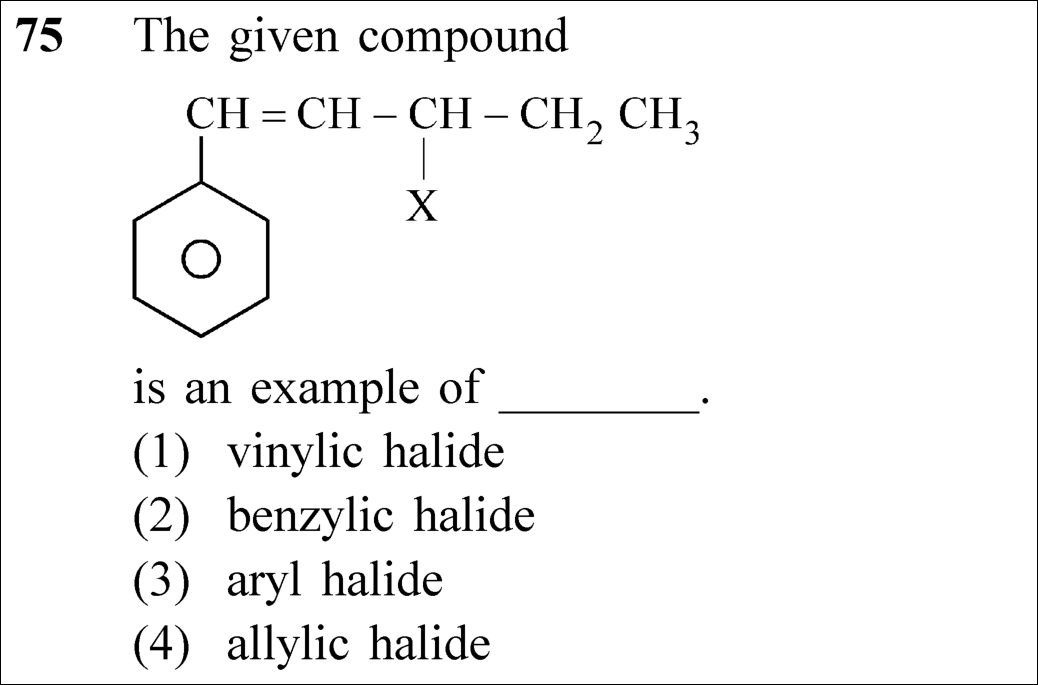
NEET 2023 Chemistry Question 75: Distinction Between Allylic Halide and Benzylic Halide

Question

The given compound C₆H₅−CH=CH−CH(X)−CH₂CH₃ is an example of ___.

✓
Verified Against NTA Final Answer Key
Option (4) : allylic halide
📚 Haloalkanes and Haloarenes Easy
📋 Given Parameters & Problem Setup
Given structure C₆H₅–CH = CH–CH(X)–CH₂CH₃
Position of halogen X Attached to sp³ carbon adjacent to aliphatic C=C double bond
⚡

The 30-Second Exam Hall Shortcut: ⚡ Carbon Neighborhood Check: Attached to C=C, NOT Benzene Ring!

⏱️ Save ~30 seconds

Halogen X is attached to an sp³ carbon that is DIRECTLY adjacent to an aliphatic C=C double bond (–CH=CH–CH(X)–) ⟹ Allylic Halide! (It is NOT benzylic because it is separated from the benzene ring by two carbons). Option (4) in 5 seconds!

1 Inspect the exact carbon holding halogen X: –CH=CH–CH(X)–CH₂CH₃.
2 The carbon bearing X is sp³-hybridized.
3 It is directly bonded to an sp²-hybridized carbon of an aliphatic double bond (–CH=CH–).
4 By definition, a halide attached to an sp³ carbon adjacent to a carbon-carbon double bond is an ALLYLIC HALIDE.
5 Why is it not benzylic? Because a benzylic halide requires X to be attached to an sp³ carbon directly bonded to an aromatic benzene ring (Ar–CH(X)–). Here, the halogen is two carbons away from the benzene ring!
6 Lock Option (4) allylic halide immediately!
🛡️
Why You Can 100% Trust This Shortcut: Organic Nomenclature · Classification of Halogen Compounds (Allylic halides are compounds in which the halogen atom is bonded to an sp³-hybridized carbon atom next to a carbon-carbon double bond).
📐

Step-by-Step Rigorous Workflow & Mathematical Proof

Step 1

IUPAC Definitions of Halide Classes

Halogen derivatives of hydrocarbons are classified into distinct structural categories based on the hybridization and environment of the carbon atom bearing the halogen:

Vinylic halide:Halogen bonded directly to an sp2 carbon of a C=C double bondAryl halide:Halogen bonded directly to an sp2 carbon of an aromatic ringBenzylic halide:Halogen bonded to an sp3 carbon attached directly to an aromatic ringAllylic halide:Halogen bonded to an sp3 carbon attached directly to a C=C double bond\begin{aligned} \text{Vinylic halide} &: \text{Halogen bonded directly to an } sp^2\text{ carbon of a } C=C \text{ double bond} \\[4pt] \text{Aryl halide} &: \text{Halogen bonded directly to an } sp^2\text{ carbon of an aromatic ring} \\[4pt] \text{Benzylic halide} &: \text{Halogen bonded to an } sp^3\text{ carbon attached directly to an aromatic ring} \\[4pt] \text{Allylic halide} &: \text{Halogen bonded to an } sp^3\text{ carbon attached directly to a } C=C \text{ double bond} \end{aligned}
Step 2

Structural Analysis of the Given Molecule

In the provided structure C₆H₅–CH=CH–CH(X)–CH₂CH₃, locate the halogen X:

Ar−CHα=CHβ−CγH(X)−CH2CH3\text{Ar}-\overset{\alpha}{\text{CH}}=\overset{\beta}{\text{CH}}-\overset{\gamma}{\text{C}}\text{H}(\text{X})-\text{CH}_2\text{CH}_3
Step 3

Evaluation of the Carbon-Halogen Environment

The halogen X is bonded to carbon C-γ, which is an sp³-hybridized carbon atom. C-γ is bonded directly to carbon C-β, which is an sp²-hybridized carbon participating in an aliphatic carbon-carbon double bond (C=C). This matches the exact definition of an allylic halide.

−CH=CH−CH(X)−  ⟹  Allylic Halide-\text{CH}=\text{CH}-\text{CH}(\text{X})- \implies \text{Allylic Halide}
Step 4

Refutation of Benzylic Character

The benzene ring (Ar) is attached to C-α, not to C-γ. Because C-γ is not directly attached to the aromatic ring, the compound CANNOT be classified as a benzylic halide.

Distance to benzene ring =2 intervening carbon atoms   ⟹  NOT benzylic\text{Distance to benzene ring } = 2\text{ intervening carbon atoms } \implies \text{NOT benzylic}
⭐

360° Option Elimination Engine Key Feature

Diagnose every choice: Know exactly why the right option works and why distractors fail.

4-Option Deep Scan
1 (1)
✗ Incorrect
Verdict & Scientific Reason:

In a vinylic halide, X must be bonded directly to an sp² double-bonded carbon (–CH=C(X)–). Here X is on an sp³ carbon.

⚠️
Student Fallacy (Why candidates pick this trap): Candidate thought any halide near a double bond is vinylic.
2 (2)
✗ Incorrect
Verdict & Scientific Reason:

In a benzylic halide, X must be on the carbon directly attached to the benzene ring (C₆H₅–CH(X)–). Here X is two carbons away.

⚠️
Student Fallacy (Why candidates pick this trap): Candidate saw the benzene ring in the drawing and reflexively chose benzylic.
3 (3)
✗ Incorrect
Verdict & Scientific Reason:

In an aryl halide, X must be directly on the benzene ring (e.g., chlorobenzene).

⚠️
Student Fallacy (Why candidates pick this trap): Candidate confused presence of an aromatic ring with direct aromatic substitution.
4 (4)
✓ 100% Correct
Verdict & Scientific Reason:

Accurate: X is attached to an sp³ carbon adjacent to an aliphatic C=C double bond.

💡
Why this is airtight: None. Candidate correctly recognized the allylic carbon position.
⚠️

NTA Trap Alert: Seeing the Benzene Ring and Blindly Choosing "Benzylic Halide" (Option 2)

The presence of the benzene ring is an intentional distractor. Students see the phenyl ring and hastily pick "benzylic halide" without checking whether the halogen-bearing carbon is actually attached to the ring. In this molecule, the halogen is attached next to the double bond, making it an ALLYLIC halide!

🛡️ How to avoid the -1 mark: Trace the direct bond: Look at the carbon attached to X. Is it attached directly to the benzene ring? NO. Is it attached to a C=C double bond? YES ⟹ Allylic!
📖

Core NEET Syllabus Standard

National Eligibility cum Entrance Test (NEET UG) · Haloalkanes and Haloarenes Standard Benchmark
Core Scientific Principle Tested:

"Allylic halides are compounds in which the halogen atom is bonded to an sp³-hybridized carbon atom adjacent to a carbon-carbon double bond (C=C)."

Syllabus Focus: Classification of Halogen Compounds
Preserved in Rationalized Curriculum Syllabus & Academic Standards ↗

Ready to attempt under real exam pressure?

Test your speed and accuracy in the authentic 200-minute timed NTA simulator.

Launch NEET 2023 CBT Test →

Spotted a mistake in this solution? Report an error (support@mycompetitiveexams.com)

⚖️ Legal & Fair Dealing Notice: Sourced from publicly released NEET 2023 question papers and NEET answer keys for private study, research, and non-commercial educational practice under Fair Dealing (Section 52(1)(a) of the Indian Copyright Act, 1957). Not affiliated with or endorsed by NTA or NMC.

Solve 4 NEET Questions a Day — One per Subject

Cover all 1,140 official NEET questions in 285 days at your own pace. Progress is saved on your device. No login needed.