NEET 2023 Physics Question 34 Solution
Question
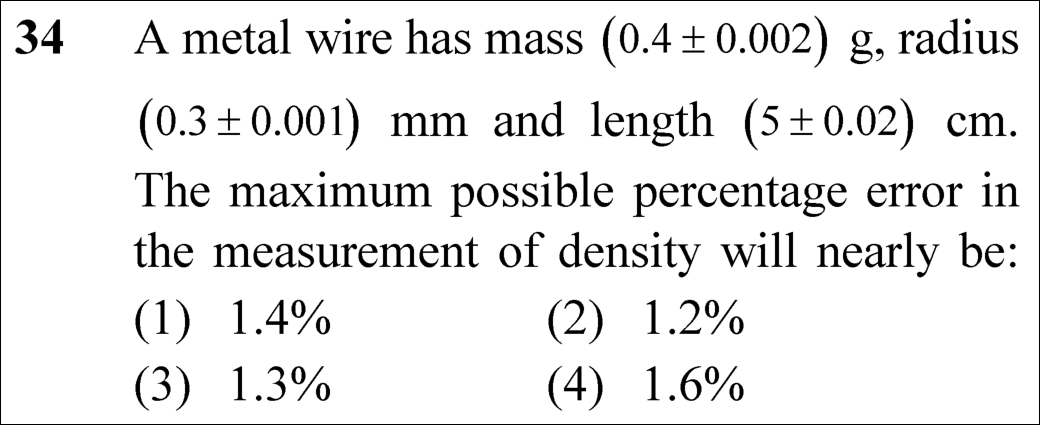
A metal wire has mass (0.4 ± 0.002) g, radius (0.3 ± 0.001) mm and length (5 ± 0.02) cm. The maximum possible percentage error in the measurement of density will nearly be:
Dynamic 180-question full-length simulator mixed dynamically from all 6 years for 2027 & 2026 aspirants.
A metal wire has mass (0.4 ± 0.002) g, radius (0.3 ± 0.001) mm and length (5 ± 0.02) cm. The maximum possible percentage error in the measurement of density will nearly be:
%Δm = (0.002/0.4)×100 = 0.5%. 2(%Δr) = 2×(0.001/0.3)×100 = 0.67%. %ΔL = (0.02/5)×100 = 0.4%. Total = 0.5 + 0.67 + 0.4 = 1.57% ≈ 1.6% in 20 seconds!
A wire is modeled as a uniform cylinder of mass m, radius r, and length L. Its volume is V = π r² L. The density ρ is defined as mass per unit volume:
Taking the natural logarithm and differentiating to obtain the maximum relative (fractional) error, where errors always add up to give the upper bound:
Convert each measurement uncertainty into percentage error (% = Δx / x × 100):
Substitute the percentage errors into the total error formula (noting the power of 2 for radius):
Diagnose every choice: Know exactly why the right option works and why distractors fail.
Underestimates error by omitting the multiplier 2 on radius.
Omitted the factor of 2 in radius error completely (0.5 + 0.33 + 0.4 = 1.23% ≈ 1.2%).
Arithmetic approximation error.
Accurate maximum percentage error: 1.567% rounds to 1.6%.
Because volume is V = π r² L, radius appears as r². The power rule states Δ(r²)/r² = 2(Δr/r). Forgetting the factor of 2 yields ~1.2% (Option 2), which is an intentional NTA trap.
"In formula X = A^a B^b / C^c, %ΔX = a(%ΔA) + b(%ΔB) + c(%ΔC)."
Test your speed and accuracy in the authentic 200-minute timed NTA simulator.
Spotted a mistake in this solution? Report an error (support@mycompetitiveexams.com)
Cover all 1,140 official NEET questions in 285 days at your own pace. Progress is saved on your device. No login needed.