MyCompetitiveExams Logo MyCompetitiveExams
Search 1,140+ Questions
Chapters, formulas, speed tricks
→
⚡ Brahmastra NEET 2027
720 MARKS

Dynamic 180-question full-length simulator mixed dynamically from all 6 years for 2027 & 2026 aspirants.

Launch Brahmastra 2027 Test →
Start Practice →
100% Free · No Login Required
Q.92 Chemistry ⭐ 360° Option Elimination Active
Vault ↗

NEET 2023 Chemistry Question 92 Solution

Topic: Aldehydes, Ketones and Carboxylic Acids · Official NTA Booklet Code G5
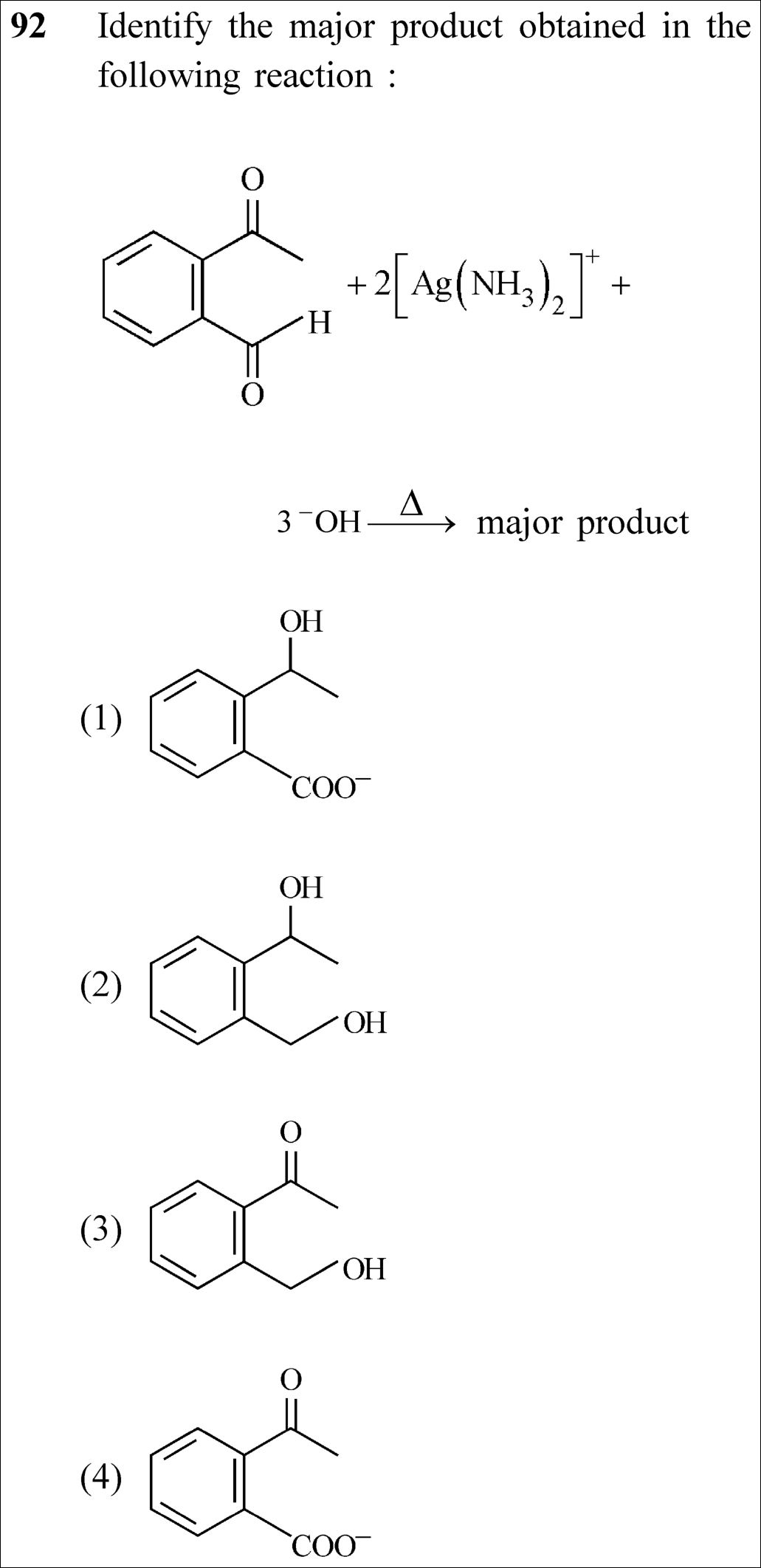
NEET 2023 Chemistry Question 92: Chemoselective Tollens Oxidation: Aldehyde vs Ketone

Question

Identify the major product obtained in the following reaction: 2-acetylbenzaldehyde + 2[Ag(NH₃)₂]⁺ + 3 ⁻OH → (Δ) major product

✓
Verified Against NTA Final Answer Key
Option (4) : Ortho-acetylbenzoate (ketone unchanged, aldehyde oxidized to -COO⁻)
📚 Aldehydes, Ketones and Carboxylic Acids Medium
📋 Given Parameters & Problem Setup
Substrate Ortho-formylacetophenone (benzene ring with ortho -COCH₃ and -CHO)
Reagent 2 [Ag(NH₃)₂]⁺ + 3 OH⁻ (Tollens’ reagent) with heat
Reaction type Mild chemoselective oxidation
⚡

The 30-Second Exam Hall Shortcut: ⚡ Chemoselective Reagent Filter: Tollens’ Oxidizes –CHO to –COO⁻, Leaves Ketone (–COCH₃) Untouched!

⏱️ Save ~35 seconds

Tollens’ reagent [Ag(NH₃)₂]⁺ is a mild, selective oxidizing agent that oxidizes aldehydes (–CHO ⟶ –COO⁻) but cannot oxidize ketones! Therefore, the –CHO group becomes –COO⁻, and the –COCH₃ group remains 100% intact. Option (4) is immediately selected in 5 seconds!

1 Identify functional groups on benzene ring: one ketone (–COCH₃) and one aldehyde (–CHO).
2 Identify reagent: [Ag(NH₃)₂]⁺ in alkaline medium is Tollens’ reagent.
3 Recall selectivity: Tollens’ reagent selectively oxidizes –CHO to carboxylate –COO⁻.
4 Ketones (aliphatic or aromatic) do NOT react with Tollens’ reagent.
5 Expected product retains –COCH₃ and has –COO⁻ (Option 4).
🛡️
Why You Can 100% Trust This Shortcut: Classical carbonyl differentiation test and mild oxidation selectivity in NCERT Organic Chemistry.
📐

Step-by-Step Rigorous Workflow & Mathematical Proof

Step 1

Identify Functional Groups of the Reactant

The reactant is 2-acetylbenzaldehyde, containing two different carbonyl functional groups on adjacent positions of a benzene ring: an aldehyde (–CHO) and a methyl ketone (–COCH₃):

Reactant: o-C6H4(COCH3)(CHO)\text{Reactant: } o\text{-}\text{C}_6\text{H}_4(\text{COCH}_3)(\text{CHO})
Step 2

Evaluate Reagent and Reaction Conditions

Ammoniacal silver nitrate solution [Ag(NH₃)₂]⁺ in the presence of base (OH⁻) is Tollens’ reagent, a classic mild oxidizing agent:

2[Ag(NH3)2]++3OH−(Tollens’ Reagent)2[\text{Ag}(\text{NH}_3)_2]^+ + 3\text{OH}^- \quad (\text{Tollens' Reagent})
Step 3

Chemoselective Oxidation Mechanism

Tollens’ reagent readily oxidizes the formyl group (–CHO) to the corresponding carboxylate anion (–COO⁻) while metallic silver is precipitated as a silver mirror:

R–CHO+2[Ag(NH3)2]++3OH−→ΔR–COO−+2Ag↓+4NH3+2H2O\text{R–CHO} + 2[\text{Ag}(\text{NH}_3)_2]^+ + 3\text{OH}^- \xrightarrow{\Delta} \text{R–COO}^- + 2\text{Ag}\downarrow + 4\text{NH}_3 + 2\text{H}_2\text{O}
Step 4

Inertness of the Ketone Carbonyl Group

Under these mild basic oxidizing conditions, ketones do not have an oxidizable hydrogen atom on the carbonyl carbon and remain completely unreacted. The –COCH₃ group persists unchanged in the product:

Product: o-C6H4(COCH3)(COO−)(Matching Option 4)\text{Product: } o\text{-}\text{C}_6\text{H}_4(\text{COCH}_3)(\text{COO}^-) \quad (\text{Matching Option 4})
⭐

360° Option Elimination Engine Key Feature

Diagnose every choice: Know exactly why the right option works and why distractors fail.

4-Option Deep Scan
1 (1)
✗ Incorrect
Verdict & Scientific Reason:

The ketone is not reduced under Tollens’ oxidation conditions.

⚠️
Student Fallacy (Why candidates pick this trap): Candidate incorrectly assumed Tollens’ reagent reduces ketones to alcohols.
2 (2)
✗ Incorrect
Verdict & Scientific Reason:

Neither group undergoes reduction; Tollens’ is an oxidizing agent, not a reducing hydride.

⚠️
Student Fallacy (Why candidates pick this trap): Candidate confused Tollens’ reagent with LiAlH₄ reduction.
3 (3)
✗ Incorrect
Verdict & Scientific Reason:

Aldehyde is oxidized to carboxylate, not reduced to primary alcohol.

⚠️
Student Fallacy (Why candidates pick this trap): Candidate treated the aldehyde as being reduced to alcohol.
4 (4)
✓ 100% Correct
Verdict & Scientific Reason:

Accurate: Chemoselective oxidation of aldehyde to carboxylate while ketone remains completely intact.

💡
Why this is airtight: None. Candidate correctly recognized the chemoselectivity of Tollens’ reagent.
⚠️

NTA Trap Alert: Confusing Redox Reagents (Oxidation vs Reduction)

Some students see [Ag(NH₃)₂]⁺ and confuse it with complex metal hydrides (NaBH₄ or LiAlH₄), mistakenly drawing reduced alcohol groups. Tollens’ is an OXIDIZING agent that converts –CHO to –COO⁻.

🛡️ How to avoid the -1 mark: Remember: Tollens’ reagent oxidizes aldehydes to carboxylate; it never reduces carbonyl groups!
📖

Core NEET Syllabus Standard

National Eligibility cum Entrance Test (NEET UG) · Aldehydes, Ketones and Carboxylic Acids Standard Benchmark
Core Scientific Principle Tested:

"Tollens’ reagent selectively oxidizes aldehydes to carboxylate anions without affecting ketonic carbonyls."

Syllabus Focus: Oxidation of Aldehydes and Ketones – Tollens’ Test
Preserved in Rationalized Curriculum Syllabus & Academic Standards ↗

Ready to attempt under real exam pressure?

Test your speed and accuracy in the authentic 200-minute timed NTA simulator.

Launch NEET 2023 CBT Test →

Spotted a mistake in this solution? Report an error (support@mycompetitiveexams.com)

⚖️ Legal & Fair Dealing Notice: Sourced from publicly released NEET 2023 question papers and NEET answer keys for private study, research, and non-commercial educational practice under Fair Dealing (Section 52(1)(a) of the Indian Copyright Act, 1957). Not affiliated with or endorsed by NTA or NMC.

Solve 4 NEET Questions a Day — One per Subject

Cover all 1,140 official NEET questions in 285 days at your own pace. Progress is saved on your device. No login needed.