MyCompetitiveExams Logo MyCompetitiveExams
Search 1,140+ Questions
Chapters, formulas, speed tricks
→
⚡ Brahmastra NEET 2027
720 MARKS

Dynamic 180-question full-length simulator mixed dynamically from all 6 years for 2027 & 2026 aspirants.

Launch Brahmastra 2027 Test →
Start Practice →
100% Free · No Login Required
Q.22 Physics ⭐ 360° Option Elimination Active
Vault ↗

NEET 2023 Physics Question 22 Solution

Topic: Dual Nature of Radiation and Matter · Official NTA Booklet Code G5
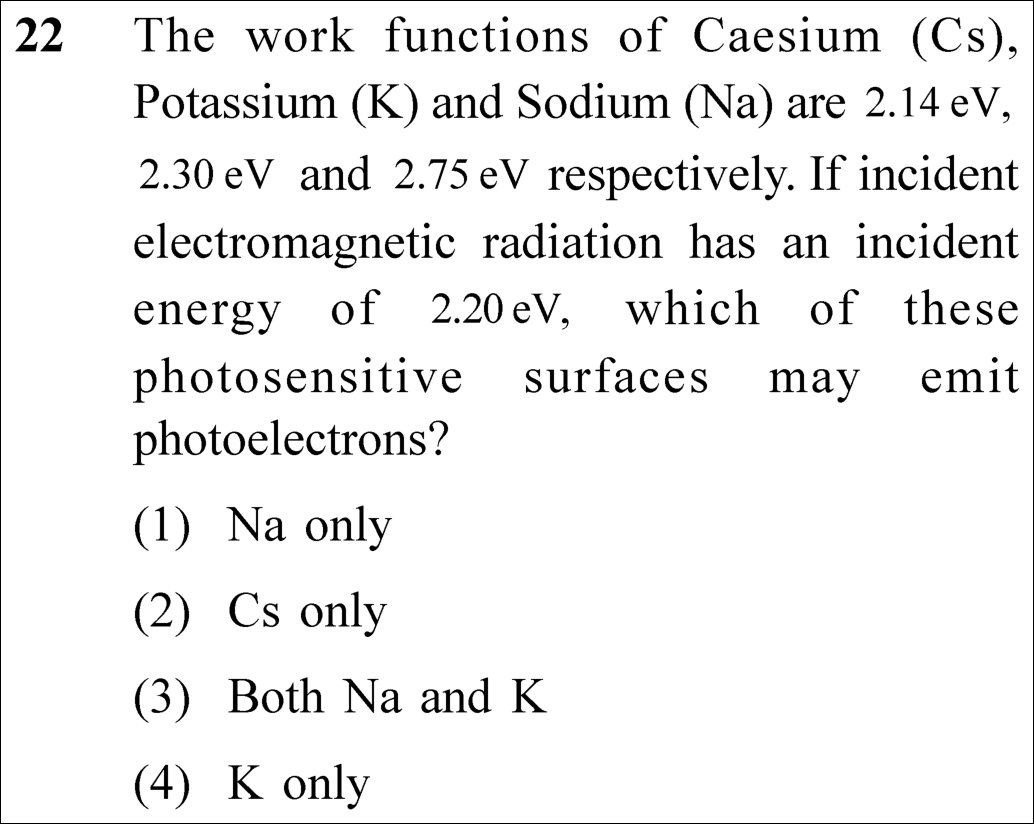
NEET 2023 Physics Question 22: Photoelectric Emission Criterion (Photon Energy vs Work Function)

Question

The work functions of Caesium (Cs), Potassium (K) and Sodium (Na) are 2.14 eV, 2.30 eV and 2.75 eV respectively. If incident electromagnetic radiation has an incident energy of 2.20 eV, which of these photosensitive surfaces may emit photoelectrons?

✓
Verified Against NTA Final Answer Key
Option (2) : Cs only
📚 Dual Nature of Radiation and Matter Easy
📋 Given Parameters & Problem Setup
Work Function of Caesium (Cs) Φ_Cs = 2.14 eV
Work Function of Potassium (K) Φ_K = 2.30 eV
Work Function of Sodium (Na) Φ_Na = 2.75 eV
Incident Photon Energy (E) 2.20 eV
⚡

The 30-Second Exam Hall Shortcut: ⚡ Einstein Photoelectric Condition Filter (E ≥ Φ₀)

⏱️ Save ~30 seconds

Photoemission occurs ONLY if photon energy E ≥ work function Φ₀! 2.20 eV is greater only than 2.14 eV (Cs), so Cs only in 5 seconds!

1 Recall Einstein's photoelectric criterion: Photoelectrons are emitted if and only if incident energy E ≥ Φ₀.
2 Compare incident photon energy E = 2.20 eV with each metal:
3 • For Cs (2.14 eV): 2.20 eV > 2.14 eV → EMISSION OCCURS!
4 • For K (2.30 eV): 2.20 eV < 2.30 eV → NO emission.
5 • For Na (2.75 eV): 2.20 eV < 2.75 eV → NO emission.
6 Only Caesium has work function lower than 2.20 eV.
7 Pick Option (2) Cs only!
🛡️
Why You Can 100% Trust This Shortcut: Fundamental Quantum Physics · Einstein Photoelectric Equation (Emission threshold: K_max = hν - Φ₀ ≥ 0 → hν ≥ Φ₀).
📐

Step-by-Step Rigorous Workflow & Mathematical Proof

Step 1

Einstein's Photoelectric Equation and Emission Threshold

According to Einstein's quantum theory of the photoelectric effect, an incident photon transfers its entire energy E = hν to a single conduction electron. Photoelectric emission can occur only if this energy exceeds the minimum energy required to liberate the electron from the metal surface (the work function Φ₀):

Kmax=E−Φ0≥0  ⟹  E≥Φ0K_{\text{max}} = E - \Phi_0 \ge 0 \implies E \ge \Phi_0
Step 2

Step-by-Step Metal Threshold Comparison

Compare the incident radiation energy E = 2.20 eV with the work functions of all three photosensitive alkali metals:

Caesium (Cs): E=2.20 eV>2.14 eV=ΦCs  ⟹  Photoelectrons emittedPotassium (K): E=2.20 eV<2.30 eV=ΦK  ⟹  No emissionSodium (Na): E=2.20 eV<2.75 eV=ΦNa  ⟹  No emission\begin{aligned} \text{Caesium (Cs): } & E = 2.20\text{ eV} > 2.14\text{ eV} = \Phi_{\text{Cs}} \implies \text{Photoelectrons emitted} \\ \text{Potassium (K): } & E = 2.20\text{ eV} < 2.30\text{ eV} = \Phi_{\text{K}} \implies \text{No emission} \\ \text{Sodium (Na): } & E = 2.20\text{ eV} < 2.75\text{ eV} = \Phi_{\text{Na}} \implies \text{No emission} \end{aligned}
Step 3

Conclusion

Only Caesium satisfies the condition E ≥ Φ₀, meaning photoelectrons are emitted from the Caesium surface only.

⭐

360° Option Elimination Engine Key Feature

Diagnose every choice: Know exactly why the right option works and why distractors fail.

4-Option Deep Scan
1 (1)
✗ Incorrect
Verdict & Scientific Reason:

Sodium has the highest work function (2.75 eV), requiring photons of at least 2.75 eV.

⚠️
Student Fallacy (Why candidates pick this trap): Candidate inverted the inequality (thought higher work function emits more easily).
2 (2)
✓ 100% Correct
Verdict & Scientific Reason:

Accurate deduction: only Caesium possesses a work function (2.14 eV) lower than the incident energy (2.20 eV).

💡
Why this is airtight: None. Candidate correctly checked E ≥ Φ₀.
3 (3)
✗ Incorrect
Verdict & Scientific Reason:

Both metals have work functions exceeding 2.20 eV.

⚠️
Student Fallacy (Why candidates pick this trap): Candidate incorrectly assumed emission occurs when work function is greater than photon energy.
4 (4)
✗ Incorrect
Verdict & Scientific Reason:

Potassium requires 2.30 eV; incident photons have only 2.20 eV.

⚠️
Student Fallacy (Why candidates pick this trap): Candidate misread 2.30 as 2.03 eV.
⚠️

NTA Trap Alert: Inverting the Work Function Threshold Condition

A student who mistakenly believes "the metal with the largest work function emits photoelectrons" will pick Na. In reality, lower work function means electrons are held less tightly and escape more easily.

🛡️ How to avoid the -1 mark: Condition: Photon energy E must be GREATER than work function Φ₀.
📖

Core NEET Syllabus Standard

National Eligibility cum Entrance Test (NEET UG) · Dual Nature of Radiation and Matter Standard Benchmark
Core Scientific Principle Tested:

"Photoelectric emission is an all-or-nothing instantaneous threshold phenomenon occurring strictly when E ≥ Φ₀."

Syllabus Focus: Einstein's Photoelectric Equation and Work Function
Preserved in Rationalized Curriculum Syllabus & Academic Standards ↗

Ready to attempt under real exam pressure?

Test your speed and accuracy in the authentic 200-minute timed NTA simulator.

Launch NEET 2023 CBT Test →

Spotted a mistake in this solution? Report an error (support@mycompetitiveexams.com)

⚖️ Legal & Fair Dealing Notice: Sourced from publicly released NEET 2023 question papers and NEET answer keys for private study, research, and non-commercial educational practice under Fair Dealing (Section 52(1)(a) of the Indian Copyright Act, 1957). Not affiliated with or endorsed by NTA or NMC.

Solve 4 NEET Questions a Day — One per Subject

Cover all 1,140 official NEET questions in 285 days at your own pace. Progress is saved on your device. No login needed.