MyCompetitiveExams Logo MyCompetitiveExams
Search 1,140+ Questions
Chapters, formulas, speed tricks
→
⚡ Brahmastra NEET 2027
720 MARKS

Dynamic 180-question full-length simulator mixed dynamically from all 6 years for 2027 & 2026 aspirants.

Launch Brahmastra 2027 Test →
Start Practice →
100% Free · No Login Required
Q.162 Zoology ⭐ 360° Option Elimination Active
Vault ↗

NEET 2023 Zoology Question 162 Solution

Topic: Human Reproduction · Official NTA Booklet Code G5
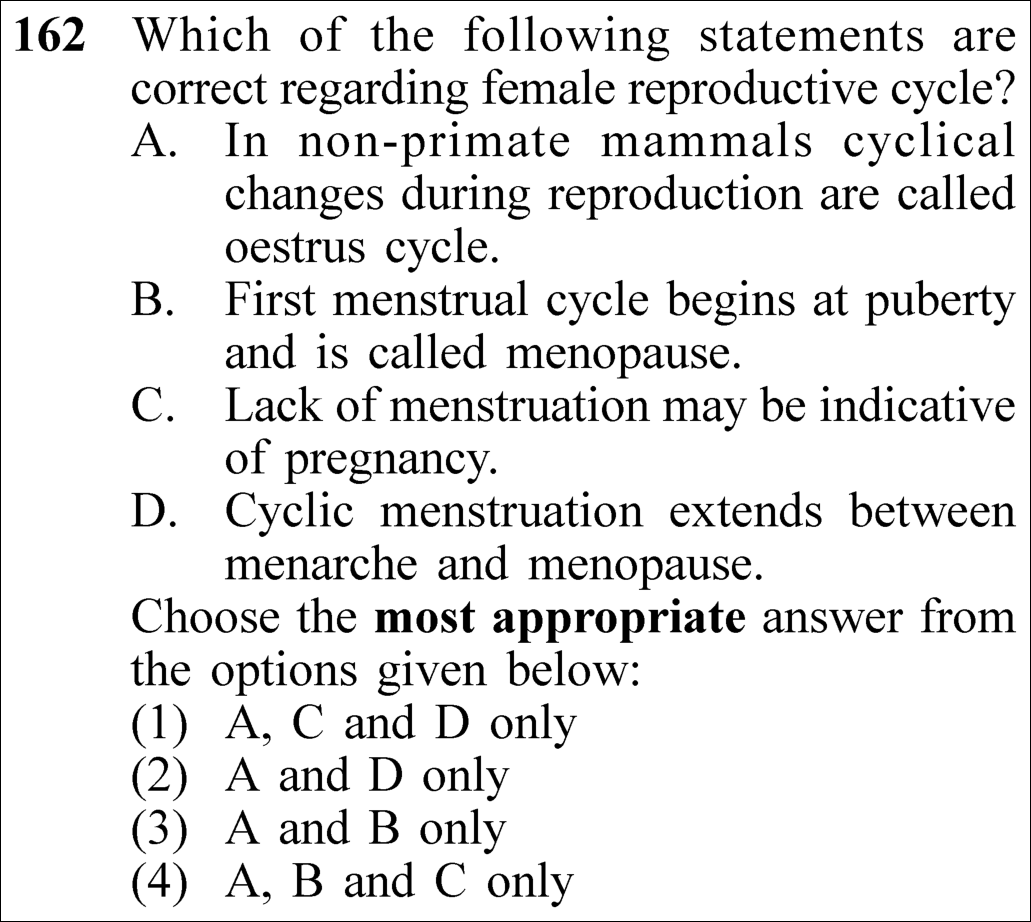
NEET 2023 Zoology Question 162: Female Reproductive Cycles: Menstrual Cycle vs. Oestrus Cycle

Question

Which of the following statements are correct regarding female reproductive cycle? A. In non-primate mammals cyclical changes during reproduction are called oestrus cycle. B. First menstrual cycle begins at puberty and is called menopause. C. Lack of menstruation may be indicative of pregnancy. D. Cyclic menstruation extends between menarche and menopause. Choose the most appropriate answer from the options given below:

  1. (1)A, C and D only
  2. (2)A and D only
  3. (3)A and B only
  4. (4)A, B and C only
✓
Verified Against NTA Final Answer Key
Option (1) : A, C and D only
📚 Human Reproduction Easy
📋 Given Parameters & Problem Setup
Statements 4 statements (A-D) on oestrus cycle, menarche, menopause, and menstruation
⚡

The 30-Second Exam Hall Shortcut: ⚡ Menopause vs. Menarche Error Spotter: B is False!

⏱️ Save ~25 seconds

Spot the single false statement: The first menstrual cycle at puberty is called MENARCHE, NOT menopause (menopause is the permanent cessation around 50 years of age). Thus Statement B is completely false, leaving A, C, and D only! Select Option (1)!

1 Statement A: In non-primates cyclical reproductive changes are called oestrus cycle -> True.
2 Statement B: First menstrual cycle at puberty is called menopause -> False (It is called menarche).
3 Statement C: Lack of menstruation may be indicative of pregnancy -> True.
4 Statement D: Cyclic menstruation extends between menarche and menopause -> True.
5 Since only B is false, A, C and D only are correct -> Option (1).
🛡️
Why You Can 100% Trust This Shortcut: Canonical NCERT Human Reproduction ovarian and uterine cycle definitions.
📐

Step-by-Step Rigorous Workflow & Mathematical Proof

Step 1

Evaluation of Statement A (Oestrus Cycle)

Cyclical reproductive changes in placental mammals are categorized into two major patterns based on taxonomic orders: - In non-primate mammals (cows, sheep, rats, deers, dogs, tiger): oestrus cycle. - In primates (monkeys, apes, humans): menstrual cycle. Statement A is TRUE.

Non-primate Mammalian Cycle≡Oestrus Cycle  ⟹  Statement A is TRUE\text{Non-primate Mammalian Cycle} \equiv \text{\textbf{Oestrus Cycle}} \implies \text{Statement A is } \mathbf{\text{TRUE}}
Step 2

Evaluation of Statement B (Menarche vs. Menopause)

The onset of menstruation at puberty in human females is termed menarche, whereas the permanent cessation of reproductive cycling around age 50 is termed menopause: Statement B claims the first menstrual cycle is called menopause, which is blatantly FALSE.

Onset at Puberty=Menarche≠Menopause (Cessation)  ⟹  Statement B is FALSE\text{Onset at Puberty} = \mathbf{\text{Menarche}} \quad \neq \quad \text{Menopause (Cessation)} \implies \text{Statement B is } \mathbf{\text{FALSE}}
Step 3

Evaluation of Statements C and D (Menstrual Regularity and Span)

NCERT states verbatim: - "Lack of menstruation may be indicative of pregnancy." (Statement C is TRUE) - "Cyclic menstruation is an indicator of normal reproductive phase and extends between menarche and menopause." (Statement D is TRUE) Therefore, Statements A, C, and D are correct.

⭐

360° Option Elimination Engine Key Feature

Diagnose every choice: Know exactly why the right option works and why distractors fail.

4-Option Deep Scan
1 1
✓ 100% Correct
Verdict & Scientific Reason:

Statements A, C, and D are fully verified textbook facts, while Statement B contains the erroneous substitution of menopause for menarche.

💡
Why this is airtight: None; textbook verbatim precision.
2 2
✗ Incorrect
Verdict & Scientific Reason:

Omits valid statement C (lack of menstruation is a classic presumptive sign of pregnancy).

⚠️
Student Fallacy (Why candidates pick this trap): Thinking lack of menstruation cannot be cited due to stress/poor health exceptions.
3 3
✗ Incorrect
Verdict & Scientific Reason:

Includes false statement B.

⚠️
Student Fallacy (Why candidates pick this trap): Confusing menarche with menopause.
4 4
✗ Incorrect
Verdict & Scientific Reason:

Includes false statement B and excludes valid statement D.

⚠️
Student Fallacy (Why candidates pick this trap): Overlooking the definition error in B.
⚠️

NTA Trap Alert: Menarche vs. Menopause Vocabulary Trap

Menarche is the beginning (puberty), while Menopause is the end (pause of menstruation). Fast readers glance at the prefix "Meno-" and assume Statement B is valid.

🛡️ How to avoid the -1 mark: Remember: "Arche" = Beginning (Menarche at puberty). "Pause" = Stop (Menopause at ~50 yrs).
📖

Core NEET Syllabus Standard

NCERT Biology · Human Reproduction Standard Benchmark
Core Scientific Principle Tested:

"The first menstruation begins at puberty and is called menarche. Menstrual cycles cease around 50 years of age, termed menopause. Cyclic menstruation extends between menarche and menopause."

Syllabus Focus: Menstrual Cycle
✓ Core NEET UG Syllabus Anchor Syllabus & Academic Standards ↗

Ready to attempt under real exam pressure?

Test your speed and accuracy in the authentic 200-minute timed NTA simulator.

Launch NEET 2023 CBT Test →

Spotted a mistake in this solution? Report an error (support@mycompetitiveexams.com)

⚖️ Legal & Fair Dealing Notice: Sourced from publicly released NEET 2023 question papers and NEET answer keys for private study, research, and non-commercial educational practice under Fair Dealing (Section 52(1)(a) of the Indian Copyright Act, 1957). Not affiliated with or endorsed by NTA or NMC.

Solve 4 NEET Questions a Day — One per Subject

Cover all 1,140 official NEET questions in 285 days at your own pace. Progress is saved on your device. No login needed.