MyCompetitiveExams Logo MyCompetitiveExams
Search 1,140+ Questions
Chapters, formulas, speed tricks
→
⚡ Brahmastra NEET 2027
720 MARKS

Dynamic 180-question full-length simulator mixed dynamically from all 6 years for 2027 & 2026 aspirants.

Launch Brahmastra 2027 Test →
Start Practice →
100% Free · No Login Required
Q.26 Physics ⭐ 360° Option Elimination Active
Vault ↗

NEET 2023 Physics Question 26 Solution

Topic: Electric Charges and Fields · Official NTA Booklet Code G5
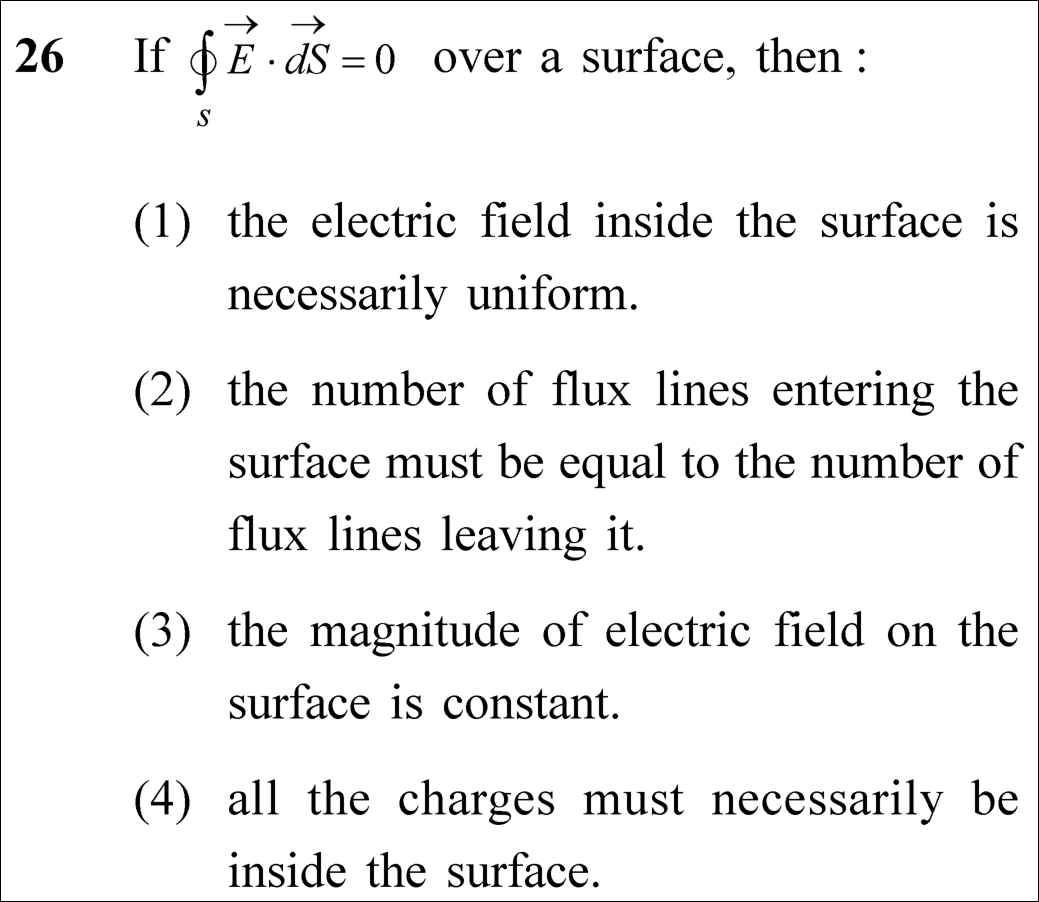
NEET 2023 Physics Question 26: Flux Balance and Determination of Enclosed Charge

Question

If ∮ E · dS = 0 over a surface, then:

✓
Verified Against NTA Final Answer Key
Option (2) : the net charge within the surface is zero
📚 Electric Charges and Fields Easy
📋 Given Parameters & Problem Setup
Surface condition Closed surface in vacuum
Electric field lines entering Equal to electric field lines leaving
Net electric flux (Φ_net) 0
⚡

The 30-Second Exam Hall Shortcut: ⚡ Gauss’s Law Net Flux Principle: Φ_net = q_enc / ε₀

⏱️ Save ~45 seconds

Number of lines entering = Number of lines leaving ⟹ Net flux Φ_net = 0 ⟹ Net enclosed charge q_enc = 0 in 5 seconds!

1 Electric flux represents the net count of electric field lines crossing a closed surface.
2 Lines entering count as negative flux; lines exiting count as positive flux.
3 If entering lines equal exiting lines, net electric flux Φ_net = 0.
4 By Gauss’s Law, Φ_net = q_enc / ε₀.
5 Since Φ_net = 0, the net enclosed charge q_enc must be identically zero.
6 Directly select Option (2)!
🛡️
Why You Can 100% Trust This Shortcut: Fundamental Electrostatics · Gauss’s Law (Net flux through any closed Gaussian surface equals net enclosed charge divided by permittivity of free space).
📐

Step-by-Step Rigorous Workflow & Mathematical Proof

Step 1

Definition of Electric Flux in Terms of Field Lines

The electric flux Φ through a closed Gaussian surface S is geometrically defined as the net count of electric field lines penetrating the surface. Inward-directed lines contribute negative flux, while outward-directed lines contribute positive flux:

Φnet=Φout−Φin\Phi_{\text{net}} = \Phi_{\text{out}} - \Phi_{\text{in}}
Step 2

Application of Given Equal-Line Condition

The problem states that the number of field lines entering the closed surface equals the number of field lines leaving it. Therefore:

Φin=Φout  ⟹  Φnet=0\Phi_{\text{in}} = \Phi_{\text{out}} \implies \Phi_{\text{net}} = 0
Step 3

Application of Gauss’s Law

According to Gauss’s Law of electrostatics, the net electric flux through any closed Gaussian surface in vacuum is directly proportional to the total net charge q_enc enclosed within the surface:

Φnet=∮SE⃗⋅dA⃗=qencε0\Phi_{\text{net}} = \oint_S \vec{E} \cdot d\vec{A} = \frac{q_{\text{enc}}}{\varepsilon_0}
Step 4

Conclusion on Enclosed Charge

Equating the net flux to zero yields:

qencε0=0  ⟹  qenc=0\frac{q_{\text{enc}}}{\varepsilon_0} = 0 \implies q_{\text{enc}} = 0
⭐

360° Option Elimination Engine Key Feature

Diagnose every choice: Know exactly why the right option works and why distractors fail.

4-Option Deep Scan
1 (1)
✗ Incorrect
Verdict & Scientific Reason:

Uniform electric field is neither necessary nor implied; non-uniform external fields also produce zero net flux.

⚠️
Student Fallacy (Why candidates pick this trap): Candidate confused zero divergence/net flux with spatial uniformity of the field.
2 (2)
✓ 100% Correct
Verdict & Scientific Reason:

Accurate deduction from Gauss’s Law: zero net flux guarantees zero net enclosed charge.

💡
Why this is airtight: None. Candidate correctly applied Gauss’s Law.
3 (3)
✗ Incorrect
Verdict & Scientific Reason:

External charges can exist freely; all field lines from external charges that enter the surface must also exit.

⚠️
Student Fallacy (Why candidates pick this trap): Candidate forgot that external charges produce equal entering and leaving flux lines.
4 (4)
✗ Incorrect
Verdict & Scientific Reason:

Completely unphysical and baseless claim.

⚠️
Student Fallacy (Why candidates pick this trap): Wild guess with no physical basis.
⚠️

NTA Trap Alert: Confusing "Net Charge Zero" with "Zero Electric Field"

Zero net flux (Φ = 0) means the algebraic SUM of enclosed charges is zero (e.g., an electric dipole inside has q_net = 0). It does NOT mean the electric field E is zero everywhere on the surface, nor does it mean no field lines exist.

🛡️ How to avoid the -1 mark: Remember: Gauss’s Law links NET FLUX to NET ENCLOSED CHARGE: Φ = ∮ E · dA = q_net / ε₀.
📖

Core NEET Syllabus Standard

National Eligibility cum Entrance Test (NEET UG) · Electric Charges and Fields Standard Benchmark
Core Scientific Principle Tested:

"The total electric flux through a closed surface is equal to 1/ε₀ times the total charge enclosed within the surface."

Syllabus Focus: Gauss’s Law and Surface Flux
Preserved in Rationalized Curriculum Syllabus & Academic Standards ↗

Ready to attempt under real exam pressure?

Test your speed and accuracy in the authentic 200-minute timed NTA simulator.

Launch NEET 2023 CBT Test →

Spotted a mistake in this solution? Report an error (support@mycompetitiveexams.com)

⚖️ Legal & Fair Dealing Notice: Sourced from publicly released NEET 2023 question papers and NEET answer keys for private study, research, and non-commercial educational practice under Fair Dealing (Section 52(1)(a) of the Indian Copyright Act, 1957). Not affiliated with or endorsed by NTA or NMC.

Solve 4 NEET Questions a Day — One per Subject

Cover all 1,140 official NEET questions in 285 days at your own pace. Progress is saved on your device. No login needed.