NEET 2023 Physics Question 7 Solution
Question
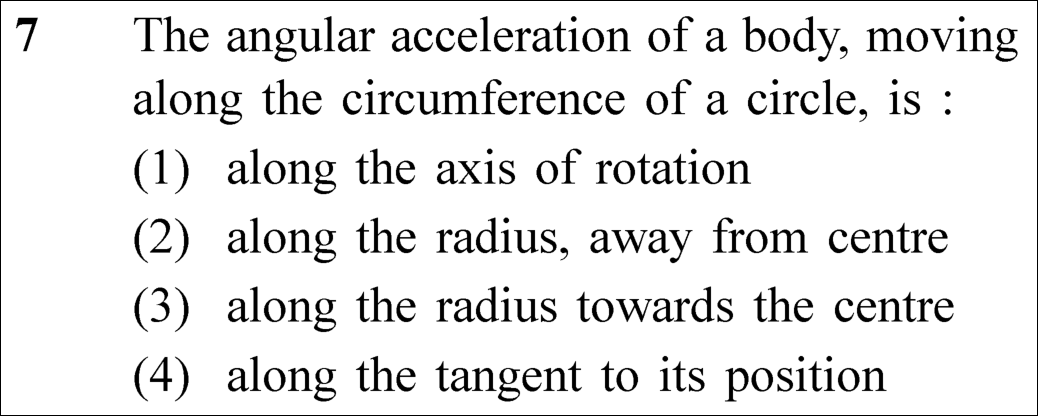
The angular acceleration of a body, moving along the circumference of a circle, is:
Dynamic 180-question full-length simulator mixed dynamically from all 6 years for 2027 & 2026 aspirants.
The angular acceleration of a body, moving along the circumference of a circle, is:
Angular velocity, angular momentum, and angular acceleration are AXIAL vectors — they ALWAYS point along the axis of rotation!
Angular acceleration α⃗ is defined as the time rate of change of angular velocity ω⃗:
Angular velocity ω⃗ is an axial vector perpendicular to the orbital plane of rotation, pointing along the axis of rotation by the right-hand screw rule. Since α⃗ is the derivative of ω⃗ with respect to scalar time t, it must be parallel (if speeding up) or antiparallel (if slowing down) to ω⃗:
In circular motion, the linear acceleration consists of centripetal acceleration (radially inwards) and tangential acceleration (tangent to the circle), whereas angular acceleration governs rotational rate and is purely axial:
Diagnose every choice: Know exactly why the right option works and why distractors fail.
Angular acceleration is by definition an axial vector directed along the axis of rotation.
Describes centrifugal tendency in a rotating frame, not angular acceleration.
Describes centripetal (radial) acceleration a_c, which is a linear acceleration.
Describes tangential acceleration a_t = α r, which is linear, not angular.
Many candidates see "acceleration" and "circle" and instantly jump to "towards the centre" (Option 3) or "along the tangent" (Option 4). They overlook the crucial word "ANGULAR".
"Angular variables (θ, ω, α) are axial vectors directed along the axis of rotation per the right-hand screw rule."
Test your speed and accuracy in the authentic 200-minute timed NTA simulator.
Spotted a mistake in this solution? Report an error (support@mycompetitiveexams.com)
Cover all 1,140 official NEET questions in 285 days at your own pace. Progress is saved on your device. No login needed.