NEET 2023 Physics Question 16 Solution
Question
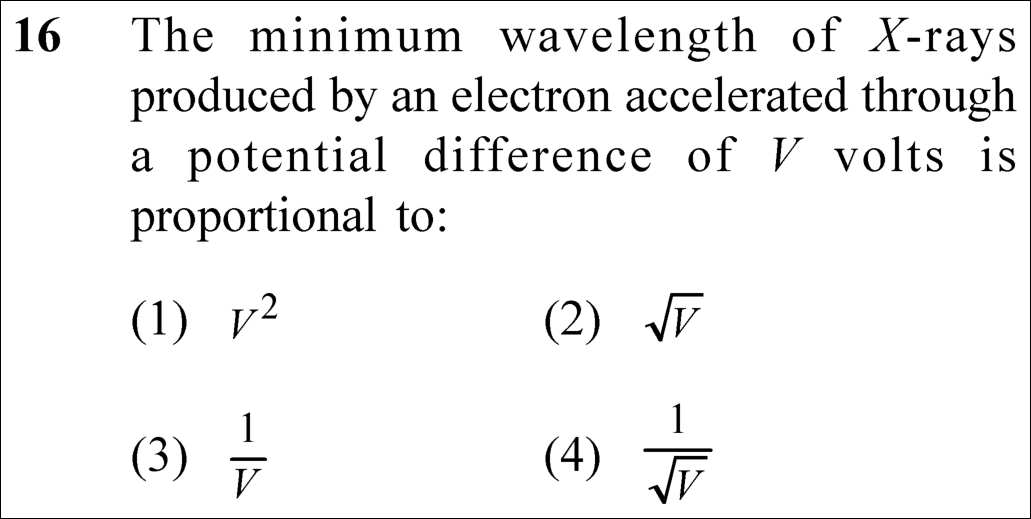
The minimum wavelength of X-rays produced by an electron accelerated through a potential difference of V volts is proportional to:
Dynamic 180-question full-length simulator mixed dynamically from all 6 years for 2027 & 2026 aspirants.
The minimum wavelength of X-rays produced by an electron accelerated through a potential difference of V volts is proportional to:
Maximum photon energy equals kinetic energy of electron: hc/λ_min = eV → λ_min = hc/(eV) ∝ 1/V in 5 seconds!
An electron of charge e accelerated from rest through potential difference V acquires kinetic energy:
In continuous X-ray production (Bremsstrahlung), the minimum wavelength λ_min corresponds to the maximum photon energy, occurring when the entire kinetic energy of the electron is transferred to a single photon in a single collision:
Solve for λ_min in terms of potential difference V:
Diagnose every choice: Know exactly why the right option works and why distractors fail.
Quadratic dependence is physically baseless.
Direct square-root dependence is incorrect.
Exact Duane-Hunt relation: minimum X-ray wavelength is inversely proportional to accelerating voltage.
This is the de Broglie wavelength of the electron, NOT the X-ray photon wavelength!
NTA intentionally includes 1/√V (Option 4) as a major trap. Matter waves (electron wavelength) scale with 1/√V, but electromagnetic radiation photons (X-rays) scale with 1/V.
"Cutoff X-ray wavelength represents the maximum single-photon quantum energy: hc/λ_min = eV."
Test your speed and accuracy in the authentic 200-minute timed NTA simulator.
Spotted a mistake in this solution? Report an error (support@mycompetitiveexams.com)
Cover all 1,140 official NEET questions in 285 days at your own pace. Progress is saved on your device. No login needed.