Q.88 Chemistry ⭐ 360° Option Elimination Active
NEET 2023 Chemistry Question 88 Solution
Topic: Coordination Compounds · Official NTA Booklet Code G5
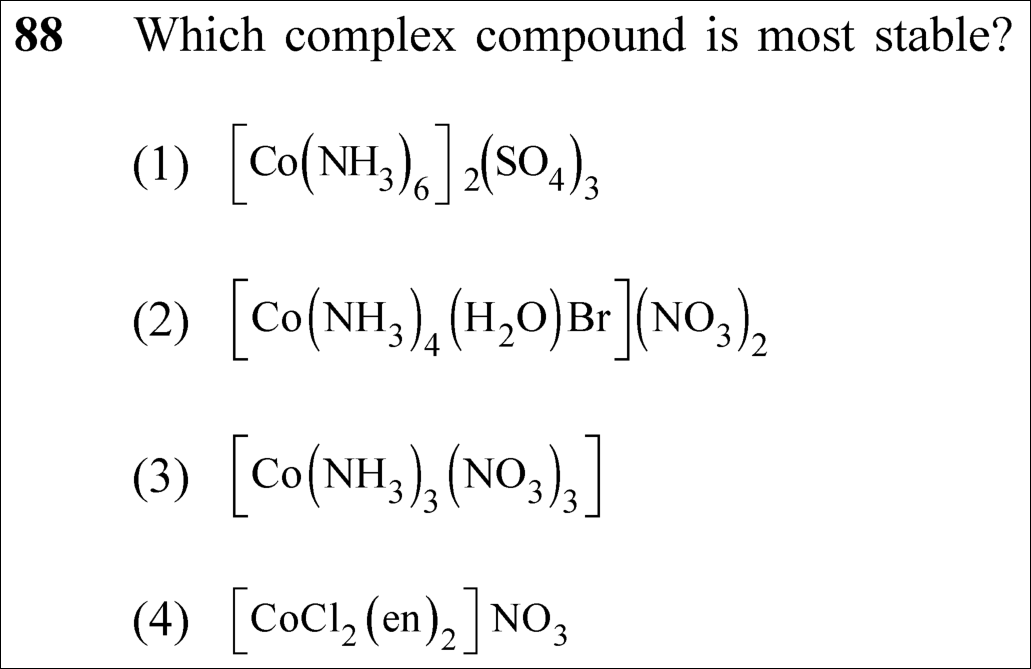
Question
Which complex compound is most stable?
 MyCompetitiveExams
Dynamic 180-question full-length simulator mixed dynamically from all 6 years for 2027 & 2026 aspirants.
Which complex compound is most stable?
Chelate complexes containing multidentate ring-forming ligands are far more stable than non-chelated complexes containing only monodentate ligands. Ethylenediamine (en) is a bidentate chelating ligand forming stable 5-membered rings. Among all four choices, ONLY Option (4) contains chelating ligands!
When a multidentate (polydentate) ligand binds to a central metal ion to form a ring structure, the resulting complex possesses significantly higher thermodynamic stability than an analogous complex containing only unidentate ligands. This phenomenon is known as the chelate effect:
Examine each coordination sphere: [Co(NH₃)₆]³⁺, [Co(NH₃)₄(H₂O)Br]²⁺, and [Co(NH₃)₃(NO₃)₃] contain only unidentate ligands. [CoCl₂(en)₂]⁺ contains two bidentate chelating ethylenediamine ligands:
Chelate formation is thermodynamically favored primarily due to a positive entropy change (ΔS° > 0). Displacement of multiple monodentate solvent molecules by a chelating ligand increases disorder:
Diagnose every choice: Know exactly why the right option works and why distractors fail.
Contains only monodentate NH₃ ligands with no chelate rings.
Contains weak and monodentate ligands (H₂O, Br⁻) with no chelation.
Neutral complex without chelate rings, possessing significantly lower formation constant.
Accurate: Contains two bidentate chelating ethylenediamine ligands forming stable 5-membered rings.
Students often try to compare ligand field strengths in the spectrochemical series (e.g., NH₃ vs Cl⁻). However, thermodynamic stability of a coordination complex is overwhelmingly governed by the chelate effect: a complex with chelate rings is vastly more stable than non-chelated complexes even if individual donor atoms are comparable.
"Polydentate ligands form stable ring structures with metal ions, dramatically enhancing the formation constant (chelate effect)."
Test your speed and accuracy in the authentic 200-minute timed NTA simulator.
Spotted a mistake in this solution? Report an error (support@mycompetitiveexams.com)
Cover all 1,140 official NEET questions in 285 days at your own pace. Progress is saved on your device. No login needed.