Q.96 Chemistry ⭐ 360° Option Elimination Active
NEET 2023 Chemistry Question 96 Solution
Topic: Alcohols, Phenols and Ethers · Official NTA Booklet Code G5
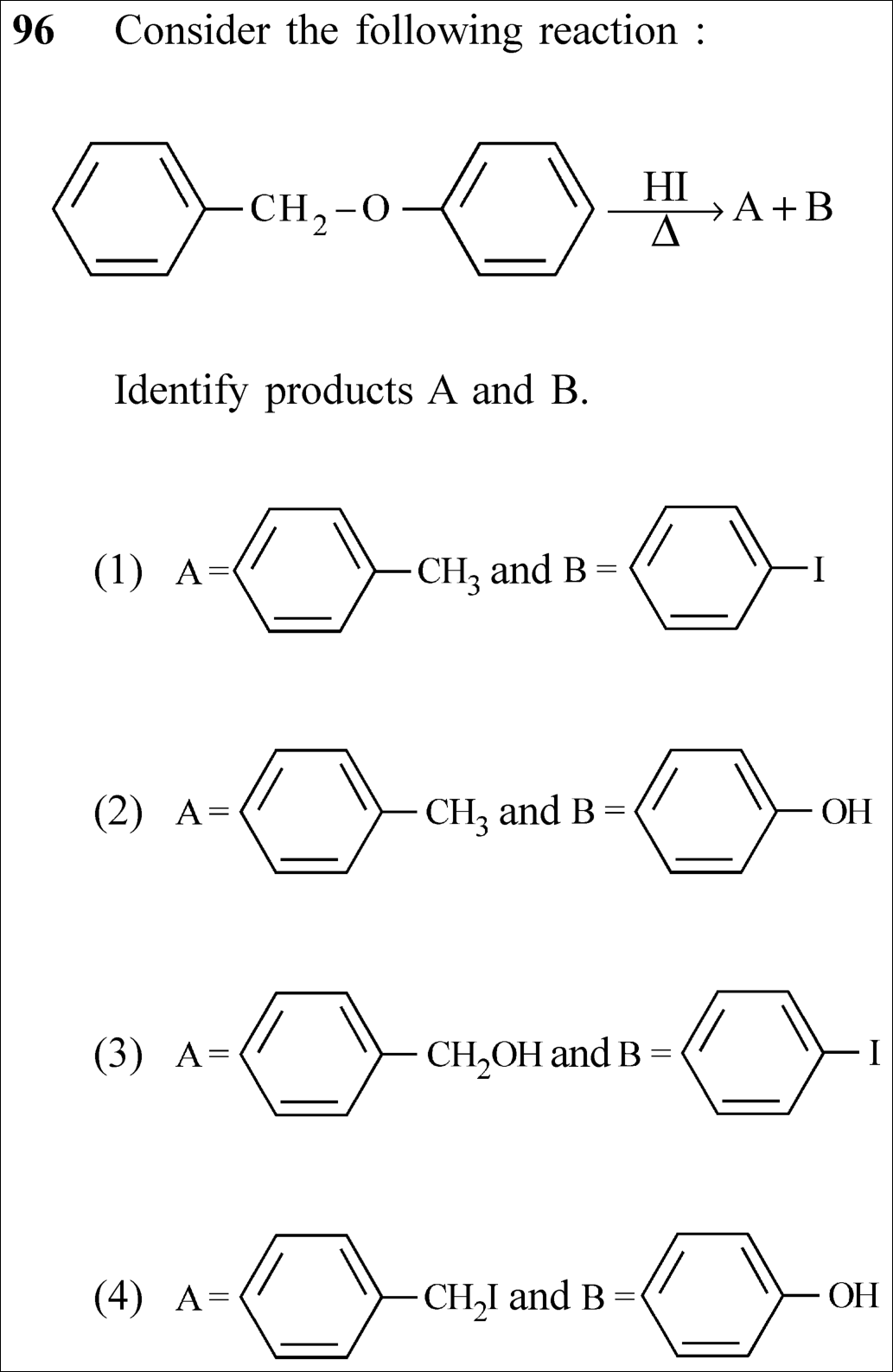
Question
Consider the following reaction: Identify products A and B.
 MyCompetitiveExams
Dynamic 180-question full-length simulator mixed dynamically from all 6 years for 2027 & 2026 aspirants.
Consider the following reaction: Identify products A and B.
In benzyl phenyl ether (C₆H₅–CH₂–O–C₆H₅), the phenyl–oxygen bond has partial double bond character due to resonance with the benzene ring, making it extremely strong. In contrast, the benzyl C–O bond cleaves easily because the benzyl carbocation (or benzyl transition state) is resonance-stabilized! Hence, iodide attacks the benzyl carbon to form benzyl iodide (C₆H₅CH₂I), while oxygen retains the proton to form phenol (C₆H₅OH)! Option (4) in 10 seconds!
In the presence of concentrated HI, the lone pair on the ether oxygen is protonated, yielding a positively charged oxonium ion:
The bond between oxygen and the phenyl ring has partial double bond character due to resonance of oxygen lone pairs with the aromatic ring, making it resistant to cleavage. Furthermore, nucleophilic attack on an sp² phenyl carbon is energetically disfavored:
The benzyl C(sp³)–O bond cleaves readily via SN1/SN2 pathway because the developing positive charge at the benzylic carbon is stabilized by resonance with the phenyl ring. Iodide ion attacks the benzylic carbon:
Product A is benzyl iodide (C₆H₅–CH₂I) and Product B is phenol (C₆H₅–OH):
Diagnose every choice: Know exactly why the right option works and why distractors fail.
Toluene and iodobenzene are not formed; the phenyl–O bond cannot cleave under these conditions.
Cannot form toluene by simple HI cleavage; iodide must attach to the carbon chain.
Requires cleavage of the partial double-bond phenyl–O bond, which is energetically forbidden.
Accurate: Cleavage yields benzyl iodide and phenol exclusively.
Students often incorrectly put iodide on the phenyl ring (forming iodobenzene) and keep –OH on the benzyl group. The phenyl–O bond has partial double bond character and never cleaves under these conditions; nucleophilic substitution occurs at the benzyl carbon!
"Ethers with alkyl and aryl groups cleave to yield phenol and alkyl iodide due to partial double-bond character of the Ar–O bond."
Test your speed and accuracy in the authentic 200-minute timed NTA simulator.
Spotted a mistake in this solution? Report an error (support@mycompetitiveexams.com)
Cover all 1,140 official NEET questions in 285 days at your own pace. Progress is saved on your device. No login needed.