MyCompetitiveExams Logo MyCompetitiveExams
Search 1,140+ Questions
Chapters, formulas, speed tricks
→
⚡ Brahmastra NEET 2027
720 MARKS

Dynamic 180-question full-length simulator mixed dynamically from all 6 years for 2027 & 2026 aspirants.

Launch Brahmastra 2027 Test →
Start Practice →
100% Free · No Login Required
Q.108 Botany ⭐ 360° Option Elimination Active
Vault ↗

NEET 2023 Botany Question 108 Solution

Topic: Sexual Reproduction in Flowering Plants · Official NTA Booklet Code G5
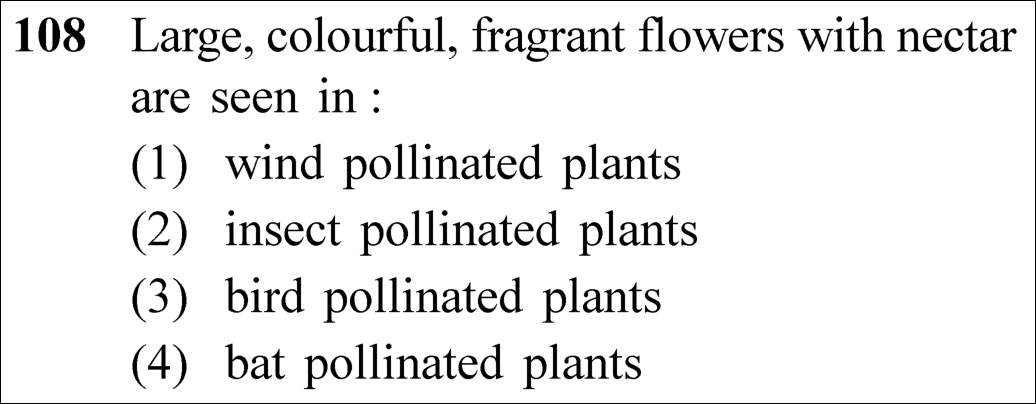
NEET 2023 Botany Question 108: Floral Adaptations for Insect Pollination (Entomophily)

Question

Large, colourful, fragrant flowers with nectar are seen in:

  1. (1)wind pollinated plants
  2. (2)insect pollinated plants
  3. (3)bird pollinated plants
  4. (4)bat pollinated plants
✓
Verified Against NTA Final Answer Key
Option (2) : insect pollinated plants
📚 Sexual Reproduction in Flowering Plants Easy
📋 Given Parameters & Problem Setup
Floral Traits Large, colourful, fragrant, rich in nectar
Agent Category Pollination syndrome
⚡

The 30-Second Exam Hall Shortcut: ⚡ Floral Sensory Syndrome: Color + Fragrance + Nectar = Insects

⏱️ Save ~20 seconds

Insects rely on visual cues (bright color), olfactory cues (fragrance), and energetic rewards (nectar). Wind plants lack fragrance/nectar; birds have poor smell; bats visit dull nocturnal flowers. Therefore, large colorful fragrant flowers are insect-pollinated!

1 Wind-pollinated (anemophilous) flowers are small, non-colourful, without fragrance or nectar.
2 Bird-pollinated (ornithophilous) flowers are brightly coloured and nectar-rich, but typically scentless (birds lack sense of smell).
3 Bat-pollinated (chiropterophilous) flowers are dull-coloured with musky/fermented odor.
4 Insect-pollinated (entomophilous) flowers feature large, colourful petals, strong fragrance, and nectar.
5 Match Option (2) insect pollinated plants.
🛡️
Why You Can 100% Trust This Shortcut: Canonical NCERT Sexual Reproduction in Flowering Plants pollination syndromes.
📐

Step-by-Step Rigorous Workflow & Mathematical Proof

Step 1

Syndromes of Biotic Pollination

Flowers have evolved specific morphological and physiological suites of traits (pollination syndromes) to attract target biotic vectors:

Entomophily (Insects):Large, brightly coloured, fragrant, nectar-rich, sticky pollenOrnithophily (Birds):Vibrant red/yellow, copious dilute nectar, scentlessChiropterophily (Bats):Large, dull/white, nocturnal opening, strong fermented scentAnemophily (Wind):Inconspicuous, light non-sticky pollen, feathery stigma, no nectar/scent\begin{aligned} \text{\textbf{Entomophily (Insects):}} & \quad \text{Large, brightly coloured, fragrant, nectar-rich, sticky pollen} \\[4pt] \text{Ornithophily (Birds):} & \quad \text{Vibrant red/yellow, copious dilute nectar, scentless} \\[4pt] \text{Chiropterophily (Bats):} & \quad \text{Large, dull/white, nocturnal opening, strong fermented scent} \\[4pt] \text{Anemophily (Wind):} & \quad \text{Inconspicuous, light non-sticky pollen, feathery stigma, no nectar/scent} \end{aligned}
Step 2

Verbatim NCERT Association

NCERT explicitly states: "Majority of insect-pollinated flowers are large, colourful, fragrant and rich in nectar. When the flowers are small, a number of flowers are clustered into an inflorescence to make them conspicuous."

Step 3

Floral Rewards

Nectar and pollen grains constitute the canonical floral rewards provided to insect visitors for facilitating pollen transfer.

⭐

360° Option Elimination Engine Key Feature

Diagnose every choice: Know exactly why the right option works and why distractors fail.

4-Option Deep Scan
1 1
✗ Incorrect
Verdict & Scientific Reason:

Wind pollinated flowers are tiny, dull green/brown, lacking fragrance, petals, and nectar.

⚠️
Student Fallacy (Why candidates pick this trap): Ignoring the energetic waste of fragrance and petals for abiotic vectors.
2 2
✓ 100% Correct
Verdict & Scientific Reason:

Exact match with NCERT: entomophilous blossoms are large, brightly coloured, fragrant, and secrete nectar.

💡
Why this is airtight: None; textbook verbatim.
3 3
✗ Incorrect
Verdict & Scientific Reason:

Birds have poorly developed olfactory systems; ornithophilous flowers are bright and nectar-rich but virtually odorless.

⚠️
Student Fallacy (Why candidates pick this trap): Assuming birds are attracted to sweet floral fragrance.
4 4
✗ Incorrect
Verdict & Scientific Reason:

Bat pollinated flowers are dull or whitish (nocturnal blooming) with heavy, fermenting/musty odors rather than sweet floral fragrance.

⚠️
Student Fallacy (Why candidates pick this trap): Failing to recognize that bats do not need bright daytime coloration.
⚠️

NTA Trap Alert: Bird vs. Insect Pollination Fragrance Distinction

Students often group bird and insect flowers together because both are colorful and offer nectar. The discriminating trait is fragrance: bird flowers are scentless, insect flowers are fragrant.

🛡️ How to avoid the -1 mark: Color + Nectar + Fragrance = Insect. Color + Nectar - Fragrance = Bird.
📖

Core NEET Syllabus Standard

NCERT Biology · Sexual Reproduction in Flowering Plants Standard Benchmark
Core Scientific Principle Tested:

"Majority of insect-pollinated flowers are large, colourful, fragrant and rich in nectar to attract pollinators like bees and butterflies."

Syllabus Focus: Pollination Agents
✓ Core NEET UG Syllabus Anchor Syllabus & Academic Standards ↗

Ready to attempt under real exam pressure?

Test your speed and accuracy in the authentic 200-minute timed NTA simulator.

Launch NEET 2023 CBT Test →

Spotted a mistake in this solution? Report an error (support@mycompetitiveexams.com)

⚖️ Legal & Fair Dealing Notice: Sourced from publicly released NEET 2023 question papers and NEET answer keys for private study, research, and non-commercial educational practice under Fair Dealing (Section 52(1)(a) of the Indian Copyright Act, 1957). Not affiliated with or endorsed by NTA or NMC.

Solve 4 NEET Questions a Day — One per Subject

Cover all 1,140 official NEET questions in 285 days at your own pace. Progress is saved on your device. No login needed.