MyCompetitiveExams Logo MyCompetitiveExams
Search 1,140+ Questions
Chapters, formulas, speed tricks
→
⚡ Brahmastra NEET 2027
720 MARKS

Dynamic 180-question full-length simulator mixed dynamically from all 6 years for 2027 & 2026 aspirants.

Launch Brahmastra 2027 Test →
Start Practice →
100% Free · No Login Required
Q.79 Chemistry ⭐ 360° Option Elimination Active
Vault ↗

NEET 2023 Chemistry Question 79 Solution

Topic: States of Matter · Official NTA Booklet Code G5
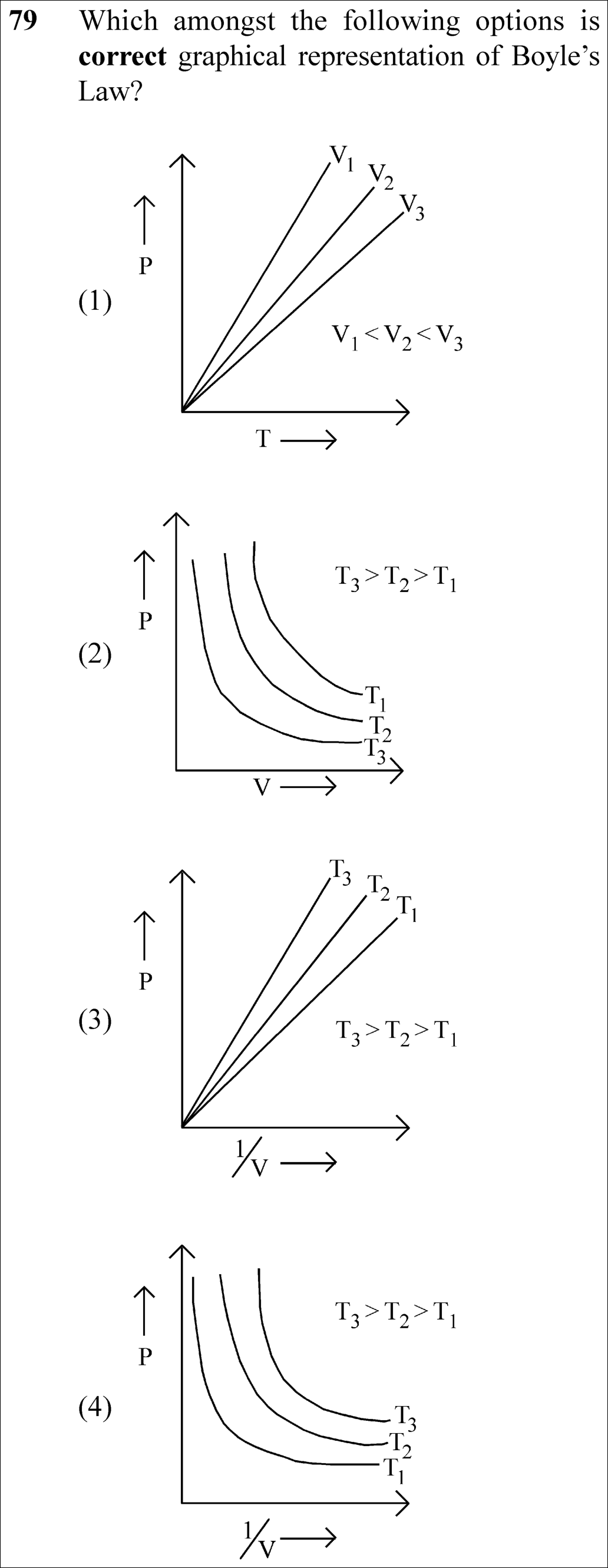
NEET 2023 Chemistry Question 79: Boyle’s Law Graphical Isotherms: P vs 1/V Linear Representation

Question

Which amongst the following options is correct graphical representation of Boyle's Law?

✓
Verified Against NTA Final Answer Key
Option (3) : P vs 1/V straight lines with slopes T₃ > T₂ > T₁
📚 States of Matter Medium
📋 Given Parameters & Problem Setup
Gas Law Evaluated Boyle’s Law (constant n and T)
Temperature Ordering T₃ > T₂ > T₁
⚡

The 30-Second Exam Hall Shortcut: ⚡ Linear Isotherm Slope Scan: P = (nRT) · (1/V) with Slope ∝ T

⏱️ Save ~35 seconds

Ideal gas law PV = nRT converts to P = (nRT)(1/V). Comparing with y = mx: plot of P vs 1/V is a straight line through the origin with slope = nRT. Higher T gives steeper slope! Since T₃ > T₂ > T₁, the slope order is slope₃ > slope₂ > slope₁. Graph (3) is instantly recognized!

1 Express Boyle’s law in terms of plotted variables: P = (nRT)(1/V).
2 This conforms to y = mx with intercept c = 0 (straight line passing through the origin).
3 Slope m = nRT is directly proportional to absolute temperature T.
4 Since T₃ > T₂ > T₁, the lines must be linear through (0,0) with steepest slope for T₃.
5 Graph (3) correctly displays this straight-line fan with slope₃ > slope₂ > slope₁.
🛡️
Why You Can 100% Trust This Shortcut: Direct functional mapping of Ideal Gas Law PV = nRT into Cartesian coordinates.
📐

Step-by-Step Rigorous Workflow & Mathematical Proof

Step 1

State Boyle’s Law and the Ideal Gas Equation

Boyle’s Law states that at constant temperature (T) and constant mass of gas (n), the pressure of a given mass of gas is inversely proportional to its volume:

P∝1V  ⟹  PV=k=nRTP \propto \frac{1}{V} \implies PV = k = nRT
Step 2

Formulate Linear Equation for P vs 1/V

Rearranging the equation of state with y = P and x = 1/V yields a linear function:

P=(nRT)(1V)  ⟺  y=mx(where slope m=nRT)P = (nRT) \left(\frac{1}{V}\right) \iff y = mx \quad (\text{where slope } m = nRT)
Step 3

Analyze Slope Variation with Temperature

Because slope m = nRT, the slope is directly proportional to absolute temperature:

T3>T2>T1  ⟹  m3>m2>m1T_3 > T_2 > T_1 \implies m_3 > m_2 > m_1
Step 4

Eliminate Alternative Graphs

Option (1) plots P vs T (Gay-Lussac’s isochores). Option (2) plots P vs V hyperbolas but inverts the temperature ordering. Option (4) shows a hyperbola for P vs 1/V, violating linearity. Graph (3) is uniquely correct:

Correct graph: Straight lines through origin with slope(T3)>slope(T2)>slope(T1)\text{Correct graph: Straight lines through origin with } \text{slope}(T_3) > \text{slope}(T_2) > \text{slope}(T_1)
⭐

360° Option Elimination Engine Key Feature

Diagnose every choice: Know exactly why the right option works and why distractors fail.

4-Option Deep Scan
1 (1)
✗ Incorrect
Verdict & Scientific Reason:

Represents Gay-Lussac’s law (isochores), not Boyle’s law.

⚠️
Student Fallacy (Why candidates pick this trap): Candidate confused isochoric pressure-temperature variation with isothermal pressure-volume variation.
2 (2)
✗ Incorrect
Verdict & Scientific Reason:

The curves are hyperbolic, but the upper isotherm has a higher PV product, so the top curve should be T₃, not T₁.

⚠️
Student Fallacy (Why candidates pick this trap): Candidate overlooked the temperature label ordering on the P vs V curves.
3 (3)
✓ 100% Correct
Verdict & Scientific Reason:

Accurate: P = (nRT)(1/V) is a straight line through the origin whose slope increases with absolute temperature.

💡
Why this is airtight: None. Candidate correctly analyzed the linear functional form and temperature dependence of slope.
4 (4)
✗ Incorrect
Verdict & Scientific Reason:

P is directly proportional to 1/V, so the plot must be linear, not hyperbolic.

⚠️
Student Fallacy (Why candidates pick this trap): Candidate confused the hyperbolic shape of P vs V with the linear shape of P vs 1/V.
⚠️

NTA Trap Alert: Confusing P vs V with P vs 1/V

P vs V is a rectangular hyperbola (isotherm). P vs 1/V is a straight line passing through the origin. Furthermore, at higher temperature, any given volume sustains a higher pressure, meaning isotherms shift upward and outward.

🛡️ How to avoid the -1 mark: Identify the axis variables first: if the x-axis is 1/V, the relationship is strictly linear with slope = nRT.
📖

Core NEET Syllabus Standard

National Eligibility cum Entrance Test (NEET UG) · States of Matter Standard Benchmark
Core Scientific Principle Tested:

"At constant temperature, the pressure of a fixed mass of gas is inversely proportional to its volume: P = k/V."

Syllabus Focus: The Gaseous State – Boyle’s Law and Isotherms
Preserved in Rationalized Curriculum Syllabus & Academic Standards ↗

Ready to attempt under real exam pressure?

Test your speed and accuracy in the authentic 200-minute timed NTA simulator.

Launch NEET 2023 CBT Test →

Spotted a mistake in this solution? Report an error (support@mycompetitiveexams.com)

⚖️ Legal & Fair Dealing Notice: Sourced from publicly released NEET 2023 question papers and NEET answer keys for private study, research, and non-commercial educational practice under Fair Dealing (Section 52(1)(a) of the Indian Copyright Act, 1957). Not affiliated with or endorsed by NTA or NMC.

Solve 4 NEET Questions a Day — One per Subject

Cover all 1,140 official NEET questions in 285 days at your own pace. Progress is saved on your device. No login needed.