NEET 2023 Botany Question 112 Solution
Question
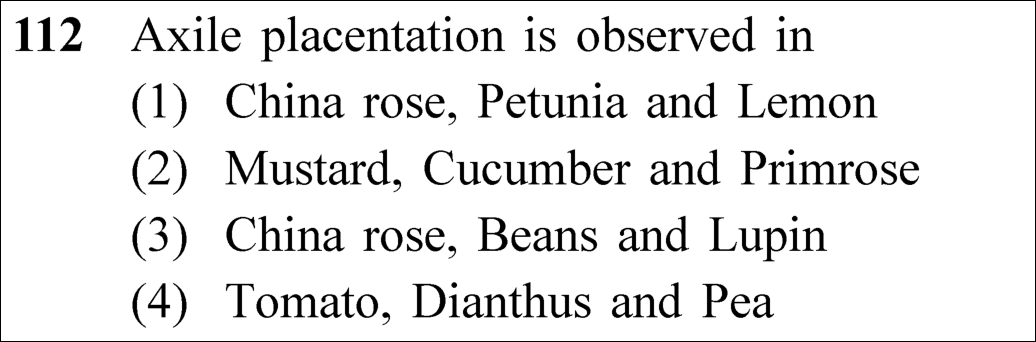
Axile placentation is observed in
- (1)China rose, Petunia and Lemon
- (2)Mustard, Cucumber and Primrose
- (3)China rose, Beans and Lupin
- (4)Tomato, Dianthus and Pea
Dynamic 180-question full-length simulator mixed dynamically from all 6 years for 2027 & 2026 aspirants.
Axile placentation is observed in
Axile placentation occurs in multilocular syncarpous ovaries where ovules attach to the central axis: Tomato, Lemon, China rose, and Petunia (Solanaceae)!
When the placenta is axial and the ovules are attached to it in a multilocular ovary, the placentation is termed axile:
Reviewing canonical plant examples classified by placentation:
Option (1) contains China rose (Malvaceae), Petunia (Solanaceae), and Lemon (Rutaceae)—all of which possess multilocular ovaries with axile placentation.
Diagnose every choice: Know exactly why the right option works and why distractors fail.
All three plants possess syncarpous multilocular ovaries with axile placentation.
Mustard and Cucumber show parietal placentation; Primrose shows free central placentation.
Beans and Lupin (Fabaceae) have unilocular ovaries with marginal placentation.
Tomato is axile, but Dianthus is free central and Pea is marginal.
Both axile and free central feature ovules positioned centrally. However, axile possesses septa dividing the ovary into multiple locules, whereas free central completely lacks septa (unilocular).
"When the placenta is axial and the ovules are attached to it in a multilocular ovary, the placentation is said to be axile, as in china rose, tomato and lemon."
Test your speed and accuracy in the authentic 200-minute timed NTA simulator.
Spotted a mistake in this solution? Report an error (support@mycompetitiveexams.com)
Cover all 1,140 official NEET questions in 285 days at your own pace. Progress is saved on your device. No login needed.