The 30-Second Exam Hall Shortcut: ⚡ "Populations Have Vital Statistics: Species Interaction is a Community Trait!"
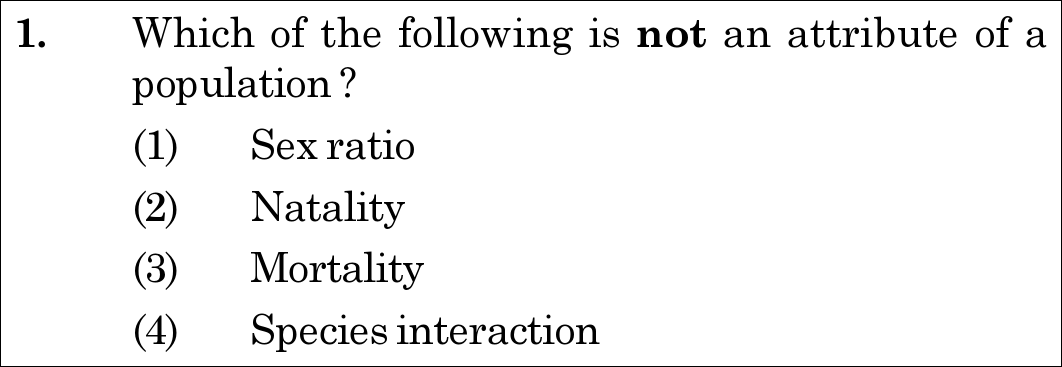
A biological population possesses demographic group metrics: Birth rate (natality), Death rate (mortality), Sex ratio, and Age pyramids. Interspecific interaction (predation, mutualism, parasitism) requires TWO or more species, making it a Community attribute! Mark Option (4) in 10 seconds.
Step-by-Step Conceptual & Mathematical Derivation
Definition and Statistical Metrics of a Population
In ecology, a population is defined as a group of individuals belonging to the same species that inhabit a defined geographic area, share or compete for similar resources, and potentially interbreed. While individual organisms are born, die, and have a male or female sex, a population exhibits aggregate demographic attributes: - Natality (Birth Rate): Number of births per unit of population per unit time. - Mortality (Death Rate): Number of deaths per unit of population per unit time. - Sex Ratio: Ratio of males to females within the population. - Age Distribution / Pyramids: Proportion of individuals in pre-reproductive, reproductive, and post-reproductive age groups.
Community Ecology: Why Species Interaction is Distinct
Species interactions (such as mutualism, competition, predation, parasitism, commensalism, and amensalism) occur between populations of two or more distinct species coexisting within a habitat. Therefore, species interactions operate at the biotic community level, not as an intrinsic demographic attribute of a single-species population.
🔍 View 360° Option Elimination Analysis & NTA Trap Alert ▼
Incorrect. Sex ratio is a canonical population attribute (e.g. 60% of the population are females and 40% are males).
Incorrect. Natality (birth rate per capita) is one of the foundational demographic attributes of a population.
Incorrect. Mortality (death rate per capita) is a core population attribute determining population growth rate.
Correct as the non-attribute. Interspecific interaction occurs between different species and is a biological community attribute.
An individual has birth, death, and sex. A population has birth rate (natality), death rate (mortality), and sex ratio. A community has species diversity and interspecific interactions. Do not blur hierarchical ecological levels.