MyCompetitiveExams Logo MyCompetitiveExams
Search 1,140+ Questions
Chapters, formulas, speed tricks
→
⚡ Brahmastra NEET 2027
720 MARKS

Dynamic 180-question full-length simulator mixed dynamically from all 6 years for 2027 & 2026 aspirants.

Launch Brahmastra 2027 Test →
Start Practice →
100% Free · No Login Required
Q.98 Chemistry ⭐ 360° Option Elimination Active
Vault ↗

NEET 2023 Chemistry Question 98 Solution

Topic: Alcohols, Phenols and Ethers · Official NTA Booklet Code G5
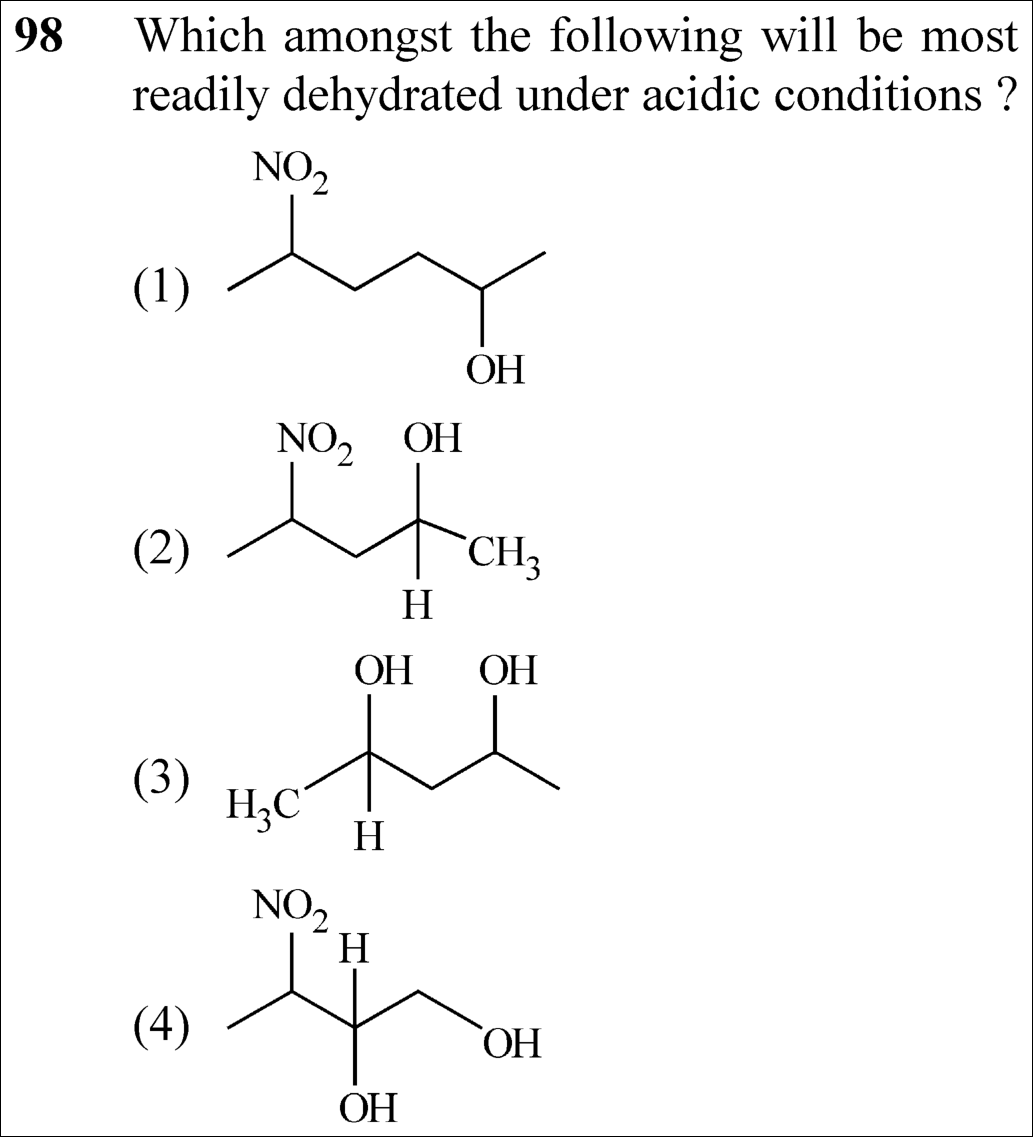
NEET 2023 Chemistry Question 98: Ease of Acid-Catalysed Dehydration of Alcohols (Destabilizing Effect of Nitro Group)

Question

Which amongst the following will be most readily dehydrated under acidic conditions?

✓
Verified Against NTA Final Answer Key
Option (3) : Diol compound without electron-withdrawing nitro group
📚 Alcohols, Phenols and Ethers Medium
📋 Given Parameters & Problem Setup
Reaction conditions Acidic conditions (H⁺, heat)
Evaluation criterion Most readily dehydrated (fastest E1 rate)
⚡

The 30-Second Exam Hall Shortcut: ⚡ Nitro Group Exclusion Filter: Option (3) is the ONLY Compound Lacking Destabilizing –NO₂!

⏱️ Save ~35 seconds

Acid-catalysed dehydration proceeds via a carbocation intermediate (E1). The nitro group (–NO₂) is a ferocious electron-withdrawing group (–I, –M) that severely destabilizes adjacent positive charge, raising the activation energy drastically. Options (1), (2), and (4) ALL contain a strongly destabilizing –NO₂ group, whereas Option (3) completely lacks –NO₂! Option (3) dehydrates fastest in 5 seconds!

1 Mechanism of acid dehydration: Protonation of –OH followed by loss of H₂O to form a carbocation (rate-determining step).
2 Rate of dehydration ∝ Stability of carbocation intermediate.
3 The –NO₂ group has very strong –I and –M electron-withdrawing effects, powerfully destabilizing positive charge.
4 Options (1), (2), and (4) all have an –NO₂ group adjacent or near to the hydroxyl group, severely suppressing carbocation formation.
5 Option (3) is free from any electron-withdrawing –NO₂ group and dehydrates most readily.
6 Select Option (3) instantly!
🛡️
Why You Can 100% Trust This Shortcut: Classical carbocation stability and electronic substituent effects in E1 alcohol dehydration.
📐

Step-by-Step Rigorous Workflow & Mathematical Proof

Step 1

Mechanism of Acid-Catalysed Alcohol Dehydration

Acid-catalysed dehydration of alcohols occurs via an E1 elimination pathway. Protonation of the hydroxyl group yields an alkyloxonium ion, which loses water in the rate-determining step to generate a carbocation intermediate:

R–OH+H+⇌R–OH2+→slow (RDS)R++H2O\text{R–OH} + \text{H}^+ \rightleftharpoons \text{R–OH}_2^+ \xrightarrow{\text{slow (RDS)}} \text{R}^+ + \text{H}_2\text{O}
Step 2

Destabilizing Electronic Effect of the Nitro (–NO₂) Group

The rate of dehydration is directly proportional to the thermodynamic stability of the intermediate carbocation. A nitro group (–NO₂) is an extremely powerful electron-withdrawing group via both inductive (–I) and resonance (–M) effects. Placing a positive charge near –NO₂ results in severe electrostatic destabilization:

Carbocation Stability: Destabilized by −NO2 (−I,−M)  ⟹  Activation energy increases enormously\text{Carbocation Stability: } \text{Destabilized by } {-}\text{NO}_2\ (-I, -M) \implies \text{Activation energy increases enormously}
Step 3

Comparative Evaluation of Given Substrates

Options (1), (2), and (4) all possess a strongly electron-withdrawing –NO₂ group on the carbon skeleton. In contrast, Option (3) possesses no –NO₂ group; its carbocation is stabilized by adjacent alkyl electron donation (hyperconjugation and +I effect):

Rate of dehydration: Option (3) [No −NO2]≫Options (1), (2), (4) [With −NO2]\text{Rate of dehydration: } \text{Option (3) [No } {-}\text{NO}_2\text{]} \gg \text{Options (1), (2), (4) [With } {-}\text{NO}_2\text{]}
⭐

360° Option Elimination Engine Key Feature

Diagnose every choice: Know exactly why the right option works and why distractors fail.

4-Option Deep Scan
1 (1)
✗ Incorrect
Verdict & Scientific Reason:

Contains a strong electron-withdrawing –NO₂ group which destabilizes the carbocation intermediate.

⚠️
Student Fallacy (Why candidates pick this trap): Candidate overlooked the strong inductive destabilization caused by the nitro group.
2 (2)
✗ Incorrect
Verdict & Scientific Reason:

The –NO₂ group is in close proximity to the hydroxyl carbon, severely retarding ionization.

⚠️
Student Fallacy (Why candidates pick this trap): Candidate assumed secondary alcohol structure alone guarantees fast dehydration.
3 (3)
✓ 100% Correct
Verdict & Scientific Reason:

Accurate: Free from the strongly destabilizing electron-withdrawing –NO₂ group, allowing unhindered carbocation formation and rapid dehydration.

💡
Why this is airtight: None. Candidate correctly identified that absence of –NO₂ maximizes carbocation stability.
4 (4)
✗ Incorrect
Verdict & Scientific Reason:

Contains an –NO₂ group and a primary hydroxyl group, giving the lowest dehydration rate.

⚠️
Student Fallacy (Why candidates pick this trap): Candidate confused primary alcohol dehydration kinetics with secondary ones.
⚠️

NTA Trap Alert: Overlooking Inductive and Mesomeric Destabilization by Nitro Groups

Students often only look at alcohol degree (1° vs 2°) and forget that an electron-withdrawing group like –NO₂ near a carbocation increases the activation energy barrier so dramatically that dehydration becomes sluggish.

🛡️ How to avoid the -1 mark: Identify substituents: An alcohol with an electron-withdrawing –NO₂ group dehydrates much slower than an alcohol without –NO₂.
📖

Core NEET Syllabus Standard

National Eligibility cum Entrance Test (NEET UG) · Alcohols, Phenols and Ethers Standard Benchmark
Core Scientific Principle Tested:

"The ease of dehydration follows carbocation stability; electron-withdrawing groups strongly destabilize carbocation intermediates and retard dehydration."

Syllabus Focus: Dehydration of Alcohols – Mechanism and Reactivity
Preserved in Rationalized Curriculum Syllabus & Academic Standards ↗

Ready to attempt under real exam pressure?

Test your speed and accuracy in the authentic 200-minute timed NTA simulator.

Launch NEET 2023 CBT Test →

Spotted a mistake in this solution? Report an error (support@mycompetitiveexams.com)

⚖️ Legal & Fair Dealing Notice: Sourced from publicly released NEET 2023 question papers and NEET answer keys for private study, research, and non-commercial educational practice under Fair Dealing (Section 52(1)(a) of the Indian Copyright Act, 1957). Not affiliated with or endorsed by NTA or NMC.

Solve 4 NEET Questions a Day — One per Subject

Cover all 1,140 official NEET questions in 285 days at your own pace. Progress is saved on your device. No login needed.