MyCompetitiveExams Logo MyCompetitiveExams
Search 1,140+ Questions
Chapters, formulas, speed tricks
→
⚡ Brahmastra NEET 2027
720 MARKS

Dynamic 180-question full-length simulator mixed dynamically from all 6 years for 2027 & 2026 aspirants.

Launch Brahmastra 2027 Test →
Start Practice →
100% Free · No Login Required
Q.129 Botany ⭐ 360° Option Elimination Active
Vault ↗

NEET 2023 Botany Question 129 Solution

Topic: Sexual Reproduction in Flowering Plants · Official NTA Booklet Code G5
NEET 2023 Botany Question 129: Ploidy of Post-Fertilization Embryo Sac Structures

Question

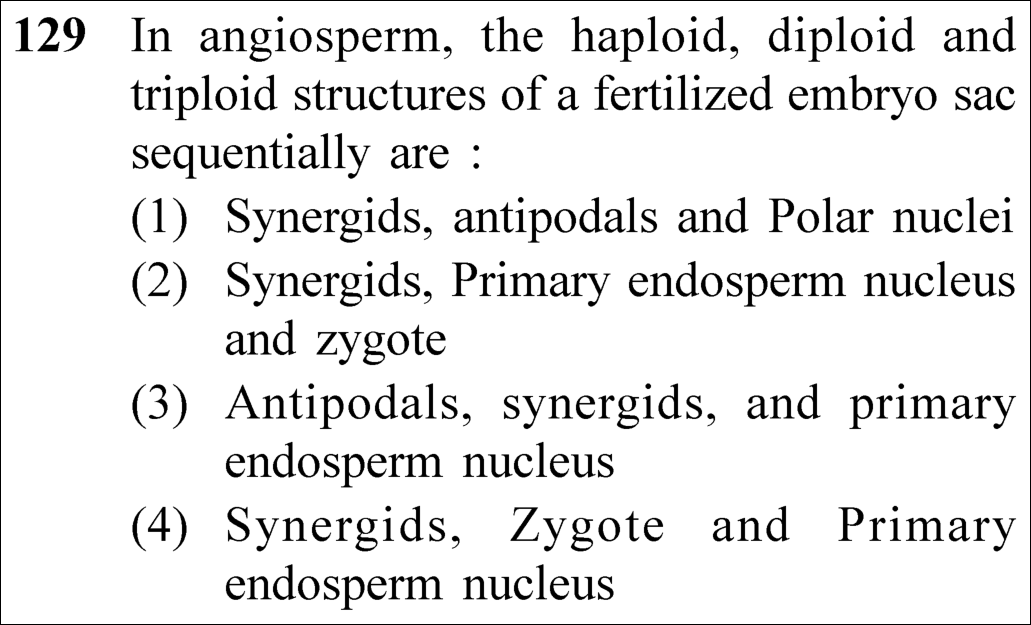
In angiosperm, the haploid, diploid and triploid structures of a fertilized embryo sac sequentially are:

  1. (1)Synergids, antipodals and Polar nuclei
  2. (2)Synergids, Primary endosperm nucleus and zygote
  3. (3)Antipodals, synergids, and primary endosperm nucleus
  4. (4)Synergids, Zygote and Primary endosperm nucleus
✓
Verified Against NTA Final Answer Key
Option (4) : Synergids, Zygote and Primary endosperm nucleus
📚 Sexual Reproduction in Flowering Plants Easy
📋 Given Parameters & Problem Setup
Organism Angiosperms
Ploidy Sequence Haploid (nn), Diploid (2n2n), and Triploid (3n3n)
⚡

The 30-Second Exam Hall Shortcut: ⚡ Sequential Ploidy Check: n → 2n → 3n

⏱️ Save ~20 seconds

Match the ploidy levels sequentially: Haploid (nn) = Synergid / Antipodal; Diploid (2n2n) = Zygote (from syngamy n+nn+n); Triploid (3n3n) = Primary Endosperm Nucleus / PEN (from triple fusion 2n+n2n+n)! Match Option (4)!

1 Identify Haploid (nn): Synergids, Antipodals, Egg cell, Male gametes.
2 Identify Diploid (2n2n): Zygote (n egg+n spermn \text{ egg} + n \text{ sperm}), secondary nucleus before fertilization.
3 Identify Triploid (3n3n): Primary Endosperm Nucleus (2n central cell+n sperm2n \text{ central cell} + n \text{ sperm}).
4 Check Sequence: Synergids (nn) -> Zygote (2n2n) -> PEN (3n3n).
5 Match Option (4).
🛡️
Why You Can 100% Trust This Shortcut: Canonical NCERT Angiosperm double fertilization and embryo sac cytology.
📐

Step-by-Step Rigorous Workflow & Mathematical Proof

Step 1

Cytological Status of Embryo Sac Cells

Analyzing the ploidy of cells present in a fertilized angiosperm embryo sac following double fertilization:

Haploid (n):Synergids, Antipodals (cells of the gametophyte)Diploid (2n):Zygote (negg+nsperm via Syngamy)Triploid (3n):Primary Endosperm Nucleus/PEN (2npolar nuclei+nsperm via Triple Fusion)\begin{aligned} \text{\textbf{Haploid (}} n \textbf{):} & \quad \text{Synergids, Antipodals (cells of the gametophyte)} \\[4pt] \text{\textbf{Diploid (}} 2n \textbf{):} & \quad \text{Zygote } (n_{\text{egg}} + n_{\text{sperm}} \text{ via Syngamy}) \\[4pt] \text{\textbf{Triploid (}} 3n \textbf{):} & \quad \text{Primary Endosperm Nucleus/PEN } (2n_{\text{polar nuclei}} + n_{\text{sperm}} \text{ via Triple Fusion}) \end{aligned}
Step 2

Matching the Specified Sequence

The question specifically requires the sequence: haploid (nn), diploid (2n2n), and triploid (3n3n):

n⟶2n⟶3n  ⟺  Synergids (n)⟶Zygote (2n)⟶PEN (3n)\mathbf{n \longrightarrow 2n \longrightarrow 3n} \iff \mathbf{\text{Synergids } (n) \longrightarrow \text{Zygote } (2n) \longrightarrow \text{PEN } (3n)}
Step 3

Evaluation of Distractor Options

Option (1) lists synergids (nn), antipodals (nn), polar nuclei (n+nn+n). Option (2) lists synergids (nn), PEN (3n3n), zygote (2n2n)—violating sequential order. Option (3) lists antipodals (nn), synergids (nn), PEN (3n3n). Only Option (4) strictly adheres to the requested n→2n→3nn \to 2n \to 3n sequence.

⭐

360° Option Elimination Engine Key Feature

Diagnose every choice: Know exactly why the right option works and why distractors fail.

4-Option Deep Scan
1 1
✗ Incorrect
Verdict & Scientific Reason:

Synergids and antipodals are both haploid (nn); lacks a diploid (2n2n) and triploid (3n3n) structure.

⚠️
Student Fallacy (Why candidates pick this trap): Failing to track sequential ploidy values.
2 2
✗ Incorrect
Verdict & Scientific Reason:

The sequence is n→3n→2nn \to 3n \to 2n, which violates the required n→2n→3nn \to 2n \to 3n sequence.

⚠️
Student Fallacy (Why candidates pick this trap): Overlooking that triploid PEN is placed before diploid zygote.
3 3
✗ Incorrect
Verdict & Scientific Reason:

Antipodals and synergids are both haploid (nn); no diploid structure is represented.

⚠️
Student Fallacy (Why candidates pick this trap): Confusing two haploid cells with a diploid structure.
4 4
✓ 100% Correct
Verdict & Scientific Reason:

Strictly satisfies the n→2n→3nn \to 2n \to 3n sequence: Synergids (nn), Zygote (2n2n), Primary endosperm nucleus (3n3n).

💡
Why this is airtight: None; rigorous sequence matching.
⚠️

NTA Trap Alert: Order of Words in Sequential Prompts Trap

Students readily know the ploidy of individual cells, but fail to notice that Option (2) switches the order to n→3n→2nn \to 3n \to 2n.

🛡️ How to avoid the -1 mark: Write down "n, 2n, 3n" on scratch paper and match the exact sequence term-by-term.
📖

Core NEET Syllabus Standard

NCERT Biology · Sexual Reproduction in Flowering Plants Standard Benchmark
Core Scientific Principle Tested:

"Syngamy results in the formation of a diploid zygote (2n), while triple fusion produces a triploid primary endosperm nucleus (3n). Synergids remain haploid (n)."

Syllabus Focus: Double Fertilisation
✓ Core NEET UG Syllabus Anchor Syllabus & Academic Standards ↗

Ready to attempt under real exam pressure?

Test your speed and accuracy in the authentic 200-minute timed NTA simulator.

Launch NEET 2023 CBT Test →

Spotted a mistake in this solution? Report an error (support@mycompetitiveexams.com)

⚖️ Legal & Fair Dealing Notice: Sourced from publicly released NEET 2023 question papers and NEET answer keys for private study, research, and non-commercial educational practice under Fair Dealing (Section 52(1)(a) of the Indian Copyright Act, 1957). Not affiliated with or endorsed by NTA or NMC.

Solve 4 NEET Questions a Day — One per Subject

Cover all 1,140 official NEET questions in 285 days at your own pace. Progress is saved on your device. No login needed.