MyCompetitiveExams Logo MyCompetitiveExams
Search 1,140+ Questions
Chapters, formulas, speed tricks
→
⚡ Brahmastra NEET 2027
720 MARKS

Dynamic 180-question full-length simulator mixed dynamically from all 6 years for 2027 & 2026 aspirants.

Launch Brahmastra 2027 Test →
Start Practice →
100% Free · No Login Required
Q.156 Zoology ⭐ 360° Option Elimination Active
Vault ↗

NEET 2023 Zoology Question 156 Solution

Topic: Evolution · Official NTA Booklet Code G5
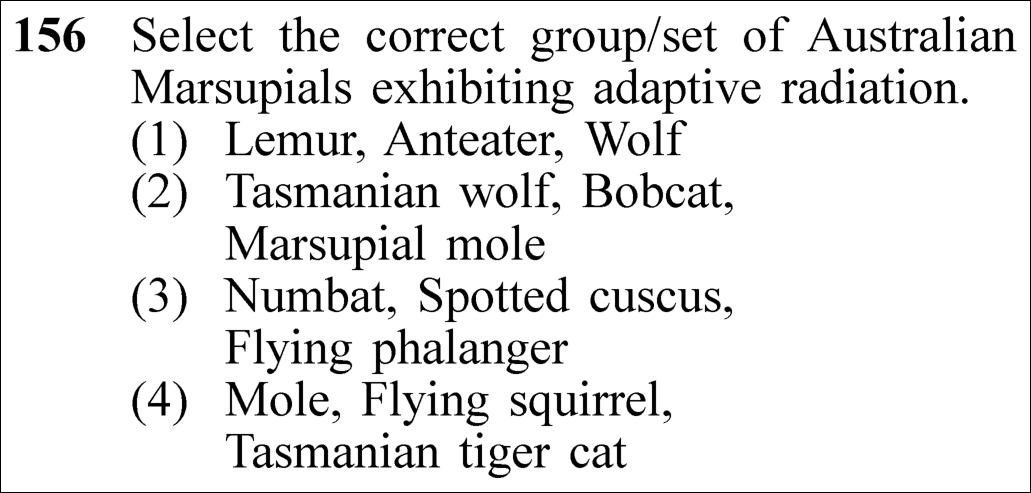
NEET 2023 Zoology Question 156: Adaptive Radiation: Australian Marsupials vs. Placental Mammals

Question

Select the correct group/set of Australian Marsupials exhibiting adaptive radiation.

  1. (1)Lemur, Anteater, Wolf
  2. (2)Tasmanian wolf, Bobcat, Marsupial mole
  3. (3)Numbat, Spotted cuscus, Flying phalanger
  4. (4)Mole, Flying squirrel, Tasmanian tiger cat
✓
Verified Against NTA Final Answer Key
Option (3) : Numbat, Spotted cuscus, Flying phalanger
📚 Evolution Medium
📋 Given Parameters & Problem Setup
Evolutionary Phenomenon Adaptive Radiation
Target Group Exclusively Australian Marsupials
⚡

The 30-Second Exam Hall Shortcut: ⚡ Marsupial vs. Placental Mammal Filter

⏱️ Save ~25 seconds

Filter out the placental mammals: Anteater, Lemur, Wolf, Bobcat, Mole, and Flying squirrel are all PLACENTAL mammals! Option (3) contains Numbat (banded anteater), Spotted cuscus, and Flying phalanger (sugar glider)—all 100% Australian marsupials!

1 Option (1): Lemur, Anteater, Wolf -> All 3 are placental mammals.
2 Option (2): Contains Bobcat -> Placental mammal.
3 Option (4): Contains Mole and Flying squirrel -> Placental mammals.
4 Option (3): Numbat, Spotted cuscus, Flying phalanger -> All 3 are Australian marsupials.
5 Match Option (3).
🛡️
Why You Can 100% Trust This Shortcut: Canonical NCERT Evolution comparative chart of adaptive radiation in Australian marsupials.
📐

Step-by-Step Rigorous Workflow & Mathematical Proof

Step 1

Adaptive Radiation of Australian Marsupials

In Australia, an ancestral marsupial stock underwent adaptive radiation to occupy diverse ecological niches in geographic isolation:

Australian Marsupials={Tasmanian wolf, Tiger catBanded anteater (Numbat)Marsupial mole, Wombat, Bandicoot, Koala, KangarooSpotted cuscus, Flying phalanger (Sugar glider)\text{Australian Marsupials} = \begin{cases} \text{Tasmanian wolf, Tiger cat} \\[2pt] \mathbf{\text{Banded anteater (Numbat)}} \\[2pt] \text{Marsupial mole, Wombat, Bandicoot, Koala, Kangaroo} \\[2pt] \mathbf{\text{Spotted cuscus, Flying phalanger (Sugar glider)}} \end{cases}
Step 2

Convergent Evolution with Placental Mammals

Placental mammals evolved parallel convergent phenotypes resembling these marsupials:

Placental Mole⟷Marsupial MolePlacental Anteater⟷Numbat (Banded Anteater)Placental Lemur⟷Spotted CuscusPlacental Flying squirrel⟷Flying PhalangerPlacental Bobcat⟷Tasmanian Tiger CatPlacental Wolf⟷Tasmanian Wolf\begin{aligned} \text{Placental Mole} & \longleftrightarrow \text{Marsupial Mole} \\[2pt] \text{Placental Anteater} & \longleftrightarrow \text{Numbat (Banded Anteater)} \\[2pt] \text{Placental Lemur} & \longleftrightarrow \text{Spotted Cuscus} \\[2pt] \text{Placental Flying squirrel} & \longleftrightarrow \text{Flying Phalanger} \\[2pt] \text{Placental Bobcat} & \longleftrightarrow \text{Tasmanian Tiger Cat} \\[2pt] \text{Placental Wolf} & \longleftrightarrow \text{Tasmanian Wolf} \end{aligned}
Step 3

Option Elimination

Options 1, 2, and 4 all contain placental mammals (Lemur, Bobcat, Mole, Flying squirrel). Only Option (3) consists entirely of Australian marsupials.

⭐

360° Option Elimination Engine Key Feature

Diagnose every choice: Know exactly why the right option works and why distractors fail.

4-Option Deep Scan
1 1
✗ Incorrect
Verdict & Scientific Reason:

All three are placental mammals, not Australian marsupials.

⚠️
Student Fallacy (Why candidates pick this trap): Selecting the placental counter-column from the NCERT diagram.
2 2
✗ Incorrect
Verdict & Scientific Reason:

Bobcat is a placental carnivore (convergent counterpart of Tasmanian tiger cat).

⚠️
Student Fallacy (Why candidates pick this trap): Failing to notice Bobcat is a placental mammal.
3 3
✓ 100% Correct
Verdict & Scientific Reason:

All three species are genuine Australian marsupials depicting adaptive radiation in the isolated island continent.

💡
Why this is airtight: None; precise taxonomic differentiation.
4 4
✗ Incorrect
Verdict & Scientific Reason:

Mole and Flying squirrel are placental mammals.

⚠️
Student Fallacy (Why candidates pick this trap): Overlooking that true moles and flying squirrels are placentals.
⚠️

NTA Trap Alert: Convergent Pair Intermixing Trap

NCERT presents a double-column diagram comparing Placental mammals on the left with Australian marsupials on the right. NTA mixes entries from both columns to catch students who memorized the names without their taxonomic category.

🛡️ How to avoid the -1 mark: Remember: Lemur, Bobcat, Wolf, Anteater, Flying squirrel = Placental. Numbat, Cuscus, Phalanger = Marsupial.
📖

Core NEET Syllabus Standard

NCERT Biology · Evolution Standard Benchmark
Core Scientific Principle Tested:

"A number of marsupials, each different from the other evolved from an ancestral stock, but all within the Australian island continent."

Syllabus Focus: Adaptive Radiation (Australian Marsupials)
✓ Core NEET UG Syllabus Anchor Syllabus & Academic Standards ↗

Ready to attempt under real exam pressure?

Test your speed and accuracy in the authentic 200-minute timed NTA simulator.

Launch NEET 2023 CBT Test →

Spotted a mistake in this solution? Report an error (support@mycompetitiveexams.com)

⚖️ Legal & Fair Dealing Notice: Sourced from publicly released NEET 2023 question papers and NEET answer keys for private study, research, and non-commercial educational practice under Fair Dealing (Section 52(1)(a) of the Indian Copyright Act, 1957). Not affiliated with or endorsed by NTA or NMC.

Solve 4 NEET Questions a Day — One per Subject

Cover all 1,140 official NEET questions in 285 days at your own pace. Progress is saved on your device. No login needed.