MyCompetitiveExams Logo MyCompetitiveExams
Search 1,140+ Questions
Chapters, formulas, speed tricks
→
⚡ Brahmastra NEET 2027
720 MARKS

Dynamic 180-question full-length simulator mixed dynamically from all 6 years for 2027 & 2026 aspirants.

Launch Brahmastra 2027 Test →
Start Practice →
100% Free · No Login Required
Q.123 Botany ⭐ 360° Option Elimination Active
Vault ↗

NEET 2023 Botany Question 123 Solution

Topic: Transport in Plants · Official NTA Booklet Code G5
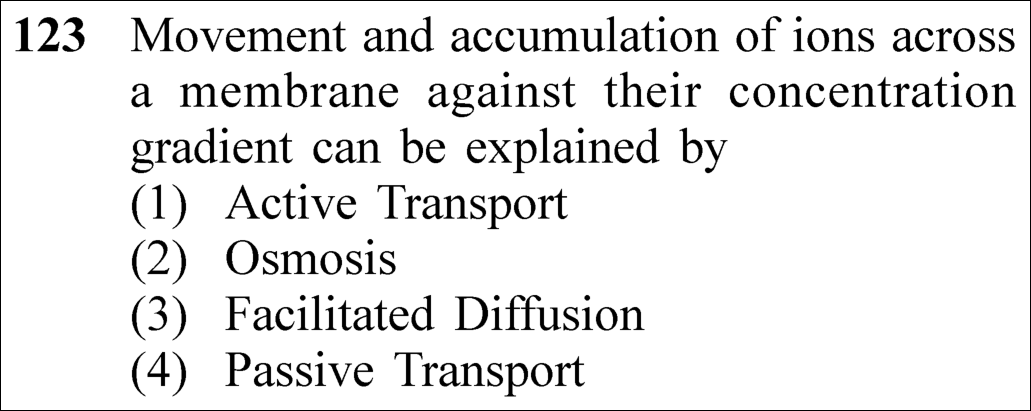
NEET 2023 Botany Question 123: Active Transport Across Biological Membranes

Question

Movement and accumulation of ions across a membrane against their concentration gradient can be explained by

  1. (1)Active Transport
  2. (2)Osmosis
  3. (3)Facilitated Diffusion
  4. (4)Passive Transport
✓
Verified Against NTA Final Answer Key
Option (1) : Active Transport
📚 Transport in Plants Easy
📋 Given Parameters & Problem Setup
Transported Entities Ions / Mineral solutes
Direction Against concentration gradient (uphill)
Result Accumulation across membrane
⚡

The 30-Second Exam Hall Shortcut: ⚡ Uphill Transport Anchor: Against Gradient = Active Transport

⏱️ Save ~20 seconds

Whenever solute transport occurs "against concentration gradient" (uphill) leading to accumulation inside the cell, it strictly requires metabolic energy (ATP) through Active Transport!

1 Passive transport (diffusion): Moves solutes downhill (along concentration gradient), no energy.
2 Osmosis: Special case of water diffusion across semipermeable membrane along chemical potential gradient.
3 Facilitated diffusion: Moves solutes along gradient using permease proteins, no ATP.
4 Active transport: Uses pump proteins and ATP energy to move solutes uphill AGAINST concentration gradient.
5 Match Option (1) Active Transport.
🛡️
Why You Can 100% Trust This Shortcut: Canonical NCERT Membrane Transport thermodynamic classifications.
📐

Step-by-Step Rigorous Workflow & Mathematical Proof

Step 1

Thermodynamic Classification of Membrane Transport

Transport mechanisms across biological membranes are categorized based on energetics and electrochemical directionality:

Passive Transport:Along concentration gradient (Δμ<0), No ATP requiredActive Transport:Against concentration gradient (Δμ>0),Consumes ATP (Uphill)\begin{aligned} \text{\textbf{Passive Transport:}} & \quad \text{Along concentration gradient } (\Delta \mu < 0), \text{ No ATP required} \\[4pt] \text{\textbf{Active Transport:}} & \quad \text{Against concentration gradient } (\Delta \mu > 0), \mathbf{\text{Consumes ATP (Uphill)}} \end{aligned}
Step 2

Ion Accumulation in Plant Roots

Because the concentration of essential mineral ions in root cortical cells is often 100 to 1000 times higher than in the surrounding soil solution, plants must actively pump ions inward across root cell membranes via membrane carrier proteins (proton-pumping ATPases).

[Ion]inside≫[Ion]outside  ⟹  Movement requires Active Transport[\text{Ion}]_{\text{inside}} \gg [\text{Ion}]_{\text{outside}} \implies \text{Movement requires } \mathbf{\text{Active Transport}}
Step 3

Verbatim NCERT Reference

NCERT states: "Active transport uses energy to pump molecules against a concentration gradient. Active transport is carried out by membrane-proteins... Active transport uses ATP."

⭐

360° Option Elimination Engine Key Feature

Diagnose every choice: Know exactly why the right option works and why distractors fail.

4-Option Deep Scan
1 1
✓ 100% Correct
Verdict & Scientific Reason:

Accurate NCERT definition: movement against a concentration gradient requiring ATP is active transport.

💡
Why this is airtight: None; fundamental physiological principle.
2 2
✗ Incorrect
Verdict & Scientific Reason:

Osmosis describes the passive diffusion of solvent (water) along its chemical potential gradient, not ion accumulation against a gradient.

⚠️
Student Fallacy (Why candidates pick this trap): Confusing solvent osmosis with solute active pumping.
3 3
✗ Incorrect
Verdict & Scientific Reason:

Facilitated diffusion is passive; transport proteins move solutes downhill along concentration gradients without ATP.

⚠️
Student Fallacy (Why candidates pick this trap): Assuming involvement of carrier proteins automatically implies active uphill movement.
4 4
✗ Incorrect
Verdict & Scientific Reason:

Passive transport only proceeds down a chemical gradient from higher to lower concentration.

⚠️
Student Fallacy (Why candidates pick this trap): Ignoring the explicit condition "against concentration gradient".
⚠️

NTA Trap Alert: Facilitated Diffusion vs. Active Transport Trap

Both facilitated diffusion and active transport require specific membrane proteins. However, only active transport can move molecules uphill against a gradient.

🛡️ How to avoid the -1 mark: Check the gradient: "Downhill" = Facilitated diffusion. "Uphill / Against gradient" = Active transport.
📖

Core NEET Syllabus Standard

NCERT Biology · Transport in Plants Standard Benchmark
Core Scientific Principle Tested:

"Active transport uses energy to pump molecules against a concentration gradient. It is carried out by specific membrane proteins."

Syllabus Focus: Active Transport
✓ Core NEET UG Syllabus Anchor Syllabus & Academic Standards ↗

Ready to attempt under real exam pressure?

Test your speed and accuracy in the authentic 200-minute timed NTA simulator.

Launch NEET 2023 CBT Test →

Spotted a mistake in this solution? Report an error (support@mycompetitiveexams.com)

⚖️ Legal & Fair Dealing Notice: Sourced from publicly released NEET 2023 question papers and NEET answer keys for private study, research, and non-commercial educational practice under Fair Dealing (Section 52(1)(a) of the Indian Copyright Act, 1957). Not affiliated with or endorsed by NTA or NMC.

Solve 4 NEET Questions a Day — One per Subject

Cover all 1,140 official NEET questions in 285 days at your own pace. Progress is saved on your device. No login needed.