MyCompetitiveExams Logo MyCompetitiveExams
Search 1,140+ Questions
Chapters, formulas, speed tricks
→
⚡ Brahmastra NEET 2027
720 MARKS

Dynamic 180-question full-length simulator mixed dynamically from all 6 years for 2027 & 2026 aspirants.

Launch Brahmastra 2027 Test →
Start Practice →
100% Free · No Login Required
Q.124 Botany ⭐ 360° Option Elimination Active
Vault ↗

NEET 2023 Botany Question 124 Solution

Topic: Anatomy of Flowering Plants · Official NTA Booklet Code G5
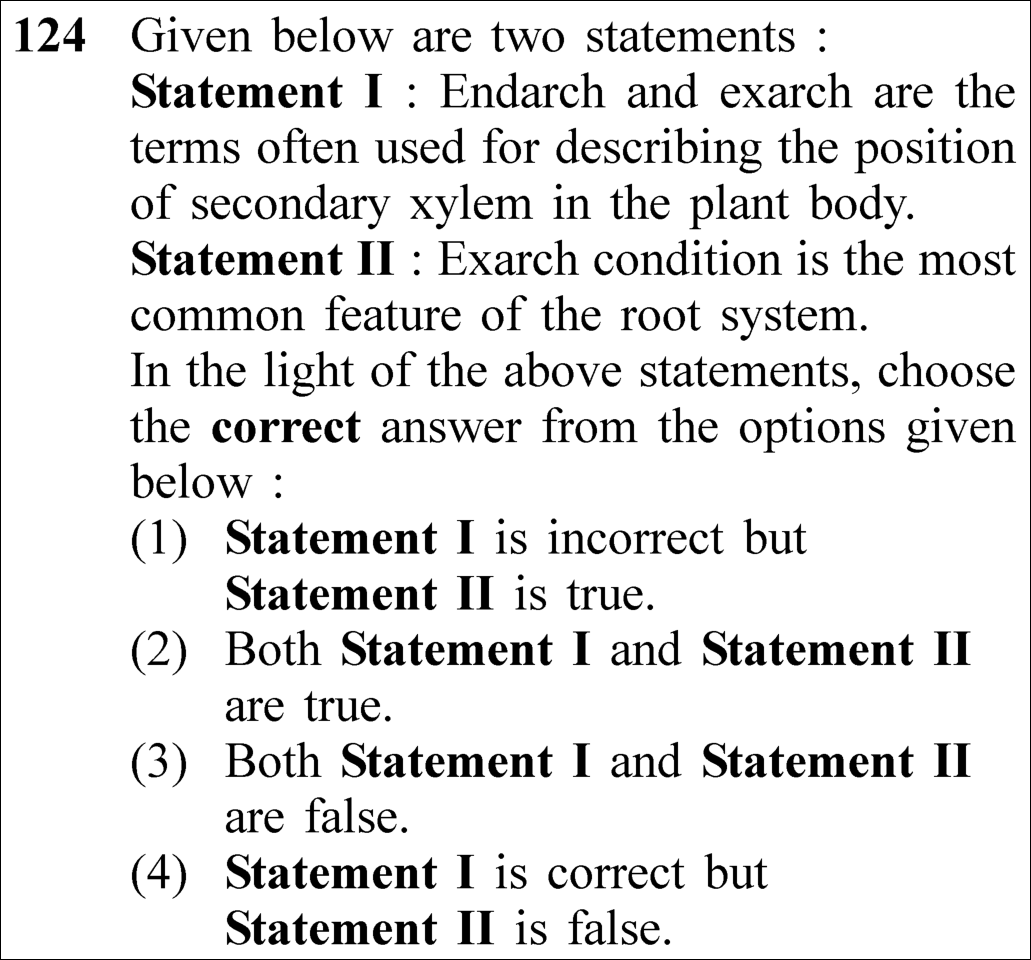
NEET 2023 Botany Question 124: Endarch vs. Exarch Primary Xylem Arrangement

Question

Given below are two statements: Statement I: Endarch and exarch are the terms often used for describing the position of secondary xylem in the plant body. Statement II: Exarch condition is the most common feature of the root system. In the light of the above statements, choose the correct answer from the options given below:

  1. (1)Statement I is incorrect but Statement II is true.
  2. (2)Both Statement I and Statement II are true.
  3. (3)Both Statement I and Statement II are false.
  4. (4)Statement I is correct but Statement II is false.
✓
Verified Against NTA Final Answer Key
Option (1) : Statement I is incorrect but Statement II is true.
📚 Anatomy of Flowering Plants Medium
📋 Given Parameters & Problem Setup
Statement I Endarch and exarch are terms describing position of secondary xylem.
Statement II Exarch condition is the most common feature of the root system.
⚡

The 30-Second Exam Hall Shortcut: ⚡ Endarch/Exarch = PRIMARY Xylem Only!

⏱️ Save ~25 seconds

Endarch and exarch describe the spatial orientation of protoxylem relative to metaxylem in PRIMARY xylem, NEVER secondary xylem! In roots, protoxylem is peripheral (Exarch). Statement I is false, Statement II is true!

1 Check Statement I: Endarch and exarch describe primary xylem (protoxylem & metaxylem), NOT secondary xylem -> Statement I is false/incorrect.
2 Check Statement II: In roots, protoxylem lies towards periphery and metaxylem lies towards centre (exarch) -> Statement II is true.
3 Statement I is incorrect but Statement II is true.
4 Match Option (1).
🛡️
Why You Can 100% Trust This Shortcut: Canonical NCERT Plant Anatomy xylem differentiation nomenclature.
📐

Step-by-Step Rigorous Workflow & Mathematical Proof

Step 1

Evaluation of Statement I (Primary vs. Secondary Xylem)

Endarch and exarch refer exclusively to developmental arrangements of primary xylem elements (protoxylem and metaxylem). Secondary xylem formed by vascular cambium does not exhibit endarch/exarch differentiation:

Endarch / Exarch  ⟺  Position of Protoxylem vs. Metaxylem in PRIMARY Xylem  ⟹  Statement I is Incorrect\text{\textbf{Endarch / Exarch}} \iff \text{Position of Protoxylem vs. Metaxylem in } \mathbf{\text{PRIMARY Xylem}} \implies \text{Statement I is } \mathbf{\text{Incorrect}}
Step 2

Evaluation of Statement II (Exarch Arrangement in Roots)

In stems, protoxylem lies towards pith (centre) and metaxylem towards periphery (endarch). In roots, protoxylem lies towards the periphery and metaxylem towards the centre (exarch):

Stem (Endarch):Protoxylem inner (centrifugal development)Root (Exarch):Protoxylem outer (centripetal development)  ⟹  Statement II is True\begin{aligned} \text{Stem (Endarch):} & \quad \text{Protoxylem inner (centrifugal development)} \\[3pt] \text{\textbf{Root (Exarch):}} & \quad \text{\textbf{Protoxylem outer (centripetal development)}} \implies \text{Statement II is } \mathbf{\text{True}} \end{aligned}
Step 3

Verbatim NCERT Reference

NCERT states verbatim: "In stems, the protoxylem lies towards the centre (pith) and the metaxylem lies towards the periphery of the organ. This type of primary xylem is called endarch. In roots, the protoxylem lies towards periphery and metaxylem lies towards the centre. Such arrangement of primary xylem is called exarch."

⭐

360° Option Elimination Engine Key Feature

Diagnose every choice: Know exactly why the right option works and why distractors fail.

4-Option Deep Scan
1 1
✓ 100% Correct
Verdict & Scientific Reason:

Statement I falsely refers to secondary xylem instead of primary xylem; Statement II accurately identifies exarch as typical of roots.

💡
Why this is airtight: None; rigorous anatomical precision.
2 2
✗ Incorrect
Verdict & Scientific Reason:

Statement I is false because endarch/exarch terms describe primary xylem, not secondary xylem.

⚠️
Student Fallacy (Why candidates pick this trap): Overlooking the word "secondary" in Statement I.
3 3
✗ Incorrect
Verdict & Scientific Reason:

Statement II is factually true according to plant anatomy.

⚠️
Student Fallacy (Why candidates pick this trap): Incorrectly believing roots are endarch.
4 4
✗ Incorrect
Verdict & Scientific Reason:

Both parts of this option are inverted.

⚠️
Student Fallacy (Why candidates pick this trap): Confusing stem and root xylem developmental patterns.
⚠️

NTA Trap Alert: Primary vs. Secondary Xylem Wording Trap

NTA intentionally substituted "secondary xylem" in place of "primary xylem" in Statement I. Students reading too fast recognize "endarch and exarch" and subconsciously assume it is true.

🛡️ How to avoid the -1 mark: Always verify developmental status: Endarch/Exarch applies strictly to PRIMARY xylem.
📖

Core NEET Syllabus Standard

NCERT Biology · Anatomy of Flowering Plants Standard Benchmark
Core Scientific Principle Tested:

"In roots, the protoxylem lies towards periphery and metaxylem lies towards the centre. Such arrangement of primary xylem is called exarch."

Syllabus Focus: Complex Tissues (Xylem)
✓ Core NEET UG Syllabus Anchor Syllabus & Academic Standards ↗

Ready to attempt under real exam pressure?

Test your speed and accuracy in the authentic 200-minute timed NTA simulator.

Launch NEET 2023 CBT Test →

Spotted a mistake in this solution? Report an error (support@mycompetitiveexams.com)

⚖️ Legal & Fair Dealing Notice: Sourced from publicly released NEET 2023 question papers and NEET answer keys for private study, research, and non-commercial educational practice under Fair Dealing (Section 52(1)(a) of the Indian Copyright Act, 1957). Not affiliated with or endorsed by NTA or NMC.

Solve 4 NEET Questions a Day — One per Subject

Cover all 1,140 official NEET questions in 285 days at your own pace. Progress is saved on your device. No login needed.