NEET 2023 Physics Question 10 Solution
Question
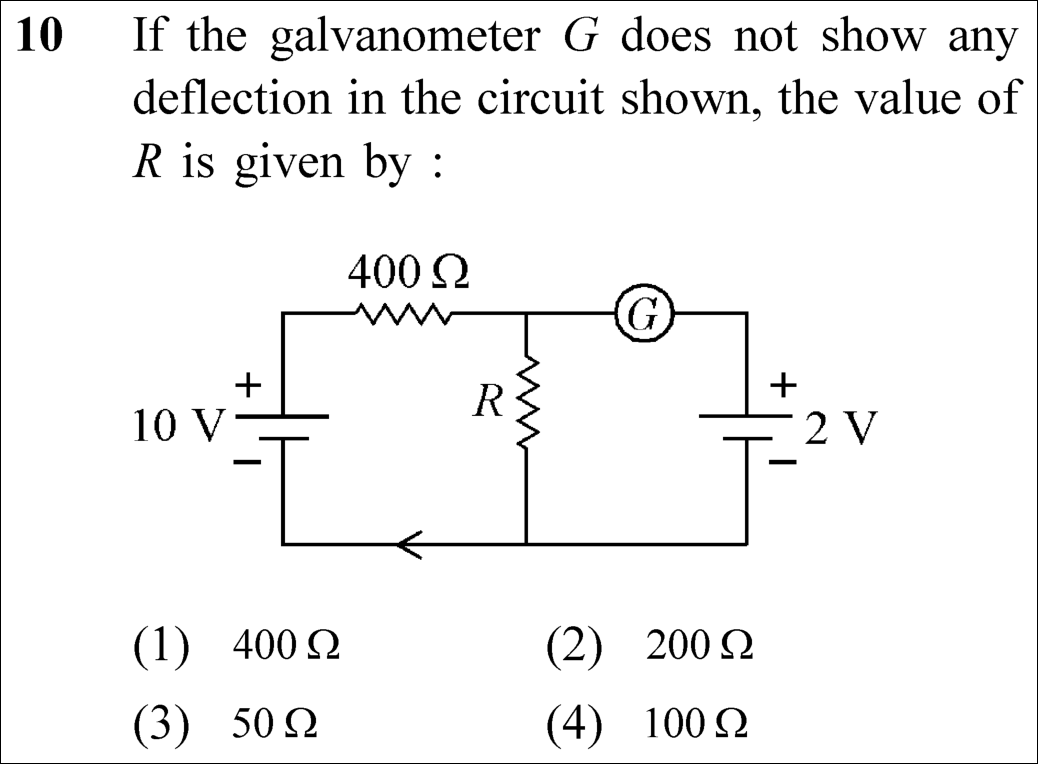
If the galvanometer G does not show any deflection in the circuit shown, the value of R is given by:
Dynamic 180-question full-length simulator mixed dynamically from all 6 years for 2027 & 2026 aspirants.
If the galvanometer G does not show any deflection in the circuit shown, the value of R is given by:
Zero deflection means voltage across R is exactly 2 V! The 10 V battery splits into 8 V across 400 Ω and 2 V across R. Since 2 V is 1/4th of 8 V, R = 400/4 = 100 Ω in 10 seconds!
When the galvanometer G shows zero deflection, the current flowing through its branch is zero (i_g = 0). By Kirchhoff's Current Law at the junction, the secondary branch is completely isolated in terms of current flow:
All current from the 10 V source circulates exclusively through the series combination of 400 Ω and R:
The potential drop across resistor R is given by Ohm's law and must balance the 2 V battery:
Solve the linear equation for resistance R:
Diagnose every choice: Know exactly why the right option works and why distractors fail.
If R were 400 Ω, V_R would be 5 V (half of 10 V), creating a 3 V unbalance across the 2 V cell.
If R were 200 Ω, V_R = (200/600) × 10 = 3.33 V ≠ 2 V.
If R were 50 Ω, V_R = (50/450) × 10 = 1.11 V ≠ 2 V.
Accurate value producing exact 2 V drop across R to achieve galvanometer null deflection.
Some students attempt to treat this circuit as a Wheatstone bridge and search for four ratio arms. This is simply a potentiometer-style null balance circuit.
"At null balance (i = 0), the branch draws no current and the terminal potential difference across the parallel resistor equals the secondary EMF."
Test your speed and accuracy in the authentic 200-minute timed NTA simulator.
Spotted a mistake in this solution? Report an error (support@mycompetitiveexams.com)
Cover all 1,140 official NEET questions in 285 days at your own pace. Progress is saved on your device. No login needed.