MyCompetitiveExams Logo MyCompetitiveExams
Search 1,140+ Questions
Chapters, formulas, speed tricks
→
⚡ Brahmastra NEET 2027
720 MARKS

Dynamic 180-question full-length simulator mixed dynamically from all 6 years for 2027 & 2026 aspirants.

Launch Brahmastra 2027 Test →
Start Practice →
100% Free · No Login Required
Q.54 Chemistry ⭐ 360° Option Elimination Active
Vault ↗

NEET 2023 Chemistry Question 54 Solution

Topic: Surface Chemistry · Official NTA Booklet Code G5
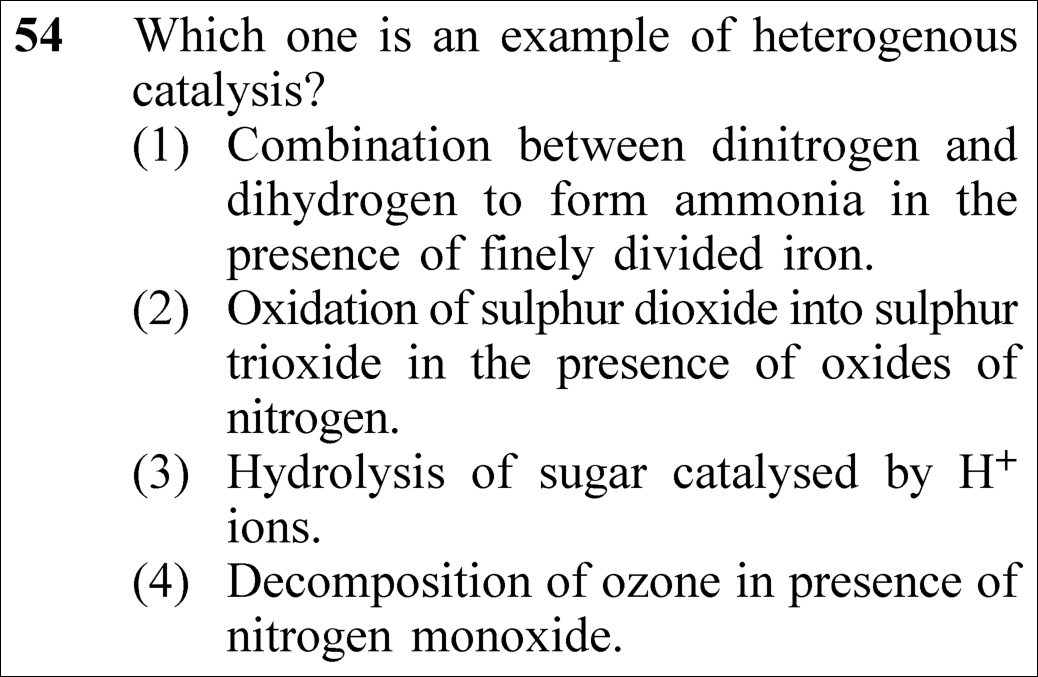
NEET 2023 Chemistry Question 54: Distinction Between Homogeneous and Heterogeneous Catalysis

Question

Which one is an example of heterogenous catalysis?

✓
Verified Against NTA Final Answer Key
Option (1) : Combination between dinitrogen and dihydrogen to form ammonia in the presence of finely divided iron.
📚 Surface Chemistry Easy
📋 Given Parameters & Problem Setup
Criterion Heterogeneous catalysis (Reactants and catalyst in different physical phases)
⚡

The 30-Second Exam Hall Shortcut: ⚡ Phase Comparison Hack: Reactants (Gas) vs Catalyst (Solid)

⏱️ Save ~30 seconds

Haber process: N₂(g) + H₂(g) over solid Fe(s) ⟹ Gaseous reactants on a solid catalyst = Heterogeneous Catalysis in 5 seconds! (All other options have identical phases).

1 Heterogeneous catalysis definition: The catalyst exists in a physical phase DIFFERENT from the reactants.
2 Examine Option (1) Haber process: N₂(g) + 3H₂(g) ⟶ 2NH₃(g) with solid iron Fe(s). Reactants are gaseous, catalyst is solid ⟹ HETEROGENEOUS.
3 Examine Option (2) Lead chamber process: SO₂(g) + O₂(g) catalyzed by NO(g). All gases ⟹ HOMOGENEOUS.
4 Examine Option (3) Inversion of cane sugar: Sucrose(aq) + H₂O(l) catalyzed by H⁺(aq). All liquid/aqueous ⟹ HOMOGENEOUS.
5 Examine Option (4) Ozone depletion: O₃(g) catalyzed by NO(g). All gases ⟹ HOMOGENEOUS.
6 Select Option (1) immediately!
🛡️
Why You Can 100% Trust This Shortcut: Surface Chemistry · Classification of Catalysis (Heterogeneous catalysis is characterized by phase boundary between reactants and catalyst, typically gas/solid or liquid/solid adsorption).
📐

Step-by-Step Rigorous Workflow & Mathematical Proof

Step 1

Definition of Heterogeneous Catalysis

When the catalyst and the reactants are in different phases, the catalytic process is termed heterogeneous catalysis. The reaction typically proceeds via the adsorption theory at the solid catalyst’s active surface sites:

Reactants (Phase 1)+Catalyst (Phase 2)⟶Products\text{Reactants (Phase 1)} + \text{Catalyst (Phase 2)} \longrightarrow \text{Products}
Step 2

Phase Analysis of Option 1 (Haber Process)

In the industrial synthesis of ammonia by Haber’s process, dinitrogen gas and dihydrogen gas react over solid finely divided iron containing molybdenum or potassium oxide promoter:

N2(g)+3H2(g)→Fe(s)2NH3(g)\text{N}_2(g) + 3\text{H}_2(g) \xrightarrow{\text{Fe}(s)} 2\text{NH}_3(g)
Step 3

Confirmation of Phase Difference

The reactants (N₂ and H₂) are in the gaseous phase, whereas the catalyst (Fe) is in the solid phase. Because the phases are different, this is a classic canonical example of heterogeneous catalysis.

Phase(reactants)=gas,Phase(catalyst)=solid  ⟹  Heterogeneous\text{Phase}(\text{reactants}) = \text{gas}, \quad \text{Phase}(\text{catalyst}) = \text{solid} \implies \text{Heterogeneous}
Step 4

Phase Analysis of Distractors (Homogeneous Reactions)

In all other options, reactants and catalysts share the identical phase:

2SO2(g)+O2(g)→NO(g)2SO3(g)(All gases   ⟹  Homogeneous)C12H22O11(aq)+H2O(l)→H+(aq)Glucose(aq)+Fructose(aq)(All liquid   ⟹  Homogeneous)O3(g)+O(g)→NO(g)2O2(g)(All gases   ⟹  Homogeneous)\begin{aligned} 2\text{SO}_2(g) + \text{O}_2(g) &\xrightarrow{\text{NO}(g)} 2\text{SO}_3(g) \quad (\text{All gases } \implies \text{Homogeneous}) \\[4pt] \text{C}_{12}\text{H}_{22}\text{O}_{11}(aq) + \text{H}_2\text{O}(l) &\xrightarrow{\text{H}^+(aq)} \text{Glucose}(aq) + \text{Fructose}(aq) \quad (\text{All liquid } \implies \text{Homogeneous}) \\[4pt] \text{O}_3(g) + \text{O}(g) &\xrightarrow{\text{NO}(g)} 2\text{O}_2(g) \quad (\text{All gases } \implies \text{Homogeneous}) \end{aligned}
⭐

360° Option Elimination Engine Key Feature

Diagnose every choice: Know exactly why the right option works and why distractors fail.

4-Option Deep Scan
1 (1)
✓ 100% Correct
Verdict & Scientific Reason:

Accurate: Reactants are gaseous (N₂, H₂) and catalyst is solid (Fe) — distinct physical phases.

💡
Why this is airtight: None. Candidate correctly identified the phase boundary.
2 (2)
✗ Incorrect
Verdict & Scientific Reason:

Homogeneous catalysis: SO₂, O₂, and NO are all in the gaseous phase.

⚠️
Student Fallacy (Why candidates pick this trap): Candidate forgot that NO catalyst is a gas in the lead chamber process.
3 (3)
✗ Incorrect
Verdict & Scientific Reason:

Homogeneous catalysis: Sugar, water, and acid catalyst H⁺ are all in the liquid/aqueous phase.

⚠️
Student Fallacy (Why candidates pick this trap): Candidate thought dissolved solid sugar made it heterogeneous.
4 (4)
✗ Incorrect
Verdict & Scientific Reason:

Homogeneous catalysis: Ozone and NO are both gases.

⚠️
Student Fallacy (Why candidates pick this trap): Candidate overlooked the uniform gaseous phase.
⚠️

NTA Trap Alert: Confusing Sugar Hydrolysis with Heterogeneous Catalysis

Because sugar starts as solid crystalline table sugar, students often mistakenly classify sugar hydrolysis as heterogeneous. However, the reaction occurs in AQUEOUS SOLUTION, meaning reactants and H⁺ ions are in the same liquid phase (homogeneous).

🛡️ How to avoid the -1 mark: Check the reaction medium: Once dissolved, solutions are single-phase liquid systems.
📖

Core NEET Syllabus Standard

National Eligibility cum Entrance Test (NEET UG) · Surface Chemistry Standard Benchmark
Core Scientific Principle Tested:

"In heterogeneous catalysis, the catalytic process involves reactants and catalyst in different physical states, typically involving surface adsorption."

Syllabus Focus: Catalysis – Homogeneous and Heterogeneous
Preserved in Rationalized Curriculum Syllabus & Academic Standards ↗

Ready to attempt under real exam pressure?

Test your speed and accuracy in the authentic 200-minute timed NTA simulator.

Launch NEET 2023 CBT Test →

Spotted a mistake in this solution? Report an error (support@mycompetitiveexams.com)

⚖️ Legal & Fair Dealing Notice: Sourced from publicly released NEET 2023 question papers and NEET answer keys for private study, research, and non-commercial educational practice under Fair Dealing (Section 52(1)(a) of the Indian Copyright Act, 1957). Not affiliated with or endorsed by NTA or NMC.

Solve 4 NEET Questions a Day — One per Subject

Cover all 1,140 official NEET questions in 285 days at your own pace. Progress is saved on your device. No login needed.