MyCompetitiveExams Logo MyCompetitiveExams
Search 1,140+ Questions
Chapters, formulas, speed tricks
→
⚡ Brahmastra NEET 2027
720 MARKS

Dynamic 180-question full-length simulator mixed dynamically from all 6 years for 2027 & 2026 aspirants.

Launch Brahmastra 2027 Test →
Start Practice →
100% Free · No Login Required
Q.163 Zoology ⭐ 360° Option Elimination Active
Vault ↗

NEET 2023 Zoology Question 163 Solution

Topic: Biomolecules · Official NTA Booklet Code G5
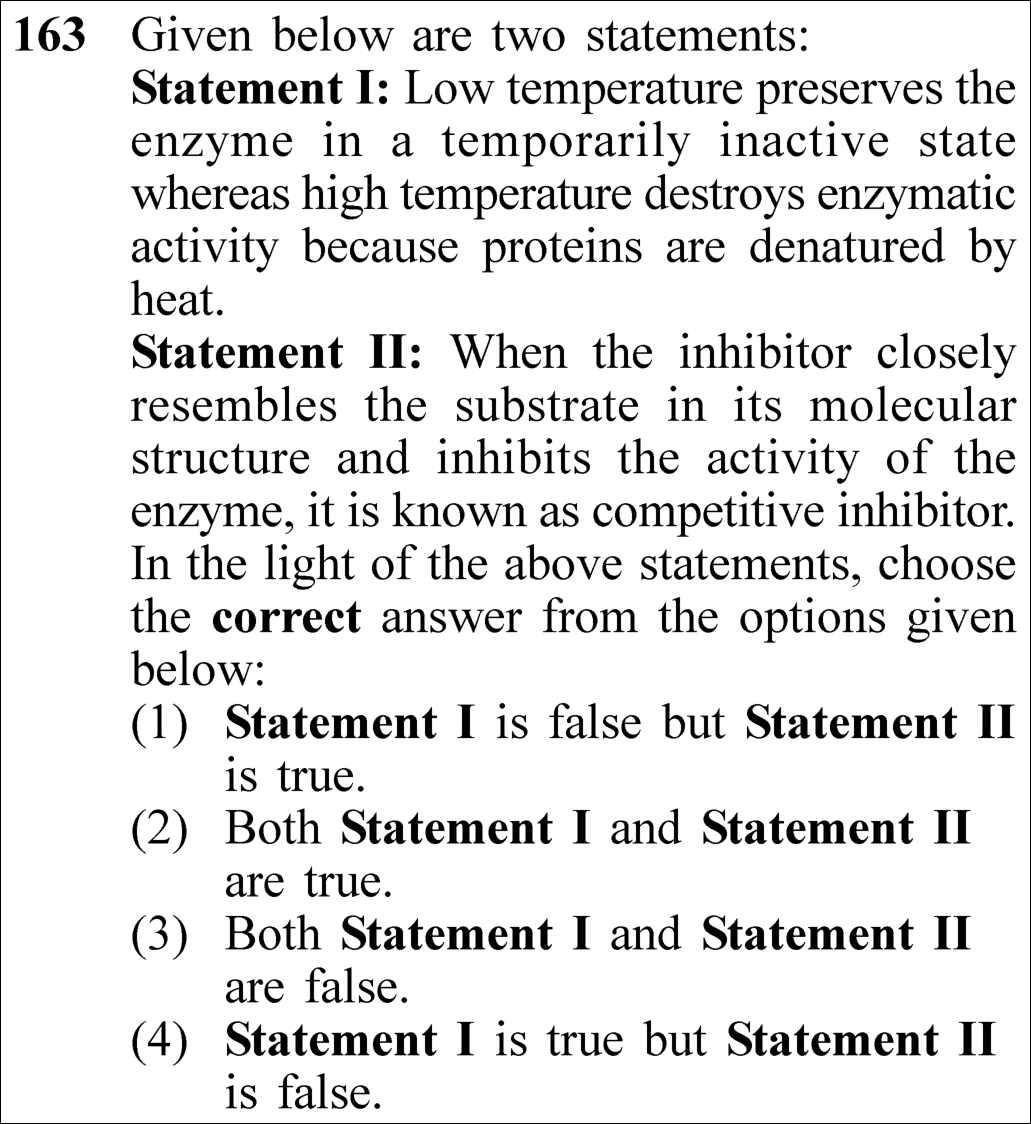
NEET 2023 Zoology Question 163: Enzyme Thermodynamics and Competitive Inhibition

Question

Given below are two statements: Statement I: Low temperature preserves the enzyme in a temporarily inactive state whereas high temperature destroys enzymatic activity because proteins are denatured by heat. Statement II: When the inhibitor closely resembles the substrate in its molecular structure and inhibits the activity of the enzyme, it is known as competitive inhibitor. In the light of the above statements, choose the correct answer from the options given below:

  1. (1)Statement I is false but Statement II is true.
  2. (2)Both Statement I and Statement II are true.
  3. (3)Both Statement I and Statement II are false.
  4. (4)Statement I is true but Statement II is false.
✓
Verified Against NTA Final Answer Key
Option (2) : Both Statement I and Statement II are true.
📚 Biomolecules Easy
📋 Given Parameters & Problem Setup
Statement I Low temperature preserves enzyme in temporarily inactive state; high temp destroys activity via denaturation.
Statement II Inhibitor closely resembling substrate in molecular structure is known as competitive inhibitor.
⚡

The 30-Second Exam Hall Shortcut: ⚡ Enzyme Temperature Kinetics & Competitive Analogue Rules

⏱️ Save ~20 seconds

Low temperature causes kinetic dormancy (reversible inactivation), while high temperature permanently denatures tertiary protein structure. Competitive inhibitors are structural analogues of the substrate. Both statements are verbatim NCERT and TRUE!

1 Check Statement I: Low temp = temporary inactivity; High temp = permanent denaturation -> Verbatim NCERT, True.
2 Check Statement II: Inhibitor resembling substrate molecular structure = competitive inhibitor -> Verbatim NCERT, True.
3 Both Statement I and Statement II are true.
4 Match Option (2).
🛡️
Why You Can 100% Trust This Shortcut: Canonical NCERT Biomolecules enzyme kinetics and inhibition definitions.
📐

Step-by-Step Rigorous Workflow & Mathematical Proof

Step 1

Evaluation of Statement I (Thermal Effects on Enzymes)

Enzyme activity exhibits a bell-shaped curve across temperature. Sub-optimal low temperatures reduce thermal molecular kinetic collisions, locking the active site in a dormant state without breaking covalent bonds. Supra-optimal high temperatures disrupt weak hydrogen and ionic bonds stabilizing tertiary folding, causing irreversible denaturation:

Low Temperature⟶Temporarily Inactive (Reversible)High Temperature⟶Protein Denaturation (Irreversible loss of activity)\begin{aligned} \text{Low Temperature} & \longrightarrow \mathbf{\text{Temporarily Inactive (Reversible)}} \\[4pt] \text{High Temperature} & \longrightarrow \mathbf{\text{Protein Denaturation (Irreversible loss of activity)}} \end{aligned}
Step 2

Evaluation of Statement II (Competitive Inhibition)

When a chemical agent shares geometric and charge complementarity with the catalytic active site of an enzyme, competing with the physiological substrate:

Substrate Analogue→Competes for active siteCompetitive Inhibitor(e.g., Malonate for Succinic Dehydrogenase)\text{Substrate Analogue} \xrightarrow{\text{Competes for active site}} \mathbf{\text{Competitive Inhibitor}} \quad (\text{e.g., Malonate for Succinic Dehydrogenase})
Step 3

Verbatim NCERT Reference

NCERT states verbatim: - "Low temperature preserves the enzyme in a temporarily inactive state whereas high temperature destroys enzymatic activity because proteins are denatured by heat." (Statement I is TRUE) - "When the inhibitor closely resembles the substrate in its molecular structure and inhibits the activity of the enzyme, it is known as competitive inhibitor." (Statement II is TRUE)

⭐

360° Option Elimination Engine Key Feature

Diagnose every choice: Know exactly why the right option works and why distractors fail.

4-Option Deep Scan
1 1
✗ Incorrect
Verdict & Scientific Reason:

Statement I is factually true: low temperature preserves enzymes in inactive states.

⚠️
Student Fallacy (Why candidates pick this trap): Thinking low temperature also denatures proteins.
2 2
✓ 100% Correct
Verdict & Scientific Reason:

Both statements are verbatim excerpts from NCERT Biomolecules.

💡
Why this is airtight: None; textbook verbatim recall.
3 3
✗ Incorrect
Verdict & Scientific Reason:

Both statements are sound biochemical truths.

⚠️
Student Fallacy (Why candidates pick this trap): Unsubstantiated skepticism regarding enzyme mechanisms.
4 4
✗ Incorrect
Verdict & Scientific Reason:

Statement II is factually true: defines competitive inhibition precisely.

⚠️
Student Fallacy (Why candidates pick this trap): Confusing competitive inhibitors with allosteric non-competitive inhibitors.
⚠️

NTA Trap Alert: Inactivation vs. Denaturation Distinction Trap

Students frequently conflate cold inactivation with heat denaturation. Freezing does not denature enzymes (which is why biological samples are stored in liquid nitrogen); high heat breaks tertiary structure permanently.

🛡️ How to avoid the -1 mark: Cold = Temporary inactivity (preservation). Heat = Denaturation (destruction).
📖

Core NEET Syllabus Standard

NCERT Biology · Biomolecules Standard Benchmark
Core Scientific Principle Tested:

"Low temperature preserves the enzyme in a temporarily inactive state whereas high temperature destroys enzymatic activity because proteins are denatured by heat."

Syllabus Focus: Enzymes (Factors Affecting Enzyme Activity)
✓ Core NEET UG Syllabus Anchor Syllabus & Academic Standards ↗

Ready to attempt under real exam pressure?

Test your speed and accuracy in the authentic 200-minute timed NTA simulator.

Launch NEET 2023 CBT Test →

Spotted a mistake in this solution? Report an error (support@mycompetitiveexams.com)

⚖️ Legal & Fair Dealing Notice: Sourced from publicly released NEET 2023 question papers and NEET answer keys for private study, research, and non-commercial educational practice under Fair Dealing (Section 52(1)(a) of the Indian Copyright Act, 1957). Not affiliated with or endorsed by NTA or NMC.

Solve 4 NEET Questions a Day — One per Subject

Cover all 1,140 official NEET questions in 285 days at your own pace. Progress is saved on your device. No login needed.