MyCompetitiveExams Logo MyCompetitiveExams
Search 1,140+ Questions
Chapters, formulas, speed tricks
→
⚡ Brahmastra NEET 2027
720 MARKS

Dynamic 180-question full-length simulator mixed dynamically from all 6 years for 2027 & 2026 aspirants.

Launch Brahmastra 2027 Test →
Start Practice →
100% Free · No Login Required
Q.193 Zoology ⭐ 360° Option Elimination Active
Vault ↗

NEET 2023 Zoology Question 193 Solution

Topic: Excretory Products and their Elimination · Official NTA Booklet Code G5
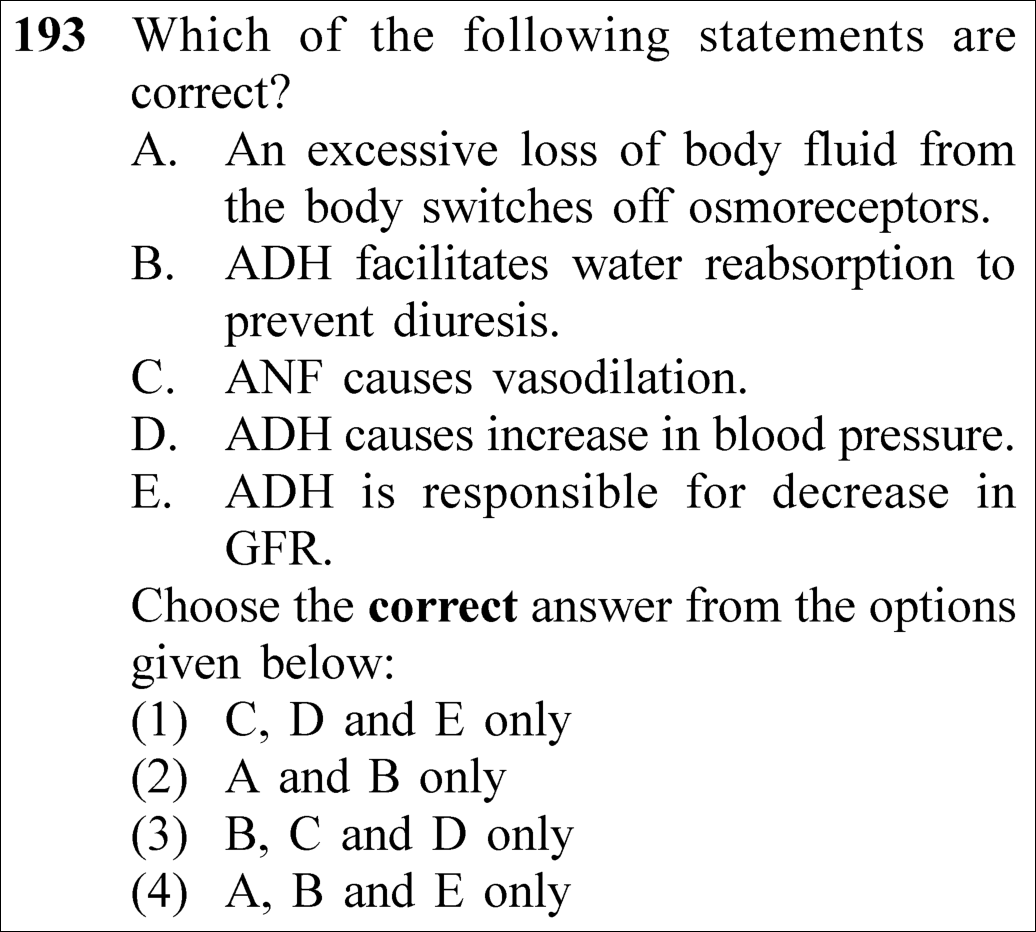
NEET 2023 Zoology Question 193: Regulation of Kidney Function: Osmoreceptors, ADH, and ANF

Question

Which of the following statements are correct? A. An excessive loss of body fluid from the body switches off osmoreceptors. B. ADH facilitates water reabsorption to prevent diuresis. C. ANF causes vasodilation. D. ADH causes increase in blood pressure. E. ADH is responsible for decrease in GFR. Choose the correct answer from the options given below:

  1. (1)C, D and E only
  2. (2)A and B only
  3. (3)B, C and D only
  4. (4)A, B and E only
✓
Verified Against NTA Final Answer Key
Option (3) : B, C and D only
📚 Excretory Products and their Elimination Medium
📋 Given Parameters & Problem Setup
Physiological Systems Osmoreceptors, ADH (Vasopressin), ANF, Blood pressure, and GFR
⚡

The 30-Second Exam Hall Shortcut: ⚡ Osmoreceptor & ADH Error Spotter: A & E are FALSE!

⏱️ Save ~25 seconds

Excess fluid loss ACTIVATES/switches ON osmoreceptors (not off, so A is false!). ADH increases blood pressure which INCREASES GFR (not decrease, so E is false!). B (ADH prevents diuresis), C (ANF causes vasodilation), and D (ADH increases BP) are all TRUE! Select Option (3)!

1 Statement A: Excessive loss of fluid switches off osmoreceptors -> False (Loss of fluid ACTIVATES osmoreceptors).
2 Statement B: ADH facilitates water reabsorption to prevent diuresis -> True.
3 Statement C: ANF causes vasodilation (opposing RAAS) -> True.
4 Statement D: ADH causes vasoconstriction and increases blood pressure -> True.
5 Statement E: ADH decreases GFR -> False (Increase in BP increases glomerular blood flow and GFR).
6 B, C and D only -> Select Option (3).
🛡️
Why You Can 100% Trust This Shortcut: Canonical NCERT Human Physiology renal autoregulation and endocrine control.
📐

Step-by-Step Rigorous Workflow & Mathematical Proof

Step 1

Evaluation of Statements B, C, and D (Valid Statements)

Analyzing the physiological mechanisms governing osmoregulation and blood volume:

Statement B:ADH inserts aquaporins in DCT/collecting duct   ⟹  Prevents Diuresis (TRUE)Statement C:ANF released by atrial stretch causes Vasodilation  ⟹  Decreases BP (TRUE)Statement D:Vasopressin (ADH) constricts arterioles   ⟹  Increases Blood Pressure (TRUE)\begin{aligned} \text{\textbf{Statement B:}} & \quad \text{ADH inserts aquaporins in DCT/collecting duct } \implies \mathbf{\text{Prevents Diuresis (TRUE)}} \\[4pt] \text{\textbf{Statement C:}} & \quad \text{ANF released by atrial stretch causes } \mathbf{\text{Vasodilation}} \implies \mathbf{\text{Decreases BP (TRUE)}} \\[4pt] \text{\textbf{Statement D:}} & \quad \text{Vasopressin (ADH) constricts arterioles } \implies \mathbf{\text{Increases Blood Pressure (TRUE)}} \end{aligned}
Step 2

Evaluation of Statements A and E (Invalid Statements)

Analyzing the specific contradictions planted in A and E: - Statement A: Osmoreceptors in the hypothalamus are stimulated by an *increase* in blood osmolarity (loss of fluid). Excessive fluid loss switches them ON, not off. Fluid gain switches them off. - Statement E: Because ADH increases systemic blood pressure, it elevates glomerular capillary hydrostatic pressure, thereby increasing (or maintaining) GFR, not decreasing it.

Step 3

Verbatim NCERT References

NCERT states under Regulation of Kidney Function: - "An excessive loss of fluid from the body can activate these receptors which stimulate the hypothalamus to release ADH..." - "ADH facilitates water reabsorption from latter parts of the tubule, thereby preventing diuresis." - "ADH has also constrictory effects on blood vessels. This causes an increase in blood pressure." - "An increase in blood pressure can increase the glomerular blood flow and thereby the GFR." - "ANF can cause vasodilation (dilation of blood vessels) and thereby decrease the blood pressure."

⭐

360° Option Elimination Engine Key Feature

Diagnose every choice: Know exactly why the right option works and why distractors fail.

4-Option Deep Scan
1 1
✗ Incorrect
Verdict & Scientific Reason:

Includes false statement E (ADH increases, not decreases, GFR).

⚠️
Student Fallacy (Why candidates pick this trap): Assuming vasoconstriction reduces glomerular filtration rate.
2 2
✗ Incorrect
Verdict & Scientific Reason:

Includes false statement A (fluid loss switches on osmoreceptors).

⚠️
Student Fallacy (Why candidates pick this trap): Misreading "switches off" for "switches on" in Statement A.
3 3
✓ 100% Correct
Verdict & Scientific Reason:

Statements B, C, and D are fully verified and accurate NCERT endocrinological principles.

💡
Why this is airtight: None; rigorous physiological discrimination.
4 4
✗ Incorrect
Verdict & Scientific Reason:

Includes both false statements A and E.

⚠️
Student Fallacy (Why candidates pick this trap): Accepting the erroneous osmoreceptor switch and GFR decrease claims.
⚠️

NTA Trap Alert: Osmoreceptor Activation vs. Deactivation Trigger Trap

Loss of body fluid = High blood osmolarity = Osmoreceptors switch ON (stimulated). Influx of water / excessive fluid = Low osmolarity = Osmoreceptors switch OFF.

🛡️ How to avoid the -1 mark: Fluid loss = Osmoreceptors ON. Fluid gain = Osmoreceptors OFF.
📖

Core NEET Syllabus Standard

NCERT Biology · Excretory Products and their Elimination Standard Benchmark
Core Scientific Principle Tested:

"ADH prevents diuresis and increases blood pressure; ANF causes vasodilation. Excessive fluid loss activates osmoreceptors."

Syllabus Focus: Regulation of Kidney Function
✓ Core NEET UG Syllabus Anchor Syllabus & Academic Standards ↗

Ready to attempt under real exam pressure?

Test your speed and accuracy in the authentic 200-minute timed NTA simulator.

Launch NEET 2023 CBT Test →

Spotted a mistake in this solution? Report an error (support@mycompetitiveexams.com)

⚖️ Legal & Fair Dealing Notice: Sourced from publicly released NEET 2023 question papers and NEET answer keys for private study, research, and non-commercial educational practice under Fair Dealing (Section 52(1)(a) of the Indian Copyright Act, 1957). Not affiliated with or endorsed by NTA or NMC.

Solve 4 NEET Questions a Day — One per Subject

Cover all 1,140 official NEET questions in 285 days at your own pace. Progress is saved on your device. No login needed.