MyCompetitiveExams Logo MyCompetitiveExams
Search 1,140+ Questions
Chapters, formulas, speed tricks
→
⚡ Brahmastra NEET 2027
720 MARKS

Dynamic 180-question full-length simulator mixed dynamically from all 6 years for 2027 & 2026 aspirants.

Launch Brahmastra 2027 Test →
Start Practice →
100% Free · No Login Required
Q.105 Botany ⭐ 360° Option Elimination Active
Vault ↗

NEET 2023 Botany Question 105 Solution

Topic: Biodiversity and Conservation · Official NTA Booklet Code G5
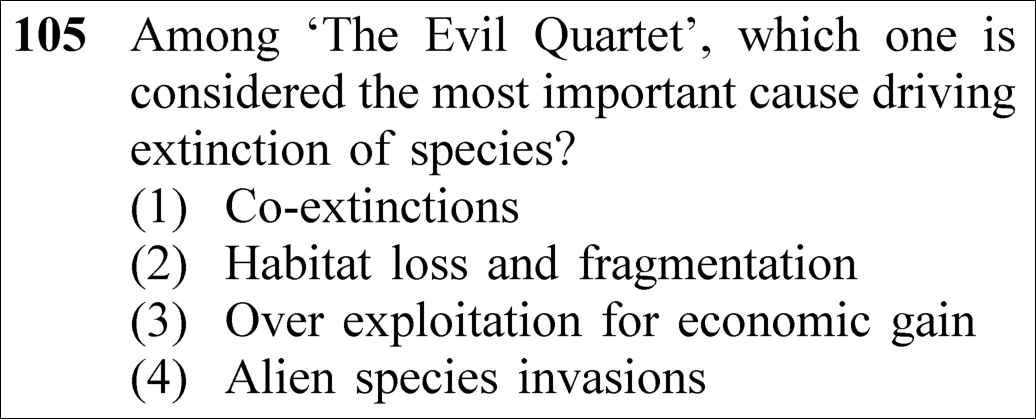
NEET 2023 Botany Question 105: The Evil Quartet and Biodiversity Depletion

Question

Among 'The Evil Quartet', which one is considered the most important cause driving extinction of species?

  1. (1)Co-extinctions
  2. (2)Habitat loss and fragmentation
  3. (3)Over exploitation for economic gain
  4. (4)Alien species invasions
✓
Verified Against NTA Final Answer Key
Option (2) : Habitat loss and fragmentation
📚 Biodiversity and Conservation Easy
📋 Given Parameters & Problem Setup
Concept The Evil Quartet (four major drivers of extinction)
Criterion Most important / prominent driver
⚡

The 30-Second Exam Hall Shortcut: ⚡ Evil Quartet Hierarchy: Habitat Loss = Cause #1

⏱️ Save ~25 seconds

Among all four drivers of "The Evil Quartet", NCERT explicitly states: "Habitat loss and fragmentation is the most important cause driving animals and plants to extinction." Instant 3-second recall!

1 Recall the four drivers of "The Evil Quartet": (1) Habitat loss & fragmentation, (2) Over-exploitation, (3) Alien species invasions, (4) Co-extinctions.
2 Identify the #1 driver: Habitat loss (exemplified by destruction of tropical rain forests from 14% to 6%).
3 Select Option (2) Habitat loss and fragmentation.
🛡️
Why You Can 100% Trust This Shortcut: Canonical NCERT Biodiversity and Conservation ecological consensus.
📐

Step-by-Step Rigorous Workflow & Mathematical Proof

Step 1

Components of The Evil Quartet

The Evil Quartet comprises four major anthropogenic drivers responsible for accelerated species extinction rates:

The Evil Quartet={1.Habitat loss and fragmentation (Primary Driver)2.Over-exploitation3.Alien species invasions4.Co-extinctions\text{The Evil Quartet} = \begin{cases} \mathbf{1.} & \text{\textbf{Habitat loss and fragmentation (Primary Driver)}} \\[3pt] 2. & \text{Over-exploitation} \\[3pt] 3. & \text{Alien species invasions} \\[3pt] 4. & \text{Co-extinctions} \end{cases}
Step 2

Evidence for Primacy of Habitat Loss

Habitat loss directly destroys home ranges, breeding territories, and foraging habitats. NCERT notes that tropical rain forests once covering over 14%14\% of the earth's land surface now cover no more than 6%6\%. Fragmentation isolates populations, leading to inbreeding depression and local extinctions.

Step 3

Evaluation of Alternative Drivers

While over-exploitation (Steller's sea cow, passenger pigeon), alien invasions (Nile perch, water hyacinth), and co-extinctions (obligate mutualists) cause extinctions, habitat destruction universally affects the largest number of taxa simultaneously.

⭐

360° Option Elimination Engine Key Feature

Diagnose every choice: Know exactly why the right option works and why distractors fail.

4-Option Deep Scan
1 1
✗ Incorrect
Verdict & Scientific Reason:

Co-extinction is a secondary consequential driver occurring when a host or obligate partner becomes extinct.

⚠️
Student Fallacy (Why candidates pick this trap): Overestimating cascading extinctions relative to primary habitat destruction.
2 2
✓ 100% Correct
Verdict & Scientific Reason:

Matches NCERT verbatim as the single most critical driver of modern species extinctions.

💡
Why this is airtight: None; textbook verbatim.
3 3
✗ Incorrect
Verdict & Scientific Reason:

Over-exploitation drives specific targeted species to extinction (e.g., passenger pigeon), but is not the overall leading cause across ecosystems.

⚠️
Student Fallacy (Why candidates pick this trap): Confusing targeted human over-harvesting with overall ecosystem disruption.
4 4
✗ Incorrect
Verdict & Scientific Reason:

Invasive species disrupt local niches and cause native species decline, but rank behind habitat destruction.

⚠️
Student Fallacy (Why candidates pick this trap): Focusing on prominent case studies like Nile perch rather than global statistical dominance of habitat destruction.
⚠️

NTA Trap Alert: Superlative Trap in Ecology Questions

All 4 options are genuine components of "The Evil Quartet", so reading carelessly without noting the superlative "most important" leads to random guessing.

🛡️ How to avoid the -1 mark: Always underline "most important" / "primary" in ecology questions; the NCERT answer is universally Habitat Loss and Fragmentation.
📖

Core NEET Syllabus Standard

NCERT Biology · Biodiversity and Conservation Standard Benchmark
Core Scientific Principle Tested:

"Habitat loss and fragmentation: This is the most important cause driving animals and plants to extinction."

Syllabus Focus: Loss of Biodiversity
✓ Core NEET UG Syllabus Anchor Syllabus & Academic Standards ↗

Ready to attempt under real exam pressure?

Test your speed and accuracy in the authentic 200-minute timed NTA simulator.

Launch NEET 2023 CBT Test →

Spotted a mistake in this solution? Report an error (support@mycompetitiveexams.com)

⚖️ Legal & Fair Dealing Notice: Sourced from publicly released NEET 2023 question papers and NEET answer keys for private study, research, and non-commercial educational practice under Fair Dealing (Section 52(1)(a) of the Indian Copyright Act, 1957). Not affiliated with or endorsed by NTA or NMC.

Solve 4 NEET Questions a Day — One per Subject

Cover all 1,140 official NEET questions in 285 days at your own pace. Progress is saved on your device. No login needed.