MyCompetitiveExams Logo MyCompetitiveExams
Search 1,140+ Questions
Chapters, formulas, speed tricks
→
⚡ Brahmastra NEET 2027
720 MARKS

Dynamic 180-question full-length simulator mixed dynamically from all 6 years for 2027 & 2026 aspirants.

Launch Brahmastra 2027 Test →
Start Practice →
100% Free · No Login Required
Q.50 Physics ⭐ 360° Option Elimination Active
Vault ↗

NEET 2023 Physics Question 50 Solution

Topic: Current Electricity · Official NTA Booklet Code G5
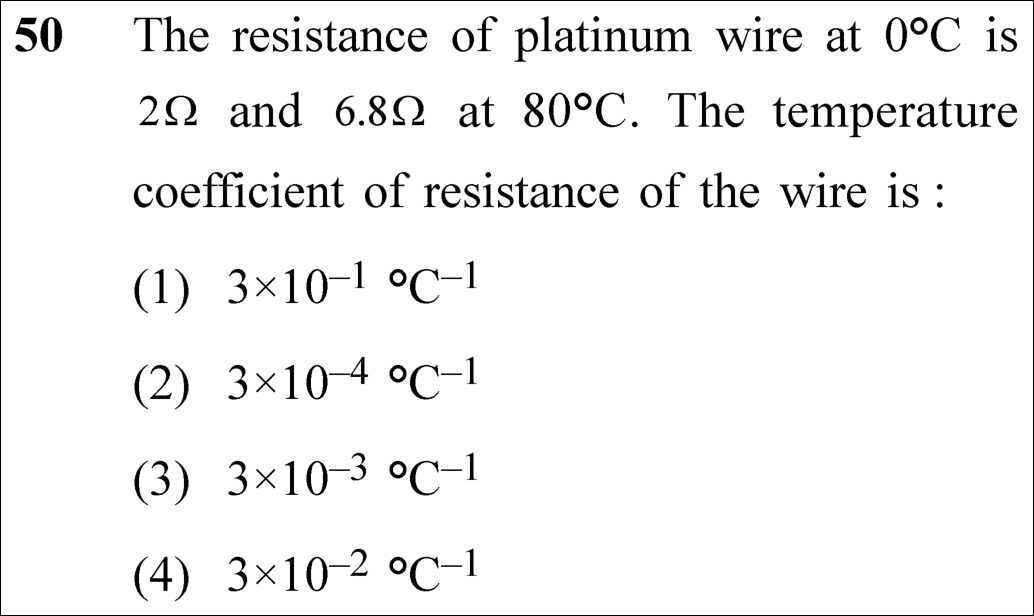
NEET 2023 Physics Question 50: Temperature Coefficient of Resistance (α) of Platinum Wire

Question

The resistance of platinum wire at 0°C is 2 Ω and 6.8 Ω at 80°C. The temperature coefficient of resistance of the wire is:

✓
Verified Against NTA Final Answer Key
Option (4) : 3 × 10⁻² °C⁻¹
📚 Current Electricity Easy
📋 Given Parameters & Problem Setup
Resistance at 0°C (R₀) 2 Ω
Resistance at 80°C (R_t) 6.8 Ω
Temperature difference (ΔT) 80°C - 0°C = 80°C
Governing relation R_t = R₀ (1 + α ΔT)
⚡

The 30-Second Exam Hall Shortcut: ⚡ Direct Slope Formula: α = ΔR / (R₀ · ΔT)

⏱️ Save ~35 seconds

ΔR = 6.8 - 2 = 4.8 Ω. Then α = 4.8 / (2 × 80) = 4.8 / 160 = 48 / 1600 = 3 / 100 = 3 × 10⁻² °C⁻¹ in 10 seconds!

1 Formula for temperature variation of resistance: R_t = R₀(1 + α ΔT).
2 Rearrange for temperature coefficient: α = (R_t - R₀) / (R₀ ΔT) = ΔR / (R₀ ΔT).
3 Calculate resistance change: ΔR = 6.8 Ω - 2 Ω = 4.8 Ω.
4 Substitute values: α = 4.8 / (2 × 80) = 4.8 / 160.
5 Simplify fraction: 4.8 / 160 = 48 / 1600 = 3 / 100 = 0.03 = 3 × 10⁻² °C⁻¹.
6 Lock Option (4) 3 × 10⁻² °C⁻¹ instantly!
🛡️
Why You Can 100% Trust This Shortcut: Current Electricity · Temperature Dependence of Resistance (α is defined as fractional change in resistance per unit temperature rise: α = ΔR / (R₀ · ΔT)).
📐

Step-by-Step Rigorous Workflow & Mathematical Proof

Step 1

Governing Formula for Temperature Dependence of Resistance

Over moderate temperature intervals, the electrical resistance of a metallic conductor varies linearly with temperature according to the relation:

Rt=R0(1+αΔT)R_t = R_0 (1 + \alpha \Delta T)
Step 2

Identification of Given Parameters

From the problem statement:

R0=2 Ω,Rt=6.8 Ω,ΔT=80∘C−0∘C=80∘CR_0 = 2\ \Omega, \quad R_t = 6.8\ \Omega, \quad \Delta T = 80^\circ\text{C} - 0^\circ\text{C} = 80^\circ\text{C}
Step 3

Rearrangement for Temperature Coefficient α

Expanding and isolating the temperature coefficient α:

Rt−R0=R0αΔT  ⟹  α=Rt−R0R0ΔTR_t - R_0 = R_0 \alpha \Delta T \implies \alpha = \frac{R_t - R_0}{R_0 \Delta T}
Step 4

Substitution and Numerical Evaluation

Substitute the given values into the isolated equation:

α=6.8−22×80=4.8160=481600=3100=0.03 ∘C−1\alpha = \frac{6.8 - 2}{2 \times 80} = \frac{4.8}{160} = \frac{48}{1600} = \frac{3}{100} = 0.03\ ^\circ\text{C}^{-1}
Step 5

Expression in Standard Scientific Notation

Convert 0.03 to scientific notation:

α=3×10⁻² ∘C−1\alpha = 3 \times 10^{-2}\ ^\circ\text{C}^{-1}
⭐

360° Option Elimination Engine Key Feature

Diagnose every choice: Know exactly why the right option works and why distractors fail.

4-Option Deep Scan
1 (1)
✗ Incorrect
Verdict & Scientific Reason:

Off by a factor of 10 (0.3 instead of 0.03).

⚠️
Student Fallacy (Why candidates pick this trap): Candidate divided 4.8 by 16 instead of 160.
2 (2)
✗ Incorrect
Verdict & Scientific Reason:

Underestimates coefficient by a factor of 100.

⚠️
Student Fallacy (Why candidates pick this trap): Candidate placed two extra zeros in the denominator.
3 (3)
✗ Incorrect
Verdict & Scientific Reason:

Typical platinum wire value in textbooks (3.9 × 10⁻³), but does NOT match the exam question’s specific numbers.

⚠️
Student Fallacy (Why candidates pick this trap): Candidate guessed based on standard textbook platinum value without doing the math.
4 (4)
✓ 100% Correct
Verdict & Scientific Reason:

Accurate value derived from given data: 4.8 / 160 = 0.03 = 3 × 10⁻² °C⁻¹.

💡
Why this is airtight: None. Candidate executed the calculation accurately.
⚠️

NTA Trap Alert: Blindly Selecting Standard Textbook Value (3.9 × 10⁻³ °C⁻¹)

Students who memorize standard physical constants often know that platinum has α ≈ 3.9 × 10⁻³ °C⁻¹ and hastily select Option (3) 3 × 10⁻³. The exam question uses hypothetical numbers (R increases from 2 Ω to 6.8 Ω over only 80°C!), yielding α = 0.03 = 3 × 10⁻² °C⁻¹.

🛡️ How to avoid the -1 mark: Never guess based on real-world constants; always calculate from the numbers given in the question!
📖

Core NEET Syllabus Standard

National Eligibility cum Entrance Test (NEET UG) · Current Electricity Standard Benchmark
Core Scientific Principle Tested:

"Temperature coefficient of resistance is α = ΔR / (R₀ ΔT)."

Syllabus Focus: Temperature Dependence of Resistivity and Resistance
Preserved in Rationalized Curriculum Syllabus & Academic Standards ↗

Ready to attempt under real exam pressure?

Test your speed and accuracy in the authentic 200-minute timed NTA simulator.

Launch NEET 2023 CBT Test →

Spotted a mistake in this solution? Report an error (support@mycompetitiveexams.com)

⚖️ Legal & Fair Dealing Notice: Sourced from publicly released NEET 2023 question papers and NEET answer keys for private study, research, and non-commercial educational practice under Fair Dealing (Section 52(1)(a) of the Indian Copyright Act, 1957). Not affiliated with or endorsed by NTA or NMC.

Solve 4 NEET Questions a Day — One per Subject

Cover all 1,140 official NEET questions in 285 days at your own pace. Progress is saved on your device. No login needed.