MyCompetitiveExams Logo MyCompetitiveExams
Search 1,140+ Questions
Chapters, formulas, speed tricks
→
⚡ Brahmastra NEET 2027
720 MARKS

Dynamic 180-question full-length simulator mixed dynamically from all 6 years for 2027 & 2026 aspirants.

Launch Brahmastra 2027 Test →
Start Practice →
100% Free · No Login Required
Q.66 Chemistry ⭐ 360° Option Elimination Active
Vault ↗

NEET 2023 Chemistry Question 66 Solution

Topic: Electrochemistry · Official NTA Booklet Code G5
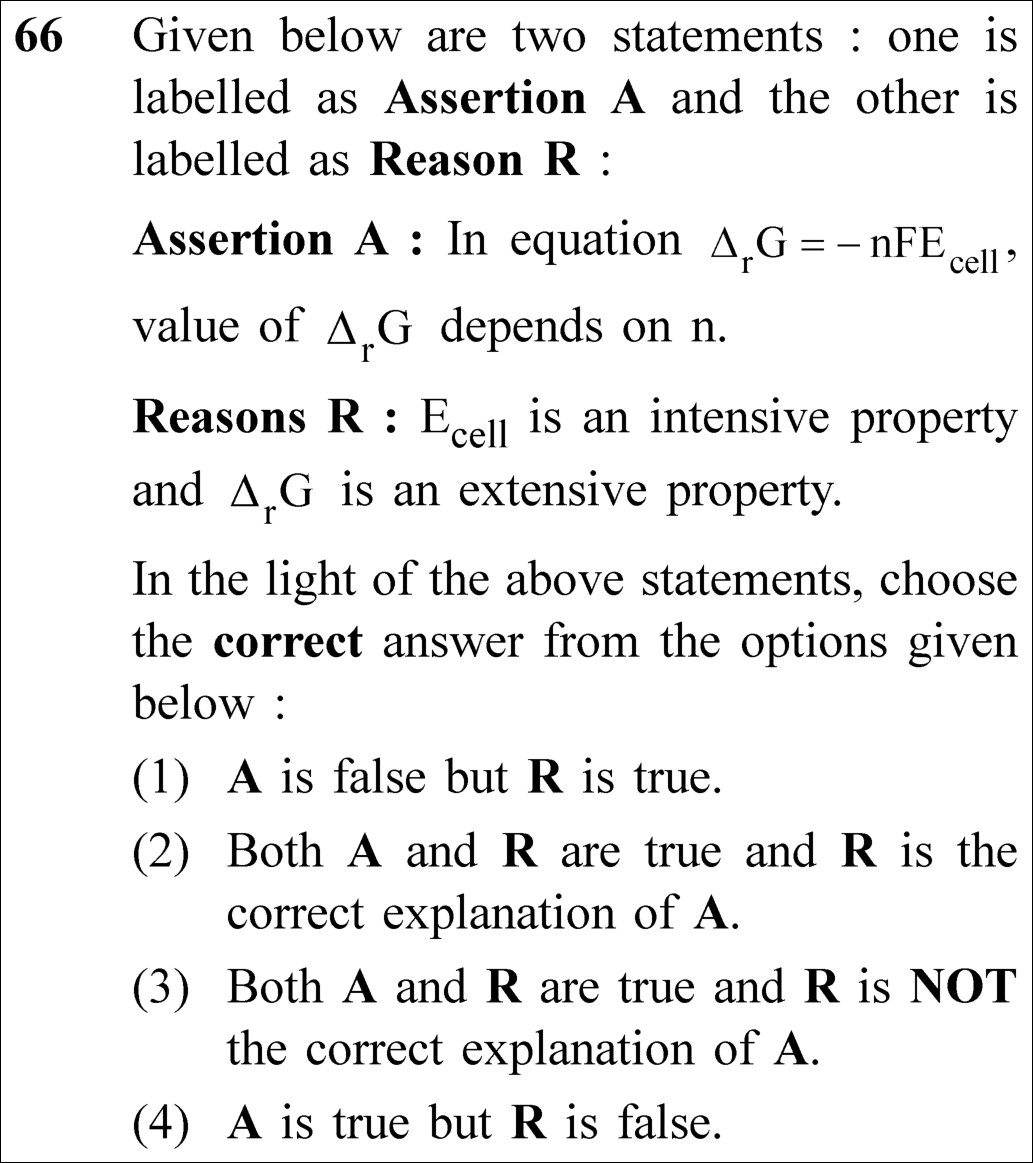
NEET 2023 Chemistry Question 66: Intensive vs Extensive Nature of E_cell and Δ_r G

Question

Given below are two statements: one is labelled as Assertion A and the other is labelled as Reason R: Assertion A: In equation ΔrG = −nFE(cell), value of ΔrG depends on n. Reasons R: E(cell) is an intensive property and ΔrG is an extensive property. In the light of the above statements, choose the correct answer from the options given below:

✓
Verified Against NTA Final Answer Key
Option (2) : Both A and R are true and R is the correct explanation of A.
📚 Electrochemistry Easy
📋 Given Parameters & Problem Setup
Assertion A In equation Δ_r G = -n F E_cell, value of Δ_r G depends on n.
Reason R E_cell is an intensive property and Δ_r G is an extensive property.
Faraday constant (F) Charge carried by 1 mole of electrons (~96487 C mol⁻¹)
⚡

The 30-Second Exam Hall Shortcut: ⚡ Extensive vs Intensive Matching Hack: ΔG Scales with Matter

⏱️ Save ~40 seconds

E_cell is intensive (voltage per unit charge doesn’t scale with amount), whereas ΔG is extensive (joules of energy scales with amount)! Thus Δ_r G = -nFE_cell must multiply by stoichiometric electrons n. Both A and R are true, and R explains A in 10 seconds!

1 Check Assertion A: In Δ_r G = -n F E_cell, n represents the stoichiometric number of moles of electrons transferred.
2 If we multiply the stoichiometric equation by 2, n doubles, so Δ_r G doubles. Hence Δ_r G depends on n (Assertion A is TRUE).
3 Check Reason R: Standard cell potential E_cell is an INTENSIVE property (like temperature or density), independent of system size.
4 Gibbs free energy Δ_r G is an EXTENSIVE property (like mass or volume), directly proportional to the amount of substance.
5 Therefore, to convert the intensive property E_cell into the extensive thermodynamic potential Δ_r G, one must multiply by the stoichiometric factor n F.
6 Reason R is true and provides the exact physical justification for Assertion A.
7 Select Option (2) Both A and R are true and R is the correct explanation of A!
🛡️
Why You Can 100% Trust This Shortcut: Chemical Thermodynamics · Extensive vs Intensive Variables (Electrical work w_elec = Δ_r G = -nFE_cell links intensive electrical potential to extensive thermodynamic free energy).
📐

Step-by-Step Rigorous Workflow & Mathematical Proof

Step 1

Thermodynamic Definition of Electrical Work and Gibbs Free Energy

The maximum non-expansion electrical work (w_elec) obtainable from a galvanic cell operating reversibly at constant temperature and pressure is equal to the decrease in Gibbs free energy of the cell reaction:

ΔrG=−welec=−nFEcell\Delta_r G = -w_{\text{elec}} = -n F E_{\text{cell}}
Step 2

Dependence of Δ_r G on Stoichiometric Multiplier n (Assertion A)

Consider the Daniell cell reaction. For the single-electron representation vs two-electron representation, the electrical potential E_cell remains identical (+1.10 V), but the moles of electrons transferred n changes, directly doubling Δ_r G:

Zn+Cu2+⟶Zn2++Cu  ⟹  n=2,ΔrG=−2FEcell12Zn+12Cu2+⟶12Zn2++12Cu  ⟹  n=1,ΔrG=−1FEcell\begin{aligned} \text{Zn} + \text{Cu}^{2+} \longrightarrow \text{Zn}^{2+} + \text{Cu} &\implies n = 2, \quad \Delta_r G = -2 F E_{\text{cell}} \\[4pt] \frac{1}{2}\text{Zn} + \frac{1}{2}\text{Cu}^{2+} \longrightarrow \frac{1}{2}\text{Zn}^{2+} + \frac{1}{2}\text{Cu} &\implies n = 1, \quad \Delta_r G = -1 F E_{\text{cell}} \end{aligned}
Step 3

Classification of Thermodynamic Properties (Reason R)

An intensive property is one whose value is independent of the size or quantity of matter in the system (e.g., electrical potential E_cell, temperature, pressure). An extensive property is one whose value depends on the mass or quantity of matter (e.g., Gibbs energy G, enthalpy H, volume V). Therefore, E_cell is intensive, and Δ_r G is extensive.

Ecell∈Intensive properties,ΔrG∈Extensive propertiesE_{\text{cell}} \in \text{Intensive properties}, \qquad \Delta_r G \in \text{Extensive properties}
Step 4

Causal Relationship Evaluation

Because Δ_r G is extensive while E_cell is intensive, Δ_r G must scale with the stoichiometric extent of reaction, which is mathematically embodied by the stoichiometric factor n. Thus, Reason R correctly explains Assertion A.

Both A and R are True, and R is the Correct Explanation of A\text{Both A and R are True, and R is the Correct Explanation of A}
⭐

360° Option Elimination Engine Key Feature

Diagnose every choice: Know exactly why the right option works and why distractors fail.

4-Option Deep Scan
1 (1)
✗ Incorrect
Verdict & Scientific Reason:

Assertion A is demonstrably true (ΔG depends on n).

⚠️
Student Fallacy (Why candidates pick this trap): Candidate thought ΔG is a fixed constant independent of reaction coefficients.
2 (2)
✓ 100% Correct
Verdict & Scientific Reason:

Accurate: Δ_r G depends on n precisely because it is an extensive property, while E_cell is intensive.

💡
Why this is airtight: None. Candidate understood the link between extensive scaling and stoichiometric factor n.
3 (3)
✗ Incorrect
Verdict & Scientific Reason:

Fails to recognize that the intensive/extensive distinction is the direct cause of the n-dependence.

⚠️
Student Fallacy (Why candidates pick this trap): Candidate treated the two statements as disconnected facts.
4 (4)
✗ Incorrect
Verdict & Scientific Reason:

Reason R is true according to fundamental thermodynamics.

⚠️
Student Fallacy (Why candidates pick this trap): Candidate confused the definitions of intensive and extensive properties.
⚠️

NTA Trap Alert: Thinking That "Both Are True But R is NOT the Explanation" (Option 3)

Many candidates correctly recognize both statements as true, but hesitate to link them causally. The only reason n appears in ΔG = -nFE is because E_cell is intensive and ΔG is extensive! R is the direct, fundamental explanation of A.

🛡️ How to avoid the -1 mark: Ask "WHY does ΔG depend on n?" Because ΔG is extensive (amount-dependent) while E_cell is intensive (amount-independent)!
📖

Core NEET Syllabus Standard

National Eligibility cum Entrance Test (NEET UG) · Electrochemistry Standard Benchmark
Core Scientific Principle Tested:

"E_cell is an intensive parameter but Δ_r G is an extensive thermodynamic property, so the value depends on n: Δ_r G = -n F E_cell."

Syllabus Focus: Electrochemical Cells and Gibbs Energy of the Reaction
Preserved in Rationalized Curriculum Syllabus & Academic Standards ↗

Ready to attempt under real exam pressure?

Test your speed and accuracy in the authentic 200-minute timed NTA simulator.

Launch NEET 2023 CBT Test →

Spotted a mistake in this solution? Report an error (support@mycompetitiveexams.com)

⚖️ Legal & Fair Dealing Notice: Sourced from publicly released NEET 2023 question papers and NEET answer keys for private study, research, and non-commercial educational practice under Fair Dealing (Section 52(1)(a) of the Indian Copyright Act, 1957). Not affiliated with or endorsed by NTA or NMC.

Solve 4 NEET Questions a Day — One per Subject

Cover all 1,140 official NEET questions in 285 days at your own pace. Progress is saved on your device. No login needed.