MyCompetitiveExams Logo MyCompetitiveExams
Search 1,140+ Questions
Chapters, formulas, speed tricks
→
⚡ Brahmastra NEET 2027
720 MARKS

Dynamic 180-question full-length simulator mixed dynamically from all 6 years for 2027 & 2026 aspirants.

Launch Brahmastra 2027 Test →
Start Practice →
100% Free · No Login Required
Q.113 Botany ⭐ 360° Option Elimination Active
Vault ↗

NEET 2023 Botany Question 113 Solution

Topic: Sexual Reproduction in Flowering Plants · Official NTA Booklet Code G5
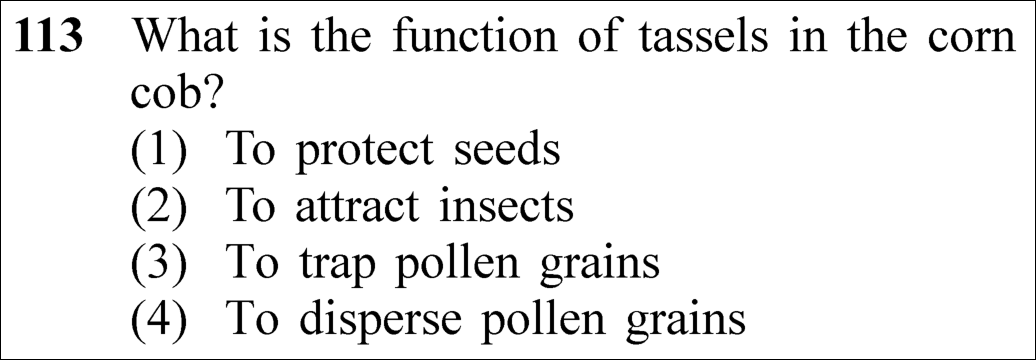
NEET 2023 Botany Question 113: Anemophily Adaptations in Maize (Zea mays)

Question

What is the function of tassels in the corn cob?

  1. (1)To protect seeds
  2. (2)To attract insects
  3. (3)To trap pollen grains
  4. (4)To disperse pollen grains
✓
Verified Against NTA Final Answer Key
Option (3) : To trap pollen grains
📚 Sexual Reproduction in Flowering Plants Easy
📋 Given Parameters & Problem Setup
Plant Structure Tassels in the corn cob (maize ear)
Morphological Identity Feathery elongated stigma and styles
Pollination Mode Anemophily (wind pollination)
⚡

The 30-Second Exam Hall Shortcut: ⚡ Corn Cob Tassels = Stigma & Style to Trap Windborne Pollen

⏱️ Save ~20 seconds

In a corn cob, the long silky threads (tassels) waving out are elongated styles and stigmas specifically adapted to capture and trap windborne pollen grains floating in air currents!

1 Maize is wind pollinated (anemophilous).
2 The male inflorescence is at the shoot apex; the female cob is borne in the leaf axil.
3 Silky tassels hanging from the cob represent tremendously elongated styles and stigmas.
4 Their function is to expose a huge receptive surface to trap airborne pollen grains.
5 Match Option (3) To trap pollen grains.
🛡️
Why You Can 100% Trust This Shortcut: Canonical NCERT Sexual Reproduction in Flowering Plants anemophilous adaptations.
📐

Step-by-Step Rigorous Workflow & Mathematical Proof

Step 1

Morphological Identity of Corn Cob Tassels

In maize (Zea mays\textit{Zea mays}), the ear (cob) is a female inflorescence (spadix). The silks or tassels emerging from the husk leaves represent extremely elongated styles and feathery stigmas attached to each ovule:

Corn Cob Tassels≡Elongated Styles and Feathery Stigmas\text{Corn Cob Tassels} \equiv \text{Elongated Styles and Feathery Stigmas}
Step 2

Adaptation for Wind Pollination (Anemophily)

Wind pollination requires large, exposed, feathery stigmas to maximize the probability of intercepting non-motile, lightweight pollen carried by air currents:

Feathery Stigma Surface+Wind Currents⟶Efficient Trapping of Airborne Pollen\text{Feathery Stigma Surface} + \text{Wind Currents} \longrightarrow \text{\textbf{Efficient Trapping of Airborne Pollen}}
Step 3

Verbatim NCERT Confirmation

NCERT states verbatim: "The tassels you see are nothing but the stigma and style which wave in the wind to trap pollen grains."

⭐

360° Option Elimination Engine Key Feature

Diagnose every choice: Know exactly why the right option works and why distractors fail.

4-Option Deep Scan
1 1
✗ Incorrect
Verdict & Scientific Reason:

Protection of developing seeds/grains is provided by the dense outer husk leaves (spathe), not the exposed stigmatic silks.

⚠️
Student Fallacy (Why candidates pick this trap): Confusing vegetative protective bracts/husks with reproductive stigmas.
2 2
✗ Incorrect
Verdict & Scientific Reason:

Maize is anemophilous (wind pollinated) and produces neither nectar nor insect-attracting visual cues.

⚠️
Student Fallacy (Why candidates pick this trap): Assuming floral structures generally serve to attract insects.
3 3
✓ 100% Correct
Verdict & Scientific Reason:

Matches NCERT verbatim: styles and stigmas wave in the breeze to intercept and trap airborne pollen grains.

💡
Why this is airtight: None; textbook verbatim.
4 4
✗ Incorrect
Verdict & Scientific Reason:

Pollen grains are produced and dispersed by the male inflorescence (the staminate tassel at the top of the plant), not by the female cob.

⚠️
Student Fallacy (Why candidates pick this trap): Confusing pollen-producing male tassels at plant apex with female cob silks.
⚠️

NTA Trap Alert: Male Tassel vs. Female Cob Silks Confusion

Botanically, the terminal male inflorescence of maize is also called a tassel. However, the question specifically specifies "tassels in the corn cob", which NCERT explicitly defines as the styles and stigmas of the female inflorescence.

🛡️ How to avoid the -1 mark: Read the prompt carefully: tassels "in the corn cob" = female styles/stigmas that trap pollen.
📖

Core NEET Syllabus Standard

NCERT Biology · Sexual Reproduction in Flowering Plants Standard Benchmark
Core Scientific Principle Tested:

"A common example is the corn cob; the tassels you see are nothing but the stigma and style which wave in the wind to trap pollen grains."

Syllabus Focus: Agents of Pollination (Wind Pollination)
✓ Core NEET UG Syllabus Anchor Syllabus & Academic Standards ↗

Ready to attempt under real exam pressure?

Test your speed and accuracy in the authentic 200-minute timed NTA simulator.

Launch NEET 2023 CBT Test →

Spotted a mistake in this solution? Report an error (support@mycompetitiveexams.com)

⚖️ Legal & Fair Dealing Notice: Sourced from publicly released NEET 2023 question papers and NEET answer keys for private study, research, and non-commercial educational practice under Fair Dealing (Section 52(1)(a) of the Indian Copyright Act, 1957). Not affiliated with or endorsed by NTA or NMC.

Solve 4 NEET Questions a Day — One per Subject

Cover all 1,140 official NEET questions in 285 days at your own pace. Progress is saved on your device. No login needed.