MyCompetitiveExams Logo MyCompetitiveExams
Search 1,140+ Questions
Chapters, formulas, speed tricks
→
⚡ Brahmastra NEET 2027
720 MARKS

Dynamic 180-question full-length simulator mixed dynamically from all 6 years for 2027 & 2026 aspirants.

Launch Brahmastra 2027 Test →
Start Practice →
100% Free · No Login Required
Q.97 Chemistry ⭐ 360° Option Elimination Active
Vault ↗

NEET 2023 Chemistry Question 97 Solution

Topic: General Principles and Processes of Isolation of Elements · Official NTA Booklet Code G5
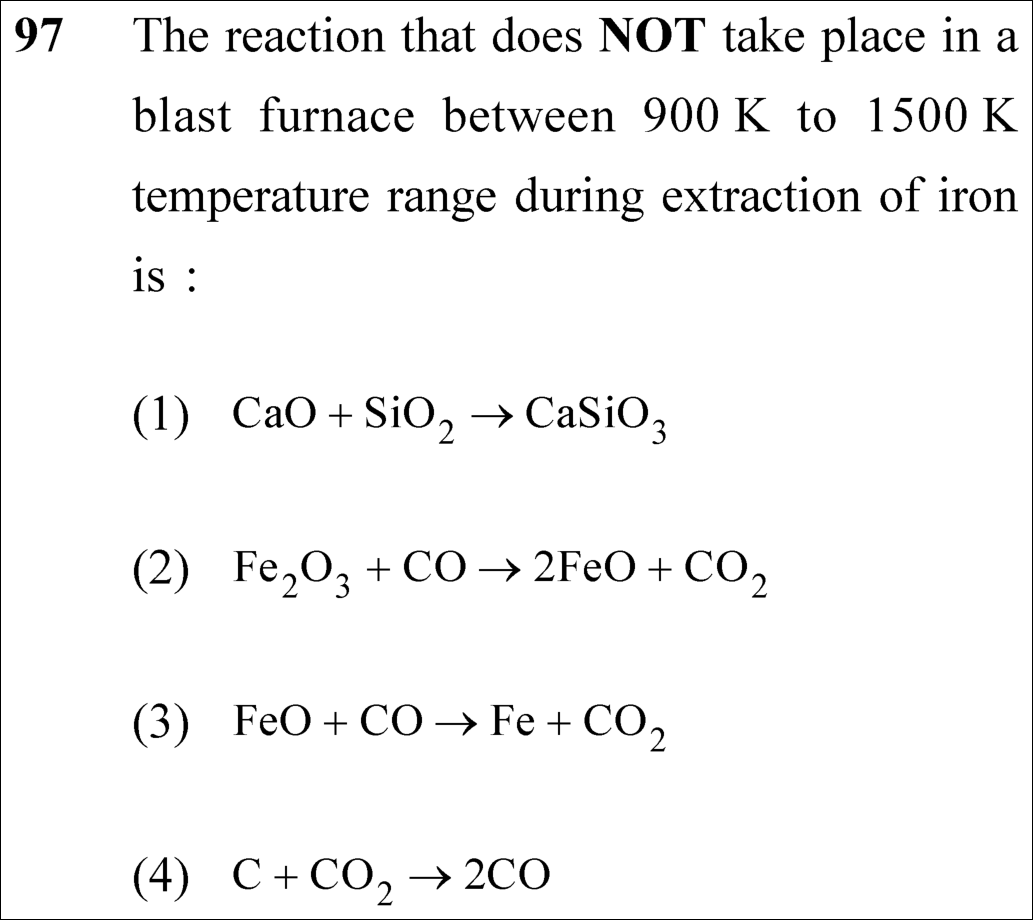
NEET 2023 Chemistry Question 97: Temperature Zones and Reactions in the Blast Furnace

Question

The reaction that does NOT take place in a blast furnace between 900K to 1500K temperature range during extraction of iron is:

✓
Verified Against NTA Final Answer Key
Option (2) : Fe₂O₃ + CO → 2FeO + CO₂
📚 General Principles and Processes of Isolation of Elements Medium
📋 Given Parameters & Problem Setup
Process Extraction of iron in blast furnace
Specified temperature range 900 K to 1500 K (higher temperature zone)
Question requirement Reaction that does NOT take place in this range
⚡

The 30-Second Exam Hall Shortcut: ⚡ Blast Furnace Thermal Zone Division: Reduction of Fe₂O₃ Occurs at Top (500–800 K)!

⏱️ Save ~30 seconds

In a blast furnace, reduction of haematite (Fe₂O₃) by CO occurs at the TOP in the LOWER temperature zone (500 K – 800 K): Fe₂O₃ + CO ⟶ 2 FeO + CO₂. The higher temperature zone (900 K – 1500 K) in the middle/lower part features C + CO₂ ⟶ 2 CO, FeO + CO ⟶ Fe + CO₂, and slag formation CaO + SiO₂ ⟶ CaSiO₃! Therefore, reaction (2) does NOT occur in 900–1500 K! Lock Option (2) in 10 seconds!

1 Check Lower Temperature Range (500 K – 800 K, top of furnace):
2 - 3 Fe₂O₃ + CO ⟶ 2 Fe₃O₄ + CO₂
3 - Fe₃O₄ + 4 CO ⟶ 3 Fe + 4 CO₂
4 - Fe₂O₃ + CO ⟶ 2 FeO + CO₂
5 Check Higher Temperature Range (900 K – 1500 K, middle/lower furnace):
6 - C + CO₂ ⟶ 2 CO
7 - FeO + CO ⟶ Fe + CO₂
8 - CaCO₃ ⟶ CaO + CO₂
9 - CaO + SiO₂ ⟶ CaSiO₃ (slag formation)
10 Reaction (2) belongs exclusively to 500–800 K, so it does NOT take place in 900–1500 K.
11 Match Option (2) directly.
🛡️
Why You Can 100% Trust This Shortcut: Verbatim NCERT Metallurgy Figure 6.6 & Blast Furnace thermal zone descriptions.
📐

Step-by-Step Rigorous Workflow & Mathematical Proof

Step 1

Thermal Profile of the Blast Furnace

The blast furnace is divided into thermal zones based on height: (a) Upper lower-temperature zone (500 K to 800 K), and (b) Middle-to-lower higher-temperature zone (900 K to 1500 K):

Zones: 500 K−800 K⏟Upper (Reduction of Fe2O3)⟷900 K−1500 K⏟Middle/Lower (Reduction of FeO, Slag, CO gen)\text{Zones: } \underbrace{500\text{ K} - 800\text{ K}}_{\text{Upper (Reduction of } \text{Fe}_2\text{O}_3)} \quad \longleftrightarrow \quad \underbrace{900\text{ K} - 1500\text{ K}}_{\text{Middle/Lower (Reduction of FeO, Slag, CO gen)}}
Step 2

Reactions in the Lower Temperature Range (500 K – 800 K)

At the top of the furnace, haematite (Fe₂O₃) is reduced in stages by carbon monoxide at 500 K – 800 K:

3Fe2O3+CO⟶2Fe3O4+CO2Fe3O4+4CO⟶3Fe+4CO2Fe2O3+CO⟶2FeO+CO2(Occurs at 500 K−800 K)\begin{aligned} 3\text{Fe}_2\text{O}_3 + \text{CO} &\longrightarrow 2\text{Fe}_3\text{O}_4 + \text{CO}_2 \\ \text{Fe}_3\text{O}_4 + 4\text{CO} &\longrightarrow 3\text{Fe} + 4\text{CO}_2 \\ \text{Fe}_2\text{O}_3 + \text{CO} &\longrightarrow 2\text{FeO} + \text{CO}_2 \quad (\text{Occurs at } 500\text{ K} - 800\text{ K}) \end{aligned}
Step 3

Reactions in the Higher Temperature Range (900 K – 1500 K)

In the 900 K to 1500 K zone, carbon dioxide is reduced by coke, FeO is reduced to iron, and limestone forms slag:

C+CO2⟶2COFeO+CO⟶Fe+CO2CaCO3⟶CaO+CO2CaO+SiO2⟶CaSiO3(Slag formation)\begin{aligned} \text{C} + \text{CO}_2 &\longrightarrow 2\text{CO} \\ \text{FeO} + \text{CO} &\longrightarrow \text{Fe} + \text{CO}_2 \\ \text{CaCO}_3 &\longrightarrow \text{CaO} + \text{CO}_2 \\ \text{CaO} + \text{SiO}_2 &\longrightarrow \text{CaSiO}_3 \quad (\text{Slag formation}) \end{aligned}
Step 4

Identify the Reaction that Does NOT Take Place in 900–1500 K

Reaction (2), Fe₂O₃ + CO ⟶ 2 FeO + CO₂, takes place strictly at the lower temperatures (500 K – 800 K). Therefore, it does NOT occur in the 900 K to 1500 K range:

Fe2O3+CO⟶2FeO+CO2(Does NOT occur at 900 K−1500 K)\text{Fe}_2\text{O}_3 + \text{CO} \longrightarrow 2\text{FeO} + \text{CO}_2 \quad (\text{Does NOT occur at } 900\text{ K} - 1500\text{ K})
⭐

360° Option Elimination Engine Key Feature

Diagnose every choice: Know exactly why the right option works and why distractors fail.

4-Option Deep Scan
1 (1)
✗ Incorrect
Verdict & Scientific Reason:

Slag formation occurs actively between 1070 K and 1270 K (inside 900 K – 1500 K).

⚠️
Student Fallacy (Why candidates pick this trap): Candidate forgot the temperature of slag formation in the middle zone.
2 (2)
✓ 100% Correct
Verdict & Scientific Reason:

Accurate: This reduction step occurs at the cooler top of the blast furnace (500 K – 800 K), not between 900 K and 1500 K.

💡
Why this is airtight: None. Candidate correctly correlated reaction thermodynamics with furnace temperature zones.
3 (3)
✗ Incorrect
Verdict & Scientific Reason:

Reduction of FeO to Fe takes place directly within the 900 K – 1500 K range.

⚠️
Student Fallacy (Why candidates pick this trap): Candidate confused the reduction of FeO with the reduction of Fe₂O₃.
4 (4)
✗ Incorrect
Verdict & Scientific Reason:

The endothermic Boudouard reaction occurs at high temperatures (around 1000 K – 1200 K).

⚠️
Student Fallacy (Why candidates pick this trap): Candidate did not recognize that coke reduction of CO₂ requires high temperature.
⚠️

NTA Trap Alert: Confusing Low and High Temperature Reduction Steps

Students remember that CO reduces iron oxides throughout the furnace, but forget that Fe₂O₃ is reduced to FeO at the top (cooler zone, 500–800 K), and FeO is reduced to molten Fe in the hotter zone (900–1500 K).

🛡️ How to avoid the -1 mark: Remember: Fe₂O₃ reduction = Top (cooler, 500–800 K); FeO reduction + Slag formation = Middle/Bottom (hotter, 900–1500 K).
📖

Core NEET Syllabus Standard

National Eligibility cum Entrance Test (NEET UG) · General Principles and Processes of Isolation of Elements Standard Benchmark
Core Scientific Principle Tested:

"Reduction of Fe₂O₃ by CO proceeds in the upper low-temperature zone (500–800 K); reduction of FeO and slag formation occur at 900–1500 K."

Syllabus Focus: Extraction of Iron from its Oxides – Blast Furnace
Preserved in Rationalized Curriculum Syllabus & Academic Standards ↗

Ready to attempt under real exam pressure?

Test your speed and accuracy in the authentic 200-minute timed NTA simulator.

Launch NEET 2023 CBT Test →

Spotted a mistake in this solution? Report an error (support@mycompetitiveexams.com)

⚖️ Legal & Fair Dealing Notice: Sourced from publicly released NEET 2023 question papers and NEET answer keys for private study, research, and non-commercial educational practice under Fair Dealing (Section 52(1)(a) of the Indian Copyright Act, 1957). Not affiliated with or endorsed by NTA or NMC.

Solve 4 NEET Questions a Day — One per Subject

Cover all 1,140 official NEET questions in 285 days at your own pace. Progress is saved on your device. No login needed.