MyCompetitiveExams Logo MyCompetitiveExams
Search 1,140+ Questions
Chapters, formulas, speed tricks
→
⚡ Brahmastra NEET 2027
720 MARKS

Dynamic 180-question full-length simulator mixed dynamically from all 6 years for 2027 & 2026 aspirants.

Launch Brahmastra 2027 Test →
Start Practice →
100% Free · No Login Required
Q.39 Physics ⭐ 360° Option Elimination Active
Vault ↗

NEET 2023 Physics Question 39 Solution

Topic: Oscillations · Official NTA Booklet Code G5
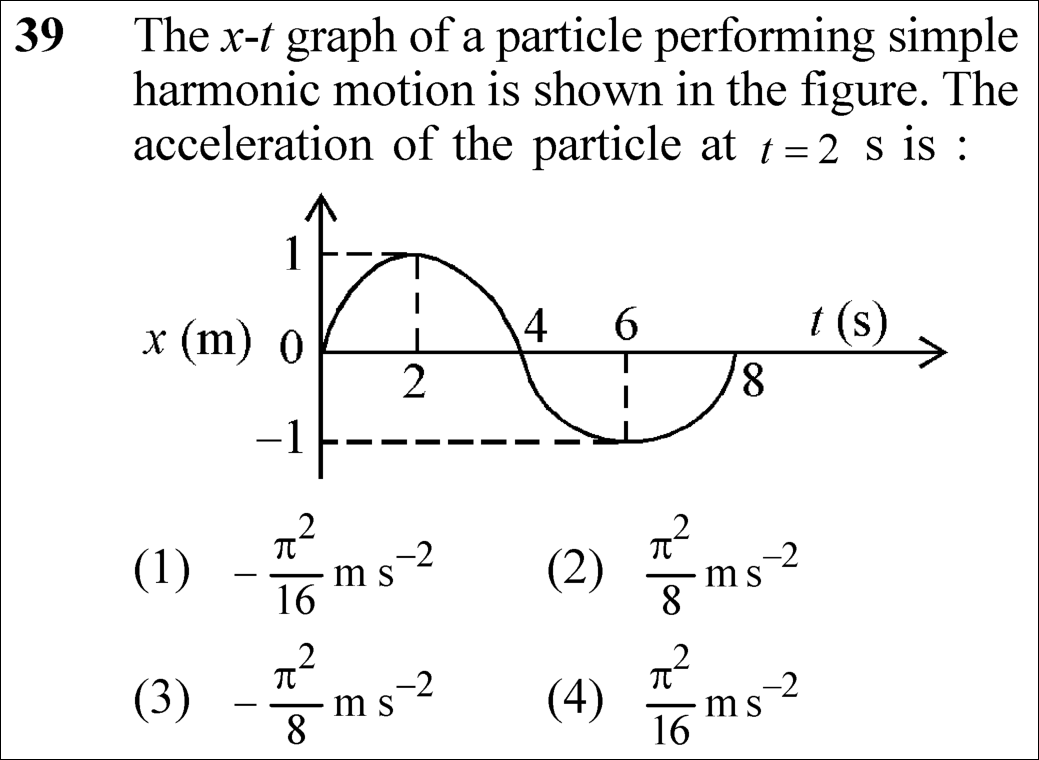
NEET 2023 Physics Question 39: Acceleration in SHM from x-t Graph at Positive Extreme

Question

The x-t graph of a particle performing simple harmonic motion is shown in the figure. The acceleration of the particle at t = 2 s is:

✓
Verified Against NTA Final Answer Key
Option (1) : -π² / 16 m s⁻²
📚 Oscillations Easy
📋 Given Parameters & Problem Setup
Amplitude (A) 1 m (from crest of x-t graph)
Time period (T) 8 s (one full wave cycle)
Evaluation instant t = 2 s (at crest x = +1 m)
Angular frequency (ω) 2π / T = 2π / 8 = π / 4 rad s⁻¹
⚡

The 30-Second Exam Hall Shortcut: ⚡ Extreme Position Acceleration Rule: a = -ω² x

⏱️ Save ~40 seconds

From graph: T = 8 s ⟹ ω = 2π/8 = π/4 rad/s. At t = 2 s, particle is at positive crest x = +1 m. Acceleration a = -ω² x = -(π/4)²(1) = -π²/16 m s⁻² in 10 seconds!

1 Inspect the graph: One full sinusoidal cycle spans from t = 0 to t = 8 s ⟹ Time period T = 8 s.
2 Calculate angular frequency: ω = 2π / T = 2π / 8 = π / 4 rad/s.
3 Locate t = 2 s on the graph: The displacement is at the positive crest, x = +1 m.
4 In SHM, acceleration is governed by a = -ω² x.
5 Substitute: a = -(π/4)² × (1) = -π² / 16 m s⁻².
6 Lock Option (1) -π²/16 m s⁻² instantly!
🛡️
Why You Can 100% Trust This Shortcut: Oscillations · Simple Harmonic Motion Dynamics (Defining differential relation of SHM: d²x/dt² = -ω²x).
📐

Step-by-Step Rigorous Workflow & Mathematical Proof

Step 1

Extraction of Parameters from the x-t Graph

The given sinusoidal waveform begins at x = 0 at t = 0, reaches its positive maximum x = +1 m at t = 2 s, returns to zero at t = 4 s, reaches its negative minimum x = -1 m at t = 6 s, and completes one full oscillation at t = 8 s:

A=1 m,T=8 sA = 1\text{ m}, \qquad T = 8\text{ s}
Step 2

Calculation of Angular Frequency ω

The angular frequency of the simple harmonic oscillator is related to the time period T by:

ω=2πT=2π8=π4 rad s−1\omega = \frac{2\pi}{T} = \frac{2\pi}{8} = \frac{\pi}{4}\text{ rad s}^{-1}
Step 3

Equation of Motion for the Particle

Since the motion starts at the origin at t = 0 moving in the positive x direction, the displacement function is represented by:

x(t)=Asin⁡(ωt)=1⋅sin⁡(π4t)x(t) = A \sin(\omega t) = 1 \cdot \sin\left(\frac{\pi}{4} t\right)
Step 4

Evaluation of Acceleration at t = 2 s

Differentiating displacement twice with respect to time yields the acceleration function a(t) = -ω² x(t). At time t = 2 s, the displacement is x(2) = sin(π/2) = +1 m:

a(2)=−ω2x(2)=−(π4)2(1)=−π216 m s−2a(2) = -\omega^2 x(2) = -\left(\frac{\pi}{4}\right)^2 (1) = -\frac{\pi^2}{16}\text{ m s}^{-2}
⭐

360° Option Elimination Engine Key Feature

Diagnose every choice: Know exactly why the right option works and why distractors fail.

4-Option Deep Scan
1 (1)
✓ 100% Correct
Verdict & Scientific Reason:

Accurate acceleration at positive extreme: a = -ω² A = -π²/16 m s⁻².

💡
Why this is airtight: None. Candidate correctly extracted parameters and applied the negative sign.
2 (2)
✗ Incorrect
Verdict & Scientific Reason:

Wrong denominator and omitted restoring negative sign.

⚠️
Student Fallacy (Why candidates pick this trap): Candidate forgot the restoring negative sign and used ω = 2π/T without squaring properly.
3 (3)
✗ Incorrect
Verdict & Scientific Reason:

Incorrect denominator (calculated 4² = 8 instead of 16).

⚠️
Student Fallacy (Why candidates pick this trap): Candidate multiplied 4 by 2 instead of squaring: (π/4)² evaluated erroneously as π²/8.
4 (4)
✗ Incorrect
Verdict & Scientific Reason:

Positive sign error.

⚠️
Student Fallacy (Why candidates pick this trap): Candidate omitted the negative sign in the SHM restoring acceleration formula a = -ω²x.
⚠️

NTA Trap Alert: Omitting the Restoring Negative Sign (Choosing +π²/16)

At the positive displacement extreme (x = +A), the restoring force and acceleration act BACKWARDS toward the mean position, meaning acceleration MUST be negative (a = -ω² A = -π²/16). Forgetting the minus sign leads to Option (4).

🛡️ How to avoid the -1 mark: Restoring Principle: In SHM, acceleration ALWAYS opposes displacement: when x > 0, acceleration a MUST be negative!
📖

Core NEET Syllabus Standard

National Eligibility cum Entrance Test (NEET UG) · Oscillations Standard Benchmark
Core Scientific Principle Tested:

"In SHM, acceleration is directly proportional to displacement and directed opposite to it: a = -ω² x."

Syllabus Focus: Simple Harmonic Motion Kinematics and Acceleration
Preserved in Rationalized Curriculum Syllabus & Academic Standards ↗

Ready to attempt under real exam pressure?

Test your speed and accuracy in the authentic 200-minute timed NTA simulator.

Launch NEET 2023 CBT Test →

Spotted a mistake in this solution? Report an error (support@mycompetitiveexams.com)

⚖️ Legal & Fair Dealing Notice: Sourced from publicly released NEET 2023 question papers and NEET answer keys for private study, research, and non-commercial educational practice under Fair Dealing (Section 52(1)(a) of the Indian Copyright Act, 1957). Not affiliated with or endorsed by NTA or NMC.

Solve 4 NEET Questions a Day — One per Subject

Cover all 1,140 official NEET questions in 285 days at your own pace. Progress is saved on your device. No login needed.