MyCompetitiveExams Logo MyCompetitiveExams
Search 1,140+ Questions
Chapters, formulas, speed tricks
→
⚡ Brahmastra NEET 2027
720 MARKS

Dynamic 180-question full-length simulator mixed dynamically from all 6 years for 2027 & 2026 aspirants.

Launch Brahmastra 2027 Test →
Start Practice →
100% Free · No Login Required
Q.52 Chemistry ⭐ 360° Option Elimination Active
Vault ↗

NEET 2023 Chemistry Question 52 Solution

Topic: Chemical Bonding and Molecular Structure · Official NTA Booklet Code G5
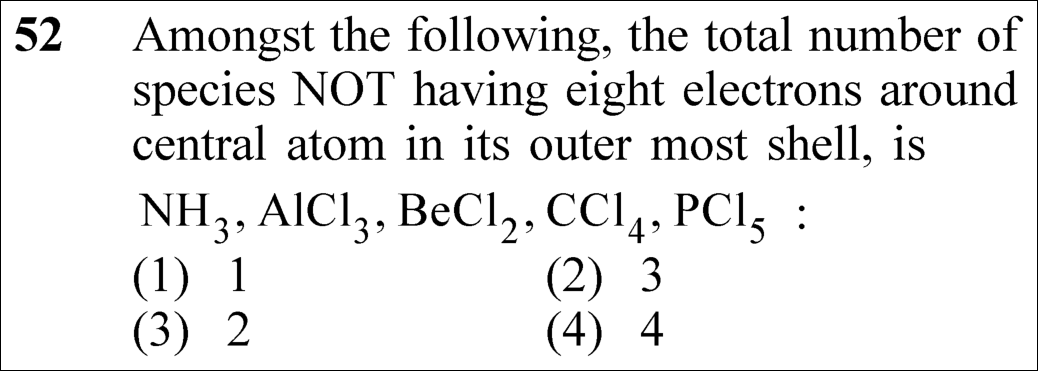
NEET 2023 Chemistry Question 52: Identification of Incomplete Octet and Expanded Octet Molecules

Question

Amongst the following, the total number of species NOT having eight electrons around central atom in its outer most shell, is NH₃, AlCl₃, BeCl₂, CCl₄, PCl₅:

✓
Verified Against NTA Final Answer Key
Option (2) : 3
📚 Chemical Bonding and Molecular Structure Easy
📋 Given Parameters & Problem Setup
Set of molecules NH₃, AlCl₃, BeCl₂, CCl₄, PCl₅
Target condition Central atom NOT having 8 electrons in outermost shell
⚡

The 30-Second Exam Hall Shortcut: ⚡ Valence Electron Quick Scan: Octet = 8; Non-Octet ≠ 8

⏱️ Save ~30 seconds

NH₃ (8 e⁻, octet) and CCl₄ (8 e⁻, octet) are normal octets. AlCl₃ (6 e⁻, hypo), BeCl₂ (4 e⁻, hypo), and PCl₅ (10 e⁻, hyper) violate octet rule! Total = 3 non-octet species in 10 seconds!

1 Inspect each central atom valence shell:
2 - NH₃: N has 3 single bonds + 1 lone pair = 6 + 2 = 8 electrons (Octet complete).
3 - AlCl₃: Al has 3 valence electrons, forming 3 single bonds = 6 electrons (Incomplete octet / Hypovalent) ⟹ COUNT #1.
4 - BeCl₂: Be has 2 valence electrons, forming 2 single bonds = 4 electrons (Incomplete octet / Hypovalent) ⟹ COUNT #2.
5 - CCl₄: C has 4 valence electrons, forming 4 single bonds = 8 electrons (Octet complete).
6 - PCl₅: P has 5 valence electrons, forming 5 single bonds = 10 electrons (Expanded octet / Hypervalent) ⟹ COUNT #3.
7 Count the non-octet species: AlCl₃, BeCl₂, and PCl₅ = 3 species.
8 Lock Option (2) 3 immediately!
🛡️
Why You Can 100% Trust This Shortcut: Chemical Bonding · Octet Rule Exceptions (Incomplete octets occur in electron-deficient Group 2 and 13 monomer halides; expanded octets occur in Period 3 elements utilizing d-orbitals).
📐

Step-by-Step Rigorous Workflow & Mathematical Proof

Step 1

Definition of Lewis Octet Completeness

According to the Lewis-Kossel octet rule, main-group atoms tend to gain, lose, or share electrons to attain a stable valence configuration of eight electrons (s² p⁶). Species deviating from 8 valence electrons around the central atom are classified as either electron-deficient (incomplete octet, < 8 e⁻) or hypervalent (expanded octet, > 8 e⁻).

Octet Criterion: Valence electrons around central atom =8\text{Octet Criterion: Valence electrons around central atom } = 8
Step 2

Individual Molecule Electron Count

Evaluate the total valence electrons surrounding the central atom in each monomeric Lewis structure:

NH3:3 bond pairs+1 lone pair=6+2=8 e−(Complete octet)AlCl3:3 bond pairs+0 lone pairs=6 e−(Incomplete octet, <8)BeCl2:2 bond pairs+0 lone pairs=4 e−(Incomplete octet, <8)CCl4:4 bond pairs+0 lone pairs=8 e−(Complete octet)PCl5:5 bond pairs+0 lone pairs=10 e−(Expanded octet, >8)\begin{aligned} \text{NH}_3 &: 3\text{ bond pairs} + 1\text{ lone pair} = 6 + 2 = 8\ e^- \quad (\text{Complete octet}) \\[4pt] \text{AlCl}_3 &: 3\text{ bond pairs} + 0\text{ lone pairs} = 6\ e^- \quad (\text{Incomplete octet, } < 8) \\[4pt] \text{BeCl}_2 &: 2\text{ bond pairs} + 0\text{ lone pairs} = 4\ e^- \quad (\text{Incomplete octet, } < 8) \\[4pt] \text{CCl}_4 &: 4\text{ bond pairs} + 0\text{ lone pairs} = 8\ e^- \quad (\text{Complete octet}) \\[4pt] \text{PCl}_5 &: 5\text{ bond pairs} + 0\text{ lone pairs} = 10\ e^- \quad (\text{Expanded octet, } > 8) \end{aligned}
Step 3

Summation of Non-Octet Species

The species not having eight electrons around their central atom are AlCl₃ (6 e⁻), BeCl₂ (4 e⁻), and PCl₅ (10 e⁻). Thus, exactly 3 species violate the octet rule.

Total non-octet species=3(AlCl3,BeCl2,PCl5)\text{Total non-octet species} = 3 \quad (\text{AlCl}_3, \text{BeCl}_2, \text{PCl}_5)
⭐

360° Option Elimination Engine Key Feature

Diagnose every choice: Know exactly why the right option works and why distractors fail.

4-Option Deep Scan
1 (1)
✗ Incorrect
Verdict & Scientific Reason:

Only counts PCl₅ (assuming only expanded octets violate the rule).

⚠️
Student Fallacy (Why candidates pick this trap): Candidate forgot that incomplete octets (< 8 e⁻) are also non-octet species.
2 (2)
✓ 100% Correct
Verdict & Scientific Reason:

Accurate count: AlCl₃ (6 e⁻), BeCl₂ (4 e⁻), and PCl₅ (10 e⁻) all lack exactly 8 electrons.

💡
Why this is airtight: None. Candidate correctly included both hypovalent and hypervalent molecules.
3 (3)
✗ Incorrect
Verdict & Scientific Reason:

Only counts hypovalent species (AlCl₃ and BeCl₂) or misses PCl₅.

⚠️
Student Fallacy (Why candidates pick this trap): Candidate forgot that having 10 electrons in PCl₅ means it does NOT have 8 electrons.
4 (4)
✗ Incorrect
Verdict & Scientific Reason:

Overcounting NH₃ or CCl₄.

⚠️
Student Fallacy (Why candidates pick this trap): Candidate miscounted the lone pair on nitrogen in NH₃.
⚠️

NTA Trap Alert: Forgetting That "NOT 8" Includes BOTH Less Than 8 AND More Than 8

Some students only look for electron-deficient species (< 8, giving AlCl₃ and BeCl₂ = 2 species). Others only look for expanded octets (> 8, giving PCl₅ = 1 species). The prompt asks for species NOT having 8 electrons, which includes ALL deviations from 8: AlCl₃ (6), BeCl₂ (4), and PCl₅ (10)!

🛡️ How to avoid the -1 mark: Read "NOT having 8" literally: Any count ≠ 8 qualifies.
📖

Core NEET Syllabus Standard

National Eligibility cum Entrance Test (NEET UG) · Chemical Bonding and Molecular Structure Standard Benchmark
Core Scientific Principle Tested:

"Exceptions to the octet rule include the incomplete octet of central atom (BeCl₂, AlCl₃) and the expanded octet (PCl₅, SF₆)."

Syllabus Focus: Kossel-Lewis Approach and Limitations of the Octet Rule
Preserved in Rationalized Curriculum Syllabus & Academic Standards ↗

Ready to attempt under real exam pressure?

Test your speed and accuracy in the authentic 200-minute timed NTA simulator.

Launch NEET 2023 CBT Test →

Spotted a mistake in this solution? Report an error (support@mycompetitiveexams.com)

⚖️ Legal & Fair Dealing Notice: Sourced from publicly released NEET 2023 question papers and NEET answer keys for private study, research, and non-commercial educational practice under Fair Dealing (Section 52(1)(a) of the Indian Copyright Act, 1957). Not affiliated with or endorsed by NTA or NMC.

Solve 4 NEET Questions a Day — One per Subject

Cover all 1,140 official NEET questions in 285 days at your own pace. Progress is saved on your device. No login needed.