MyCompetitiveExams Logo MyCompetitiveExams
Search 1,140+ Questions
Chapters, formulas, speed tricks
→
⚡ Brahmastra NEET 2027
720 MARKS

Dynamic 180-question full-length simulator mixed dynamically from all 6 years for 2027 & 2026 aspirants.

Launch Brahmastra 2027 Test →
Start Practice →
100% Free · No Login Required
Q.74 Chemistry ⭐ 360° Option Elimination Active
Vault ↗

NEET 2023 Chemistry Question 74 Solution

Topic: Hydrocarbons · Official NTA Booklet Code G5
NEET 2023 Chemistry Question 74: Mass of Two Moles of Methane Obtained via Soda-Lime Decarboxylation

Question

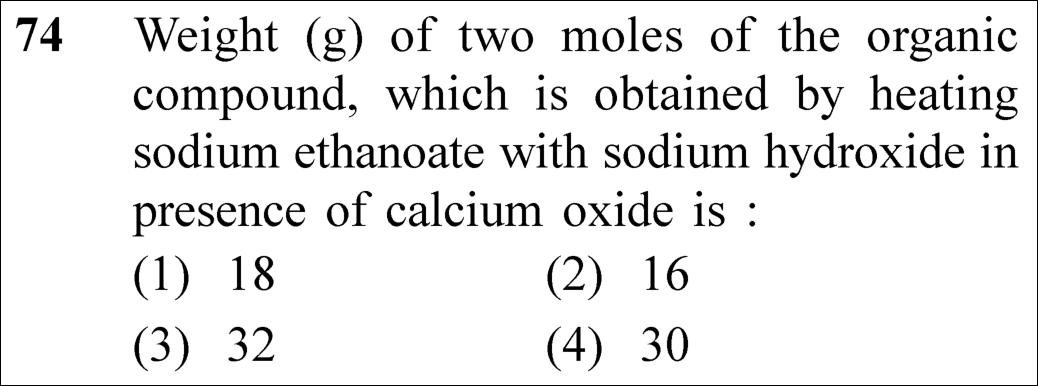
Weight (g) of two moles of the organic compound, which is obtained by heating sodium ethanoate with sodium hydroxide in presence of calcium oxide is:

  1. (1)18
  2. (2)16
  3. (3)32
  4. (4)30
✓
Verified Against NTA Final Answer Key
Option (3) : 32
📚 Hydrocarbons Easy
📋 Given Parameters & Problem Setup
Reactant Sodium ethanoate (CH₃COONa)
Reagent Soda-lime (NaOH + CaO in 3:1 ratio, Δ)
Target quantity Weight (in grams) of TWO MOLES of the organic product
⚡

The 30-Second Exam Hall Shortcut: ⚡ Decarboxylation Product & 2-Mole Mass Hack

⏱️ Save ~30 seconds

CH₃COONa + NaOH ⟶ CH₄ + Na₂CO₃. The organic compound is methane (CH₄, molar mass = 16 g/mol). Two moles weigh 2 × 16 = 32 g in 10 seconds! (Option 3)

1 Identify the reaction: Heating sodium ethanoate with soda-lime (NaOH + CaO) is the classic decarboxylation reaction.
2 The carboxyl group is cleaved as Na₂CO₃: CH₃COONa + NaOH ⟶ CH₄ + Na₂CO₃.
3 The organic compound formed is methane (CH₄).
4 Calculate the molar mass of methane: M(CH₄) = 12 + 4(1) = 16 g mol⁻¹.
5 The question specifically asks for the weight of TWO MOLES of the compound:
6 Mass = 2 mol × 16 g mol⁻¹ = 32 g.
7 Lock Option (3) 32 immediately!
🛡️
Why You Can 100% Trust This Shortcut: Organic Syntheses · Decarboxylation of Carboxylic Acids (Sodium salts of carboxylic acids heated with soda-lime lose carbon dioxide to form alkanes containing one carbon less than the carboxylic acid).
📐

Step-by-Step Rigorous Workflow & Mathematical Proof

Step 1

Equation for Soda-Lime Decarboxylation

When sodium ethanoate is heated with soda-lime (a dry mixture of sodium hydroxide and calcium oxide in an approximate 3:1 mass ratio), it undergoes decarboxylation to produce an alkane with one less carbon atom than the parent carboxylate salt:

CH3COONa+NaOH→CaO, ΔCH4(g)+Na2CO3(s)\text{CH}_3\text{COONa} + \text{NaOH} \xrightarrow{\text{CaO, } \Delta} \text{CH}_4(g) + \text{Na}_2\text{CO}_3(s)
Step 2

Identification of the Organic Product

Of the two products formed, Na₂CO₃ is an inorganic salt, so the organic compound obtained is methane (CH₄).

Organic Product=Methane (CH4)\text{Organic Product} = \text{Methane } (\text{CH}_4)
Step 3

Molar Mass Calculation of Methane

Calculate the molecular weight of methane from standard atomic masses (C = 12 u, H = 1 u):

M(CH4)=12+4(1)=16 g mol−1M(\text{CH}_4) = 12 + 4(1) = 16\text{ g mol}^{-1}
Step 4

Evaluation of the Mass of Two Moles

The problem explicitly asks for the weight in grams of TWO MOLES of this organic compound:

Mass=n×M=2 mol×16 g mol−1=32 g\text{Mass} = n \times M = 2\text{ mol} \times 16\text{ g mol}^{-1} = 32\text{ g}
⭐

360° Option Elimination Engine Key Feature

Diagnose every choice: Know exactly why the right option works and why distractors fail.

4-Option Deep Scan
1 (1)
✗ Incorrect
Verdict & Scientific Reason:

Molar mass of water (H₂O), completely irrelevant to methane.

⚠️
Student Fallacy (Why candidates pick this trap): Candidate confused the product with water.
2 (2)
✗ Incorrect
Verdict & Scientific Reason:

Mass of ONE mole of methane (CH₄), forgetting that the question asks for TWO moles.

⚠️
Student Fallacy (Why candidates pick this trap): Candidate solved for 1 mole of CH₄ (16 g) and forgot to multiply by 2.
3 (3)
✓ 100% Correct
Verdict & Scientific Reason:

Accurate weight of 2 moles of methane: 2 × 16 g = 32 g.

💡
Why this is airtight: None. Candidate accounted for the "two moles" multiplier.
4 (4)
✗ Incorrect
Verdict & Scientific Reason:

Molar mass of ethane (C₂H₆), which would form in Kolbe’s electrolysis, not soda-lime decarboxylation.

⚠️
Student Fallacy (Why candidates pick this trap): Candidate confused soda-lime decarboxylation with Kolbe’s electrolytic coupling.
⚠️

NTA Trap Alert: Reporting the Molar Mass (16 g) Instead of Two Moles (32 g)

The most frequent mistake on this question is correctly identifying methane (CH₄, 16 g/mol) and immediately circling 16 (Option 2). The question prompt explicitly starts with "Weight (g) of TWO MOLES..."!

🛡️ How to avoid the -1 mark: Always reread the question stem: "two moles" means 2 × 16 = 32 g.
📖

Core NEET Syllabus Standard

National Eligibility cum Entrance Test (NEET UG) · Hydrocarbons Standard Benchmark
Core Scientific Principle Tested:

"Decarboxylation of sodium ethanoate yields methane: CH₃COONa + NaOH ⟶ CH₄ + Na₂CO₃. 2 moles of CH₄ weigh 32 g."

Syllabus Focus: Alkanes – Preparation from Carboxylic Acids (Decarboxylation)
Preserved in Rationalized Curriculum Syllabus & Academic Standards ↗

Ready to attempt under real exam pressure?

Test your speed and accuracy in the authentic 200-minute timed NTA simulator.

Launch NEET 2023 CBT Test →

Spotted a mistake in this solution? Report an error (support@mycompetitiveexams.com)

⚖️ Legal & Fair Dealing Notice: Sourced from publicly released NEET 2023 question papers and NEET answer keys for private study, research, and non-commercial educational practice under Fair Dealing (Section 52(1)(a) of the Indian Copyright Act, 1957). Not affiliated with or endorsed by NTA or NMC.

Solve 4 NEET Questions a Day — One per Subject

Cover all 1,140 official NEET questions in 285 days at your own pace. Progress is saved on your device. No login needed.