MyCompetitiveExams Logo MyCompetitiveExams
Search 1,140+ Questions
Chapters, formulas, speed tricks
→
⚡ Brahmastra NEET 2027
720 MARKS

Dynamic 180-question full-length simulator mixed dynamically from all 6 years for 2027 & 2026 aspirants.

Launch Brahmastra 2027 Test →
Start Practice →
100% Free · No Login Required
Q.106 Botany ⭐ 360° Option Elimination Active
Vault ↗

NEET 2023 Botany Question 106 Solution

Topic: Biotechnology: Principles and Processes · Official NTA Booklet Code G5
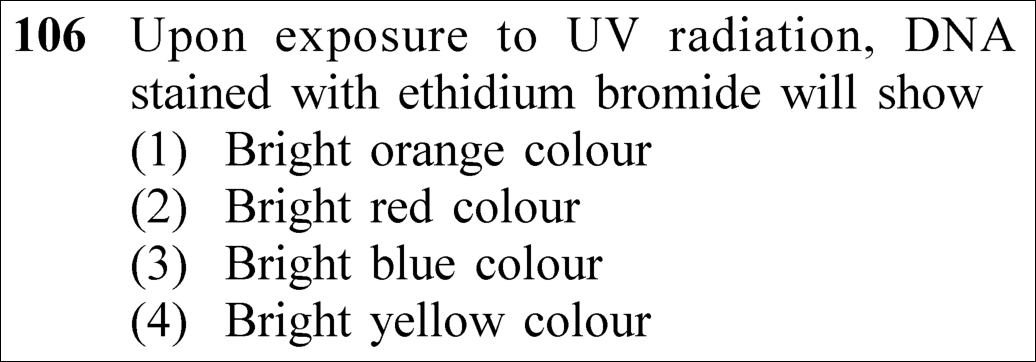
NEET 2023 Botany Question 106: Agarose Gel Electrophoresis and DNA Visualization

Question

Upon exposure to UV radiation, DNA stained with ethidium bromide will show

  1. (1)Bright orange colour
  2. (2)Bright red colour
  3. (3)Bright blue colour
  4. (4)Bright yellow colour
✓
Verified Against NTA Final Answer Key
Option (1) : Bright orange colour
📚 Biotechnology: Principles and Processes Easy
📋 Given Parameters & Problem Setup
Staining Dye Ethidium bromide (EtBr)
Excitation Light Ultraviolet (UV) radiation
Visual Result Fluorophore emission under UV transillumination
⚡

The 30-Second Exam Hall Shortcut: ⚡ EtBr + UV = Bright Orange DNA Bands

⏱️ Save ~20 seconds

DNA cannot be seen directly in visible light. Staining with ethidium bromide followed by UV light transillumination yields striking bright orange bands!

1 Recall that pure DNA in agarose gels is completely transparent and colorless under normal visible light.
2 Ethidium bromide intercalates between adjacent stacked base pairs of DNA.
3 Under UV light excitation (~300 nm), the intercalated dye fluoresces brightly at orange-red wavelengths (~590 nm).
4 Option (1) bright orange is the verbatim textbook color.
🛡️
Why You Can 100% Trust This Shortcut: Canonical NCERT Biotechnology protocol on agarose gel electrophoresis.
📐

Step-by-Step Rigorous Workflow & Mathematical Proof

Step 1

Intercalation Mechanism of Ethidium Bromide

Ethidium bromide (EtBrEtBr) is a planar polycyclic aromatic cation that slips between adjacent stacked nitrogenous base pairs of double-stranded DNA:

dsDNA+EtBr⟶[dsDNA-EtBr complex](hydrophobic intercalation)\text{dsDNA} + \text{EtBr} \longrightarrow [\text{dsDNA-EtBr complex}]_{{(\text{hydrophobic intercalation})}}
Step 2

Fluorometric Excitation and Emission

Intercalation isolates the ethidium fluorophore from water molecules that would otherwise quench its fluorescence. When irradiated with UV light, the complex emits intense visible fluorescence:

UV Light (λ≈302 nm)→ExcitationFluorescence (λ≈590 nm)  ⟹  Bright Orange Bands\text{UV Light (}\lambda \approx 302\text{ nm)} \xrightarrow{\text{Excitation}} \text{Fluorescence (}\lambda \approx 590\text{ nm)} \implies \text{\textbf{Bright Orange Bands}}
Step 3

Downstream Processing (Elution)

The separated orange DNA bands are excised from the agarose gel slab and extracted into buffer in a technique known as elution.

⭐

360° Option Elimination Engine Key Feature

Diagnose every choice: Know exactly why the right option works and why distractors fail.

4-Option Deep Scan
1 1
✓ 100% Correct
Verdict & Scientific Reason:

Matches NCERT verbatim: DNA stained with ethidium bromide glows as bright orange bands under UV transillumination.

💡
Why this is airtight: None; canonical lab principle.
2 2
✗ Incorrect
Verdict & Scientific Reason:

Incorrect hue; emission is distinctly bright orange, not red.

⚠️
Student Fallacy (Why candidates pick this trap): Associating orange fluorescence loosely with red coloration.
3 3
✗ Incorrect
Verdict & Scientific Reason:

Blue color corresponds to tracking dye (bromophenol blue) under visible light, not fluorescent DNA.

⚠️
Student Fallacy (Why candidates pick this trap): Confusing loading tracking dye with the DNA stain itself.
4 4
✗ Incorrect
Verdict & Scientific Reason:

Incorrect emission wavelength.

⚠️
Student Fallacy (Why candidates pick this trap): Misremembering fluorescence colors from other biochemical stains.
⚠️

NTA Trap Alert: Visible Light vs. UV Light Trap

Students forget that DNA bands cannot be seen under ordinary visible light without UV transillumination, or confuse the blue loading dye with the intercalating stain.

🛡️ How to avoid the -1 mark: EtBr + UV = Bright Orange. Bromophenol blue loading dye = Blue in visible light.
📖

Core NEET Syllabus Standard

NCERT Biology · Biotechnology: Principles and Processes Standard Benchmark
Core Scientific Principle Tested:

"You cannot see pure DNA fragments in the visible light and without staining. The separated DNA fragments can be visualized only after staining the DNA with a compound known as ethidium bromide followed by exposure to UV radiation (you can see bright orange coloured bands of DNA)."

Syllabus Focus: Separation and Isolation of DNA Fragments
✓ Core NEET UG Syllabus Anchor Syllabus & Academic Standards ↗

Ready to attempt under real exam pressure?

Test your speed and accuracy in the authentic 200-minute timed NTA simulator.

Launch NEET 2023 CBT Test →

Spotted a mistake in this solution? Report an error (support@mycompetitiveexams.com)

⚖️ Legal & Fair Dealing Notice: Sourced from publicly released NEET 2023 question papers and NEET answer keys for private study, research, and non-commercial educational practice under Fair Dealing (Section 52(1)(a) of the Indian Copyright Act, 1957). Not affiliated with or endorsed by NTA or NMC.

Solve 4 NEET Questions a Day — One per Subject

Cover all 1,140 official NEET questions in 285 days at your own pace. Progress is saved on your device. No login needed.