MyCompetitiveExams Logo MyCompetitiveExams
Search 1,140+ Questions
Chapters, formulas, speed tricks
→
⚡ Brahmastra NEET 2027
720 MARKS

Dynamic 180-question full-length simulator mixed dynamically from all 6 years for 2027 & 2026 aspirants.

Launch Brahmastra 2027 Test →
Start Practice →
100% Free · No Login Required
Q.150 Botany ⭐ 360° Option Elimination Active
Vault ↗

NEET 2023 Botany Question 150 Solution

Topic: Mineral Nutrition · Official NTA Booklet Code G5
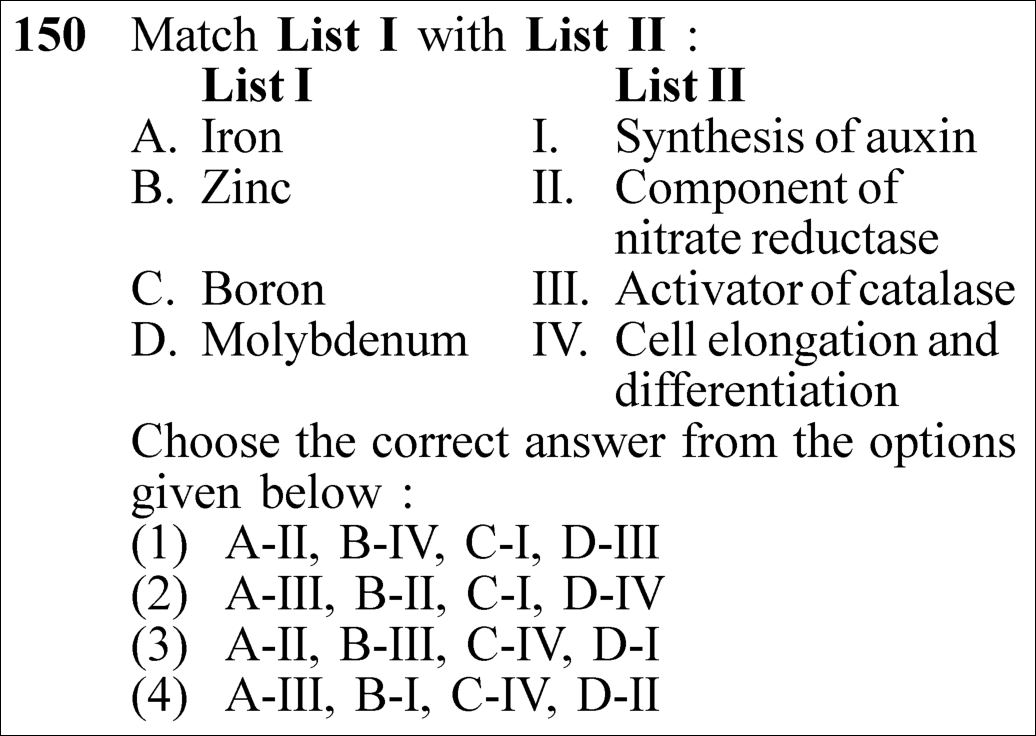
NEET 2023 Botany Question 150: Roles of Essential Micronutrients: Fe, Zn, B, Mo

Question

Match List I with List II. List I: A. Iron; B. Zinc; C. Boron; D. Molybdenum. List II: I. Synthesis of auxin; II. Component of nitrate reductase; III. Activator of catalase; IV. Cell elongation and differentiation. Choose the correct answer from the options given below:

✓
Verified Against NTA Final Answer Key
Option (4) : A-III, B-I, C-IV, D-II
📚 Mineral Nutrition Easy
📋 Given Parameters & Problem Setup
List I (Micronutrients) Iron (Fe), Zinc (Zn), Boron (B), Molybdenum (Mo)
List II (Functions) Auxin synthesis, Nitrate reductase component, Catalase activator, Cell elongation and differentiation
⚡

The 30-Second Exam Hall Shortcut: ⚡ Micronutrient Function Fingerprints

⏱️ Save ~25 seconds

Match each mineral to its unique physiological fingerprint: Iron activates Catalase (III). Zinc is needed for Auxin synthesis (I). Boron mediates Cell elongation and pollen germination (IV). Molybdenum is a cofactor of Nitrate reductase (II)! Match Option (4)!

1 Iron (Fe): Activator of catalase enzyme and involved in electron transfer (ferredoxin/cytochrome) -> A-III.
2 Zinc (Zn): Needed for synthesis of auxin (tryptophan-dependent pathway) -> B-I.
3 Boron (B): Required for pollen germination, cell elongation, and differentiation -> C-IV.
4 Molybdenum (Mo): Component of nitrate reductase and nitrogenase -> D-II.
5 Match combination: A-III, B-I, C-IV, D-II -> Option (4).
🛡️
Why You Can 100% Trust This Shortcut: Canonical NCERT Mineral Nutrition essential micronutrient physiological roles inventory.
📐

Step-by-Step Rigorous Workflow & Mathematical Proof

Step 1

Verbatim NCERT Physiological Functions of Micronutrients

Analyzing the specific biochemical roles assigned to each trace element in NCERT:

A. Iron (Fe):It activates catalase enzyme and is essential for chlorophyll formation  ⟹  IIIB. Zinc (Zn):It is needed in the synthesis of auxin  ⟹  IC. Boron (B):Required for pollen germination, cell elongation, and differentiation  ⟹  IVD. Molybdenum (Mo):It is a component of several enzymes, including nitrate reductase  ⟹  II\begin{aligned} \text{\textbf{A. Iron (Fe):}} & \quad \text{It activates catalase enzyme and is essential for chlorophyll formation} \implies \mathbf{\text{III}} \\[4pt] \text{\textbf{B. Zinc (Zn):}} & \quad \text{It is needed in the synthesis of auxin} \implies \mathbf{\text{I}} \\[4pt] \text{\textbf{C. Boron (B):}} & \quad \text{Required for pollen germination, cell elongation, and differentiation} \implies \mathbf{\text{IV}} \\[4pt] \text{\textbf{D. Molybdenum (Mo):}} & \quad \text{It is a component of several enzymes, including nitrate reductase} \implies \mathbf{\text{II}} \end{aligned}
Step 2

Elimination Strategy

A maps to III (immediately eliminates Options 1 and 3). B maps to I (confirms Option 4, while Option 2 incorrectly pairs B with II).

Step 3

Biochemical Corroboration

Nitrate reductase requires a molybdenum cofactor (MoCo). Auxin synthesis from tryptophan requires Zn2+Zn^{2+}-dependent enzymes. Catalase is a heme-iron enzyme containing ferric iron.

⭐

360° Option Elimination Engine Key Feature

Diagnose every choice: Know exactly why the right option works and why distractors fail.

4-Option Deep Scan
1 1
✗ Incorrect
Verdict & Scientific Reason:

Mismatches Iron with nitrate reductase (molybdenum).

⚠️
Student Fallacy (Why candidates pick this trap): Confusing iron enzymes with molybdenum enzymes.
2 2
✗ Incorrect
Verdict & Scientific Reason:

Mismatches Zinc with nitrate reductase and Boron with auxin.

⚠️
Student Fallacy (Why candidates pick this trap): Swapping zinc and molybdenum roles.
3 3
✗ Incorrect
Verdict & Scientific Reason:

Mismatches iron with nitrate reductase and zinc with catalase.

⚠️
Student Fallacy (Why candidates pick this trap): Scrambling multiple metalloenzyme functions.
4 4
✓ 100% Correct
Verdict & Scientific Reason:

Flawless 1-to-1 match with the canonical NCERT micronutrient roles.

💡
Why this is airtight: None; exact textbook recall.
⚠️

NTA Trap Alert: Zinc vs. Boron vs. Molybdenum Enzyme Assignment Trap

Students frequently remember that all these micronutrients act on enzymes, but interchange their targets: Zn with nitrate reductase or Mo with auxin.

🛡️ How to avoid the -1 mark: Remember: Zn = Auxin (zinc for hormones). Mo = Nitrogen/Nitrate reductase. Fe = Catalase. B = Pollen & cell elongation.
📖

Core NEET Syllabus Standard

NCERT Biology · Mineral Nutrition Standard Benchmark
Core Scientific Principle Tested:

"Iron activates catalase; Zinc is needed for auxin synthesis; Boron is required for cell elongation and differentiation; Molybdenum is a component of nitrate reductase."

Syllabus Focus: Essential Mineral Elements
✓ Core NEET UG Syllabus Anchor Syllabus & Academic Standards ↗

Ready to attempt under real exam pressure?

Test your speed and accuracy in the authentic 200-minute timed NTA simulator.

Launch NEET 2023 CBT Test →

Spotted a mistake in this solution? Report an error (support@mycompetitiveexams.com)

⚖️ Legal & Fair Dealing Notice: Sourced from publicly released NEET 2023 question papers and NEET answer keys for private study, research, and non-commercial educational practice under Fair Dealing (Section 52(1)(a) of the Indian Copyright Act, 1957). Not affiliated with or endorsed by NTA or NMC.

Solve 4 NEET Questions a Day — One per Subject

Cover all 1,140 official NEET questions in 285 days at your own pace. Progress is saved on your device. No login needed.