MyCompetitiveExams Logo MyCompetitiveExams
Search 1,140+ Questions
Chapters, formulas, speed tricks
→
⚡ Brahmastra NEET 2027
720 MARKS

Dynamic 180-question full-length simulator mixed dynamically from all 6 years for 2027 & 2026 aspirants.

Launch Brahmastra 2027 Test →
Start Practice →
100% Free · No Login Required
Q.197 Zoology ⭐ 360° Option Elimination Active
Vault ↗

NEET 2023 Zoology Question 197 Solution

Topic: Animal Kingdom · Official NTA Booklet Code G5
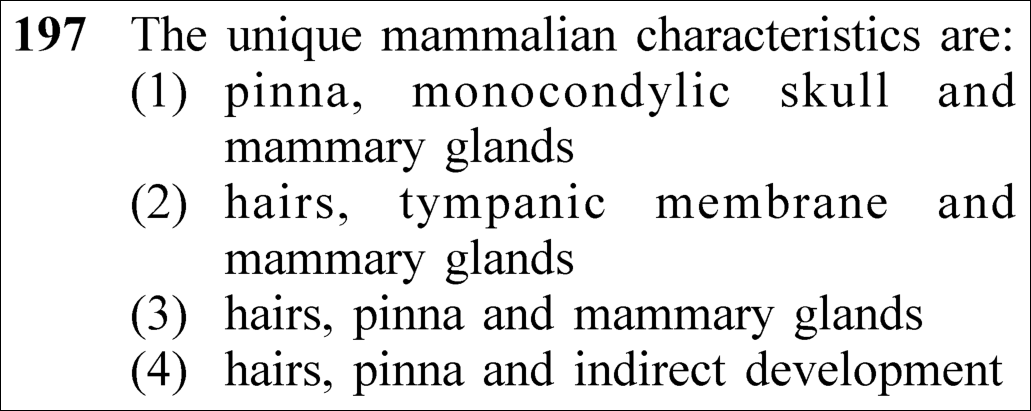
NEET 2023 Zoology Question 197: Unique Diagnostic Hallmarks of Class Mammalia

Question

The unique mammalian characteristics are:

  1. (1)pinna, monocondylic skull and mammary glands
  2. (2)hairs, tympanic membrane and mammary glands
  3. (3)hairs, pinna and mammary glands
  4. (4)hairs, pinna and indirect development
✓
Verified Against NTA Final Answer Key
Option (3) : hairs, pinna and mammary glands
📚 Animal Kingdom Easy
📋 Given Parameters & Problem Setup
Class Mammalia
Criterion Unique mammalian diagnostic characteristics
⚡

The 30-Second Exam Hall Shortcut: ⚡ Mammalian Diagnostic Triad: Hair + Pinna + Mammary Glands

⏱️ Save ~20 seconds

What features are found ONLY in mammals and nowhere else in the animal kingdom? Mammary glands (milk secretion), epidermal Hairs, and external ear Pinnae! Monocondylic skull belongs to reptiles/birds (mammals have dicondylic skull). Match Option (3)!

1 Mammalian skull is DICONDYLIC (two occipital condyles), ruling out Option (1) which says monocondylic.
2 Tympanic membrane is present in amphibians, reptiles, and birds too, ruling out Option (2).
3 Mammalian development is DIRECT (no larval stage), ruling out Option (4) which says indirect.
4 Option (3) contains Hairs, Pinna, and Mammary glands—all three are uniquely mammalian.
5 Match Option (3).
🛡️
Why You Can 100% Trust This Shortcut: Canonical NCERT Animal Kingdom Class Mammalia unique synapomorphies.
📐

Step-by-Step Rigorous Workflow & Mathematical Proof

Step 1

Diagnostic Synapomorphies of Class Mammalia

Class Mammalia possesses anatomical hallmarks that are uniquely derived and not shared with other vertebrate classes:

Unique Mammalian Triad={1.Mammary Glands(milk-producing glands nourishing young)2.Body Hairs(epidermal keratinised hair covering)3.Pinna(external cartilaginous ear flap)\text{\textbf{Unique Mammalian Triad}} = \begin{cases} \mathbf{1.} & \mathbf{\text{Mammary Glands}} \quad (\text{milk-producing glands nourishing young}) \\[3pt] \mathbf{2.} & \mathbf{\text{Body Hairs}} \quad (\text{epidermal keratinised hair covering}) \\[3pt] \mathbf{3.} & \mathbf{\text{Pinna}} \quad (\text{external cartilaginous ear flap}) \end{cases}
Step 2

Refutation of False Anatomical Claims

Analyzing the errors in distractor options: - Mammals possess a dicondylic skull with two occipital condyles (monocondylic skulls characterize reptiles and birds). - Tympanic membrane represents the ear in amphibians and reptiles as well; it is not unique to mammals. - Mammals exhibit direct development without intermediate metamorphic larval stages.

Step 3

Verbatim NCERT Reference

NCERT states verbatim under Class Mammalia: "The most unique mammalian characteristic is the presence of milk producing glands (mammary glands) by which the young ones are nourished... The skin of mammals is unique in possessing hair. External ears or pinnae are present."

⭐

360° Option Elimination Engine Key Feature

Diagnose every choice: Know exactly why the right option works and why distractors fail.

4-Option Deep Scan
1 1
✗ Incorrect
Verdict & Scientific Reason:

Mammals possess a dicondylic skull (two occipital condyles), not a monocondylic skull.

⚠️
Student Fallacy (Why candidates pick this trap): Confusing reptilian monocondylic skull with mammalian dicondylic skull.
2 2
✗ Incorrect
Verdict & Scientific Reason:

Tympanic membrane is present in amphibians and reptiles and is not unique to mammals.

⚠️
Student Fallacy (Why candidates pick this trap): Overlooking that frogs and lizards also possess tympanic membranes.
3 3
✓ 100% Correct
Verdict & Scientific Reason:

Exact NCERT triad: epidermal hair, external pinna, and mammary glands are unique to mammals.

💡
Why this is airtight: None; textbook verbatim match.
4 4
✗ Incorrect
Verdict & Scientific Reason:

Mammalian development is direct, without larval metamorphosis.

⚠️
Student Fallacy (Why candidates pick this trap): Confusing direct and indirect developmental modes.
⚠️

NTA Trap Alert: Monocondylic vs. Dicondylic Skull Trap

Students frequently mix up condyle counts: Amphibians and Mammals have DICONDYLIC skulls (2 condyles). Reptiles and Birds have MONOCONDYLIC skulls (1 condyle).

🛡️ How to avoid the -1 mark: Mammals = Dicondylic skull. Unique traits = Mammary glands + Hair + Pinna.
📖

Core NEET Syllabus Standard

NCERT Biology · Animal Kingdom Standard Benchmark
Core Scientific Principle Tested:

"The skin of mammals is unique in possessing hair. External ears or pinnae are present, and mammary glands nourish the young."

Syllabus Focus: Class Mammalia
✓ Core NEET UG Syllabus Anchor Syllabus & Academic Standards ↗

Ready to attempt under real exam pressure?

Test your speed and accuracy in the authentic 200-minute timed NTA simulator.

Launch NEET 2023 CBT Test →

Spotted a mistake in this solution? Report an error (support@mycompetitiveexams.com)

⚖️ Legal & Fair Dealing Notice: Sourced from publicly released NEET 2023 question papers and NEET answer keys for private study, research, and non-commercial educational practice under Fair Dealing (Section 52(1)(a) of the Indian Copyright Act, 1957). Not affiliated with or endorsed by NTA or NMC.

Solve 4 NEET Questions a Day — One per Subject

Cover all 1,140 official NEET questions in 285 days at your own pace. Progress is saved on your device. No login needed.