MyCompetitiveExams Logo MyCompetitiveExams
Search 1,140+ Questions
Chapters, formulas, speed tricks
→
⚡ Brahmastra NEET 2027
720 MARKS

Dynamic 180-question full-length simulator mixed dynamically from all 6 years for 2027 & 2026 aspirants.

Launch Brahmastra 2027 Test →
Start Practice →
100% Free · No Login Required
Q.159 Zoology ⭐ 360° Option Elimination Active
Vault ↗

NEET 2023 Zoology Question 159 Solution

Topic: Biotechnology and its Applications · Official NTA Booklet Code G5
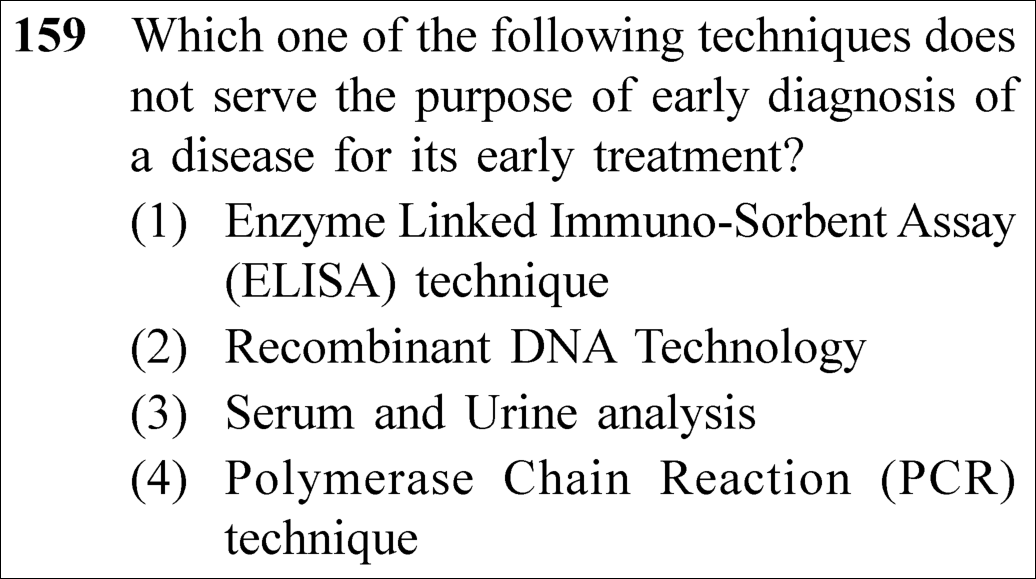
NEET 2023 Zoology Question 159: Molecular Diagnostics: Conventional vs. Modern Diagnostic Techniques

Question

Which one of the following techniques does not serve the purpose of early diagnosis of a disease for its early treatment?

  1. (1)Enzyme Linked Immuno-Sorbent Assay (ELISA) technique
  2. (2)Recombinant DNA Technology
  3. (3)Serum and Urine analysis
  4. (4)Polymerase Chain Reaction (PCR) technique
✓
Verified Against NTA Final Answer Key
Option (3) : Serum and Urine analysis
📚 Biotechnology and its Applications Easy
📋 Given Parameters & Problem Setup
Criterion Technique that does NOT serve the purpose of early disease diagnosis
⚡

The 30-Second Exam Hall Shortcut: ⚡ Conventional vs. Molecular Diagnostics Anchor

⏱️ Save ~20 seconds

Conventional diagnostic methods (serum and urine analysis) only detect diseases when pathogen load or tissue damage has already peaked (late detection). Molecular diagnostics (ELISA, PCR, rDNA probes) enable EARLY diagnosis when pathogen count is extremely low!

1 Early diagnostic techniques: PCR (amplifies minute DNA), ELISA (detects nanograms of antigen/antibody), Recombinant DNA probes.
2 Conventional non-early techniques: Routine serum and urine analysis.
3 The prompt asks which does NOT serve early diagnosis.
4 Match Option (3) Serum and Urine analysis.
🛡️
Why You Can 100% Trust This Shortcut: Canonical NCERT Biotechnology molecular diagnostics classification.
📐

Step-by-Step Rigorous Workflow & Mathematical Proof

Step 1

Limitation of Conventional Clinical Tests

Conventional diagnostic techniques rely on gross biochemical changes or visible pathogen counts in blood/urine. By the time symptoms appear and serum/urine metabolites alter, the infection is already widely established:

Serum & Urine Analysis  ⟺  Conventional Diagnosis (Late Detection / Non-Early)\text{Serum \& Urine Analysis} \iff \text{Conventional Diagnosis (Late Detection / Non-Early)}
Step 2

Verbatim NCERT Statement

NCERT states verbatim under Molecular Diagnosis: "Using conventional methods of diagnosis (serum and urine analysis, etc.) early detection is not possible. Recombinant DNA technology, Polymerase Chain Reaction (PCR) and Enzyme Linked Immuno-sorbent Assay (ELISA) are some of the techniques that serve the purpose of early diagnosis."

Step 3

Sensitivity of Modern Molecular Diagnostics

PCR can detect trace pathogens (<10<10 viral particles) by exponential target DNA amplification. ELISA exploits high-affinity antibody-enzyme conjugates to detect picogram antigen quantities before clinical symptom onset.

⭐

360° Option Elimination Engine Key Feature

Diagnose every choice: Know exactly why the right option works and why distractors fail.

4-Option Deep Scan
1 1
✗ Incorrect
Verdict & Scientific Reason:

ELISA is a modern molecular tool that explicitly serves early diagnosis; hence incorrect for the negative prompt.

⚠️
Student Fallacy (Why candidates pick this trap): Missing the negative prompt "does not serve".
2 2
✗ Incorrect
Verdict & Scientific Reason:

rDNA technology with radioactive probes enables early detection of mutated genes and latent pathogens.

⚠️
Student Fallacy (Why candidates pick this trap): Overlooking the diagnostic utility of recombinant nucleic acid probes.
3 3
✓ 100% Correct
Verdict & Scientific Reason:

Matches NCERT verbatim: conventional serum and urine analysis cannot detect diseases early.

💡
Why this is airtight: None; textbook verbatim identification.
4 4
✗ Incorrect
Verdict & Scientific Reason:

PCR is the quintessential early diagnosis tool (e.g., detecting HIV in suspected asymptomatic patients).

⚠️
Student Fallacy (Why candidates pick this trap): Confusing PCR early detection with conventional diagnosis.
⚠️

NTA Trap Alert: Routine Hospital Testing vs. "Early Detection" Trap

Because blood (serum) and urine tests are the most common laboratory tests ordered by doctors, students intuitively consider them reliable and miss that they are too insensitive for early detection.

🛡️ How to avoid the -1 mark: Always remember: Serum & Urine = Conventional (cannot detect early). PCR, ELISA, rDNA = Molecular (early detection).
📖

Core NEET Syllabus Standard

NCERT Biology · Biotechnology and its Applications Standard Benchmark
Core Scientific Principle Tested:

"Using conventional methods of diagnosis (serum and urine analysis, etc.) early detection is not possible. Recombinant DNA technology, PCR and ELISA serve the purpose of early diagnosis."

Syllabus Focus: Molecular Diagnosis
✓ Core NEET UG Syllabus Anchor Syllabus & Academic Standards ↗

Ready to attempt under real exam pressure?

Test your speed and accuracy in the authentic 200-minute timed NTA simulator.

Launch NEET 2023 CBT Test →

Spotted a mistake in this solution? Report an error (support@mycompetitiveexams.com)

⚖️ Legal & Fair Dealing Notice: Sourced from publicly released NEET 2023 question papers and NEET answer keys for private study, research, and non-commercial educational practice under Fair Dealing (Section 52(1)(a) of the Indian Copyright Act, 1957). Not affiliated with or endorsed by NTA or NMC.

Solve 4 NEET Questions a Day — One per Subject

Cover all 1,140 official NEET questions in 285 days at your own pace. Progress is saved on your device. No login needed.