MyCompetitiveExams Logo MyCompetitiveExams
Search 1,140+ Questions
Chapters, formulas, speed tricks
→
⚡ Brahmastra NEET 2027
720 MARKS

Dynamic 180-question full-length simulator mixed dynamically from all 6 years for 2027 & 2026 aspirants.

Launch Brahmastra 2027 Test →
Start Practice →
100% Free · No Login Required
Q.62 Chemistry ⭐ 360° Option Elimination Active
Vault ↗

NEET 2023 Chemistry Question 62 Solution

Topic: Classification of Elements and Periodicity in Properties · Official NTA Booklet Code G5
NEET 2023 Chemistry Question 62: Ionic Radii in Isoelectronic Series of Second & Third Period Elements

Question

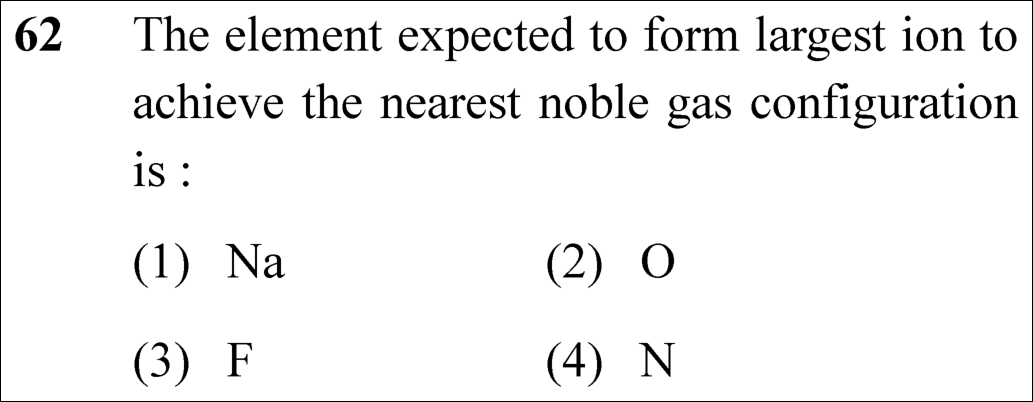
The element expected to form largest ion to achieve the nearest noble gas configuration is:

  1. (1)Na
  2. (2)O
  3. (3)F
  4. (4)N
✓
Verified Against NTA Final Answer Key
Option (4) : N
📚 Classification of Elements and Periodicity in Properties Easy
📋 Given Parameters & Problem Setup
Elements tested Na, O, F, N
Condition Ion formed to achieve nearest noble gas configuration (Neon, 10 e⁻)
Resulting isoelectronic ions Na⁺, O²⁻, F⁻, N³⁻
⚡

The 30-Second Exam Hall Shortcut: ⚡ Isoelectronic Radius Rule: Radius ∝ 1 / Nuclear Charge (Z)

⏱️ Save ~30 seconds

All form 10-electron ions: Na⁺ (Z=11), F⁻ (Z=9), O²⁻ (Z=8), N³⁻ (Z=7). Smallest nuclear charge (Z=7) has weakest hold on electrons ⟹ N³⁻ is LARGEST in 5 seconds!

1 Determine the stable noble-gas ion formed by each element:
2 - Na (Z = 11) loses 1 e⁻ ⟶ Na⁺ (10 electrons).
3 - F (Z = 9) gains 1 e⁻ ⟶ F⁻ (10 electrons).
4 - O (Z = 8) gains 2 e⁻ ⟶ O²⁻ (10 electrons).
5 - N (Z = 7) gains 3 e⁻ ⟶ N³⁻ (10 electrons).
6 All four ions are isoelectronic with Neon (10 electrons).
7 In an isoelectronic series, ionic radius is inversely proportional to atomic number Z: Radius ∝ 1 / Z.
8 Nitrogen has the lowest nuclear charge (Z = 7 protons pulling on 10 electrons).
9 Therefore, N³⁻ experiences the lowest Z_eff and expands to the largest ionic radius (171 pm).
10 Lock Option (4) N immediately!
🛡️
Why You Can 100% Trust This Shortcut: Periodic Properties · Isoelectronic Series Trends (In isoelectronic species, the greater the negative charge or smaller the nuclear charge, the larger the ionic radius: r ∝ 1/Z).
📐

Step-by-Step Rigorous Workflow & Mathematical Proof

Step 1

Formation of Nearest Noble Gas Configurations

Each element attains the electron configuration of the nearest noble gas (Neon, 1s² 2s² 2p⁶, total 10 electrons) by gaining or losing electrons:

Na (Z=11)⟶Na++e−(10 e−)F (Z=9)+e−⟶F−(10 e−)O (Z=8)+2e−⟶O2−(10 e−)N (Z=7)+3e−⟶N3−(10 e−)\begin{aligned} \text{Na } (Z=11) &\longrightarrow \text{Na}^+ + e^- \quad (10\ e^-) \\[4pt] \text{F } (Z=9) + e^- &\longrightarrow \text{F}^- \quad (10\ e^-) \\[4pt] \text{O } (Z=8) + 2e^- &\longrightarrow \text{O}^{2-} \quad (10\ e^-) \\[4pt] \text{N } (Z=7) + 3e^- &\longrightarrow \text{N}^{3-} \quad (10\ e^-) \end{aligned}
Step 2

Effective Nuclear Charge (Z_eff) Comparison

All four resulting ions possess the identical number of electrons (10), but differing nuclear charges (number of protons Z in the nucleus):

Nuclear charge Z:Na+(11)>F−(9)>O2−(8)>N3−(7)\text{Nuclear charge } Z: \quad \text{Na}^+ (11) > \text{F}^- (9) > \text{O}^{2-} (8) > \text{N}^{3-} (7)
Step 3

Determination of Ionic Radius Hierarchy

As nuclear charge decreases, the inward electrostatic pull on the 10 electrons weakens and interelectronic repulsions dominate, causing the electron cloud to expand. Consequently, ionic radius increases with decreasing Z:

r(N3−)>r(O2−)>r(F−)>r(Na+)r(\text{N}^{3-}) > r(\text{O}^{2-}) > r(\text{F}^-) > r(\text{Na}^+)
Step 4

Conclusion

Nitrogen forms the N³⁻ ion (radius ≈ 171 pm), which is the largest among all ions in this isoelectronic group.

r(N3−)=171 pm(Largest ion)r(\text{N}^{3-}) = 171\text{ pm} \quad (\text{Largest ion})
⭐

360° Option Elimination Engine Key Feature

Diagnose every choice: Know exactly why the right option works and why distractors fail.

4-Option Deep Scan
1 (1)
✗ Incorrect
Verdict & Scientific Reason:

Forms Na⁺, which has the HIGHEST nuclear charge (Z=11) and is the SMALLEST ion (102 pm).

⚠️
Student Fallacy (Why candidates pick this trap): Candidate confused atomic size (Na atom is largest) with ionic size of its noble gas ion (Na⁺ is smallest).
2 (2)
✗ Incorrect
Verdict & Scientific Reason:

Forms O²⁻ (radius 140 pm), which is smaller than N³⁻.

⚠️
Student Fallacy (Why candidates pick this trap): Candidate overlooked that N³⁻ has higher negative charge and lower Z.
3 (3)
✗ Incorrect
Verdict & Scientific Reason:

Forms F⁻ (radius 133 pm), which is smaller than O²⁻ and N³⁻.

⚠️
Student Fallacy (Why candidates pick this trap): Candidate confused electronegativity with ionic size.
4 (4)
✓ 100% Correct
Verdict & Scientific Reason:

Accurate: Forms N³⁻ with the lowest nuclear charge (Z=7) and highest negative charge, resulting in the largest ionic radius (171 pm).

💡
Why this is airtight: None. Candidate correctly analyzed the isoelectronic series.
⚠️

NTA Trap Alert: Selecting Na by Looking at Atomic Radius Instead of Ionic Radius

As a neutral atom, Sodium (Period 3) is much larger than neutral Nitrogen (Period 2). But the question explicitly asks for the ION formed to achieve noble gas configuration! Na forms a cation (Na⁺, losing its 3s shell, r = 102 pm), whereas N forms an anion (N³⁻, expanding to r = 171 pm).

🛡️ How to avoid the -1 mark: Always compare the IONS: Anions swell due to electron repulsions, cations shrink due to loss of shell and increased Z/e ratio.
📖

Core NEET Syllabus Standard

National Eligibility cum Entrance Test (NEET UG) · Classification of Elements and Periodicity in Properties Standard Benchmark
Core Scientific Principle Tested:

"In isoelectronic ions, the radius increases with the decrease in nuclear charge (or increase in negative charge): N³⁻ > O²⁻ > F⁻ > Na⁺."

Syllabus Focus: Periodic Trends in Properties – Ionic Radii
Preserved in Rationalized Curriculum Syllabus & Academic Standards ↗

Ready to attempt under real exam pressure?

Test your speed and accuracy in the authentic 200-minute timed NTA simulator.

Launch NEET 2023 CBT Test →

Spotted a mistake in this solution? Report an error (support@mycompetitiveexams.com)

⚖️ Legal & Fair Dealing Notice: Sourced from publicly released NEET 2023 question papers and NEET answer keys for private study, research, and non-commercial educational practice under Fair Dealing (Section 52(1)(a) of the Indian Copyright Act, 1957). Not affiliated with or endorsed by NTA or NMC.

Solve 4 NEET Questions a Day — One per Subject

Cover all 1,140 official NEET questions in 285 days at your own pace. Progress is saved on your device. No login needed.