MyCompetitiveExams Logo MyCompetitiveExams
Search 1,140+ Questions
Chapters, formulas, speed tricks
→
⚡ Brahmastra NEET 2027
720 MARKS

Dynamic 180-question full-length simulator mixed dynamically from all 6 years for 2027 & 2026 aspirants.

Launch Brahmastra 2027 Test →
Start Practice →
100% Free · No Login Required
Q.144 Botany ⭐ 360° Option Elimination Active
Vault ↗

NEET 2023 Botany Question 144 Solution

Topic: Photosynthesis in Higher Plants · Official NTA Booklet Code G5
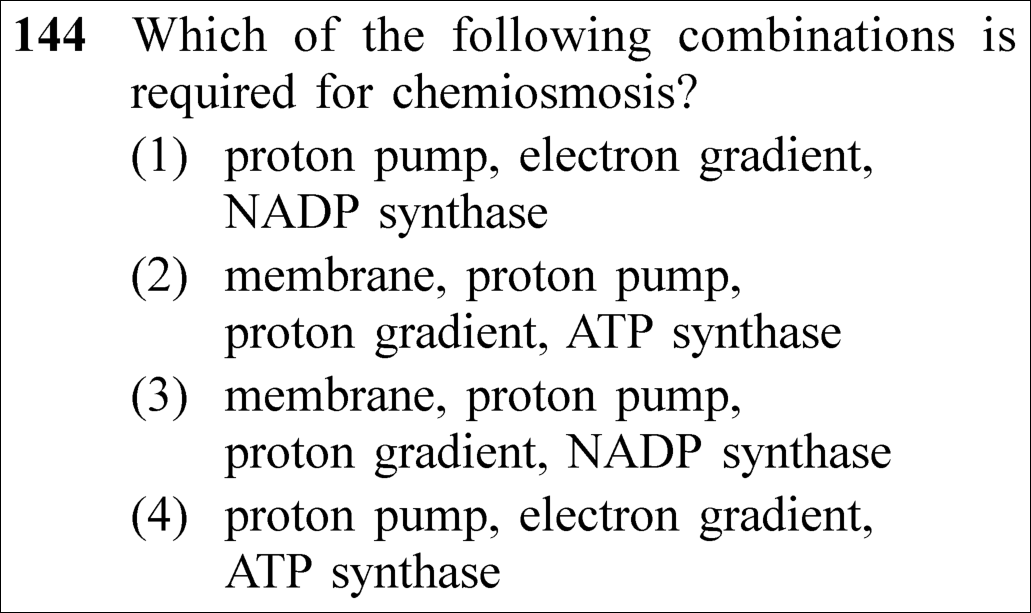
NEET 2023 Botany Question 144: Chemiosmotic Hypothesis: Essential Components

Question

Which of the following combinations is required for chemiosmosis?

  1. (1)proton pump, electron gradient, NADP synthase
  2. (2)membrane, proton pump, proton gradient, ATP synthase
  3. (3)membrane, proton pump, proton gradient, NADP synthase
  4. (4)proton pump, electron gradient, ATP synthase
✓
Verified Against NTA Final Answer Key
Option (2) : membrane, proton pump, proton gradient, ATP synthase
📚 Photosynthesis in Higher Plants Easy
📋 Given Parameters & Problem Setup
Biophysical Process Chemiosmosis (Mitchell's Chemiosmotic Hypothesis)
Criterion Combination of essential biological components
⚡

The 30-Second Exam Hall Shortcut: ⚡ Chemiosmosis Quartet: Membrane + Pump + Gradient + ATP Synthase

⏱️ Save ~20 seconds

Verbatim NCERT Chemiosmotic Hypothesis declaration: "Chemiosmosis requires a membrane, a proton pump, a proton gradient and ATP synthase!" Instant 5-second answer!

1 Recall the four essential pillars of Mitchell's chemiosmotic hypothesis:
2 (i) A membrane (impermeable thylakoid or inner mitochondrial membrane).
3 (ii) A proton pump (ETS complexes pumping H+ into lumen/intermembrane space).
4 (iii) A proton gradient (pH and electrochemical gradient across the membrane).
5 (iv) ATP synthase (CF0−CF1CF_0-CF_1 or F0−F1F_0-F_1 channel and catalytic headpiece).
6 Select Option (2) membrane, proton pump, proton gradient, ATP synthase.
🛡️
Why You Can 100% Trust This Shortcut: Canonical NCERT Photosynthesis Mitchell chemiosmotic model components.
📐

Step-by-Step Rigorous Workflow & Mathematical Proof

Step 1

The Four Fundamental Components of Chemiosmosis

Peter Mitchell's chemiosmotic mechanism explains phosphorylation in both chloroplasts and mitochondria through four cooperative structures:

Chemiosmotic Apparatus={1.Intact Membrane(creates closed compartment)2.Proton Pump(active translocators in ETS)3.Proton Gradient (\DeltapH)(high [H+] inside)4.ATP Synthase(F0/CF0 channel +F1/CF1 head)\text{Chemiosmotic Apparatus} = \begin{cases} \mathbf{1.} & \text{\textbf{Intact Membrane}} \quad (\text{creates closed compartment}) \\[3pt] \mathbf{2.} & \text{\textbf{Proton Pump}} \quad (\text{active translocators in ETS}) \\[3pt] \mathbf{3.} & \text{\textbf{Proton Gradient (}\Delta\text{pH)}} \quad (\text{high } [H^+] \text{ inside}) \\[3pt] \mathbf{4.} & \text{\textbf{ATP Synthase}} \quad (F_0/CF_0 \text{ channel } + F_1/CF_1 \text{ head}) \end{cases}
Step 2

Verbatim NCERT Reference

NCERT explicitly states: "Chemiosmosis requires a membrane, a proton pump, a proton gradient and ATP synthase. Energy is used to pump protons across a membrane, to create a gradient or a high concentration of protons within the thylakoid lumen."

Step 3

Elimination of Distractor Components

NADP reductase (not "NADP synthase") is a peripheral stroma-facing enzyme facilitating NADP+ reduction, but is not the motor of chemiosmotic ATP synthesis. An "electron gradient" does not drive ATP synthase; the proton-motive force drives it.

⭐

360° Option Elimination Engine Key Feature

Diagnose every choice: Know exactly why the right option works and why distractors fail.

4-Option Deep Scan
1 1
✗ Incorrect
Verdict & Scientific Reason:

Chemiosmosis requires a proton gradient (not electron gradient) and ATP synthase (not NADP synthase).

⚠️
Student Fallacy (Why candidates pick this trap): Confusing electron transport with the driving proton-motive force.
2 2
✓ 100% Correct
Verdict & Scientific Reason:

Verbatim NCERT quote listing the four essential components required for chemiosmosis.

💡
Why this is airtight: None; textbook verbatim.
3 3
✗ Incorrect
Verdict & Scientific Reason:

Chemiosmotic ATP generation requires ATP synthase, not NADP synthase.

⚠️
Student Fallacy (Why candidates pick this trap): Misreading ATP synthase as NADP synthase.
4 4
✗ Incorrect
Verdict & Scientific Reason:

Lacks the indispensable membrane barrier and misidentifies the proton gradient as an electron gradient.

⚠️
Student Fallacy (Why candidates pick this trap): Overlooking the fundamental necessity of an intact coupling membrane.
⚠️

NTA Trap Alert: ATP Synthase vs. NADP Synthase Reading Trap

Options 1 and 3 substitute "NADP synthase" in place of "ATP synthase", preying on students reading quickly through repetitive lists.

🛡️ How to avoid the -1 mark: Always check the final enzyme: chemiosmosis makes ATP, so it MUST be ATP synthase!
📖

Core NEET Syllabus Standard

NCERT Biology · Photosynthesis in Higher Plants Standard Benchmark
Core Scientific Principle Tested:

"Chemiosmosis requires a membrane, a proton pump, a proton gradient and ATP synthase."

Syllabus Focus: Chemiosmotic Hypothesis
✓ Core NEET UG Syllabus Anchor Syllabus & Academic Standards ↗

Ready to attempt under real exam pressure?

Test your speed and accuracy in the authentic 200-minute timed NTA simulator.

Launch NEET 2023 CBT Test →

Spotted a mistake in this solution? Report an error (support@mycompetitiveexams.com)

⚖️ Legal & Fair Dealing Notice: Sourced from publicly released NEET 2023 question papers and NEET answer keys for private study, research, and non-commercial educational practice under Fair Dealing (Section 52(1)(a) of the Indian Copyright Act, 1957). Not affiliated with or endorsed by NTA or NMC.

Solve 4 NEET Questions a Day — One per Subject

Cover all 1,140 official NEET questions in 285 days at your own pace. Progress is saved on your device. No login needed.