Q.91 Chemistry ⭐ 360° Option Elimination Active
NEET 2023 Chemistry Question 91 Solution
Topic: Surface Chemistry · Official NTA Booklet Code G5
Question
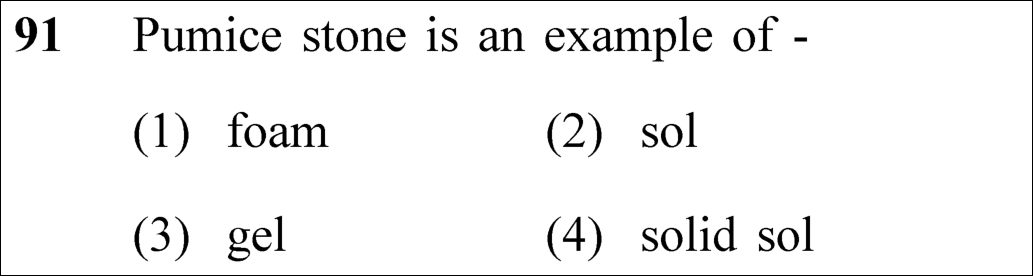
Pumice stone is an example of -
- (1)foam
- (2)sol
- (3)gel
- (4)solid sol
 MyCompetitiveExams
Dynamic 180-question full-length simulator mixed dynamically from all 6 years for 2027 & 2026 aspirants.
Pumice stone is an example of -
Pumice stone is formed from volcanic lava with trapped gas bubbles: Dispersed Phase = Gas; Dispersion Medium = Solid. A gas dispersed in a solid medium is canonically classified as a "solid sol" (along with foam rubber). Instant 5-second answer!
Pumice stone is a highly vesicular, porous volcanic rock formed when gas bubbles remain trapped in rapidly cooling molten lava:
In pumice stone, the trapped gas bubbles constitute the dispersed phase, while the solid rock matrix constitutes the dispersion medium:
Referring to the standard eight colloidal classes based on physical states (Gas in Gas forms a true mixture):
Diagnose every choice: Know exactly why the right option works and why distractors fail.
Foam has liquid as dispersion medium and gas as dispersed phase (e.g., soap lather, whipped cream).
Sol has solid dispersed in liquid medium (e.g., paints, cell fluids).
Gel has liquid dispersed in solid medium (e.g., cheese, butter, jellies).
Accurate: Gas dispersed in solid medium represents solid sol (e.g., pumice stone, foam rubber).
Because pumice stone contains bubbly trapped gas, students often associate it with "foam". But "foam" strictly has a LIQUID dispersion medium. When the dispersion medium is SOLID, it is classified as a "solid sol"!
"Colloidal systems are classified based on physical state: Gas dispersed in Solid is a solid sol."
Test your speed and accuracy in the authentic 200-minute timed NTA simulator.
Spotted a mistake in this solution? Report an error (support@mycompetitiveexams.com)
Cover all 1,140 official NEET questions in 285 days at your own pace. Progress is saved on your device. No login needed.