MyCompetitiveExams Logo MyCompetitiveExams
Search 1,140+ Questions
Chapters, formulas, speed tricks
→
⚡ Brahmastra NEET 2027
720 MARKS

Dynamic 180-question full-length simulator mixed dynamically from all 6 years for 2027 & 2026 aspirants.

Launch Brahmastra 2027 Test →
Start Practice →
100% Free · No Login Required
Q.57 Chemistry ⭐ 360° Option Elimination Active
Vault ↗

NEET 2023 Chemistry Question 57 Solution

Topic: The d- and f-Block Elements · Official NTA Booklet Code G5
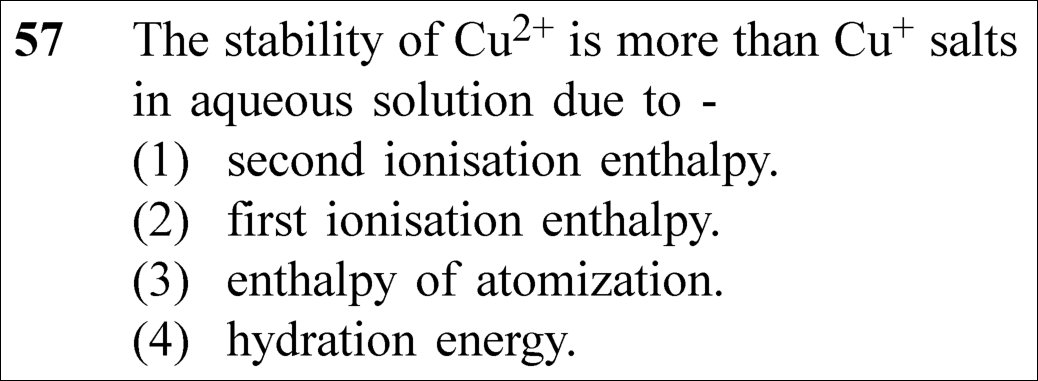
NEET 2023 Chemistry Question 57: Superior Stability of Cu²⁺ over Cu⁺ in Aqueous Media Due to Hydration Enthalpy

Question

The stability of Cu²⁺ is more than Cu⁺ salts in aqueous solution due to -

✓
Verified Against NTA Final Answer Key
Option (4) : hydration energy
📚 The d- and f-Block Elements Easy
📋 Given Parameters & Problem Setup
Transition metal ion pair Cu²⁺(aq) vs Cu⁺(aq)
Medium Aqueous solution
Observed phenomenon Cu²⁺ is much more stable than Cu⁺; Cu⁺ disproportionates
⚡

The 30-Second Exam Hall Shortcut: ⚡ Hydration Enthalpy Dominance Rule: Δ_hyd H(Cu²⁺) Compensates IE₂

⏱️ Save ~30 seconds

Cu⁺ has d¹⁰ configuration, but Cu²⁺ has double the charge density! High negative hydration enthalpy of Cu²⁺ (-2121 kJ/mol) overcomes its 2nd ionization enthalpy, making Cu²⁺ stable in aqueous solution in 5 seconds!

1 In the gas phase, Cu⁺ (3d¹⁰) is more stable than Cu²⁺ (3d⁹) due to a fully filled d-subshell.
2 In aqueous solution, however, Cu⁺ spontaneously disproportionates: 2 Cu⁺(aq) ⟶ Cu²⁺(aq) + Cu(s).
3 Why is Cu²⁺ favored in water? Because Cu²⁺ has a smaller ionic radius and a +2 charge.
4 This high charge density produces an enormous negative hydration enthalpy for Cu²⁺.
5 The high hydration energy more than compensates for the high second ionization enthalpy (IE₂) of copper.
6 Lock Option (4) hydration energy immediately!
🛡️
Why You Can 100% Trust This Shortcut: d-Block Chemistry · Standard Reduction Potentials (The stability of Cu²⁺(aq) rather than Cu⁺(aq) is due to the much more negative hydration enthalpy of Cu²⁺(aq) than Cu⁺(aq)).
📐

Step-by-Step Rigorous Workflow & Mathematical Proof

Step 1

Electronic Configurations and Gas Phase Stability

In the isolated gaseous state, copper exhibits the following configurations:

Cu+:[Ar] 3d10,Cu2+:[Ar] 3d9\text{Cu}^+ : [\text{Ar}]\, 3d^{10}, \qquad \text{Cu}^{2+} : [\text{Ar}]\, 3d^9
Step 2

Thermodynamic Cycle in Aqueous Medium

The stability of an oxidation state in aqueous solution is dictated by the total standard electrode potential (E°), which is governed by the Born-Haber energy cycle involving sublimation enthalpy, ionization enthalpy, and hydration enthalpy:

ΔHtotal=ΔsubH+IE1+IE2+ΔhydH\Delta H_{\text{total}} = \Delta_{\text{sub}}H + \text{IE}_1 + \text{IE}_2 + \Delta_{\text{hyd}}H
Step 3

The Compensation Role of Hydration Enthalpy

Although removing a second electron from copper requires a very large amount of energy (high second ionization enthalpy IE₂ = 1958 kJ mol⁻¹ to break the stable 3d¹⁰ shell), the much smaller ionic radius and higher charge of Cu²⁺ gives it a massive negative hydration enthalpy (-2121 kJ mol⁻¹ compared to only -593 kJ mol⁻¹ for Cu⁺):

∣ΔhydH(Cu2+)−ΔhydH(Cu+)∣>IE2|\Delta_{\text{hyd}}H(\text{Cu}^{2+}) - \Delta_{\text{hyd}}H(\text{Cu}^+)| > \text{IE}_2
Step 4

Disproportionation of Cu⁺ in Water

Because the hydration enthalpy heavily tilts the free energy balance toward Cu²⁺, Cu⁺ ions are unstable in water and undergo rapid disproportionation:

2Cu+(aq)⟶Cu2+(aq)+Cu(s),E∘=+0.37 V2\text{Cu}^+(aq) \longrightarrow \text{Cu}^{2+}(aq) + \text{Cu}(s), \quad E^\circ = +0.37\text{ V}
⭐

360° Option Elimination Engine Key Feature

Diagnose every choice: Know exactly why the right option works and why distractors fail.

4-Option Deep Scan
1 (1)
✗ Incorrect
Verdict & Scientific Reason:

Second ionization enthalpy is unfavorable (endothermic, opposes Cu²⁺ formation).

⚠️
Student Fallacy (Why candidates pick this trap): Candidate confused the factor that opposes formation with the factor that favors it.
2 (2)
✗ Incorrect
Verdict & Scientific Reason:

First ionization enthalpy is identical for forming Cu⁺.

⚠️
Student Fallacy (Why candidates pick this trap): Irrelevant to the difference between Cu⁺ and Cu²⁺.
3 (3)
✗ Incorrect
Verdict & Scientific Reason:

Sublimation/atomization enthalpy is the same for both oxidation states starting from metallic copper.

⚠️
Student Fallacy (Why candidates pick this trap): Candidate selected a generic thermodynamic parameter.
4 (4)
✓ 100% Correct
Verdict & Scientific Reason:

Direct canonical textbook reason: huge negative hydration enthalpy of Cu²⁺ compensates for IE₂.

💡
Why this is airtight: None. Candidate correctly cited the hydration energy compensation effect.
⚠️

NTA Trap Alert: Thinking d¹⁰ Makes Cu⁺ More Stable in Solution

Students frequently remember that Cu⁺ has a fully filled 3d¹⁰ configuration and assume it must be more stable than 3d⁹ Cu²⁺. In aqueous solution, lattice/hydration energetics completely override subshell symmetry!

🛡️ How to avoid the -1 mark: Golden Rule: In gas phase, 3d¹⁰ Cu⁺ is more stable; in AQUEOUS SOLUTION, 3d⁹ Cu²⁺ is far more stable due to hydration enthalpy.
📖

Core NEET Syllabus Standard

National Eligibility cum Entrance Test (NEET UG) · The d- and f-Block Elements Standard Benchmark
Core Scientific Principle Tested:

"The stability of Cu²⁺(aq) rather than Cu⁺(aq) is due to the much more negative hydration enthalpy of Cu²⁺(aq) which more than compensates for second ionization enthalpy."

Syllabus Focus: Trends in the M²⁺/M Standard Electrode Potentials
Preserved in Rationalized Curriculum Syllabus & Academic Standards ↗

Ready to attempt under real exam pressure?

Test your speed and accuracy in the authentic 200-minute timed NTA simulator.

Launch NEET 2023 CBT Test →

Spotted a mistake in this solution? Report an error (support@mycompetitiveexams.com)

⚖️ Legal & Fair Dealing Notice: Sourced from publicly released NEET 2023 question papers and NEET answer keys for private study, research, and non-commercial educational practice under Fair Dealing (Section 52(1)(a) of the Indian Copyright Act, 1957). Not affiliated with or endorsed by NTA or NMC.

Solve 4 NEET Questions a Day — One per Subject

Cover all 1,140 official NEET questions in 285 days at your own pace. Progress is saved on your device. No login needed.