NEET 2023 Physics Question 19 Solution
Question
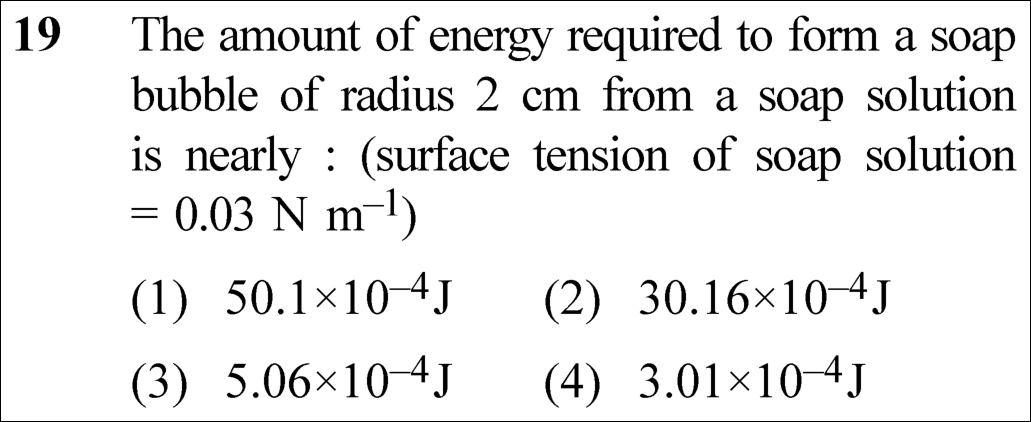
The amount of energy required to form a soap bubble of radius 2 cm from a soap solution is nearly: (surface tension of soap solution = 0.03 N m⁻¹)
Dynamic 180-question full-length simulator mixed dynamically from all 6 years for 2027 & 2026 aspirants.
The amount of energy required to form a soap bubble of radius 2 cm from a soap solution is nearly: (surface tension of soap solution = 0.03 N m⁻¹)
A soap bubble has TWO surfaces, so ΔA = 2 × (4πr²) = 8πr²! W = 8 × 3.14 × (4 × 10⁻⁴) × 0.03 ≈ 3.01 × 10⁻⁴ J in 25 seconds!
Unlike a solid liquid drop which has only one outer surface, a soap bubble has a hollow spherical air pocket inside and air outside, creating two distinct liquid-air interfaces of virtually identical surface area:
The work done W required to form the bubble from a soap solution is equal to the surface energy created:
Substitute radius r = 2 × 10⁻² m and surface tension T = 0.03 N/m:
Using π ≈ 3.1416:
Diagnose every choice: Know exactly why the right option works and why distractors fail.
Gross arithmetic error off by more than an order of magnitude.
Off by a factor of 10 in decimal exponent (30.16 × 10⁻⁴ = 3.016 × 10⁻³ J).
Incorrect numerical coefficient.
Accurate calculation accounting for both free surfaces: W = 8πr²T ≈ 3.01 × 10⁻⁴ J.
A liquid drop has 1 surface (W = 4πr²T = 1.51 × 10⁻⁴ J). A soap bubble has 2 surfaces (W = 8πr²T = 3.01 × 10⁻⁴ J). Forgetting the factor of 2 is the #1 mistake in NEET surface tension questions.
"Surface energy equals work done in creating free surface area: W = T ΔA. Soap bubbles possess two concentric interfaces."
Test your speed and accuracy in the authentic 200-minute timed NTA simulator.
Spotted a mistake in this solution? Report an error (support@mycompetitiveexams.com)
Cover all 1,140 official NEET questions in 285 days at your own pace. Progress is saved on your device. No login needed.