MyCompetitiveExams Logo MyCompetitiveExams
Search 1,140+ Questions
Chapters, formulas, speed tricks
→
⚡ Brahmastra NEET 2027
720 MARKS

Dynamic 180-question full-length simulator mixed dynamically from all 6 years for 2027 & 2026 aspirants.

Launch Brahmastra 2027 Test →
Start Practice →
100% Free · No Login Required
Q.83 Chemistry ⭐ 360° Option Elimination Active
Vault ↗

NEET 2023 Chemistry Question 83 Solution

Topic: Chemical Kinetics · Official NTA Booklet Code G5
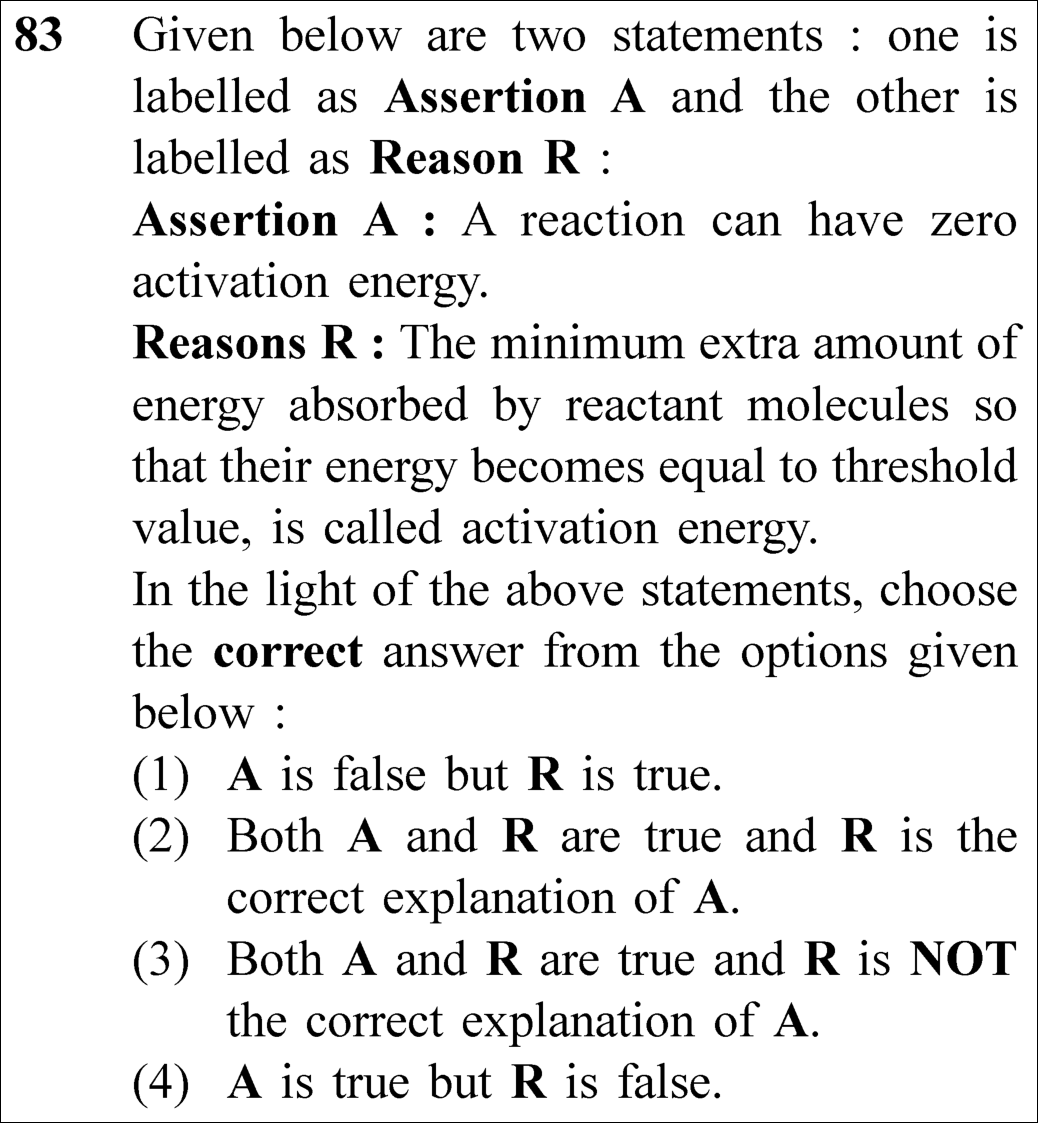
NEET 2023 Chemistry Question 83: Activation Energy and Threshold Energy Concepts (Assertion-Reason)

Question

Given below are two statements: one is labelled as Assertion A and the other is labelled as Reason R: Assertion A: A reaction can have zero activation energy. Reasons R: The minimum extra amount of energy absorbed by reactant molecules so that their energy becomes equal to threshold value, is called activation energy. In the light of the above statements, choose the correct answer from the options given below:

  1. (1)A is false but R is true.
  2. (2)Both A and R are true and R is the correct explanation of A.
  3. (3)Both A and R are true and R is NOT the correct explanation of A.
  4. (4)A is true but R is false.
✓
Verified Against NTA Final Answer Key
Option (1) : A is false but R is true.
📚 Chemical Kinetics Medium
📋 Given Parameters & Problem Setup
Assertion A A reaction can have zero activation energy.
Reason R The minimum extra amount of energy absorbed by reactant molecules so that their energy becomes equal to threshold value, is called activation energy.
⚡

The 30-Second Exam Hall Shortcut: ⚡ Chemical Kinetics Rule: Every Reaction Requires Finite Activation Energy (Ea > 0)

⏱️ Save ~25 seconds

Arrhenius equation k = A·e^(-Ea/RT) dictates that if Ea = 0, rate constant k = A, meaning rate is completely independent of temperature — which is impossible for chemical transformations involving bond reorganization. Hence Assertion is FALSE. Reason is the verbatim NCERT definition: Ea = E(threshold) - E(reactants) (TRUE). Lock Option (1)!

1 Evaluate Assertion A: Chemical reactions require energy to cross a transition state barrier; Ea cannot be zero in canonical curriculum. Assertion is FALSE.
2 Evaluate Reason R: "The minimum extra amount of energy absorbed by reactant molecules so that their energy becomes equal to threshold value, is called activation energy." This is the exact NCERT textbook definition (TRUE).
3 Match: A is false but R is true (Option 1).
🛡️
Why You Can 100% Trust This Shortcut: Official NTA Final Answer Key & NCERT Chemical Kinetics Collision Theory.
📐

Step-by-Step Rigorous Workflow & Mathematical Proof

Step 1

Analyze Assertion A Using Arrhenius Theory

According to the Arrhenius equation, if activation energy were zero (Ea = 0), the rate constant would equal the frequency factor A and become temperature-independent:

k=Ae−EaRT→Ea=0k=Ae0=Ak = A e^{-\frac{E_a}{RT}} \xrightarrow{E_a = 0} k = A e^0 = A
Step 2

Physical Feasibility of Zero Activation Energy

For any chemical reaction involving breaking of chemical bonds and formation of new bonds, a finite energy barrier must be crossed. Therefore, a chemical reaction cannot have zero activation energy. Assertion A is FALSE:

Ea>0(Mandatory energy barrier for chemical reactions)E_a > 0 \quad (\text{Mandatory energy barrier for chemical reactions})
Step 3

Analyze Reason R via Collision Theory

Activation energy (Ea) is formally defined as the minimum excess energy that reactant molecules must absorb to acquire threshold energy (E_threshold) required for effective collisions. Reason R is TRUE:

Ea=Ethreshold−EreactantsE_a = E_{\text{threshold}} - E_{\text{reactants}}
⭐

360° Option Elimination Engine Key Feature

Diagnose every choice: Know exactly why the right option works and why distractors fail.

4-Option Deep Scan
1 (1)
✓ 100% Correct
Verdict & Scientific Reason:

Accurate: Chemical reactions require a finite activation barrier (Ea > 0), whereas Reason correctly defines activation energy.

💡
Why this is airtight: None. Candidate recognized that chemical reactions cannot proceed with zero activation energy.
2 (2)
✗ Incorrect
Verdict & Scientific Reason:

Assertion A is false under standard Arrhenius kinetic theory.

⚠️
Student Fallacy (Why candidates pick this trap): Candidate confused fast radical recombination reactions with zero activation energy in textbook theory.
3 (3)
✗ Incorrect
Verdict & Scientific Reason:

Assertion A is scientifically false in the context of chemical kinetics curriculum.

⚠️
Student Fallacy (Why candidates pick this trap): Candidate incorrectly assumed Ea = 0 is a valid general chemical phenomenon.
4 (4)
✗ Incorrect
Verdict & Scientific Reason:

Completely inverts the validity of both statements; Reason R is the textbook definition.

⚠️
Student Fallacy (Why candidates pick this trap): Candidate rejected the classical definition of threshold energy.
⚠️

NTA Trap Alert: Confusing Free Radical Recombination with Zero Ea

Some students read advanced physical chemistry and recall that simple combination of free radicals has nearly zero activation barrier. However, NCERT and NTA strictly adhere to classical Arrhenius kinetics: all chemical reactions require activation energy to initiate.

🛡️ How to avoid the -1 mark: In NEET exams, always follow the NCERT guideline: chemical reactions require an activation barrier; Ea = 0 is considered false.
📖

Core NEET Syllabus Standard

National Eligibility cum Entrance Test (NEET UG) · Chemical Kinetics Standard Benchmark
Core Scientific Principle Tested:

"Activation energy represents the energy barrier that reactants must overcome to form products: Ea = E(threshold) - E(reactants)."

Syllabus Focus: Temperature Dependence of Rate of a Reaction – Arrhenius Equation
Preserved in Rationalized Curriculum Syllabus & Academic Standards ↗

Ready to attempt under real exam pressure?

Test your speed and accuracy in the authentic 200-minute timed NTA simulator.

Launch NEET 2023 CBT Test →

Spotted a mistake in this solution? Report an error (support@mycompetitiveexams.com)

⚖️ Legal & Fair Dealing Notice: Sourced from publicly released NEET 2023 question papers and NEET answer keys for private study, research, and non-commercial educational practice under Fair Dealing (Section 52(1)(a) of the Indian Copyright Act, 1957). Not affiliated with or endorsed by NTA or NMC.

Solve 4 NEET Questions a Day — One per Subject

Cover all 1,140 official NEET questions in 285 days at your own pace. Progress is saved on your device. No login needed.