The 30-Second Exam Hall Shortcut: ⚡ Instantaneous Center of Rotation Shortcut
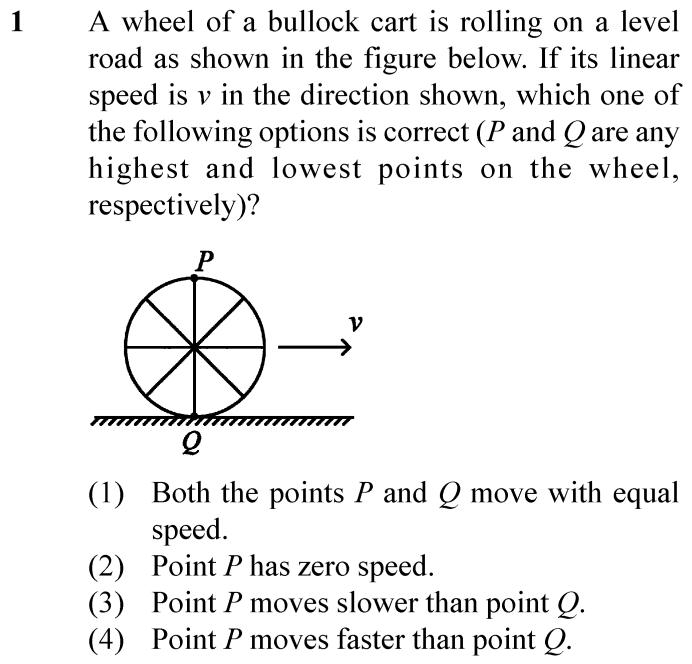
Point Q is instantaneously at rest (v_Q = 0); the top point P moves at twice the wheel speed (v_P = 2v)!
Step-by-Step Conceptual & Mathematical Derivation
Superposition of Translation and Rotation
For any rigid body undergoing pure planar rolling without slipping on a stationary surface with linear velocity v and angular velocity ω = v/R, the total velocity of any point on the rim is the vector sum of the translational velocity of the center of mass (v_cm) and the tangential rotational velocity (v_rot = ωR):
Velocity Evaluation at Highest Point P
At the uppermost point P, the translational velocity is forward (+v î) and the rotational velocity is also in the forward direction (+ωR î = +v î). Adding both vectors yields:
Velocity Evaluation at Lowest Point Q
At the bottom contact point Q, the translational velocity is directed forward (+v î), whereas the rotational tangential velocity is directed backward (-ωR î = -v î). Under the condition of pure rolling without slipping, these two components cancel each other out identically:
Final Comparative Conclusion
Comparing the speeds of the two points: v_P = 2v, while v_Q = 0. Therefore, point P moves significantly faster than point Q, matching Option (4).
🔍 View 360° Option Elimination Analysis & NTA Trap Alert ▼
Violates the superposition of translation and rotation in pure rolling.
Inverts the kinematics: the bottom contact point Q is instantaneously at rest, not the top point P.
Contradicts physical reality where v_P = 2v and v_Q = 0.
Rigorous first-principles derivation proves v_P = 2v while v_Q = 0.
Aspirants often treat rolling as a fixed-axis rotation about the central axle, concluding that all points on the rim have equal speed v = ωR.