NEET 2023 Zoology Question 152 Solution
Question
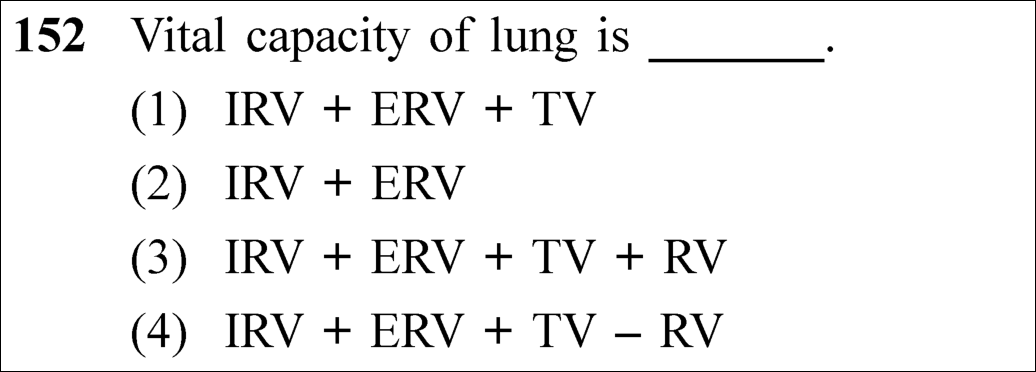
Vital capacity of lung is.
- (1)IRV + ERV+TV
- (2)IRV + ERV
- (3)IRV+ ERV+TV+RV
- (4)IRV + ERV + TV -RV
Dynamic 180-question full-length simulator mixed dynamically from all 6 years for 2027 & 2026 aspirants.
Vital capacity of lung is.
Vital Capacity is the maximum volume of air a person can breathe out after a forced inspiration (or breathe in after a forced expiration). It includes all movable volumes (IRV + TV + ERV) and strictly excludes Residual Volume (RV)!
Vital Capacity is defined as the maximum volume of air a person can exhale after a maximal forced inspiration, or the maximum volume of air a person can inhale after a maximal forced expiration:
NCERT defines Vital Capacity: "The maximum volume of air a person can breathe in after a forced expiration. This includes ERV, TV and IRV or the maximum volume of air a person can breathe out after a forced inspiration."
Expiratory Capacity (); Inspiratory Capacity (); Functional Residual Capacity (); Total Lung Capacity ().
Diagnose every choice: Know exactly why the right option works and why distractors fail.
Exact mathematical formula and physiological definition of Vital Capacity (VC).
Omits the Tidal Volume (TV, ~500 mL) which is an essential mobilizable component.
This represents Total Lung Capacity (TLC), not Vital Capacity.
Nonsensical mathematical deduction; Residual Volume is not subtracted from mobilizable volumes.
Students frequently mix up VC with TLC. TLC includes the residual volume (air that can never be exhaled), while VC measures only the air that can be actively moved in and out.
"Vital Capacity (VC): The maximum volume of air a person can breathe in after a forced expiration. This includes ERV, TV and IRV."
Test your speed and accuracy in the authentic 200-minute timed NTA simulator.
Spotted a mistake in this solution? Report an error (support@mycompetitiveexams.com)
Cover all 1,140 official NEET questions in 285 days at your own pace. Progress is saved on your device. No login needed.