MyCompetitiveExams Logo MyCompetitiveExams
Search 1,140+ Questions
Chapters, formulas, speed tricks
→
⚡ Brahmastra NEET 2027
720 MARKS

Dynamic 180-question full-length simulator mixed dynamically from all 6 years for 2027 & 2026 aspirants.

Launch Brahmastra 2027 Test →
Start Practice →
100% Free · No Login Required
Q.76 Chemistry ⭐ 360° Option Elimination Active
Vault ↗

NEET 2023 Chemistry Question 76 Solution

Topic: Structure of Atom · Official NTA Booklet Code G5
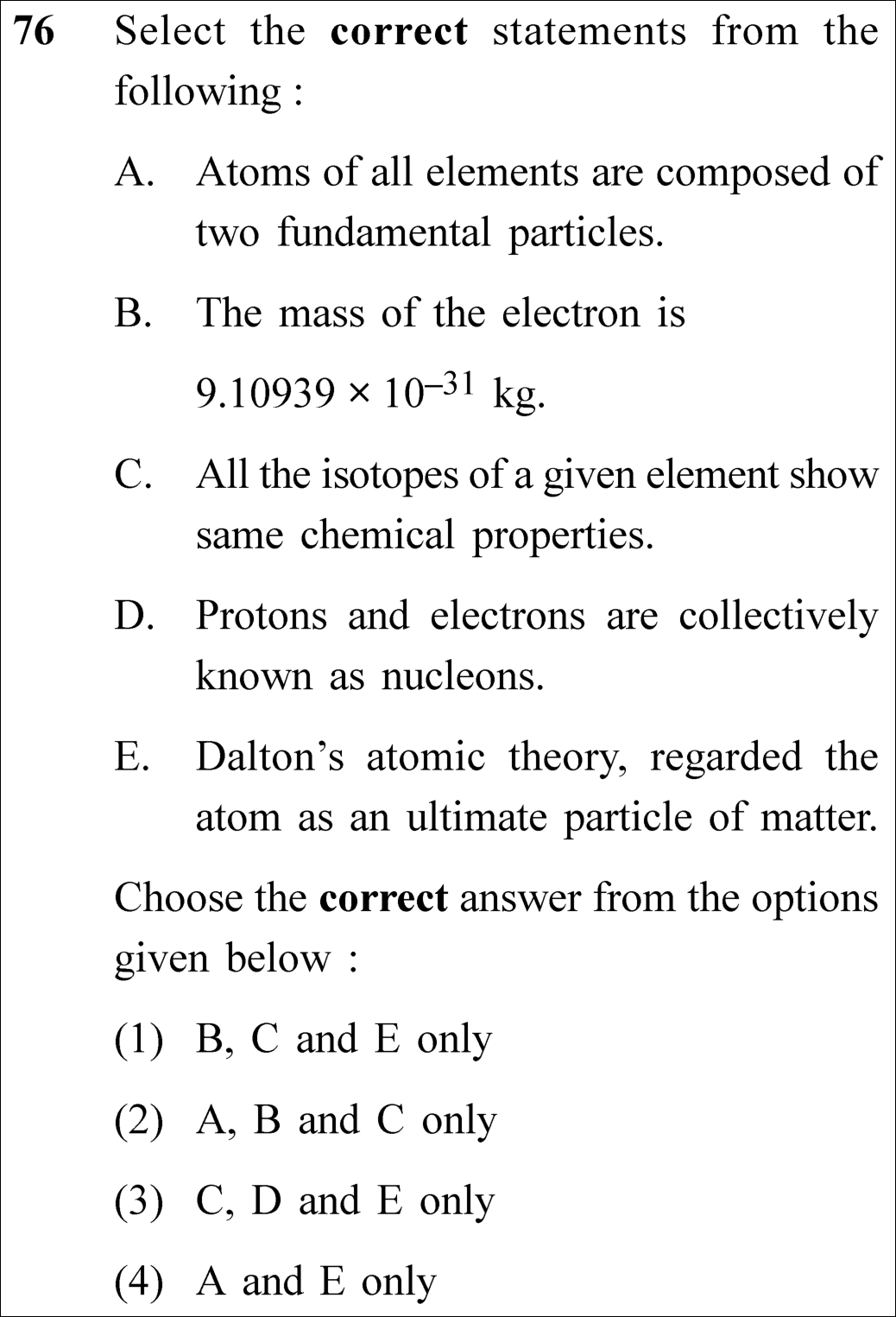
NEET 2023 Chemistry Question 76: Correct Statements Regarding Subatomic Mass, Isotopes, and Dalton’s Theory

Question

Select the correct statements from the following: A. Atoms of all elements are composed of two fundamental particles. B. The mass of the electron is 9.10939 x 10⁻³! kg. C. All the isotopes of a given element show same chemical properties. D. Protons and electrons are collectively known as nucleons. E. Dalton's atomic theory, regarded the atom as an ultimate particle of matter. Choose the correct answer from the options given below:

✓
Verified Against NTA Final Answer Key
Option (1) : B, C and E only
📚 Structure of Atom Easy
📋 Given Parameters & Problem Setup
Statement A Atoms of all elements are composed of two fundamental particles.
Statement B Mass of the electron is 9.10939 × 10⁻³¹ kg.
Statement C All isotopes of a given element show same chemical properties.
Statement D Protons and electrons are collectively known as nucleons.
Statement E Dalton’s atomic theory regarded the atom as an ultimate particle of matter.
⚡

The 30-Second Exam Hall Shortcut: ⚡ False Statement Elimination Hack: D is FALSE (Nucleons = Protons + Neutrons)

⏱️ Save ~35 seconds

Nucleons are protons and NEUTRONS, not electrons ⟹ D is FALSE (eliminates Options 3). Most atoms have THREE particles (p, n, e), not two ⟹ A is FALSE (eliminates Options 2, 4). Thus B, C, and E only in 10 seconds! (Option 1)

1 Check Statement D: Nucleons are particles in the nucleus (protons + NEUTRONS). Calling protons and electrons nucleons is completely false. Eliminate any option containing D (eliminates Option 3).
2 Check Statement A: Atoms of all elements (except ordinary protium ¹H) contain THREE fundamental particles: protons, neutrons, and electrons. Statement A says "two fundamental particles" ⟶ FALSE. Eliminate any option containing A (eliminates Options 2 and 4).
3 Verify B: Mass of electron = 9.10939 × 10⁻³¹ kg (Exact NCERT value ⟶ TRUE).
4 Verify C: Isotopes have identical atomic numbers (same electron count and configuration), so they exhibit identical chemical properties (TRUE).
5 Verify E: Dalton’s atomic theory postulated the atom as indivisible and the ultimate particle of matter (TRUE).
6 Correct set: B, C, and E only.
7 Select Option (1) immediately!
🛡️
Why You Can 100% Trust This Shortcut: Atomic Structure · Subatomic Particle Fundamentals (Mass of electron = 9.10939 × 10⁻³¹ kg; isotopes share chemical identity; Dalton’s postulate defines indivisible ultimate particles).
📐

Step-by-Step Rigorous Workflow & Mathematical Proof

Step 1

Evaluation of Statement A (Particle Composition of Atoms)

Atoms of all elements (with the sole exception of the hydrogen isotope protium, ¹H, which lacks a neutron) are composed of three subatomic fundamental particles: electrons, protons, and neutrons. Stating that all elements are composed of "two" fundamental particles is false.

Fundamental particles in atoms=protons, neutrons, electrons (Three, not two)  ⟹  Statement A is False\text{Fundamental particles in atoms} = \text{protons, neutrons, electrons (Three, not two)} \implies \text{Statement A is False}
Step 2

Evaluation of Statement B (Mass of the Electron)

The rest mass of an electron measured to six significant figures in SI units is 9.10939 × 10⁻³¹ kg (or 9.10939 × 10⁻²⁸ g). This matches the official NCERT physical constant table verbatim.

me=9.10939×10⁻³¹ kg  ⟹  Statement B is Truem_e = 9.10939 \times 10^{-31}\text{ kg} \implies \text{Statement B is True}
Step 3

Evaluation of Statement C (Chemical Behavior of Isotopes)

Chemical properties of an atom are determined by the number of valence electrons and electronic configuration, which depends strictly on the atomic number Z. Because all isotopes of a given element have identical atomic numbers Z, they exhibit identical chemical properties (differing only in nuclear reactions and slight physical mass-dependent rate isotope effects).

Same Z  ⟹  Same electronic configuration  ⟹  Same chemical properties (Statement C is True)\text{Same } Z \implies \text{Same electronic configuration} \implies \text{Same chemical properties } (\text{Statement C is True})
Step 4

Evaluation of Statement D (Definition of Nucleons)

Protons and neutrons reside within the atomic nucleus and are collectively referred to as nucleons. Electrons orbit outside the nucleus and are not nucleons.

Nucleons=Protons+Neutrons (Not electrons)  ⟹  Statement D is False\text{Nucleons} = \text{Protons} + \text{Neutrons } (\text{Not electrons}) \implies \text{Statement D is False}
Step 5

Evaluation of Statement E (Dalton’s Atomic Hypothesis)

Dalton’s atomic theory (1808) postulated that all matter is composed of extremely small, indivisible particles called atoms, regarding the atom as the ultimate indivisible building block of matter.

Dalton’s postulate: Atom is the ultimate indivisible particle of matter   ⟹  Statement E is True\text{Dalton's postulate: Atom is the ultimate indivisible particle of matter } \implies \text{Statement E is True}
⭐

360° Option Elimination Engine Key Feature

Diagnose every choice: Know exactly why the right option works and why distractors fail.

4-Option Deep Scan
1 (1)
✓ 100% Correct
Verdict & Scientific Reason:

Accurate: B (electron mass), C (isotope chemical properties), and E (Dalton’s theory) are all factually correct.

💡
Why this is airtight: None. Candidate correctly eliminated the false statements A and D.
2 (2)
✗ Incorrect
Verdict & Scientific Reason:

Includes false statement A (atoms contain three particles, not two).

⚠️
Student Fallacy (Why candidates pick this trap): Candidate thought atoms consist only of protons and electrons.
3 (3)
✗ Incorrect
Verdict & Scientific Reason:

Includes false statement D (nucleons are protons and neutrons, not electrons).

⚠️
Student Fallacy (Why candidates pick this trap): Candidate confused the definition of nucleons.
4 (4)
✗ Incorrect
Verdict & Scientific Reason:

Includes false statement A and omits true statements B and C.

⚠️
Student Fallacy (Why candidates pick this trap): Candidate overlooked the precise mass of electron and isotopic properties.
⚠️

NTA Trap Alert: Confusing Nucleons (Protons + Neutrons) with Atomic Particles

Statement D asserts that protons and electrons are called nucleons. Nucleons are the particles in the NUCLEUS (protons and neutrons). Electrons are extranuclear.

🛡️ How to avoid the -1 mark: Etymology Check: "Nucleon" comes from "Nucleus". Only particles inside the nucleus (protons + neutrons) are nucleons.
📖

Core NEET Syllabus Standard

National Eligibility cum Entrance Test (NEET UG) · Structure of Atom Standard Benchmark
Core Scientific Principle Tested:

"Protons and neutrons are nucleons; electron mass is 9.10939 × 10⁻³¹ kg; isotopes have identical chemical properties; Dalton viewed atoms as ultimate particles."

Syllabus Focus: Sub-atomic Particles and Atomic Models
Preserved in Rationalized Curriculum Syllabus & Academic Standards ↗

Ready to attempt under real exam pressure?

Test your speed and accuracy in the authentic 200-minute timed NTA simulator.

Launch NEET 2023 CBT Test →

Spotted a mistake in this solution? Report an error (support@mycompetitiveexams.com)

⚖️ Legal & Fair Dealing Notice: Sourced from publicly released NEET 2023 question papers and NEET answer keys for private study, research, and non-commercial educational practice under Fair Dealing (Section 52(1)(a) of the Indian Copyright Act, 1957). Not affiliated with or endorsed by NTA or NMC.

Solve 4 NEET Questions a Day — One per Subject

Cover all 1,140 official NEET questions in 285 days at your own pace. Progress is saved on your device. No login needed.