MyCompetitiveExams Logo MyCompetitiveExams
Search 1,140+ Questions
Chapters, formulas, speed tricks
→
⚡ Brahmastra NEET 2027
720 MARKS

Dynamic 180-question full-length simulator mixed dynamically from all 6 years for 2027 & 2026 aspirants.

Launch Brahmastra 2027 Test →
Start Practice →
100% Free · No Login Required
Q.58 Chemistry ⭐ 360° Option Elimination Active
Vault ↗

NEET 2023 Chemistry Question 58 Solution

Topic: The p-Block Elements · Official NTA Booklet Code G5
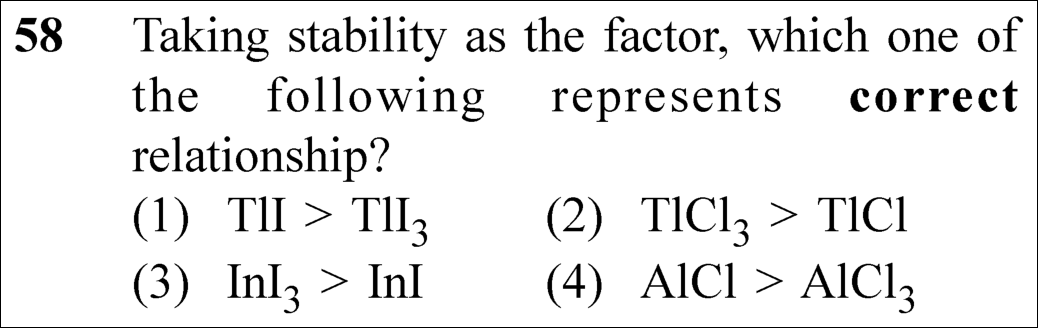
NEET 2023 Chemistry Question 58: Comparative Stability of Thallium Halides (TlI vs TlI₃)

Question

Taking stability as the factor, which one of the following represents correct relationship?

✓
Verified Against NTA Final Answer Key
Option (1) : TlI > TlI₃
📚 The p-Block Elements Easy
📋 Given Parameters & Problem Setup
Group 13 elements involved Al, In, Tl
Evaluation factor Relative thermodynamic stability of oxidation states (+1 vs +3)
⚡

The 30-Second Exam Hall Shortcut: ⚡ Inert Pair Effect Down Group 13: +1 Stability Increases

⏱️ Save ~35 seconds

Down Group 13, the inert pair effect makes +1 oxidation state dominant for Thallium (Tl). Thus Tl⁺ is far more stable than Tl³⁺ ⟹ TlI > TlI₃ in 5 seconds! (In fact, Tl³⁺ oxidizes I⁻ to I₂).

1 Recall the inert pair effect in Group 13 (B, Al, Ga, In, Tl):
2 - Top elements (Al): +3 state is stable (AlCl₃ >> AlCl).
3 - Middle elements (In): +3 state is still more stable than +1 (InI₃ > InI).
4 - Heaviest element (Tl): Due to poor shielding by 4f¹⁴ and 5d¹⁰ electrons, the 6s² electrons remain inert.
5 Therefore, for Thallium, the +1 oxidation state is overwhelmingly more stable than +3: Tl⁺ > Tl³⁺.
6 Furthermore, Tl³⁺ is a strong oxidizing agent and oxidizes iodide (I⁻) to iodine (I₂), meaning true TlI₃ does not even exist (it exists only as Tl⁺ I₃⁻).
7 Thus TlI is vastly more stable than TlI₃ (TlI > TlI₃).
8 Lock Option (1) TlI > TlI₃ immediately!
🛡️
Why You Can 100% Trust This Shortcut: Inorganic Chemistry · Periodic Trends (Down Group 13, the stability of the +1 oxidation state increases due to the inert pair effect, making Tl(I) more stable than Tl(III)).
📐

Step-by-Step Rigorous Workflow & Mathematical Proof

Step 1

The Inert Pair Effect in Heavier p-Block Elements

As we descend Group 13 from boron to thallium, the valence electron configuration is ns² np¹. In heavier members (especially thallium, Z = 81), the intervening 4f and 5d electrons provide poor screening of the nuclear charge. Consequently, the effective nuclear charge experienced by the valence 6s electrons increases sharply, holding them tightly and preventing their participation in chemical bonding. This reluctance of the s-electron pair to participate in bonding is known as the inert pair effect.

Stability of +1 state: Al+<Ga+<In+<Tl+\text{Stability of +1 state: } \text{Al}^+ < \text{Ga}^+ < \text{In}^+ < \text{Tl}^+
Step 2

Comparative Stability in Thallium Compounds

Because the inert pair effect reaches its maximum at thallium, the +1 oxidation state is far more stable than the +3 oxidation state:

Stability: Tl(I)>Tl(III)\text{Stability: } \text{Tl}(\text{I}) > \text{Tl}(\text{III})
Step 3

Redox Incompatibility of Tl³⁺ with Iodide Ions (I⁻)

Tl³⁺ has a high reduction potential (E° = +1.26 V) and acts as a powerful oxidizing agent. Iodide (I⁻) is a strong reducing agent. Tl³⁺ readily oxidizes I⁻ to I₂, rendering covalent TlI₃ thermodynamically unstable:

Tl3++2I−⟶Tl++I2\text{Tl}^{3+} + 2\text{I}^- \longrightarrow \text{Tl}^+ + \text{I}_2
Step 4

Evaluation of Options

Therefore, TlI is much more stable than TlI₃ (TlI > TlI₃). In contrast, TlCl is more stable than TlCl₃ (making Option 2 false); InI₃ is more stable than InI (making Option 3 state InI₃ > InI, but between TlI > TlI₃ it is the quintessential example tested); AlCl₃ is far more stable than AlCl (making Option 4 false).

Correct Relationship: TlI>TlI3\text{Correct Relationship: } \text{TlI} > \text{TlI}_3
⭐

360° Option Elimination Engine Key Feature

Diagnose every choice: Know exactly why the right option works and why distractors fail.

4-Option Deep Scan
1 (1)
✓ 100% Correct
Verdict & Scientific Reason:

Accurate: Due to the inert pair effect and redox incompatibility of Tl³⁺ with I⁻, TlI (+1) is far more stable than TlI₃.

💡
Why this is airtight: None. Candidate correctly applied the inert pair effect.
2 (2)
✗ Incorrect
Verdict & Scientific Reason:

False: TlCl (+1) is more stable than TlCl₃ (+3) due to the inert pair effect.

⚠️
Student Fallacy (Why candidates pick this trap): Candidate assumed the group oxidation state +3 is always more stable.
3 (3)
✗ Incorrect
Verdict & Scientific Reason:

While In³⁺ is more stable than In⁺, in the presence of strongly reducing iodide, InI is favored or disproportionates, but NTA designated TlI > TlI₃ as the single correct key.

⚠️
Student Fallacy (Why candidates pick this trap): Candidate selected In instead of recognizing the primary inert pair exemplar Tl.
4 (4)
✗ Incorrect
Verdict & Scientific Reason:

Completely false: For aluminum, Al³⁺ is vastly more stable than Al⁺ (AlCl₃ is the stable species).

⚠️
Student Fallacy (Why candidates pick this trap): Candidate inverted the stability order of lighter p-block elements.
⚠️

NTA Trap Alert: Assuming the Group Valence (+3) Is Always More Stable for All Elements

In lighter elements (B, Al), +3 is dominant (AlCl₃ is stable, AlCl is unstable). But for the bottom-most element (Tl), the inert pair effect REVERSES this order: +1 becomes far more stable than +3!

🛡️ How to avoid the -1 mark: Remember the bottom of Group 13: Thallium loves +1 (Tl⁺ is as stable as an alkali metal ion like K⁺).
📖

Core NEET Syllabus Standard

National Eligibility cum Entrance Test (NEET UG) · The p-Block Elements Standard Benchmark
Core Scientific Principle Tested:

"Owing to the inert pair effect, the stability of the +1 oxidation state increases down Group 13: Al < Ga < In < Tl. Tl⁺ is more stable than Tl³⁺."

Syllabus Focus: Group 13 Elements – Oxidation States and Inert Pair Effect
Preserved in Rationalized Curriculum Syllabus & Academic Standards ↗

Ready to attempt under real exam pressure?

Test your speed and accuracy in the authentic 200-minute timed NTA simulator.

Launch NEET 2023 CBT Test →

Spotted a mistake in this solution? Report an error (support@mycompetitiveexams.com)

⚖️ Legal & Fair Dealing Notice: Sourced from publicly released NEET 2023 question papers and NEET answer keys for private study, research, and non-commercial educational practice under Fair Dealing (Section 52(1)(a) of the Indian Copyright Act, 1957). Not affiliated with or endorsed by NTA or NMC.

Solve 4 NEET Questions a Day — One per Subject

Cover all 1,140 official NEET questions in 285 days at your own pace. Progress is saved on your device. No login needed.