MyCompetitiveExams Logo MyCompetitiveExams
Search 1,140+ Questions
Chapters, formulas, speed tricks
→
⚡ Brahmastra NEET 2027
720 MARKS

Dynamic 180-question full-length simulator mixed dynamically from all 6 years for 2027 & 2026 aspirants.

Launch Brahmastra 2027 Test →
Start Practice →
100% Free · No Login Required
Q.100 Chemistry ⭐ 360° Option Elimination Active
Vault ↗

NEET 2023 Chemistry Question 100 Solution

Topic: Environmental Chemistry · Official NTA Booklet Code G5
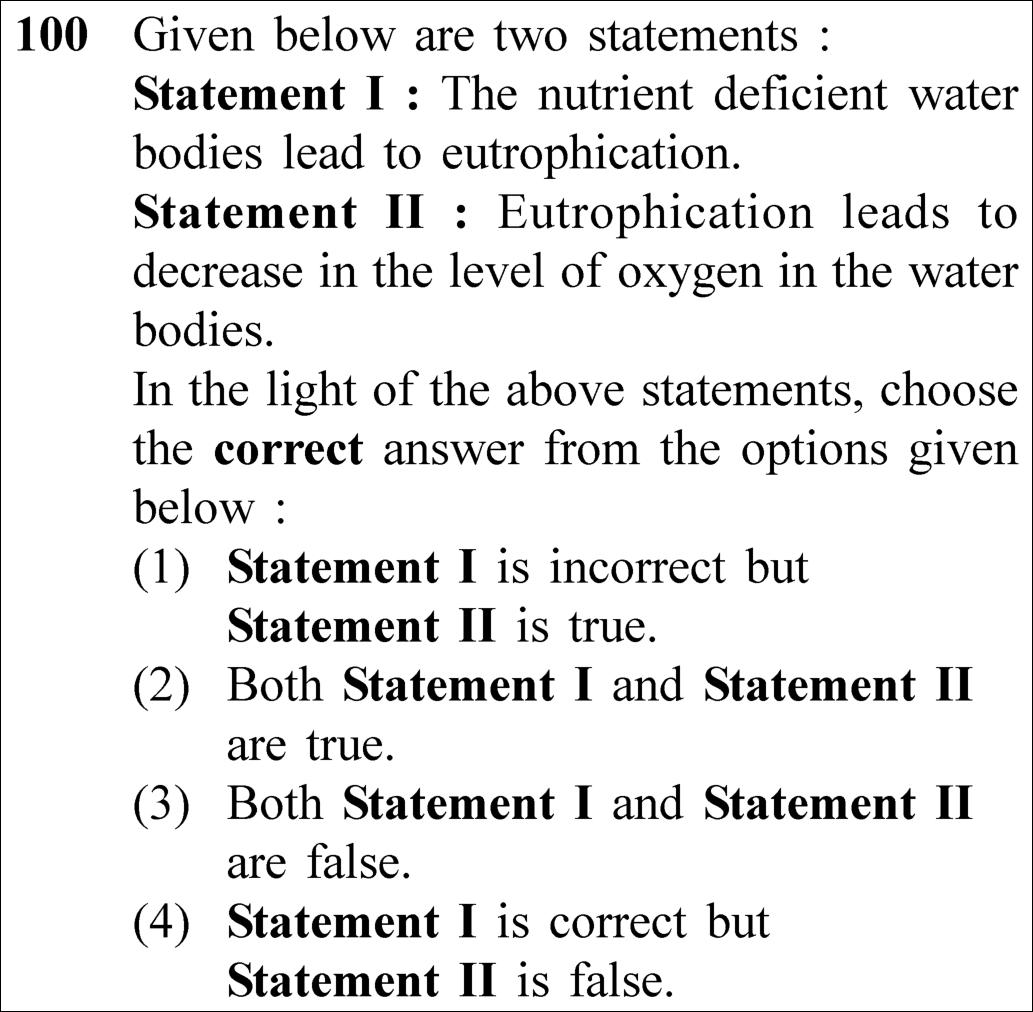
NEET 2023 Chemistry Question 100: Eutrophication: Nutrient Enrichment and Dissolved Oxygen Depletion

Question

Given below are two statements: Statement I: The nutrient deficient water bodies lead to eutrophication. Statement II: Eutrophication leads to decrease in the level of oxygen in the water bodies. In the light of the above statements, choose the correct answer from the options given below:

  1. (1)Statement I is incorrect but Statement II is true.
  2. (2)Both Statement I and Statement II are true.
  3. (3)Both Statement I and Statement II are false.
  4. (4)Statement I is correct but Statement II is false.
✓
Verified Against NTA Final Answer Key
Option (1) : Statement I is incorrect but Statement II is true.
📚 Environmental Chemistry Easy
📋 Given Parameters & Problem Setup
Statement I The nutrient deficient water bodies lead to eutrophication.
Statement II Eutrophication leads to decrease in the level of oxygen in the water bodies.
⚡

The 30-Second Exam Hall Shortcut: ⚡ Definition Check: Eutrophication Means Nutrient ENRICHED, Not Deficient!

⏱️ Save ~25 seconds

By canonical definition, eutrophication is the process in which water bodies become nutrient-ENRICHED (excess nitrates and phosphates from runoff), causing massive algal bloom! Hence Statement I is INCORRECT. Algae die and decay aerially, consuming dissolved oxygen and suffocating aquatic life! Hence Statement II is TRUE. Verdict: Statement I is incorrect but Statement II is true (Option 1) in 10 seconds!

1 Check Statement I: "The nutrient deficient water bodies lead to eutrophication." False! Eutrophication is caused by nutrient-rich (nutrient-enriched) water bodies, particularly phosphates and nitrates.
2 Check Statement II: "Eutrophication leads to decrease in the level of oxygen in the water bodies." True! Dense algal bloom prevents sunlight, and microbial decomposition of dead algae depletes dissolved oxygen (BOD surges, DO plummets).
3 Match: Statement I is incorrect but Statement II is true (Option 1).
🛡️
Why You Can 100% Trust This Shortcut: Verbatim NCERT Environmental Chemistry section on Water Pollution & Eutrophication.
📐

Step-by-Step Rigorous Workflow & Mathematical Proof

Step 1

Definition of Eutrophication

Eutrophication is defined as the process in which a water body becomes overly enriched with nutrients (primarily phosphates and nitrates from agricultural runoff, fertilizers, and sewage):

Eutrophication  ⟺  Nutrient enrichment  (NOT nutrient deficiency)\text{Eutrophication} \iff \text{Nutrient \textbf{enrichment}} \; (\text{NOT nutrient deficiency})
Step 2

Evaluate Statement I

Statement I asserts that "nutrient deficient water bodies lead to eutrophication." This directly contradicts the canonical definition, as oligotrophic (nutrient-deficient) waters support low biological productivity and do NOT undergo eutrophication. Statement I is INCORRECT:

Statement I=INCORRECT (requires nutrient-rich waters)\text{Statement I} = \text{INCORRECT (requires nutrient-rich waters)}
Step 3

Mechanism of Dissolved Oxygen Depletion (Statement II)

Nutrient enrichment stimulates explosive growth of algae (algal bloom). When the dense algal mass dies, aerobic bacteria consume enormous quantities of dissolved oxygen to decompose the dead organic matter. Consequently, the concentration of dissolved oxygen (DO) plummets below critical levels, killing fish and other aquatic organisms. Statement II is TRUE:

Algal decay+Aerobic bacteria  ⟹  BOD increases, Dissolved O2 decreases\text{Algal decay} + \text{Aerobic bacteria} \implies \text{BOD increases, Dissolved } \text{O}_2 \text{ decreases}
⭐

360° Option Elimination Engine Key Feature

Diagnose every choice: Know exactly why the right option works and why distractors fail.

4-Option Deep Scan
1 (1)
✓ 100% Correct
Verdict & Scientific Reason:

Accurate: Eutrophication is driven by nutrient enrichment (making I false), which subsequently depletes dissolved oxygen (making II true).

💡
Why this is airtight: None. Candidate read the critical word "deficient" carefully.
2 (2)
✗ Incorrect
Verdict & Scientific Reason:

Statement I is false because nutrient-deficient waters do not cause eutrophication.

⚠️
Student Fallacy (Why candidates pick this trap): Candidate skimmed the statement and assumed "nutrient" implied nutrient-rich.
3 (3)
✗ Incorrect
Verdict & Scientific Reason:

Statement II is factually true; oxygen levels dramatically decrease due to algal decomposition.

⚠️
Student Fallacy (Why candidates pick this trap): Candidate doubted that eutrophication causes dissolved oxygen depletion.
4 (4)
✗ Incorrect
Verdict & Scientific Reason:

Completely inverts the truth values of both statements.

⚠️
Student Fallacy (Why candidates pick this trap): Candidate reversed the concepts of nutrient enrichment and oxygen depletion.
⚠️

NTA Trap Alert: Misreading "Nutrient Deficient" as "Nutrient Enriched"

Under exam pressure, students read the word "nutrient" and quickly assume Statement I says "nutrient rich". Look closely at the word "deficient" — that single opposite word makes Statement I completely false!

🛡️ How to avoid the -1 mark: Read every qualifying word carefully: "deficient" vs "enriched".
📖

Core NEET Syllabus Standard

National Eligibility cum Entrance Test (NEET UG) · Environmental Chemistry Standard Benchmark
Core Scientific Principle Tested:

"Eutrophication is the aging of water bodies due to nutrient enrichment, leading to algal blooms and drastic loss of dissolved oxygen."

Syllabus Focus: Water Pollution – Eutrophication and Biochemical Oxygen Demand (BOD)
Preserved in Rationalized Curriculum Syllabus & Academic Standards ↗

Ready to attempt under real exam pressure?

Test your speed and accuracy in the authentic 200-minute timed NTA simulator.

Launch NEET 2023 CBT Test →

Spotted a mistake in this solution? Report an error (support@mycompetitiveexams.com)

⚖️ Legal & Fair Dealing Notice: Sourced from publicly released NEET 2023 question papers and NEET answer keys for private study, research, and non-commercial educational practice under Fair Dealing (Section 52(1)(a) of the Indian Copyright Act, 1957). Not affiliated with or endorsed by NTA or NMC.

Solve 4 NEET Questions a Day — One per Subject

Cover all 1,140 official NEET questions in 285 days at your own pace. Progress is saved on your device. No login needed.