MyCompetitiveExams Logo MyCompetitiveExams
Search 1,140+ Questions
Chapters, formulas, speed tricks
→
⚡ Brahmastra NEET 2027
720 MARKS

Dynamic 180-question full-length simulator mixed dynamically from all 6 years for 2027 & 2026 aspirants.

Launch Brahmastra 2027 Test →
Start Practice →
100% Free · No Login Required
Q.129 Botany ⭐ 360° Option Elimination Active
Vault ↗

NEET 2024 Botany Question 129 Solution

Topic: Sexual Reproduction in Flowering Plants · Official NTA Booklet Code T1
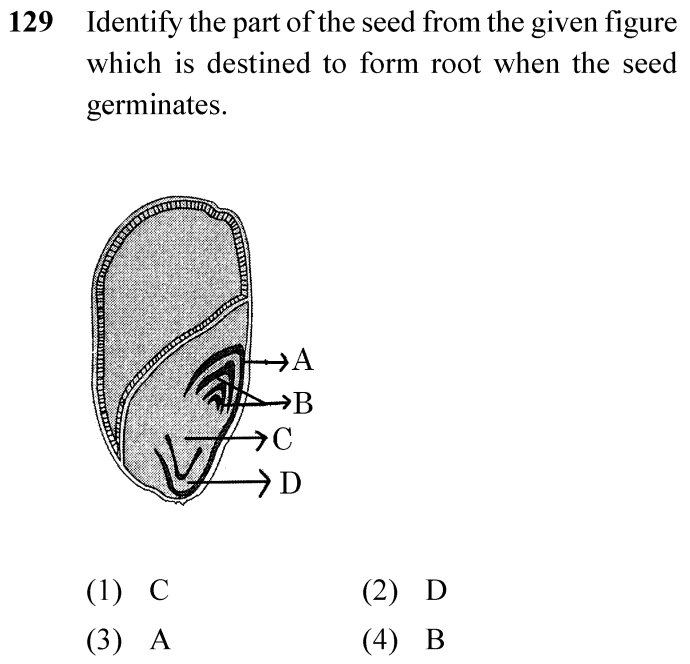
NEET 2024 Botany Question 129: Anatomy of Monocot Seed (Maize Grain) and Embryonal Axis Parts

Question

Identify the part of the seed from the given figure which is destined to form root when the seed germinates.

✓
Verified Against NTA Final Answer Key
Option (1) : C
📚 Sexual Reproduction in Flowering Plants Easy
📋 Given Parameters & Problem Setup
Diagram Longitudinal section of maize grain (monocot seed)
Target Part destined to form root upon germination
⚡

The 30-Second Exam Hall Shortcut: ⚡ Monocot Embryo Anatomical Axis

⏱️ Save ~20 seconds

In a maize grain embryo: Scutellum = cotyledon; Coleoptile = sheath over plumule (shoot); Radicle (C) = future root enclosed by Coleorhiza (D). Root originates from Radicle C!

1 Identify labels in the L.S. of maize embryo:
2 - A: Scutellum (single large shield-shaped cotyledon)
3 - B: Coleoptile (protective sheath covering plumule / shoot apex)
4 - C: Radicle (embryonic root destined to form root system)
5 - D: Coleorhiza (protective sheath covering radicle)
6 The question asks for the part destined to form the root -> Radicle = C -> Option (1) / A.
🛡️
Why You Can 100% Trust This Shortcut: NCERT Biology · Sexual Reproduction in Flowering Plants (Structure of Monocotyledonous Seed)
📐

Step-by-Step Rigorous Workflow & Mathematical Proof

Step 1

Examine the Maize Grain Longitudinal Section

In the monocotyledonous embryo of the grass family (maize/wheat), the embryo consists of one large, shield-shaped cotyledon known as scutellum situated towards one side of the embryonal axis.

Step 2

Identify Upper vs Lower Axis Poles

At the upper end, the embryonal axis has the shoot apex and a few leaf primordia enclosed in a hollow foliar structure called coleoptile. At its lower end, the embryonal axis has the radical and root cap enclosed in an undifferentiated sheath called coleorhiza.

Step 3

Determine the Part Forming the Root

The radicle (labeled C) is the embryonic root that gives rise to the primary root system upon germination.

⭐

360° Option Elimination Engine Key Feature

Diagnose every choice: Know exactly why the right option works and why distractors fail.

4-Option Deep Scan
1 (1)
✓ 100% Correct
Verdict & Scientific Reason:

Label C indicates the radicle, which is destined to develop into the root system upon germination.

💡
Why this is airtight: None.
2 (2)
✗ Incorrect
Verdict & Scientific Reason:

Label D points to the coleorhiza, a protective sheath covering the radicle.

⚠️
Student Fallacy (Why candidates pick this trap): Label D points to the coleorhiza, a protective sheath covering the radicle.
3 (3)
✗ Incorrect
Verdict & Scientific Reason:

Label A points to the scutellum (cotyledon).

⚠️
Student Fallacy (Why candidates pick this trap): Label A points to the scutellum (cotyledon).
4 (4)
✗ Incorrect
Verdict & Scientific Reason:

Label B points to the coleoptile, covering the shoot apex/plumule.

⚠️
Student Fallacy (Why candidates pick this trap): Label B points to the coleoptile, covering the shoot apex/plumule.
⚠️

NTA Trap Alert: Radicle vs Coleorhiza Pointer Identification

Confusing the radicle (inner embryonic organ) with its outer sheath, the coleorhiza.

🛡️ How to avoid the -1 mark: Radicle is the internal root primordium (C); Coleorhiza is the enveloping basal sheath (D).
📖

Core NEET Syllabus Standard

Biology Core Botany · Sexual Reproduction in Flowering Plants Standard Benchmark
Core Scientific Principle Tested:

"At its lower end, the embryonal axis has the radical and root cap enclosed in an undifferentiated sheath called coleorhiza. The radicle develops into the root."

Syllabus Focus: Anatomy of Monocot Seed (Maize Grain) and Embryonal Axis Parts
✓ Core NEET UG Syllabus Anchor Syllabus & Academic Standards ↗

Ready to attempt under real exam pressure?

Test your speed and accuracy in the authentic 200-minute timed NTA simulator.

Launch NEET 2024 CBT Test →

Spotted a mistake in this solution? Report an error (support@mycompetitiveexams.com)

⚖️ Legal & Fair Dealing Notice: Sourced from publicly released NEET 2024 question papers and NEET answer keys for private study, research, and non-commercial educational practice under Fair Dealing (Section 52(1)(a) of the Indian Copyright Act, 1957). Not affiliated with or endorsed by NTA or NMC.

Solve 4 NEET Questions a Day — One per Subject

Cover all 1,140 official NEET questions in 285 days at your own pace. Progress is saved on your device. No login needed.