MyCompetitiveExams Logo MyCompetitiveExams
Search 1,140+ Questions
Chapters, formulas, speed tricks
→
⚡ Brahmastra NEET 2027
720 MARKS

Dynamic 180-question full-length simulator mixed dynamically from all 6 years for 2027 & 2026 aspirants.

Launch Brahmastra 2027 Test →
Start Practice →
100% Free · No Login Required
Q.133 Botany ⭐ 360° Option Elimination Active
Vault ↗

NEET 2024 Botany Question 133 Solution

Topic: Anatomy of Flowering Plants · Official NTA Booklet Code T1
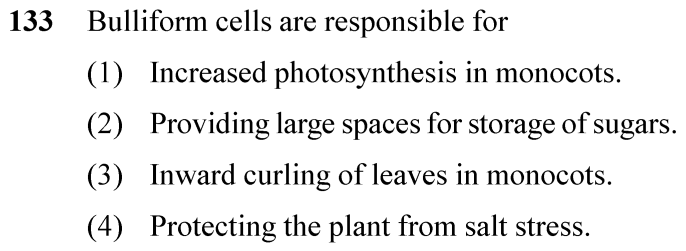
NEET 2024 Botany Question 133: Bulliform Cells and Inward Leaf Rolling in Monocots

Question

Bulliform cells are responsible for

  1. (1)Increased photosynthesis in monocots.
  2. (2)Providing large spaces for storage of sugars.
  3. (3)Inward curling of leaves in monocots.
  4. (4)Protecting the plant from salt stress.
✓
Verified Against NTA Final Answer Key
Option (3) : Inward curling of leaves in monocots
📚 Anatomy of Flowering Plants Easy
📋 Given Parameters & Problem Setup
Cell Type Bulliform cells (motor cells)
Plant Group Monocot grasses
⚡

The 30-Second Exam Hall Shortcut: ⚡ Bulliform Cells Turgor Mechanism

⏱️ Save ~20 seconds

When water stressed, large empty bulliform cells lose turgor and become flaccid, causing leaves to curl inward to minimize surface area and transpiration!

1 Recall bulliform cell function in grass leaves:
2 - Located on the adaxial (upper) epidermis of monocot leaves.
3 - Large, empty, colourless cells.
4 - When they absorb water and are turgid, the leaf surface is exposed.
5 - When flaccid due to water stress, they cause leaves to curl inward to minimize water loss.
6 Direct match: Inward curling of leaves in monocots -> Option (3) / C.
🛡️
Why You Can 100% Trust This Shortcut: NCERT Biology · Anatomy of Flowering Plants (Isobilateral Leaf and Bulliform Cells)
📐

Step-by-Step Rigorous Workflow & Mathematical Proof

Step 1

Locate and Describe Bulliform Cells

In grasses, certain adaxial epidermal cells along the veins modify themselves into large, empty, colourless cells called bulliform cells (or motor cells).

Step 2

Understand the Turgor-Mediated Dynamic

When the bulliform cells have absorbed water and are turgid, the leaf surface is exposed. When they are flaccid due to water stress, they cause the leaves to curl inward to minimize water loss via transpiration.

Step 3

Match with Options

The primary physiological function is mediating inward curling of leaves in monocots.

⭐

360° Option Elimination Engine Key Feature

Diagnose every choice: Know exactly why the right option works and why distractors fail.

4-Option Deep Scan
1 (1)
✗ Incorrect
Verdict & Scientific Reason:

Bulliform cells are hydro-passive motor cells regulating water conservation, not halophytic salt-extruding glands.

⚠️
Student Fallacy (Why candidates pick this trap): Bulliform cells are hydro-passive motor cells regulating water conservation, not halophytic salt-extruding glands.
2 (2)
✗ Incorrect
Verdict & Scientific Reason:

Stomatal opening is controlled by the guard cells, not bulliform cells.

⚠️
Student Fallacy (Why candidates pick this trap): Stomatal opening is controlled by the guard cells, not bulliform cells.
3 (3)
✓ 100% Correct
Verdict & Scientific Reason:

Loss of turgor in bulliform cells causes leaves to curl inward to reduce exposed surface area during drought.

💡
Why this is airtight: None.
4 (4)
✗ Incorrect
Verdict & Scientific Reason:

Bulliform cells are empty, water-filled cells that do not store carbohydrates.

⚠️
Student Fallacy (Why candidates pick this trap): Bulliform cells are empty, water-filled cells that do not store carbohydrates.
⚠️

NTA Trap Alert: Stomatal Pore vs Leaf Rolling

Attributing stomatal opening/closing to bulliform cells.

🛡️ How to avoid the -1 mark: Guard cells control stomatal pores; bulliform cells control whole-leaf rolling/curling.
📖

Core NEET Syllabus Standard

Biology Core Botany · Anatomy of Flowering Plants Standard Benchmark
Core Scientific Principle Tested:

"In grasses, certain adaxial epidermal cells along the veins modify themselves into large, empty, colourless cells. These are called bulliform cells. When the bulliform cells in the leaves have absorbed water and are turgid, the leaf surface is exposed. When they are flaccid due to water stress, they make the leaves curl inwards to minimise water loss."

Syllabus Focus: Bulliform Cells and Inward Leaf Rolling in Monocots
✓ Core NEET UG Syllabus Anchor Syllabus & Academic Standards ↗

Ready to attempt under real exam pressure?

Test your speed and accuracy in the authentic 200-minute timed NTA simulator.

Launch NEET 2024 CBT Test →

Spotted a mistake in this solution? Report an error (support@mycompetitiveexams.com)

⚖️ Legal & Fair Dealing Notice: Sourced from publicly released NEET 2024 question papers and NEET answer keys for private study, research, and non-commercial educational practice under Fair Dealing (Section 52(1)(a) of the Indian Copyright Act, 1957). Not affiliated with or endorsed by NTA or NMC.

Solve 4 NEET Questions a Day — One per Subject

Cover all 1,140 official NEET questions in 285 days at your own pace. Progress is saved on your device. No login needed.