MyCompetitiveExams Logo MyCompetitiveExams
Search 1,140+ Questions
Chapters, formulas, speed tricks
→
⚡ Brahmastra NEET 2027
720 MARKS

Dynamic 180-question full-length simulator mixed dynamically from all 6 years for 2027 & 2026 aspirants.

Launch Brahmastra 2027 Test →
Start Practice →
100% Free · No Login Required
Q.65 Chemistry · Section A ⭐ 360° Option Elimination Active
Vault ↗

NEET 2024 Chemistry Question 65 Solution

Topic: The d- and f-Block Elements · Official NTA Booklet Code T1
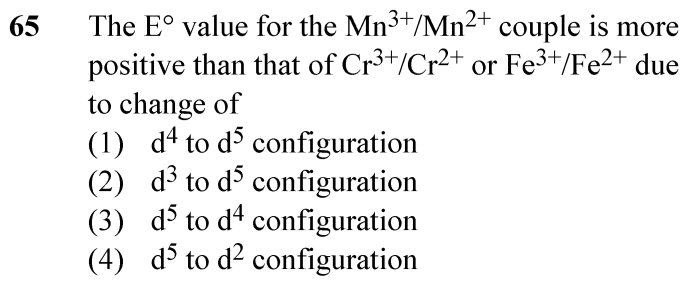
NEET 2024 Chemistry Question 65: Standard Electrode Potential (E°) of Mn3+/Mn2+ Couple

Question

The E° value for the Mn³⁺/Mn²⁺ couple is more positive than that of Cr³⁺/Cr²⁺ or Fe³⁺/Fe²⁺ due to change of

✓
Verified Against NTA Final Answer Key
Option (1) : d4 to d5 configuration
📚 The d- and f-Block Elements Easy
📋 Given Parameters & Problem Setup
Electrode couples Mn3+/Mn2+ (E° = +1.57 V) vs Cr3+/Cr2+ (E° = -0.41 V) and Fe3+/Fe2+ (E° = +0.77 V)
Core question Reason for the unusually high positive E° value of Mn3+/Mn2+
⚡

The 30-Second Exam Hall Shortcut: ⚡ Half-Filled d5 Stability Hack

⏱️ Save ~35 seconds

Mn3+ is 3d4; when reduced to Mn2+ it gains an electron to form 3d5, an extraordinarily stable HALF-FILLED subshell -> Huge driving force -> Highly positive E°!

1 Write reduction half-reaction: Mn3+ + e- -> Mn2+.
2 Electronic configuration: Mn3+ is [Ar] 3d4.
3 Product Mn2+ is [Ar] 3d5, possessing a symmetrically half-filled subshell with high exchange energy.
4 Transition from less stable d4 to exceptionally stable d5 imparts a massive thermodynamic driving force (ΔG° < 0).
5 Consequently, E°(Mn3+/Mn2+) is highly positive (+1.57 V), far more positive than Cr3+/Cr2+ or Fe3+/Fe2+.
6 Direct match: "d4 to d5 configuration" -> Option (1) in 3 seconds!
🛡️
Why You Can 100% Trust This Shortcut: NCERT Chemistry · The d- and f-Block Elements (Trends in the M3+/M2+ standard electrode potentials and stability of d5 configuration).
📐

Step-by-Step Rigorous Workflow & Mathematical Proof

Step 1

Electronic Configurations of the Redox Couple

Manganese has atomic number Z = 25 with neutral ground-state configuration [Ar] 3d5 4s2. Removing valence electrons gives: - Mn3+: [Ar] 3d4 (partially filled, relatively less stable) - Mn2+: [Ar] 3d5 (symmetrically half-filled, possessing maximal exchange energy and high stabilization)

Mn3+(3d4)+e⊖⟶Mn2+(3d5)\text{Mn}^{3+} (3d^4) + e^\ominus \longrightarrow \text{Mn}^{2+} (3d^5)
Step 2

Thermodynamic Driving Force and Electrode Potential

Standard reduction potential E° is related to the standard Gibbs free energy change by ΔG° = -nFE°. Because the conversion of d4 into the half-filled d5 configuration is energetically extremely favorable, ΔG° is large and negative, rendering E° unusually high and positive (+1.57 V):

E∘(Mn3+/Mn2+)=+1.57  V(highly favorable reduction due to stable 3d5)E^\circ(\text{Mn}^{3+}/\text{Mn}^{2+}) = +1.57\;\text{V} \quad (\text{highly favorable reduction due to stable } 3d^5)
Step 3

Comparison with Chromium and Iron Couples

For chromium: Cr3+ is [Ar] 3d3 (stable half-filled t2g³ level in octahedral fields), so reducing it to Cr2+ (3d4) is unfavorable (E° = -0.41 V). For iron: Fe3+ is already 3d5, so reducing it to Fe2+ (3d6) loses the d5 stability (E° = +0.77 V). Only in the manganese couple does reduction produce the stable d5 configuration from d4.

Cr3+(3d3)→Cr2+(3d4)  [E∘=−0.41V];Fe3+(3d5)→Fe2+(3d6)  [E∘=+0.77V]\text{Cr}^{3+} (3d^3) \rightarrow \text{Cr}^{2+} (3d^4) \; [E^\circ = -0.41\text{V}]; \quad \text{Fe}^{3+} (3d^5) \rightarrow \text{Fe}^{2+} (3d^6) \; [E^\circ = +0.77\text{V}]
⭐

360° Option Elimination Engine Key Feature

Diagnose every choice: Know exactly why the right option works and why distractors fail.

4-Option Deep Scan
1 (1)
✓ 100% Correct
Verdict & Scientific Reason:

Verbatim NCERT rationale: reduction converts 3d4 (Mn3+) into extra-stable half-filled 3d5 (Mn2+).

💡
Why this is airtight: None.
2 (2)
✗ Incorrect
Verdict & Scientific Reason:

A single-electron reduction cannot change the d-count by 2.

⚠️
Student Fallacy (Why candidates pick this trap): Assuming reduction involves a 2-electron transfer.
3 (3)
✗ Incorrect
Verdict & Scientific Reason:

Represents oxidation (Mn2+ -> Mn3+), not reduction.

⚠️
Student Fallacy (Why candidates pick this trap): Inverting oxidation and reduction.
4 (4)
✗ Incorrect
Verdict & Scientific Reason:

Irrelevant configuration change.

⚠️
Student Fallacy (Why candidates pick this trap): Arbitrary guess.
⚠️

NTA Trap Alert: Confusing Reduction with Oxidation

Option (3) states "d5 to d4 configuration", which describes the reverse process (oxidation of Mn2+ to Mn3+). The E° value refers strictly to REDUCTION (Mn3+ -> Mn2+), which is d4 to d5.

🛡️ How to avoid the -1 mark: E° is always defined for reduction: Mn3+ (d4) + e- -> Mn2+ (d5).
📖

Core NEET Syllabus Standard

Chemistry Core Inorganic Chemistry · The d- and f-Block Elements Standard Benchmark
Core Scientific Principle Tested:

"The standard electrode potential E° for the Mn3+/Mn2+ couple is exceptionally high (+1.57 V) because reduction transforms the d4 ion into the extra stable half-filled d5 configuration."

Syllabus Focus: Trends in Standard Reduction Potentials: Stability of d5 Half-Filled Shell
✓ Core NEET UG Syllabus Anchor Syllabus & Academic Standards ↗
d4 gains an electron to reach d5: half-filled stability keeps positive E° alive!

Ready to attempt under real exam pressure?

Test your speed and accuracy in the authentic 200-minute timed NTA simulator.

Launch NEET 2024 CBT Test →

Spotted a mistake in this solution? Report an error (support@mycompetitiveexams.com)

⚖️ Legal & Fair Dealing Notice: Sourced from publicly released NEET 2024 question papers and NEET answer keys for private study, research, and non-commercial educational practice under Fair Dealing (Section 52(1)(a) of the Indian Copyright Act, 1957). Not affiliated with or endorsed by NTA or NMC.

Solve 4 NEET Questions a Day — One per Subject

Cover all 1,140 official NEET questions in 285 days at your own pace. Progress is saved on your device. No login needed.